Recognition: unknown
Transient Multiscale Workflow for Thermal Analysis of 3DHI Chip Stack
Pith reviewed 2026-05-09 19:07 UTC · model grok-4.3
The pith
A workflow demonstrates transient thermal analysis of 3D chip stacks by homogenizing 3D heterogeneous BEOL structures from design files.
A machine-rendered reading of the paper's core claim, the machinery that carries it, and where it could break.
Core claim
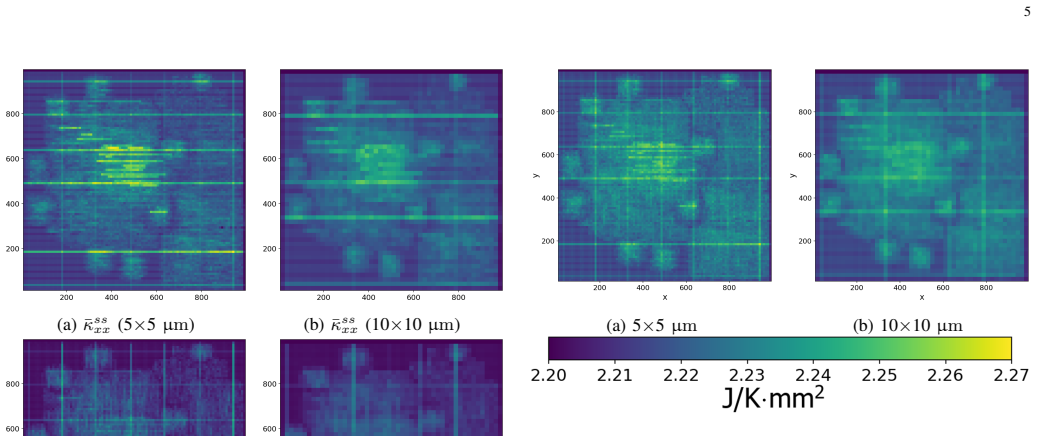
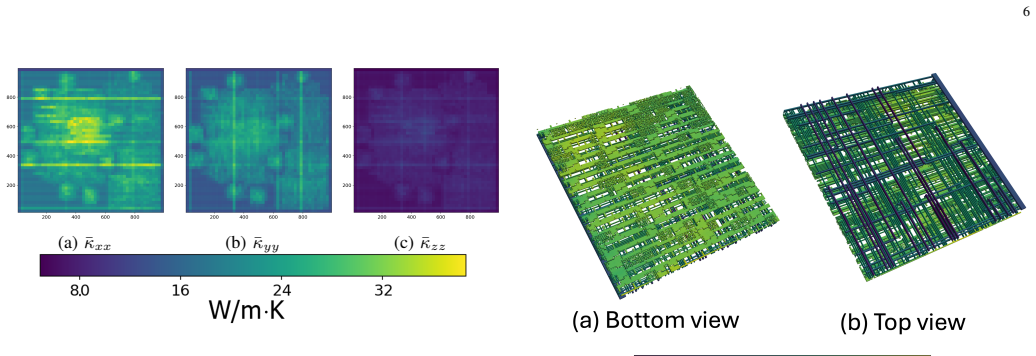
The paper demonstrates a transient thermal workflow that accounts for the 3D heterogeneous structures in the BEOL for problems with strong- and weak- temporal scale separation. Property maps for heat capacity and conductivity are generated for a 1 mm by 1 mm SoC-style model die using 100 by 100 grids with 5 micron RVEs and 50 by 50 grids with 10 micron RVEs. Expressions for transient effective conductivity are provided, the impact of transient effects is shown for a single RVE, and transient conductivity maps are given for a timestep of 0.001, all under the assumption of temperature independent constitutive properties.
What carries the argument
The transient multiscale homogenization workflow that automatically processes GDSII and OASIS files into thermal property maps using representative volume elements and expressions for transient effective conductivity.
If this is right
- Transient simulations can now include fine-scale BEOL heterogeneity without resolving every feature at all times.
- Both strong and weak temporal scale separations in thermal problems can be handled within the same framework.
- Design files can be directly converted to thermal models for time-dependent analysis.
- The workflow produces usable conductivity and heat capacity maps for specific timesteps like 0.001.
Where Pith is reading between the lines
- Such maps could be used to speed up larger system-level simulations by replacing detailed regions with homogenized equivalents.
- Extending the workflow to temperature-dependent properties would broaden its applicability to high-power scenarios.
- Validation against physical measurements on fabricated test chips would confirm the homogenized predictions.
Load-bearing premise
The workflow relies on the assumption that thermal conductivity and heat capacity do not change with temperature.
What would settle it
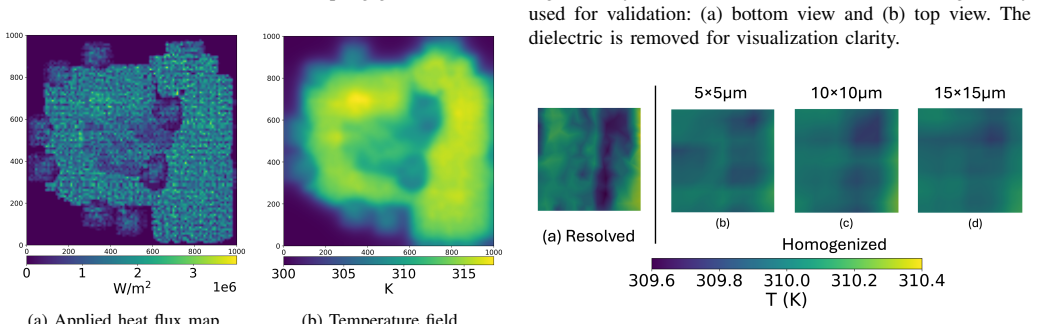
A side-by-side comparison of the workflow's transient temperature predictions against a fully resolved 3D transient simulation of the same heterogeneous structure would falsify the claim if the results diverge beyond acceptable numerical tolerances.
Figures




read the original abstract
Modern package designs make use of technologies such as backside power delivery (BSPD) and 3D stacked chiplets that require accounting for the heterogeneity in back end of the line (BEOL) structures in hot-spot prediction. Multiscale homogenization strategies have been demonstrated to be effective for steady-state simulations, however accurate 3D transient simulations that include BEOL structures remain an open challenge. In this work, we demonstrate a transient thermal workflow that accounts for the 3D heterogeneous structures in the BEOL for problems with strong- and weak- temporal scale separation under the assumption of temperature independent constitutive properties. Our workflow, based on Bloomfield et. al. 2025, automatically extracts, meshes, and homogenizes thermal properties from GDSII and OASIS files to construct thermal property maps. Property maps (heat capacity and conductivity) have been generated for a 1 mm by 1 mm SoC-style model die that was constructed with LibreLane for 100 by 100 grids with 5 micron by 5 micron representative volume elements (RVEs), and 50 by 50 grids with 10 micron by 10 micron RVEs. The expressions for a transient effective conductivity are provided and a demonstration of the impact of the transient effects are provided for a single RVE. Finally, transient conductivity maps have been provided for a time integration timestep of dt=0.001.
Editorial analysis
A structured set of objections, weighed in public.
Referee Report
Summary. The paper presents a transient multiscale thermal analysis workflow for 3D heterogeneous integration (3DHI) chip stacks, extending steady-state homogenization methods to handle BEOL heterogeneity in transient simulations. Building on Bloomfield et al. 2025, the workflow automatically extracts, meshes, and homogenizes thermal properties (heat capacity and conductivity) from GDSII and OASIS files to generate property maps on 100x100 (5um RVE) and 50x50 (10um RVE) grids for a 1mm x 1mm SoC-style die. It provides expressions for transient effective conductivity, demonstrates transient effects on a single RVE, and produces conductivity maps for a fixed timestep dt=0.001, under the assumption of temperature-independent constitutive properties, targeting problems with strong- and weak-temporal scale separation.
Significance. If the full workflow including end-to-end transient multiscale simulations and validations were demonstrated, it would provide a practical tool for accurate hot-spot prediction in modern 3D stacked packages with complex BEOL structures, potentially reducing computational cost compared to full 3D transient simulations while maintaining fidelity for scale-separated problems. The automation from design files is a notable strength for reproducibility and applicability.
major comments (2)
- [Results and abstract description of demonstrations] The central claim of demonstrating a transient thermal workflow that accounts for 3D heterogeneous BEOL structures in problems with strong- and weak-temporal scale separation is not supported by the presented evidence. The results are limited to property map generation via homogenization, expressions for transient effective conductivity, a single-RVE illustration of transient effects, and maps for dt=0.001; no end-to-end multiscale transient simulations applying the maps in a time integrator, nor any verification or comparison against reference 3D heterogeneous transient solutions for different scale separations, are shown. This leaves the transient capability untested.
- [Expressions for transient effective conductivity] The expressions for transient effective conductivity are stated to be provided, but without visible derivation details or extension from the steady-state base in Bloomfield et al. 2025, it is unclear how they rigorously capture transient scale separation effects beyond the homogenization step.
minor comments (2)
- [Introduction and assumptions] The assumption of temperature-independent constitutive properties is central but its validity range or sensitivity in transient regimes is not discussed or tested.
- [Results] No error analysis, grid convergence studies, or quantitative metrics (e.g., comparison of homogenized vs. direct simulation) are reported for the generated maps or single-RVE case.
Simulated Author's Rebuttal
We thank the referee for the careful and constructive review. We address each major comment below, acknowledging limitations in the current demonstrations and outlining targeted revisions to align claims with presented results while improving clarity on the transient extensions.
read point-by-point responses
-
Referee: The central claim of demonstrating a transient thermal workflow that accounts for 3D heterogeneous BEOL structures in problems with strong- and weak-temporal scale separation is not supported by the presented evidence. The results are limited to property map generation via homogenization, expressions for transient effective conductivity, a single-RVE illustration of transient effects, and maps for dt=0.001; no end-to-end multiscale transient simulations applying the maps in a time integrator, nor any verification or comparison against reference 3D heterogeneous transient solutions for different scale separations, are shown. This leaves the transient capability untested.
Authors: We agree that the manuscript does not include full end-to-end multiscale transient simulations or direct verifications against heterogeneous 3D reference solutions. The presented work centers on extending the homogenization workflow to transient regimes by generating timestep-dependent property maps (conductivity and heat capacity) from layout files and demonstrating transient effects at the single-RVE level. These maps are intended as inputs for larger-scale transient solvers in scale-separated problems. We will revise the abstract, introduction, and conclusions to precisely describe the scope as the homogenization and map-generation steps of the transient workflow, rather than implying complete system-level transient simulations. A new discussion subsection will outline how the maps integrate into time integrators and note verification as future work. revision: partial
-
Referee: The expressions for transient effective conductivity are stated to be provided, but without visible derivation details or extension from the steady-state base in Bloomfield et al. 2025, it is unclear how they rigorously capture transient scale separation effects beyond the homogenization step.
Authors: The transient effective conductivity expressions extend the steady-state homogenization by incorporating the heat-capacity term from the transient heat equation, yielding a timestep-dependent effective conductivity that reflects the balance between conduction and thermal storage within the RVE. We will add a dedicated subsection with a complete derivation, beginning from the steady-state formulation in Bloomfield et al. 2025, showing the modifications for the transient case, the role of RVE size and timestep in capturing scale separation, and the resulting expressions. This will make the extension explicit and rigorous. revision: yes
Circularity Check
Transient workflow builds on self-cited prior homogenization; results limited to map generation without end-to-end transient verification
specific steps
-
self citation load bearing
[Abstract]
"Our workflow, based on Bloomfield et. al. 2025, automatically extracts, meshes, and homogenizes thermal properties from GDSII and OASIS files to construct thermal property maps."
The transient workflow's ability to handle strong- and weak-temporal scale separation is asserted via this self-citation to the base homogenization method. The presented results (property maps on 100x100/50x50 grids, transient conductivity expressions, single-RVE demo, and dt=0.001 maps) apply the prior method but do not independently derive or verify the transient multiscale integration, reducing the central demonstration to the cited prior work.
full rationale
The paper's core claim is a demonstrated transient multiscale workflow for BEOL structures under temporal scale separation. It explicitly states the workflow is 'based on Bloomfield et. al. 2025' for automatic extraction, meshing, and homogenization to produce property maps. Results consist of grid-based maps, expressions for transient effective conductivity, a single-RVE transient illustration, and maps at fixed dt=0.001. No comparative multiscale transient simulations or verification against full 3D heterogeneous solutions are described. This creates moderate self-citation dependence for the load-bearing homogenization step while the transient expressions add some independent content, justifying score 4 rather than higher.
Axiom & Free-Parameter Ledger
free parameters (2)
- grid size (100x100 with 5um RVE or 50x50 with 10um RVE)
- time integration timestep (dt=0.001)
axioms (1)
- domain assumption temperature independent constitutive properties
Reference graph
Works this paper leans on
-
[1]
A multiscale workflow for thermal analysis of 3DI chip stacks,
M. Bloomfield, T. Borca-Tasciuc, A. Wasti, Z. Yang, M. Galarza, T. Chainer, P. Chowdhury, A. Jain, and J. Merson, “A multiscale workflow for thermal analysis of 3DI chip stacks,” inThe Intersociety Conference on Thermal and Thermomechanical Phenomena in Elec- tronic Systems (iTherm), May 2025
2025
-
[2]
Fast and Accurate Machine Learning Prediction of Back-End-of-Line Thermal Resistances in Backside Power Delivery and Chiplet Archi- tectures,
P. R. Chowdhury, A. Jain, D. Chidambarrao, K. Acharya, and A. Ogino, “Fast and Accurate Machine Learning Prediction of Back-End-of-Line Thermal Resistances in Backside Power Delivery and Chiplet Archi- tectures,” in2025 IEEE 75th Electronic Components and Technology Conference (ECTC), pp. 1577–1582, May 2025. ISSN: 2377-5726
2025
-
[3]
Physical feature-based machine learning of BEOL thermal conductivity in 3D ICs,
Y . Liu, R. Fu, Jixiang Zhu, K. Zhang, C. Chen, J. Li, and L. Cao, “Physical feature-based machine learning of BEOL thermal conductivity in 3D ICs,”Microelectronics Journal, vol. 168, p. 107024, Feb. 2026
2026
-
[4]
Effective medium approximation in investigating heat transfer through multiple sandwiched layers of beol materials,
A. Wasti, Z. Yang, M. Galarza, J. Kendra, D. Knight, M. Bloomfield, T. Chainer, R. Yu, P. Chowdhury, A. Jain, J. Merson, and T. Borca- Tasciuc, “Effective medium approximation in investigating heat transfer through multiple sandwiched layers of beol materials,” inProceedings of the ASME 2025 Heat Transfer Summer Conference, June 2025
2025
-
[5]
A Multiscale Anisotropic Thermal Model of Chiplet Heterogeneous Integration System,
C. Wang, Q. Xu, C. Nie, H. Cao, J. Liu, D. Zhang, and Z. Li, “A Multiscale Anisotropic Thermal Model of Chiplet Heterogeneous Integration System,”IEEE Transactions on Very Large Scale Integration (VLSI) Systems, vol. 32, pp. 178–189, Jan. 2024. Conference Name: IEEE Transactions on Very Large Scale Integration (VLSI) Systems
2024
-
[6]
Multiscale Transient Thermal Analysis of Microelectronics,
B. Barabadi, S. Kumar, V . Sukharev, and Y . K. Joshi, “Multiscale Transient Thermal Analysis of Microelectronics,”Journal of Electronic Packaging, vol. 137, p. 031002, Sept. 2015
2015
-
[7]
Thermal Modeling and Analysis of Equivalent Thermal Properties for Advanced BEOL Stacks,
X. Chang, B. Vermeersch, H. Oprins, M. Lofrano, V . Cherman, S. Park, Z. Tokei, and I. De Wolf, “Thermal Modeling and Analysis of Equivalent Thermal Properties for Advanced BEOL Stacks,”IEEE Transactions on Components, Packaging and Manufacturing Technology, vol. 15, pp. 1708–1716, Aug. 2025
2025
-
[8]
Efficient transient thermal analysis of chiplet heterogeneous integration,
C. Nie, Q. Xu, C. Wang, H. Cao, J. Liu, and Z. Li, “Efficient transient thermal analysis of chiplet heterogeneous integration,”Applied Thermal Engineering, vol. 229, p. 120609, July 2023
2023
-
[9]
Therminator 2: A Fast Thermal Simulator for Portable Devices,
M. J. Dousti, Q. Xie, M. Nazemi, and M. Pedram, “Therminator 2: A Fast Thermal Simulator for Portable Devices,”IEEE Transactions on Computer-Aided Design of Integrated Circuits and Systems, vol. 40, pp. 2528–2541, Dec. 2021
2021
-
[10]
MFIT: Multi-Fidelity Thermal Modeling for 2.5D and 3D Multi-Chiplet Architectures,
L. Pfromm, A. Kanani, H. Sharma, P. Solanki, E. Tervo, J. Park, J. R. Doppa, P. P. Pande, and U. Y . Ogras, “MFIT: Multi-Fidelity Thermal Modeling for 2.5D and 3D Multi-Chiplet Architectures,” Feb. 2025. arXiv:2410.09188 [cs]
-
[11]
Variationally consistent computational homogenization of transient heat flow,
F. Larsson, K. Runesson, and F. Su, “Variationally consistent computational homogenization of transient heat flow,”International Journal for Numerical Methods in Engineering, vol. 81, no. 13, pp. 1659–1686, 2010. eprint: https://onlinelibrary.wiley.com/doi/pdf/10.1002/nme.2747
-
[12]
G. R. Ramos, T. dos Santos, and R. Rossi, “An extension of the Hill–Mandel principle for transient heat conduction in hetero- geneous media with heat generation incorporating finite RVE ther- mal inertia effects,”International Journal for Numerical Methods in Engineering, vol. 111, no. 6, pp. 553–580, 2017. eprint: https://onlinelibrary.wiley.com/doi/pdf/...
-
[13]
Model reduction in computational homogenization for transient heat conduction,
A. Waseem, T. Heuz ´e, L. Stainier, M. G. D. Geers, and V . G. Kouznetsova, “Model reduction in computational homogenization for transient heat conduction,”Computational Mechanics, vol. 65, pp. 249– 266, Jan. 2020
2020
-
[14]
Librelane: An open-source asic imple- mentation infrastructure
LibreLane Developers, “Librelane: An open-source asic imple- mentation infrastructure.” https://github.com/librelane/librelane, 2025. OpenROAD-based RTL-to-GDSII flow
2025
-
[15]
FOSSi Foundation
“FOSSi Foundation.” https://fossi-foundation.org/, 2025. Non-profit organization stewarding open-source silicon tooling and ecosystems
2025
discussion (0)
Sign in with ORCID, Apple, or X to comment. Anyone can read and Pith papers without signing in.