Recognition: unknown
Budget-Feasible Mechanisms for Submodular Welfare Maximization in Procurement Auctions
Pith reviewed 2026-05-09 19:02 UTC · model grok-4.3
The pith
A mechanism called BFM-SWM is the first to deliver budget feasibility, truthfulness, and a provable approximation ratio for submodular welfare maximization in procurement auctions.
A machine-rendered reading of the paper's core claim, the machinery that carries it, and where it could break.
Core claim
We propose BFM-SWM, the first budget-feasible mechanism with provable approximation guarantees for submodular welfare maximization in procurement auctions. The mechanism satisfies truthfulness, individual rationality, and non-negative auctioneer surplus. A companion mechanism BFM-VM for pure valuation maximization improves the best deterministic ratio from 1/64 to 1/(12 + 4√3) while reducing running time from O(n² log n) to O(n log n).
What carries the argument
BFM-SWM, a deterministic mechanism that selects a feasible allocation under the budget constraint and sets payments so that truthful reporting is dominant-strategy while the total welfare is within a constant factor of the optimum for any monotone submodular welfare function.
If this is right
- Procurement platforms can now run welfare-maximizing auctions without risking budget overrun or strategic misrepresentation.
- The same design template yields a deterministic 1/(12 + 4√3)-approximation for buyer-valuation maximization that is both faster and tighter than the previous 1/64 bound.
- Auctioneers obtain non-negative surplus, removing the need for external subsidies in budget-constrained settings.
- The mechanisms extend directly to data-acquisition and crowdsourcing markets where welfare, not just buyer value, drives long-term platform health.
Where Pith is reading between the lines
- The same structural approach may extend to other monotone objectives that are not submodular, provided a suitable greedy or threshold rule can be shown to preserve the approximation.
- Empirical testing on real crowdsourcing traces could reveal whether the theoretical constants translate into measurable welfare gains over simpler greedy baselines.
- If the approximation ratio can be shown tight, it would separate budget-feasible welfare maximization from the easier valuation-maximization case in terms of achievable guarantees.
Load-bearing premise
A single polynomial-time rule can enforce budget feasibility, dominant-strategy truthfulness, and a non-trivial approximation ratio for arbitrary monotone submodular welfare functions at the same time.
What would settle it
An instance of a monotone submodular welfare function together with seller costs and a budget such that every mechanism satisfying budget feasibility and truthfulness returns welfare strictly worse than the claimed constant-factor guarantee.
Figures

read the original abstract
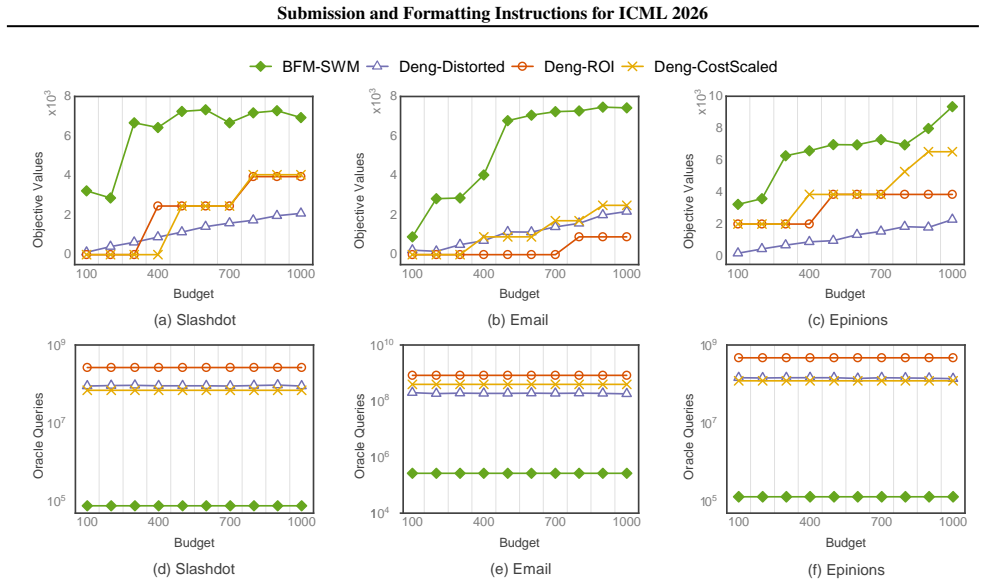
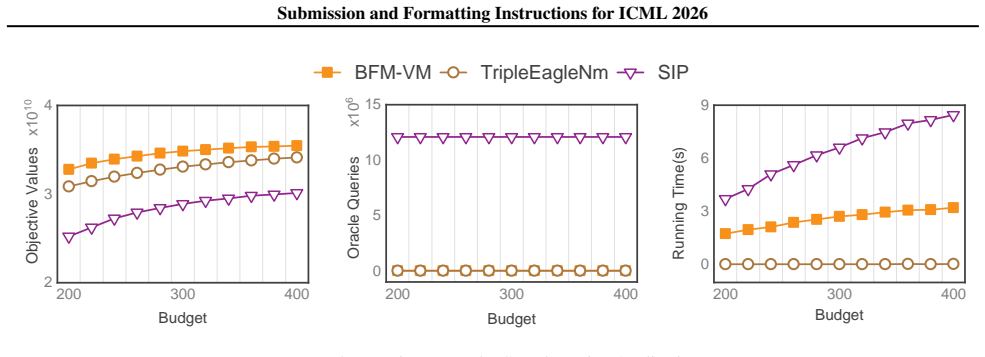
Budget-feasible procurement auctions play a pivotal role in various AI-driven marketplaces, such as data acquisition and crowdsourcing, where a buyer with a limited budget seeks to procure services from strategic sellers with private costs. While numerous budget-feasible mechanisms have been proposed for the classic objective of maximizing the buyer's valuation, the more challenging and economically significant objective of social welfare maximization has only recently been studied, and existing approaches still sacrifice budget feasibility, thereby limiting their practical applicability. In this paper, we bridge this gap by proposing BFM-SWM, the first budget-feasible mechanism with provable approximation guarantees for submodular welfare maximization in procurement auctions. Our mechanism satisfies standard economic properties, including truthfulness, individual rationality, and non-negative auctioneer surplus. As a by-product, we develop BFM-VM, a variant tailored for valuation maximization, which achieves a deterministic approximation ratio of $1/(12+4\sqrt{3})$ for general submodular functions, substantially improving upon the best-known deterministic ratio of $1/64$ established by [Balkanski et al., SODA 2022], while reducing the running time from $\mathcal{O}(n^2\log n)$ to $\mathcal{O}(n\log n)$. Extensive experiments demonstrate the efficiency and effectiveness of our mechanisms.
Editorial analysis
A structured set of objections, weighed in public.
Referee Report
Summary. The paper proposes BFM-SWM, the first budget-feasible mechanism with provable approximation guarantees for submodular welfare maximization in procurement auctions. The mechanism satisfies truthfulness, individual rationality, and non-negative auctioneer surplus. As a by-product, BFM-VM improves the deterministic approximation ratio for submodular valuation maximization to 1/(12 + 4√3) with O(n log n) runtime, improving on the prior 1/64 ratio and O(n² log n) runtime from Balkanski et al. (SODA 2022). Experiments are included to show efficiency and effectiveness in AI marketplaces such as data acquisition and crowdsourcing.
Significance. If the claimed approximation guarantees, budget feasibility, and incentive properties hold, the result would be significant: it closes a gap between valuation-maximization mechanisms and the more economically relevant welfare objective while preserving budget feasibility, which prior welfare approaches sacrificed. The deterministic improvement for valuation maximization and the linearithmic runtime are practically relevant for large-scale procurement settings.
major comments (2)
- [Section 4 (mechanism construction and proof of BFM-SWM)] The central claim for BFM-SWM rests on an implicit reduction from submodular welfare maximization (value minus realized seller costs) to the valuation-maximization case. No equation or lemma in the manuscript demonstrates that the payment adjustment preserves both budget feasibility (total payments ≤ budget) and dominant-strategy truthfulness for arbitrary monotone submodular valuations; this reduction is load-bearing for the main result and must be shown explicitly.
- [Section 6 (experiments)] The experimental section reports that the mechanisms are efficient and effective but supplies no concrete data, baselines, instance sizes, statistical measures, or comparison tables. Without these, the practical claims cannot be assessed and the experiments do not yet support the theoretical guarantees.
minor comments (2)
- [Abstract] The abstract states the new ratio as 1/(12+4√3) but does not simplify or bound it numerically for easy comparison with 1/64; add the approximate decimal value.
- [Introduction and Section 3] Ensure every theorem statement is followed by a clear proof sketch or pointer to the appendix; several claims in the introduction are stated without immediate reference.
Simulated Author's Rebuttal
We thank the referee for the constructive comments and for recognizing the significance of closing the gap between valuation and welfare objectives under budget feasibility. We address each major comment below and will revise the manuscript to incorporate the suggested clarifications and additions.
read point-by-point responses
-
Referee: [Section 4 (mechanism construction and proof of BFM-SWM)] The central claim for BFM-SWM rests on an implicit reduction from submodular welfare maximization (value minus realized seller costs) to the valuation-maximization case. No equation or lemma in the manuscript demonstrates that the payment adjustment preserves both budget feasibility (total payments ≤ budget) and dominant-strategy truthfulness for arbitrary monotone submodular valuations; this reduction is load-bearing for the main result and must be shown explicitly.
Authors: We agree that the connection between the welfare-maximization mechanism and the valuation-maximization subroutine was presented at a high level without a dedicated lemma isolating the payment adjustment. In the revision we will insert a new Lemma 4.3 (immediately following the mechanism definition) that explicitly states the adjusted payment rule p_i = v_i(S) - c_i(S) + p_i^{VM}, proves that sum p_i ≤ B whenever the VM payments satisfy the budget constraint, and shows dominant-strategy truthfulness by verifying that any deviation in reported cost cannot increase a seller's utility beyond the truthful outcome for arbitrary monotone submodular valuations. The proof will reuse the monotonicity and submodularity properties already established for BFM-VM. revision: yes
-
Referee: [Section 6 (experiments)] The experimental section reports that the mechanisms are efficient and effective but supplies no concrete data, baselines, instance sizes, statistical measures, or comparison tables. Without these, the practical claims cannot be assessed and the experiments do not yet support the theoretical guarantees.
Authors: We acknowledge that the current experimental write-up is too high-level. The revised Section 6 will include: (i) instance sizes ranging from n=50 to n=2000 sellers with submodular valuations generated from coverage and facility-location functions; (ii) explicit baselines consisting of the greedy algorithm, the 1/64-approximation mechanism of Balkanski et al. (SODA 2022), and a random sampling benchmark; (iii) tables reporting mean and standard deviation of achieved welfare/valuation ratios and running times over 100 independent runs per size; and (iv) statistical significance tests (paired t-tests) confirming that BFM-SWM and BFM-VM outperform the baselines at p<0.01. All raw data and code will be released in a supplementary repository. revision: yes
Circularity Check
No circularity; mechanism proposal is constructive and independent of self-referential inputs.
full rationale
The paper proposes BFM-SWM as a new mechanism achieving budget feasibility, truthfulness, IR, and approximation for submodular welfare maximization, with BFM-VM as a by-product improving the deterministic ratio over an external citation to Balkanski et al. (SODA 2022). No equations, parameter fits, or self-citations appear in the provided text that reduce the claimed guarantees to prior results by construction. The derivation is presented as a direct construction of new mechanisms rather than a renaming, self-definition, or load-bearing self-citation chain, making the claims self-contained.
Axiom & Free-Parameter Ledger
axioms (2)
- domain assumption The buyer's welfare function is submodular.
- domain assumption Sellers have private costs and act strategically.
invented entities (2)
-
BFM-SWM mechanism
no independent evidence
-
BFM-VM mechanism
no independent evidence
Reference graph
Works this paper leans on
-
[1]
American Economic Review , volume=
Obviously strategy-proof mechanisms , author=. American Economic Review , volume=
-
[2]
arXiv preprint arXiv:1804.08178 , year=
Nearly linear time deterministic algorithms for submodular maximization under knapsack constraint and beyond , author=. arXiv preprint arXiv:1804.08178 , year=
-
[3]
Journal of Political Economy , volume=
Clock auctions and radio spectrum reallocation , author=. Journal of Political Economy , volume=
-
[4]
Unpublished manuscript , volume=
Knapsack voting: Voting mechanisms for participatory budgeting , author=. Unpublished manuscript , volume=
-
[5]
Algorithmica , volume=
Budget feasible mechanisms on matroids , author=. Algorithmica , volume=
-
[6]
International Conference on Autonomous Agents and MultiAgent Systems (AAMAS) , pages=
Group Fairness for Knapsack Problems , author=. International Conference on Autonomous Agents and MultiAgent Systems (AAMAS) , pages=
-
[7]
ACM Transactions on Economics and Computation (TEAC) , volume=
Knapsack voting for participatory budgeting , author=. ACM Transactions on Economics and Computation (TEAC) , volume=
-
[8]
AAAI Conference on Artificial Intelligence (AAAI) , year=
The network data repository with interactive graph analytics and visualization , author=. AAAI Conference on Artificial Intelligence (AAAI) , year=
-
[9]
AAAI Conference on Artificial Intelligence (AAAI) , volume=
Fair knapsack , author=. AAAI Conference on Artificial Intelligence (AAAI) , volume=
-
[10]
Lecture Notes, Available at https://thibaut
Notes on greedy algorithms for submodular maximization , author=. Lecture Notes, Available at https://thibaut. horel. org/submodularity/notes/02-12. pdf , year=
-
[11]
arXiv preprint arXiv:2208.07582 , year=
Deletion robust non-monotone submodular maximization over matroids , author=. arXiv preprint arXiv:2208.07582 , year=
-
[12]
International Conference on Machine Learning (ICML) , pages=
Fast constrained submodular maximization: Personalized data summarization , author=. International Conference on Machine Learning (ICML) , pages=
-
[13]
International Conference on Machine Learning (ICML) , pages=
Deletion robust submodular maximization over matroids , author=. International Conference on Machine Learning (ICML) , pages=
-
[14]
International Conference on Machine Learning (ICML) , pages=
Robust submodular maximization: A non-uniform partitioning approach , author=. International Conference on Machine Learning (ICML) , pages=
-
[15]
Acm transactions on interactive intelligent systems (TiiS) , volume=
The movielens datasets: History and context , author=. Acm transactions on interactive intelligent systems (TiiS) , volume=
-
[16]
International Conference on Machine Learning (ICML) , pages=
Submodular maximization beyond non-negativity: Guarantees, fast algorithms, and applications , author=. International Conference on Machine Learning (ICML) , pages=
-
[17]
IEEE/CVF Computer Vision and Pattern Recognition Conference (CVPR) , pages=
Efficient object detection and segmentation for fine-grained recognition , author=. IEEE/CVF Computer Vision and Pattern Recognition Conference (CVPR) , pages=
-
[18]
International Joint Conference on Artificial Intelligence (IJCAI) , year=
Group-Fairness in Influence Maximization , author=. International Joint Conference on Artificial Intelligence (IJCAI) , year=
-
[19]
International Joint Conference on Artificial Intelligence (IJCAI) , pages=
Participatory Budgeting with Project Groups , author=. International Joint Conference on Artificial Intelligence (IJCAI) , pages=
-
[20]
International Joint Conference on Artificial Intelligence (IJCAI) , pages=
Budget feasible mechanisms: A survey , author=. International Joint Conference on Artificial Intelligence (IJCAI) , pages=
-
[21]
arXiv preprint arXiv:2304.04700 , year=
Achieving long-term fairness in submodular maximization through randomization , author=. arXiv preprint arXiv:2304.04700 , year=
-
[22]
Journal of Combinatorial Optimization , volume=
Group fairness in non-monotone submodular maximization , author=. Journal of Combinatorial Optimization , volume=
-
[23]
arXiv preprint arXiv:2312.14299 , year=
Fairness in Submodular Maximization over a Matroid Constraint , author=. arXiv preprint arXiv:2312.14299 , year=
-
[24]
Journal of Combinatorial Optimization , volume=
Beyond submodularity: a unified framework of randomized set selection with group fairness constraints , author=. Journal of Combinatorial Optimization , volume=
-
[25]
International Joint Conference on Artificial Intelligence (IJCAI) , pages=
Multiwinner voting with fairness constraints , author=. International Joint Conference on Artificial Intelligence (IJCAI) , pages=
-
[26]
Pham and Tan D
Canh V. Pham and Tan D. Tran and Dung T. K. Ha and My T. Thai , title =. International Joint Conference on Artificial Intelligence (IJCAI) , pages =
-
[27]
International Conference on Medical Image Computing and Computer-Assisted Intervention (MICCAI) , pages=
A submodular approach to create individualized parcellations of the human brain , author=. International Conference on Medical Image Computing and Computer-Assisted Intervention (MICCAI) , pages=
-
[28]
Annual Meeting of the Association for Computational Linguistics (ACL) , pages=
A class of submodular functions for document summarization , author=. Annual Meeting of the Association for Computational Linguistics (ACL) , pages=
-
[29]
Combinatorial auctions , volume=
Industrial procurement auctions , author=. Combinatorial auctions , volume=
-
[30]
Operations Research , volume=
Optimal and differentially private data acquisition: Central and local mechanisms , author=. Operations Research , volume=
-
[31]
International World Wide Web Conferences (WWW) , pages=
Optimal marketing strategies over social networks , author=. International World Wide Web Conferences (WWW) , pages=
-
[32]
International World Wide Web Conferences (WWW) , pages=
Pricing mechanisms for crowdsourcing markets , author=. International World Wide Web Conferences (WWW) , pages=
-
[33]
International World Wide Web Conferences (WWW) , pages=
Randomized Pricing with Deferred Acceptance for Revenue Maximization with Submodular Objectives , author=. International World Wide Web Conferences (WWW) , pages=
-
[34]
International World Wide Web Conferences (WWW) , pages=
Fair and representative subset selection from data streams , author=. International World Wide Web Conferences (WWW) , pages=
-
[35]
IEEE/CVF Computer Vision and Pattern Recognition Conference (CVPR) , pages=
Submodular object recognition , author=. IEEE/CVF Computer Vision and Pattern Recognition Conference (CVPR) , pages=
-
[36]
Conference on Uncertainty in Artificial Intelligence (UAI) , pages=
Learning mixtures of submodular shells with application to document summarization , author=. Conference on Uncertainty in Artificial Intelligence (UAI) , pages=
-
[37]
Applied Intelligence , volume=
Multi-document summarization via submodularity , author=. Applied Intelligence , volume=
-
[38]
International Joint Conference on Natural Language Processing (IJCNLP) , pages=
Towards abstractive multi-document summarization using submodular function-based framework, sentence compression and merging , author=. International Joint Conference on Natural Language Processing (IJCNLP) , pages=
-
[39]
International Conference on Research on Development in Information Retrieval (SIGIR) , pages=
Mssf: a multi-document summarization framework based on submodularity , author=. International Conference on Research on Development in Information Retrieval (SIGIR) , pages=
-
[40]
Information Sciences , volume=
Ontology-enriched multi-document summarization in disaster management using submodular function , author=. Information Sciences , volume=
-
[41]
American Control Conference (ACC) , pages=
Sensor placement for optimal Kalman filtering: Fundamental limits, submodularity, and algorithms , author=. American Control Conference (ACC) , pages=
-
[42]
Reliability Engineering & System Safety , volume=
Submodularity issues in value-of-information-based sensor placement , author=. Reliability Engineering & System Safety , volume=
-
[43]
2018 Annual American Control Conference (ACC) , pages=
A submodular approach for optimal sensor placement in traffic networks , author=. 2018 Annual American Control Conference (ACC) , pages=
2018
-
[44]
Transportation research part B: methodological , volume=
Submodularity of optimal sensor placement for traffic networks , author=. Transportation research part B: methodological , volume=
-
[45]
, author=
Near-optimal sensor placements in Gaussian processes: Theory, efficient algorithms and empirical studies. , author=. Journal of Machine Learning Research , volume=
-
[46]
Conference on Uncertainty in Artificial Intelligence (UAI) , pages=
Near-optimal nonmyopic value of information in graphical models , author=. Conference on Uncertainty in Artificial Intelligence (UAI) , pages=
-
[47]
Systems and Machine Learning (SysML) , volume=
Discrete adversarial attacks and submodular optimization with applications to text classification , author=. Systems and Machine Learning (SysML) , volume=
-
[48]
Artificial Intelligence , volume=
Pareto optimization for subset selection with dynamic cost constraints , author=. Artificial Intelligence , volume=
-
[49]
Advances in Neural Information Processing Systems (NeurIPS) , year=
Submodular maximization through barrier functions , author=. Advances in Neural Information Processing Systems (NeurIPS) , year=
-
[50]
Advances in Neural Information Processing Systems (NeurIPS) , volume=
Learning mixtures of submodular functions for image collection summarization , author=. Advances in Neural Information Processing Systems (NeurIPS) , volume=
-
[51]
Artificial Intelligence , volume=
Maximizing submodular or monotone approximately submodular functions by multi-objective evolutionary algorithms , author=. Artificial Intelligence , volume=
-
[52]
Foundations and Trends in Machine Learning , volume=
Determinantal point processes for machine learning , author=. Foundations and Trends in Machine Learning , volume=
-
[53]
ACM-SIAM Symposium on Discrete Algorithms (SODA) , pages=
Submodular maximization with nearly optimal approximation, adaptivity and query complexity , author=. ACM-SIAM Symposium on Discrete Algorithms (SODA) , pages=
-
[54]
Mathematical Programming , volume=
Submodular maximization meets streaming: matchings, matroids, and more , author=. Mathematical Programming , volume=. 2015 , publisher=
2015
-
[55]
ACM-SIAM Symposium on Discrete Algorithms (SODA) , pages=
Deterministic Algorithms for Submodular Maximization Problems , author=. ACM-SIAM Symposium on Discrete Algorithms (SODA) , pages=
-
[56]
ACM-SIAM Symposium on Discrete Algorithms (SODA) , pages=
Submodular function maximization in parallel via the multilinear relaxation , author=. ACM-SIAM Symposium on Discrete Algorithms (SODA) , pages=
-
[57]
ACM Symposium on the Theory of Computing (STOC) , pages=
Chekuri, Chandra and Quanrud, Kent , title=. ACM Symposium on the Theory of Computing (STOC) , pages=
-
[58]
ACM Symposium on the Theory of Computing (STOC) , pages=
The adaptive complexity of maximizing a submodular function , author=. ACM Symposium on the Theory of Computing (STOC) , pages=
-
[59]
ACM Symposium on the Theory of Computing (STOC) , pages=
Randomized composable core-sets for distributed submodular maximization , author=. ACM Symposium on the Theory of Computing (STOC) , pages=
-
[60]
AAAI Conference on Artificial Intelligence (AAAI) , year=
Nearly linear-time, parallelizable algorithms for non-monotone submodular maximization , author=. AAAI Conference on Artificial Intelligence (AAAI) , year=
-
[61]
AAAI Conference on Artificial Intelligence (AAAI) , volume=
District-fair participatory budgeting , author=. AAAI Conference on Artificial Intelligence (AAAI) , volume=
-
[62]
AAAI Conference on Artificial Intelligence (AAAI) , volume=
Near-optimal observation selection using submodular functions , author=. AAAI Conference on Artificial Intelligence (AAAI) , volume=
-
[63]
Water Distribution Systems Analysis Symposium , pages=
Optimizing sensor placements in water distribution systems using submodular function maximization , author=. Water Distribution Systems Analysis Symposium , pages=
-
[64]
IEEE Transactions on Automatic Control , volume=
Randomized greedy sensor selection: Leveraging weak submodularity , author=. IEEE Transactions on Automatic Control , volume=
-
[65]
ACM Transactions on Intelligent Systems and Technology (TIST) , volume=
Submodularity and its applications in optimized information gathering , author=. ACM Transactions on Intelligent Systems and Technology (TIST) , volume=
-
[66]
AAAI Conference on Artificial Intelligence (AAAI) , volume=
Noisy submodular maximization via adaptive sampling with applications to crowdsourced image collection summarization , author=. AAAI Conference on Artificial Intelligence (AAAI) , volume=
-
[67]
AAAI Conference on Artificial Intelligence (AAAI) , year=
The Network Data Repository with Interactive Graph Analytics and Visualization , author=. AAAI Conference on Artificial Intelligence (AAAI) , year=
-
[68]
AAAI Conference on Artificial Intelligence (AAAI) , volume=
Submodular span, with applications to conditional data summarization , author=. AAAI Conference on Artificial Intelligence (AAAI) , volume=
-
[69]
Jure Leskovec and Andrej Krevl , year=
-
[70]
Cumulative number of reviews submitted to Yelp from 2009 to 2021 , url=
Stacy Jo Dixon , year=. Cumulative number of reviews submitted to Yelp from 2009 to 2021 , url=
2009
-
[71]
Cumulative total of Tumblr posts between May 2011 and April 2019 , url=
Stacy Jo Dixon , year=. Cumulative total of Tumblr posts between May 2011 and April 2019 , url=
2011
-
[72]
Hours of video uploaded to YouTube every minute as of February 2022 , url=
Laura Ceci , year=. Hours of video uploaded to YouTube every minute as of February 2022 , url=
2022
-
[73]
Artificial Intelligence and Statistics (AISTATS) , pages=
Adaptive Sampling for Fast Constrained Maximization of Submodular Functions , author=. Artificial Intelligence and Statistics (AISTATS) , pages=
-
[74]
International Conference on Data Engineering (ICDE) , pages=
On efficient and scalable time-continuous spatial crowdsourcing , author=. International Conference on Data Engineering (ICDE) , pages=
-
[75]
IEEE International Conference on Acoustics, Speech and Signal Processing , pages=
Submodular feature selection for high-dimensional acoustic score spaces , author=. IEEE International Conference on Acoustics, Speech and Signal Processing , pages=
-
[76]
Information Processing & Management , volume=
On the task assignment with group fairness for spatial crowdsourcing , author=. Information Processing & Management , volume=
-
[77]
IEEE/ACM Transactions on Networking , volume=
Quality-aware pricing for mobile crowdsensing , author=. IEEE/ACM Transactions on Networking , volume=
-
[78]
ACM International Symposium on Mobile Ad Hoc Networking and Computing , pages=
Posted pricing for robust crowdsensing , author=. ACM International Symposium on Mobile Ad Hoc Networking and Computing , pages=
-
[79]
Wireless Communications and Networking Conference (WCNC) , pages=
TCAM: A truthful combinatorial auction mechanism for crowdsourcing systems , author=. Wireless Communications and Networking Conference (WCNC) , pages=
-
[80]
IEEE Systems Journal , year=
Online Truthful Incentives for Heterogeneous and k-Submodular Crowdsensing , author=. IEEE Systems Journal , year=
discussion (0)
Sign in with ORCID, Apple, or X to comment. Anyone can read and Pith papers without signing in.