Recognition: unknown
Fundamental Efficiency Limits of Transition-Metal Dichalcogenide Solar Cells with Carrier Multiplication and Hot-Carrier Effects
Pith reviewed 2026-05-09 15:19 UTC · model grok-4.3
The pith
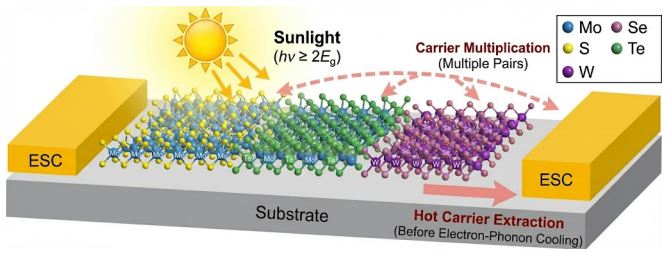
Carrier multiplication cannot raise the reversible hot-carrier efficiency limit in TMD solar cells because both effects draw from the same excess photon energy.
A machine-rendered reading of the paper's core claim, the machinery that carries it, and where it could break.
Core claim
The central claim is that carrier multiplication and hot-carrier extraction in TMD solar cells utilize the same pool of photon energy above the bandgap. As a result, multiplication does not increase the maximum efficiency set by reversible hot-carrier operation. When heat leakage is finite, multiplication instead protects performance by converting excess energy into current rather than into a cooling-sensitive voltage increase.
What carries the argument
An endoreversible hot-carrier engine with finite heat-leak coefficient kappa, coupled to energy- and thickness-dependent absorptance and a carrier-multiplication quantum-yield limit of 0.97.
If this is right
- Optically thick TMDs reach peak efficiency near 1.0 eV bandgap rather than 1.3 eV when both multiplication and hot-carrier extraction are active.
- Monolayer TMDs such as WSe2 obtain less than 1 percent short-circuit-current gain from multiplication because few AM1.5G photons exceed twice the bandgap.
- Bulk-like TMD layers 10-50 nm thick can exhibit hot-carrier gains, but even a modest kappa of 0.2 W m^{-2} K^{-1} produces roughly 100 W m^{-2} heat leak at a 500 K temperature difference.
- Efficiencies above 50 percent require simultaneous realization of energy-selective contacts and phonon-engineered cooling suppression.
Where Pith is reading between the lines
- Device design should therefore favor narrow-gap bulk TMD absorbers over high-gap monolayers when targeting beyond-SQ performance.
- Strategies that enhance multiplication may reduce the voltage benefit of hot-carrier extraction unless the two are balanced through material engineering.
- The framework implies that separate treatment of multiplication and hot-carrier effects in device models will overestimate performance when both are present.
Load-bearing premise
The model assumes ideal energy-selective contacts, a controllable finite heat-leak coefficient kappa, and a carrier-multiplication yield upper limit that holds under operating conditions.
What would settle it
A measurement showing that enabling carrier multiplication raises open-circuit voltage rather than only short-circuit current in a hot-carrier TMD device under above-bandgap illumination would contradict the shared-reservoir claim.
Figures


read the original abstract
Detailed-balance limits for transition-metal dichalcogenide (TMD) solar cells have been reported, but existing TMD-specific limits do not simultaneously resolve thickness-dependent optics, carrier multiplication (CM), hot-carrier (HC) extraction, and finite cooling leakage. Here, we develop a generalized detailed-balance theory that provides an upper-bound framework. The model combines energy- and thickness-dependent absorptance a(E,d), exciton-resolved monolayer absorbance, an experimentally available CM quantum-yield limit (eta_CM <= 0.97), and an endoreversible HC engine with ideal energy-selective contacts and finite heat-leak coefficient kappa. The framework shows that CM and HC draw on the same above-gap photon-energy reservoir; therefore, CM does not raise the reversible HC thermodynamic limit. Instead, CM can protect finite-kappa performance only by shifting excess-energy utilization from a cooling-sensitive voltage channel into collected current. For optically thick TMDs under AM1.5G illumination, the SQ optimum lies near E_g = 1.3 eV, whereas the CM/HC-favored envelope shifts toward E_g = 1.0 eV with reversible efficiencies above 50%. For monolayer TMDs such as WSe2 (E_g = 1.63 eV), CM is essentially inactive because only about 3.7% of above-gap AM1.5G photons satisfy E > 2E_g, giving an idealized short-circuit-current gain of only about 0.6% before device nonidealities. Bulk-like TMDs can show large HC-related gains at d = 10-50 nm, but even kappa = 0.2 W m^-2 K^-1 implies about 100 W m^-2 heat leak for Delta T = 500 K. Thus, high-E_g monolayer TMDs are not promising one-sun CM candidates, whereas narrow-E_g, bulk-like TMD absorbers remain plausible beyond-SQ candidates only if energy-selective extraction and phonon-engineered cooling suppression are realized together.
Editorial analysis
A structured set of objections, weighed in public.
Referee Report
Summary. The paper develops a generalized detailed-balance framework for TMD solar cells that integrates thickness-dependent absorptance a(E,d), an experimental CM quantum yield upper limit of 0.97, and an endoreversible hot-carrier engine with finite heat-leak coefficient kappa and ideal energy-selective contacts. It demonstrates that CM and HC extraction compete for the same above-gap photon energy reservoir, implying that CM does not increase the reversible (kappa=0) efficiency limit but can improve performance at finite kappa by converting excess energy into additional current rather than voltage. Specific results include SQ optimum at Eg=1.3 eV for thick films, CM/HC envelope shifting to Eg=1.0 eV with efficiencies >50%, and negligible CM benefit for high-gap monolayers like WSe2 due to only 3.7% of AM1.5G photons exceeding 2Eg.
Significance. If valid, this work provides a valuable theoretical upper-bound tool for evaluating the potential of TMD materials in advanced photovoltaic concepts beyond the Shockley-Queisser limit. By showing the competition between CM and HC, it clarifies that simultaneous benefits are limited and directs attention to the practical requirements of energy-selective contacts and suppressed cooling (low kappa). The inclusion of realistic thickness-dependent optics and experimental CM bounds strengthens the applicability to real TMD devices, offering guidance that narrow-gap bulk TMDs are more promising than monolayers for these effects. The endoreversible treatment with controllable kappa is a useful extension of standard detailed-balance methods.
major comments (2)
- [Generalized detailed-balance theory and HC engine] The central claim that CM does not raise the reversible HC thermodynamic limit (while only protecting finite-kappa performance via current gain) is load-bearing for the paper's main conclusion. Please provide the explicit efficiency expression or derivation (likely in the model section combining the endoreversible engine with detailed-balance current) showing that introducing eta_CM leaves the kappa=0 limit unchanged.
- [Results for monolayer TMDs] The monolayer TMD result that only ~3.7% of above-gap AM1.5G photons satisfy E > 2Eg for WSe2 (Eg=1.63 eV), yielding ~0.6% idealized Jsc gain, underpins the claim that high-Eg monolayers are not promising CM candidates. Specify the exact spectrum integration (including any weighting by a(E,d) for d~monolayer) and confirm whether this fraction is robust to the exciton-resolved absorbance model.
minor comments (3)
- [Abstract] The abstract packs many quantitative claims; consider adding a short table or bullet list of key efficiency numbers for SQ vs. CM/HC cases at different d and Eg to improve scannability.
- [Model description] Notation for eta_CM (experimental upper bound) and kappa should be defined at first use in the main text with a brief statement of their physical meaning and how they enter the current and power expressions.
- [Figures and results] If efficiency contour plots vs. Eg and d are present, ensure the reversible (kappa=0) and finite-kappa curves are overlaid with clear legends distinguishing CM-on vs. CM-off cases.
Simulated Author's Rebuttal
We thank the referee for the positive evaluation and recommendation for minor revision. The comments are constructive and help clarify key aspects of the generalized detailed-balance framework. We address each major comment below and will incorporate the requested details into the revised manuscript.
read point-by-point responses
-
Referee: [Generalized detailed-balance theory and HC engine] The central claim that CM does not raise the reversible HC thermodynamic limit (while only protecting finite-kappa performance via current gain) is load-bearing for the paper's main conclusion. Please provide the explicit efficiency expression or derivation (likely in the model section combining the endoreversible engine with detailed-balance current) showing that introducing eta_CM leaves the kappa=0 limit unchanged.
Authors: We agree that an explicit derivation strengthens the central claim. In the revised manuscript we will add a short subsection deriving the combined efficiency. The endoreversible HC engine power is P = (1 - T_c/T_h) * (integral E * a(E) * Phi(E) * eta_CM(E) dE - kappa*(T_h - T_c)), where the chemical potential mu_h is set by detailed balance of the carrier flux. For kappa=0 the maximum efficiency reduces to the reversible limit set by mu_h and T_h alone; increasing eta_CM raises the current but lowers the average carrier energy, leaving the extractable work (and thus the kappa=0 efficiency) unchanged when energy-selective contacts are ideal. The derivation will be inserted after Eq. (3) with the limiting case shown analytically. revision: yes
-
Referee: [Results for monolayer TMDs] The monolayer TMD result that only ~3.7% of above-gap AM1.5G photons satisfy E > 2Eg for WSe2 (Eg=1.63 eV), yielding ~0.6% idealized Jsc gain, underpins the claim that high-Eg monolayers are not promising CM candidates. Specify the exact spectrum integration (including any weighting by a(E,d) for d~monolayer) and confirm whether this fraction is robust to the exciton-resolved absorbance model.
Authors: We will expand the methods and results sections to give the exact integral: f_CM = [integral_{2Eg}^infty a(E,d) * Phi_AM1.5(E) dE] / [integral_{Eg}^infty a(E,d) * Phi_AM1.5(E) dE], where a(E,d) for d~0.7 nm is the exciton-resolved absorbance from the model in Sec. II. For WSe2 this evaluates to 3.7% using the published continuum absorption above 2Eg. The Jsc gain is then 0.6% at eta_CM=0.97 before non-idealities. The fraction is robust because the A and B exciton resonances lie below 2Eg and the above-gap continuum is insensitive to the precise exciton lineshape; we will add a brief sensitivity check confirming <0.2% variation. revision: yes
Circularity Check
No significant circularity in derivation chain
full rationale
The paper builds a generalized detailed-balance framework by combining externally measured inputs (thickness-dependent a(E,d), experimental eta_CM upper bound of 0.97) with standard endoreversible thermodynamics (finite kappa, energy-selective contacts). The key result—that CM and HC compete for the same above-gap reservoir and thus CM cannot raise the reversible (kappa=0) limit—emerges as a direct consequence of the energy-balance equations rather than being presupposed or fitted. Reported efficiencies are computed outputs under AM1.5G, not renormalized inputs. No self-citation load-bearing steps, ansatz smuggling, or renaming of known results appear; the model remains self-contained against external benchmarks.
Axiom & Free-Parameter Ledger
free parameters (2)
- kappa
- eta_CM
axioms (3)
- standard math Detailed-balance principle relating absorption and emission rates
- domain assumption Endoreversible hot-carrier engine with ideal energy-selective contacts
- domain assumption Energy- and thickness-dependent absorptance a(E,d) together with exciton-resolved monolayer absorbance
Reference graph
Works this paper leans on
-
[1]
Bernardi, M.; Palummo, M.; Grossman, J. C. Extraordinary Sunlight Absorption and One Nanometer Thick Photovoltaics Using Two-Dimensional Monolayer Materials. Nano Lett. 2013, 13, 3664--3670. DOI: 10.1021/nl401544y
-
[2]
Nassiri Nazif, K.; Nitta, F. U.; Daus, A.; Saraswat, K. C.; Pop, E. Efficiency Limit of Transition Metal Dichalcogenide Solar Cells. Commun. Phys. 2023, 6, 367. DOI: 10.1038/s42005-023-01447-y
-
[3]
Fundamental Limit of Nanophotonic Light Trapping in Solar Cells
Yu, Z.; Raman, A.; Fan, S. Fundamental Limit of Nanophotonic Light Trapping in Solar Cells. Proc. Natl. Acad. Sci. U.S.A. 2010, 107, 17491--17496. DOI: 10.1073/pnas.1008296107
-
[4]
Miller, D. A. B. Why Optics Needs Thickness. Science 2023, 379, 41--45. DOI: 10.1126/science.ade3395
-
[5]
Kim, J. H.; Bergren, M. R.; Park, J. C.; Adhikari, S.; Lorke, M.; Frauenheim, T.; Choe, D.-H.; Kim, B.; Choi, H.; Gregorkiewicz, T.; Lee, Y. H. Carrier Multiplication in van der Waals Layered Transition Metal Dichalcogenides. Nat. Commun. 2019, 10, 5488. DOI: 10.1038/s41467-019-13325-9
-
[6]
Werner, J. H.; Brendel, R.; Queisser, H. J. Radiative Efficiency Limit of Terrestrial Solar Cells with Internal Carrier Multiplication. Appl. Phys. Lett. 1995, 67, 1028--1030. DOI: 10.1063/1.114719
-
[7]
Brendel, R.; Werner, J. H.; Queisser, H. J. Thermodynamic Efficiency Limits for Semiconductor Solar Cells with Carrier Multiplication. Sol. Energy Mater. Sol. Cells 1996, 41--42, 419--425. DOI: 10.1016/0927-0248(95)00125-5
-
[8]
Klimov, V. I. Detailed-Balance Power Conversion Limits of Nanocrystal-Quantum-Dot Solar Cells in the Presence of Carrier Multiplication. Appl. Phys. Lett. 2006, 89, 123118. DOI: 10.1063/1.2356314
-
[9]
Hanna, M. C.; Nozik, A. J. Solar Conversion Efficiency of Photovoltaic and Photoelectrolysis Cells with Carrier Multiplication Absorbers. J. Appl. Phys. 2006, 100, 074510. DOI: 10.1063/1.2356795
-
[10]
Paul, K. K.; Kim, J.-H.; Lee, Y. H. Hot Carrier Photovoltaics in van der Waals Heterostructures. Nat. Rev. Phys. 2021, 3, 178--192. DOI: 10.1038/s42254-020-00272-4
-
[11]
Ross, R. T.; Nozik, A. J. Efficiency of Hot-Carrier Solar Energy Converters. J. Appl. Phys. 1982, 53, 3813--3818. DOI: 10.1063/1.331124
-
[12]
The Endoreversible Theory of Solar Energy Conversion: A Tutorial
De Vos, A. The Endoreversible Theory of Solar Energy Conversion: A Tutorial. Sol. Energy Mater. Sol. Cells 1993, 31, 75--93. DOI: 10.1016/0927-0248(93)90008-Q
-
[14]
Shockley, W.; Queisser, H. J. Detailed Balance Limit of Efficiency of p-n Junction Solar Cells. J. Appl. Phys. 1961, 32, 510--519. DOI: 10.1063/1.1736034
-
[15]
C.; Lee, D.; Huh, W.; Kim, Y.; Lee, S
Yang, S.; Cha, J.; Kim, J. C.; Lee, D.; Huh, W.; Kim, Y.; Lee, S. W.; Park, H. G.; Jeong, H. Y.; Hong, S.; Lee, G. H.; Lee, C. H. Monolithic Interface Contact Engineering to Boost Optoelectronic Performances of 2D Semiconductor Photovoltaic Heterojunctions. Nano Lett. 2020, 20, 2443--2451. DOI: 10.1021/acs.nanolett.9b05162
-
[16]
Ruppert, C.; Aslan, O. B.; Heinz, T. F. Optical Properties and Band Gap of Single- and Few-Layer MoTe _2 Crystals. Nano Lett. 2014, 14, 6231--6236. DOI: 10.1021/nl502557g
-
[17]
ASTM G-173-03 Reference Spectra for Photovoltaic Performance Evaluation , year =
-
[18]
Shockley, William and Queisser, Hans J. , doi =. Detailed Balance Limit of Efficiency of p-n Junction Solar Cells , volume =. Journal of Applied Physics , number =. 1961 , bdsk-url-1 =
1961
-
[19]
and Daus, Alwin and Saraswat, Krishna C
Nassiri Nazif, Koosha and Nitta, Frederick U. and Daus, Alwin and Saraswat, Krishna C. and Pop, Eric , doi =. Efficiency limit of transition metal dichalcogenide solar cells , volume =. Communications Physics , pages =. 2023 , bdsk-url-1 =
2023
-
[20]
Bernardi, Marco and Palummo, Marco and Grossman, Jeffrey C. , doi =. Extraordinary Sunlight Absorption and One Nanometer Thick Photovoltaics Using Two-Dimensional Monolayer Materials , volume =. Nano Letters , number =. 2013 , bdsk-url-1 =
2013
-
[21]
Monolithic Interface Contact Engineering to Boost Optoelectronic Performances of 2D Semiconductor Photovoltaic Heterojunctions , volume =
Yang, Seunghoon and Cha, Janghwan and Kim, Jong Chan and Lee, Donghun and Huh, Woong and Kim, Yoonseok and Lee, Seong Won and Park, Hong-Gyu and Jeong, Hu Young and Hong, Suklyun and Lee, Gwan-Hyoung and Lee, Chul-Ho , doi =. Monolithic Interface Contact Engineering to Boost Optoelectronic Performances of 2D Semiconductor Photovoltaic Heterojunctions , vo...
2020
-
[22]
Carrier multiplication in van der Waals layered transition metal dichalcogenides , volume =
Kim, Ji-Hee and others , doi =. Carrier multiplication in van der Waals layered transition metal dichalcogenides , volume =. Nature Communications , pages =. 2019 , bdsk-url-1 =
2019
-
[23]
Beard, Matthew C. , doi =. Multiple exciton generation in semiconductor quantum dots , volume =. The Journal of Physical Chemistry Letters , number =. 2011 , bdsk-url-1 =
2011
-
[24]
Klimov, Victor I. , doi =. Detailed-balance power conversion limits of nanocrystal-quantum-dot solar cells in the presence of carrier multiplication , volume =. Applied Physics Letters , pages =. 2006 , bdsk-url-1 =
2006
-
[25]
Thermodynamic efficiency limits for semiconductor solar cells with carrier multiplication , volume =
Brendel, Rolf and Werner, J. Thermodynamic efficiency limits for semiconductor solar cells with carrier multiplication , volume =. Solar Energy Materials and Solar Cells , note =
-
[26]
Hot carrier photovoltaics in van der Waals heterostructures , volume =
Paul, Kamal Kumar and Kim, Ji-Hee and Lee, Young Hee , doi =. Hot carrier photovoltaics in van der Waals heterostructures , volume =. Nature Reviews Physics , pages =. 2021 , bdsk-url-1 =
2021
-
[27]
Reciprocity relation between photovoltaic quantum efficiency and electroluminescent emission of solar cells , volume =
Rau, Uwe , doi =. Reciprocity relation between photovoltaic quantum efficiency and electroluminescent emission of solar cells , volume =. Physical Review B , pages =. 2007 , bdsk-url-1 =
2007
-
[28]
What Makes a Good Solar Cell? , volume =
Kirchartz, Thomas and Rau, Uwe , doi =. What Makes a Good Solar Cell? , volume =. Advanced Energy Materials , number =. 2018 , bdsk-url-1 =
2018
-
[29]
Fundamental limit of nanophotonic light trapping in solar cells , volume =
Yu, Zongfu and Raman, Arvind and Fan, Shanhui , doi =. Fundamental limit of nanophotonic light trapping in solar cells , volume =. Proceedings of the National Academy of Sciences , number =. 2010 , bdsk-url-1 =
2010
-
[30]
Miller, David A. B. , doi =. Why optics needs thickness , volume =. Science , number =. 2023 , bdsk-url-1 =
2023
-
[31]
and Heinz, Tony F
Ruppert, Claudia and Aslan, Ozge B. and Heinz, Tony F. , doi =. Optical Properties and Band Gap of Single- and Few-Layer MoTe2 Crystals , volume =. Nano Letters , number =. 2014 , bdsk-url-1 =
2014
-
[32]
Yablonovitch, Eli , title =. J. Opt. Soc. Am. , year =
-
[33]
and Yablonovitch, E
Tiedje, T. and Yablonovitch, E. and Cody, G. D. and Brooks, B. G. , title =. IEEE Trans. Electron Devices , year =
-
[34]
, title =
De Vos, A. , title =. Solar Energy Materials and Solar Cells , year =
-
[35]
Sergeev, A. and Sablon, K. , title =. Phys. Rev. Applied , year =. doi:10.1103/PhysRevApplied.10.064001 , note =
-
[36]
Werner, J. H. and Brendel, R. and Queisser, H. J. , title =. Applied Physics Letters , year =
-
[37]
Hanna, M. C. and Nozik, A. J. , title =. Journal of Applied Physics , year =
-
[38]
Ross, R. T. and Nozik, A. J. , title =. Journal of Applied Physics , year =
discussion (0)
Sign in with ORCID, Apple, or X to comment. Anyone can read and Pith papers without signing in.