Recognition: unknown
Reduced-Precision Stochastic Simulation for Mathematical Biology
Pith reviewed 2026-05-09 15:23 UTC · model grok-4.3
The pith
Mixed-precision arithmetic lets the stochastic simulation algorithm run faster while matching full-precision statistics on standard biological models.
A machine-rendered reading of the paper's core claim, the machinery that carries it, and where it could break.
Core claim
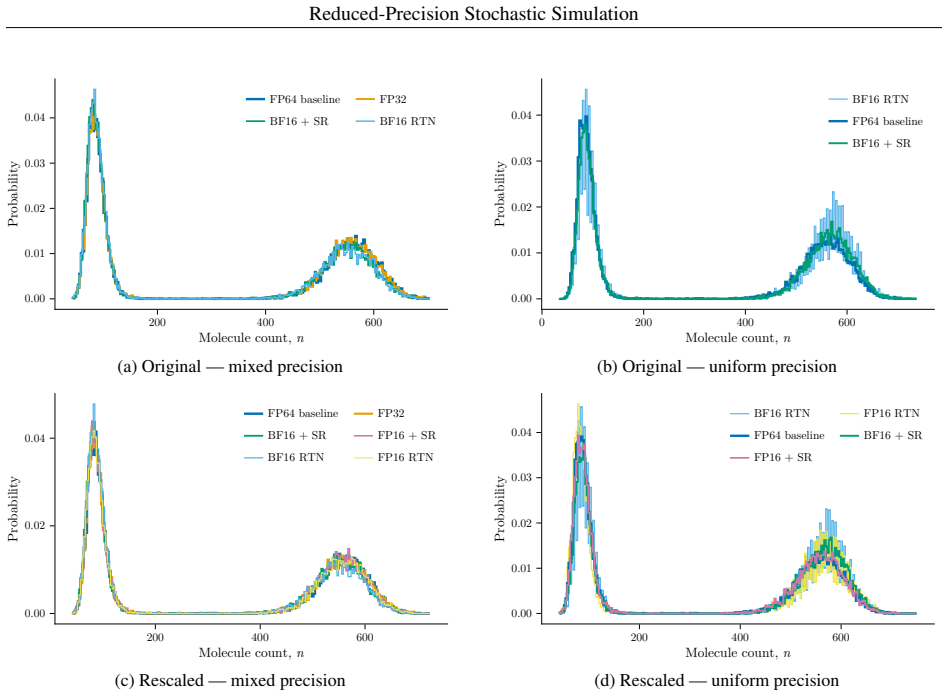
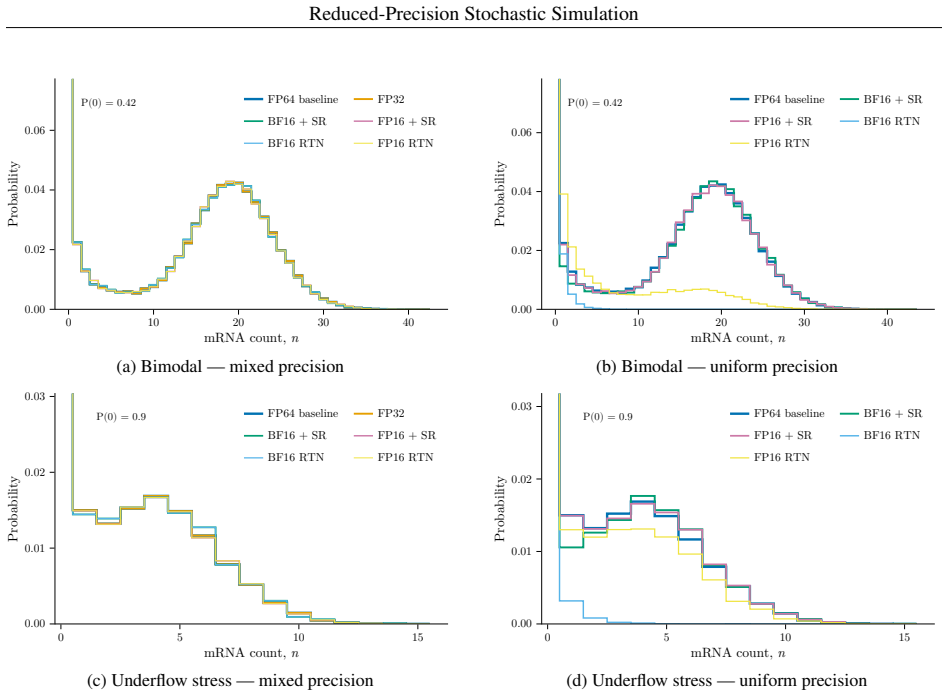
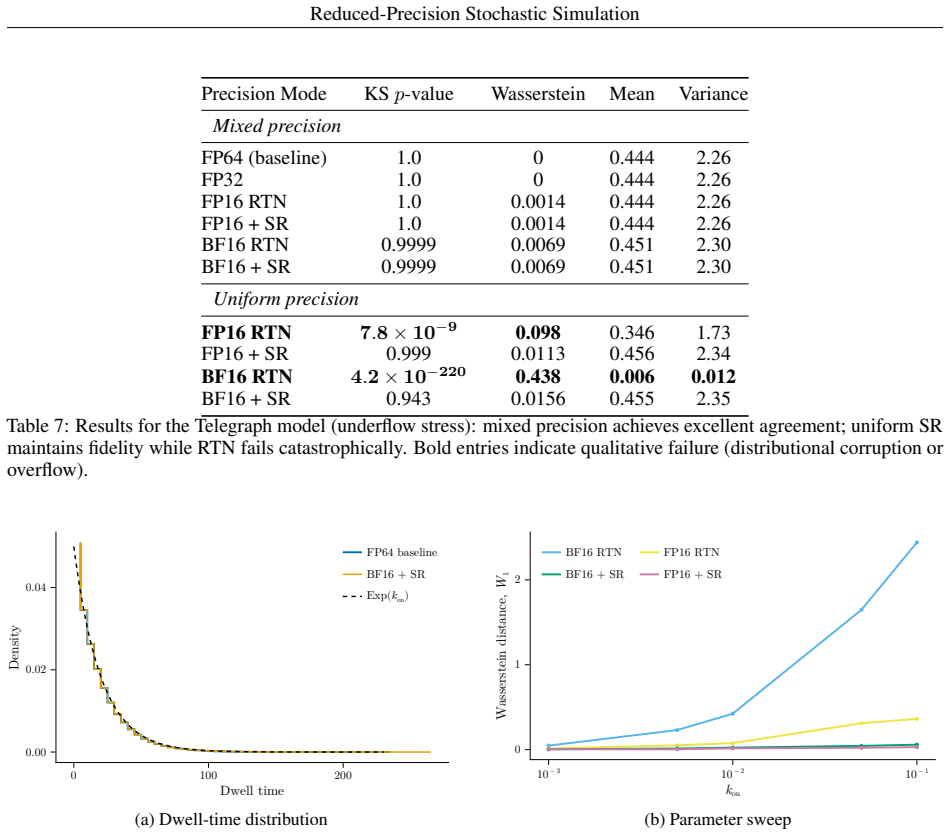
Mixed-precision SSA computes propensities in 16-bit floating point while retaining 32-bit accumulators and yields ensemble statistics that are statistically indistinguishable from 64-bit references across all five tested models; uniform 16-bit arithmetic with deterministic rounding produces measurable biases, which are eliminated when stochastic rounding and propensity normalisation are applied.
What carries the argument
Mixed-precision SSA with stochastic rounding: propensities are evaluated in 16-bit format while accumulators remain in 32-bit format, and rounding errors are randomised rather than truncated to prevent systematic drift in the sampled trajectories.
If this is right
- Memory required per variable drops by a factor of two to four relative to 32-bit or 64-bit storage.
- Wall-clock time on conventional CPUs improves by up to roughly 1.5 times even without native 16-bit hardware support.
- The method complements existing algorithmic accelerations such as tau-leaping.
- The reduced data movement maps directly onto GPUs and TPUs that already provide fast 16-bit arithmetic.
- Ensemble sizes or simulation durations can be increased on fixed hardware budgets while keeping the same statistical quality.
Where Pith is reading between the lines
- The same low-precision pattern could be applied to other Monte Carlo methods used in systems biology, such as spatial SSA or hybrid deterministic-stochastic integrators.
- Hardware vendors could expose 16-bit stochastic rounding as a standard primitive, making the speedup available without code changes on future accelerators.
- Real-time or on-device simulation of small genetic circuits becomes feasible on embedded or mobile processors that support half-precision arithmetic.
Load-bearing premise
The statistical agreement found on the five small canonical models will continue to hold when the same arithmetic is applied to larger, more complex biological networks.
What would settle it
A Kolmogorov-Smirnov p-value below 0.05 or a Wasserstein distance clearly larger than the reference values when the mixed-precision code is run on any of the five models with substantially increased molecule counts or reaction steps.
Figures



read the original abstract
The stochastic simulation algorithm (SSA) is widely used to perform exact forward simulation of discrete stochastic processes in biology. However, the computational cost, driven by sequential event-by-event sampling across large ensembles, remains a computational barrier. We investigate whether reduced-precision floating-point arithmetic can accelerate SSA without degrading statistical fidelity, drawing on the success of reduced-precision methods in weather and climate modelling. We evaluate two strategies across five canonical models (birth--death, Schl\"{o}gl, Telegraph, dimerisation, repressilator): (i) mixed precision, computing propensities in 16-bit while maintaining accumulators in 32-bit; and (ii) uniform precision, performing all arithmetic in 16-bit. Mixed-precision SSA produces ensemble statistics that closely match the 64-bit reference for all models, as measured by Kolmogorov--Smirnov tests and Wasserstein distances. Under uniform precision, deterministic rounding introduces systematic biases across several models, with catastrophic failures in some cases. Stochastic rounding (SR) and propensity normalisation eliminate these biases, restoring distributional fidelity across all models tested (KS $p > 0.05$). Our results establish mixed-precision SSA with SR as a viable acceleration strategy for mathematical biology: 16-bit formats shrink per-variable data size by $2$--$4\times$ relative to \texttt{fp32}/\texttt{fp64}, yielding comparable reductions in memory footprint and up to $\sim 1.5\times$ wall-clock speedup on CPU hardware that lacks native 16-bit arithmetic. As a hardware-level acceleration, mixed-precision SSA complements algorithmic methods such as tau-leaping and maps naturally onto modern GPU and TPU architectures with native 16-bit arithmetic.
Editorial analysis
A structured set of objections, weighed in public.
Referee Report
Summary. The paper investigates the use of reduced-precision (16-bit) floating-point arithmetic in the stochastic simulation algorithm (SSA) for discrete stochastic processes in mathematical biology. It evaluates mixed-precision (16-bit propensities with 32-bit accumulators) and uniform 16-bit precision strategies on five canonical models (birth-death, Schlögl, Telegraph, dimerisation, repressilator). Mixed-precision SSA matches 64-bit reference ensemble statistics closely per Kolmogorov-Smirnov tests and Wasserstein distances. Uniform precision with deterministic rounding introduces biases, but stochastic rounding combined with propensity normalisation restores fidelity (KS p > 0.05). The work claims this yields 2-4x memory reduction and up to 1.5x wall-clock speedup on CPU, positioning it as a hardware-level acceleration complementary to tau-leaping and suited to GPU/TPU architectures.
Significance. If the fidelity results generalise, the approach could meaningfully accelerate ensemble SSA runs for biological models on low-precision hardware, reducing memory footprint and runtime while preserving statistical properties. The empirical use of KS tests and Wasserstein distances to quantify distributional agreement, plus explicit comparison to 64-bit baselines, provides a concrete starting point. However, the restriction to small models (1-3 species) limits immediate impact; broader adoption would require evidence on scaling to networks with tens of species and hundreds of reactions where propensity summation errors could accumulate.
major comments (2)
- [Abstract / Results] Abstract and Results (five-model evaluation): The central claim that mixed-precision SSA 'establishes a viable acceleration strategy for mathematical biology' rests on statistical agreement for only five small canonical models (birth-death: 1 species; Schlögl: 1; Telegraph: 2; dimerisation: 2; repressilator: 3 species/6 reactions). No tests are reported on larger networks where summed low-precision propensities could produce larger relative errors or where rare-event/long-time statistics might diverge despite KS p > 0.05 on the small set. This is load-bearing for the viability claim.
- [Methods] Methods / Implementation details: The abstract reports KS p-values and Wasserstein distances but the manuscript provides no full pseudocode, random-number generator details, or raw data for the 16-bit exponential sampling and propensity calculations. Without these, independent reproduction and assessment of whether the observed fidelity is robust to implementation choices is not possible.
minor comments (2)
- [Results] Clarify the exact 16-bit format (bfloat16 vs. fp16) and any hardware-specific intrinsics used for the reported CPU speedups, as this affects portability claims.
- [Abstract] The abstract states 'up to ~1.5x wall-clock speedup on CPU hardware that lacks native 16-bit arithmetic'; provide the baseline compiler flags and measurement methodology for this figure.
Simulated Author's Rebuttal
We thank the referee for their constructive comments, which help clarify the scope and reproducibility of our work. We address each major point below and propose targeted revisions.
read point-by-point responses
-
Referee: [Abstract / Results] Abstract and Results (five-model evaluation): The central claim that mixed-precision SSA 'establishes a viable acceleration strategy for mathematical biology' rests on statistical agreement for only five small canonical models (birth-death: 1 species; Schlögl: 1; Telegraph: 2; dimerisation: 2; repressilator: 3 species/6 reactions). No tests are reported on larger networks where summed low-precision propensities could produce larger relative errors or where rare-event/long-time statistics might diverge despite KS p > 0.05 on the small set. This is load-bearing for the viability claim.
Authors: We agree that the evaluation is confined to five small canonical models and that this constrains the strength of the broad viability claim for mathematical biology as a whole. These models were selected because they are standard benchmarks in the SSA literature and permit rigorous statistical comparison via KS tests and Wasserstein distances. We acknowledge that propensity summation errors could accumulate in networks with tens of species and hundreds of reactions, and that rare-event statistics might behave differently. In the revised manuscript we will (i) temper the abstract and conclusion language to emphasize that the results demonstrate feasibility on representative small systems, and (ii) add a new paragraph in the Discussion that explicitly discusses potential scaling limitations, references relevant numerical-stability literature, and identifies validation on larger networks as a priority for future work. No new large-scale experiments will be added at this stage. revision: partial
-
Referee: [Methods] Methods / Implementation details: The abstract reports KS p-values and Wasserstein distances but the manuscript provides no full pseudocode, random-number generator details, or raw data for the 16-bit exponential sampling and propensity calculations. Without these, independent reproduction and assessment of whether the observed fidelity is robust to implementation choices is not possible.
Authors: We accept that the current manuscript lacks sufficient implementation detail for independent reproduction. The revised version will include: (i) complete pseudocode for the mixed-precision SSA (16-bit propensities, 32-bit accumulators) and the uniform-precision variant with stochastic rounding and normalisation; (ii) explicit specification of the random-number generator (Mersenne Twister with fixed seeds) and the emulation of 16-bit arithmetic; and (iii) a public GitHub repository containing the raw simulation trajectories, analysis scripts, and exact parameter sets used for the five models. These additions will allow readers to verify the reported KS p-values and Wasserstein distances. revision: yes
Circularity Check
No circularity; purely empirical validation on fixed models
full rationale
The paper reports direct numerical experiments: mixed- and uniform-precision SSA runs on five named canonical models are compared to 64-bit reference trajectories via Kolmogorov-Smirnov and Wasserstein metrics. No equations are derived, no parameters are fitted and then re-predicted, and no self-citations are invoked to justify uniqueness or ansatzes. All claims reduce to observable statistical agreement on the tested instances; the derivation chain is empty.
Axiom & Free-Parameter Ledger
Reference graph
Works this paper leans on
-
[1]
Daniel T. Gillespie. Exact stochastic simulation of coupled chemical reactions.The Journal of Physical Chemistry, 81(25):2340–2361, 1977. doi:10.1021/j100540a008
-
[2]
David F. Anderson. A modified next reaction method for simulating chemical systems with time dependent propensities and delays.The Journal of Chemical Physics, 127(21):214107, 2007. doi:10.1063/1.2799998
-
[3]
Yang Cao, Daniel T. Gillespie, and Linda R. Petzold. Efficient step size selection for the τ-leaping simulation method.The Journal of Chemical Physics, 124(4):044109, 2006. doi:10.1063/1.2159468
-
[4]
Eric L. Haseltine and James B. Rawlings. Approximate simulation of coupled fast and slow reactions for stochastic chemical kinetics.The Journal of Chemical Physics, 117(15):6959–6969, 2002. doi:10.1063/1.1505860
-
[5]
Yang Cao, Daniel T. Gillespie, and Linda R. Petzold. The slow-scale stochastic simulation algorithm.The Journal of Chemical Physics, 122(1):014116, 2005. doi:10.1063/1.1824902
-
[6]
In-datacenter performance analysis of a tensor processing unit,
Norman P. Jouppi, Cliff Young, Nishant Patil, David Patterson, et al. In-datacenter performance analysis of a tensor processing unit. InProceedings of the 44th Annual International Symposium on Computer Architecture (ISCA), pages 1–12, 2017. doi:10.1145/3079856.3080246
-
[7]
A Study of BFLOAT16 for Deep Learning Training
Dhiraj Kalamkar, Dheevatsa Mudigere, Naveen Mellempudi, Dipankar Das, Kunal Banerjee, Sasikanth Avancha, Dharma Teja V ooturi, et al. A study of bfloat16 for deep learning training.arXiv preprint arXiv:1905.12322, 2019. URLhttps://arxiv.org/abs/1905.12322
work page Pith review arXiv 1905
-
[8]
Tim N. Palmer. More reliable forecasts with less precise computations: A fast-track route to cloud-resolved weather and climate simulators?Philosophical Transactions of the Royal Society A, 372(2018):20130391, 2014. doi:10.1098/rsta.2013.0391
-
[9]
Matthew Chantry, Tobias Thornes, Tim Palmer, and Peter Düben. Scale-selective precision for weather and climate forecasting.Monthly Weather Review, 147(2):645–655, 2019. doi:10.1175/MWR-D-18-0308.1
-
[10]
Andrew Dawson, Peter D. Düben, David A. MacLeod, and Tim N. Palmer. Reliable low precision simulations in land surface models.Climate Dynamics, 51(7–8):2657–2666, 2018. doi:10.1007/s00382-017-4034-x
-
[11]
Monte carlo arithmetic: Exploiting randomness in floating-point arithmetic
David Stott Parker. Monte carlo arithmetic: Exploiting randomness in floating-point arithmetic. Technical Report CSD-970002, Computer Science Department, University of California, Los Angeles, Los Angeles, CA, 1997. URLhttps://searchworks.stanford.edu/view/4234742. 18 Reduced-Precision Stochastic Simulation
-
[12]
Michael P. Connolly, Nicholas J. Higham, and Théo Mary. Stochastic rounding and its probabilistic backward error analysis.SIAM Journal on Scientific Computing, 43(1):A566–A585, 2021. doi:10.1137/20M1334796
-
[13]
Matteo Croci and Mike B. Giles. Effects of round-to-nearest and stochastic rounding in the numerical so- lution of the heat equation in low precision.IMA Journal of Numerical Analysis, 43(3):1358–1390, 2022. doi:10.1093/imanum/drac012. URLhttps://arxiv.org/abs/2010.16225
-
[14]
Higham, Théo Mary, and Mantas Mikaitis
Matteo Croci, Massimiliano Fasi, Nicholas J. Higham, Théo Mary, and Mantas Mikaitis. Stochastic round- ing: Implementation, error analysis and applications.Royal Society Open Science, 9(3):211631, 2022. doi:10.1098/rsos.211631
-
[15]
Paxton, Matthew Chantry, and Tim Palmer
Tom Kimpson, Ellie A. Paxton, Matthew Chantry, and Tim Palmer. Climate-change modelling at reduced floating-point precision with stochastic rounding.Quarterly Journal of the Royal Meteorological Society, 150(S1): e4435, 2024. doi:10.1002/qj.4435
-
[16]
On the use of scale-dependent precision in Earth system modelling
Tobias Thornes, Peter Düben, and Tim Palmer. On the use of scale-dependent precision in Earth system modelling. Quarterly Journal of the Royal Meteorological Society, 143(703):897–908, 2017. doi:10.1002/qj.2974
-
[17]
Adam Paxton, Matthew Chantry, Milan Klöwer, Leo Saffin, and Tim Palmer
E. Adam Paxton, Matthew Chantry, Milan Klöwer, Leo Saffin, and Tim Palmer. Climate modeling in low precision: Effects of both deterministic and stochastic rounding.Journal of Climate, 35(4):1215–1229, 2022. doi:10.1175/JCLI-D-21-0343.1
-
[18]
Michael B. Elowitz, Arnold J. Levine, Eric D. Siggia, and Peter S. Swain. Stochastic gene expression in a single cell.Science, 297(5584):1183–1186, 2002. doi:10.1126/science.1070919
-
[19]
Ryan N. Gutenkunst, Joshua J. Waterfall, Fergal P. Casey, Kevin S. Brown, Christopher R. Myers, and James P. Sethna. Universally sloppy parameter sensitivities in systems biology models.PLoS Computational Biology, 3 (10):e189, 2007. doi:10.1371/journal.pcbi.0030189
-
[20]
Babtie, Paul Kirk, and Michael P
Ann C. Babtie, Paul Kirk, and Michael P. H. Stumpf. Topological sensitivity analysis for systems biology. Proceedings of the National Academy of Sciences, 111(52):18507–18512, 2014. doi:10.1073/pnas.1414026112
-
[21]
Yang Cao, Hong Li, and Linda Petzold. Efficient formulation of the stochastic simulation algorithm for chemically reacting systems.The Journal of Chemical Physics, 121(9):4059–4067, 2004. doi:10.1063/1.1778376
-
[22]
Michael A. Gibson and Jehoshua Bruck. Efficient exact stochastic simulation of chemical systems with many species and many channels.The Journal of Physical Chemistry A, 104(9):1876–1889, 2000. doi:10.1021/jp993732q
-
[23]
Alexander Slepoy, Aidan P. Thompson, and Steven J. Plimpton. A constant-time kinetic Monte Carlo algorithm for simulation of large biochemical reaction networks.The Journal of Chemical Physics, 128(20):205101, 2008. doi:10.1063/1.2919546
-
[24]
Jonathan R. Karr, Jayodita C. Sanghvi, Derek N. Macklin, Miriam V . Gutschow, Jared M. Jacobs, Benjamin Bolival, Nacyra Assad-Garcia, John I. Glass, and Markus W. Covert. A whole-cell computational model predicts phenotype from genotype.Cell, 150(2):389–401, 2012. doi:10.1016/j.cell.2012.05.044
-
[25]
Stefan Engblom, Lars Ferm, Andreas Hellander, and Per Lötstedt. Simulation of stochastic reaction- diffusion processes on unstructured meshes.SIAM Journal on Scientific Computing, 31(3):1774–1797, 2009. doi:10.1137/080721388
-
[26]
Gary An, Qi Mi, Joyeeta Dutta-Moscato, and Yoram V odovotz. Agent-based models in translational systems biology.WIREs Systems Biology and Medicine, 1(2):159–171, 2009. doi:10.1002/wsbm.45
-
[27]
Shiryaev.Limit Theorems for Stochastic Processes
Willem Hundsdorfer and Jan Verwer.Numerical Solution of Time-Dependent Advection-Diffusion-Reaction Equations, volume 33 ofSpringer Series in Computational Mathematics. Springer, 2003. doi:10.1007/978-3-662- 09017-6
-
[28]
Daniel T. Gillespie. Approximate accelerated stochastic simulation of chemically reacting systems.The Journal of Chemical Physics, 115(4):1716–1733, 2001. doi:10.1063/1.1378322
-
[29]
Anderson
David F. Anderson. Incorporating postleap checks in τ-leaping.The Journal of Chemical Physics, 128(5):054103,
-
[30]
doi:10.1063/1.2819665
-
[31]
Anne Auger, Philippe Chatelain, and Petros Koumoutsakos. R-leaping: Accelerating the stochastic simulation algorithm by reaction leaps.The Journal of Chemical Physics, 125(8):084103, 2006. doi:10.1063/1.2218339
-
[32]
Eric Mjolsness, David Orendorff, Philippe Chatelain, and Petros Koumoutsakos. An exact accelerated stochastic simulation algorithm.The Journal of Chemical Physics, 130(14):144110, 2009. doi:10.1063/1.3078490
-
[33]
IEEE Std 754-2019 (Revision of IEEE 754-2008)
IEEE standard for floating-point arithmetic, 2019. IEEE Std 754-2019 (Revision of IEEE 754-2008). 19 Reduced-Precision Stochastic Simulation
2019
-
[34]
Kolmogorov
Andrey N. Kolmogorov. Sulla determinazione empirica di una legge di distribuzione.Giornale dell’Istituto Italiano degli Attuari, 4:83–91, 1933
1933
-
[35]
Nikolai V . Smirnov. Table for estimating the goodness of fit of empirical distributions.The Annals of Mathematical Statistics, 19(2):279–281, 1948. doi:10.1214/aoms/1177730256
-
[36]
Vaserstein
Leonid N. Vaserstein. Markov processes over denumerable products of spaces, describing large systems of automata.Problemy Peredachi Informatsii, 5(3):64–72, 1969
1969
-
[37]
Cédric Villani.Optimal Transport: Old and New, volume 338 ofGrundlehren der mathematischen Wissenschaften. Springer, 2009. doi:10.1007/978-3-540-71050-9
-
[38]
Friedrich Schlögl. Chemical reaction models for non-equilibrium phase transitions.Zeitschrift für Physik, 253(2): 147–161, 1972. doi:10.1007/BF01379769
-
[39]
Milan Klöwer, Sam Hatfield, Matteo Croci, Peter D. Düben, and Tim N. Palmer. Fluid simulations accelerated with 16 bits: Approaching 4× speedup on A64FX by squeezing ShallowWaters.jl into Float16.Journal of Advances in Modeling Earth Systems, 14(2):e2021MS002684, 2022. doi:10.1029/2021MS002684
-
[40]
Markovian modeling of gene-product synthesis.Theoretical Population Biology, 48(2):222–234, 1995
Jean Peccoud and Bernard Ycart. Markovian modeling of gene-product synthesis.Theoretical Population Biology, 48(2):222–234, 1995. doi:10.1006/tpbi.1995.1027
-
[41]
Daniel T. Gillespie. Stochastic simulation of chemical kinetics.Annual Review of Physical Chemistry, 58(1): 35–55, 2007. doi:10.1146/annurev.physchem.58.032806.104637
work page doi:10.1146/annurev.physchem.58.032806.104637 2007
-
[42]
A synthetic oscilla- tory network of transcriptional regulators,
Michael B. Elowitz and Stanislas Leibler. A synthetic oscillatory network of transcriptional regulators.Nature, 403(6767):335–338, 2000. doi:10.1038/35002125
-
[43]
Dissecting the Graphcore IPU architecture via microbenchmarking, 2019
Zhe Jia, Blake Tillman, Marco Maggioni, and Daniele Paolo Scarpazza. Dissecting the Graphcore IPU architecture via microbenchmarking, 2019
2019
-
[44]
arXiv preprint arXiv:2502.01070 , year=
Jiwoo Kim, Joonhyung Lee, Gunho Park, Byeongwook Kim, Se Jung Kwon, Dongsoo Lee, and Youngjoo Lee. An inquiry into datacenter TCO for LLM inference with FP8.arXiv preprint arXiv:2502.01070, 2025. doi:10.48550/arXiv.2502.01070. Documents hardware-accelerated stochastic rounding as a distinctive feature of Intel Gaudi HPUs
-
[45]
Algorithms for stochastically rounded elementary arithmetic operations in IEEE 754 floating-point arithmetic.IEEE Transactions on Emerging Topics in Computing, 9(3):1451–1466,
Massimiliano Fasi and Mantas Mikaitis. Algorithms for stochastically rounded elementary arithmetic operations in IEEE 754 floating-point arithmetic.IEEE Transactions on Emerging Topics in Computing, 9(3):1451–1466,
-
[46]
doi:10.1109/TETC.2021.3069165
-
[47]
Federico Brogi, S. Bna, G. Boga, Giorgio Amati, T. Esposti Ongaro, and M. Cerminara. On floating point precision in computational fluid dynamics using OpenFOAM.Future Generation Computer Systems, 152:1–16,
-
[48]
doi:10.1016/j.future.2023.10.006. 20
discussion (0)
Sign in with ORCID, Apple, or X to comment. Anyone can read and Pith papers without signing in.