Recognition: unknown
Zero-Knowledge Model Checking
Pith reviewed 2026-05-09 19:34 UTC · model grok-4.3
The pith
Zero-knowledge proofs on ranking functions let verifiers confirm a secret system's correctness against a public temporal specification.
A machine-rendered reading of the paper's core claim, the machinery that carries it, and where it could break.
Core claim
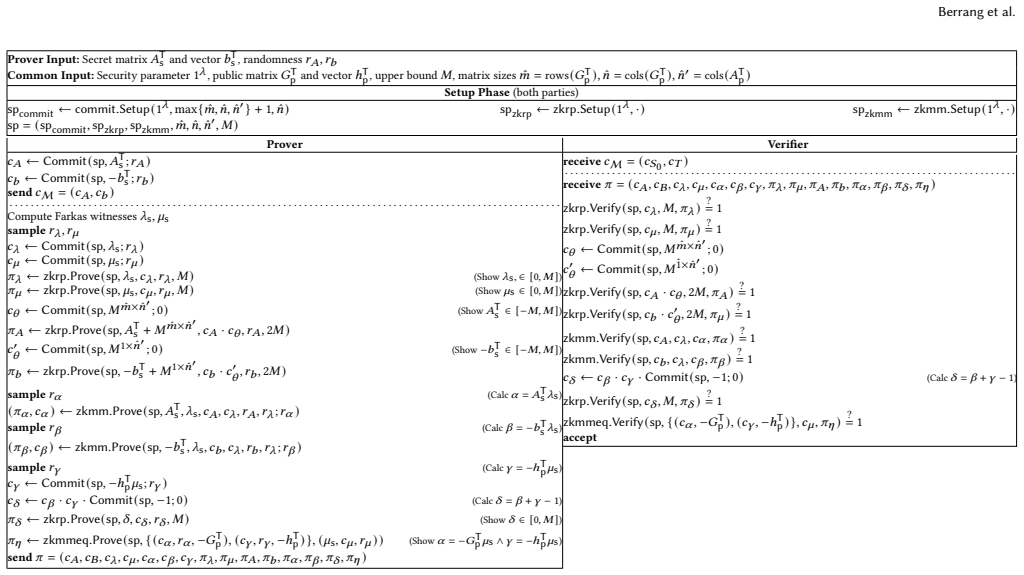
We introduce both an explicit-state and a symbolic scheme for model checking in zero knowledge. The explicit-state scheme assumes systems represented as transition graphs and uses polynomial commitments to convince the verifier that the public proof certificates correspond to the secret transition relation. The symbolic scheme assumes systems specified as linear guarded commands and uses piecewise-linear ranking functions; Farkas' lemma produces a witness for the validity of the ranking function with public and secret components, and sigma protocols for matrix multiplication and range proofs convince the verifier of the witness's existence.
What carries the argument
Ranking functions serving as formal certificates of correctness, paired with zero-knowledge proof machinery (polynomial commitments for graphs and Farkas witnesses plus sigma protocols for guarded commands) to hide the underlying system while exposing only the validity of the certificate.
If this is right
- Linear temporal logic properties can be verified on systems whose transition relation or commands remain hidden.
- Explicit-state model checking becomes possible in zero knowledge when systems are given as transition graphs.
- Symbolic model checking becomes possible in zero knowledge when systems are given as linear guarded commands.
- A prototype implementation demonstrates that the two schemes are feasible on standard verification benchmarks.
Where Pith is reading between the lines
- The same certificate-plus-zero-knowledge pattern could be applied to other deductive verification methods that produce algebraic witnesses.
- If the overhead remains low, the approach would allow independent auditors to check safety properties of proprietary hardware or machine-learning models without access to their internals.
- Combining the schemes with existing succinct proof systems could further reduce communication cost for large state spaces.
Load-bearing premise
Efficient zero-knowledge proofs exist for the algebraic statements that arise from ranking-function certificates and can be instantiated without prohibitive overhead on realistic systems.
What would settle it
A small, known-correct transition system or guarded-command program for which no zero-knowledge proof can be produced for its ranking-function certificate, or for which the resulting proof size and verification time exceed practical limits.
Figures


read the original abstract
We introduce a technology to formally verify that a software system satisfies a temporal specification of functional correctness, without revealing the system itself. Our method combines a deductive approach to model checking to obtain a formal certificate of correctness for the system, with zero-knowledge proofs to convince an external verifier that the system -- kept secret -- complies with its specification of correctness -- made public. We consider proof certificates represented as ranking functions, and introduce both an explicit-state and a symbolic scheme for model checking in zero knowledge. Our explicit-state scheme assumes systems represented as transition graphs. We use polynomial commitments to convince the verifier that the public proof certificates correspond to the secret transition relation. Our symbolic scheme assumes systems specified as linear guarded commands and uses piecewise-linear ranking functions. We apply Farkas' lemma to obtain a witness for the validity of the ranking function with public and secret components, and employ sigma protocols for matrix multiplication and range proofs to convince the verifier of the witness's existence. We built a prototype to demonstrate the practical efficacy of our two schemes on linear temporal logic verification examples. Our technology enables formal verification in domains where both the safety and the confidentiality of the system under analysis are critical.
Editorial analysis
A structured set of objections, weighed in public.
Referee Report
Summary. The paper introduces a technology for formally verifying that a secret software system satisfies a public temporal specification of functional correctness. It combines deductive model checking via ranking-function certificates with zero-knowledge proofs, presenting an explicit-state scheme (using polynomial commitments over secret transition graphs) and a symbolic scheme (using Farkas' lemma on linear guarded commands together with sigma protocols for matrix multiplication and range proofs). A prototype implementation is evaluated on LTL verification examples.
Significance. If the ZK instantiations prove efficient at scale, the work would enable formal verification in safety-critical domains where the system itself must remain confidential. The explicit composition of ranking functions with polynomial commitments and sigma protocols is a novel contribution, and the existence of a working prototype is a positive indicator of feasibility for small instances. The approach bridges formal methods and cryptography in a way that could support new applications in proprietary or regulated software.
major comments (2)
- [Prototype and evaluation section] The central practicality claim rests on the ZK proofs for ranking-function certificates (polynomial commitments in the explicit-state case and Farkas witnesses in the symbolic case) remaining efficient as the number of states, transitions, or variables grows. The prototype evaluation only reports results on small LTL examples; no scaling curves, asymptotic analysis, or comparison against standard model checkers is supplied to substantiate that overhead stays acceptable for realistic systems.
- [Symbolic scheme description] In the symbolic scheme, the reduction via Farkas' lemma produces a witness containing both public and secret components; the security argument that the sigma protocols for matrix multiplication and range proofs leak nothing about the secret system components needs an explicit hybrid argument or simulation proof, which is not provided.
minor comments (2)
- [Preliminaries] Notation for the piecewise-linear ranking functions and the guarded-command syntax should be introduced with a small running example before the general construction.
- [Introduction] The abstract states that both schemes support LTL verification, but the body should clarify which fragment of LTL is handled and how the ranking functions are derived for liveness properties.
Simulated Author's Rebuttal
We thank the referee for their constructive feedback and positive assessment of the novelty and potential applications of our work. We address each major comment below and outline the revisions we will make to the manuscript.
read point-by-point responses
-
Referee: [Prototype and evaluation section] The central practicality claim rests on the ZK proofs for ranking-function certificates (polynomial commitments in the explicit-state case and Farkas witnesses in the symbolic case) remaining efficient as the number of states, transitions, or variables grows. The prototype evaluation only reports results on small LTL examples; no scaling curves, asymptotic analysis, or comparison against standard model checkers is supplied to substantiate that overhead stays acceptable for realistic systems.
Authors: We acknowledge that the current prototype evaluation demonstrates feasibility on small LTL instances but does not include scaling curves or direct comparisons. In the revised manuscript we will add a dedicated complexity analysis section deriving the asymptotic growth of proof size, prover time, and verifier time for both schemes in terms of the number of states (explicit case) and variables (symbolic case). We will also report additional experimental results on larger synthetic transition systems and guarded-command programs, together with a qualitative comparison to the overhead of standard explicit-state and symbolic model checkers, while clarifying that the cryptographic cost is the necessary price for confidentiality. revision: yes
-
Referee: [Symbolic scheme description] In the symbolic scheme, the reduction via Farkas' lemma produces a witness containing both public and secret components; the security argument that the sigma protocols for matrix multiplication and range proofs leak nothing about the secret system components needs an explicit hybrid argument or simulation proof, which is not provided.
Authors: We thank the referee for this observation. While the manuscript relies on the standard zero-knowledge properties of the matrix-multiplication and range-proof sigma protocols, we agree that an explicit composition argument is required. In the revised version we will insert a new security subsection that presents a hybrid argument: the first hybrid replaces the secret witness components with simulated values using the zero-knowledge simulator of the sigma protocols; the second hybrid replaces the polynomial commitments with hiding commitments. The argument shows that the verifier's view is computationally indistinguishable from a simulated view that uses only the public ranking-function certificate and the public specification. revision: yes
Circularity Check
No significant circularity; construction composes independent primitives
full rationale
The paper's derivation chain introduces explicit-state and symbolic ZK model-checking schemes by combining ranking-function certificates (from deductive model checking) with standard cryptographic tools (polynomial commitments, Farkas' lemma, sigma protocols for matrix multiplication and range proofs). No equation or claim reduces to a fitted parameter renamed as a prediction, no self-definition of the target result, and no load-bearing step justified solely by self-citation. The central feasibility claim rests on the existence and efficiency of ZK instantiations for the resulting algebraic statements, which is an external assumption rather than a circular reduction. The prototype serves as empirical support without forcing the outcome by construction.
Axiom & Free-Parameter Ledger
axioms (2)
- domain assumption Soundness and completeness of the underlying zero-knowledge proof systems (sigma protocols, polynomial commitments)
- domain assumption Existence of suitable ranking functions for the systems under consideration
Reference graph
Works this paper leans on
-
[1]
Alessandro Abate, Daniele Ahmed, Mirco Giacobbe, and Andrea Peruffo. 2021. Formal Synthesis of Lyapunov Neural Networks.IEEE Control. Syst. Lett.5, 3 (2021), 773–778
2021
-
[2]
Alessandro Abate, Alec Edwards, Mirco Giacobbe, Hashan Punchihewa, and Diptarko Roy. 2026. Quantitative Verification with Neural Networks.Log. Methods Comput. Sci.22, 2 (2026)
2026
-
[3]
Alessandro Abate, Mirco Giacobbe, Sergey Ichtchenko, and Diptarko Roy. 2026. Complete Supermartingale Certificates for 𝜔-Regular Properties. InLICS. To appear
2026
-
[4]
Alessandro Abate, Mirco Giacobbe, and Diptarko Roy. 2024. Stochastic Omega- Regular Verification and Control with Supermartingales. InCA V (3) (Lecture Notes in Computer Science). Springer, 395–419
2024
-
[5]
Alessandro Abate, Mirco Giacobbe, and Diptarko Roy. 2025. Quantitative Super- martingale Certificates. InCA V (2) (Lecture Notes in Computer Science). Springer, 3–28
2025
-
[6]
2015.Principles of cyber-physical systems
Rajeev Alur. 2015.Principles of cyber-physical systems. MIT press
2015
-
[7]
Henzinger
Rajeev Alur and Thomas A. Henzinger. 1996. Reactive Modules. InLICS. IEEE Computer Society, 207–218
1996
-
[8]
arkworks contributors. 2022. arkworks zkSNARK ecosystem. https://arkworks.rs
2022
-
[9]
Edoardo Bacci, Mirco Giacobbe, and David Parker. 2021. Verifying Reinforcement Learning up to Infinity. InIJCAI. ijcai.org, 2154–2160
2021
-
[10]
2008.Principles of model checking
Christel Baier and Joost-Pieter Katoen. 2008.Principles of model checking. MIT Press
2008
-
[11]
Barrett, Roberto Sebastiani, Sanjit A
Clark W. Barrett, Roberto Sebastiani, Sanjit A. Seshia, and Cesare Tinelli. 2009. Satisfiability Modulo Theories. InHandbook of Satisfiability. Frontiers in Artificial Intelligence and Applications, Vol. 185. IOS Press, 825–885
2009
-
[12]
Mihir Bellare and Oded Goldreich. 1992. On Defining Proofs of Knowledge. InAdvances in Cryptology - CRYPTO ’92, 12th Annual International Cryptol- ogy Conference, Santa Barbara, California, USA, August 16-20, 1992, Proceedings (Lecture Notes in Computer Science), Ernest F. Brickell (Ed.). Springer, 390–420. doi:10.1007/3-540-48071-4_28
-
[13]
Dan Boneh, Ben Lynn, and Hovav Shacham. 2001. Short Signatures from the Weil Pairing. InAdvances in Cryptology - ASIACRYPT 2001, 7th International Conference on the Theory and Application of Cryptology and Information Security, Gold Coast, Australia, December 9-13, 2001, Proceedings (Lecture Notes in Computer Science), Colin Boyd (Ed.). Springer, 514–532....
-
[14]
Benedikt Bünz, Jonathan Bootle, Dan Boneh, Andrew Poelstra, Pieter Wuille, and Greg Maxwell. 2018. Bulletproofs: Short proofs for confidential transactions and more. In2018 IEEE symposium on security and privacy (SP). IEEE, 315–334
2018
-
[15]
Burch, Edmund M
Jerry R. Burch, Edmund M. Clarke, Kenneth L. McMillan, David L. Dill, and L. J. Hwang. 1990. Symbolic Model Checking:10 20 States and Beyond. InLICS. IEEE Computer Society, 428–439
1990
-
[16]
Ya-Chien Chang, Nima Roohi, and Sicun Gao. 2019. Neural Lyapunov Control. InNeurIPS. 3240–3249
2019
-
[17]
David Chaum and Torben Pryds Pedersen. 1992. Wallet Databases with Observers. InCRYPTO (Lecture Notes in Computer Science, Vol. 740). Springer, 89–105
1992
-
[18]
Clarke, Orna Grumberg, Daniel Kroening, Doron A
Edmund M. Clarke, Orna Grumberg, Daniel Kroening, Doron A. Peled, and Helmut Veith. 2018.Model checking, 2nd Edition. MIT Press
2018
-
[19]
Michael Colón, Sriram Sankaranarayanan, and Henny Sipma. 2003. Linear Invariant Generation Using Non-linear Constraint Solving. InComputer Aided Verification, 15th International Conference, CA V 2003, Boulder, CO, USA, July 8-12, 2003, Proceedings (Lecture Notes in Computer Science), Warren A. Hunt Jr. and Fabio Somenzi (Eds.). Springer, 420–432. doi:10.1...
-
[20]
Michael Colón and Henny Sipma. 2001. Synthesis of Linear Ranking Functions. InTACAS (Lecture Notes in Computer Science, Vol. 2031). Springer, 67–81
2001
-
[21]
Mingshu Cong, Tsz Hon Yuen, and Siu-Ming Yiu. 2024. zkMatrix: Batched Short Proof for Committed Matrix Multiplication. InAsiaCCS. ACM
2024
-
[22]
Byron Cook, Alexey Gotsman, Andreas Podelski, Andrey Rybalchenko, and Moshe Y. Vardi. 2007. Proving that programs eventually do something good. In POPL. ACM, 265–276
2007
-
[23]
Byron Cook, Heidy Khlaaf, and Nir Piterman. 2015. Fairness for Infinite-State Systems. InTACAS (Lecture Notes in Computer Science). Springer, 384–398
2015
-
[24]
Geoffroy Couteau, Michael Klooß, Huang Lin, and Michael Reichle. 2021. Efficient Range Proofs with Transparent Setup from Bounded Integer Commitments. In EUROCRYPT (3) (Lecture Notes in Computer Science, Vol. 12698). Springer, 247–277
2021
-
[25]
Leonardo de Moura and Sebastian Ullrich. 2021. The Lean 4 Theorem Prover and Programming Language. InCADE (Lecture Notes in Computer Science, Vol. 12699). Springer, 625–635
2021
-
[26]
Leonardo Mendonça de Moura and Nikolaj S. Bjørner. 2008. Z3: An Efficient SMT Solver. InTACAS (Lecture Notes in Computer Science, Vol. 4963). Springer, 337–340
2008
-
[27]
Leonardo Mendonça de Moura and Nikolaj S. Bjørner. 2011. Satisfiability modulo theories: introduction and applications.Commun. ACM54, 9 (2011), 69–77
2011
-
[28]
Rayna Dimitrova, Luis María Ferrer Fioriti, Holger Hermanns, and Rupak Ma- jumdar. 2016. Probabilistic CTL*: The Deductive Way. InTACAS (Lecture Notes in Computer Science). Springer, 280–296
2016
-
[29]
Ralph Droms. 1997. Dynamic Host Configuration Protocol. RFC 2131. doi:10. 17487/RFC2131
1997
-
[30]
Alexandre Duret-Lutz, Etienne Renault, Maximilien Colange, Florian Renkin, Alexandre Gbaguidi Aisse, Philipp Schlehuber-Caissier, Thomas Medioni, An- toine Martin, Jérôme Dubois, Clément Gillard, and Henrich Lauko. 2022. From Spot 2.0 to Spot 2.10: What’s New?. InCA V (2) (Lecture Notes in Computer Science, Vol. 13372). Springer, 174–187
2022
-
[31]
Julius Farkas. 1902. Theorie der einfachen Ungleichungen.Journal für die reine und angewandte Mathematik (Crelles Journal)1902, 124 (1902), 1–27
1902
-
[32]
Amos Fiat and Adi Shamir. 1986. How to Prove Yourself: Practical Solutions to Identification and Signature Problems. InAdvances in Cryptology - CRYPTO ’86, Santa Barbara, California, USA, 1986, Proceedings (Lecture Notes in Computer Science), Andrew M. Odlyzko (Ed.). Springer, 186–194
1986
-
[33]
Robert W. Floyd. 1993. Assigning Meanings to Programs. InProgram Verification. Springer Netherlands, 65–81
1993
-
[34]
Williamson, and Oana Ciobotaru
Ariel Gabizon, Zachary J. Williamson, and Oana Ciobotaru. 2019. PLONK: Permutations over Lagrange-bases for Oecumenical Noninteractive arguments of Knowledge.IACR Cryptol. ePrint Arch.2019 (2019), 953. https://eprint.iacr. org/2019/953
2019
-
[35]
Steven D. Galbraith, Kenneth G. Paterson, and Nigel P. Smart. 2008. Pairings for cryptographers.Discret. Appl. Math.156, 16 (2008), 3113–3121. doi:10.1016/J. DAM.2007.12.010
work page doi:10.1016/j 2008
-
[37]
InNeurIPS
Neural Model Checking. InNeurIPS
-
[38]
Mirco Giacobbe, Daniel Kroening, Abhinandan Pal, and Michael Tautschnig
-
[39]
InNeurIPS
Let a Neural Network be Your Invariant. InNeurIPS
-
[40]
Mirco Giacobbe, Daniel Kroening, and Julian Parsert. 2022. Neural termination analysis. InESEC/SIGSOFT FSE. ACM, 633–645
2022
-
[41]
Jens Groth. 2016. On the Size of Pairing-Based Non-interactive Arguments. In Advances in Cryptology - EUROCRYPT 2016 - 35th Annual International Conference on the Theory and Applications of Cryptographic Techniques, Vienna, Austria, May 8-12, 2016, Proceedings, Part II (Lecture Notes in Computer Science), Marc Fischlin and Jean-Sébastien Coron (Eds.). Spr...
-
[42]
Makowsky, and Willem P
Orna Grumberg, Nissim Francez, Johann A. Makowsky, and Willem P. de Roever
-
[43]
Control.66, 1/2 (1985), 83–102
A Proof Rule for Fair Termination of Guarded Commands.Inf. Control.66, 1/2 (1985), 83–102
1985
-
[44]
Thomas Hader and Alex Ozdemir. 2024. An SMT-LIB Theory of Finite Fields. In Proceedings of the 22nd International Workshop on Satisfiability Modulo Theories (SMT 2024), Montreal, Canada, July, 22-23, 2024., Vol. 3725. CEUR Workshop Proceedings
2024
-
[45]
Henzinger, Mahyar Karimi, and K
Thomas A. Henzinger, Mahyar Karimi, and K. S. Thejaswini. 2025. Privacy- Preserving Runtime Verification. InCCS. ACM, 2774–2787
2025
-
[46]
Henzinger, Kaushik Mallik, Pouya Sadeghi, and Dorde Zikelic
Thomas A. Henzinger, Kaushik Mallik, Pouya Sadeghi, and Dorde Zikelic. 2025. Supermartingale Certificates for Quantitative Omega-Regular Verification and Control. InCA V (2) (Lecture Notes in Computer Science). Springer, 29–55
2025
-
[47]
Holzmann
Gerard J. Holzmann. 2018. Explicit-State Model Checking. InHandbook of Model Checking. Springer, 153–171
2018
-
[48]
Xiaowei Huang, Marta Kwiatkowska, Sen Wang, and Min Wu. 2017. Safety Verification of Deep Neural Networks. InCA V (1) (Lecture Notes in Computer Science). Springer, 3–29
2017
-
[49]
Samuel Judson, Ning Luo, Timos Antonopoulos, and Ruzica Piskac. 2020. Pri- vacy Preserving CTL Model Checking through Oblivious Graph Algorithms. In WPES@CCS. ACM, 101–115
2020
-
[50]
Zaverucha, and Ian Goldberg
Aniket Kate, Gregory M. Zaverucha, and Ian Goldberg. 2010. Constant-Size Commitments to Polynomials and Their Applications. InASIACRYPT (Lecture Notes in Computer Science, Vol. 6477). Springer, 177–194
2010
-
[51]
2014.Introduction to Modern Cryptography, Second Edition
Jonathan Katz and Yehuda Lindell. 2014.Introduction to Modern Cryptography, Second Edition. CRC Press
2014
-
[52]
2016.Decision Procedures - An Algorithmic Point of View, Second Edition
Daniel Kroening and Ofer Strichman. 2016.Decision Procedures - An Algorithmic Point of View, Second Edition. Springer
2016
-
[53]
Orna Kupferman and Moshe Y. Vardi. 2005. From complementation to certifica- tion.Theor. Comput. Sci.345, 1 (2005), 83–100
2005
-
[54]
Satoshi Kura and Hiroshi Unno. 2025. A Hierarchy of Supermartingales for 𝜔-Regular Verification.CoRRabs/2512.00270 (2025)
work page internal anchor Pith review Pith/arXiv arXiv 2025
-
[55]
Leslie Lamport. 1983. Specifying Concurrent Program Modules.ACM Trans. Program. Lang. Syst.5, 2 (1983), 190–222
1983
-
[56]
Evan Laufer, Alex Ozdemir, and Dan Boneh. 2024. zkPi: Proving Lean Theorems in Zero-Knowledge. InCCS. ACM, 4301–4315. Berrang et al
2024
-
[57]
Hen- zinger
Mathias Lechner, Dorde Zikelic, Krishnendu Chatterjee, and Thomas A. Hen- zinger. 2022. Stability Verification in Stochastic Control Systems via Neural Network Supermartingales. InAAAI. AAAI Press, 7326–7336
2022
-
[58]
Kolesar, Timos Antonopoulos, William R
Daniel Luick, John C. Kolesar, Timos Antonopoulos, William R. Harris, James Parker, Ruzica Piskac, Eran Tromer, Xiao Wang, and Ning Luo. 2024. ZKSMT: A VM for Proving SMT Theorems in Zero Knowledge. InUSENIX Security Sympo- sium. USENIX Association
2024
-
[59]
Harris, Ruzica Piskac, Eran Tromer, and Xiao Wang
Ning Luo, Timos Antonopoulos, William R. Harris, Ruzica Piskac, Eran Tromer, and Xiao Wang. 2022. Proving UNSAT in Zero Knowledge. InCCS. ACM, 2203– 2217
2022
-
[60]
Zohar Manna and Amir Pnueli. 1990. A Hierarchy of Temporal Properties. In PODC. ACM, 377–410
1990
-
[61]
Grigory Neustroev, Mirco Giacobbe, and Anna Lukina. 2025. Neural Continuous- Time Supermartingale Certificates. InAAAI. AAAI Press, 27538–27546
2025
-
[62]
numerous contributors. 2022. bls_bulletproofs. https://github.com/maidsafe/ bls_bulletproofs
2022
-
[63]
Torben P. Pedersen. 1991. Non-Interactive and Information-Theoretic Secure Verifiable Secret Sharing. InAdvances in Cryptology - CRYPTO ’91, 11th Annual International Cryptology Conference, Santa Barbara, California, USA, August 11-15, 1991, Proceedings (Lecture Notes in Computer Science), Joan Feigenbaum (Ed.). Springer, 129–140. doi:10.1007/3-540-46766-1_9
-
[64]
Amir Pnueli. 1977. The Temporal Logic of Programs. InFOCS. IEEE Computer Society, 46–57
1977
-
[65]
Andreas Podelski and Andrey Rybalchenko. 2004. A Complete Method for the Synthesis of Linear Ranking Functions. InVMCAI (Lecture Notes in Computer Science, Vol. 2937). Springer, 239–251
2004
-
[66]
Jon Postel. 1981. Transmission Control Protocol. RFC 793. doi:10.17487/RFC0793
-
[67]
Stephen Prajna and Ali Jadbabaie. 2004. Safety Verification of Hybrid Systems Using Barrier Certificates. InHSCC (Lecture Notes in Computer Science). Springer, 477–492
2004
-
[68]
Stephen Prajna, Ali Jadbabaie, and George J. Pappas. 2004. Stochastic safety verification using barrier certificates. InCDC. IEEE, 929–934
2004
-
[69]
Luca Pulina and Armando Tacchella. 2010. An Abstraction-Refinement Approach to Verification of Artificial Neural Networks. InCA V (Lecture Notes in Computer Science). Springer, 243–257
2010
-
[70]
RISC Zero, Inc. 2024. RISC Zero: A General-Purpose Zero-Knowledge Computing Platform. https://www.risczero.com. Accessed 2025
2024
-
[71]
Goodfellow, and Rob Fergus
Christian Szegedy, Wojciech Zaremba, Ilya Sutskever, Joan Bruna, Dumitru Erhan, Ian J. Goodfellow, and Rob Fergus. 2014. Intriguing properties of neural networks. InICLR (Poster)
2014
-
[72]
Johnson, and Xenofon D
Hoang-Dung Tran, Feiyang Cai, Diego Manzanas Lopez, Patrick Musau, Taylor T. Johnson, and Xenofon D. Koutsoukos. 2019. Safety Verification of Cyber-Physical Systems with Reinforcement Learning Control.ACM Trans. Embed. Comput. Syst.18, 5s (2019), 105:1–105:22
2019
-
[73]
Hoang-Dung Tran, Xiaodong Yang, Diego Manzanas Lopez, Patrick Musau, Luan Viet Nguyen, Weiming Xiang, Stanley Bak, and Taylor T. Johnson. 2020. NNV: The Neural Network Verification Tool for Deep Neural Networks and Learning-Enabled Cyber-Physical Systems. InCA V (1) (Lecture Notes in Computer Science). Springer, 3–17
2020
-
[74]
Caterina Urban, Arie Gurfinkel, and Temesghen Kahsai. 2016. Synthesizing Ranking Functions from Bits and Pieces. InTACAS (Lecture Notes in Computer Science, Vol. 9636). Springer, 54–70
2016
-
[75]
Moshe Y. Vardi. 1991. Verification of Concurrent Programs: The Automata- Theoretic Framework.Ann. Pure Appl. Log.51, 1-2 (1991), 79–98
1991
-
[76]
Vardi and Pierre Wolper
Moshe Y. Vardi and Pierre Wolper. 1986. An Automata-Theoretic Approach to Automatic Program Verification (Preliminary Report). InLICS. IEEE Computer Society, 332–344
1986
-
[77]
Zico Kolter
Shiqi Wang, Huan Zhang, Kaidi Xu, Xue Lin, Suman Jana, Cho-Jui Hsieh, and J. Zico Kolter. 2021. Beta-CROWN: Efficient Bound Propagation with Per-neuron Split Constraints for Neural Network Robustness Verification. InNeurIPS. 29909– 29921
2021
-
[78]
Henzinger, and Krishnendu Chatter- jee
Dorde Zikelic, Mathias Lechner, Thomas A. Henzinger, and Krishnendu Chatter- jee. 2023. Learning Control Policies for Stochastic Systems with Reach-Avoid Guarantees. InAAAI. AAAI Press, 11926–11935
2023
-
[79]
Henzinger
Dorde Zikelic, Mathias Lechner, Abhinav Verma, Krishnendu Chatterjee, and Thomas A. Henzinger. 2023. Compositional Policy Learning in Stochastic Control Systems with Formal Guarantees. InNeurIPS. A Open Science We provide three tools and prototypes, as well as a series of bench- mark data files, that enable the program committee to evaluate the paper’s co...
2023
discussion (0)
Sign in with ORCID, Apple, or X to comment. Anyone can read and Pith papers without signing in.