Recognition: unknown
Scale-Aware Adversarial Analysis: A Diagnostic for Generative AI in Multiscale Complex Systems
Pith reviewed 2026-05-09 19:52 UTC · model grok-4.3
The pith
Generative models for multiscale physics exhibit localized structural freezing and nonlinear divergence under scale-aware perturbations
A machine-rendered reading of the paper's core claim, the machinery that carries it, and where it could break.
Core claim
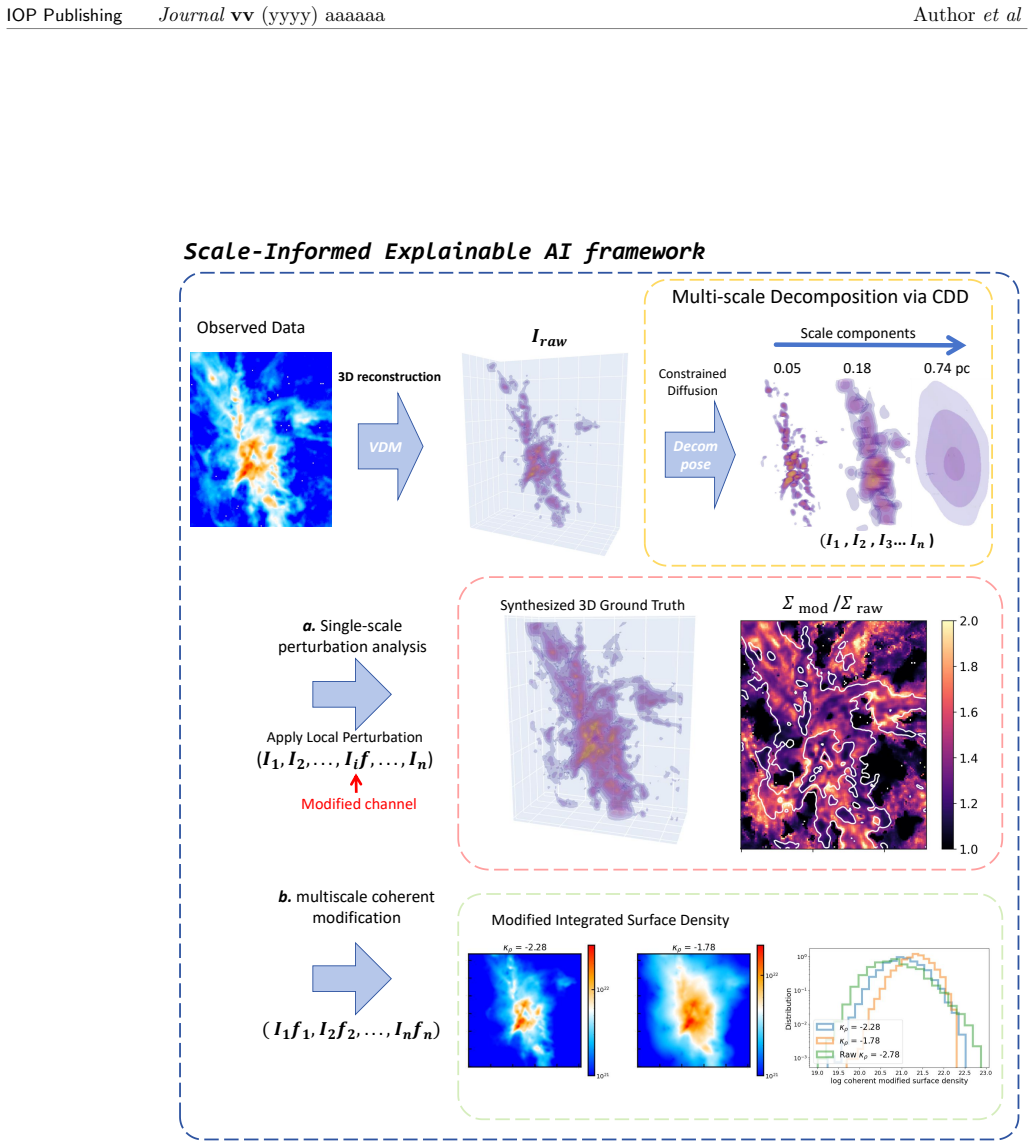
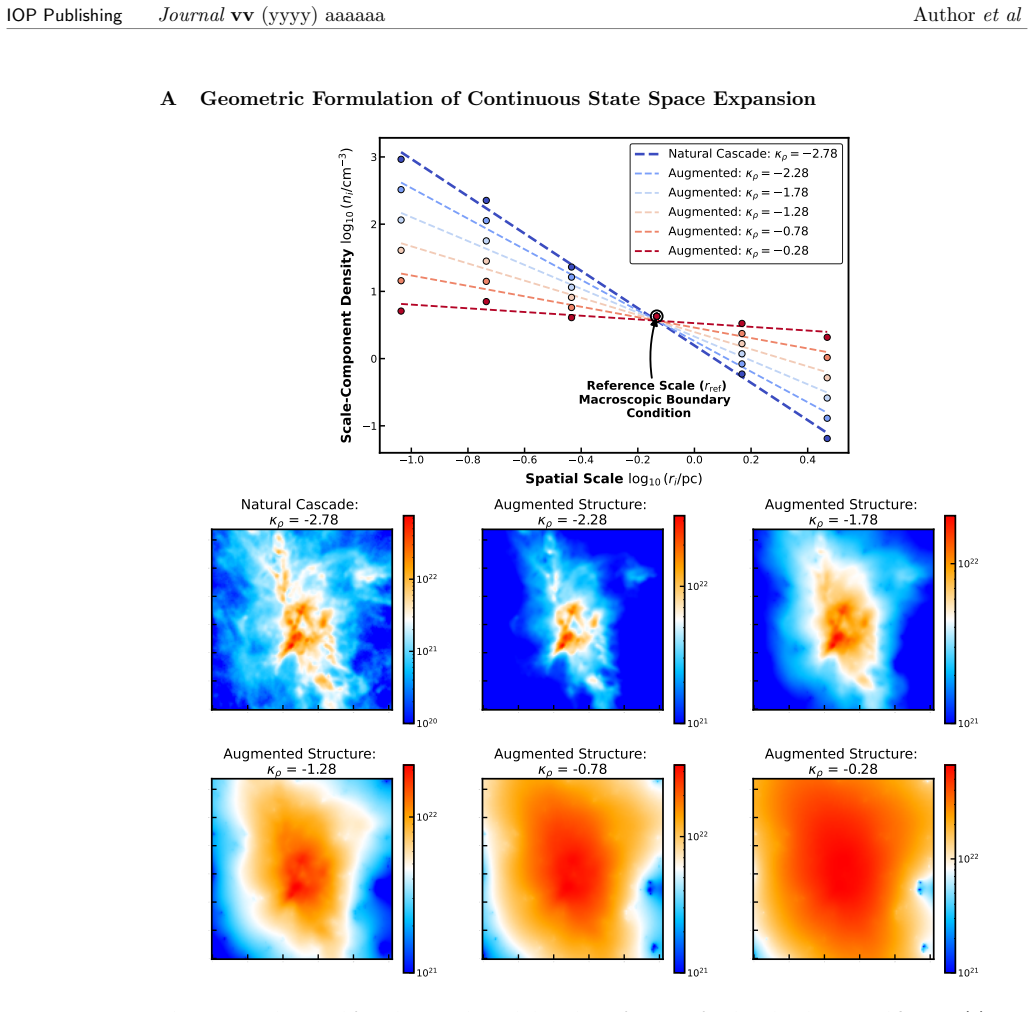
Under moderate physical perturbations executed via deterministic interventions in the continuous CDD-based scale space, the unconstrained generative model exhibits localized structural freezing and non-linear instability rather than continuous PDE-like responses. The network fails to maintain cross-scale continuity, causing the generative trajectory to diverge when pushed into unseen physical states.
What carries the argument
Constrained Diffusion Decomposition (CDD), a diffusion-based multiscale data decomposition algorithm that performs physically constrained data generation and model evaluation through scale-aware modifications
If this is right
- Generative models must incorporate mechanisms that enforce cross-scale continuity when modeling multiscale physical systems.
- The CDD framework supplies a testbed for exposing algorithmic vulnerabilities before deployment in scientific simulations.
- Future architectures will need explicit physical constraints to respect multiscale causality in the natural universe.
Where Pith is reading between the lines
- This diagnostic approach could be adapted to other data-driven models to check whether they preserve continuous dynamics beyond the training distribution.
- Standard pixel-wise perturbation methods in explainable AI are likely to remain inadequate for any system whose governing laws operate across continuous scales.
Load-bearing premise
Modifications produced by Constrained Diffusion Decomposition remain inside the valid physical distribution and represent meaningful real-world multiscale perturbations without introducing unphysical artifacts.
What would settle it
A generative model that maintains continuous cross-scale responses and PDE-like behavior under identical CDD perturbations would falsify the claim of inherent structural freezing and divergence.
Figures


read the original abstract
Complex physical systems, from supersonic turbulence to the macroscopic structure of the universe, are governed by continuous multiscale dynamics. While modern machine learning architectures excel at mapping the high-dimensional observables of these systems, it remains unclear whether they internalize the governing physical laws or merely interpolate discrete statistical correlations. Standard Explainable AI (XAI) architectures, particularly perturbation-based and gradient-saliency methods, rely on pixel-wise perturbations, which generate unphysical artifacts and push inputs off the valid empirical distribution. To resolve this, we introduce a diagnostic framework driven by Constrained Diffusion Decomposition (CDD), a diffusion-based multiscale data decomposition algorithm that enables physically constrained data generation and model evaluation via scale-aware modifications. Applying this framework to a Denoising Diffusion Probabilistic Model (DDPM), we execute deterministic interventions directly within the continuous, CDD-based scale space. We demonstrate that under moderate physical perturbations, the unconstrained generative model exhibits localized structural freezing and non-linear instability rather than continuous PDE-like responses. The network fails to maintain cross-scale continuity, causing the generative trajectory to diverge when pushed into unseen physical states. By synthesizing a continuum of physically coherent states, this scale-informed methodology establishes a controlled test ground to evaluate algorithmic vulnerabilities, providing the rigorous physical constraints necessary for future architectures to respect the multiscale causality of the natural universe.
Editorial analysis
A structured set of objections, weighed in public.
Referee Report
Summary. The paper introduces Constrained Diffusion Decomposition (CDD), a diffusion-based multiscale data decomposition algorithm, to enable physically constrained, scale-aware perturbations for diagnosing whether generative models such as Denoising Diffusion Probabilistic Models (DDPM) internalize continuous multiscale physical dynamics rather than discrete statistical correlations. Applying deterministic interventions in CDD scale space to an unconstrained DDPM, the work claims to show localized structural freezing and non-linear instability instead of continuous PDE-like responses, with the generative trajectory diverging under unseen physical states due to failure to maintain cross-scale continuity.
Significance. If the central demonstration holds, the framework supplies a controlled, continuum-based testbed for exposing vulnerabilities in generative AI applied to multiscale systems (e.g., turbulence or cosmology), crediting the synthesis of physically coherent states via CDD as a step toward rigorous physical constraints on model evaluation. This could inform development of architectures that better respect multiscale causality.
major comments (1)
- Abstract: the claim that CDD enables 'physically constrained data generation' and 'scale-aware modifications' that remain inside the valid physical distribution is asserted without any reported check against governing equations, conservation laws, dispersion relations, or consistency with numerical PDE solutions. Because every reported trajectory, instability metric, and divergence observation depends on this assumption, the demonstration that the DDPM exhibits structural freezing rather than continuous responses cannot be verified as evidence of model failure versus an artifact of off-manifold test states.
minor comments (1)
- Abstract: quantitative results, error bars, specific instability metrics, and details of the DDPM architecture or intervention magnitudes are absent, limiting immediate assessment of effect sizes.
Simulated Author's Rebuttal
We thank the referee for their careful reading and for identifying a key gap in the validation of our claims. We address the major comment below.
read point-by-point responses
-
Referee: Abstract: the claim that CDD enables 'physically constrained data generation' and 'scale-aware modifications' that remain inside the valid physical distribution is asserted without any reported check against governing equations, conservation laws, dispersion relations, or consistency with numerical PDE solutions. Because every reported trajectory, instability metric, and divergence observation depends on this assumption, the demonstration that the DDPM exhibits structural freezing rather than continuous responses cannot be verified as evidence of model failure versus an artifact of off-manifold test states.
Authors: We agree that the abstract asserts physical fidelity of CDD without explicit verification against governing equations or conservation laws. The current manuscript relies on the construction of CDD (diffusion decomposition constrained to the learned data manifold) but does not report direct comparisons to PDE solutions or dispersion relations. We will revise the manuscript to include such checks on the turbulence and cosmology datasets, for example by quantifying conservation errors and consistency with numerical solvers for the perturbed states. This will allow readers to confirm that the reported instabilities reflect model behavior rather than off-manifold artifacts. We will also moderate the abstract language pending these additions. revision: yes
Circularity Check
No significant circularity; empirical diagnostic stands independent of inputs
full rationale
The paper introduces CDD as a novel decomposition method and applies it to observe DDPM behavior under scale-aware perturbations. The reported findings (localized freezing, non-linear instability, divergence from PDE-like continuity) are presented as direct empirical outcomes of those interventions rather than quantities derived by fitting or self-definition. No equations reduce a prediction to a fitted parameter, no uniqueness theorem is imported from self-citation, and the framework's physical-constraint claim is definitional to the new tool rather than a tautological restatement of the model evaluation results. The derivation chain is therefore self-contained observational analysis.
Axiom & Free-Parameter Ledger
axioms (1)
- domain assumption Multiscale physical systems admit a continuous decomposition into scale components that can be modified independently while remaining on the valid data manifold.
invented entities (1)
-
Constrained Diffusion Decomposition (CDD)
no independent evidence
Reference graph
Works this paper leans on
-
[1]
Changes of Dust Opacity with Density in the Orion A Molecular Cloud. apj , keywords =. doi:10.1088/0004-637X/763/1/55 , archivePrefix =. 1211.6475 , primaryClass =
-
[2]
Two Mass Distributions in the L 1641 Molecular Clouds: The Herschel Connection of Dense Cores and Filaments in Orion A. apjl , keywords =. doi:10.1088/2041-8205/777/2/L33 , archivePrefix =. 1309.2332 , primaryClass =
-
[3]
The Photodetector Array Camera and Spectrometer (PACS) on the Herschel Space Observatory. , keywords =. doi:10.1051/0004-6361/201014535 , archivePrefix =. 1005.1487 , primaryClass =
-
[4]
J., Abergel, A., Abreu, A., et al
The Herschel-SPIRE instrument and its in-flight performance. , keywords =. doi:10.1051/0004-6361/201014519 , archivePrefix =. 1005.5123 , primaryClass =
-
[5]
Large-scale filaments associated with Milky Way spiral arms. mnras , keywords =. doi:10.1093/mnras/stv735 , archivePrefix =. 1504.00647 , primaryClass =
-
[6]
Turbulence and star formation in molecular clouds. mnras , keywords =. doi:10.1093/mnras/194.4.809 , adsurl =
-
[7]
Gravitational collapse of the OMC-1 region. , keywords =. doi:10.1051/0004-6361/201730732 , archivePrefix =. 1703.03464 , primaryClass =
-
[8]
Density exponent analysis: gravity-driven steepening of the density profiles of star-forming regions. mnras , keywords =. doi:10.1093/mnrasl/slac049 , archivePrefix =. 2205.03215 , primaryClass =
-
[9]
Theory of Star Formation. araa , keywords =. doi:10.1146/annurev.astro.45.051806.110602 , archivePrefix =. 0707.3514 , primaryClass =
-
[10]
2012, , 50, 29, 10.1146/annurev-astro-081811-125514
Magnetic Fields in Molecular Clouds. araa , year = 2012, month = sep, volume =. doi:10.1146/annurev-astro-081811-125514 , adsurl =
-
[11]
Turbulence in Milky Way Star-forming Regions Traced by Young Stars and Gas. apj , keywords =. doi:10.3847/1538-4357/ac76bf , archivePrefix =. 2205.00012 , primaryClass =
-
[12]
Criteria for gravitational instability and quasi-isolated gravitational collapse in turbulent medium. mnras , keywords =. doi:10.1093/mnras/stw2707 , archivePrefix =. 1610.06577 , primaryClass =
-
[13]
Scale-free gravitational collapse as the origin of r ^ -2 density profile - a possible role of turbulence in regulating gravitational collapse. mnras , keywords =. doi:10.1093/mnras/sty657 , archivePrefix =. 1803.03273 , primaryClass =
-
[14]
Hierarchical star cluster assembly in globally collapsing molecular clouds. mnras , keywords =. doi:10.1093/mnras/stw3229 , archivePrefix =. 1611.00088 , primaryClass =
-
[15]
Towards a comprehensive scenario
Global hierarchical collapse in molecular clouds. Towards a comprehensive scenario. mnras , keywords =. doi:10.1093/mnras/stz2736 , archivePrefix =. 1903.11247 , primaryClass =
-
[16]
Multiscale accretion in dense cloud cores and the delayed formation of massive stars. mnras , keywords =. doi:10.1093/mnras/stae1090 , archivePrefix =. 2306.13846 , primaryClass =
-
[17]
Gravity or turbulence? - II. Evolving column density probability distribution functions in molecular clouds. mnras , keywords =. doi:10.1111/j.1365-2966.2011.19141.x , archivePrefix =. 1105.5411 , primaryClass =
-
[18]
The Star Formation Rate in the Gravoturbulent Interstellar Medium. apj , keywords =. doi:10.3847/1538-4357/aad002 , archivePrefix =. 1801.05428 , primaryClass =
-
[19]
On the shape and completeness of the column density probability distribution function of molecular clouds. mnras , keywords =. doi:10.1093/mnras/sty3071 , archivePrefix =. 1811.02864 , primaryClass =
-
[20]
Evolution of column density distributions within Orion A. , keywords =. doi:10.1051/0004-6361/201526243 , archivePrefix =. 1504.05188 , primaryClass =
-
[21]
2010, ApJL, 723, L7, doi: 10.1088/2041-8205/723/1/L7
How Many Infrared Dark Clouds Can form Massive Stars and Clusters?. apjl , keywords =. doi:10.1088/2041-8205/723/1/L7 , archivePrefix =. 1009.1617 , primaryClass =
-
[22]
Density profile evolution during prestellar core collapse: collapse starts at the large scale. mnras , keywords =. doi:10.1093/mnras/stab394 , archivePrefix =. 2009.14151 , primaryClass =
-
[23]
Star formation in molecular clouds: observation and theory. araa , keywords =. doi:10.1146/annurev.aa.25.090187.000323 , adsurl =
-
[24]
Initial Conditions for Star Formation: a Physical Description of the Filamentary ISM. Protostars and Planets VII , year = 2023, editor =. doi:10.48550/arXiv.2203.09562 , archivePrefix =. 2203.09562 , primaryClass =
-
[25]
Magnetic Fields in Molecular Clouds Observation and Interpretation. Galaxies , keywords =. doi:10.3390/galaxies9020041 , archivePrefix =. 2106.08172 , primaryClass =
-
[26]
On the Evolution of the Density Probability Density Function in Strongly Self-gravitating Systems. apj , keywords =. doi:10.1088/0004-637X/781/2/91 , archivePrefix =. 1310.4346 , primaryClass =
-
[27]
The Stability of a Spherical Nebula. Philosophical Transactions of the Royal Society of London Series A , year = 1902, month = jan, volume =. doi:10.1098/rsta.1902.0012 , adsurl =
-
[28]
Super-Jeans fragmentation in massive star-forming regions revealed by triangulation analysis. arXiv e-prints , keywords =. doi:10.48550/arXiv.2410.14610 , archivePrefix =. 2410.14610 , primaryClass =
-
[29]
Helical fields and filamentary molecular clouds - I. mnras , keywords =. doi:10.1046/j.1365-8711.2000.03066.x , archivePrefix =. astro-ph/9901096 , primaryClass =
-
[30]
2023, MNRAS, 520, 3259, doi: 10.1093/mnras/stad012
ATOMS: ALMA Three-millimeter Observations of Massive Star-forming regions - XV. Steady accretion from global collapse to core feeding in massive hub-filament system SDC335. mnras , keywords =. doi:10.1093/mnras/stad012 , archivePrefix =. 2301.01895 , primaryClass =
-
[31]
The distance to the Orion Nebula. , keywords =. doi:10.1051/0004-6361:20078247 , archivePrefix =. 0709.0485 , primaryClass =
-
[32]
The Two States of Star-forming Clouds. apj , keywords =. doi:10.1088/0004-637X/750/1/13 , archivePrefix =. 1202.2594 , primaryClass =
-
[33]
Observational Diagnostics of Self-gravitating MHD Turbulence in Giant Molecular Clouds. apj , keywords =. doi:10.1088/0004-637X/808/1/48 , archivePrefix =. 1505.03855 , primaryClass =
-
[34]
Slope of Magnetic Field Density Relation as an Indicator of Magnetic Dominance. apj , keywords =. doi:10.3847/1538-4357/ad8b4d , archivePrefix =. 2409.02786 , primaryClass =
-
[35]
Multiscale Decomposition of Astronomical Maps: A Constrained Diffusion Method. apjs , keywords =. doi:10.3847/1538-4365/ac4bc4 , archivePrefix =. 2201.05484 , primaryClass =
-
[36]
The Catalogue for Astrophysical Turbulence Simulations (CATS). apj , keywords =. doi:10.3847/1538-4357/abc484 , archivePrefix =. 2010.11227 , primaryClass =
-
[37]
Cosmological Adaptive Mesh Refinement Magnetohydrodynamics with Enzo. apjs , keywords =. doi:10.1088/0067-0049/186/2/308 , archivePrefix =. 0902.2594 , primaryClass =
-
[38]
Bird's eye view of molecular clouds in the Milky Way. I. Column density and star formation from sub-parsec to kiloparsec scales. , keywords =. doi:10.1051/0004-6361/202040021 , archivePrefix =. 2108.04518 , primaryClass =
-
[39]
Magnetic Field of Molecular Gas Measured with the Velocity Gradient Technique I. Orion A. apj , keywords =. doi:10.3847/1538-4357/ac78e8 , archivePrefix =. 2206.06717 , primaryClass =
-
[40]
Super-Jeans fragmentation in massive star-forming regions revealed by triangulation analysis. mnras , keywords =. doi:10.1093/mnras/staf1116 , archivePrefix =. 2410.14610 , primaryClass =
-
[41]
AI: Predict Density and Measure Width of molecular clouds by Multiscale Decomposition
Equation vs. AI: Predict Density and Measure Width of molecular clouds by Multiscale Decomposition. arXiv e-prints , keywords =. doi:10.48550/arXiv.2508.01130 , archivePrefix =. 2508.01130 , primaryClass =
-
[42]
apj , year = 1967, month = feb, volume =
Observations of an Infrared Star in the Orion Nebula. apj , year = 1967, month = feb, volume =. doi:10.1086/149055 , adsurl =
-
[43]
apjl , year = 1967, month = jul, volume =
Discovery of an Infrared Nebula in Orion. apjl , year = 1967, month = jul, volume =. doi:10.1086/180039 , adsurl =
-
[44]
Explosive Outflows Powered by the Decay of Non-hierarchical Multiple Systems of Massive Stars: Orion BN/KL. apj , keywords =. doi:10.1088/0004-637X/727/2/113 , archivePrefix =. 1011.5512 , primaryClass =
-
[45]
A Tale of Three: Magnetic Fields along the Orion Integral-shaped Filament as Revealed by the JCMT BISTRO Survey. apjl , keywords =. doi:10.3847/2041-8213/ad93d2 , archivePrefix =. 2412.17716 , primaryClass =
-
[46]
On the Density Distribution in Star-forming Interstellar Clouds. apjl , keywords =. doi:10.1088/2041-8205/727/1/L20 , archivePrefix =. 1007.2950 , primaryClass =
-
[47]
Constructing multiscale gravitational energy spectra from molecular cloud surface density PDF - interplay between turbulence and gravity. mnras , keywords =. doi:10.1093/mnras/stw1544 , archivePrefix =. 1603.04342 , primaryClass =
-
[48]
Volume Density Mapper: 3D Density Reconstruction Algorithm for Molecular Clouds. arXiv e-prints , keywords =. doi:10.48550/arXiv.2509.17369 , archivePrefix =. 2509.17369 , primaryClass =
-
[49]
Equation versus AI: Predicting Density and Measuring Width of Molecular Clouds by Multiscale Decomposition. apj , keywords =. doi:10.3847/1538-4357/ae3377 , archivePrefix =. 2508.01130 , primaryClass =
-
[50]
VISION - Vienna survey in Orion. III. Young stellar objects in Orion A. , keywords =. doi:10.1051/0004-6361/201832577 , archivePrefix =. 1810.00878 , primaryClass =
-
[51]
Far-Infrared and Submillimeter Polarization of OMC-1: Evidence for Magnetically Regulated Star Formation. apj , keywords =. doi:10.1086/305139 , adsurl =
-
[52]
Self-similar collapse of isothermal spheres and star formation. apj , keywords =. doi:10.1086/155274 , adsurl =
-
[53]
What Determines the Density Structure of Molecular Clouds? A Case Study of Orion B with Herschel. apjl , keywords =. doi:10.1088/2041-8205/766/2/L17 , archivePrefix =. 1304.0327 , primaryClass =
-
[54]
A New Method for Constraining Molecular Cloud Thickness: A Study of Taurus, Perseus, and Ophiuchus. apj , keywords =. doi:10.1088/0004-637X/811/1/71 , archivePrefix =. 1508.04220 , primaryClass =
-
[55]
Magnetic, kinetic, and transition regime: spatially segregated structure of compressive MHD turbulence. mnras , keywords =. doi:10.1093/mnras/staf1320 , archivePrefix =. 2409.02769 , primaryClass =
-
[56]
Mad Max: Affine Spline Insights Into Deep Learning: In this article, the bridge between deep networks (DNs) and approximation theory via spline functions and operators is rigorously established. IEEE Proceedings , keywords =. doi:10.1109/JPROC.2020.3042100 , archivePrefix =. 1805.06576 , primaryClass =
-
[57]
Learning in High Dimension Always Amounts to Extrapolation. arXiv e-prints , keywords =. doi:10.48550/arXiv.2110.09485 , archivePrefix =. 2110.09485 , primaryClass =
-
[58]
Denoising Diffusion Probabilistic Models to Predict the Density of Molecular Clouds. apj , keywords =. doi:10.3847/1538-4357/accae5 , archivePrefix =. 2304.01670 , primaryClass =
-
[59]
Geometric Deep Learning: Grids, Groups, Graphs, Geodesics, and Gauges
Geometric Deep Learning: Grids, Groups, Graphs, Geodesics, and Gauges. arXiv e-prints , keywords =. doi:10.48550/arXiv.2104.13478 , archivePrefix =. 2104.13478 , primaryClass =
work page internal anchor Pith review doi:10.48550/arxiv.2104.13478
-
[60]
Toward causal representation learning.Proceedings of the IEEE, 109(5):612–634, 2021
Toward Causal Representation Learning: This article reviews fundamental concepts of causal inference and relates them to crucial open problems of machine learning, including transfer learning and generalization, thereby assaying how causality can contribute to modern machine learning research. IEEE Proceedings , keywords =. doi:10.1109/JPROC.2021.3058954 ...
-
[61]
Reviews of Modern Physics , keywords =
Control of star formation by supersonic turbulence. Reviews of Modern Physics , keywords =. doi:10.1103/RevModPhys.76.125 , archivePrefix =. astro-ph/0301093 , primaryClass =
-
[62]
Rotation-invariant convolutional neural networks for galaxy morphology prediction. mnras , keywords =. doi:10.1093/mnras/stv632 , archivePrefix =. 1503.07077 , primaryClass =
-
[63]
Galaxy Zoo DECaLS: Detailed visual morphology measurements from volunteers and deep learning for 314 000 galaxies. mnras , keywords =. doi:10.1093/mnras/stab2093 , archivePrefix =. 2102.08414 , primaryClass =
-
[64]
The frontier of simulation-based inference
The frontier of simulation-based inference. Proceedings of the National Academy of Science , keywords =. doi:10.1073/pnas.1912789117 , archivePrefix =. 1911.01429 , primaryClass =
-
[65]
Physics-informed neural networks: A deep learning framework for solving forward and inverse problems involving nonlinear partial differential equations. Journal of Computational Physics , keywords =. doi:10.1016/j.jcp.2018.10.045 , adsurl =
-
[66]
Kevrekidis, Lu Lu, Paris Perdikaris, Sifan Wang, and Liu Yang
Physics-informed machine learning. Nature Reviews Physics , year = 2021, month = jun, volume =. doi:10.1038/s42254-021-00314-5 , adsurl =
-
[67]
2019, arXiv preprint arXiv:1904.07248
Machine Learning in Astronomy: a practical overview. arXiv e-prints , keywords =. doi:10.48550/arXiv.1904.07248 , archivePrefix =. 1904.07248 , primaryClass =
-
[68]
IEEE Transactions on Knowledge and Data Engineering , keywords =
Theory-Guided Data Science: A New Paradigm for Scientific Discovery from Data. IEEE Transactions on Knowledge and Data Engineering , keywords =. doi:10.1109/TKDE.2017.2720168 , adsurl =
-
[69]
Deep learning and process understanding for data-driven Earth system science , author=. Nature , volume=. doi:10.1038/s41586-019-0912-1 , year=
-
[70]
2012, in Conference on Intelligent Data Understanding (CIDU), 47 –54, doi: 10.1109/CIDU.2012.6382200
Introduction to astroML: Machine learning for astrophysics. Proceedings of Conference on Intelligent Data Understanding (CIDU , year = 2012, month = oct, pages =. doi:10.1109/CIDU.2012.6382200 , archivePrefix =. 1411.5039 , primaryClass =
-
[71]
2014, in Protostars and Planets VI, ed
From Filamentary Networks to Dense Cores in Molecular Clouds: Toward a New Paradigm for Star Formation. Protostars and Planets VI , year = 2014, editor =. doi:10.2458/azu_uapress_9780816531240-ch002 , archivePrefix =. 1312.6232 , primaryClass =
-
[72]
Alert Classification for the ALeRCE Broker System: The Real-time Stamp Classifier. , keywords =. doi:10.3847/1538-3881/ac0ef1 , archivePrefix =. 2008.03309 , primaryClass =
-
[73]
Shortcut Learning in Deep Neural Networks. arXiv e-prints , keywords =. doi:10.48550/arXiv.2004.07780 , archivePrefix =. 2004.07780 , primaryClass =
-
[74]
Physics-informed machine learning: case studies for weather and climate modelling. Philosophical Transactions of the Royal Society of London Series A , year = 2021, month = apr, volume =. doi:10.1098/rsta.2020.0093 , adsurl =
-
[75]
The Star Formation Rate of Turbulent Magnetized Clouds: Comparing Theory, Simulations, and Observations. apj , keywords =. doi:10.1088/0004-637X/761/2/156 , archivePrefix =. 1209.2856 , primaryClass =
-
[76]
In: Advances in Neural Information Processing Systems, vol
Characterizing possible failure modes in physics-informed neural networks. arXiv e-prints , keywords =. doi:10.48550/arXiv.2109.01050 , archivePrefix =. 2109.01050 , primaryClass =
-
[77]
Stop Explaining Black Box Machine Learning Models for High Stakes Decisions and Use Interpretable Models Instead. arXiv e-prints , keywords =. doi:10.48550/arXiv.1811.10154 , archivePrefix =. 1811.10154 , primaryClass =
-
[78]
Machine learning and the physical sciences,
Machine learning and the physical sciences*. Reviews of Modern Physics , keywords =. doi:10.1103/RevModPhys.91.045002 , archivePrefix =. 1903.10563 , primaryClass =
-
[79]
and Garcke, Jochen , journal=
Roscher, Ribana and Bohn, Bastian and Duarte, Marco F. and Garcke, Jochen , journal=. Explainable Machine Learning for Scientific Insights and Discoveries , year=
-
[80]
``why should i trust you?": Explaining the predictions of any classifier
``Why Should I Trust You?'': Explaining the Predictions of Any Classifier. arXiv e-prints , keywords =. doi:10.48550/arXiv.1602.04938 , archivePrefix =. 1602.04938 , primaryClass =
discussion (0)
Sign in with ORCID, Apple, or X to comment. Anyone can read and Pith papers without signing in.