Recognition: unknown
Vesselpose: Vessel Graph Reconstruction from Learned Voxel-wise Direction Vectors in 3D Vascular Images
Pith reviewed 2026-05-09 19:27 UTC · model grok-4.3
The pith
Predicting voxel-wise direction vectors jointly with segmentation enables topologically accurate vascular graph reconstruction from 3D images.
A machine-rendered reading of the paper's core claim, the machinery that carries it, and where it could break.
Core claim
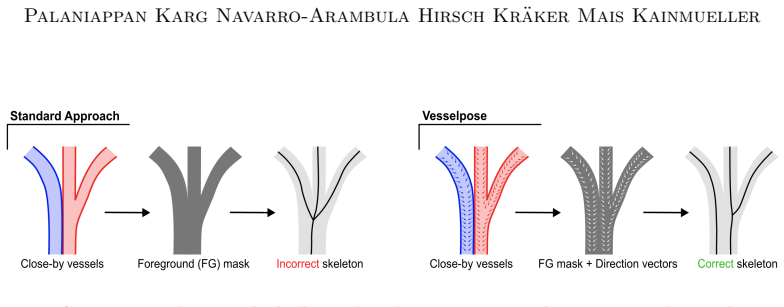
Our approach first predicts voxel-wise vessel direction vectors joint with standard vessel segmentation masks. Second, to extract the vascular graph from these predictions, we introduce a direction-vector-guided extension of the TEASAR algorithm. Our approach achieves state-of-the-art performance on three benchmark datasets, spanning both synthetic and real imagery. We further demonstrate the applicability of our approach to challenging 3D micro-CT scans of rat heart vasculature. Finally, we propose meaningful and interpretable measures of topological error, namely false splits and false merges for graphs. Overall, our approach substantially improves the topological accuracy of reconstructed
What carries the argument
The direction-vector-guided extension of the TEASAR algorithm, which uses predicted voxel-wise vessel orientations to trace and connect vessel paths while avoiding incorrect merges or breaks.
Load-bearing premise
That accurate voxel-wise direction vector predictions can be learned jointly with segmentation and that the direction-guided TEASAR extension will reliably produce topologically correct graphs without introducing new failure modes not captured by the proposed false-split and false-merge metrics.
What would settle it
A test volume where direction vectors are predicted accurately yet the extracted graph still shows elevated false-merge rates between separate vessels or false-split rates within single vessels.
Figures


read the original abstract
Blood vessel segmentation and -tracing are essential tasks in many medical imaging applications. Although numerous methods exist, the prevailing segment-then-fix paradigm is fundamentally limited regarding its suitability for modeling the task of complete and topologically accurate vascular network reconstruction. Here, we propose an approach to extract topologically more accurate vascular graphs from 3D image data, building upon highly successful ideas from the related biomedical tasks of cell segmentation and -tracking. Our approach first predicts voxel-wise vessel direction vectors joint with standard vessel segmentation masks. Second, to extract the vascular graph from these predictions, we introduce a direction-vector-guided extension of the TEASAR algorithm. Our approach achieves state-of-the-art performance on three benchmark datasets, spanning both synthetic and real imagery. We further demonstrate the applicability of our approach to challenging 3D micro-CT scans of rat heart vasculature. Finally, we propose meaningful and interpretable measures of topological error, namely false splits and false merges for graphs. Overall, our approach substantially improves the topological accuracy of reconstructed vascular graphs, being able to separate closely apposed vessel segments and handle multiple vascular trees within a single volume.
Editorial analysis
A structured set of objections, weighed in public.
Referee Report
Summary. The manuscript introduces Vesselpose, which jointly predicts 3D vessel segmentation masks and voxel-wise direction vectors, then applies a direction-vector-guided extension of the TEASAR algorithm to reconstruct topologically accurate vascular graphs. It reports state-of-the-art results on three benchmark datasets (synthetic and real), demonstrates applicability to rat heart micro-CT volumes, and introduces false-split and false-merge metrics for evaluating graph topology.
Significance. If the central claims hold, the work would be significant for medical image analysis because it moves beyond the segment-then-fix paradigm by using learned direction fields to resolve closely apposed vessels and multiple trees, directly addressing a common failure mode in vascular graph reconstruction. The proposal of interpretable false-split/false-merge metrics is a clear positive contribution that could be adopted more broadly.
major comments (2)
- [§4] §4 (Experiments) and associated tables: the abstract and introduction assert SOTA performance plus substantial topological gains from the direction-guided TEASAR extension, yet no quantitative evaluation of direction-vector accuracy (e.g., mean angular error, especially in low-contrast or apposed-vessel boundary voxels) is reported. The false-split/false-merge metrics evaluate only final graph topology and therefore cannot isolate whether the claimed improvements originate from the novel guidance mechanism or from segmentation quality and post-processing alone.
- [§4] §4 and Table 2 (or equivalent result tables): no error bars, standard deviations, or statistical significance tests are provided for the reported metrics across the three benchmark datasets, nor are the exact baseline implementations and hyper-parameter settings for competing methods detailed. This makes it impossible to assess whether the topological improvements are robust or reproducible.
minor comments (2)
- [§3] The description of the direction-vector-guided TEASAR extension in §3 would benefit from a pseudocode listing or explicit step-by-step comparison to the original TEASAR to clarify the precise modifications.
- [Figures] Figure captions for qualitative results should explicitly state the source dataset and whether the displayed direction field is ground-truth or predicted.
Simulated Author's Rebuttal
We thank the referee for the constructive feedback. We address each major comment below and will revise the manuscript to strengthen the experimental reporting and analysis.
read point-by-point responses
-
Referee: [§4] §4 (Experiments) and associated tables: the abstract and introduction assert SOTA performance plus substantial topological gains from the direction-guided TEASAR extension, yet no quantitative evaluation of direction-vector accuracy (e.g., mean angular error, especially in low-contrast or apposed-vessel boundary voxels) is reported. The false-split/false-merge metrics evaluate only final graph topology and therefore cannot isolate whether the claimed improvements originate from the novel guidance mechanism or from segmentation quality and post-processing alone.
Authors: We agree that a direct quantitative evaluation of the predicted direction vectors (e.g., mean angular error, with emphasis on challenging voxels) would provide valuable additional insight and help isolate the contribution of the guidance mechanism. While the false-split/false-merge metrics are intended to capture the end-task topological accuracy that is the primary focus of the work, they do not explicitly separate the effects of direction guidance from segmentation quality. In the revised manuscript, we will add a dedicated analysis of direction-vector accuracy, reporting mean angular error on the benchmark datasets with breakdowns for low-contrast and apposed-vessel regions. We will also include an ablation comparing the full method against a direction-free TEASAR baseline to demonstrate that the topological gains are attributable to the learned vectors. revision: yes
-
Referee: [§4] §4 and Table 2 (or equivalent result tables): no error bars, standard deviations, or statistical significance tests are provided for the reported metrics across the three benchmark datasets, nor are the exact baseline implementations and hyper-parameter settings for competing methods detailed. This makes it impossible to assess whether the topological improvements are robust or reproducible.
Authors: We acknowledge the need for statistical rigor and full reproducibility details. In the revised manuscript, we will report standard deviations (or error bars) for all metrics across the three datasets and include appropriate statistical significance tests (e.g., paired Wilcoxon tests) for the observed improvements. We will also expand the experimental section to provide complete descriptions of the baseline implementations, including the precise hyper-parameter settings and any adaptations used for fair comparison. The source code and trained models will be released publicly upon acceptance to enable independent reproduction. revision: yes
Circularity Check
No circularity: derivation uses learned directions + external TEASAR extension on independent benchmarks
full rationale
The paper's chain is image → joint segmentation + direction vector prediction (supervised learning) → direction-guided TEASAR extension → graph output. TEASAR is cited as prior external work; the extension is described as novel but not derived from the current predictions by definition. Topological claims rest on false-split/false-merge metrics evaluated on three external benchmark datasets (synthetic and real) plus micro-CT scans, not on self-referential fitting or renaming. No self-definitional loops, fitted inputs renamed as predictions, or load-bearing self-citations appear in the provided description. The method is self-contained against external data.
Axiom & Free-Parameter Ledger
Reference graph
Works this paper leans on
-
[1]
2019 , eprint=
DeepVesselNet: Vessel Segmentation, Centerline Prediction, and Bifurcation Detection in 3-D Angiographic Volumes , author=. 2019 , eprint=
2019
-
[2]
Self-supervised Vessel Enhancement Using Flow-Based Consistencies
Jena, Rohit and Singla, Sumedha and Batmanghelich, Kayhan. Self-supervised Vessel Enhancement Using Flow-Based Consistencies. Medical Image Computing and Computer Assisted Intervention -- MICCAI 2021. 2021
2021
-
[3]
Delineating trees in noisy 2D images and 3D image-stacks , year=
González, Germán and Türetken, Engin and Fleuret, Franc¸ois and Fua, Pascal , booktitle=. Delineating trees in noisy 2D images and 3D image-stacks , year=
-
[4]
and Bitter, I
Sato, M. and Bitter, I. and Bender, M.A. and Kaufman, A.E. and Nakajima, M. , booktitle=. TEASAR: tree-structure extraction algorithm for accurate and robust skeletons , year=
-
[5]
T.C. Lee and R.L. Kashyap and C.N. Chu , abstract =. Building Skeleton Models via 3-D Medial Surface Axis Thinning Algorithms , journal =. 1994 , issn =. doi:https://doi.org/10.1006/cgip.1994.1042 , url =
-
[6]
proceedings of Medical Image Computing and Computer Assisted Intervention -- MICCAI 2024 , year =
Naeem, Roman and Hagerman, David and Svensson, Lennart and Kahl, Fredrik , title =. proceedings of Medical Image Computing and Computer Assisted Intervention -- MICCAI 2024 , year =
2024
-
[7]
Trexplorer Super: Topologically Correct Centerline Tree Tracking of Tubular Objects in CT Volumes
Naeem, Roman and Hagerman, David and Alv \'e n, Jennifer and Svensson, Lennart and Kahl, Fredrik. Trexplorer Super: Topologically Correct Centerline Tree Tracking of Tubular Objects in CT Volumes. Medical Image Computing and Computer Assisted Intervention -- MICCAI 2025. 2025
2025
-
[8]
Medical Imaging with Deep Learning , pages =
Vesselformer: Towards Complete 3D Vessel Graph Generation from Images , author =. Medical Imaging with Deep Learning , pages =. 2024 , editor =
2024
-
[9]
Cellpose: a genera list algorithm for cellular segmentation
Stringer, Carsen and Wang, Tim and Michaelos, Michalis and Pachitariu, Marius , title=. Nature Methods , year=. doi:10.1038/s41592-020-01018-x , url=
-
[10]
Pachitariu, Marius and Stringer, Carsen , title=. Nature Methods , year=. doi:10.1038/s41592-022-01663-4 , url=
-
[11]
IEEE Computer Graphics and Applications , year=
Voreen: A Rapid-Prototyping Environment for Ray-Casting-Based Volume Visualizations , author=. IEEE Computer Graphics and Applications , year=
-
[12]
Maier-Hein, Lena and Reinke, Annika and Godau, Patrick and Tizabi, Minu D. and Buettner, Florian and Christodoulou, Evangelia and Glocker, Ben and Isensee, Fabian and Kleesiek, Jens and Kozubek, Michal and Reyes, Mauricio and Riegler, Michael A. and Wiesenfarth, Manuel and Kavur, A. Emre and Sudre, Carole H. and Baumgartner, Michael and Eisenmann, Matthia...
-
[13]
U-Net: Convolutional Networks for Biomedical Image Segmentation
Ronneberger, Olaf and Fischer, Philipp and Brox, Thomas. U-Net: Convolutional Networks for Biomedical Image Segmentation. Medical Image Computing and Computer-Assisted Intervention -- MICCAI 2015. 2015
2015
-
[14]
Plos one , volume=
CT imaging of a multi-organ vascular fingerprint in rats , author=. Plos one , volume=. 2024 , publisher=
2024
-
[15]
arXiv: Optimization and Control ,year=
Faster Wasserstein Distance Estimation with the Sinkhorn Divergence ,author=. arXiv: Optimization and Control ,year=
-
[16]
POT: Python Optimal Transport , journal =
R. POT: Python Optimal Transport , journal =. 2021 , volume =
2021
-
[17]
, author=
Tutorial on Directed Acyclic Graphs. , author=. Journal of clinical epidemiology , year=
-
[18]
Neuroinformatics , volume =
The DIADEM Metric: Comparing Multiple Reconstructions of the Same Neuron , author =. Neuroinformatics , volume =. 2011 , publisher =
2011
-
[19]
Communications of the ACM , month = sep, pages =
Bentley, Jon Louis , title =. 1975 , issue_date =. doi:10.1145/361002.361007 , journal =
-
[20]
Medical Image Computing and Computer-Assisted Intervention-MICCAI 2016: 19th International Conference, Athens, Greece, October 17-21, 2016, Proceedings, Part III 19 , pages=
The minimum cost connected subgraph problem in medical image analysis , author=. Medical Image Computing and Computer-Assisted Intervention-MICCAI 2016: 19th International Conference, Athens, Greece, October 17-21, 2016, Proceedings, Part III 19 , pages=. 2016 , organization=
2016
-
[21]
Simultaneous segmentation and anatomical labeling of the cerebral vasculature , journal =
David Robben and Engin Türetken and Stefan Sunaert and Vincent Thijs and Guy Wilms and Pascal Fua and Frederik Maes and Paul Suetens , keywords =. Simultaneous segmentation and anatomical labeling of the cerebral vasculature , journal =. 2016 , issn =. doi:https://doi.org/10.1016/j.media.2016.03.006 , url =
-
[22]
Reconstructing Curvilinear Networks Using Path Classifiers and Integer Programming , year=
Türetken, Engin and Benmansour, Fethallah and Andres, Bjoern and Głowacki, Przemysław and Pfister, Hanspeter and Fua, Pascal , journal=. Reconstructing Curvilinear Networks Using Path Classifiers and Integer Programming , year=
-
[23]
Simultaneous Segmentation and Anatomical Labeling of the Cerebral Vasculature
Robben, David and T \"u retken, Engin and Sunaert, Stefan and Thijs, Vincent and Wilms, Guy and Fua, Pascal and Maes, Frederik and Suetens, Paul. Simultaneous Segmentation and Anatomical Labeling of the Cerebral Vasculature. Medical Image Computing and Computer-Assisted Intervention -- MICCAI 2014. 2014
2014
-
[24]
T. Automated Reconstruction of Dendritic and Axonal Trees by Global Optimization with Geometric Priors , journal=. 2011 , month=. doi:10.1007/s12021-011-9122-1 , url=
-
[25]
Reconstructing Geometrically Consistent Tree Structures from Noisy Images
T \"u retken, Engin and Blum, Christian and Gonz \'a lez, Germ \'a n and Fua, Pascal. Reconstructing Geometrically Consistent Tree Structures from Noisy Images. Medical Image Computing and Computer-Assisted Intervention -- MICCAI 2010. 2010
2010
-
[26]
Machine learning analysis of whole mouse brain vasculature , journal=
Todorov, Mihail Ivilinov and Paetzold, Johannes Christian and Schoppe, Oliver and Tetteh, Giles and Shit, Suprosanna and Efremov, Velizar and Todorov-V. Machine learning analysis of whole mouse brain vasculature , journal=. 2020 , month=. doi:10.1038/s41592-020-0792-1 , url=
-
[27]
Quantitative neuroanatomy for connectomics in
Schneider-Mizell, Casey M and Gerhard, Stephan and Longair, Mark and Kazimiers, Tom and Li, Feng and Zwart, Maarten F and Champion, Andrew and Midgley, Frank M and Fetter, Richard D and Saalfeld, Stephan and Cardona, Albert , editor =. Quantitative neuroanatomy for connectomics in. eLife , issn =. doi:10.7554/eLife.12059 , url =
-
[28]
Saalfeld, Stephan and Cardona, Albert and Hartenstein, Volker and Tomančák, Pavel , title =. Bioinformatics , volume =. 2009 , month =. doi:10.1093/bioinformatics/btp266 , url =
-
[29]
Drees, Dominik and Scherzinger, Aaron and H. Scalable robust graph and feature extraction for arbitrary vessel networks in large volumetric datasets , journal=. 2021 , month=. doi:10.1186/s12859-021-04262-w , url=
-
[30]
GERoMe-a Method for Evaluating Stability of Graph Extraction Algorithms Without Ground Truth , year=
Drees, Dominik and Scherzinger, Aaron and Jiang, Xiaoyi , journal=. GERoMe-a Method for Evaluating Stability of Graph Extraction Algorithms Without Ground Truth , year=
-
[31]
Kangxian Xie and Jiancheng Yang and Donglai Wei and Ziqiao Weng and Pascal Fua , keywords =. Efficient anatomical labeling of pulmonary tree structures via deep point-graph representation-based implicit fields , journal =. 2025 , issn =. doi:https://doi.org/10.1016/j.media.2024.103367 , url =
-
[32]
Kuhn , title =
Harold W. Kuhn , title =. Naval Research Logistics Quarterly , volume =. 1955 , publisher =
1955
-
[33]
Computational Topology: An Introduction , isbn =
Edelsbrunner, Herbert and Harer, John , year =. Computational Topology: An Introduction , isbn =
-
[34]
2020 , eprint=
Computational Optimal Transport , author=. 2020 , eprint=
2020
-
[35]
Mechanosensitive PIEZO2 channels shape coronary artery development , journal=
Pampols-Perez, Mireia and F. Mechanosensitive PIEZO2 channels shape coronary artery development , journal=. 2025 , month=. doi:10.1038/s44161-025-00677-3 , url=
-
[36]
and Kinney-Lang, Eli and Rashid, Faisal and Hamer, Mary and DeFazio, Richard A
Obenaus, Andre and Ng, Michelle and Orantes, Amanda M. and Kinney-Lang, Eli and Rashid, Faisal and Hamer, Mary and DeFazio, Richard A. and Tang, Jiping and Zhang, John H. and Pearce, William J. , title=. Scientific Reports , year=. doi:10.1038/s41598-017-00161-4 , url=
-
[37]
Hemodynamics regulate spatiotemporal artery muscularization in the developing circle of Willis , author =. eLife , issn =. doi:10.7554/eLife.94094 , url =
-
[38]
Three-dimensional imaging of vascular development in the mouse epididymis , author =. eLife , issn =. doi:10.7554/eLife.82748 , url =
-
[39]
and Stefan, Sabina and Lee, Jang-Hoon and Puttigampala, Pooja and Kim, Anna H
Walek, Konrad W. and Stefan, Sabina and Lee, Jang-Hoon and Puttigampala, Pooja and Kim, Anna H. and Park, Seong Wook and Marchand, Paul J. and Lesage, Frederic and Liu, Tao and Huang, Yu-Wen Alvin and Boas, David A. and Moore, Christopher and Lee, Jonghwan , title=. Nature Communications , year=. doi:10.1038/s41467-023-38609-z , url=
-
[40]
Proceedings of the Computer Vision and Pattern Recognition Conference (CVPR) , month =
Wittmann, Bastian and Wattenberg, Yannick and Amiranashvili, Tamaz and Shit, Suprosanna and Menze, Bjoern , title =. Proceedings of the Computer Vision and Pattern Recognition Conference (CVPR) , month =. 2025 , pages =
2025
-
[41]
Jacob R. Bumgarner and Randy J. Nelson , keywords =. Open-source analysis and visualization of segmented vasculature datasets with VesselVio , journal =. 2022 , issn =. doi:https://doi.org/10.1016/j.crmeth.2022.100189 , url =
-
[42]
and McGinnis, Julian and Shit, Suprosanna and Ezhov, Ivan and B\"
Paetzold, Johannes C. and McGinnis, Julian and Shit, Suprosanna and Ezhov, Ivan and B\". Whole Brain Vessel Graphs: A Dataset and Benchmark for Graph Learning and Neuroscience , url =. Proceedings of the Neural Information Processing Systems Track on Datasets and Benchmarks , editor =
-
[43]
and Prabhakar, Chinmay and Rueckert, Daniel and Menze, Bjoern , booktitle=
Wittmann, Bastian and Paetzold, Johannes C. and Prabhakar, Chinmay and Rueckert, Daniel and Menze, Bjoern , booktitle=. Link Prediction for Flow-Driven Spatial Networks , year=
-
[44]
Deformable
Xizhou Zhu and Weijie Su and Lewei Lu and Bin Li and Xiaogang Wang and Jifeng Dai , booktitle=. Deformable. 2021 , url=
2021
-
[45]
End-to-End Object Detection with Transformers
Carion, Nicolas and Massa, Francisco and Synnaeve, Gabriel and Usunier, Nicolas and Kirillov, Alexander and Zagoruyko, Sergey. End-to-End Object Detection with Transformers. Computer Vision -- ECCV 2020. 2020
2020
-
[46]
Lyu, Xingzheng and Cheng, Li and Zhang, Sanyuan , title=. Scientific Data , year=. doi:10.1038/s41597-022-01507-y , url=
-
[47]
and Sekuboyina, Anjany and Ezhov, Ivan and Unger, Alexander and Zhylka, Andrey and Pluim, Josien P
Shit, Suprosanna and Paetzold, Johannes C. and Sekuboyina, Anjany and Ezhov, Ivan and Unger, Alexander and Zhylka, Andrey and Pluim, Josien P. W. and Bauer, Ulrich and Menze, Bjoern H. , title =. Proceedings of the IEEE/CVF Conference on Computer Vision and Pattern Recognition (CVPR) , month =. 2021 , pages =
2021
-
[48]
Lawrence
Lin, Tsung-Yi and Maire, Michael and Belongie, Serge and Hays, James and Perona, Pietro and Ramanan, Deva and Doll \'a r, Piotr and Zitnick, C. Lawrence. Microsoft COCO: Common Objects in Context. Computer Vision -- ECCV 2014. 2014
2014
-
[49]
Foucart, Adrien and Debeir, Olivier and Decaestecker, Christine , title=. Scientific Reports , year=. doi:10.1038/s41598-023-35605-7 , url=
-
[50]
Similarity evaluation of retinal vascular network based on tree edit distance , year=
Li, Wenjian and Wu, Guannan and Li, Huiqi , booktitle=. Similarity evaluation of retinal vascular network based on tree edit distance , year=
-
[51]
Cell Tracking Accuracy Measurement Based on Comparison of Acyclic Oriented Graphs , year =. PLOS ONE , publisher =. doi:10.1371/journal.pone.0144959 , author =
-
[52]
Proceedings of the IEEE/CVF Conference on Computer Vision and Pattern Recognition (CVPR) , month =
Mais, Lisa and Hirsch, Peter and Managan, Claire and Kandarpa, Ramya and Rumberger, Josef Lorenz and Reinke, Annika and Maier-Hein, Lena and Ihrke, Gudrun and Kainmueller, Dagmar , title =. Proceedings of the IEEE/CVF Conference on Computer Vision and Pattern Recognition (CVPR) , month =. 2024 , pages =
2024
-
[53]
Medical image analysis , volume=
Tissue metabolism driven arterial tree generation , author=. Medical image analysis , volume=. 2012 , publisher=
2012
-
[54]
Numerische mathematik , volume=
A note on two problems in connexion with graphs , author=. Numerische mathematik , volume=. 1959 , publisher=
1959
-
[55]
Verified details , author=
-
[56]
Chulin Wu and Heye Zhang and Jiaqi Chen and Zhifan Gao and Pengfei Zhang and Khan Muhammad and Javier. Vessel-GAN: Angiographic reconstructions from myocardial CT perfusion with explainable generative adversarial networks , journal =. 2022 , issn =. doi:https://doi.org/10.1016/j.future.2021.12.007 , url =
-
[57]
Alexander and Li, Peter H
Silversmith, William and Bae, J. Alexander and Li, Peter H. and Wilson, A.M. , doi =
-
[58]
Frontiers in Oncology , volume=
Assessment of Vascular Network Connectivity of Hepatocellular Carcinoma Using Graph-Based Approach , author=. Frontiers in Oncology , volume=
-
[59]
Hypertension , volume=
Abstract P203: Microvascular Imaging As Early Predictor For Cardiac Dysfunction After Preeclampsia , author=. Hypertension , volume=. 2023 , publisher=
2023
-
[60]
and Kainmueller, Dagmar and Keller, Philipp J
Malin-Mayor, Caroline and Hirsch, Peter and Guignard, Leo and McDole, Katie and Wan, Yinan and Lemon, William C. and Kainmueller, Dagmar and Keller, Philipp J. and Preibisch, Stephan and Funke, Jan , title=. Nature Biotechnology , year=. doi:10.1038/s41587-022-01427-7 , url=
-
[61]
PatchPerPix for Instance Segmentation
Mais, Lisa and Hirsch, Peter and Kainmueller, Dagmar. PatchPerPix for Instance Segmentation. Computer Vision -- ECCV 2020. 2020
2020
-
[62]
The Thirteenth International Conference on Learning Representations , year=
Topograph: An Efficient Graph-Based Framework for Strictly Topology Preserving Image Segmentation , author=. The Thirteenth International Conference on Learning Representations , year=
-
[63]
and Roy, Saikat and Kovacs, Balint and Ulrich, Constantin and Wald, Tassilo and Zenk, Maximilian and Vollmuth, Philipp and Kleesiek, Jens and Isensee, Fabian and Maier-Hein, Klaus
Kirchhoff, Yannick and Rokuss, Maximilian R. and Roy, Saikat and Kovacs, Balint and Ulrich, Constantin and Wald, Tassilo and Zenk, Maximilian and Vollmuth, Philipp and Kleesiek, Jens and Isensee, Fabian and Maier-Hein, Klaus. Skeleton Recall Loss for Connectivity Conserving and Resource Efficient Segmentation of Thin Tubular Structures. Computer Vision --...
2024
-
[64]
and Zhou, Jiayan and Fan, Xiaochen and Zanetti, Daniela and Naftaly, Jeffrey A
Rios Coronado, Pamela E. and Zhou, Jiayan and Fan, Xiaochen and Zanetti, Daniela and Naftaly, Jeffrey A. and Prabala, Pratima and Mart. <em>CXCL12</em> drives natural variation in coronary artery anatomy across diverse populations , journal=. 2025 , month=. doi:10.1016/j.cell.2025.02.005 , url=
-
[65]
and Deb, Diptodip and Lee, Wei-Chung Allen and Saalfeld, Stephan and Turaga, Srinivas C
Sheridan, Arlo and Nguyen, Tri M. and Deb, Diptodip and Lee, Wei-Chung Allen and Saalfeld, Stephan and Turaga, Srinivas C. and Manor, Uri and Funke, Jan , title=. Nature Methods , year=. doi:10.1038/s41592-022-01711-z , url=
-
[66]
Marta Costa and James D. Manton and Aaron D. Ostrovsky and Steffen Prohaska and Gregory S.X.E. Jefferis , keywords =. NBLAST: Rapid, Sensitive Comparison of Neuronal Structure and Construction of Neuron Family Databases , journal =. 2016 , issn =. doi:https://doi.org/10.1016/j.neuron.2016.06.012 , url =
-
[67]
Sexton and Dominic Rütsche and Jessica E
Zachary A. Sexton and Dominic Rütsche and Jessica E. Herrmann and Andrew R. Hudson and Soham Sinha and Jianyi Du and Daniel J. Shiwarski and Anastasiia Masaltseva and Fredrik Samdal Solberg and Jonathan Pham and Jason M. Szafron and Sean M. Wu and Adam W. Feinberg and Mark A. Skylar-Scott and Alison L. Marsden , title =. Science , volume =. 2025 , doi =. ...
-
[68]
2024 , eprint=
Efficient automatic segmentation for multi-level pulmonary arteries: The PARSE challenge , author=. 2024 , eprint=
2024
-
[69]
2017 , isbn =
Reinhard Diestel , title =. 2017 , isbn =
2017
-
[70]
Breiman, Leo , title=. Machine Learning , year=. doi:10.1023/A:1010933404324 , url=
-
[71]
and Vincken, Koen and Viergever, Max , year =
Frangi, Alejandro and Niessen, W.J. and Vincken, Koen and Viergever, Max , year =. Multiscale Vessel Enhancement Filtering , volume =
-
[72]
International Conference on Medical Imaging with Deep Learning,
Hirsch, Peter and Kainmueller, Dagmar , title =. International Conference on Medical Imaging with Deep Learning,
-
[73]
Nature methods , volume=
nnU-Net: a self-configuring method for deep learning-based biomedical image segmentation , author=. Nature methods , volume=. 2021 , publisher=
2021
discussion (0)
Sign in with ORCID, Apple, or X to comment. Anyone can read and Pith papers without signing in.