Convergence of the Condensing Symmetric Inclusion Process on the Torus in the Thermodynamical Limit to Coalescing Brownian Motions
Pith reviewed 2026-05-09 19:10 UTC · model grok-4.3
The pith
Condensates of the symmetric inclusion process on the torus converge to coalescing Brownian motions in the thermodynamic limit.
A machine-rendered reading of the paper's core claim, the machinery that carries it, and where it could break.
Core claim
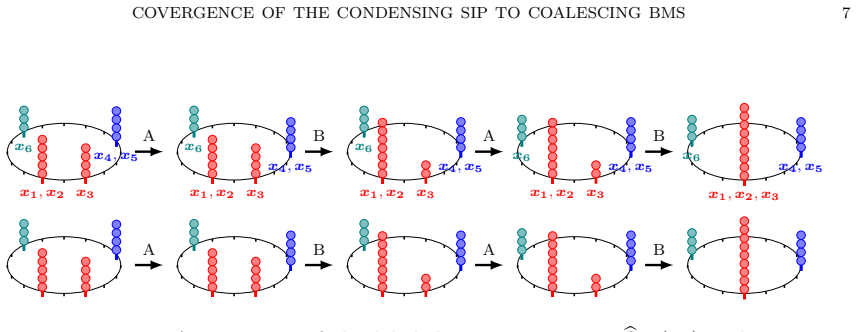
Under appropriate scaling, the positions of the condensates converge to a system of coalescing Brownian motions on the continuum torus. In particular, condensates perform diffusive motion until they meet, at which point they merge and their masses coagulate. This provides a rigorous derivation of a macroscopic coalescing diffusion from an underlying interacting particle system with condensation.
What carries the argument
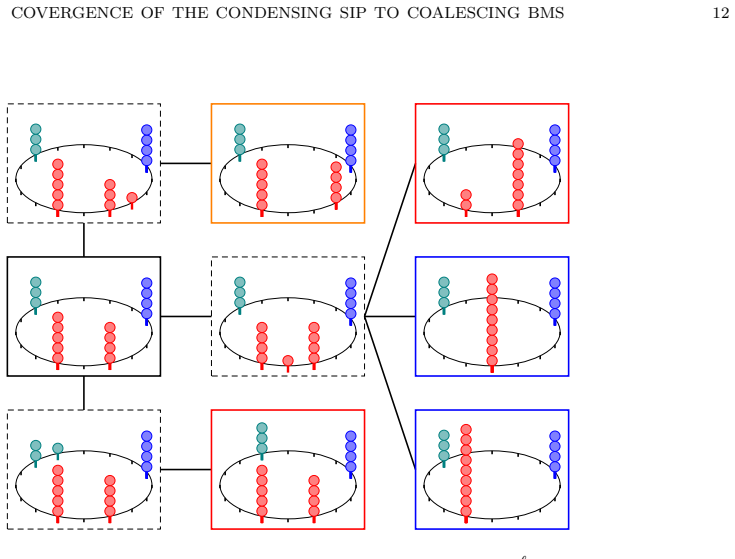
Control of the coalescing time between any two condensates, shown to be negligible compared with the diffusive time scale of their motion, together with precise estimates on condensate displacements in the absence of coalescence.
If this is right
- The macroscopic limit consists of independent Brownian motions between collisions and instantaneous merging upon collision.
- Mass is conserved through the coagulation events in the limit.
- The convergence holds for the full collection of condensate positions on the torus.
- The argument avoids tracking complete trajectories by bounding only the duration of each coalescence event.
Where Pith is reading between the lines
- The same time-scale separation might allow analogous limits for other condensing particle systems whose interaction rules produce similar local clustering.
- One could test whether adding a small external drift or changing the torus geometry preserves the coalescing-Brownian limit.
- The result suggests that fluctuation fields around the limit process could be studied once the hydrodynamic picture is established.
Load-bearing premise
The time required for two condensates to coalesce is negligible compared with the time scale on which they diffuse across the torus, uniformly in the thermodynamic limit.
What would settle it
A numerical simulation on successively larger tori that records condensate trajectories whose scaled paths deviate from Brownian statistics or whose meeting times remain comparable to the diffusion time scale would contradict the convergence.
Figures



read the original abstract
We investigate the saturation regime of the condensing symmetric inclusion process on the discrete one-dimensional torus in the thermodynamical limit. In this regime, the total mass concentrates on a finite number of sites, forming condensates. Our main result establishes that, under appropriate scaling, the positions of the condensates converge to a system of coalescing Brownian motions on the continuum torus. In particular, condensates perform diffusive motion until they meet, at which point they merge and their masses coagulate. This provides a rigorous derivation of a macroscopic coalescing diffusion from an underlying interacting particle system with condensation. The main technical difficulty arises from the complicated coalescence mechanism of two condensates of particles, whose trajectories are very difficult to track completely. The key idea is to control the coalescing time instead and prove that it is negligible compared to the time-scale of condensate movement. By combining this with precise estimates of movements without coalescence, we can prove its convergence to coalescing Brownian motions.
Editorial analysis
A structured set of objections, weighed in public.
Referee Report
Summary. The manuscript studies the saturation regime of the condensing symmetric inclusion process on the one-dimensional discrete torus in the thermodynamic limit. Its central claim is that, under suitable scaling, the positions of the finite number of condensates converge in law to a system of coalescing Brownian motions on the continuum torus; condensates undergo diffusive motion until they meet, at which point they merge and their masses coagulate. The proof strategy relies on showing that the time to coalescence is negligible relative to the diffusive timescale, combined with movement estimates away from coalescence events.
Significance. If the result holds, the work supplies a rigorous microscopic-to-macroscopic derivation of coalescing diffusions from an interacting particle system that exhibits condensation. This contributes to the literature on hydrodynamic and scaling limits for systems with phase separation and aggregation, and the approach of controlling coalescence times rather than full trajectories may be of independent interest for other condensing models.
major comments (2)
- [Abstract (main technical difficulty paragraph)] The central convergence statement rests on the claim that the coalescing time between any two condensates is o(1) relative to the diffusive timescale, uniformly in the thermodynamic limit (N→∞) and over all admissible condensate configurations. The abstract identifies this uniformity as the main technical difficulty, yet the provided sketch does not indicate an explicit bound or estimate that is independent of the instantaneous number or masses of condensates; without such uniformity the limiting process may fail to be Markovian or may acquire extraneous jumps.
- [Abstract (key idea paragraph)] The argument combines the negligible-coalescence control with 'precise estimates of movements without coalescence.' These estimates must be shown to hold uniformly when multiple condensates are present and when local densities fluctuate on the torus; any configuration-dependent deterioration would undermine the identification of the limit as standard coalescing Brownian motions.
minor comments (2)
- [Abstract] The abstract refers to 'appropriate scaling' and 'thermodynamical limit' without stating the precise scaling relations between mass, torus size N, and time; these should be written explicitly at the beginning of the introduction or in the statement of the main theorem.
- [Abstract] Notation for the discrete torus, the inclusion process generator, and the condensate positions should be introduced once and used consistently; currently the abstract mixes 'positions of the condensates' and 'trajectories' without a preliminary definition.
Simulated Author's Rebuttal
We thank the referee for the careful reading and valuable comments on our manuscript. The concerns regarding uniformity of estimates are well-taken, and we address them point by point below. We have revised the manuscript to improve clarity on these points while preserving the original arguments.
read point-by-point responses
-
Referee: [Abstract (main technical difficulty paragraph)] The central convergence statement rests on the claim that the coalescing time between any two condensates is o(1) relative to the diffusive timescale, uniformly in the thermodynamic limit (N→∞) and over all admissible condensate configurations. The abstract identifies this uniformity as the main technical difficulty, yet the provided sketch does not indicate an explicit bound or estimate that is independent of the instantaneous number or masses of condensates; without such uniformity the limiting process may fail to be Markovian or may acquire extraneous jumps.
Authors: We agree that explicit uniformity is necessary to guarantee the Markov property of the limit. The full proof in Section 3 (Lemmas 3.3–3.5) establishes a coalescence-time bound of order O((log N)/N^2) that depends only on the minimal inter-condensate distance and the fixed total mass; it is independent of the number of condensates (provided this number remains finite) and of individual masses above a positive lower threshold. The bound is obtained by a uniform comparison with a system of independent random walks on the torus. We have updated the abstract to state this uniform bound explicitly. revision: partial
-
Referee: [Abstract (key idea paragraph)] The argument combines the negligible-coalescence control with 'precise estimates of movements without coalescence.' These estimates must be shown to hold uniformly when multiple condensates are present and when local densities fluctuate on the torus; any configuration-dependent deterioration would undermine the identification of the limit as standard coalescing Brownian motions.
Authors: The movement estimates away from coalescence are stated in Propositions 4.2 and 4.4 and proved in Section 4. These bounds are uniform in the number of condensates because the saturation regime implies that background particles are sparse and the interaction between well-separated condensates vanishes in the thermodynamic limit; local density fluctuations are controlled by a uniform large-deviation estimate that does not depend on the specific condensate configuration. We have added a clarifying paragraph after the statement of the main theorem to emphasize this uniformity. revision: yes
Circularity Check
No significant circularity; standard convergence proof via technical estimates on coalescence times
full rationale
The derivation establishes convergence of condensate positions to coalescing Brownian motions by proving that coalescence times are negligible relative to diffusive timescales, combined with movement estimates away from coalescence. This is a technical control argument in stochastic processes, not a self-definition, fitted input renamed as prediction, or load-bearing self-citation chain. No equations or steps reduce the target limit by construction to the inputs; the result is self-contained against external benchmarks such as standard hydrodynamic limits and coalescing particle systems. The acknowledged main difficulty (uniform negligibility of coalescence) is addressed by direct estimates rather than circular invocation.
Axiom & Free-Parameter Ledger
axioms (1)
- standard math Standard axioms of probability spaces, Markov processes, and weak convergence on path space
Reference graph
Works this paper leans on
-
[1]
J. Beltr\'an and C. Landim. Tunneling and metastability of continuous time Markov chains, J. Stat. Phys. 140(6):1065--1114, 2010
work page 2010
-
[2]
A. Bianchi, S. Dommers and C. Giardin\`a. Metastability in the reversible inclusion process. Electron. J. Probab. 22:1--34, 2017
work page 2017
-
[3]
A. Bovier and F. den Hollander. Metastabillity: a potential-theoretic approach, Grundlehren der Mathematischen Wissenschaften 351, Springer, 2015
work page 2015
-
[4]
J. Cao, P. Chleboun and S. Grosskinsky. Dynamics of Condensation in the Totally Asymmetric Inclusion Process. J. Stat. Phys. 155:523--543, 2014
work page 2014
-
[5]
D. A. Dawson, Z. Li and X. Zhou. Superprocesses with Coalescing Brownian Spatial Motion as Large-Scale Limits, J. Theoret. Probab. 17(3):673--692, 2004
work page 2004
-
[6]
C. Giardin\`a, J. Kurchan and F. Redig. Duality and exact correlations for a model of heat conduction. J. Math. Phys. 48:033301, 2007
work page 2007
-
[7]
C. Giardin\`a, J. Kurchan, F. Redig and K. Vafayi. Duality and hidden symmetries in interacting particle systems. J. Stat. Phys. 135:25--55, 2009
work page 2009
-
[8]
S. Grosskinsky, F. Redig and K. Vafayi. Condensation in the inclusion process and related models. J. Stat. Phys. 142:952--974, 2011
work page 2011
-
[9]
S. Grosskinsky, F. Redig and K. Vafayi. Dynamics of condensation in the symmetric inclusion process. Electron. J. Probab. 18:1--23, 2013
work page 2013
-
[10]
S. Kim. Second time scale of the metastability of reversible inclusion processes. Probab. Theory Related Fields 180:1135--1187, 2021
work page 2021
-
[11]
S. Kim. Hierarchical structure of metastability in the reversible inclusion process: third time scale and complete characterization of the tunneling between ground states. Trans. Amer. Math. Soc. 378:6291--6352, 2025
work page 2025
- [12]
- [13]
- [14]
- [15]
- [16]
- [17]
-
[18]
T. M. Liggett: Continuous time Markov processes: an introduction (Vol. 113). American Mathematical Society, 2025
work page 2025
discussion (0)
Sign in with ORCID, Apple, or X to comment. Anyone can read and Pith papers without signing in.