Recognition: unknown
Parity-dependent reentrant topology in a Su--Schrieffer--Heeger chain with power-law quasiperiodic modulation
Pith reviewed 2026-05-09 15:09 UTC · model grok-4.3
The pith
Quasiperiodic power-law modulation induces parity-dependent reentrant topological phases in SSH chains.
A machine-rendered reading of the paper's core claim, the machinery that carries it, and where it could break.
Core claim
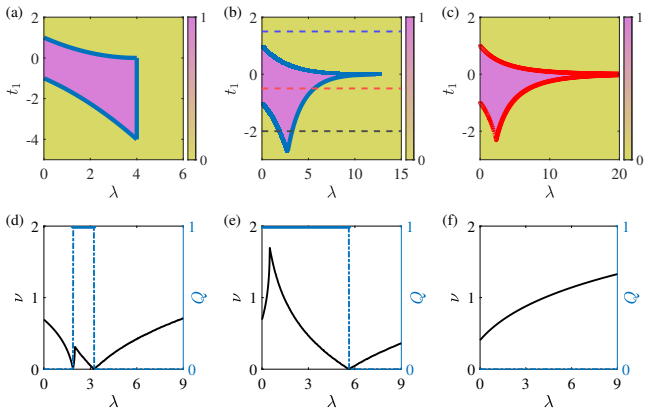
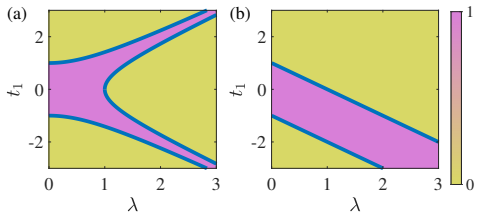
We show that deterministic quasiperiodic modulation can induce TAI-like reentrant topological phases within finite parameter windows. The formation of these phases depends crucially on the parity of n: for positive modulation strength, odd-power modulations can induce reentrant topology from the clean trivial regime |t1|>1, whereas even-power modulations allow such reentrance only from the negative clean trivial regime t1<-1. Exact analytical expressions for the zero-mode inverse localization length are obtained for n=1,2,3,4, yielding explicit or implicit transition conditions. The finite-beta results demonstrate that the parity-dependent structure remains robust throughout the interp
What carries the argument
The power-law quasiperiodic modulation of intracell hopping, parameterized by positive integer exponent n and interpolation parameter beta, whose effect on topology is tracked by the combination of zero-mode inverse localization length and a real-space topological indicator.
If this is right
- Exact analytical expressions for the zero-mode inverse localization length exist for n=1,2,3,4 and supply explicit or implicit conditions for the topological transitions.
- The parity-dependent reentrant structure persists for all finite values of the interpolation parameter beta.
- An electrical-circuit realization can be constructed to observe the reentrant trivial-topological-trivial transition.
- Experimentally accessible signatures of the reentrant transition include changes in the localization of mid-gap states.
Where Pith is reading between the lines
- Similar parity effects may appear in other quasiperiodic lattice models if the modulation can be written as a power of a cosine-like function.
- The electrical-circuit proposal could allow experimental tuning of beta to map the full phase diagram in a single device.
- The sign-structure argument suggests that replacing the cosine with other periodic functions of definite parity might produce analogous reentrant behavior.
Load-bearing premise
The real-space topological indicator combined with the zero-mode inverse localization length correctly identifies all phase boundaries without missing transitions or artifacts from the modulation.
What would settle it
A numerical calculation of the topological indicator and zero-mode localization length for odd n at positive modulation strength that finds no reentrant window starting from |t1| > 1 would falsify the parity-dependent claim.
Figures




read the original abstract
We investigate reentrant topological transitions in a one-dimensional Su--Schrieffer--Heeger chain with power-law quasiperiodically modulated intracell hopping. The modulation is characterized by a positive integer exponent $n$ and a tunable parameter $\beta$, which continuously interpolates between the smooth power-law quasiperiodic limit and a sign-function limit that becomes square-wave-like for odd $n$ and uniform for even $n$. By combining analytical calculations of the zero-mode inverse localization length with numerical evaluations of a real-space topological indicator, we determine the topological phase diagrams in the $\beta\to 0$, $\beta\to\infty$, and finite-$\beta$ regimes. We show that deterministic quasiperiodic modulation can induce TAI-like reentrant topological phases within finite parameter windows. The formation of these phases depends crucially on the parity of $n$: for positive modulation strength, odd-power modulations can induce reentrant topology from the clean trivial regime $|t_1|>1$, whereas even-power modulations allow such reentrance only from the negative clean trivial regime $t_1<-1$. Exact analytical expressions for the zero-mode inverse localization length are obtained for $n=1,2,3,4$, yielding explicit or implicit transition conditions. The finite-$\beta$ results demonstrate that the parity-dependent structure remains robust throughout the interpolation between the two limiting cases. This parity effect originates from whether the modulation preserves or removes the sign structure of $\cos x$. We further propose an electrical-circuit implementation and discuss experimentally accessible signatures of the reentrant trivial--topological--trivial transition.
Editorial analysis
A structured set of objections, weighed in public.
Referee Report
Summary. The manuscript investigates reentrant topological transitions in a one-dimensional Su-Schrieffer-Heeger chain with power-law quasiperiodically modulated intracell hopping, parameterized by a positive integer exponent n and tunable β that interpolates between smooth quasiperiodic and sign-function limits. It derives exact analytical expressions for the zero-mode inverse localization length for n=1,2,3,4 and combines these with numerical computations of a real-space topological indicator to map phase diagrams in the β→0, β→∞, and finite-β regimes, claiming that the modulation induces TAI-like reentrant topological phases whose existence and direction of reentrance from the clean trivial regime depend on the parity of n.
Significance. If the central claims hold, the work is significant for demonstrating how deterministic quasiperiodic modulations can produce reentrant topology with a parity-dependent structure, providing analytical transition conditions for small n and proposing an electrical-circuit realization with accessible signatures. The exact analytical localization-length expressions for n=1–4 constitute a clear strength, as they yield explicit or implicit transition conditions without free parameters beyond β and n.
major comments (3)
- [Numerical results and phase diagrams] The central claim that odd-n modulations induce reentrance from |t1|>1 while even-n do so only from t1<-1 rests on the real-space topological indicator correctly identifying all boundaries in the finite-β diagrams. However, the numerical results section provides no finite-size scaling analysis, no direct comparison of the indicator against the analytical zero-mode inverse localization length in the β→0 or β→∞ limits, and no cross-check with transfer-matrix winding numbers; without these, it remains possible that reported reentrant windows contain spurious regions induced by the modulation's sign structure rather than true topological protection.
- [Analytical calculations of zero-mode inverse localization length] The analytical derivations of the zero-mode inverse localization length for n=1,2,3,4 (yielding the parity-dependent transition conditions) are presented as exact, but the manuscript does not display the intermediate steps or the explicit functional forms that would confirm the claimed origin in the preservation versus removal of the cos x sign structure; this gap is load-bearing because the parity effect is invoked to explain the differing reentrant regimes.
- [Finite-β regime and interpolation] The robustness statement that the parity-dependent structure remains intact throughout the finite-β interpolation is supported only by selected numerical diagrams; no systematic scan or quantitative measure (e.g., width of reentrant windows versus β) is given to show that the odd/even distinction does not collapse or shift for intermediate β values.
minor comments (3)
- [Abstract and introduction] The abstract and introduction use 'TAI-like' without a brief clarification of how the deterministic, clean modulated system differs from disorder-driven TAI; a single sentence distinguishing the mechanisms would improve readability.
- [Figure captions] Figure captions for the phase diagrams do not list the specific n values, β ranges, or system sizes employed in the numerical indicator calculations, hindering direct connection to the analytical n=1–4 cases.
- [Model definition] Notation for the modulation strength and the clean-limit parameter t1 is introduced without an explicit reminder of the SSH Hamiltonian form in the main text; a short equation reference would aid readers.
Simulated Author's Rebuttal
We thank the referee for their careful reading and constructive comments, which will help strengthen the manuscript. We address each major comment point by point below, indicating the revisions we will implement.
read point-by-point responses
-
Referee: [Numerical results and phase diagrams] The central claim that odd-n modulations induce reentrance from |t1|>1 while even-n do so only from t1<-1 rests on the real-space topological indicator correctly identifying all boundaries in the finite-β diagrams. However, the numerical results section provides no finite-size scaling analysis, no direct comparison of the indicator against the analytical zero-mode inverse localization length in the β→0 or β→∞ limits, and no cross-check with transfer-matrix winding numbers; without these, it remains possible that reported reentrant windows contain spurious regions induced by the modulation's sign structure rather than true topological protection.
Authors: We agree that these validations are necessary to confirm the indicator's reliability and exclude spurious effects. In the revised manuscript we will add finite-size scaling analysis demonstrating convergence of the real-space topological indicator with increasing system size. We will also include direct comparisons between the numerical indicator values and the analytical zero-mode inverse localization length in both the β→0 and β→∞ limits. Additionally, we will perform transfer-matrix winding-number calculations at representative points inside the reported reentrant windows to cross-validate the topological character and rule out artifacts from the modulation's sign structure. revision: yes
-
Referee: [Analytical calculations of zero-mode inverse localization length] The analytical derivations of the zero-mode inverse localization length for n=1,2,3,4 (yielding the parity-dependent transition conditions) are presented as exact, but the manuscript does not display the intermediate steps or the explicit functional forms that would confirm the claimed origin in the preservation versus removal of the cos x sign structure; this gap is load-bearing because the parity effect is invoked to explain the differing reentrant regimes.
Authors: We acknowledge that the absence of intermediate steps obscures the origin of the parity dependence. In the revision we will insert the complete derivations for the zero-mode inverse localization length at n=1,2,3,4, together with the explicit functional forms. These steps will explicitly demonstrate how the parity of n determines whether the cos x sign structure is preserved or removed, thereby grounding the distinct reentrant regimes for odd and even n. revision: yes
-
Referee: [Finite-β regime and interpolation] The robustness statement that the parity-dependent structure remains intact throughout the finite-β interpolation is supported only by selected numerical diagrams; no systematic scan or quantitative measure (e.g., width of reentrant windows versus β) is given to show that the odd/even distinction does not collapse or shift for intermediate β values.
Authors: We agree that a more quantitative demonstration is warranted. The revised manuscript will contain a systematic scan over a dense grid of β values for representative odd and even n. We will add plots of the reentrant-window widths versus β, together with a quantitative measure of the separation between odd-n and even-n boundaries, confirming that the parity-dependent structure persists without collapse or significant shift throughout the interpolation. revision: yes
Circularity Check
No circularity: phase boundaries obtained from direct solution of the modulated Hamiltonian
full rationale
The derivation computes the zero-mode inverse localization length analytically for n=1–4 and evaluates a real-space topological indicator numerically on the SSH chain with explicit power-law quasiperiodic term; neither step reduces to a fitted parameter renamed as a prediction nor to a self-citation whose content is presupposed. The parity-dependent reentrance follows from the algebraic sign structure of cos(x) under the modulation, which is an input definition rather than an output. The reported phase diagrams are therefore independent of the target claims and do not collapse by construction.
Axiom & Free-Parameter Ledger
free parameters (2)
- beta
- n
axioms (2)
- domain assumption The real-space topological indicator correctly identifies the topological phase for the modulated chain
- standard math The zero-mode inverse localization length is analytically obtainable for n=1,2,3,4 and marks transitions
Reference graph
Works this paper leans on
-
[1]
I. C. Fulga, F. Hassler, A. R. Akhmerov, C. W. J. Beenakker , Scattering formula for the topological quantum number of a disordered m ultimode wire, Phys. Rev. B 83 (2011) 155429
2011
-
[2]
X. Cai, L. Lang, S. Chen, Y. Wang, Topological supercondu ctor to an- derson localization transition in one-dimensional incomm ensurate lat- tices, Phys. Rev. Lett. 110 (2013) 176403
2013
-
[3]
Longhi, Phase transitions in a non-hermitian aubry-a ndré-harper model, Phys
S. Longhi, Phase transitions in a non-hermitian aubry-a ndré-harper model, Phys. Rev. B 103 (2021) 054203
2021
-
[4]
Bansil, H
A. Bansil, H. Lin, T. Das, Colloquium: Topological band t heory, Rev. Mod. Phys. 88 (2016) 021004. 24
2016
-
[5]
Z. Wang, Y. D. Chong, J. D. Joannopoulos, M. Soljačić, Refl ection-free one-way edge modes in a gyromagnetic photonic crystal, Phys . Rev. Lett. 100 (2008) 013905
2008
-
[6]
Z. Wang, Y. D. Chong, J. D. Joannopoulos, M. Soljačić, Obs erva- tion of unidirectional backscattering-immune topologica l electromag- netic states, Nature 461 (2009) 772–775
2009
-
[7]
Sinha, T
A. Sinha, T. Shit, A. Tetarwal, D. Sen, S. Mukherjee, Prob ing the topo- logical anderson transition in quasiperiodic photonic lat tices via chiral displacement and wavelength tuning, Phys. Rev. A 112 (2025) 013512
2025
-
[8]
Lima, Interplay of phase transition from purely real a nd line-gapped phase on quantum entanglement in the generalized su–schrie ffer–heeger model, Phys
L. Lima, Interplay of phase transition from purely real a nd line-gapped phase on quantum entanglement in the generalized su–schrie ffer–heeger model, Phys. A Stat. Mech. Appl. 694 (2026) 131574
2026
-
[9]
E. G. Cinnirella, A. Nava, G. Campagnano, D. Giuliano, Fa te of high winding number topological phases in the disordered ex tended su- schrieffer-heeger model, Phys. Rev. B 109 (2024) 035114
2024
-
[10]
A. Nava, G. Campagnano, P. Sodano, D. Giuliano, Lindbla d master equation approach to the topological phase transition in th e disordered su-schrieffer-heeger model, Phys. Rev. B 107 (2023) 035113
2023
-
[11]
Scollon, M
M. Scollon, M. P. Kennett, Persistence of chirality in t he su-schrieffer- heeger model in the presence of on-site disorder, Phys. Rev. B 101 (2020) 144204
2020
-
[12]
Z. Lu, Y. Zhang, Z. Xu, Reentrant localization transiti ons in a topo- logical anderson insulator: A study of a generalized su-sch rieffer-heeger quasicrystal, Front. Phys. 20 (2025) 024204–
2025
-
[13]
Z. Lu, Z. Xu, Y. Zhang, Exact mobility edges and topologi cal anderson insulating phase in a slowly varying quasiperiodic model, A nn. Phys. 534 (2022) 2200203
2022
-
[14]
L. Tang, S. Liu, G. Zhang, D. Zhang, Topological anderso n insulators with different bulk states in quasiperiodic chains, Phys. Re v. A 105 (2022) 063327. 25
2022
-
[15]
Z. Zuo, J. Lin, D. Kang, Topological inverse anderson in sulator, Phys. Rev. B 110 (2024) 085157
2024
-
[16]
B. D. Assun ç ao, G. J. Ferreira, C. H. Lewenkopf, Phase tr ansitions and scale invariance in topological anderson insulators, P hys. Rev. B 109 (2024) L201102
2024
-
[17]
Ouyang, Q
C. Ouyang, Q. He, D. Xu, F. Liu, Higher-order topology in fibonacci quasicrystals, Phys. Rev. B 110 (2024) 075425
2024
-
[18]
G. Rai, H. Schlömer, C. Matsumura, S. Haas, A. Jagannath an, Bulk topological signatures of a quasicrystal, Phys. Rev. B 104 ( 2021) 184202
2021
-
[19]
Kobiałka, O
A. Kobiałka, O. A. Awoga, M. Leijnse, T. Domański, P. Hol mvall, A. M. Black-Schaffer, Topological superconductivity in fibonacc i quasicrystals, Phys. Rev. B 110 (2024) 134508
2024
-
[20]
Sandberg, O
A. Sandberg, O. A. Awoga, A. M. Black-Schaffer, P. Holmva ll, Josephson effect in a fibonacci quasicrystal, Phys. Rev. B 110 (2024) 104 513
2024
-
[21]
R. Ji, Z. Xu, Fibonacci-modulation-induced multiple t opological ander- son insulators, Commun. Phys. 8 (2025) 336
2025
-
[22]
Padhan, S
A. Padhan, S. R. Padhi, T. Mishra, Complete delocalizat ion and reen- trant topological transition in a non-hermitian quasiperi odic lattice, Phys. Rev. B 109 (2024) L020203
2024
-
[23]
Mansha, Y
S. Mansha, Y. D. Chong, Robust edge states in amorphous g yromagnetic photonic lattices, Phys. Rev. B 96 (2017) 121405
2017
-
[24]
C. Liu, W. Gao, B. Yang, S. Zhang, Disorder-induced topo logical state transition in photonic metamaterials, Phys. Rev. Let t. 119 (2017) 183901
2017
-
[25]
L. Lin, Y. Ke, C. Lee, Real-space representation of the w inding number for a one-dimensional chiral-symmetric topological insul ator, Phys. Rev. B 103 (2021) 224208
2021
-
[26]
Zhang, L
G. Zhang, L. Tang, L. Zhang, D. Zhang, S. Zhu, Connecting topolog- ical anderson and mott insulators in disordered interactin g fermionic systems, Phys. Rev. B 104 (2021) L161118. 26
2021
-
[27]
J. Li, R. Chu, J. K. Jain, S. Shen, Topological anderson i nsulator, Phys. Rev. Lett. 102 (2009) 136806
2009
-
[28]
C. W. Groth, M. Wimmer, A. R. Akhmerov, J. Tworzydło, C. W . J. Beenakker, Theory of the topological anderson insulator, P hys. Rev. Lett. 103 (2009) 196805
2009
-
[29]
Jiang, L
H. Jiang, L. Wang, Q. Sun, X. C. Xie, Numerical study of th e topological anderson insulator in hgte/cdte quantum wells, Phys. Rev. B 80 (2009) 165316
2009
-
[30]
H. Liu, B. Xie, H. Wang, W. Liu, Z. Li, H. Cheng, J. Tian, Z. Liu, S. Chen, Acoustic spin-chern topological anderson insulat ors, Phys. Rev. B 108 (2023) L161410
2023
-
[31]
Meier, F
E. Meier, F. An, A. Dauphin, M. Maffei, P. Massignan, T. Hu ghes, B. Gadway, Observation of the topological anderson insulat or in disor- dered atomic wires, Science 362 (2018) 929–933
2018
-
[32]
Mondragon-Shem, T
I. Mondragon-Shem, T. L. Hughes, J. Song, E. Prodan, Top ological criticality in the chiral-symmetric aiii class at strong di sorder, Phys. Rev. Lett. 113 (2014) 046802
2014
-
[33]
Zhang, A
H. Zhang, A. Kamenev, Anatomy of topological anderson t ransitions, Phys. Rev. B 108 (2023) 224201
2023
-
[34]
Y. Xing, L. Zhang, J. Wang, Topological anderson insula tor phenomena, Phys. Rev. B 84 (2011) 035110
2011
-
[35]
Zhang, R
Y. Zhang, R. Chu, F. Zhang, S. Shen, Localization and mob ility gap in the topological anderson insulator, Phys. Rev. B 85 (2012) 0 35107
2012
-
[36]
Titum, N
P. Titum, N. H. Lindner, M. C. Rechtsman, G. Refael, Diso rder-induced floquet topological insulators, Phys. Rev. Lett. 114 (2015) 056801
2015
-
[37]
P. O. Christoph, S. Tibor, B. Christoph, L. S. Thomas, Th e topological anderson insulator phase in the kane-mele model, Sci. Rep. 6 (2016) 24007
2016
-
[38]
Zhang, B
Z. Zhang, B. Wu, J. Song, H. Jiang, Topological anderson insulator in electric circuits, Phys. Rev. B 100 (2019) 184202. 27
2019
-
[39]
P. Zhao, Z. Xiao, Y. Zhang, R. Shindou, Topological effec t on the ander- son transition in chiral symmetry classes, Phys. Rev. Lett. 133 (2024) 226601
2024
-
[40]
G. Liu, Y. Yang, X. Ren, H. Xue, X. Lin, Y. Hu, H. Sun, B. Pen g, P. Zhou, Y. Chong, B. Zhang, Topological anderson insulator in disor- dered photonic crystals, Phys. Rev. Lett. 125 (2020) 133603
2020
-
[41]
Q. Lin, T. Li, L. Xiao, K. Wang, W. Yi, P. Xue, Observation of non- hermitian topological anderson insulator in quantum dynam ics, Nat. Commun. 13 (2022) 3229
2022
-
[42]
C. Wang, T. Cheng, Z. Liu, F. Liu, H. Huang, Structural am orphization- induced topological order, Phys. Rev. Lett. 128 (2022) 0564 01
2022
-
[43]
X. Cui, R. Zhang, Z. Zhang, C. T. Chan, Photonic Z2 topological an- derson insulators, Phys. Rev. Lett. 129 (2022) 043902
2022
-
[44]
M. Ren, Y. Yu, B. Wu, X. Qi, Y. Wang, X. Yao, J. Ren, Z. Guo, H. Jiang, H. Chen, X.-J. Liu, Z. Chen, Y. Sun, Realization of g apped and ungapped photonic topological anderson insulators, Ph ys. Rev. Lett. 132 (2024) 066602
2024
-
[45]
A. Li, B. Xu, B. Xie, Successive phase transition in high er-order topo- logical anderson insulators, Phys. Rev. Res. 7 (2025) 01320 4
2025
-
[46]
Bagrets, K
D. Bagrets, K. W. Kim, S. Barkhofen, S. De, J. Sperling, C . Silberhorn, A. Altland, T. Micklitz, Probing the topological anderson t ransition with quantum walks, Phys. Rev. Res. 3 (2021) 023183
2021
-
[47]
Grindall, A
C. Grindall, A. C. Tyner, A.-K. Wu, T. L. Hughes, J. H. Pix ley, Sep- arate surface and bulk topological anderson localization t ransitions in disordered axion insulators, Phys. Rev. Lett. 135 (2025) 22 6601
2025
-
[48]
X. Li, H. Xu, J. Wang, L. Tang, D. Zhang, C. Yang, T. Su, C. W ang, Z. Mi, W. Sun, X. Liang, M. Chen, C. Li, Y. Zhang, K. Linghu, J. H an, W. Liu, Y. Feng, P. Liu, G. Xue, J. Zhang, Y. Jin, S. Zhu, H. Yu, S . P. Zhao, Q. Xue, Mapping the topology-localization phase diag ram with quasiperiodic disorder using a programmable superconduct ing simula- tor, Phy...
2024
-
[49]
Longhi, Topological anderson phase in quasi-period ic waveguide lat- tices, Opt
S. Longhi, Topological anderson phase in quasi-period ic waveguide lat- tices, Opt. Lett. 45 (2020) 4036–4039
2020
-
[50]
Y. Deng, Y. He, Quadrupole moment of higher-order topol ogicals insu- lator at finite temperature, Phys. Rev. B 112 (2025) 205131
2025
-
[51]
A. K. Ghosh, T. Nag, A. Saha, Floquet second-order topol ogical ander- son insulator hosting corner localized modes, Phys. Rev. B 1 10 (2024) 125427
2024
-
[52]
Q. Dai, Z. Lu, Z. Xu, Emergence of multifractality throu gh cascadelike transitions in a mosaic interpolating aubry-andré-fibonac ci chain, Phys. Rev. B 108 (2023) 144207
2023
-
[53]
Y. Wang, G. Rai, C. Matsumura, A. Jagannathan, S. Haas, S upercon- ductivity in the fibonacci chain, Phys. Rev. B 109 (2024) 2145 07
2024
-
[54]
Sbroscia, K
M. Sbroscia, K. Viebahn, E. Carter, J. Yu, A. Gaunt, U. Sc hneider, Observing localization in a 2d quasicrystalline optical la ttice, Phys. Rev. Lett. 125 (2020) 200604
2020
- [55]
-
[56]
H. Yao, T. Giamarchi, L. Sanchez-Palencia, Lieb-linig er bosons in a shallow quasiperiodic potential: Bose glass phase and frac tal mott lobes, Phys. Rev. Lett. 125 (2020) 060401
2020
-
[57]
Jagannathan, The fibonacci quasicrystal: Case study of hidden di- mensions and multifractality, Rev
A. Jagannathan, The fibonacci quasicrystal: Case study of hidden di- mensions and multifractality, Rev. Mod. Phys. 93 (2021) 045 001
2021
-
[58]
Longhi, Metal-insulator phase transition in a non-h ermitian aubry- andré-harper model, Phys
S. Longhi, Metal-insulator phase transition in a non-h ermitian aubry- andré-harper model, Phys. Rev. B 100 (2019) 125157
2019
-
[59]
Altland, D
A. Altland, D. Bagrets, L. Fritz, A. Kamenev, H. Schmied t, Quan- tum criticality of quasi-one-dimensional topological and erson insulators, Phys. Rev. Lett. 112 (2014) 206602
2014
-
[60]
H. Liu, Z. Lu, X. Xia, Z. Xu, Fate of localization feature s in a one- dimensional non-hermitian flat-band lattice with quasiper iodic modula- tions, New J. Phys. 26 (9) (2024) 093007. 29
2024
discussion (0)
Sign in with ORCID, Apple, or X to comment. Anyone can read and Pith papers without signing in.