Recognition: no theorem link
Colorful-Noise: Training-Free Low-Frequency Noise Manipulation for Color-Based Conditional Image Generation
Pith reviewed 2026-05-12 02:14 UTC · model grok-4.3
The pith
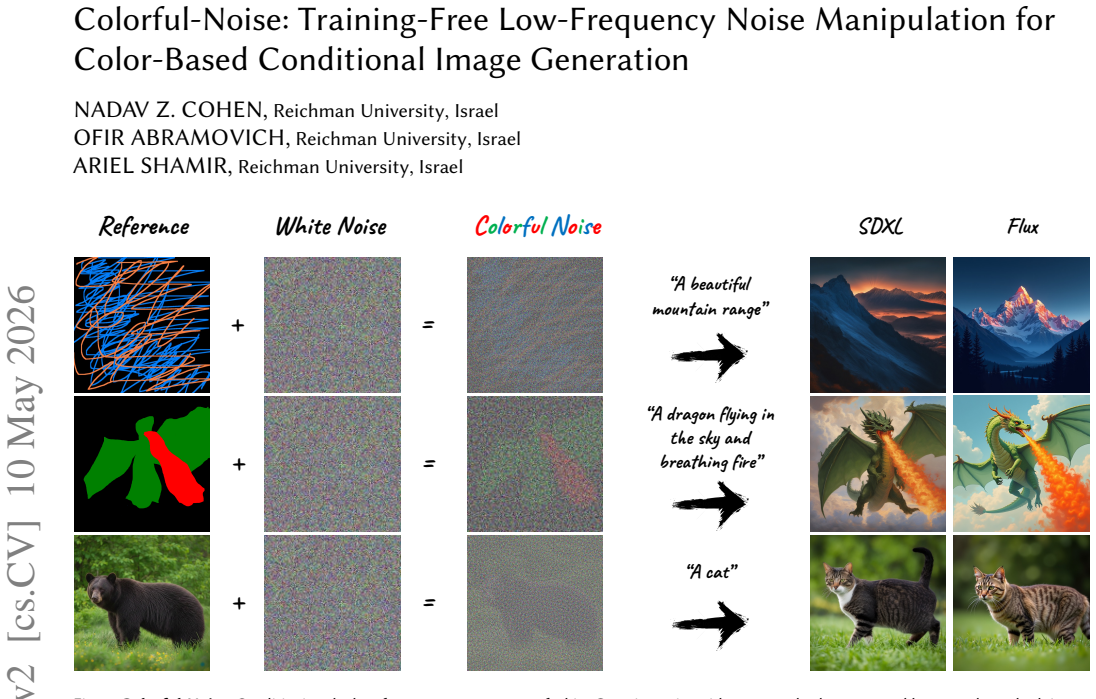
Low-frequency components of the input noise set global structure and color in diffusion-generated images, allowing training-free conditioning via simple prior-based edits.
A machine-rendered reading of the paper's core claim, the machinery that carries it, and where it could break.
Core claim
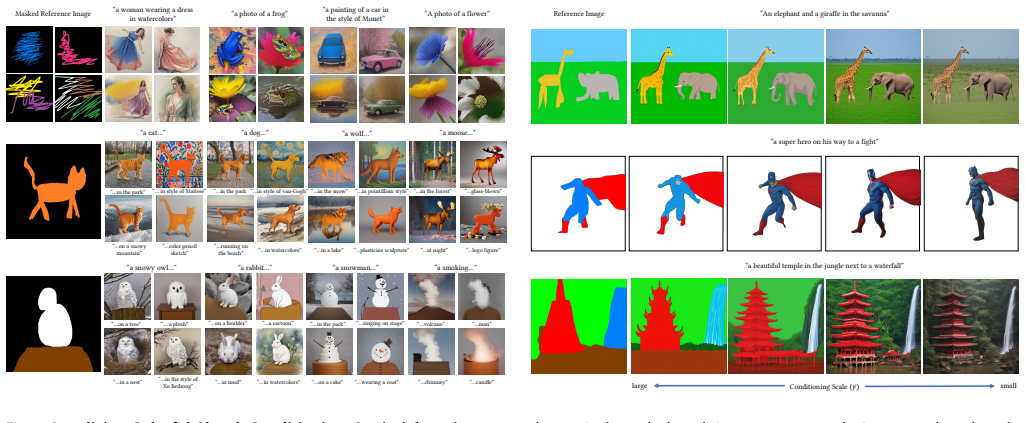
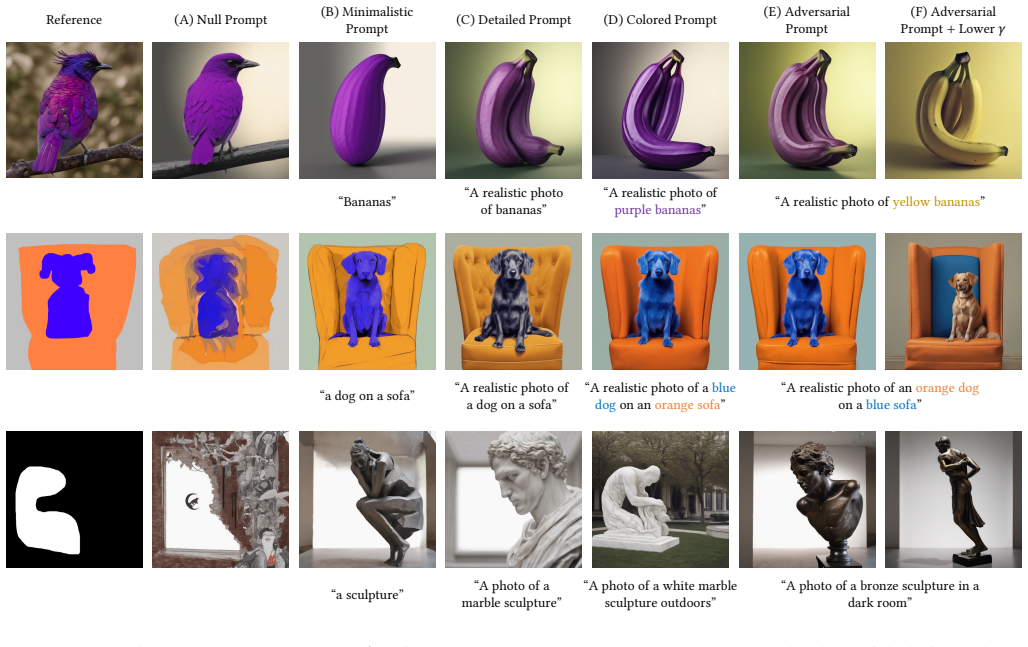
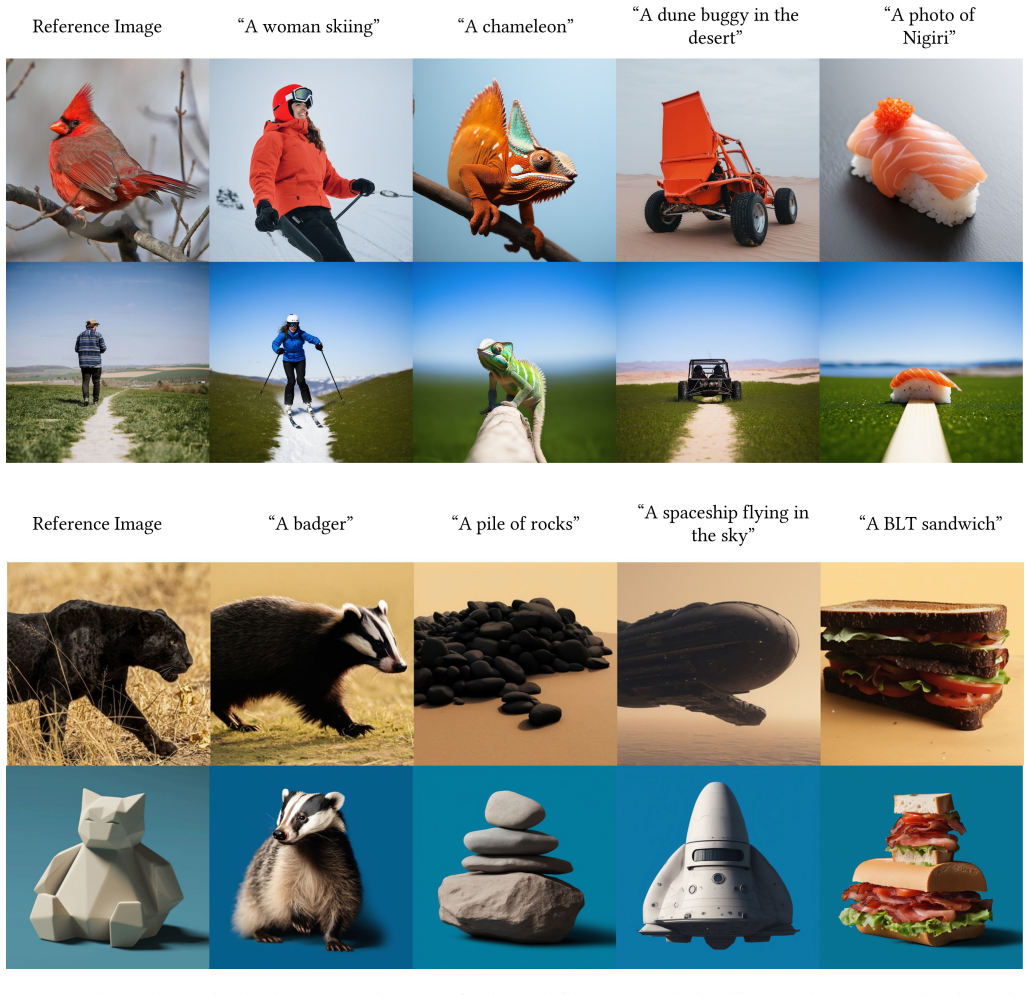
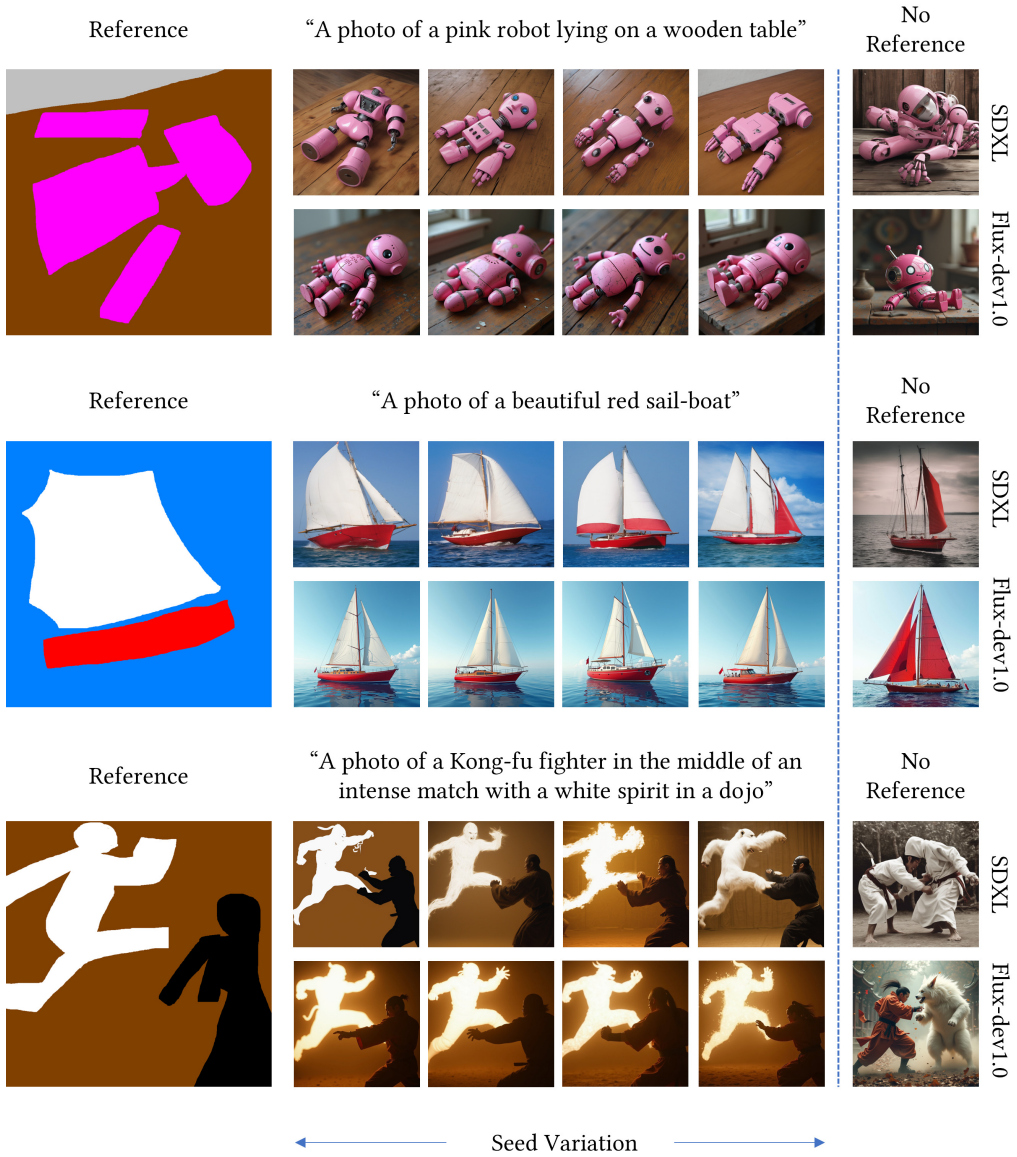
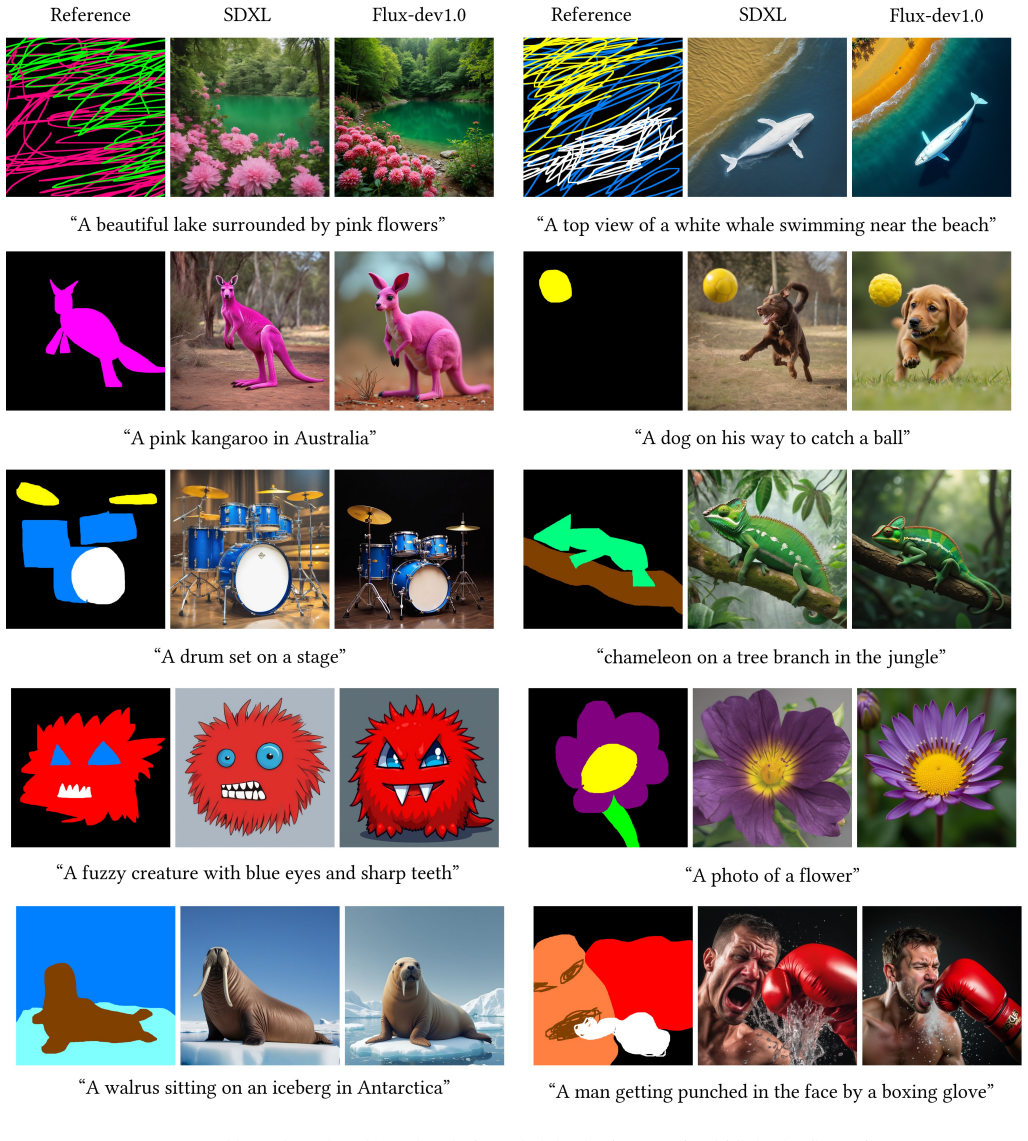
Although all frequencies in white Gaussian noise have comparable statistical energy, low-frequency components primarily determine the image's global structure and color composition, while high-frequency components control finer details. Simple manipulations of the low-frequency noise using low-frequency image priors can therefore condition the generation process to reconstruct those low-frequency visual cues, steering overall appearance while leaving high-frequency components free to produce varied fine details.
What carries the argument
Low-frequency noise manipulation with low-frequency image priors, which isolates the structural and chromatic information in the initial noise and replaces it with a matching prior before the diffusion process begins.
If this is right
- Overall image structure and color can be steered without retraining or modifying the diffusion model.
- High-frequency noise continues to generate diverse fine details, preserving output variability.
- The approach adds minimal computational overhead and works as a plug-in step on existing text-to-image pipelines.
- Specific visual attributes such as color composition become more predictable from the initial noise alone.
Where Pith is reading between the lines
- The same frequency separation might be used to control other mid-level attributes by targeting different bands of the noise spectrum.
- Prompt engineering for color consistency could be partly replaced by this noise-level intervention.
- The method's effectiveness on non-photographic domains such as illustrations or abstract art remains to be checked.
Load-bearing premise
Low-frequency noise components are the dominant drivers of global structure and color, and editing them conditions the output without creating unwanted side effects or interactions with higher frequencies.
What would settle it
Running the diffusion process after low-frequency noise edits and finding that the generated images show no consistent change in global color distribution or coarse layout compared with unedited noise.
Figures










read the original abstract
Text-to-image diffusion models generate images by gradually converting white Gaussian noise into a natural image. White Gaussian noise is well suited for producing diverse outputs from a single text prompt due to its absence of structure. However, this very property limits control over, and predictability of, specific visual attributes, as the noise is not human-interpretable. In this work, we investigate the characteristics of the input noise in diffusion models. We show that, although all frequencies in white Gaussian noise have comparable statistical energy, low-frequency components primarily determine the images global structure and color composition, while high-frequency components control finer details. Building on this observation, we demonstrate that simple manipulations of the low-frequency noise using low-frequency image priors can effectively condition the generation process to reconstruct these low-frequency visual cues. This allows us to define a simple, training-free method with minimal overhead that steers overall image structure and color, while letting high-frequency components freely emerge as fine details, enabling variability across generated outputs.
Editorial analysis
A structured set of objections, weighed in public.
Referee Report
Summary. The paper claims that in text-to-image diffusion models, although all frequencies in the initial white Gaussian noise have comparable energy, the low-frequency components predominantly determine the global structure and color composition of the generated image x_0, while high-frequency components control finer details. Building on this, it proposes a simple training-free method that manipulates the low-frequency part of the noise x_T using low-frequency priors extracted from reference images (via FFT or similar) to steer overall color and structure, while allowing high-frequency noise to produce variable details.
Significance. If the frequency-separation claim holds and the manipulations propagate reliably through the reverse diffusion process, the method would provide an efficient, training-free mechanism for color-based conditioning in diffusion models. This could be valuable for applications needing controllable global attributes without retraining or heavy compute, while preserving output diversity. The approach is lightweight and interpretable, which is a strength if empirically validated.
major comments (3)
- [§3] §3 (Empirical Observation): The central claim that low-frequency noise components primarily determine global structure and color (while high-freq control details) is presented as an observation but lacks quantitative validation such as frequency-domain correlation metrics or ablation studies comparing power spectra of x_T components to those of x_0 across multiple timesteps and models. Without this, it is unclear whether the separation is robust or model-specific.
- [§4] §4 (Method and Propagation): The proposed low-frequency manipulation (e.g., replacement or blending of FFT coefficients in x_T using image priors) assumes that these edits survive the U-Net's downsampling, upsampling, skip connections, and attention layers without significant mixing or dilution across frequency bands. No analysis, frequency decomposition of intermediate activations, or ablation on output spectra is provided to confirm that low-freq control remains localized to color/structure rather than introducing artifacts or being overridden.
- [Evaluation] Evaluation section: The abstract and method description mention 'effectively condition the generation' but the manuscript provides no standard metrics (e.g., color histogram distance, LPIPS for structure, FID for quality, or user studies) comparing the proposed method against baselines like prompt engineering or ControlNet-style conditioning. This makes it impossible to assess whether the claimed variability in details is preserved or if unintended side effects occur.
minor comments (2)
- [§4] The notation for the low-frequency prior extraction (e.g., how the cutoff frequency is chosen or how the prior image is processed) is introduced without a clear equation or pseudocode, making the method harder to reproduce.
- Figure captions and the abstract use 'low-frequency image priors' without specifying whether these are derived from the target image, a reference, or a color palette, which could confuse readers.
Simulated Author's Rebuttal
We thank the referee for the constructive and detailed feedback on our manuscript. We address each major comment point by point below, indicating where revisions will be made to strengthen the paper.
read point-by-point responses
-
Referee: [§3] The central claim that low-frequency noise components primarily determine global structure and color (while high-freq control details) is presented as an observation but lacks quantitative validation such as frequency-domain correlation metrics or ablation studies comparing power spectra of x_T components to those of x_0 across multiple timesteps and models. Without this, it is unclear whether the separation is robust or model-specific.
Authors: We acknowledge that §3 currently relies primarily on qualitative visualizations and illustrative examples to support the frequency-separation observation. To address this, we will add quantitative validation in the revised manuscript, including Pearson correlation metrics between low-frequency FFT components of x_T and x_0, as well as power-spectrum ablation plots across multiple timesteps and diffusion models (e.g., Stable Diffusion variants). These additions will demonstrate the robustness of the claim beyond the current examples. revision: yes
-
Referee: [§4] The proposed low-frequency manipulation (e.g., replacement or blending of FFT coefficients in x_T using image priors) assumes that these edits survive the U-Net's downsampling, upsampling, skip connections, and attention layers without significant mixing or dilution across frequency bands. No analysis, frequency decomposition of intermediate activations, or ablation on output spectra is provided to confirm that low-freq control remains localized to color/structure rather than introducing artifacts or being overridden.
Authors: We agree that explicit propagation analysis is missing. In the revision, we will include frequency-domain decomposition of intermediate U-Net activations (at downsampling, upsampling, and attention layers) for selected examples, showing that low-frequency edits remain largely localized. We will also add output-spectrum ablations demonstrating that high-frequency variability is preserved and that artifacts are minimal when the manipulation strength is controlled. revision: yes
-
Referee: [Evaluation] The abstract and method description mention 'effectively condition the generation' but the manuscript provides no standard metrics (e.g., color histogram distance, LPIPS for structure, FID for quality, or user studies) comparing the proposed method against baselines like prompt engineering or ControlNet-style conditioning. This makes it impossible to assess whether the claimed variability in details is preserved or if unintended side effects occur.
Authors: We recognize the value of quantitative evaluation. The revised evaluation section will report color histogram distances to the reference priors (for color control), LPIPS between generated images and low-frequency priors (for structure), and FID scores to quantify quality and diversity relative to unconditioned sampling. We will also include comparisons against prompt-engineering baselines. Direct comparison to trained methods such as ControlNet will be framed as complementary, highlighting the training-free advantage while noting differences in control granularity. revision: yes
Circularity Check
No circularity; central claim rests on empirical observation of noise frequencies, not self-referential derivation
full rationale
The paper states an observation that low-frequency components of white Gaussian noise primarily determine global structure and color while high-frequency components control details, then builds a training-free manipulation method on this. This is presented as an empirical finding demonstrated via experiments rather than any mathematical derivation, equation, or fitted parameter that reduces the result to its own inputs by construction. No self-citations, ansatzes, or uniqueness theorems are invoked in the provided text to load-bear the claim. The method is self-contained as a direct manipulation of input noise x_T, with no reduction of predictions to prior fits or definitions.
Axiom & Free-Parameter Ledger
axioms (1)
- domain assumption Low-frequency components of white Gaussian noise primarily determine global structure and color composition in generated images
Reference graph
Works this paper leans on
-
[1]
Patricia S. Abril and Robert Plant. The patent holder's dilemma: Buy, sell, or troll?. Communications of the ACM. 2007. doi:10.1145/1188913.1188915
-
[2]
Deciding equivalances among conjunctive aggregate queries
Sarah Cohen and Werner Nutt and Yehoshua Sagic. Deciding equivalances among conjunctive aggregate queries. 2007. doi:10.1145/1219092.1219093
-
[3]
Special issue: Digital Libraries. 1996
work page 1996
-
[4]
Understanding Policy-Based Networking
David Kosiur. Understanding Policy-Based Networking. 2001
work page 2001
-
[7]
The title of book two. 2008. doi:10.1007/3-540-09237-4
-
[8]
Asad Z. Spector. Achieving application requirements. Distributed Systems. 1990. doi:10.1145/90417.90738
-
[9]
Douglass and David Harel and Mark B
Bruce P. Douglass and David Harel and Mark B. Trakhtenbrot. Statecarts in use: structured analysis and object-orientation. Lectures on Embedded Systems. 1998. doi:10.1007/3-540-65193-4_29
-
[10]
Donald E. Knuth. The Art of Computer Programming, Vol. 1: Fundamental Algorithms (3rd. ed.). 1997
work page 1997
-
[11]
Donald E. Knuth. The Art of Computer Programming. 1998
work page 1998
-
[12]
Structured Variational Inference Procedures and their Realizations (as incol)
Dan Geiger and Christopher Meek. Structured Variational Inference Procedures and their Realizations (as incol). Proceedings of Tenth International Workshop on Artificial Intelligence and Statistics, The Barbados
-
[13]
Stan W. Smith. An experiment in bibliographic mark-up: Parsing metadata for XML export. Proceedings of the 3rd. annual workshop on Librarians and Computers. 2010. doi:99.9999/woot07-S422
work page 2010
-
[14]
Catch me, if you can: Evading network signatures with web-based polymorphic worms
Matthew Van Gundy and Davide Balzarotti and Giovanni Vigna. Catch me, if you can: Evading network signatures with web-based polymorphic worms. Proceedings of the first USENIX workshop on Offensive Technologies. 2007
work page 2007
-
[15]
Catch me, if you can: Evading network signatures with web-based polymorphic worms
Matthew Van Gundy and Davide Balzarotti and Giovanni Vigna. Catch me, if you can: Evading network signatures with web-based polymorphic worms. Proceedings of the first USENIX workshop on Offensive Technologies. 2008
work page 2008
-
[16]
Catch me, if you can: Evading network signatures with web-based polymorphic worms
Matthew Van Gundy and Davide Balzarotti and Giovanni Vigna. Catch me, if you can: Evading network signatures with web-based polymorphic worms. Proceedings of the first USENIX workshop on Offensive Technologies. 2009
work page 2009
-
[17]
Sten Andler. Predicate Path expressions. Proceedings of the 6th. ACM SIGACT-SIGPLAN symposium on Principles of Programming Languages. 1979. doi:10.1145/567752.567774
-
[18]
LOGICS of Programs: AXIOMATICS and DESCRIPTIVE POWER
David Harel. LOGICS of Programs: AXIOMATICS and DESCRIPTIVE POWER. 1978
work page 1978
- [19]
- [20]
-
[21]
Introduction to Bayesian Statistics
Harry Thornburg. Introduction to Bayesian Statistics. 2001
work page 2001
-
[22]
CLIFFORD: a Maple 11 Package for Clifford Algebra Computations, version 11
Rafal Ablamowicz and Bertfried Fauser. CLIFFORD: a Maple 11 Package for Clifford Algebra Computations, version 11. 2007
work page 2007
- [23]
- [24]
- [25]
-
[26]
Dave Novak. Solder man. ACM SIGGRAPH 2003 Video Review on Animation theater Program: Part I - Vol. 145 (July 27--27, 2003). 2003. doi:99.9999/woot07-S422
work page 2003
-
[27]
Interview with Bill Kinder: January 13, 2005
Newton Lee. Interview with Bill Kinder: January 13, 2005. Comput. Entertain. 2005. doi:10.1145/1057270.1057278
-
[28]
The Enabling of Digital Libraries
Bernard Rous. The Enabling of Digital Libraries. Digital Libraries. 2008
work page 2008
-
[30]
(new) Finding minimum congestion spanning trees , journal =
Werneck, Renato and Setubal, Jo\. (new) Finding minimum congestion spanning trees , journal =. 2000 , issn =. doi:10.1145/351827.384253 , acmid =
-
[32]
Conti, Mauro and Di Pietro, Roberto and Mancini, Luigi V. and Mei, Alessandro , title =. Inf. Fusion , volume =. 2009 , issn =. doi:10.1016/j.inffus.2009.01.002 , acmid =
-
[33]
Li, Cheng-Lun and Buyuktur, Ayse G. and Hutchful, David K. and Sant, Natasha B. and Nainwal, Satyendra K. , title =. CHI '08 extended abstracts on Human factors in computing systems , year =. doi:10.1145/1358628.1358946 , acmid =
- [34]
-
[35]
Goossens, Michel and Rahtz, S. P. and Moore, Ross and Sutor, Robert S. , title =. 1999 , isbn =
work page 1999
-
[36]
Buss, Jonathan F. and Rosenberg, Arnold L. and Knott, Judson D. , title =. 1987 , source =
work page 1987
-
[37]
CHI '08: CHI '08 extended abstracts on Human factors in computing systems , year =
, note =. CHI '08: CHI '08 extended abstracts on Human factors in computing systems , year =
-
[38]
Algorithms for Closest-Point Problems (Computational Geometry) , year =
Clarkson, Kenneth Lee , advisor =. Algorithms for Closest-Point Problems (Computational Geometry) , year =
-
[39]
SIGCOMM Comput. Commun. Rev. , year =
-
[40]
IEEE TCSC Executive Committee , booktitle =. 2004 , isbn =. doi:http://dx.doi.org/10.1109/ICWS.2004.64 , acmid =
-
[41]
Distributed systems (2nd Ed.) , year =
- [42]
-
[43]
Donald E. Knuth. Seminumerical Algorithms. 1981
work page 1981
-
[44]
E-commerce and cultural values , year =
Kong, Wei-Chang , Title =. E-commerce and cultural values , year =
-
[45]
E-commerce and cultural values , year =
Kong, Wei-Chang , type =. E-commerce and cultural values , year =
-
[46]
Kong, Wei-Chang , editor =. Chapter 9 , booktitle =. 2002 , address =
work page 2002
-
[47]
E-commerce and cultural values , editor =
Kong, Wei-Chang , title =. E-commerce and cultural values , editor =. 2003 , isbn =
work page 2003
-
[48]
E-commerce and cultural values - (InBook-num-in-chap) , chapter =
Kong, Wei-Chang , editor =. E-commerce and cultural values - (InBook-num-in-chap) , chapter =. 2004 , address =
work page 2004
-
[49]
E-commerce and cultural values (Inbook-text-in-chap) , chapter =
Kong, Wei-Chang , editor =. E-commerce and cultural values (Inbook-text-in-chap) , chapter =. 2005 , address =
work page 2005
-
[50]
E-commerce and cultural values (Inbook-num chap) , chapter =
Kong, Wei-Chang , editor =. E-commerce and cultural values (Inbook-num chap) , chapter =. 2006 , address =
work page 2006
-
[51]
Mehdi Saeedi and Morteza Saheb Zamani and Mehdi Sedighi , title =. Microelectron. J. , volume =. 2010 , pages =
work page 2010
-
[52]
Mehdi Saeedi and Morteza Saheb Zamani and Mehdi Sedighi and Zahra Sasanian , title =. J. Emerg. Technol. Comput. Syst. , volume =
-
[53]
Kirschmer, Markus and Voight, John , title =. SIAM J. Comput. , issue_date =. 2010 , issn =. doi:https://doi.org/10.1137/080734467 , acmid =
-
[54]
Hoare, C. A. R. , title =. Structured programming (incoll) , editor =. 1972 , isbn =
work page 1972
-
[55]
History of programming languages I (incoll) , editor =
Lee, Jan , title =. History of programming languages I (incoll) , editor =. 1981 , isbn =. doi:http://doi.acm.org/10.1145/800025.1198348 , acmid =
- [56]
-
[57]
Wenzel, Elizabeth M. , title =. Multimedia interface design (incoll) , year =. doi:10.1145/146022.146089 , acmid =
- [58]
-
[59]
McCracken, Daniel D. and Golden, Donald G. , title =. 1990 , isbn =
work page 1990
-
[60]
The analysis of linear partial differential operators
H. The analysis of linear partial differential operators. 1985 , PAGES =
work page 1985
-
[61]
A. Adya and P. Bahl and J. Padhye and A.Wolman and L. Zhou , title =. Proceedings of the IEEE 1st International Conference on Broadnets Networks (BroadNets'04) , publisher = "IEEE", address = "Los Alamitos, CA", year =
-
[62]
I. F. Akyildiz and W. Su and Y. Sankarasubramaniam and E. Cayirci , title =. Comm. ACM , volume = 38, number = "4", year =
-
[63]
I. F. Akyildiz and T. Melodia and K. R. Chowdhury , title =. Computer Netw. , volume = 51, number = "4", year =
-
[64]
P. Bahl and R. Chancre and J. Dungeon , title =. Proceeding of the 10th International Conference on Mobile Computing and Networking (MobiCom'04) , publisher = "ACM", address = "New York, NY", year =
-
[65]
8 (Special Issue on Sensor Networks)
D. Culler and D. Estrin and M. Srivastava , title =. IEEE Comput. , volume = 37, number = "8 (Special Issue on Sensor Networks)", publisher = "IEEE", address = "Los Alamitos, CA", year =
-
[66]
A. Natarajan and M. Motani and B. de Silva and K. Yap and K. C. Chua , title =. Network Architectures , editor =. 960935712
- [67]
- [68]
-
[69]
Mapping Powerlists onto Hypercubes
Jacob Kornerup. Mapping Powerlists onto Hypercubes. 1994
work page 1994
-
[70]
Automatic Parallelization for Distributed-Memory Multiprocessing Systems
Michael Gerndt. Automatic Parallelization for Distributed-Memory Multiprocessing Systems
-
[71]
J. E. Archer, Jr. and R. Conway and F. B. Schneider. User recovery and reversal in interactive systems. ACM Trans. Program. Lang. Syst
-
[72]
D. D. Dunlop and V. R. Basili. Generalizing specifications for uniformly implemented loops. ACM Trans. Program. Lang. Syst
-
[73]
J. Heering and P. Klint. Towards monolingual programming environments. ACM Trans. Program. Lang. Syst
-
[74]
Donald E. Knuth. The book
-
[75]
E. Korach and D. Rotem and N. Santoro. Distributed algorithms for finding centers and medians in networks. ACM Trans. Program. Lang. Syst
- [76]
-
[77]
F. Nielson. Program transformations in a denotational setting. ACM Trans. Program. Lang. Syst
-
[78]
Brian K. Reid. A high-level approach to computer document formatting. Proceedings of the 7th Annual Symposium on Principles of Programming Languages
-
[79]
Zhou, Gang and Wu, Yafeng and Yan, Ting and He, Tian and Huang, Chengdu and Stankovic, John A. and Abdelzaher, Tarek F. , title =. ACM Trans. Embed. Comput. Syst. , issue_date =. doi:10.1145/1721695.1721705 , acmid = 1721705, publisher =
-
[80]
Institutional members of the Users Group
-
[81]
Boris Veytsman , title =
-
[82]
Bowman, Mic and Debray, Saumya K. and Peterson, Larry L. , title =. ACM Trans. Program. Lang. Syst. , volume =. 1993 , doi =
work page 1993
- [83]
-
[84]
Malcolm Clark. Post Congress Tristesse. TeX90 Conference Proceedings
discussion (0)
Sign in with ORCID, Apple, or X to comment. Anyone can read and Pith papers without signing in.