Recognition: unknown
rho mesons in finite magnetic field and finite temperature
Pith reviewed 2026-05-09 18:39 UTC · model grok-4.3
The pith
Rho mesons acquire multiple mass solutions in magnetic fields because their constituent quarks undergo dimension reduction.
A machine-rendered reading of the paper's core claim, the machinery that carries it, and where it could break.
Core claim
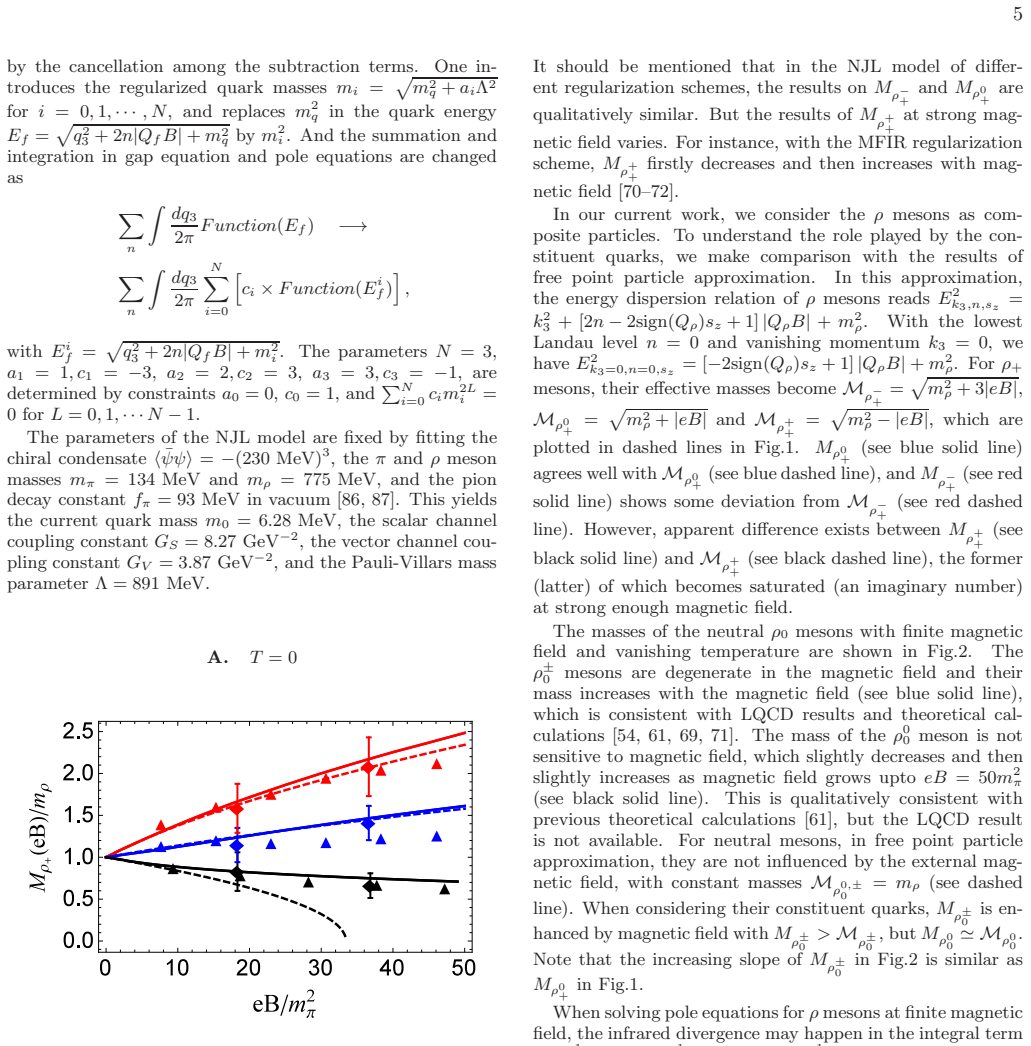
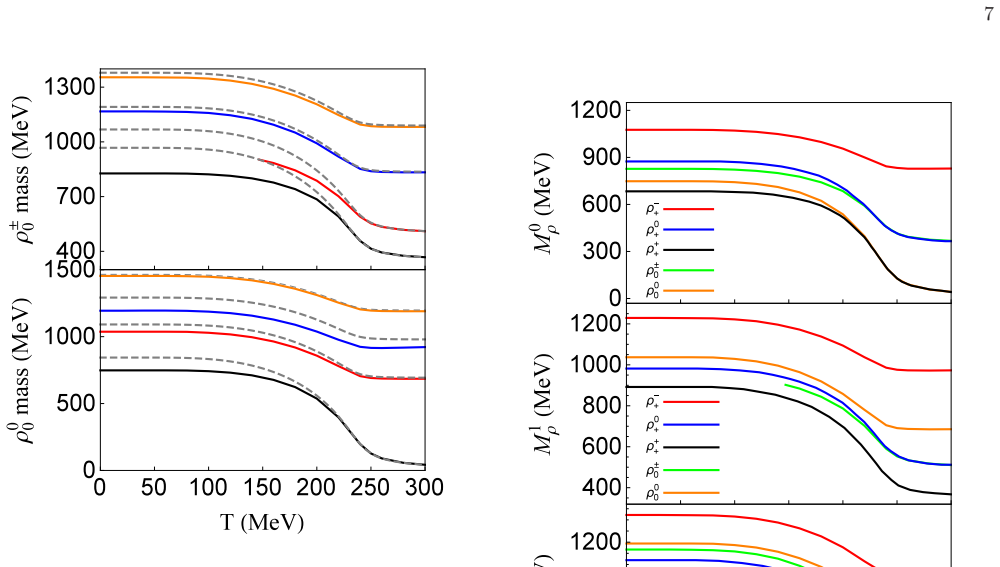
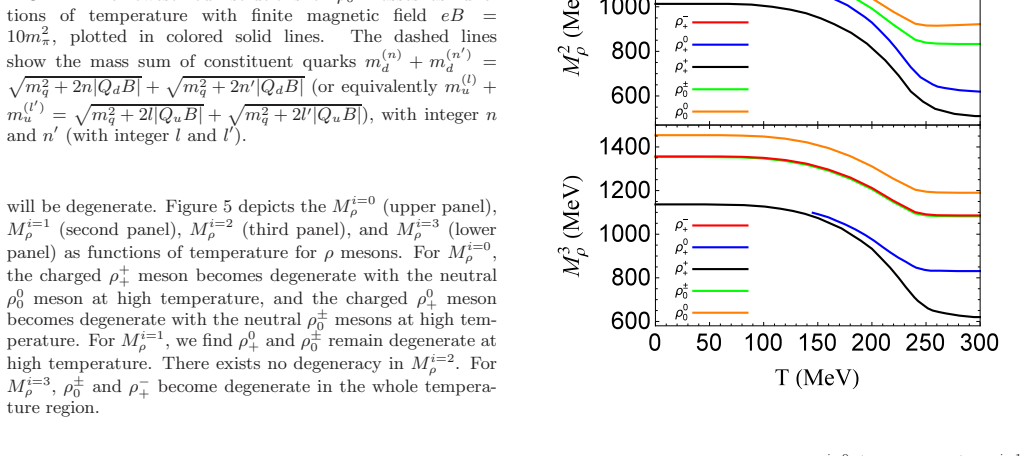
When the pole equation of the rho meson propagators is solved, multiple mass solutions appear because the magnetic field reduces the effective dimensionality of the constituent quarks. At vanishing temperature the lowest solutions are tracked: the masses of rho minus positive, rho zero positive, and rho plus zero rise with field strength, the rho plus positive mass first drops then saturates, and the rho zero zero mass is insensitive to the field; these patterns match available lattice QCD results. At finite temperature the lowest four or five solutions for each rho state decrease and approach the sum of the constituent quark masses at high temperature, and some of the solutions for charged,
What carries the argument
the pole equation obtained from the rho meson propagator in the Ritus or Schwinger basis, whose multiple roots originate in the Landau-level quantization and dimensional reduction of the quark loop.
If this is right
- At zero temperature the lowest mass of the positively charged rho with positive spin projection decreases initially and then becomes independent of further increases in the magnetic field.
- The lowest masses of rho-minus positive, rho-zero positive, and rho-plus zero all increase steadily with magnetic field strength.
- The lowest mass of the neutral rho with zero spin projection stays nearly constant as the magnetic field grows.
- At fixed magnetic field every lowest mass solution falls with rising temperature and approaches twice the constituent quark mass in the high-temperature limit.
- At combined finite magnetic field and temperature some mass solutions belonging to different charge and polarization states become degenerate.
Where Pith is reading between the lines
- In heavy-ion collisions or magnetized astrophysical matter the splitting into multiple mass branches could produce observable shifts in dilepton or decay spectra.
- The convergence of all solutions to the quark-mass sum at high temperature supplies a concrete signature for the crossover from hadronic to quark degrees of freedom.
- The appearance of degeneracies at finite B and T suggests that spin and charge distinctions among rho states may wash out under realistic conditions.
- Extending the calculation to include vector-meson mixing or three flavors could test whether the neutral-state insensitivity survives.
Load-bearing premise
The two-flavor Nambu-Jona-Lasinio model with its usual regularization and mean-field treatment continues to give reliable rho-meson masses once magnetic fields quantize the quark spectrum and temperature is added.
What would settle it
A lattice QCD calculation at zero temperature that finds only one mass solution per rho state or shows the rho-plus-positive mass continuing to decrease without saturation at high field strength would contradict the central claim.
Figures


read the original abstract
The mass spectra of $\rho$ mesons ($\rho_{Q=\pm 1}^{s_z=0,\pm 1}$ and $\rho_{Q=0}^{s_z=0,\pm 1}$) at finite magnetic field and temperature are studied in frame of the two-flavor Nambu-Jona-Lasinio model. Fully considering the breaking of translational invariance induced by external magnetic field, the analytical form of $\rho$ meson propagators have been derived in the Ritus scheme and Schwinger scheme, which gives the same algebraic formula. When solving the pole equation of $\rho$ meson propagators, multiple solutions of the meson mass appear due to the dimension reduction of their constituent quarks in magnetic fields. At vanishing temperature, we focus on the $\rho$ meson masses $M_{\rho}$ corresponding to the lowest value solution of the pole equation. $M_{\rho^{-}_+}$, $M_{\rho^{0}_+}$ and $M_{\rho^{\pm}_0}$ increase with magnetic field. $M_{\rho^{+}_+}$ firstly decreases and then becomes saturated with increasing magnetic field. $M_{\rho^0_0}$ is not sensitive to magnetic field. These results are consistent with the available LQCD simulations. At finite temperature, we discuss the lowest four/five solutions of $\rho$ meson masses $M^{i=0,1,2,3,4}_{\rho}$. With fixed magnetic field, they decrease with temperature, and approach the mass sum of their constituent quarks at high temperature. The mass solution $M^{i}_{\rho}$ for different mesons $\rho_+^{0,\pm}$ and $\rho_0^{0,\pm}$ may become degenerate at finite magnetic field and temperature.
Editorial analysis
A structured set of objections, weighed in public.
Referee Report
Summary. The manuscript investigates the mass spectra of ρ mesons (charged and neutral, with various spin projections) in the two-flavor Nambu–Jona-Lasinio model at finite magnetic field B and temperature T. The authors derive the analytical form of the ρ propagators in the Ritus and Schwinger schemes, accounting for translational invariance breaking, and solve the resulting pole equations. Multiple mass solutions appear due to the Landau-level structure and dimension reduction of the constituent quarks. At T=0 the lowest solutions exhibit specific B-dependencies (increasing for M_ρ⁻₊, M_ρ⁰₊, M_ρ±₀; decreasing then saturating for M_ρ⁺₊; insensitive for M_ρ⁰₀), claimed consistent with LQCD. At finite T the lowest four/five solutions decrease toward the constituent-quark mass sum, with possible degeneracies between different charge/polarization channels.
Significance. If the central trends hold, the work offers a concrete illustration of how magnetic quantization induces multiple poles and modifies vector-meson masses in a chiral effective model, with potential relevance to magnetized QCD matter. The explicit propagator derivation that agrees between the Ritus and Schwinger schemes is a technical strength. However, because the quantitative B- and T-dependence rests on vacuum-fitted parameters and a mean-field cutoff regularization whose validity at finite B is untested, the results remain exploratory rather than predictive.
major comments (4)
- [Model setup / parameter determination] Model-setup section (parameter fixing): The four-fermion coupling G and ultraviolet cutoff Λ are determined exclusively from vacuum (B=T=0) observables and then reused unchanged at finite B. Because the cutoff now competes with the Landau-level spacing √(eB), the regularization procedure becomes B-dependent in an uncontrolled manner; this directly affects the reported B-dependence of the lowest M_ρ solutions. A cutoff-sensitivity study or alternative regularization (e.g., proper-time) is required to establish robustness.
- [T=0 results] T=0 results section (lowest-mass solutions and LQCD comparison): The abstract and results claim consistency with available LQCD simulations, yet no error bars on the model masses, no tabulated numerical values, and no direct overlay or χ² comparison with specific LQCD data sets are provided. Without these, the consistency statement cannot be evaluated quantitatively.
- [Pole equation solutions] Pole-equation analysis (multiple solutions): While the appearance of multiple roots is attributed to quark dimension reduction, the manuscript selects the “lowest value solution” for the reported masses without a clear physical criterion (e.g., residue strength, continuity with B=0, or relation to the vector spectral function). Higher solutions are mentioned but not interpreted; their omission from the main claims needs justification.
- [Finite temperature results] Finite-T discussion: The mean-field treatment omits meson-loop corrections that become sizable near the chiral crossover. This approximation may alter the temperature dependence and the reported degeneracies; an estimate of the size of such corrections (or a comparison with beyond-mean-field results) would strengthen the finite-T claims.
minor comments (3)
- [Introduction / notation] Notation: the labeling of the various ρ_Q^{s_z} channels is introduced without an explicit table; a compact summary table would improve readability.
- [Results figures] Figures: the plots of M_ρ versus B (T=0) and versus T (finite B) lack error bands or sensitivity bands from parameter variation, making visual assessment of trends harder.
- [Introduction] References: several earlier NJL studies of vector mesons in magnetic fields are cited, but the manuscript does not explicitly contrast its propagator derivation or regularization choice with those works.
Simulated Author's Rebuttal
We thank the referee for the careful reading and constructive comments. We address each of the major comments below and indicate the revisions we will make to the manuscript.
read point-by-point responses
-
Referee: Model setup / parameter determination: The four-fermion coupling G and ultraviolet cutoff Λ are determined exclusively from vacuum (B=T=0) observables and then reused unchanged at finite B. Because the cutoff now competes with the Landau-level spacing √(eB), the regularization procedure becomes B-dependent in an uncontrolled manner; this directly affects the reported B-dependence of the lowest M_ρ solutions. A cutoff-sensitivity study or alternative regularization (e.g., proper-time) is required to establish robustness.
Authors: We appreciate the referee pointing out the potential issues with the cutoff regularization at finite magnetic field. While using vacuum parameters is the conventional approach in NJL model applications to finite B (as the model parameters are not inherently B-dependent), we agree that demonstrating robustness is important. In the revised manuscript, we will add a new subsection or appendix performing a cutoff sensitivity analysis. Specifically, we will vary the cutoff Λ by ±5% and ±10% around the vacuum value and recompute the B-dependence of the lowest ρ masses, showing that the qualitative trends (e.g., increasing for M_ρ⁻₊ etc.) persist, although the saturation values may shift. This will help establish that the reported behaviors are not artifacts of the specific cutoff choice. revision: yes
-
Referee: T=0 results section (lowest-mass solutions and LQCD comparison): The abstract and results claim consistency with available LQCD simulations, yet no error bars on the model masses, no tabulated numerical values, and no direct overlay or χ² comparison with specific LQCD data sets are provided. Without these, the consistency statement cannot be evaluated quantitatively.
Authors: We agree that the consistency with LQCD should be supported by more quantitative evidence. In the revised version, we will include a table in the T=0 results section that lists our calculated lowest masses for several values of eB (such as 0, 0.1, 0.2, 0.3 GeV²) for the different charge and spin states, alongside the corresponding LQCD results from relevant simulations (e.g., those showing increase or decrease in masses). Where LQCD provides error bars, we will include them for comparison. We will also add a brief discussion on the agreement, noting that while the model is not expected to match exactly due to its effective nature, the directional trends align with LQCD findings. This will allow readers to evaluate the consistency quantitatively. revision: yes
-
Referee: Pole-equation analysis (multiple solutions): While the appearance of multiple roots is attributed to quark dimension reduction, the manuscript selects the “lowest value solution” for the reported masses without a clear physical criterion (e.g., residue strength, continuity with B=0, or relation to the vector spectral function). Higher solutions are mentioned but not interpreted; their omission from the main claims needs justification.
Authors: The choice of the lowest solution is motivated by its continuity with the B=0 ρ mass and its expected dominance in the spectral function at low energies. Higher solutions arise from the Landau level structure and correspond to states with higher effective masses. To address this, we will revise the relevant section to explicitly describe the selection criterion, including a brief calculation or statement on the residue of the propagator for the lowest pole to confirm it is the primary one. Additionally, we will add a paragraph interpreting the higher solutions as possible excitations or unphysical artifacts within the model approximation, justifying why they are not the focus of the main claims. This will provide the needed physical justification. revision: yes
-
Referee: Finite-T discussion: The mean-field treatment omits meson-loop corrections that become sizable near the chiral crossover. This approximation may alter the temperature dependence and the reported degeneracies; an estimate of the size of such corrections (or a comparison with beyond-mean-field results) would strengthen the finite-T claims.
Authors: We recognize that the mean-field approximation neglects meson fluctuations, which can be significant near the chiral crossover temperature. A full inclusion of meson loops would require going beyond the current framework, which is outside the scope of this study. In the revised manuscript, we will enhance the discussion of finite-T results by adding a paragraph that acknowledges this limitation and provides an estimate based on existing literature for the NJL model at finite T (without B), where meson-loop corrections typically modify meson masses by up to 20-30% near Tc. We will argue that the main features—decrease with T, approach to constituent quark mass sum, and degeneracies at finite B and T—originate from the underlying chiral dynamics and magnetic quantization, and are likely robust against such corrections. This will strengthen the presentation of the finite-T claims. revision: partial
Circularity Check
No significant circularity in the derivation of rho meson spectra
full rationale
The paper derives the rho propagator analytically in both Ritus and Schwinger schemes for finite B, obtains an identical algebraic pole equation, and solves it numerically for multiple mass roots arising from Landau-level quantization of the constituent quarks. Model parameters (G, Lambda) are fixed once in vacuum using standard NJL procedures and then held fixed; the finite-B,T masses are genuine outputs of that fixed model rather than being redefined or statistically forced to equal the vacuum inputs. No load-bearing self-citation, imported uniqueness theorem, or ansatz smuggling is present. Consistency with LQCD is presented as an external check, not as part of the derivation chain. The central claim (multiple solutions from dimension reduction) follows directly from the Landau-level structure and is independent of the vacuum fit.
Axiom & Free-Parameter Ledger
free parameters (2)
- NJL four-fermion coupling G
- Ultraviolet cutoff Lambda
axioms (2)
- domain assumption Mean-field approximation for the NJL gap equation and meson propagators
- domain assumption Equivalence of Ritus and Schwinger representations for the rho propagator in a magnetic field
Reference graph
Works this paper leans on
-
[1]
D. E. Kharzeev, L. D. McLerran, and H. J. Warringa, Nucl. Phys. A 803, 227 (2008)
2008
-
[2]
D. E. Kharzeev and H. Warringa, Phys. Rev. D 78, 074033 (2008)
2008
-
[3]
D. E. Kharzeev, Nucl. Phys. A 830, 543c (2009)
2009
-
[4]
D. E. Kharzeev and H. J. Warringa, Phys. Rev. D 80, 034028 (2009)
2009
-
[5]
Skokov, A
V. Skokov, A. Y. Illarionov, and V. Toneev, Int. J. Mod. 10 Phys. A 24, 5925 (2009)
2009
-
[6]
Voronyuk, V
V. Voronyuk, V. D. Toneev, W. Cassing, E. L. Bratkovskaya, V. P. Konchakovski, and S. A. Voloshin, Phys. Rev. C 83, 054911 (2011)
2011
-
[7]
Deng and X
W. Deng and X. Huang, Phys. Rev. C 85, 044907 (2012)
2012
-
[8]
Ba¸ sar, D
G. Ba¸ sar, D. E. Kharzeev, and V. Skokov, Phys. Rev. Lett. 109, 202303 (2012)
2012
-
[9]
Kouveliotou, S
C. Kouveliotou, S. Dieters, T. Strohmayer, J. Van Paradijs, G. Fishman, C. Meegan, K. Hur- ley, et al., Nature 393, 235 (1998)
1998
-
[10]
E. J. Ferrer, V. de La Incera, J. P. Keith, I. Portillo, an d P. L. Springsteen, Phys. Rev. C 82, 065802 (2010)
2010
-
[11]
Paulucci, E
L. Paulucci, E. J. Ferrer, V. de La Incera, and J. E. Horvath, Phys. Rev. D 83, 043009 (2011)
2011
-
[12]
Isayev and J
A. Isayev and J. Yang, Phys. Rev. C 84, 065802 (2011)
2011
-
[13]
E. J. Ferrer and V. de la Incera, Lect. Notes Phys. 871, 399 (2013)
2013
-
[14]
Mallick and S
R. Mallick and S. Schramm, Phys. Rev. C 89, 045805 (2014)
2014
-
[15]
D. P. Menezes, M. B. Pinto, L. B. Castro, P. Costa, and C. Providˆ encia, Phys. Rev. C 89, 055207 (2014)
2014
-
[16]
P. Chu, X. Wang, L. Chen, and M. Huang, Phys. Rev. D 91, 023003 (2015)
2015
-
[17]
Cao and P
G. Cao and P. Zhuang, Phys. Rev. D 92, 105030 (2015)
2015
-
[18]
Vachaspati, Phys
T. Vachaspati, Phys. Lett. B 265, 258 (1991)
1991
-
[19]
Enqvist and P
K. Enqvist and P. Olesen, Phys. Lett. B 319, 178 (1993)
1993
-
[20]
Cheng and A
B. Cheng and A. V. Olinto, Phys. Rev. D 50, 2421 (1994)
1994
-
[21]
G. Baym, D. B¨ odeker, and L. McLerran, Phys. Rev. D 53, 662 (1996)
1996
-
[22]
Ayala, J
A. Ayala, J. L. Hern´ andez, L. A. Hernandez, R. L. Farias, and R. Zamora, Phys. Rev. D 103, 054038 (2021)
2021
-
[23]
R. M. Aguirre, Phys. Rev. D 96, 096013 (2017)
2017
-
[24]
Ayala, R
A. Ayala, R. L. Farias, S. Hern´ andez-Ortiz, L. A. Hern´ andez, D. M. Paret, and R. Zamora, Phys. Rev. D 98, 114008 (2018)
2018
-
[25]
Das and N
A. Das and N. Haque, Phys. Rev. D 101, 074033 (2020)
2020
-
[26]
Nasser Tawfik, A
A. Nasser Tawfik, A. Magied Diab, and M. Hussein, Chin. Phys. C 43, 034103 (2019)
2019
-
[27]
Luschevskaya, O
E. Luschevskaya, O. Solovjeva, O. A. Kochetkov, and O. Teryaev, Nucl. Phys. B 898, 627 (2015)
2015
-
[28]
H. Ding, S. Li, A. Tomiya, X. Wang, and Y. Zhang, Phys. Rev. D 104, 014505 (2021)
2021
-
[29]
S. S. Avancini, R. L. Farias, M. B. Pinto, W. R. Tavares, and V. S. Tim´ oteo, Phys. Lett. B 767, 247 (2017)
2017
-
[30]
S. S. Avancini, W. R. Tavares, and M. B. Pinto, Phys. Rev. D 93, 014010 (2016)
2016
-
[31]
Fayazbakhsh, S
S. Fayazbakhsh, S. Sadeghian, and N. Sadooghi, Phys. Rev. D 86, 085042 (2012)
2012
-
[32]
Fayazbakhsh and N
S. Fayazbakhsh and N. Sadooghi, Phys. Rev. D 88, 065030 (2013)
2013
-
[33]
Sheng, Y
B. Sheng, Y. Wang, X. Wang, and L. Yu, Phys. Rev. D 103, 094001 (2021)
2021
-
[34]
Sheng, X
B. Sheng, X. Wang, and L. Yu, Phys. Rev. D 105, 034003 (2022)
2022
-
[35]
G´ omez Dumm, M
D. G´ omez Dumm, M. F. Izzo Villafa˜ ne, and N. N. Scoc- cola, Phys. Rev. D 97, 034025 (2018)
2018
-
[36]
S. S. Avancini, R. L. Farias, and W. R. Tavares, Phys. Rev. D 99, 056009 (2019)
2019
-
[37]
J. O. Andersen, Phys. Rev. D 86, 025020 (2012)
2012
-
[38]
Luschevskaya, O
E. Luschevskaya, O. Solovjeva, and O. Teryaev, Phys. Lett. B 761, 393 (2016)
2016
-
[39]
Wang and P
Z. Wang and P. Zhuang, Phys. Rev. D 97, 034026 (2018)
2018
-
[40]
Zhang, W
R. Zhang, W. Fu, and Y. Liu, Eur. Phys. J. C 76, 1 (2016)
2016
-
[41]
H. Liu, X. Wang, L. Yu, and M. Huang, Phys. Rev. D 97, 076008 (2018)
2018
-
[42]
J. Li, G. Cao, and L. He, Phys. Rev. D 104, 074026 (2021)
2021
-
[43]
Li and S
L. Li and S. Mao, Chin. Phys. C 46, 094105 (2022)
2022
-
[44]
Li and S
L. Li and S. Mao, Phys. Rev. D 108, 054001 (2023)
2023
-
[45]
Coppola, D
M. Coppola, D. G. Dumm, S. Noguera, and N. N. Scoc- cola, Phys. Rev. D 100, 054014 (2019)
2019
-
[46]
K. Xu, J. Chao, and M. Huang, Phys. Rev. D 103, 076015 (2021)
2021
-
[47]
Orlovsky and Y
V. Orlovsky and Y. A. Simonov, J. High Energy Phys. 2013, 1 (2013)
2013
-
[48]
Hattori, T
K. Hattori, T. Kojo, and N. Su, Nucl. Phys. A 951, 1 (2016)
2016
-
[49]
Y. A. Simonov, Phys. At. Nucl. 79, 455 (2016)
2016
-
[50]
Kojo, Eur
T. Kojo, Eur. Phys. J. A 57, 317 (2021)
2021
-
[51]
Mishra and S
A. Mishra and S. Misra, Int. J. Mod. Phys. E 30, 2150014 (2021)
2021
-
[52]
S. S. Avancini, J. C. Sodr´ e, M. Coppola, and N. N. Scoc- cola, Phys. Rev. D 104, 094040 (2021)
2021
-
[53]
Z. Xing, J. Chao, L. Chang, and Y. Liu, Phys. Rev. D 105, 114003 (2022)
2022
-
[54]
Larina, E
O. Larina, E. Luschevskaya, O. Kochetkov, and O. Teryaev, Proc. Sci. LATTICE2014, 120 (2014)
2014
-
[55]
Wei and M
M. Wei and M. Huang, Chin. Phys. C 47, 104105 (2023)
2023
- [56]
-
[57]
J. Mei, T. Xia, and S. Mao, Phys. Rev. D 107, 074018 (2023)
2023
-
[58]
Mao and Y
S. Mao and Y. Wang, Phys. Rev. D 96, 034004 (2017)
2017
-
[59]
Sheng, S
X. Sheng, S. Yang, Y. Zou, and D. Hou, Eur. Phys. J. C 84, 299 (2024)
2024
-
[60]
Ghosh, A
S. Ghosh, A. Mukherjee, N. Chaudhuri, P. Roy, and S. Sarkar, Phys. Rev. D 101, 056023 (2020)
2020
-
[61]
S. S. Avancini, R. L. Farias, W. R. Tavares, and V. S. Tim´ oteo, Nucl. Phys. B981, 115862 (2022)
2022
-
[62]
Colucci, E
G. Colucci, E. S. Fraga, and A. Sedrakian, Phys. Lett. B 728, 19 (2014)
2014
-
[63]
Hidaka and A
Y. Hidaka and A. Yamamoto, Phys. Rev. D 87, 094502 (2013)
2013
-
[64]
Coppola, D
M. Coppola, D. G. Dumm, and N. N. Scoccola, Phys. Lett. B 782, 155 (2018)
2018
-
[65]
Mao, Phys
S. Mao, Phys. Rev. D 99, 056005 (2019)
2019
-
[66]
Y. Tian, J. Zhang, Z. Liu, J. Mei, M. Zhou, C. Xie, G. Shao, and S. Mao, PRD under review (2026)
2026
-
[67]
J. Chao and K. Xu, arXiv. 2604.24595 (2026)
work page internal anchor Pith review Pith/arXiv arXiv 2026
-
[68]
Luschevskaya, O
E. Luschevskaya, O. Solovjeva, and O. Teryaev, J. High Energy Phys. 2017, 1 (2017)
2017
-
[69]
G. S. Bali, B. B. Brandt, G. Endr˝ odi, and B. Gl¨ aßle, Phys. Rev. D 97, 034505 (2018)
2018
-
[70]
J. P. Carlomagno, D. Gomez Dumm, M. F. Izzo Vil- lafa˜ ne, S. Noguera, and N. N. Scoccola, Phys. Rev. D 106, 094035 (2022)
2022
-
[71]
Coppola, D
M. Coppola, D. Gomez Dumm, S. Noguera, and N. N. Scoccola, Phys. Rev. D 109, 054014 (2024)
2024
-
[72]
G´ omez Dumm, S
D. G´ omez Dumm, S. Noguera, and N. N. Scoccola, Phys. Rev. D 108, 016012 (2023)
2023
-
[73]
J. Mei, R. Wen, M. Zhou, S. Mao, and M. Huang, Phys. Rev. D 113, 074031 (2026)
2026
-
[74]
S. P. Klevansky, Rev. Mod. Phys. 64, 649 (1992)
1992
-
[75]
Nambu and G
Y. Nambu and G. Jona-Lasinio, Phys. Rev. 124, 246 (1961)
1961
-
[76]
Volkov, Phys
M. Volkov, Phys. Part. Nucl. 24 (1992)
1992
-
[77]
Hatsuda and T
T. Hatsuda and T. Kunihiro, Phys. Rep. 247, 221 (1994). 11
1994
-
[78]
Buballa, Phys
M. Buballa, Phys. Rep. 407, 205 (2005)
2005
-
[79]
Zhuang, J
P. Zhuang, J. H¨ ufner, and S. Klevansky, Nucl. Phys. A 576, 525 (1994)
1994
-
[80]
J. O. Andersen, W. R. Naylor, and A. Tranberg, Rev. Mod. Phys. 88, 025001 (2016)
2016
discussion (0)
Sign in with ORCID, Apple, or X to comment. Anyone can read and Pith papers without signing in.