Recognition: unknown
Mass spectra of charged mesons and the quenching of vector meson condensation via exact phase-space diagonalization
Pith reviewed 2026-05-08 02:51 UTC · model grok-4.3
The pith
Magnetic catalysis in the NJL model quenches the tachyonic instability of the charged rho meson by raising the continuum threshold above the Zeeman attraction.
A machine-rendered reading of the paper's core claim, the machinery that carries it, and where it could break.
Core claim
In the two-flavor NJL model the exact algebraic diagonalization of the Bethe-Salpeter equations reveals that the tachyonic instability of the spin-aligned rho+ state is quenched. The magnetic catalysis of the chiral condensate drives the continuum threshold (2M) upwards, overtaking the Zeeman attraction and preventing vector meson condensation within this mean-field framework.
What carries the argument
The non-commutative phase-space framework obtained via the Wigner-Weyl transform and Moyal star product, which permits algebraic diagonalization of the Bethe-Salpeter kernel for mesons carrying asymmetric fractional charges.
If this is right
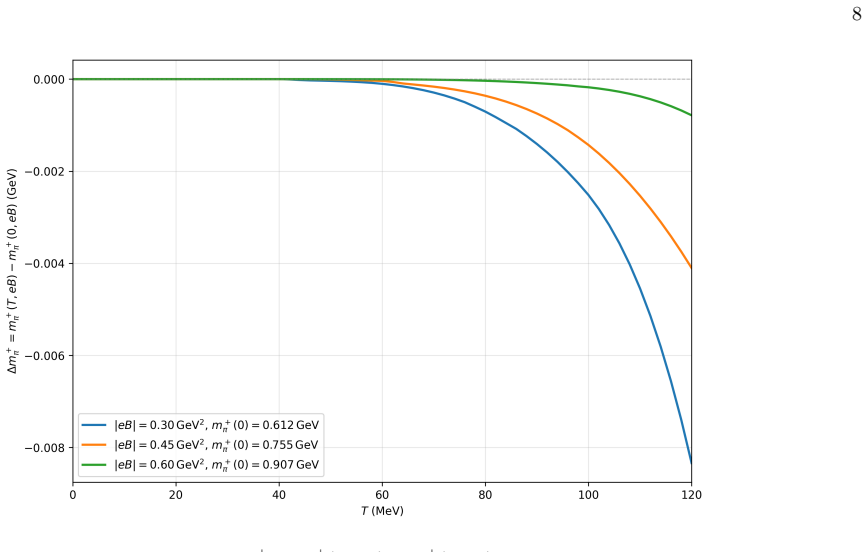
- The generalized Goldstone theorem holds exactly for the charged pion, whose mass tracks the kinematic zero-point energy at order eB.
- The Zeeman spin-splitting in the vector channel emerges dynamically from microscopic threshold truncations set by the chiral Dirac algebra.
- All meson modes remain bound at finite temperature and undergo only monotonic thermal suppression without Mott dissociation before chiral restoration.
- Vector meson condensation is absent in this mean-field description of QCD matter in strong magnetic fields.
Where Pith is reading between the lines
- The result implies that any observation of rho condensation would require either going beyond mean-field or altering the regularization scheme.
- The phase-space diagonalization technique can be applied to other composite operators or to multi-flavor extensions.
- The quenching mechanism may constrain the location of possible magnetic phases in the QCD phase diagram relevant to heavy-ion collisions or magnetars.
Load-bearing premise
The two-flavor NJL model in the mean-field approximation with the chosen regularization and truncation of the Bethe-Salpeter kernel remains valid for the vector channel at finite magnetic field and temperature.
What would settle it
A lattice QCD calculation or a beyond-mean-field NJL study that finds the spin-aligned rho+ pole mass becoming imaginary below the two-quark threshold in a sufficiently strong magnetic field would falsify the quenching result.
Figures




read the original abstract
We investigate the dynamics and mass spectra of charged pseudoscalar ($\pi^+$) and vector ($\rho^+$) mesons in a background magnetic field at finite temperature using the two-flavor Nambu-Jona--Lasinio (NJL) model. By employing a quark propagator that isolates the Schwinger phase from its Landau level expansion, we formulate an exact non-commutative phase-space framework utilizing the Wigner-Weyl transform and the Moyal star product. This approach enables the algebraic diagonalization of the Bethe-Salpeter equations for composite states with asymmetric fractional constituent charges. For the pseudoscalar channel, we analytically verify the exact cancellation between the dynamical random phase approximation spatial sum rules and the vacuum gap equation. This identity preserves the generalized Goldstone theorem, causing the $\pi^+$ pole mass to strictly track the kinematic zero-point energy drift at order of $eB$. In the vector channel, our full phase-space evaluation reveals that the Zeeman spin-splitting emerges dynamically from microscopic threshold truncations governed by the chiral Dirac algebra. Notably, we find that the tachyonic instability of the spin-aligned $\rho^+$ state is quenched. The magnetic catalysis of the chiral condensate drives the continuum threshold ($2M$) upwards, overtaking the Zeeman attraction and preventing vector meson condensation within this mean-field framework. Furthermore, finite-temperature evaluations show a monotonic thermal suppression of the meson masses driven by Pauli blocking, yet all modes remain bound without undergoing Mott dissociation prior to chiral symmetry restoration.
Editorial analysis
A structured set of objections, weighed in public.
Referee Report
Summary. The manuscript develops an exact non-commutative phase-space framework (Wigner-Weyl transform and Moyal star product) to diagonalize the Bethe-Salpeter equations for charged π+ and ρ+ mesons in the two-flavor NJL model at finite B and T. It analytically verifies cancellation identities that preserve the generalized Goldstone theorem for the pseudoscalar channel, so that the π+ pole mass tracks the kinematic zero-point energy. For the vector channel, a full phase-space evaluation shows that the Zeeman spin-splitting emerges from the chiral Dirac algebra in the threshold truncation; the tachyonic instability of the spin-aligned ρ+ is quenched because magnetic catalysis raises the continuum threshold 2M above the Zeeman attraction. Finite-T results indicate monotonic thermal suppression of masses without Mott dissociation prior to chiral restoration.
Significance. If the central results hold, the work provides a technically innovative exact-diagonalization method for composite states with fractional charges in magnetic backgrounds, together with explicit analytical identities that enforce Goldstone-mode protection. These are genuine strengths. The quenching mechanism, however, remains tied to the mean-field NJL ladder approximation and its regularization, so the broader phenomenological implications for heavy-ion collisions or magnetized QCD matter are limited until robustness is demonstrated.
major comments (2)
- [vector-channel phase-space evaluation] The quenching of the spin-aligned ρ+ tachyonic mode is the central claim and rests on the competition between the upward shift of 2M (driven by magnetic catalysis in the gap equation) and the Zeeman attraction extracted from the Dirac algebra in the threshold truncation. Because both effects are controlled by the ultraviolet regulator (cutoff on Landau levels or equivalent) and by the precise truncation of the Bethe-Salpeter kernel, the manuscript must show explicitly that 2M overtakes the Zeeman term for the range of NJL parameters (G, Λ) employed; otherwise the result is an artifact of the chosen regularization.
- [formalism and gap equation] The self-consistent mean-field treatment determines the chiral condensate M from the same gap equation that sets the continuum threshold 2M. This introduces a built-in correlation that guarantees the quenching outcome inside the model; the paper should clarify whether the cancellation identities and threshold behavior survive when the ladder approximation is relaxed or when higher-order kernel terms are restored.
minor comments (1)
- [phase-space framework] The notation for the Moyal star product and the separation of the Schwinger phase from the Landau-level expansion would benefit from an explicit worked example in the formalism section to aid reproducibility.
Simulated Author's Rebuttal
We thank the referee for the thorough review and insightful comments on our manuscript. We address each major comment point by point below, providing clarifications on the framework and indicating where revisions will strengthen the presentation. The analysis remains within the consistent mean-field NJL ladder approximation, as stated in the abstract and throughout the text.
read point-by-point responses
-
Referee: [vector-channel phase-space evaluation] The quenching of the spin-aligned ρ+ tachyonic mode is the central claim and rests on the competition between the upward shift of 2M (driven by magnetic catalysis in the gap equation) and the Zeeman attraction extracted from the Dirac algebra in the threshold truncation. Because both effects are controlled by the ultraviolet regulator (cutoff on Landau levels or equivalent) and by the precise truncation of the Bethe-Salpeter kernel, the manuscript must show explicitly that 2M overtakes the Zeeman term for the range of NJL parameters (G, Λ) employed; otherwise the result is an artifact of the chosen regularization.
Authors: We agree that an explicit demonstration is necessary to confirm the result is not regularization-dependent. The phase-space evaluation in the manuscript uses standard NJL parameters (G and Λ) fixed by vacuum phenomenology. In the revised version we will add a dedicated subsection and accompanying figure that numerically compares the continuum threshold 2M (from the self-consistent gap equation) against the Zeeman shift for the employed parameter set across the relevant range of eB. This will explicitly verify that magnetic catalysis drives 2M above the Zeeman attraction, quenching the instability. The addition will also include a brief sensitivity check within the phenomenologically allowed window for G and Λ. revision: yes
-
Referee: [formalism and gap equation] The self-consistent mean-field treatment determines the chiral condensate M from the same gap equation that sets the continuum threshold 2M. This introduces a built-in correlation that guarantees the quenching outcome inside the model; the paper should clarify whether the cancellation identities and threshold behavior survive when the ladder approximation is relaxed or when higher-order kernel terms are restored.
Authors: The cancellation identities and the resulting Goldstone protection are derived analytically from the structure of the ladder Bethe-Salpeter kernel being consistent with the gap equation; this self-consistency is essential for the exact algebraic diagonalization via the Moyal product. We will revise the manuscript to state more explicitly that all reported results, including the quenching mechanism, are obtained within the mean-field NJL ladder approximation. A short paragraph will be added noting that relaxing the ladder kernel would require a different non-perturbative framework (e.g., full Dyson-Schwinger equations) and lies beyond the present scope. revision: partial
- Whether the cancellation identities and quenching mechanism survive when the ladder approximation is relaxed or higher-order kernel terms are restored.
Circularity Check
No significant circularity; derivation is model-internal but self-contained
full rationale
The paper solves the NJL gap equation for the chiral condensate M(B,T) under magnetic catalysis, then diagonalizes the Bethe-Salpeter equation in the Wigner-Weyl phase-space formulation to extract meson poles. The continuum threshold 2M and the Zeeman splitting both arise as outputs of the same Dirac algebra and Landau-level sums; the observation that 2M overtakes the splitting is a computed dynamical result, not a redefinition or fit to the target quantity. The exact cancellation identity for the pseudoscalar channel is verified algebraically against the gap equation rather than assumed. No load-bearing self-citations, ansatz smuggling, or renaming of known results appear in the derivation chain. The framework dependence is explicitly acknowledged but does not reduce the central claim to its inputs by construction.
Axiom & Free-Parameter Ledger
free parameters (2)
- NJL four-fermion coupling G
- Ultraviolet cutoff Lambda
axioms (2)
- domain assumption Mean-field approximation for the chiral condensate
- domain assumption Truncation of the Bethe-Salpeter kernel to ladder level
Forward citations
Cited by 1 Pith paper
-
$\rho$ mesons in finite magnetic field and finite temperature
In the NJL model, rho meson masses for different charge and spin states increase or decrease with magnetic field at zero temperature, decrease with temperature at fixed B, approach constituent quark masses at high T, ...
Reference graph
Works this paper leans on
-
[1]
indicate that while theρ ± mass initially decreases, it ultimately avoids the tachyonic zero. These advancements emphasize that internal quark structure and interactions with the QCD vacuum, such as magnetic catalysis, are critical for stabilizing the vector meson. To describe these composite dynamics, models such as the Nambu-Jona– Lasinio (NJL) model [4...
work page internal anchor Pith review Pith/arXiv arXiv 2026
-
[2]
= 4iNc π|qπB| ∞X nu,nd=0 Z dωdpz (2π)2 − 1 2 SL J (1) nu,nd−1,0 +J (1) nu−1,nd,0 +J (2) nu,nd,0 Du(ω+q 0)Dd(ω) .(26) Here, the inverse quark propagators governing the longitudinal energy poles areD u(ω+q 0) = (ω+q 0)2 −p 2 z −M 2 − 2nu|quB|,D d(ω) =ω 2 −p 2 z −M 2 −2n d|qdB|andω=p 0 for convenience. We isolate the vacuum condensate background from the dyn...
-
[3]
The single-denominator terms constitute the vacuum condensate background
= J1 +J m(q2 0). The single-denominator terms constitute the vacuum condensate background. BecauseD d(ω) depends exclusively onn d, the infinite summation overn u acts solely on the spatial overlap factor. Utilizing the completeness relation of the Type I overlap integral derived in Appendix B, we have: ∞X nu=0 J (1) nu,nd,0 = π2 2 |qπB||qdB|.(28) Substit...
-
[4]
=− 4iNc π|qπB| ∞X nu,nd=0 Z dωdpz (2π)2 Nπ+ Du(ω+q 0)Dd(ω) ,(29) where the scalar dynamic mass scale isR 2 π+ =n u|quB|+n d|qdB| −q 2 0/2, and the consolidated transverse spatial weight is: Nπ+ = 1 2 R2 π+ J (1) nu,nd−1,0 +J (1) nu−1,nd,0 − J (2) nu,nd,0.(30) Applying the Matsubara summation formalism (ω→iω m =i(2m+ 1)πT), the kernel splits into vacuum an...
-
[5]
The transverse regularization scale is designated to depend exclusively on the Landau level of asinglereference constituent quark
=− 4Nc π|qπB| ∞X nu,nd=0 Z ∞ −∞ dpz 2π Nπ+ 2EuEd Eu +E d q2 0 −(E u +E d)2 ,(31) Jmed m (q2 0, T) = 4Nc π|qπB| ∞X nu,nd=0 Z ∞ −∞ dpz 2π Nπ+ 2EuEd " Eu +E d q2 0 −(E u +E d)2 (nF (Eu) +n F (Ed)) − Eu −E d q2 0 −(E u −E d)2 (nF (Eu)−n F (Ed)) # .(32) To manage ultraviolet divergences, we apply a 3D soft cutoff regularization with a smooth damping function f...
-
[6]
Applying the Matsubara summation, the dynamic kernels separate into vacuum and medium components: Jvac m,λ(q2
=J 1+J m,∥(q2 0). Applying the Matsubara summation, the dynamic kernels separate into vacuum and medium components: Jvac m,λ(q2
-
[7]
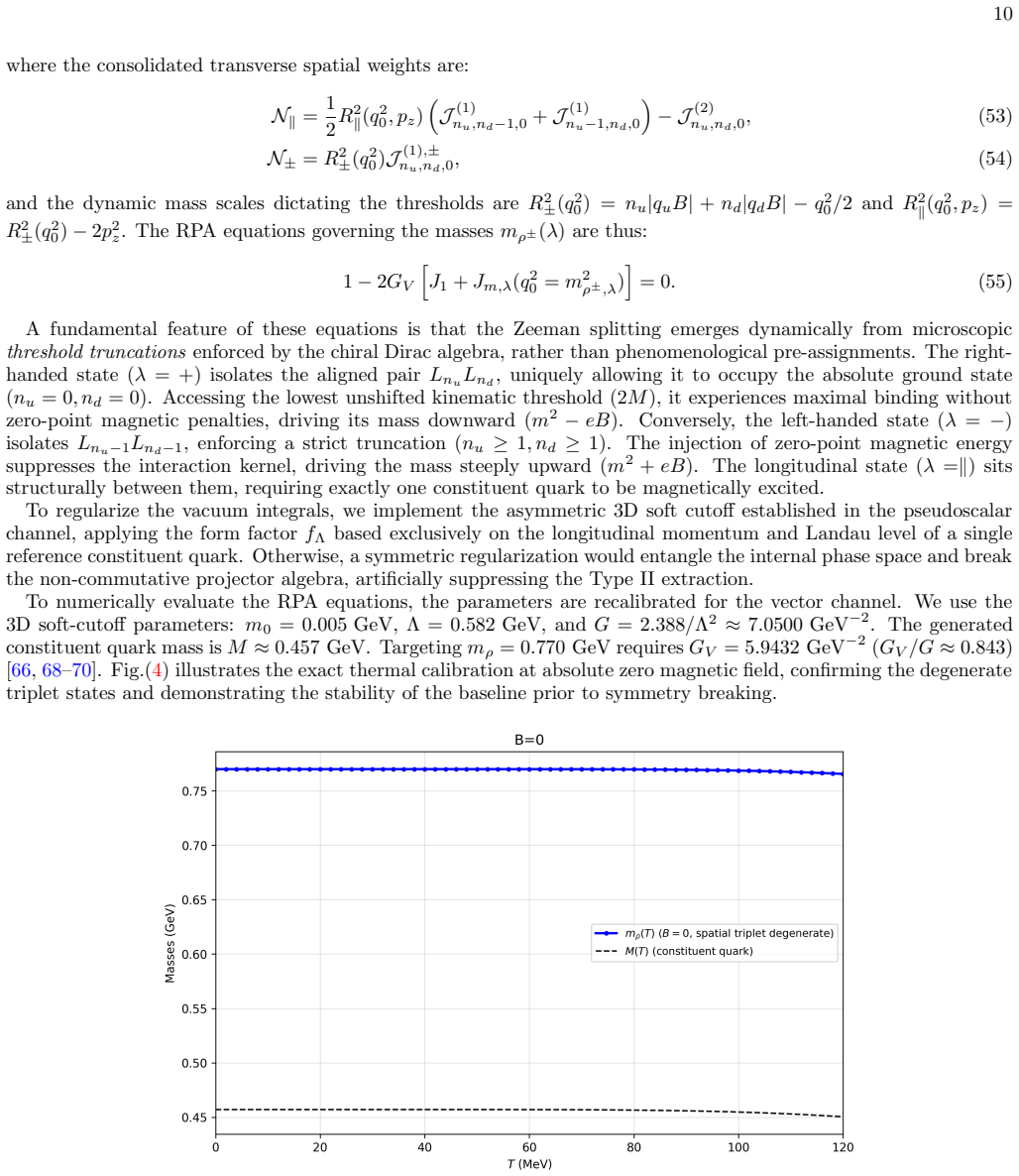
=− 4Nc π|qρB| ∞X nu,nd=0 Z ∞ −∞ dpz 2π Nλ 2EuEd Eu +E d q2 0 −(E u +E d)2 ,(51) Jmed m,λ (q2 0, T) = 4Nc π|qρB| ∞X nu,nd=0 Z ∞ −∞ dpz 2π Nλ 2EuEd " Eu +E d q2 0 −(E u +E d)2 (nF (Eu) +n F (Ed)) − Eu −E d q2 0 −(E u −E d)2 (nF (Eu)−n F (Ed)) # ,(52) 10 where the consolidated transverse spatial weights are: N∥ = 1 2 R2 ∥(q2 0, pz) J (1) nu,nd−1,0 +J (1) nu−...
-
[8]
=n u|quB|+n d|qdB| −q 2 0/2 andR 2 ∥(q2 0, pz) = R2 ±(q2 0)−2p 2 z. The RPA equations governing the massesm ρ±(λ) are thus: 1−2G V h J1 +J m,λ(q2 0 =m 2 ρ±,λ) i = 0.(55) A fundamental feature of these equations is that the Zeeman splitting emerges dynamically from microscopic threshold truncationsenforced by the chiral Dirac algebra, rather than phenomeno...
-
[9]
Type I (Scalar) Overlap Integrals For the standard Laguerre polynomialsL n(x) present in the longitudinal trace, we utilize the generating function in Eq. (A4). To perform the transverse phase-space integration, we define the composite 2D momentum vector v= (k ⊥,p ⊥)T . Substituting the explicit definitions ofα u,α d, andα π into the generating function p...
-
[10]
Summing over all possible internal states of one constituent quark must analytically recover a constant density of states
Completeness and Probability Conservation The physical consistency of the spatial projection framework is verified by evaluating the completeness limit for the macroscopic ground state (n= 0). Summing over all possible internal states of one constituent quark must analytically recover a constant density of states. Recall the integral definition for the ca...
-
[11]
Type II (V ector) Overlaps and Auxiliary Recurrence Type II integralsJ (2) involve the bilinear momentum factor (k⊥ ·p⊥). We express this inner product as a symmetric quadratic form overv: k⊥ ·p ⊥ = 1 2 vT Mv,whereM= 0 1 1 0 .(B14) According to the Gaussian moment generating theorem, inserting this quadratic form evaluates to 1 2Tr(MA−1) multiplied by the...
- [12]
- [13]
- [14]
- [15]
-
[16]
Estimate of the magnetic field strength in heavy-ion collisions
V. Skokov, A. Y. Illarionov, and V. Toneev, Estimate of the magnetic field strength in heavy-ion collisions, Int. J. Mod. Phys. A24, 5925 (2009), arXiv:0907.1396 [nucl-th]
work page Pith review arXiv 2009
-
[17]
Event-by-event generation of electromagnetic fields in heavy-ion collisions
W.-T. Deng and X.-G. Huang, Event-by-event generation of electromagnetic fields in heavy-ion collisions, Phys. Rev. C 85, 044907 (2012), arXiv:1201.5108 [nucl-th]
work page Pith review arXiv 2012
-
[18]
K. Fukushima, D. E. Kharzeev, and H. J. Warringa, The Chiral Magnetic Effect, Phys. Rev. D78, 074033 (2008), arXiv:0808.3382 [hep-ph]
work page Pith review arXiv 2008
- [19]
- [20]
-
[21]
F. Bruckmann, G. Endrodi, and T. G. Kovacs, Inverse magnetic catalysis and the Polyakov loop, JHEP04, 112, arXiv:1303.3972 [hep-lat]
- [22]
- [23]
-
[24]
H.-T. Ding and D. Zhang, Chiral Properties of (2 + 1)-Flavor QCD in Magnetic Fields at Zero Temperature (2026), arXiv:2601.18354 [hep-lat]
- [25]
- [26]
- [27]
-
[28]
G. Colucci, E. S. Fraga, and A. Sedrakian, Chiral pions in a magnetic background, Phys. Lett. B728, 19 (2014), arXiv:1310.3742 [nucl-th]
- [29]
-
[30]
T. Brauner and N. Yamamoto, Chiral Soliton Lattice and Charged Pion Condensation in Strong Magnetic Fields, JHEP 04, 132, arXiv:1609.05213 [hep-ph]
- [31]
- [32]
- [33]
- [34]
- [35]
-
[36]
pion-rho Mixing as a mechanism for non-monotonic charged pion behavior in magnetic fields
Z. Wang, Residue-Enhanced Pion-Rho Mixing as the Origin of Nonmonotonic Charged Pion Mass in Magnetic Fields (2026), arXiv:2602.15410 [hep-ph]
work page internal anchor Pith review Pith/arXiv arXiv 2026
-
[37]
Y. Hidaka and A. Yamamoto, Charged vector mesons in a strong magnetic field, Phys. Rev. D87, 094502 (2013), arXiv:1209.0007 [hep-ph]
-
[38]
M. Kawaguchi and S. Matsuzaki, Vector meson masses from a hidden local symmetry in a constant magnetic field, Phys. Rev. D93, 125027 (2016), arXiv:1511.06990 [hep-ph]
- [39]
-
[40]
N. Callebaut, D. Dudal, and H. Verschelde, Holographic study of rho meson mass in an external magnetic field: Paving the road towards a magnetically induced superconducting QCD vacuum?, PoSF ACESQCD, 046 (2010), arXiv:1102.3103 [hep-ph]
- [41]
- [42]
-
[43]
T. Brauner and X.-G. Huang, Vector meson condensation in a pion superfluid, Phys. Rev. D94, 094003 (2016), arXiv:1610.00426 [hep-ph]
-
[44]
M. D’Elia and F. Negro, Chiral Properties of Strong Interactions in a Magnetic Background, Phys. Rev. D83, 114028 (2011), arXiv:1103.2080 [hep-lat]
- [45]
- [46]
- [47]
-
[48]
H.-T. Ding, S.-T. Li, S. Mukherjee, A. Tomiya, and X.-D. Wang, Meson masses in external magnetic fields with HISQ fermions, PoSLA TTICE2019, 250 (2020), arXiv:2001.05322 [hep-lat]
-
[49]
Endrodi, QCD with background electromagnetic fields on the lattice: A review, Prog
G. Endrodi, QCD with background electromagnetic fields on the lattice: A review, Prog. Part. Nucl. Phys.141, 104153 (2025), arXiv:2406.19780 [hep-lat]
-
[50]
Z. Wang and P. Zhuang, Meson properties in magnetized quark matter, Phys. Rev. D97, 034026 (2018), arXiv:1712.00554 [hep-ph]
-
[51]
S. P. Klevansky, The Nambu-Jona-Lasinio model of quantum chromodynamics, Rev. Mod. Phys.64, 649 (1992)
1992
- [52]
-
[53]
N. Chaudhuri, S. Ghosh, S. Sarkar, and P. Roy, Effect of the anomalous magnetic moment of quarks on the phase structure and mesonic properties in the NJL model, Phys. Rev. D99, 116025 (2019), arXiv:1907.03990 [nucl-th]
- [54]
-
[55]
G. Cao, Recent progresses on QCD phases in a strong magnetic field: views from Nambu–Jona-Lasinio model, Eur. Phys. J. A57, 264 (2021), arXiv:2103.00456 [hep-ph]
- [56]
- [57]
-
[58]
J. Chao and Y.-X. Liu, Dimensional reduction and the generalized pion in a magnetic field within the NJL model, Phys. Rev. D107, 074038 (2023), arXiv:2202.05090 [hep-ph]
- [59]
-
[60]
L. Chang and C. D. Roberts, Sketching the Bethe-Salpeter kernel, Phys. Rev. Lett.103, 081601 (2009), arXiv:0903.5461 [nucl-th]
-
[61]
V. I. Ritus, Radiative corrections in quantum electrodynamics with intense field and their analytical properties, Annals Phys.69, 555 (1972)
1972
-
[62]
R. Zhang, W.-j. Fu, and Y.-x. Liu, Properties of Mesons in a Strong Magnetic Field, Eur. Phys. J. C76, 307 (2016), arXiv:1604.08888 [hep-ph]
-
[63]
Liu and S
Z. Liu and S. Mao, Vector meson in magnetic field at finite temperature (2026), in preparation. While finalizing this work, we noted a concurrent investigation into the equivalence between the Schwinger proper time and Ritus formalisms. Our non-commutative Wigner-Weyl approach and their findings represent independent yet mutually reinforcing perspectives ...
2026
-
[64]
J. E. Moyal, Quantum mechanics as a statistical theory, Proc. Cambridge Phil. Soc.45, 99 (1949)
1949
-
[65]
T. Curtright, D. Fairlie, and C. K. Zachos, Features of time independent Wigner functions, Phys. Rev. D58, 025002 (1998), arXiv:hep-th/9711183
- [66]
-
[67]
J. S. Schwinger, On gauge invariance and vacuum polarization, Phys. Rev.82, 664 (1951)
1951
- [68]
- [69]
- [70]
-
[71]
Mao, Pions in magnetic field at finite temperature, Phys
S. Mao, Pions in magnetic field at finite temperature, Phys. Rev. D99, 056005 (2019), arXiv:1808.10242 [nucl-th]
-
[72]
J. Berra-Montiel, H. Garcia-Compean, and A. Molgado, Star exponentials from propagators and path integrals, Annals Phys.468, 169744 (2024), arXiv:2404.08815 [math-ph]
-
[73]
M. Coppola, D. G´ omez Dumm, and N. N. Scoccola, Charged pion masses under strong magnetic fields in the NJL model, Phys. Lett. B782, 155 (2018), arXiv:1802.08041 [hep-ph]
-
[74]
M. Coppola, D. Gomez Dumm, S. Noguera, and N. N. Scoccola, Neutral and charged pion properties under strong magnetic 19 fields in the NJL model, Phys. Rev. D100, 054014 (2019), arXiv:1907.05840 [hep-ph]
- [75]
- [76]
- [77]
- [78]
- [79]
-
[80]
D. Gomez Dumm, S. Noguera, and N. N. Scoccola, Charged meson masses under strong magnetic fields: Gauge invariance and schwinger phases, Phys. Rev. D108, 016012 (2023), arXiv:2306.04128 [hep-ph]
discussion (0)
Sign in with ORCID, Apple, or X to comment. Anyone can read and Pith papers without signing in.