Recognition: unknown
XMAGNET -- Stir before serving: a Lagrangian perspective on mixing-driven condensation in the intracluster medium
Pith reviewed 2026-05-09 19:19 UTC · model grok-4.3
The pith
Magnetic fields alter how cold gas forms and moves in cool-core galaxy clusters
A machine-rendered reading of the paper's core claim, the machinery that carries it, and where it could break.
Core claim
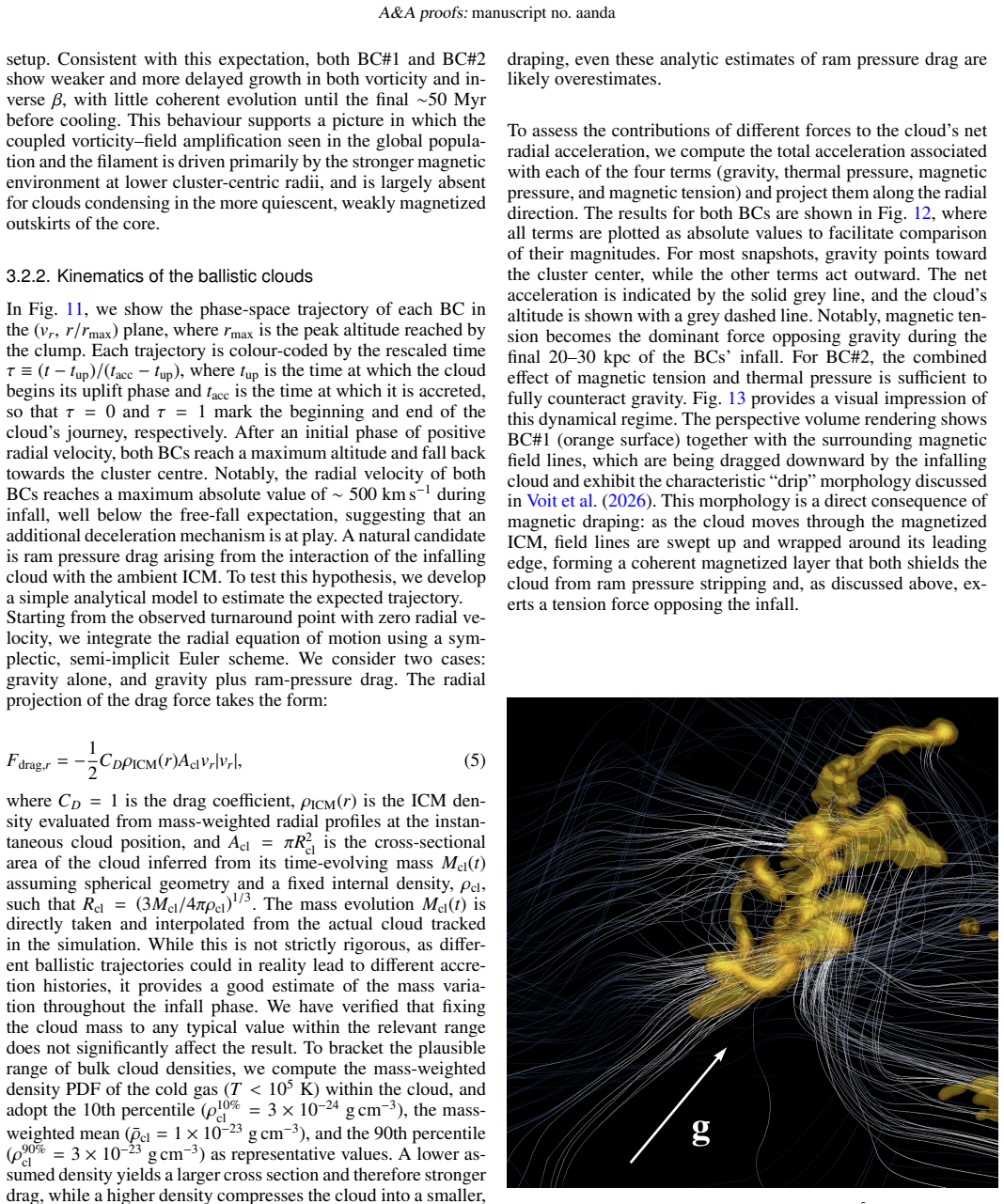
In both hydro and MHD runs the large majority of tracers that condense follow mixing-driven pathways onto low-entropy seeds, but magnetic fields produce a more complex cycle in which AGN outflows shred existing filaments into fragments that are uplifted to seed further condensation; condensing tracers diverge from the background ICM significantly earlier, at lower turbulent Mach numbers, and after condensation magnetic tension dominates ram pressure to set the terminal velocity of cold clouds and filaments.
What carries the argument
Monte-Carlo tracer particle algorithm that reconstructs the thermodynamic and dynamical histories of individual gas parcels transitioning to the cold phase in hydro and MHD simulations of an idealized cool-core cluster.
If this is right
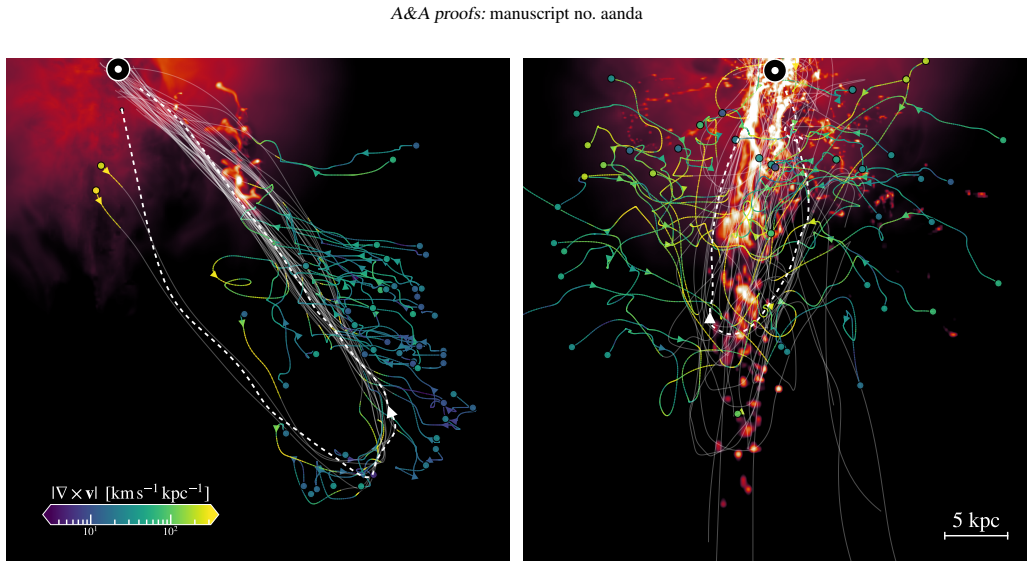
- In the MHD run AGN outflows shred portions of existing filaments into fragments that are uplifted and seed new condensation.
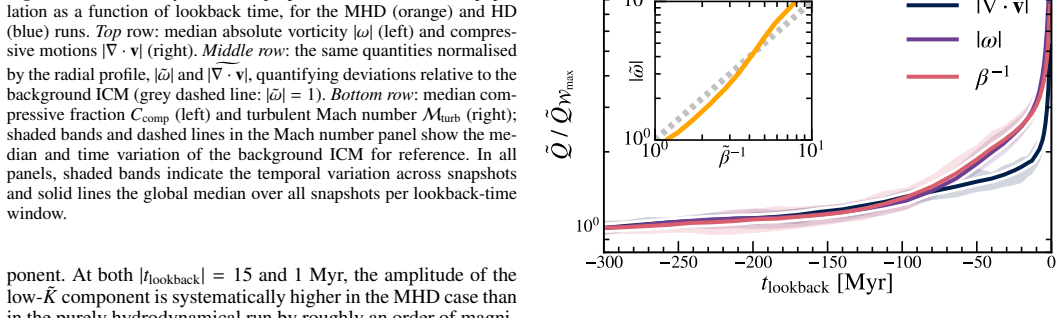
- Condensing tracers in the MHD run begin diverging from the background ICM properties about 150 Myr before condensation, versus 30 Myr in the hydro run.
- The turbulent Mach number at the cooling transition is systematically lower when magnetic fields are included.
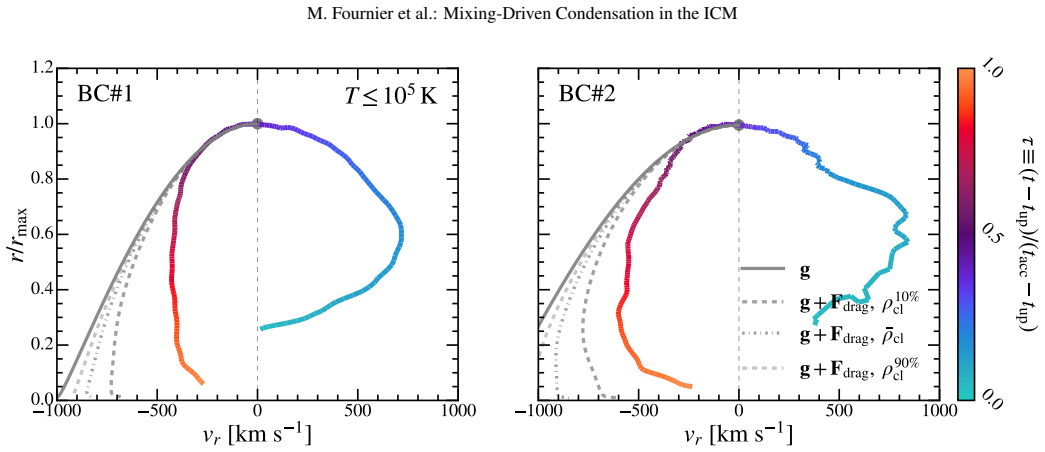
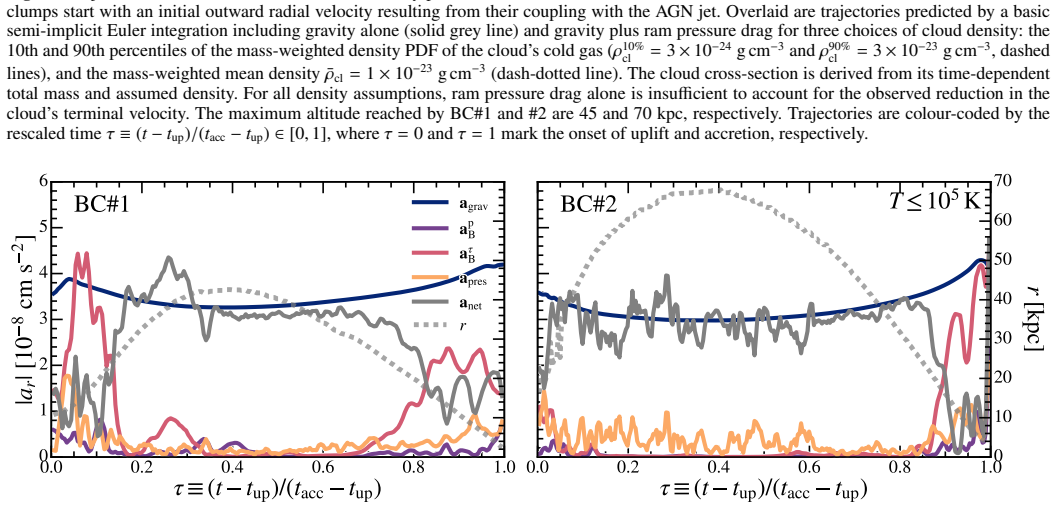
- Magnetic tension dominates ram pressure as the drag force on cold structures after condensation, reducing their terminal velocities.
Where Pith is reading between the lines
- Magnetic fields may allow cold gas structures to persist longer by slowing their motion, altering the efficiency of AGN feedback loops.
- The Lagrangian tracer method could be extended to full cosmological cluster simulations to check how local mixing and magnetic effects scale up.
- Observed kinematics of cold molecular gas in clusters might indirectly constrain ICM magnetic field strengths.
- Similar mixing-driven condensation tracked with tracers could apply to other environments such as the circumgalactic medium.
Load-bearing premise
The idealized cool-core cluster setup together with the Monte-Carlo tracer algorithm and chosen condensation thresholds faithfully capture the real thermodynamic pathways and dynamical conditions in the intracluster medium.
What would settle it
High-resolution observations that measure the pre-condensation divergence timescales of gas properties and the terminal velocities of cold clouds and filaments in real cool-core clusters would test whether magnetic fields produce the predicted earlier changes and slower motions.
Figures



read the original abstract
We aim to characterize the thermodynamic and dynamical conditions leading to condensation in cluster cores, and to assess the role of magnetic fields. We implement a Monte-Carlo tracer particle algorithm in the GPU-accelerated code AthenaPK, and run a purely hydrodynamical and a magnetohydrodynamical (MHD) simulations of an idealized cool-core cluster. We identify the subset of hot ICM tracers that undergo a transition to the cold phase and reconstruct their histories over a lookback time of $300\,\mathrm{Myr}$ prior to condensation. In both runs, the large majority of tracers transitioning to the cold phase follow a thermodynamic pathway driven by mixing, whereby hot ambient gas is entrained onto low-entropy seed clumps that subsequently grow into larger clouds and filaments. In the hydrodynamical run, these seeds form mainly via in-situ cooling at the edges of AGN cavities. In the MHD run, the cold gas cycle is more complex: AGN outflows occasionally shred portions of existing filaments into fragments which are then uplifted, seeding further condensation. In the MHD run, the properties of condensing tracers begin to diverge from the background ICM significantly earlier than in the hydrodynamical run (${\sim}150\,\rm Myr$ before the cooling transition versus ${\sim}30\,\rm Myr$), with vorticity and magnetic energy growing together. The turbulent Mach number at condensation is also systematically lower than in the hydrodynamical run. We examine the post-condensation evolution of individual cold structures in the MHD run, namely a massive core filament and two isolated clouds in quiescent regions. We find that magnetic tension dominates over ram pressure as the primary drag force, significantly reducing the clouds' terminal velocity. Our results demonstrate that magnetic fields substantially impact the assembly history and kinematic properties of the cold phase in cool-core clusters.
Editorial analysis
A structured set of objections, weighed in public.
Referee Report
Summary. The paper implements Monte-Carlo tracer particles in the AthenaPK code to compare a single hydrodynamical and a single MHD simulation of an idealized cool-core cluster. It reconstructs 300 Myr lookback histories of tracers that transition to the cold phase, finding that both runs are dominated by mixing-driven condensation onto low-entropy seeds, but the MHD case exhibits a more complex cycle involving filament shredding by AGN outflows, earlier divergence of tracer properties (~150 Myr before condensation versus ~30 Myr), lower turbulent Mach numbers, and magnetic tension as the dominant post-condensation drag force. The central claim is that magnetic fields substantially impact the assembly history and kinematic properties of the cold phase.
Significance. If the reported differences prove robust, the Lagrangian tracer analysis would offer a useful complement to Eulerian studies of multiphase ICM gas, highlighting specific pathways (in-situ cooling at cavity edges in hydro; filament fragmentation in MHD) and the role of magnetic tension in reducing cloud velocities. This could inform subgrid models for AGN feedback and cooling-flow simulations, though the idealized setup restricts direct observational mapping.
major comments (2)
- [Abstract and Results] Abstract and Results: The central claim that magnetic fields substantially alter condensation timelines and kinematics rests on a single hydro versus single MHD realization. In a chaotic, mixing-driven system, order-unity differences in divergence times (~150 Myr vs ~30 Myr) and Mach numbers can arise from stochastic seed variations alone; without an ensemble of runs with perturbed initial turbulence or AGN parameters, attribution to B-fields rather than run-to-run variance cannot be established.
- [Methods] Methods: The manuscript provides no resolution study, convergence test, or validation of the Monte-Carlo tracer algorithm and condensation thresholds against analytic mixing models. This leaves the reported thermodynamic pathways and force balances without quantified numerical robustness, which is load-bearing for the claim of distinct MHD versus hydro behavior.
minor comments (1)
- [Figures] Ensure all tracer-history figures explicitly label the 300 Myr lookback window and mark the condensation transition time for direct comparison between hydro and MHD cases.
Simulated Author's Rebuttal
We thank the referee for their constructive and insightful comments on our manuscript. We address each major comment point by point below, outlining our responses and planned revisions where appropriate.
read point-by-point responses
-
Referee: [Abstract and Results] The central claim that magnetic fields substantially alter condensation timelines and kinematics rests on a single hydro versus single MHD realization. In a chaotic, mixing-driven system, order-unity differences in divergence times (~150 Myr vs ~30 Myr) and Mach numbers can arise from stochastic seed variations alone; without an ensemble of runs with perturbed initial turbulence or AGN parameters, attribution to B-fields rather than run-to-run variance cannot be established.
Authors: We acknowledge that the use of single realizations in a chaotic, mixing-driven system means we cannot fully exclude the possibility that stochastic variations in initial turbulence or AGN seeding contribute to the reported differences. The observed trends (earlier divergence, lower Mach numbers, and magnetic tension dominance) are consistent across the population of ~thousands of tracers in each run and align with the expected physical effects of magnetic fields on mixing and drag. However, we agree that ensemble simulations would be required to rigorously attribute the differences solely to B-fields. We will revise the manuscript to add an explicit discussion of this limitation in the Results and Conclusions sections, framing the current findings as suggestive of substantial magnetic impact while highlighting the need for future ensemble studies to assess robustness. revision: partial
-
Referee: [Methods] The manuscript provides no resolution study, convergence test, or validation of the Monte-Carlo tracer algorithm and condensation thresholds against analytic mixing models. This leaves the reported thermodynamic pathways and force balances without quantified numerical robustness, which is load-bearing for the claim of distinct MHD versus hydro behavior.
Authors: We appreciate this observation. While the Monte-Carlo tracer algorithm is a standard implementation in AthenaPK and the condensation threshold follows common practice in the literature, the original manuscript indeed lacked dedicated resolution studies or direct validation against analytic mixing models. In the revised version, we will add a new appendix presenting (i) convergence tests of key diagnostics (condensation timelines, vorticity growth, and post-condensation force balances) at multiple resolutions and (ii) comparisons of the mixing-driven pathway to simple analytic expectations for entrainment and cooling. These additions will quantify the numerical robustness of the reported hydro versus MHD distinctions. revision: yes
Circularity Check
No circularity: results are direct diagnostics from simulation snapshots
full rationale
The paper reports outcomes from two numerical simulations (hydro and MHD) of an idealized cool-core cluster using a Monte-Carlo tracer algorithm in AthenaPK. All key findings—thermodynamic pathways of condensing tracers, divergence times (~150 Myr vs ~30 Myr), turbulent Mach numbers, vorticity/magnetic energy growth, and post-condensation drag forces—are extracted directly from particle histories and snapshot data. No equations are derived or fitted; no parameters are tuned to match target observables and then re-used as predictions; no self-citations supply load-bearing uniqueness theorems or ansatzes; and no known empirical patterns are merely renamed. The derivation chain consists solely of running the code and post-processing the output, rendering the analysis self-contained against external benchmarks.
Axiom & Free-Parameter Ledger
free parameters (2)
- Initial entropy profile and AGN cavity parameters
- Tracer particle count and Monte-Carlo sampling parameters
axioms (2)
- domain assumption The chosen temperature or entropy threshold correctly identifies the hot-to-cold phase transition
- domain assumption Idealized hydro and MHD equations plus sub-grid AGN feedback capture the dominant physics of the ICM
Reference graph
Works this paper leans on
-
[1]
How Binaries Accrete: Hydrodynamic Simulations with Passive Tracer Particles. , keywords =. doi:10.3847/1538-4357/ac6c2b , archivePrefix =. 2111.04721 , primaryClass =
-
[2]
2024, Nature Astronomy, 8, 256, doi: 10.1038/s41550-023-02138-y
Oosterloo, Tom and Morganti, Raffaella and Murthy, Suma , year=. Closing the feedback-feeding loop of the radio galaxy 3C 84 , volume=. Nature Astronomy , publisher=. doi:10.1038/s41550-023-02138-y , number=
-
[3]
2013, MNRAS, 435, 1426, doi: 10.1093/mnras/stt1383
Following the flow: tracer particles in astrophysical fluid simulations. , keywords =. doi:10.1093/mnras/stt1383 , archivePrefix =. 1305.2195 , primaryClass =
-
[4]
Accurate tracer particles of baryon dynamics in the adaptive mesh refinement code Ramses. , keywords =. doi:10.1051/0004-6361/201834496 , archivePrefix =. 1810.11401 , primaryClass =
-
[5]
Numerical Modeling of Space Plasma Flows , year = 2008, editor =
A Simple Dual Implementation to Track Pressure Accurately. Numerical Modeling of Space Plasma Flows , year = 2008, editor =
2008
-
[6]
Parthenon -- a performance portable block-structured adaptive mesh refinement framework. arXiv e-prints , keywords =. doi:10.48550/arXiv.2202.12309 , archivePrefix =. 2202.12309 , primaryClass =
-
[7]
The Athena++ Adaptive Mesh Refinement Framework: Design and Magnetohydrodynamic Solvers. , keywords =. doi:10.3847/1538-4365/ab929b , archivePrefix =. 2005.06651 , primaryClass =
-
[8]
XMAGNET: Velocity structure functions of active galactic nucleus-driven turbulence in the multiphase intracluster medium. , keywords =. doi:10.1051/0004-6361/202554278 , archivePrefix =. 2502.19486 , primaryClass =
-
[9]
The XMAGNET Exascale MHD Simulations of SMBH Feedback in Galaxy Groups and Clusters: Overview and Preliminary Cluster Results. , keywords =. doi:10.3847/1538-4357/adde45 , archivePrefix =. 2502.13213 , primaryClass =
-
[10]
Baryon cycles in the biggest galaxies. , keywords =. doi:10.1016/j.physrep.2022.04.005 , archivePrefix =. 2204.08099 , primaryClass =
-
[11]
Precipitation possible: turbulence-driven thermal instability with constrained entropy profiles. , keywords =. 2025 , month = feb, volume =. doi:10.1093/mnras/staf092 , archivePrefix =. 2410.03886 , primaryClass =
-
[12]
Precipitation plausible: magnetized thermal instability in the intracluster medium , journal =. 2025 , month = oct, issn =. doi:10.1093/mnras/staf1801 , url =
-
[13]
, archivePrefix = "arXiv", eprint =
Thermal instability in gravitationally stratified plasmas: implications for multiphase structure in clusters and galaxy haloes. , keywords =. doi:10.1111/j.1365-2966.2011.19972.x , archivePrefix =. 1105.2563 , primaryClass =
-
[14]
Tales of tension: magnetized infalling cold clouds and streams in the CGM. , keywords =. doi:10.1093/mnras/staf706 , archivePrefix =. 2502.17549 , primaryClass =
-
[15]
Non-Kolmogorov turbulence in multiphase intracluster medium driven by cold gas precipitation and AGN jets. , keywords =. doi:10.1093/mnras/stab966 , archivePrefix =. 2012.11085 , primaryClass =
-
[16]
Modeling Active Galactic Nucleus Feedback in Cool-core Clusters: The Formation of Cold Clumps. , keywords =. doi:10.1088/0004-637X/789/2/153 , archivePrefix =. 1310.7580 , primaryClass =
-
[17]
A Graphical Interpretation of Circumgalactic Precipitation. , keywords =. doi:10.3847/2041-8213/abe11f , archivePrefix =. 2102.00056 , primaryClass =
-
[18]
Woven by the Whirls: The growth and entrainment of cold clouds in turbulent hot winds. arXiv e-prints , keywords =. doi:10.48550/arXiv.2510.03552 , archivePrefix =. 2510.03552 , primaryClass =
-
[19]
Fabian, A. C. and Sanders, J. S. and Taylor, G. B. and Allen, S. W. and Crawford, C. S. and Johnstone, R. M. and Iwasawa, K. , year=. A very deep Chandra observation of the Perseus cluster: shocks, ripples and conduction , volume=. Monthly Notices of the Royal Astronomical Society , publisher=. doi:10.1111/j.1365-2966.2005.09896.x , number=
-
[20]
A Systematic Study of Radio-induced X-Ray Cavities in Clusters, Groups, and Galaxies. , keywords =. doi:10.1086/383519 , archivePrefix =. astro-ph/0402348 , primaryClass =
-
[21]
Ram Pressure Stripping of Disc Galaxies: The Role of the Inclination Angle , shorttitle =
Magnetic fields in the centre of the Perseus cluster. , keywords =. doi:10.1111/j.1365-2966.2006.10244.x , archivePrefix =. astro-ph/0602622 , primaryClass =
-
[22]
doi:10.1038/nature18627 , eprint =
The quiescent intracluster medium in the core of the Perseus cluster. , keywords =. doi:10.1038/nature18627 , archivePrefix =. 1607.04487 , primaryClass =
-
[23]
Disentangling Multiple Gas Kinematic Drivers in the Perseus Galaxy Cluster. arXiv e-prints , keywords =. doi:10.48550/arXiv.2509.04421 , archivePrefix =. 2509.04421 , primaryClass =
-
[24]
A., Markevitch, M., & Zhuravleva, I
Mapping the Gas Turbulence in the Coma Cluster: Predictions for Astro-H. , keywords =. doi:10.3847/0004-637X/817/2/110 , archivePrefix =. 1505.07848 , primaryClass =
-
[25]
Astronomy Letters , keywords =
Resonant scattering in galaxy clusters for anisotropic gas motions on various spatial scales. Astronomy Letters , keywords =. doi:10.1134/S1063773711010087 , archivePrefix =. 1102.4098 , primaryClass =
-
[26]
Tracing Multiphase Structure in the Circumgalactic Medium: Insights from Magnetohydrodynamic Turbulence Simulations. arXiv e-prints , keywords =. doi:10.48550/arXiv.2511.00229 , archivePrefix =. 2511.00229 , primaryClass =
-
[27]
Measuring the intracluster medium velocity structure within the A3266 galaxy cluster. , keywords =. doi:10.1051/0004-6361/202451640 , archivePrefix =. 2408.00837 , primaryClass =
-
[28]
The International Journal of High Performance Computing Applications , volume =
Philipp Grete and Joshua C Dolence and Jonah M Miller and Joshua Brown and Ben Ryan and Andrew Gaspar and Forrest Glines and Sriram Swaminarayan and Jonas Lippuner and Clell J Solomon and Galen Shipman and Christoph Junghans and Daniel Holladay and James M Stone and Luke F Roberts , title =. The International Journal of High Performance Computing Applicat...
-
[30]
Restoration of the contact surface in the HLL-Riemann solver. Shock Waves , keywords =. doi:10.1007/BF01414629 , adsurl =
-
[32]
A new radiative cooling curve based on an up-to-date plasma emission code. , keywords =. doi:10.1051/0004-6361/200912495 , archivePrefix =. 0909.5204 , primaryClass =
-
[33]
arXiv , author =:2306.03141 , journal =
Cosmic ray feedback in galaxies and galaxy clusters. , keywords =. doi:10.1007/s00159-023-00149-2 , archivePrefix =. 2306.03141 , primaryClass =
-
[34]
Cosmic-Ray Feedback Heating of the Intracluster Medium. , keywords =. doi:10.3847/1538-4357/aa79f8 , archivePrefix =. 1701.07441 , primaryClass =
-
[36]
Triggering and Delivery Algorithms for AGN Feedback. , keywords =. doi:10.3847/1538-4357/aa6fb1 , archivePrefix =. 1603.03674 , primaryClass =
-
[37]
Electromagnetic extraction of energy from Kerr black holes. , keywords =. doi:10.1093/mnras/179.3.433 , adsurl =
-
[38]
Modeling the Large-Scale Structures of Astrophysical Jets in the Magnetically Dominated Limit. , keywords =. doi:10.1086/501499 , archivePrefix =. astro-ph/0604469 , primaryClass =
-
[39]
, year = 1997, month = dec, volume = 490, pages =
A Universal Density Profile from Hierarchical Clustering. , keywords =. doi:10.1086/304888 , archivePrefix =. astro-ph/9611107 , primaryClass =
-
[40]
1990, ApJ, 356, 359, doi: 10.1086/168845
An Analytical Model for Spherical Galaxies and Bulges. , keywords =. doi:10.1086/168845 , adsurl =
-
[41]
Intracluster Medium Entropy Profiles for a Chandra Archival Sample of Galaxy Clusters. , keywords =. doi:10.1088/0067-0049/182/1/12 , archivePrefix =. 0902.1802 , primaryClass =
-
[42]
H., Sivanandam, S., Zabludoff, A
Galaxy Cluster Baryon Fractions Revisited. , keywords =. doi:10.1088/0004-637X/778/1/14 , archivePrefix =. 1309.3565 , primaryClass =
-
[43]
X-ray spectroscopy of galaxy clusters: studying astrophysical processes in the largest celestial laboratories. , keywords =. doi:10.1007/s00159-009-0023-3 , adsurl =
-
[44]
Peterson, J. R. and Paerels, F. B. S. and Kaastra, J. S. and Arnaud, M. and Reiprich, T. H. and Fabian, A. C. and Mushotzky, R. F. and Jernigan, J. G. and Sakelliou, I. , year=. X-ray imaging-spectroscopy of Abell 1835 , volume=. Astronomy & Astrophysics , publisher=. doi:10.1051/0004-6361:20000021 , number=
-
[45]
McDonald, Michael and Veilleux, Sylvain and Rupke, David S. N. , year=. OPTICAL SPECTROSCOPY OF Hα FILAMENTS IN COOL CORE CLUSTERS: KINEMATICS, REDDENING, AND SOURCES OF IONIZATION , volume=. The Astrophysical Journal , publisher=. doi:10.1088/0004-637x/746/2/153 , number=
-
[46]
Modeling Active Galactic Nucleus Feedback in Cool-core Clusters: The Balance between Heating and Cooling. , keywords =. doi:10.1088/0004-637X/789/1/54 , archivePrefix =. 1401.7695 , primaryClass =
-
[47]
Velocity structure functions in multiphase turbulence: interpreting kinematics of H filaments in cool-core clusters. , keywords =. doi:10.1093/mnras/stab3429 , archivePrefix =. 2109.01771 , primaryClass =
-
[48]
arXiv , author =:1909.01329 , journal =
Dense gas formation and destruction in a simulated Perseus-like galaxy cluster with spin-driven black hole feedback. , keywords =. doi:10.1051/0004-6361/201936188 , archivePrefix =. 1909.01329 , primaryClass =
-
[49]
Self-regulated AGN feedback of light jets in cool-core galaxy clusters. , keywords =. doi:10.1093/mnras/stac2860 , archivePrefix =. 2204.01765 , primaryClass =
-
[50]
The Interplay of Kinetic and Radiative Feedback in Galaxy Clusters. , keywords =. doi:10.3847/1538-4357/ab18fd , archivePrefix =. 1810.01857 , primaryClass =
-
[51]
HST imaging of the dusty filaments and nucleus swirl in NGC4696 at the centre of the Centaurus Cluster. , keywords =. doi:10.1093/mnras/stw1350 , archivePrefix =. 1606.02436 , primaryClass =
-
[52]
Fabian, A. C. and Johnstone, R. M. and Sanders, J. S. and Conselice, C. J. and Crawford, C. S. and III, J. S. Gallagher and Zweibel, E. , year=. Magnetic support of the optical emission line filaments in NGC 1275 , volume=. Nature , publisher=. doi:10.1038/nature07169 , number=
-
[53]
Alma Observations of Massive Molecular Gas Filaments Encasing Radio Bubbles in the Phoenix Cluster. , keywords =. doi:10.3847/1538-4357/836/1/130 , archivePrefix =. 1611.00017 , primaryClass =
-
[54]
2019, A&A, 631, A22, doi: 10.1051/0004-6361/201935350 18
Ubiquitous cold and massive filaments in cool core clusters. , keywords =. doi:10.1051/0004-6361/201935350 , archivePrefix =. 1902.09164 , primaryClass =
-
[55]
A Galaxy-scale Fountain of Cold Molecular Gas Pumped by a Black Hole. , keywords =. doi:10.3847/1538-4357/aad6dd , archivePrefix =. 1808.00473 , primaryClass =
-
[56]
Association with X-ray cavity, H filaments and cooling flow
Cold molecular gas in the Perseus cluster core. Association with X-ray cavity, H filaments and cooling flow. , keywords =. doi:10.1051/0004-6361:20054745 , archivePrefix =. astro-ph/0603350 , primaryClass =
-
[57]
Cosmic rays and thermal instability in self-regulating cooling flows of massive galaxy clusters. , keywords =. doi:10.1051/0004-6361/202142527 , archivePrefix =. 2204.03629 , primaryClass =
-
[58]
The split in the ancient cold front in the Perseus cluster. Nature Astronomy , keywords =. doi:10.1038/s41550-018-0401-8 , archivePrefix =. 1803.00898 , primaryClass =
-
[59]
Sloshing of the Magnetized Cool Gas in the Cores of Galaxy Clusters. , keywords =. doi:10.1088/0004-637X/743/1/16 , archivePrefix =. 1108.4427 , primaryClass =
-
[60]
yt: A Multi-code Analysis Toolkit for Astrophysical Simulation Data. The Astrophysical Journal Supplement Series , archivePrefix = "arXiv", eprint =. doi:10.1088/0067-0049/192/1/9 , adsurl =
-
[61]
The Onset of Thermally Unstable Cooling from the Hot Atmospheres of Giant Galaxies in Clusters: Constraints on Feedback Models. , keywords =. doi:10.3847/1538-4357/aa9af3 , archivePrefix =. 1704.00011 , primaryClass =
-
[62]
A characteristic scale for cold gas. , keywords =. doi:10.1093/mnras/stx2687 , archivePrefix =. 1610.01164 , primaryClass =
-
[63]
P., 2018, @doi [ ] 10.1093/mnrasl/sly131 , http://adsabs.harvard.edu/abs/2018MNRAS.tmpL.135G
The growth and entrainment of cold gas in a hot wind. , keywords =. doi:10.1093/mnrasl/sly131 , archivePrefix =. 1806.02728 , primaryClass =
-
[64]
The Launching of Cold Clouds by Galaxy Outflows. V. The Role of Anisotropic Thermal Conduction. , keywords =. doi:10.3847/1538-4357/acd63e , archivePrefix =. 2304.09881 , primaryClass =
-
[65]
A Universal Entropy Profile for the Hot Atmospheres of Galaxies and Clusters within R _ 2500. , keywords =. doi:10.3847/1538-4357/aacce5 , archivePrefix =. 1802.02589 , primaryClass =
-
[66]
The Nature of Filamentary Cold Gas in the Core of the Virgo Cluster. , keywords =. doi:10.1088/0004-637X/767/2/153 , archivePrefix =. 1211.6722 , primaryClass =
-
[67]
A ROSAT HRI study of the interaction of the X-ray emitting gas and radio lobes of NGC 1275. , keywords =. doi:10.1093/mnras/264.1.L25 , adsurl =
-
[68]
AGN Feedback and Cooling Flows: Problems with Simple Hydrodynamic Models. , keywords =. doi:10.1086/504029 , archivePrefix =. astro-ph/0511501 , primaryClass =
-
[69]
Simulations of AGN-driven Galactic Outflow Morphology and Content. , keywords =. doi:10.3847/1538-3881/ac4d23 , archivePrefix =. 2201.08360 , primaryClass =
-
[70]
Ram Pressure Stripping of Disc Galaxies: The Role of the Inclination Angle , shorttitle =
Investigating AGN heating in a sample of nearby clusters. , keywords =. doi:10.1111/j.1365-2966.2006.11080.x , archivePrefix =. astro-ph/0609537 , primaryClass =
-
[71]
Turbulent heating in galaxy clusters brightest in X-rays. , keywords =. doi:10.1038/nature13830 , archivePrefix =. 1410.6485 , primaryClass =
-
[72]
2004, MNRAS, 351, 1379, doi: 10.1111/j.1365-2966.2004.07876.x
Mapping small-scale temperature and abundance structures in the core of the Perseus cluster. , keywords =. doi:10.1111/j.1365-2966.2004.07576.x , archivePrefix =. astro-ph/0311502 , primaryClass =
-
[73]
Do sound waves transport the AGN energy in the Perseus cluster?. , keywords =. doi:10.1093/mnrasl/slw170 , archivePrefix =. 1608.07088 , primaryClass =
-
[74]
Magnetic fields in multiphase turbulence: impact on dynamics and structure. , keywords =. doi:10.1093/mnras/stad3125 , archivePrefix =. 2307.06411 , primaryClass =
-
[75]
The evaporation of spherical clouds in a hot gas. I. Classical and saturated mass loss rates. , keywords =. doi:10.1086/154911 , adsurl =
-
[76]
Handbook of X-ray and Gamma-ray Astrophysics , year = 2022, eid =
AGN Feedback in Groups and Clusters of Galaxies. Handbook of X-ray and Gamma-ray Astrophysics , year = 2022, eid =. doi:10.1007/978-981-16-4544-0_122-1 , adsurl =
-
[77]
Multiple Shock Fronts in RBS 797: The Chandra Window on Shock Heating in Galaxy Clusters. , keywords =. doi:10.3847/1538-4357/acacf9 , archivePrefix =. 2212.10581 , primaryClass =
-
[78]
Sanders, J. S. and Fabian, A. C. and Russell, H. R. and Walker, S. A. and Blundell, K. M. , year=. Detecting edges in the X-ray surface brightness of galaxy clusters , volume=. Monthly Notices of the Royal Astronomical Society , publisher=. doi:10.1093/mnras/stw1119 , number=
-
[79]
A volume-limited sample of X-ray galaxy groups and clusters - II. X-ray cavity dynamics. , keywords =. doi:10.1093/mnras/stu1499 , archivePrefix =. 1407.6614 , primaryClass =
-
[80]
Do Jets Precess... or Even Move at All?. , keywords =. doi:10.1088/2041-8205/765/1/L7 , archivePrefix =. 1301.5321 , primaryClass =
-
[81]
Multiphase gas in the circumgalactic medium: relative role of t _ cool /t _ ff and density fluctuations. , keywords =. doi:10.1093/mnras/stz1857 , archivePrefix =. 1901.02903 , primaryClass =
-
[82]
and Springel, Volker and Li, Yuan and Burkhart, Blakesley and Choi, Ena and Faucher-Gigu
Active galactic nucleus jet feedback in hydrostatic haloes. , keywords =. doi:10.1093/mnras/stad1396 , archivePrefix =. 2211.11771 , primaryClass =
-
[83]
The stellar mass fraction and baryon content of galaxy clusters and groups. , keywords =. doi:10.1111/j.1365-2966.2010.16856.x , archivePrefix =. 1004.2785 , primaryClass =
discussion (0)
Sign in with ORCID, Apple, or X to comment. Anyone can read and Pith papers without signing in.