Recognition: unknown
High-resolution ro-vibrational and rotational spectroscopy of the open-shell, linear CCH^+ ion (³Pi)
Pith reviewed 2026-05-09 18:46 UTC · model grok-4.3
The pith
High-resolution infrared and rotational spectra of CCH+ yield constants that enabled its first detection in space.
A machine-rendered reading of the paper's core claim, the machinery that carries it, and where it could break.
Core claim
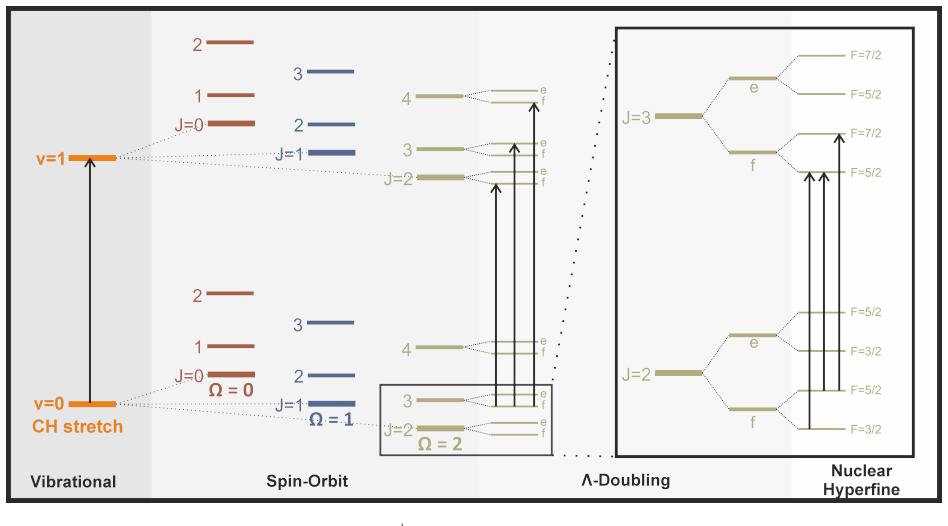
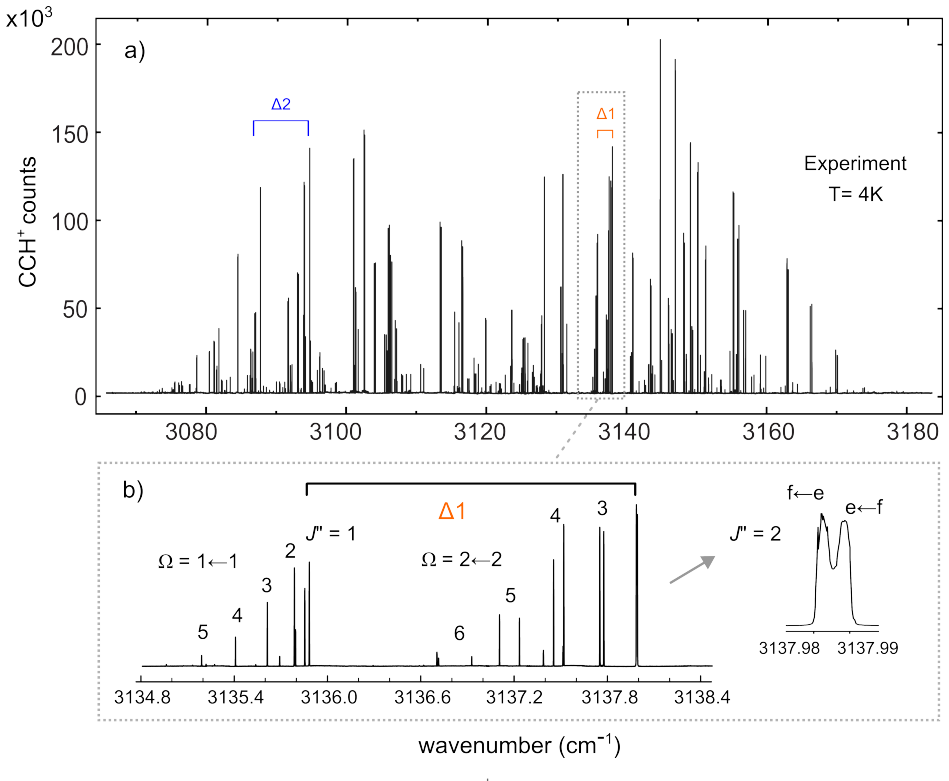
The authors recorded the high-resolution infrared spectrum of CCH+ (^3 Pi) by leak-out spectroscopy and assigned 385 ro-vibrational lines to the CH-stretching fundamental and a highly excited bending mode. An effective Hamiltonian fit to these lines produced accurate spectroscopic constants for the ground state and the two vibrationally excited states. Using the ground-state constants, they observed all pure rotational transitions from J''=2 to J''=6 within the Omega=2 component with resolved hyperfine splittings via a two-color millimeter-wave infrared scheme. This laboratory data set has already guided the first detection of CCH+ in space toward the Orion Bar.
What carries the argument
Effective Hamiltonian analysis of 385 ro-vibrational lines that extracts band origins, spin-orbit, rotational, centrifugal-distortion, and Lambda-doubling constants for the ground and excited vibrational states of the ^3 Pi ion.
If this is right
- The constants allow reliable prediction of additional rotational and ro-vibrational transitions for targeted astronomical searches.
- Infrared transitions can be used to identify CCH+ in observations with the James Webb Space Telescope.
- The hyperfine-resolved data provide benchmarks for theoretical calculations of open-shell molecular ions.
- The same laboratory approach can be applied to other linear open-shell ions to support their detection in space.
Where Pith is reading between the lines
- Detection in the Orion Bar suggests CCH+ participates in the ion-molecule chemistry of UV-irradiated interstellar gas.
- Similar high-resolution methods could be used to search for CCH+ or related species in other photodissociation regions or protoplanetary disks.
- Extending the measurements to higher vibrational levels would test the limits of the effective Hamiltonian description for this ion.
Load-bearing premise
The line assignments and effective Hamiltonian model fully capture all interactions present in the ^3 Pi state without significant perturbations or misassignments.
What would settle it
A measured pure-rotational transition frequency that deviates by more than the stated uncertainty from the value predicted by the derived constants, or the continued non-detection of CCH+ at the predicted positions in deep astronomical spectra of the Orion Bar.
Figures



read the original abstract
In this work, we report on the high-resolution infrared spectrum of CCH$^+$ ($^3\Pi$) recorded in the range $3066-3184$~cm$^{-1}$ by means of leak-out spectroscopy. This spectral range covers the fundamental of the CH stretching mode and a highly excited bending vibrational mode. Based on this data (385 ro-vibrational lines), accurate spectroscopic descriptions of the ground and the two vibrationally excited states of CCH$^+$ were obtained. Besides the band origins, spin-orbit coupling constants, rotational constants, centrifugal distortion constants and $\Lambda$-doubling constants for the ground and excited vibrational states have been derived. This effective Hamiltonian analysis allowed a search for pure rotational lines of CCH$^+$ in its electronic and vibrational ground state using a two-color millimeterwave - infrared scheme. We observed all rotational transitions from $J^{\prime\prime} = 2$ up to $J^{\prime\prime} = 6$ within the $\Omega = 2$ lowest energy fine structure component with resolved hyperfine splittings. This data has already guided the first detection of CCH$^+$ in space toward the Orion Bar photo-dissociation region, and has the potential to support further astronomical searches for CCH$^+$ either through radio or infrared spectroscopy, for example with the James Webb Space Telescope.
Editorial analysis
A structured set of objections, weighed in public.
Referee Report
Summary. The manuscript reports high-resolution infrared spectroscopy of the open-shell linear CCH⁺ ion in its ³Π state using leak-out spectroscopy over 3066–3184 cm⁻¹, covering the CH stretching fundamental and a highly excited bending mode. Assignment of 385 ro-vibrational lines yields effective-Hamiltonian constants (band origins, spin-orbit, rotational, centrifugal distortion, and Λ-doubling) for the ground state and two vibrationally excited levels. These constants enabled a two-color millimeter-wave–infrared double-resonance search that observed all rotational transitions from J″=2 to J″=6 in the Ω=2 fine-structure component with resolved hyperfine structure. The derived parameters have already guided the first astronomical detection of CCH⁺ toward the Orion Bar photodissociation region.
Significance. If the assignments and fits hold, the work supplies accurate, experimentally validated spectroscopic constants for an astrophysically relevant open-shell molecular ion. The combination of a large IR data set (385 lines), direct mm-wave confirmation of the rotational constants, and successful external astronomical identification provides orthogonal consistency checks that strengthen the reliability of the effective-Hamiltonian description. The results have immediate utility for further radio and infrared searches, including with JWST, and illustrate the value of combined laboratory techniques for molecular ions.
minor comments (3)
- [Abstract] The abstract refers to “a highly excited bending vibrational mode” without specifying the vibrational quantum numbers (e.g., v₂=1 or higher); a brief clarification in the abstract or introduction would aid readers.
- A consolidated table listing all fitted constants (with 1σ uncertainties) for the ground and excited states, together with any comparison to prior theoretical or experimental values, would improve accessibility of the results.
- [Experimental methods] The description of the two-color mmW–IR double-resonance scheme is concise; adding a short schematic or explicit statement of the IR pump and mmW probe frequencies used for each J would enhance experimental reproducibility.
Simulated Author's Rebuttal
We thank the referee for the positive assessment of our manuscript, the accurate summary of our results, and the recommendation to accept. No major comments were raised that require a point-by-point response.
Circularity Check
No significant circularity
full rationale
The paper's derivation chain consists of experimental recording of 385 ro-vibrational lines, assignment, and least-squares fitting of an effective Hamiltonian to extract band origins, spin-orbit, rotational, centrifugal distortion, and Lambda-doubling constants for the ground and excited states. These fitted constants are then used to predict and observe new millimeter-wave rotational transitions via an independent two-color double-resonance experiment, which directly confirms the values, followed by external astronomical detection. No step reduces by construction to prior fitted inputs or self-citations; the model is standard for open-shell linear molecules, the mm-wave data provide orthogonal validation, and the Orion Bar detection is an external consistency check outside the fitted dataset.
Axiom & Free-Parameter Ledger
free parameters (1)
- band origins, spin-orbit coupling, rotational, centrifugal distortion and Lambda-doubling constants
axioms (1)
- domain assumption The effective Hamiltonian for a 3Pi state accurately describes the energy levels of CCH+ without significant perturbations.
Reference graph
Works this paper leans on
-
[1]
(1) Lichten, W.; Wik, T.; Miller, T. A. Fine structure of 3s, 3d: 3Σ, 3Π, 3∆complex of H 2 by Doppler-free, laser spectroscopy.J. Chem. Phys.1979,71, 2441–2457, DOI: 10.1063/1.438650. (2) Davies, P. B.; Martin, P. A. Infrared laser spectroscopy of the fundamental band of a 3ΠCO. Chem. Phys. Lett.1987,136, 527–530, DOI: 10.1016/0009-2614(87)80511-0. (3) De...
-
[2]
(19) Zajfman, D.; Vager, Z.; Naaman, R.; Mitchell, R. E.; Kanter, E. P.; Graber, T.; Belkacem, A. The structures of C 2H+ and C2H2+ as measured by Coulomb explosion imaging.J. Chem. Phys1991,94, 6377–6387, DOI: 10.1063/1.460316. (20) Andrews, L.; Kushto, G. P.; Zhou, M.; Willson, S. P.; Souter, P. F. Infrared spectrum of CCH+ in solid argon and neon.J. Ch...
-
[3]
(33) Western, C. M.; Billinghurst, B. E. Automatic and semi-automatic assignment and fit- ting of spectra with PGOPHER.Phys. Chem. Chem. Phys.2019,21, 13986–13999, DOI: 10.1039/C8CP06493H. (34) Pople, J. A. The Renner effect and spin-orbit coupling.Mol. Phys.1960,3, 16–22, DOI: 10.1080/00268976000100021. (35) Hirota, E.High-Resolution Spectroscopy of Tran...
discussion (0)
Sign in with ORCID, Apple, or X to comment. Anyone can read and Pith papers without signing in.