Suppressing Plasmonic Heating in Aqueous Environments with Hexagonal Boron Nitride
Pith reviewed 2026-05-09 18:59 UTC · model grok-4.3
The pith
Hexagonal boron nitride reduces the temperature rise around heated gold nanoparticles by up to 60 percent in water.
A machine-rendered reading of the paper's core claim, the machinery that carries it, and where it could break.
Core claim
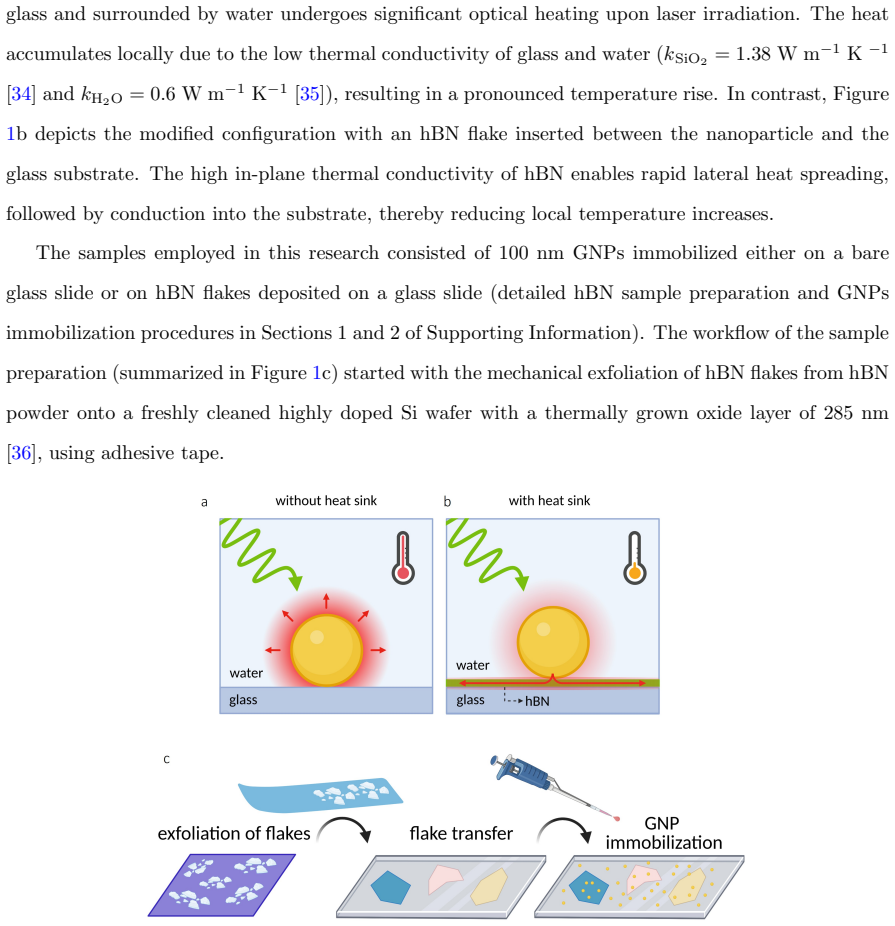
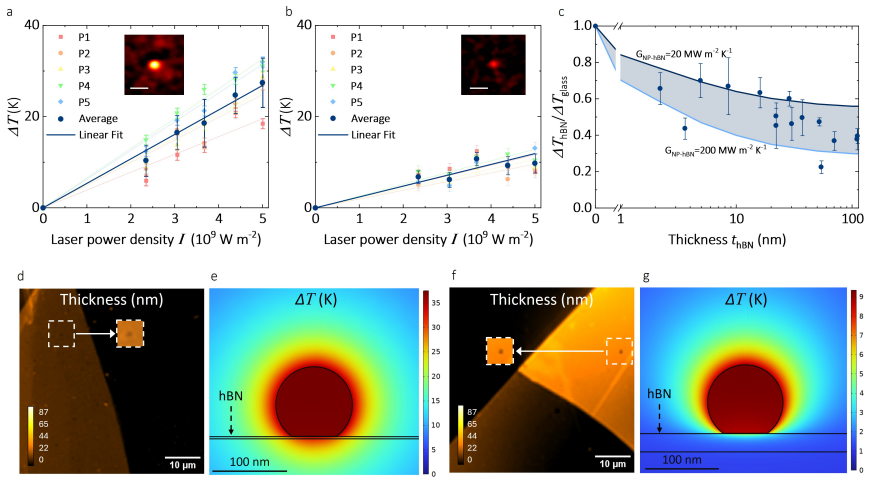
Incorporating hexagonal boron nitride thin flakes suppresses the temperature rise around optically heated gold nanospheres in aqueous environments by up to 60 percent relative to glass substrates alone. Finite-element simulations quantify that cooling depends strongly on flake thickness, limited by heat capacity in thin flakes and by interfacial thermal conductance in thick flakes. Experiments with cross-grating wavefront microscopy confirm the reduction and show two heat-dissipation routes: a direct path from the nanoparticle into the hBN and an indirect path through the surrounding water into the hBN. This supplies design rules for placing 2D materials in plasmonic platforms.
What carries the argument
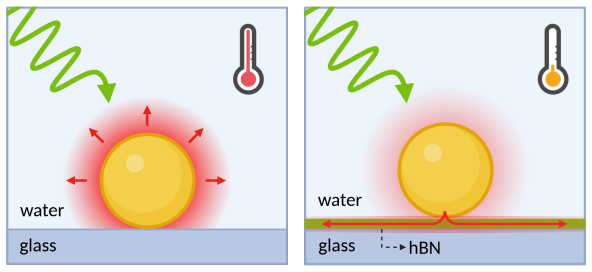
hexagonal boron nitride thin flakes used as passive heat spreaders that improve dissipation from plasmonically heated gold nanospheres via direct and indirect pathways
If this is right
- Heat leaves the nanoparticles along a direct route into the hBN and an indirect route through water into the hBN.
- Cooling strength varies sharply with hBN thickness: thin flakes are limited by their own heat capacity while thick flakes are limited by the interface resistance.
- The method supplies practical thickness guidelines for placing 2D materials in heat-sensitive plasmonic devices such as biosensors.
- The optical temperature-mapping technique can also characterize non-absorbing 2D layers without contact.
Where Pith is reading between the lines
- The same hBN layer could support higher light intensities in water-based sensors before heat damage occurs.
- Other layered materials with high in-plane conductivity might be tested in similar nanoparticle setups to compare cooling performance.
- The observed thickness crossover point could be used to choose flake size during device fabrication for a target operating temperature.
Load-bearing premise
The simulations must correctly predict heat flow across the material boundaries, and the temperature maps must accurately reflect the local heating without distortion from the layers or the water.
What would settle it
An independent temperature measurement around the same gold nanoparticles, performed with and without the hBN flakes and showing no temperature reduction or a thickness dependence different from the simulations, would show the claimed cooling effect does not occur.
Figures


read the original abstract
Optical heating of plasmonic nanostructures is a critical challenge in nanoscale systems. Although plasmonic effects enable enhanced optical functionalities, the associated temperature rise can degrade performance in heat-sensitive applications such as biosensing, nanophotonics, and microelectronics. Conventional cooling strategies fail at these scales due to limited heat transport and high interfacial thermal resistance, motivating the integration of advanced materials for thermal management. Here, we investigate hexagonal boron nitride (hBN) thin flakes as heat spreaders to mitigate plasmonic heating of gold nanospheres immobilized on hBN deposited on glass and surrounded by water. Using finite-element simulations, we quantify the influence of hBN thickness, in-plane thermal conductivity, and interfacial thermal conductance on cooling efficiency. Complementary experiments employ cross-grating wavefront microscopy (CGM) for nanothermometry to map the temperature around optically heated gold nanoparticles and quantify the cooling effect of hBN. We extend the application of CGM for rapid, non-invasive, and all-optical characterization of non-absorbing 2D materials. Our results reveal a strong thickness dependence, where heat dissipation in thin flakes is limited by the heat capacity of hBN and in thick flakes by interfacial thermal conductance. Including hBN, we obtain a reduction in temperature rise by up to 60% compared to glass. In addition, the presence of two main heat dissipation pathways emerges: a direct one from the nanoparticle to the hBN and an indirect one from the particle via water to the hBN. This combined simulation-experiment framework offers a versatile approach to improve thermal management in plasmonic systems and beyond, establishing design guidelines for integrating 2D materials into thermally sensitive platforms such as biosensors and integrated circuits.
Editorial analysis
A structured set of objections, weighed in public.
Referee Report
Summary. The paper investigates hexagonal boron nitride (hBN) thin flakes as heat spreaders to suppress plasmonic heating of gold nanospheres on glass in aqueous environments. Finite-element simulations quantify the effects of hBN thickness, in-plane thermal conductivity, and interfacial thermal conductance on cooling. Experiments use cross-grating wavefront microscopy (CGM) nanothermometry to map local temperatures and confirm the cooling effect. The central results are a strong thickness dependence of the cooling and a maximum 60% reduction in temperature rise relative to bare glass, with two identified heat-dissipation pathways (direct nanoparticle-to-hBN and indirect via water).
Significance. A robust demonstration of 60% plasmonic cooling via hBN would be significant for thermal management in biosensing, nanophotonics, and integrated optics where local heating limits performance. The extension of CGM to rapid, all-optical characterization of non-absorbing 2D materials is a useful methodological contribution. However, the mechanistic interpretation of the thickness dependence appears inconsistent with the steady-state heat equation, which limits the strength of the derived design guidelines even if the numerical reduction holds.
major comments (2)
- Abstract: the claim that 'heat dissipation in thin flakes is limited by the heat capacity of hBN' contradicts the steady-state heat equation solved by the finite-element method (∇ · (k ∇T) = −Q). Volumetric heat capacity ρc appears only in the transient term ρc ∂T/∂t and does not affect the steady temperature rise under continuous illumination. This indicates either a transient component retained in the simulations or an incorrect physical picture of the two dissipation pathways, weakening the mechanistic conclusions and design guidelines even if the raw 60% figure is numerically correct.
- Abstract and results: the reported 60% reduction and thickness dependence rest on free parameters (hBN thickness, in-plane k, interfacial thermal conductance) whose values are not shown to be independently constrained by experiment. Without explicit comparison of simulated versus measured temperature maps (including error analysis and calibration of CGM for possible optical artifacts from hBN or water), it is unclear whether the central number is robust or sensitive to post-hoc parameter choices.
minor comments (3)
- Clarify throughout whether all simulations are strictly steady-state or include any time-stepping; if the latter, state the criterion used to declare convergence to steady state.
- Add explicit discussion of possible optical artifacts in CGM measurements when hBN flakes are present (e.g., refractive-index mismatch or scattering).
- Provide the full set of material parameters used in the finite-element model (including values and sources for interfacial conductances) in a dedicated table or methods subsection.
Simulated Author's Rebuttal
We thank the referee for the careful review and constructive feedback. The comments have helped us improve the clarity of our mechanistic description and strengthen the presentation of experimental validation. We address each point below.
read point-by-point responses
-
Referee: Abstract: the claim that 'heat dissipation in thin flakes is limited by the heat capacity of hBN' contradicts the steady-state heat equation solved by the finite-element method (∇ · (k ∇T) = −Q). Volumetric heat capacity ρc appears only in the transient term ρc ∂T/∂t and does not affect the steady temperature rise under continuous illumination. This indicates either a transient component retained in the simulations or an incorrect physical picture of the two dissipation pathways, weakening the mechanistic conclusions and design guidelines even if the raw 60% figure is numerically correct.
Authors: We agree that referencing heat capacity for steady-state dissipation is imprecise. Our finite-element simulations solve the steady-state heat equation; the observed thickness dependence arises from geometry-dependent lateral thermal spreading resistance within the hBN layer, which grows with thickness until the interfacial thermal conductance becomes the limiting factor. The two dissipation pathways (direct nanoparticle-to-hBN and indirect via water) remain valid. We have revised the abstract and results sections to remove any reference to heat capacity and to describe the mechanisms strictly in terms of thermal resistance and conductance. This correction improves the mechanistic interpretation without altering the numerical results. revision: yes
-
Referee: Abstract and results: the reported 60% reduction and thickness dependence rest on free parameters (hBN thickness, in-plane k, interfacial thermal conductance) whose values are not shown to be independently constrained by experiment. Without explicit comparison of simulated versus measured temperature maps (including error analysis and calibration of CGM for possible optical artifacts from hBN or water), it is unclear whether the central number is robust or sensitive to post-hoc parameter choices.
Authors: hBN flake thicknesses were measured directly by AFM and optical contrast for each experimental data point. In-plane thermal conductivity and interfacial conductance values are taken from established literature for hBN-glass and hBN-water interfaces, with a sensitivity analysis already present in the supplementary information demonstrating that the reported cooling effect remains stable across plausible parameter ranges. In the revised manuscript we have added side-by-side comparisons of simulated and CGM-measured temperature profiles for representative particles, including error bars derived from CGM calibration and an explicit discussion of potential optical artifacts introduced by hBN or the aqueous medium. These additions confirm the robustness of the 60 % figure. revision: yes
Circularity Check
No significant circularity detected
full rationale
The paper derives its central results—the up to 60% temperature reduction and thickness-dependent cooling—from finite-element simulations of the steady-state heat equation and independent CGM nanothermometry experiments. No step reduces a claimed prediction or first-principles result to a fitted parameter or self-citation by construction. The reported design guidelines and pathway analysis follow directly from the numerical outputs and measured maps rather than being equivalent to the inputs. While the physical attribution of thin-flake behavior to heat capacity (rather than conductance) may be inconsistent with the steady-state formulation used, this is a modeling-interpretation issue, not a circularity in the derivation chain.
Axiom & Free-Parameter Ledger
free parameters (3)
- hBN thickness
- in-plane thermal conductivity of hBN
- interfacial thermal conductance
axioms (2)
- domain assumption Heat transport obeys the continuum Fourier law at the nanoparticle scale.
- domain assumption Cross-grating wavefront microscopy provides accurate, non-contact temperature maps around the nanoparticles.
Reference graph
Works this paper leans on
-
[1]
Boriskina, Thomas Alan Cooper, Lingping Zeng, George Ni, Jonathan K
Svetlana V. Boriskina, Thomas Alan Cooper, Lingping Zeng, George Ni, Jonathan K. Tong, Yoichiro Tsurimaki, Yi Huang, Laureen Meroueh, Gerald Mahan, and Gang Chen. Losses in plasmonics: from mitigating energy dissipation to embracing loss-enabled functionalities.Adv. Opt. Photon., 9(4):775–827, 2017
work page 2017
- [2]
-
[3]
Alexander O. Govorov and Hugh H. Richardson. Generating heat with metal nanoparticles.Nano Today, 2(1):30–38, 2007
work page 2007
-
[4]
Andrea Baldi and Sven H. C. Askes. Pulsed photothermal heterogeneous catalysis.ACS Catalysis, 13(5):3419–3432, 2023
work page 2023
-
[5]
E. Pop, S. Sinha, and K.E. Goodson. Heat generation and transport in nanometer-scale transistors. Proceedings of the IEEE, 94(8):1587–1601, 2006
work page 2006
-
[6]
Steven Jones, Daniel Andr´ en, Pawel Karpinski, and Mikael K¨ all. Photothermal heating of plas- monic nanoantennas: Influence on trapped particle dynamics and colloid distribution.ACS Pho- tonics, 5(7):2878–2887, 2018
work page 2018
-
[7]
Femtosecond-pulsed optical heating of gold nanoparticles
Guillaume Baffou and Herv´ e Rigneault. Femtosecond-pulsed optical heating of gold nanoparticles. Phys. Rev. B, 84:035415, 2011
work page 2011
-
[8]
Braun, Abdullah Mamun, Zeyu Liu, Kenny Huynh, Michael E
Md Shafkat Bin Hoque, Yee Rui Koh, Jeffrey L. Braun, Abdullah Mamun, Zeyu Liu, Kenny Huynh, Michael E. Liao, Kamal Hussain, Zhe Cheng, Eric R. Hoglund, David H. Olson, John A. Tomko, Kiumars Aryana, Roisul Galib, John T. Gaskins, Mirza Mohammad Mahbube Elahi, Zayd C. Leseman, James M. Howe, Tengfei Luo, Samuel Graham, Mark S. Goorsky, Asif Khan, and Patri...
work page 2021
-
[9]
Kenji Setoura, Yudai Okada, Daniel Werner, and Shuichi Hashimoto. Observation of nanoscale cooling effects by substrates and the surrounding media for single gold nanoparticles under cw- laser illumination.ACS Nano, 7(9):7874–7885, 2013
work page 2013
-
[10]
Cl´ ement Panais, Romain Rouxel, No¨ elle Lascoux, Sylvie Marguet, Paolo Maioli, Francesco Banfi, Fabrice Vall´ ee, Natalia Del Fatti, and Aur´ elien Crut. Cooling dynamics of individual gold nan- 20 odisks deposited on thick substrates and nanometric membranes.The Journal of Physical Chem- istry Letters, 14(23):5343–5352, 2023
work page 2023
-
[11]
Mizanur Rahman, Mohammadreza Shahzadeh, and Simone Pisana. Simultaneous measurement of anisotropic thermal conductivity and thermal boundary conductance of 2-dimensional materials. Journal of Applied Physics, 126(20):205103, 2019
work page 2019
-
[12]
Glen A. Slack. Thermal conductivity of MgP, Al 2O3, MgAl 2O4, and Fe 3O4 crystals from 3°to 300°K.Phys. Rev., 126:427–441, 1962
work page 1962
-
[13]
David G. Cahill, Wayne K. Ford, Kenneth E. Goodson, Gerald D. Mahan, Arun Majumdar, Humphrey J. Maris, Roberto Merlin, and Simon R. Phillpot. Nanoscale thermal transport.Journal of Applied Physics, 93(2):793–818, 2003
work page 2003
-
[14]
G.A. Slack. Nonmetallic crystals with high thermal conductivity.Journal of Physics and Chem- istry of Solids, 34(2):321–335, 1973
work page 1973
-
[15]
R. Tanos, W. Akhtar, S. Monneret, F. Favaro de Oliveira, G. Seniutinas, M. Munsch, P. Maletinsky, L. le Gratiet, I. Sagnes, A. Dr´ eau, C. Gergely, V. Jacques, G. Baffou, and I. Robert- Philip. Optimal architecture for diamond-based wide-field thermal imaging.AIP Advances, 10(2):025027, 2020
work page 2020
-
[16]
Mingyu Sang, Jongwoon Shin, Kiho Kim, and Ki Jun Yu. Electronic and thermal properties of graphene and recent advances in graphene based electronics applications.Nanomaterials, 9, 2019
work page 2019
-
[17]
Alexander A. Balandin, Suchismita Ghosh, Wenzhong Bao, Irene Calizo, Desalegne Teweldebrhan, Feng Miao, and Chun Ning Lau. Superior thermal conductivity of single-layer graphene.Nano Letters, 8(3):902–907, 2008
work page 2008
- [18]
-
[19]
Yee Kan Koh, Myung-Ho Bae, David G. Cahill, and Eric Pop. Heat conduction across monolayer and few-layer graphenes.Nano Letters, 10(11):4363–4368, 2010
work page 2010
-
[20]
Fan Wu, He Tian, Yang Shen, Zheng-Qiang Zhu, Yanming Liu, Thomas Hirtz, Rui Wu, Guangyang Gou, Yancong Qiao, Yi Yang, Chao-Yang Xing, Gang Zhang, and Tian-Ling Ren. High thermal conductivity 2d materials: From theory and engineering to applications.Advanced Materials Interfaces, 9(21):2200409, 2022
work page 2022
-
[21]
Sadegh Alborzi and Ali Rajabpour
M. Sadegh Alborzi and Ali Rajabpour. Thermal transport in van der waals graphene/boron- nitride structure: a molecular dynamics study.The European Physical Journal Plus, 136, 2021. 21
work page 2021
-
[22]
Ziqian Wang, Rongguo Xie, Cong Tinh Bui, Dan Liu, Xiaoxi Ni, Baowen Li, and John T. L. Thong. Thermal transport in suspended and supported few-layer graphene.Nano Letters, 11(1):113–118, 2011
work page 2011
-
[23]
Jialin Tang, Jiongzhi Zheng, Xiaohan Song, Lin Cheng, and Ruiqiang Guo. In-plane thermal conductivity of hexagonal boron nitride from 2d to 3d.Journal of Applied Physics, 135(20):205105, 2024
work page 2024
-
[24]
Chao Yuan, Jiahan Li, Lucas Lindsay, David Cherns, James W. Pomeroy, Song Liu, James H. Edgar, and Martin Kuball. Modulating the thermal conductivity in hexagonal boron nitride via controlled boron isotope concentration.Communications Physics, 2, 2019
work page 2019
-
[25]
L. Lindsay and D. A. Broido. Enhanced thermal conductivity and isotope effect in single-layer hexagonal boron nitride.Phys. Rev. B, 84:155421, 2011
work page 2011
-
[26]
Li Song, Lijie Ci, Hao Lu, Pavel B Sorokin, Chuanhong Jin, Jie Ni, Alexander G Kvashnin, Dmitry G Kvashnin, Jun Lou, Boris I Yakobson, and Pulickel M Ajayan. Large scale growth and characterization of atomic hexagonal boron nitride layers.Nano letters, 11:3209–15, 2010
work page 2010
-
[27]
Bohai Liu, Riccardo Farina, Micha l ´Swiniarski, Wiktor Kwapi´ nski, Ronny Omar De La Bastida Chiza, Marvin van Tilburg, Marvin Marco Jansen, Kenji Watanabe, Takashi Taniguchi, Erik P. A. M. Bakkers, Jos E. M. Haverkort, and Klaas-Jan Tielrooij. Hexagonal boron nitride for nanoscale heat dissipation in electronic and photonic chips.Nano Letters, 26(7):241...
work page 2026
-
[28]
J. Gargiulo, M. Herran, I. L. Violi, A. Sousa-Castillo, L. P. Martinez, S. Ezendam, M. Barella, H. Giesler, R. Grzeschik, S. Schl¨ ucker, S. A. Maier, F. D. Stefani, and E. Cort´ es. Impact of bimetallic interface design on heat generation in plasmonic au/pd nanostructures studied by single- particle thermometry.Nature Communications, 14:3813, 2023
work page 2023
-
[29]
Caldwell, Igor Aharonovich, Guillaume Cassabois, James H
Joshua D. Caldwell, Igor Aharonovich, Guillaume Cassabois, James H. Edgar, Bernard Gil, and D. N. Basov.Nature Reviews Materials, 4:552–567, 2019
work page 2019
-
[30]
E. K. Sichel, R. E. Miller, M. S. Abrahams, and C. J. Buiocchi. Heat capacity and thermal conductivity of hexagonal pyrolytic boron nitride.Phys. Rev. B, 13:4607–4611, 1976
work page 1976
-
[31]
Khlebtsov, Sonia Centi, Fulvio Ratto, Nikolai G
Lucia Cavigli, Alessio Milanesi, Boris N. Khlebtsov, Sonia Centi, Fulvio Ratto, Nikolai G. Khlebtsov, and Roberto Pini. Impact of kapitza resistance on the stability and efficiency of pho- toacoustic conversion from gold nanorods.Journal of Colloid and Interface Science, 578:358–365, 2020. 22
work page 2020
-
[32]
Guillaume Baffou, Pierre Bon, Julien Savatier, Julien Polleux, Min Zhu, Marine Merlin, Herv´ e Rigneault, and Serge Monneret. Thermal imaging of nanostructures by quantitative optical phase analysis.ACS Nano, 6(3):2452–2458, 2012
work page 2012
-
[33]
Guillaume Baffou. Wavefront microscopy using quadriwave lateral shearing interferometry: From bioimaging to nanophotonics.ACS Photonics, 10(2):322–339, 2023
work page 2023
-
[34]
Yongjian Yang, Hirofumi Tokunaga, Kazutaka Hayashi, Madoka Ono, and John C. Mauro. Inves- tigation of the thermal conductivity of sio2 glass using molecular dynamics simulations.Journal of the American Ceramic Society, 107(12):7836–7849, 2024
work page 2024
-
[35]
The thermal conductivity of water.Proceedings of the Physical Society, 45(4):523, 1933
L H Martin and K C Lang. The thermal conductivity of water.Proceedings of the Physical Society, 45(4):523, 1933
work page 1933
- [36]
-
[37]
Filippo Pizzocchero, Lene Gammelgaard, Bjarke S. Jessen, Jos´ e M. Caridad, Lei Wang, James Hone, Peter Bøggild, and Timothy J. Booth. The hot pick-up technique for batch assembly of van der waals heterostructures.Nature Communications, 7:11894, 2016
work page 2016
-
[38]
Ho-Ki Lyeo and David G. Cahill. Thermal conductance of interfaces between highly dissimilar materials.Phys. Rev. B, 73:144301, 2006
work page 2006
-
[39]
S. Alosious, S. K. Kannam, S. P. Sathian, and B. D. Todd. Effects of electrostatic interactions on kapitza resistance in hexagonal boron nitride-water interfaces.Langmuir, 38:8783–8793, 2022
work page 2022
-
[40]
Experimental studies of small particle structures.Reports on Progress in Physics, 57(6):603, 1994
L D Marks. Experimental studies of small particle structures.Reports on Progress in Physics, 57(6):603, 1994
work page 1994
-
[41]
Chun-Hong Kuo, Tian-Fu Chiang, Lih-Juann Chen, and Michael H. Huang. Synthesis of highly faceted pentagonal- and hexagonal-shaped gold nanoparticles with controlled sizes by sodium dodecyl sulfate.Langmuir, 20(18):7820–7824, 2004
work page 2004
- [42]
-
[43]
Gabriel R. Jaffe, Keenan J. Smith, Kenji Watanabe, Takashi Taniguchi, Max G. Lagally, Mark A. Eriksson, and Victor W. Brar. Thickness-dependent cross-plane thermal conductivity measure- ments of exfoliated hexagonal boron nitride.ACS Applied Materials & Interfaces, 15(9):12545– 12550, 2023. 23
work page 2023
-
[44]
Quadriwave lateral shearing interferometry for quantitative phase microscopy of living cells.Opt
Pierre Bon, Guillaume Maucort, Benoit Wattellier, and Serge Monneret. Quadriwave lateral shearing interferometry for quantitative phase microscopy of living cells.Opt. Express, 17:13080– 13094, 2009
work page 2009
-
[45]
Luciana P. Martinez, M. Cristina Mina Villarreal, Cecilia Zaza, Mariano Barella, Guillermo P. Acuna, Fernando D. Stefani, Ianina L. Violi, and Julian Gargiulo. Thermometries for single nanoparticles heated with light.ACS Sensors, 9(3):1049–1064, 2024
work page 2024
-
[46]
Chaumet, Pierre Bon, Guillaume Maire, Anne Sentenac, and Guillaume Baffou
Patrick C. Chaumet, Pierre Bon, Guillaume Maire, Anne Sentenac, and Guillaume Baffou. Quan- titative phase microscopies: accuracy comparison.Light: Science&Applications, 13:288, 2024
work page 2024
-
[47]
Baptiste Marthy and Guillaume Baffou. Cross-grating phase microscopy (cgm): In silico experi- ment (insilex) algorithm, noise and accuracy.Optics Communications, 521:128577, 2022
work page 2022
-
[48]
Guillaume Baffou. Quantitative phase microscopy using quadriwave lateral shearing interferom- etry (qlsi): principle, terminology, algorithm and grating shadow description.Journal of Physics D: Applied Physics, 54(29):294002, 2021
work page 2021
-
[49]
Samira Khadir, Pierre Bon, Dominique Vignaud, Elizabeth Galopin, Niall McEvoy, David Mc- Closkey, Serge Monneret, and Guillaume Baffou. Optical imaging and characterization of graphene and other 2d materials using quantitative phase microscopy.ACS Photonics, 4(12):3130–3139, 2017
work page 2017
-
[50]
P. Nemes-Incze, Z. Osv´ ath, K. Kamar´ as, and L.P. Bir´ o. Anomalies in thickness measurements of graphene and few layer graphite crystals by tapping mode atomic force microscopy.Carbon, 46(11):1435–1442, 2008
work page 2008
-
[51]
Yeonghoon Jin, Yoonhyuk Rah, Junghoon Park, Jaeho Shim, and Kyoungsik Yu. Rapid and broad-range thickness estimation method of hexagonal boron nitride using raman spectroscopy and optical microscope.Applied Physics Letters, 116(8):081104, 2020
work page 2020
-
[52]
Dheeraj Golla, Kanokporn Chattrakun, Kenji Watanabe, Takashi Taniguchi, Brian J. LeRoy, and Arvinder Sandhu. Optical thickness determination of hexagonal boron nitride flakes.Applied Physics Letters, 102(16):161906, 2013
work page 2013
-
[53]
D. V. Grudinin, G. A. Ermolaev, D. G. Baranov, A. N. Toksumakov, K. V. Voronin, A. S. Slavich, A. A. Vyshnevyy, A. B. Mazitov, I. A. Kruglov, D. A. Ghazaryan, A. V. Arsenin, K. S. Novoselov, and V. S. Volkov. Hexagonal boron nitride nanophotonics: a record-breaking material for the ultraviolet and visible spectral ranges.Mater. Horiz., 10:2427–2435, 2023. 24
work page 2023
-
[54]
Jonglo Park and David G. Cahill. Plasmonic sensing of heat transport at solid–liquid interfaces. The Journal of Physical Chemistry C, 120(5):2814–2821, 2016
work page 2016
-
[55]
E. T. Swartz and R. O. Pohl. Thermal boundary resistance.Rev. Mod. Phys., 61:605–668, 1989
work page 1989
-
[56]
R. J. Stoner and H. J. Maris. Kapitza conductance and heat flow between solids at temperatures from 50 to 300 k.Phys. Rev. B, 48:16373–16387, 1993
work page 1993
-
[57]
Tereza Koˇ sutov´ a, Zdenˇ ek Krtouˇ s, Jaroslav Kousal, Ondˇ rej Kyli´ an, Jan Hanuˇ s, Lidia Mart´ ınez, Yves Huttel, Daniil Nikitin, Pavel Pleskunov, Hynek Biederman, Luk´ aˇ s Hor´ ak, and Milan Dopita. Temperature-driven morphological and microstructural changes of gold nanoparticles prepared by aggregation from the gas phase.ACS Omega, 10(21):22052–...
work page 2025
discussion (0)
Sign in with ORCID, Apple, or X to comment. Anyone can read and Pith papers without signing in.