Recognition: unknown
Estimation of random coefficients logit demand models with interactive fixed effects
Pith reviewed 2026-05-09 18:41 UTC · model grok-4.3
The pith
A two-step least squares-minimum distance procedure estimates random coefficients logit demand models with interactive fixed effects.
A machine-rendered reading of the paper's core claim, the machinery that carries it, and where it could break.
Core claim
We extend the BLP random coefficients discrete-choice demand model by adding interactive fixed effects in the form of a factor structure on the unobserved product characteristics. The interactive fixed effects can be arbitrarily correlated with the observed product characteristics including price. We propose a two-step least squares-minimum distance procedure to calculate the estimator.
What carries the argument
The two-step LS-MD procedure applied to the random-coefficients logit model augmented with a low-rank factor structure on unobserved product characteristics.
If this is right
- The estimator accommodates endogeneity arising from correlation between prices and unobserved characteristics without requiring external instruments.
- The factor structure captures strong persistence in market shares across products and markets.
- The procedure is computationally straightforward and suitable for standard empirical applications in industrial organization.
- Monte Carlo simulations show that the estimator performs well in finite samples.
Where Pith is reading between the lines
- Researchers facing weak instruments for price endogeneity in discrete-choice settings may obtain more robust estimates by adopting this factor-augmented approach.
- The same two-step structure could be tested in other discrete-choice contexts such as dynamic demand or differentiated-product supply models.
- Re-estimating classic automobile demand studies with this richer control for unobserved heterogeneity might alter inferred price elasticities and welfare calculations.
Load-bearing premise
The unobserved product characteristics follow a low-rank factor structure that can be separated from the random coefficients and observed covariates while allowing arbitrary correlation with price and other regressors.
What would settle it
Generate simulated data from a demand model whose unobserved product characteristics do not follow a low-rank factor structure, then check whether the two-step LS-MD estimator recovers the true random-coefficient parameters without bias.
Figures

read the original abstract
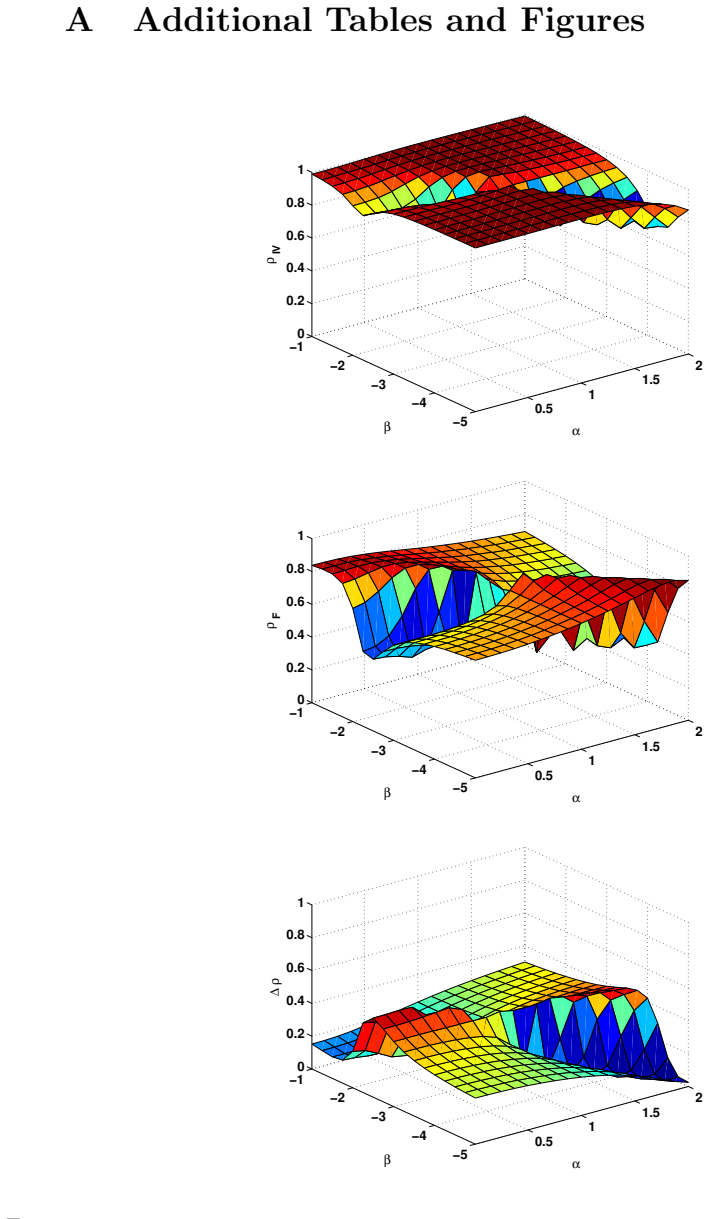
We extend the Berry, Levinsohn and Pakes (BLP, 1995) random coefficients discrete-choice demand model, which underlies much recent empirical work in IO. We add interactive fixed effects in the form of a factor structure on the unobserved product characteristics. The interactive fixed effects can be arbitrarily correlated with the observed product characteristics (including price), which accommodates endogeneity and, at the same time, captures strong persistence in market shares across products and markets. We propose a two-step least squares-minimum distance (LS-MD) procedure to calculate the estimator. Our estimator is easy to compute, and Monte Carlo simulations show that it performs well. We consider an empirical illustration to US automobile demand.
Editorial analysis
A structured set of objections, weighed in public.
Referee Report
Summary. The paper extends the Berry-Levinsohn-Pakes (1995) random coefficients logit demand model by incorporating interactive fixed effects via a low-rank factor structure on unobserved product characteristics. These factors are permitted to correlate arbitrarily with observed covariates including price. The authors propose a two-step least squares-minimum distance (LS-MD) estimator: the first step inverts market shares to recover mean utilities for fixed random-coefficient parameters, and the second step applies LS-MD to estimate the remaining parameters while treating the factors as additional regressors. Monte Carlo simulations are reported to show good finite-sample performance, and an empirical illustration on US automobile demand is provided.
Significance. If the estimator is consistent and the Monte Carlo evidence is robust, the contribution would be useful for empirical IO applications that require both flexible substitution patterns and controls for persistent unobserved heterogeneity correlated with price. The computational simplicity of the two-step procedure is a practical strength relative to full-information GMM alternatives.
major comments (2)
- [§3] §3 (Estimation), the two-step LS-MD procedure: the consistency argument relies on exact separability of the low-rank factor structure from the nonlinear share inversion δ(σ). Because the BLP inversion is nonlinear in σ, estimation error in the first-step σ feeds back into the recovered δ_jt(σ); this error can be absorbed into the estimated factors or β when factors are allowed arbitrary correlation with price. No formal consistency theorem or identification proof is supplied to bound this feedback, and the Monte Carlo design does not isolate the joint estimation of σ from the factor recovery.
- [§4] §4 (Monte Carlo), Tables 1–3: the reported bias and RMSE for the random-coefficient parameters and factor loadings are presented only for correctly specified designs; there is no experiment that perturbs the rank of the factor structure or introduces misspecification in the random-coefficient distribution to test whether the two-step procedure remains stable when the separability assumption is mildly violated.
minor comments (2)
- The notation for the factor loadings and the minimum-distance objective could be clarified with an explicit statement of the weighting matrix and how it is estimated.
- The empirical application would benefit from reporting the estimated number of factors and a sensitivity check to alternative factor counts.
Simulated Author's Rebuttal
We thank the referee for the constructive comments, which will help improve the paper. We respond to each major comment below.
read point-by-point responses
-
Referee: §3 (Estimation), the two-step LS-MD procedure: the consistency argument relies on exact separability of the low-rank factor structure from the nonlinear share inversion δ(σ). Because the BLP inversion is nonlinear in σ, estimation error in the first-step σ feeds back into the recovered δ_jt(σ); this error can be absorbed into the estimated factors or β when factors are allowed arbitrary correlation with price. No formal consistency theorem or identification proof is supplied to bound this feedback, and the Monte Carlo design does not isolate the joint estimation of σ from the factor recovery.
Authors: We appreciate the referee pointing out the potential feedback issue arising from the nonlinear nature of the BLP share inversion. The manuscript sketches the consistency based on the fact that the first-step estimator for the random coefficient parameters σ converges at a parametric rate, and the factor structure is recovered in the second step treating the estimated δ as observed. However, we acknowledge that a rigorous proof bounding the propagation of the first-step error through the nonlinear inversion into the factors and β is not provided. In the revision, we will include a formal consistency theorem that establishes the conditions under which this feedback is asymptotically negligible, leveraging the low-rank structure and the arbitrary correlation allowance. We will also update the Monte Carlo section to include a design that fixes σ at its true value versus estimating it jointly to isolate the effect. revision: yes
-
Referee: §4 (Monte Carlo), Tables 1–3: the reported bias and RMSE for the random-coefficient parameters and factor loadings are presented only for correctly specified designs; there is no experiment that perturbs the rank of the factor structure or introduces misspecification in the random-coefficient distribution to test whether the two-step procedure remains stable when the separability assumption is mildly violated.
Authors: We agree that robustness checks under misspecification are important for validating the practical usefulness of the estimator. The current Monte Carlo focuses on the correctly specified case to demonstrate the estimator's performance when assumptions hold. In the revised version, we will add new experiments that introduce mild misspecifications, such as estimating with an incorrect number of factors (e.g., over- or under-specifying the rank) and using a misspecified distribution for the random coefficients. This will allow us to assess the sensitivity of the two-step LS-MD procedure to violations of the exact separability. revision: yes
Circularity Check
Two-step LS-MD estimator extends BLP with interactive fixed effects via independent separability assumption
full rationale
The paper's core contribution is a two-step LS-MD procedure that first inverts the random-coefficients share equation for fixed σ to recover mean utilities δ(σ), then applies least-squares minimum distance to extract β and the low-rank factors from the interactive fixed-effects structure. This chain is self-contained: the low-rank factor assumption is stated as a modeling primitive that permits arbitrary correlation with price, the inversion step is the standard BLP map, and the second-step regression is a standard interactive fixed-effects estimator. No equation reduces to a tautology, no fitted parameter is relabeled as a prediction, and no load-bearing step relies on a self-citation whose validity is presupposed rather than independently verified. Monte Carlo results supply external performance checks rather than internal re-derivation.
Axiom & Free-Parameter Ledger
axioms (1)
- domain assumption Unobserved product characteristics follow an interactive fixed effects factor structure that can be arbitrarily correlated with observed characteristics including price.
Reference graph
Works this paper leans on
-
[1]
Ackerberg, D., Benkard, L., Berry, S., and Pakes, A. (2007). Econometric tools for analyzing market outcomes. In Heckman, J. and Leamer, E., editors, Handbook of Econometrics, Vol. 6A . North-Holland
2007
-
[2]
Ahn, S. C. and Horenstein, A. R. (2013). Eigenvalue ratio test for the number of factors. Econometrica , 81(3):1203--1227
2013
-
[3]
C., Lee, Y
Ahn, S. C., Lee, Y. H., and Schmidt, P. (2001). GMM estimation of linear panel data models with time-varying individual effects. Journal of Econometrics , 101(2):219--255
2001
-
[4]
C., Lee, Y
Ahn, S. C., Lee, Y. H., and Schmidt, P. (2013). Panel data models with multiple time-varying individual effects. Journal of Econometrics , 174(1):1--14
2013
-
[5]
Bai, J. (2009). Panel data models with interactive fixed effects . Econometrica , 77(4):1229--1279
2009
-
[6]
and Ng, S
Bai, J. and Ng, S. (2002). Determining the number of factors in approximate factor models. Econometrica , 70(1):191--221
2002
-
[7]
and Ng, S
Bai, J. and Ng, S. (2006). Confidence intervals for diffusion index forecasts and inference for factor-augmented regressions. Econometrica , 74(4):1133--1150
2006
-
[8]
Bajari, P., Fox, J., Kim, K., and Ryan, S. (2011). A simple nonparametric estimator for the distribution of random coefficients. Quantitative Economics , 2:381--418
2011
-
[9]
Bajari, P., Fox, J., Kim, K., and Ryan, S. (2012). The random coefficients logit model is identified. Journal of Econometrics , 166:204--212
2012
-
[10]
Berry, S., Gandhi, A., and Haile, P. (2013). Connected Substitutes and Invertibility of Demand . Econometrica , 81:2087--2111
2013
-
[11]
Berry, S., Levinsohn, J., and Pakes, A. (1995). Automobile prices in market equilibrium. Econometrica , 63(4):841--890
1995
-
[12]
B., and Pakes, A
Berry, S., Linton, O. B., and Pakes, A. (2004). Limit theorems for estimating the parameters of differentiated product demand systems. The Review of Economic Studies , 71(3):613--654
2004
-
[13]
Berry, S. T. (1994). Estimating discrete-choice models of product differentiation. The RAND Journal of Economics , 25(2):242--262
1994
-
[14]
Berry, S. T. and Haile, P. A. (2014). Identification in differentiated products markets using market level data. Econometrica , 82(5):1749--1797
2014
-
[15]
and Doraszelski, U
Besanko, D. and Doraszelski, U. (2004). Capacity dynamics and endogenous asymmetries in firm size. RAND Journal of Economics , 35:23--49
2004
-
[16]
and Hansen, C
Chernozhukov, V. and Hansen, C. (2006). Instrumental quantile regression inference for structural and treatment effect models . Journal of Econometrics , 132(2):491--525
2006
-
[17]
and Komunjer, I
Chiappori, P. and Komunjer, I. (2009). On the nonparametric identification of multiple choice models. Manuscript, Columbia University
2009
-
[18]
P., Fox, J., and Su, C
Dube, J. P., Fox, J., and Su, C. (2012). Improving the Numerical Performance of BLP Static and Dynamic Discrete Choice Random Coefficients Demand Estimation . Econometrica , 80:2231--2267
2012
-
[19]
and Shum, M
Esteban, S. and Shum, M. (2007). Durable Goods Oligopoly with Secondary Markets: the Case of Automobiles . RAND Journal of Economics , 38:332--354
2007
-
[20]
Gandhi, A., Kim, K., and Petrin, A. (2010). Identification and Estimation in Discrete Choice Demand Models when Endogenous Variables Interact with the Error . Manuscript
2010
-
[21]
Gandhi, A., Lu, Z., and Shi, X. (2013). Estimating Demand for Differentiated Products with Error in Market Shares . Working paper, University of Wisconsin
2013
-
[22]
n" and " T
Hahn, J. and Kuersteiner, G. (2002). Asymptotically unbiased inference for a dynamic panel model with fixed effects when both "n" and " T " are large. Econometrica , 70(4):1639--1657
2002
-
[23]
and Kuersteiner, G
Hahn, J. and Kuersteiner, G. (2004). Bias reduction for dynamic nonlinear panel models with fixed effects. Manuscript
2004
-
[24]
and Newey, W
Hahn, J. and Newey, W. (2004). Jackknife and analytical bias reduction for nonlinear panel models. Econometrica , 72(4):1295--1319
2004
-
[25]
Harding, M. (2007). Structural estimation of high-dimensional factor models. Manuscript
2007
-
[26]
and Hausman, J
Harding, M. and Hausman, J. (2007). Using a Laplace Approximation to Estimate the Random Coefficients Logit Model By Nonlinear Least Squares . International Economic Review , 48:1311--1328
2007
-
[27]
Hausman, J. (1997). Valuation of new goods under perfect and imperfect competition. In The Economics of New Goods . University of Chicago Press
1997
-
[28]
Holtz-Eakin, D., Newey, W., and Rosen, H. S. (1988). Estimating vector autoregressions with panel data. Econometrica , 56(6):1371--95
1988
-
[29]
and Metaxoglou, K
Knittel, C. and Metaxoglou, K. (2014). Estimation of random coefficient demand models: Two empiricists' perspective. Review of Economics and Statistics , 96:34--59
2014
-
[30]
Matzkin, R. (2013). Nonparametric identification in structural economic models. In Annual Review of Economics , volume 5
2013
-
[31]
Media Dynamics, Inc. (1997). TV Dimensions . Media Dynamics, Inc. annual publication
1997
-
[32]
and Weidner, M
Moon, H. and Weidner, M. (2015a). Dynamic Linear Panel Regression Models with Interactive Fixed Effects . Forthcoming in Econometric Theory
-
[33]
Moon, H. R. and Weidner, M. (2015b). Linear regression for panel with unknown number of factors as interactive fixed effects. Econometrica , 83(4):1543--1579
-
[34]
Nevo, A. (2001). Measuring market power in the ready-to-eat cereals industry. Econometrica , 69:307--342
2001
-
[35]
and Scott, E
Neyman, J. and Scott, E. L. (1948). Consistent estimates based on partially consistent observations. Econometrica , 16(1):1--32
1948
-
[36]
Onatski, A. (2010). Determining the number of factors from empirical distribution of eigenvalues. The Review of Economics and Statistics , 92(4):1004--1016
2010
-
[37]
Petrin, A. (2002). Quantifying the benefits of new products: the case of the minivan. Journal of Political Economy , 110:705--729
2002
-
[38]
and Winer, R
Villas-Boas, J. and Winer, R. (1999). Endogeneity in brand choice models. Management Science , 45:1324--1338
1999
discussion (0)
Sign in with ORCID, Apple, or X to comment. Anyone can read and Pith papers without signing in.