Recognition: unknown
D-SHIFT: Transferring High Spatial Information from GRACE Monthly TWSA Mascon to Daily Products Using Generative Adversarial Networks
Pith reviewed 2026-05-09 15:10 UTC · model grok-4.3
The pith
A deep learning model trained on monthly GRACE data generates daily high-resolution terrestrial water storage anomaly maps from lower-resolution daily inputs.
A machine-rendered reading of the paper's core claim, the machinery that carries it, and where it could break.
Core claim
D-SHIFT transfers high spatial information from GRACE monthly TWSA mascon products to daily products by training a deep learning framework on low-resolution daily solutions paired with monthly mascon targets, then applying it to unseen daily SHC inputs to produce high-resolution daily fields that achieve a global mean RMSE of about 2.3 cm, good correlation and explained variance, and better basin-scale trend and seasonality estimates than low-resolution SHC solutions, particularly for localized signals.
What carries the argument
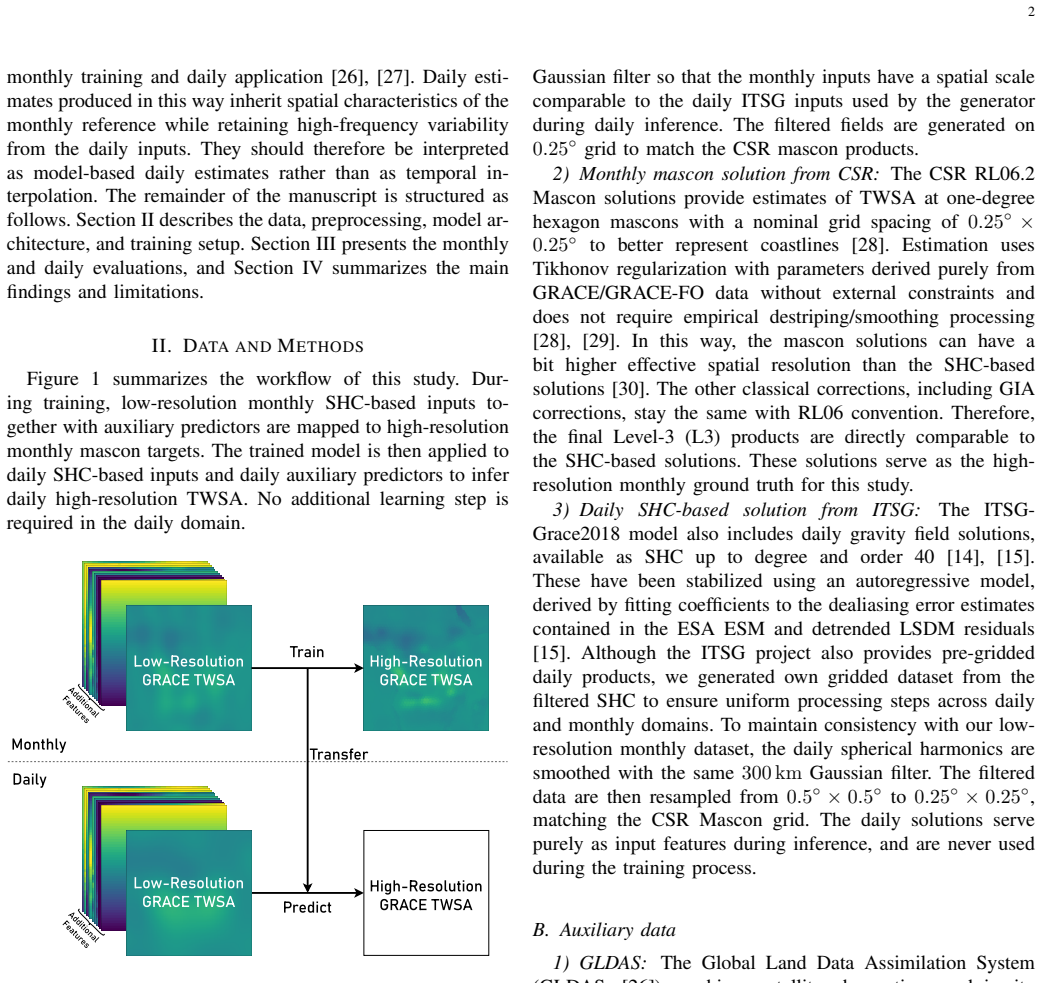
D-SHIFT, a generative adversarial network trained exclusively in the monthly domain on low-resolution daily inputs and high-resolution mascon targets to perform feature transformation for daily high-resolution inference.
If this is right
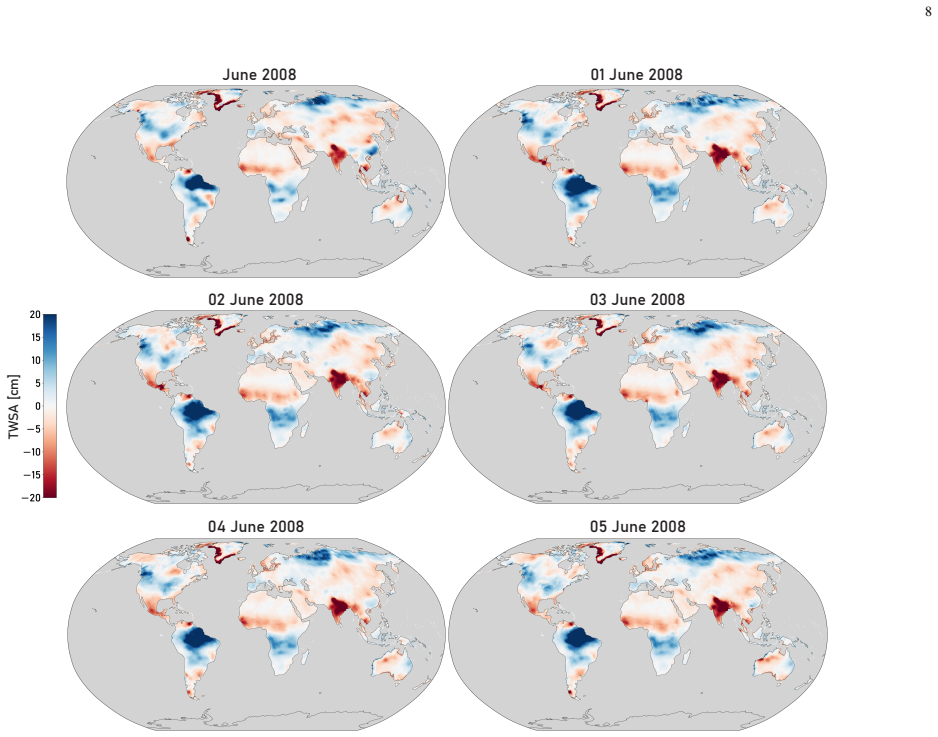
- Daily TWSA fields maintain spatial coherence from one day to the next while matching monthly mascon resolution.
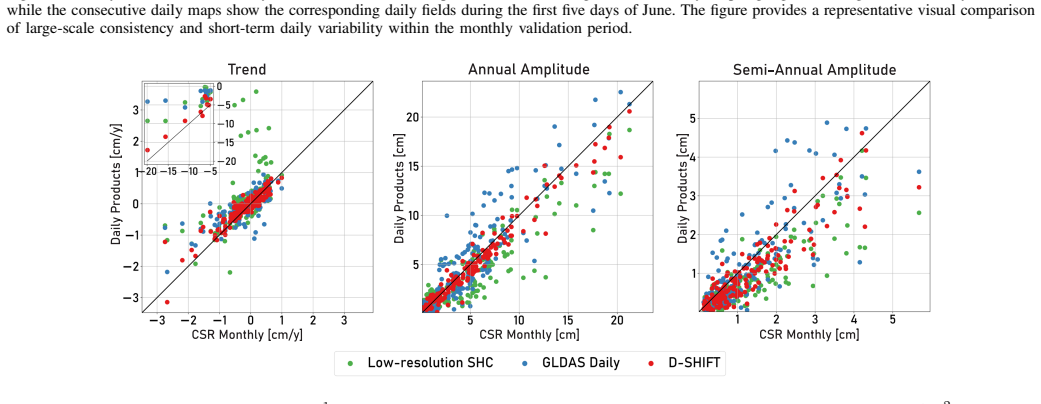
- Basin-scale trend and seasonality estimates improve over low-resolution SHC solutions, with gains largest for localized signals.
- Coastal mass-loss patterns in regions like Greenland are reproduced more accurately, yielding a basin-mean trend of -10.5 cm/yr close to the CSR monthly value.
- Leakage and smoothing effects are reduced for spatially confined water storage changes compared with standard daily products.
Where Pith is reading between the lines
- The same training strategy could be tested on data from other gravity satellite missions to generate consistent daily high-resolution products across different instruments.
- If the model preserves high-frequency signals, it could support analysis of sub-monthly hydrological extremes at the spatial scale previously available only in monthly averages.
- Application to real-time or near-real-time daily inputs would enable earlier detection of rapid water storage shifts during events like heavy rainfall or melt periods.
Load-bearing premise
The spatial patterns and relationships learned from monthly low-resolution daily inputs paired with monthly mascon targets will transfer accurately to unseen daily SHC inputs to produce temporally coherent high-resolution daily fields without introducing artifacts or losing fidelity in high-frequency signals.
What would settle it
Independent daily high-resolution TWSA observations from hydrological models or other sensors during a short-term localized event, such as a flood or drought, would show whether the generated fields match real spatial patterns without unrealistic day-to-day jumps or loss of temporal detail.
Figures




read the original abstract
The Gravity Recovery and Climate Experiment (GRACE) and GRACE Follow-On missions provide monthly terrestrial water storage anomaly (TWSA) estimates for monitoring large-scale water storage change. The monthly temporal resolution of official products limits the analysis of high-frequency hydrological events, while existing daily GRACE products often have reduced spatial resolution due to sparse groundtrack coverage and required smoothing and regularization. This study introduces D-SHIFT (Daily Spatial High-Resolution Inference via Feature Transformation), a deep learning-based framework for generating daily, high-resolution TWSA fields from daily spherical harmonic coefficient (SHC) solutions. The model is trained in the monthly domain by using low-resolution daily solutions and other auxiliary features as inputs, while targeting on monthly mascon products. The model is then applied to daily SHC inputs to generate products with similar spatial resolution of monthly products. Monthly validation against mascon products gives a global mean root mean square error of about 2.3cm, with good correlation and explained variance agreement. Daily analyses show that D-SHIFT produces spatially coherent day-to-day fields and improves basin-scale trend and seasonality estimates compared with low-resolution SHC. The basin-area double-difference analysis indicates that these gains are most relevant for spatially localized signals affected by smoothing and leakage. In Greenland, D-SHIFT better reproduces coastal mass-loss patterns and gives a basin-mean trend of -10.5cm/yr, close to the CSR Monthly value of -12.0cm/yr.
Editorial analysis
A structured set of objections, weighed in public.
Referee Report
Summary. The manuscript introduces D-SHIFT, a generative adversarial network (GAN) framework designed to produce daily high-resolution terrestrial water storage anomaly (TWSA) fields from daily spherical harmonic coefficient (SHC) solutions. The model is trained exclusively in the monthly domain by pairing low-resolution daily SHC inputs and auxiliary features with monthly mascon TWSA targets, then applied directly to unseen daily SHC inputs. Reported performance includes a global mean RMSE of approximately 2.3 cm against mascon products, along with improved basin-scale trend and seasonality estimates relative to low-resolution SHC solutions, with a specific Greenland basin trend of -10.5 cm/yr versus the CSR monthly value of -12.0 cm/yr. The central claim is that the learned spatial mapping transfers to daily scales while preserving coherence and reducing leakage effects for localized signals.
Significance. If the transfer assumption holds and daily fidelity is confirmed, the approach would address a longstanding limitation in GRACE/GRACE-FO products by enabling daily TWSA at mascon-like spatial resolution. This could improve monitoring of high-frequency hydrological processes and localized mass changes without requiring new satellite data. The reported monthly metrics and basin improvements suggest practical utility, but the absence of daily-scale quantitative benchmarks limits immediate adoption.
major comments (2)
- [Abstract] Abstract and validation description: All quantitative metrics (global RMSE ~2.3 cm, correlation, explained variance) and the Greenland trend comparison are computed only against monthly mascon targets. No independent daily-scale validation (e.g., against in-situ data, altimetry, or other daily references) is presented to test whether high-frequency signals are preserved or artifacts introduced when the monthly-trained generator is applied to daily SHC inputs.
- [Abstract] Abstract and methods outline: The training relies on the assumption that spatial feature transformations learned from monthly low-resolution inputs paired with monthly targets remain valid for daily inputs whose noise characteristics, sampling density, and high-frequency content differ. No ablation or sensitivity tests on this temporal-scale invariance are described, which is load-bearing for the daily-product claim.
minor comments (1)
- The abstract mentions auxiliary features and GAN training but does not specify the exact architecture, loss terms, regularization, or data partitioning; these details should be expanded in the methods section for reproducibility.
Simulated Author's Rebuttal
We thank the referee for the constructive review and for recognizing the potential of D-SHIFT to address temporal limitations in GRACE/GRACE-FO products. We address each major comment below with proposed revisions to improve clarity and rigor.
read point-by-point responses
-
Referee: [Abstract] Abstract and validation description: All quantitative metrics (global RMSE ~2.3 cm, correlation, explained variance) and the Greenland trend comparison are computed only against monthly mascon targets. No independent daily-scale validation (e.g., against in-situ data, altimetry, or other daily references) is presented to test whether high-frequency signals are preserved or artifacts introduced when the monthly-trained generator is applied to daily SHC inputs.
Authors: We agree that all reported quantitative metrics, including the global mean RMSE of ~2.3 cm and the Greenland basin trend comparison, are computed exclusively against monthly mascon targets. This follows directly from the training setup, where monthly mascon products serve as the high-resolution targets. Independent daily-scale validation against in-situ, altimetry, or other daily references is not available in the manuscript because no such reference datasets exist at mascon-like spatial resolution for direct quantitative comparison. Daily performance is instead demonstrated through qualitative assessment of spatial coherence in day-to-day fields and quantitative improvements in basin-scale trend and seasonality estimates relative to the low-resolution SHC inputs. We will revise the abstract to explicitly note the monthly basis of the metrics and add a dedicated limitations subsection discussing the transfer to daily scales, potential high-frequency artifacts, and the absence of independent daily benchmarks. This will make the validation scope transparent without overstating the daily fidelity. revision: partial
-
Referee: [Abstract] Abstract and methods outline: The training relies on the assumption that spatial feature transformations learned from monthly low-resolution inputs paired with monthly targets remain valid for daily inputs whose noise characteristics, sampling density, and high-frequency content differ. No ablation or sensitivity tests on this temporal-scale invariance are described, which is load-bearing for the daily-product claim.
Authors: The framework does rely on the assumption that the spatial mapping learned from monthly low-resolution inputs to monthly mascon targets generalizes to daily SHC inputs. We view this as plausible because daily and monthly SHC solutions share the same underlying processing pipeline and the dominant differences are temporal sampling and associated noise rather than spatial structure. However, we acknowledge that no explicit ablation or sensitivity tests on temporal-scale invariance were included in the original submission. In the revised manuscript we will add such analyses, including (1) injecting daily-like noise levels into monthly training inputs and measuring output stability and (2) quantifying day-to-day consistency of generated fields over short windows. Results will be reported in a new methods subsection and the abstract will be updated to reflect the strengthened evaluation of the transfer assumption. revision: yes
Circularity Check
No circularity: standard supervised GAN training with external mascon targets and independent validation
full rationale
The derivation consists of supervised training of a GAN on monthly low-resolution daily SHC inputs paired with monthly mascon targets, followed by inference on daily SHC inputs. This produces high-resolution daily fields whose quality is assessed via direct comparison to external mascon products (global RMSE ~2.3 cm) and basin-scale metrics against low-resolution SHC baselines. No equations, parameters, or outputs reduce to the inputs by construction; the learned mapping is not tautological, and no self-citations, uniqueness theorems, or ansatzes are invoked as load-bearing steps. The transfer assumption across temporal scales is an empirical claim subject to validation rather than a definitional equivalence, leaving the chain self-contained against external benchmarks.
Axiom & Free-Parameter Ledger
axioms (1)
- domain assumption Monthly spatial patterns learned from low-resolution daily inputs are representative for inferring high-resolution daily fields
Reference graph
Works this paper leans on
-
[1]
The gravity recovery and climate experiment: Mission overview and early results,
B. D. Tapley, S. Bettadpur, M. Watkins, and C. Reigber, “The gravity recovery and climate experiment: Mission overview and early results,” Geophysical Research Letters, vol. 31, no. 9, 2004
2004
-
[2]
Time-variable gravity from GRACE: First results,
J. Wahr, S. Swenson, V . Zlotnicki, and I. Velicogna, “Time-variable gravity from GRACE: First results,”Geophysical Research Letters, vol. 31, no. 11, 2004
2004
-
[3]
Extending the global mass change data record: GRACE Follow- On instrument and science data performance,
F. W. Landerer, F. M. Flechtner, H. Save, F. H. Webb, T. Bandikova, W. I. Bertiger, S. V . Bettadpur, S. H. Byun, C. Dahle, H. Dobslaw et al., “Extending the global mass change data record: GRACE Follow- On instrument and science data performance,”Geophysical Research Letters, vol. 47, no. 12, p. e2020GL088306, 2020
2020
-
[4]
Applications and challenges of grace and grace follow-on satellite gravimetry,
J. Chen, A. Cazenave, C. Dahle, W. Llovel, I. Panet, J. Pfeffer, and L. Moreira, “Applications and challenges of grace and grace follow-on satellite gravimetry,”Surveys in Geophysics, vol. 43, no. 1, p. 305–345, Jan. 2022. [Online]. Available: http://dx.doi.org/10.1007/ s10712-021-09685-x
2022
-
[5]
Emerging trends in global freshwater availability,
M. Rodell, J. S. Famiglietti, D. N. Wiese, J. Reager, H. K. Beaudoing, F. W. Landerer, and M.-H. Lo, “Emerging trends in global freshwater availability,”Nature, vol. 557, no. 7707, pp. 651–659, 2018
2018
-
[6]
Water cycle science enabled by the GRACE and GRACE-FO satellite missions,
M. Rodell and J. T. Reager, “Water cycle science enabled by the GRACE and GRACE-FO satellite missions,”Nature Water, vol. 1, no. 1, pp. 47– 59, 2023
2023
-
[7]
Daily grace gravity field solutions track major flood events in the ganges–brahmaputra delta,
B. T. Gouweleeuw, A. Kvas, C. Gruber, A. K. Gain, T. Mayer-G ¨urr, F. Flechtner, and A. G ¨untner, “Daily grace gravity field solutions track major flood events in the ganges–brahmaputra delta,”Hydrology and Earth System Sciences, vol. 22, no. 5, pp. 2867–2880, 2018. [Online]. Available: https://hess.copernicus.org/articles/22/2867/2018/
2018
-
[8]
Using satellite-based terrestrial water storage data: a review,
V . Humphrey, M. Rodell, and A. Eicker, “Using satellite-based terrestrial water storage data: a review,”Surveys in Geophysics, vol. 44, no. 5, pp. 1489–1517, 2023
2023
-
[9]
J. Gou and B. Soja, “Global high-resolution total water storage anomalies from self-supervised data assimilation using deep learning algorithms,”Nature Water, vol. 2, no. 2, p. 139–150, Feb. 2024. [Online]. Available: http://dx.doi.org/10.1038/s44221-024-00194-w
-
[10]
Improved daily grace gravity field solutions using a kalman smoother,
E. Kurtenbach, A. Eicker, T. Mayer-G ¨urr, M. Holschneider, M. Hayn, M. Fuhrmann, and J. Kusche, “Improved daily grace gravity field solutions using a kalman smoother,”Journal of Geodynamics, vol. 59-60, pp. 39–48, 2012, mass Transport and Mass Distribution in the System Earth. [Online]. Available: https://www.sciencedirect.com/ science/article/pii/S02643...
2012
-
[11]
Accuracy of scaled grace terrestrial water storage estimates,
F. W. Landerer and S. C. Swenson, “Accuracy of scaled grace terrestrial water storage estimates,”Water Resources Research, vol. 48, no. 4,
-
[12]
Available: https://agupubs.onlinelibrary.wiley.com/doi/ abs/10.1029/2011WR011453
[Online]. Available: https://agupubs.onlinelibrary.wiley.com/doi/ abs/10.1029/2011WR011453
-
[13]
Accuracy of grace mass estimates,
J. Wahr, S. Swenson, and I. Velicogna, “Accuracy of grace mass estimates,”Geophysical Research Letters, vol. 33, no. 6, 2006. [Online]. Available: https://agupubs.onlinelibrary.wiley.com/doi/abs/10. 1029/2005GL025305
2006
-
[14]
What is the spatial resolution of GRACE satellite products for hydrology?
B. D. Vishwakarma, B. Devaraju, and N. Sneeuw, “What is the spatial resolution of GRACE satellite products for hydrology?”Remote Sensing, vol. 10, no. 6, p. 852, 2018
2018
-
[15]
Itsg-grace2018: Overview and evaluation of a new grace-only gravity field time series,
A. Kvas, S. Behzadpour, M. Ellmer, B. Klinger, S. Strasser, N. Zehentner, and T. Mayer-G ¨urr, “Itsg-grace2018: Overview and evaluation of a new grace-only gravity field time series,”Journal of Geophysical Research: Solid Earth, vol. 124, no. 8, pp. 9332–9344,
-
[16]
Available: https://agupubs.onlinelibrary.wiley.com/doi/ abs/10.1029/2019JB017415
[Online]. Available: https://agupubs.onlinelibrary.wiley.com/doi/ abs/10.1029/2019JB017415
-
[17]
Itsg-grace2018 - monthly, daily and static gravity field solutions from grace,
T. Mayer-G ¨urr, S. Behzadpur, M. Ellmer, A. Kvas, B. Klinger, S. Strasser, and N. Zehentner, “Itsg-grace2018 - monthly, daily and static gravity field solutions from grace,” 2018. [Online]. Available: https://dataservices.gfz-potsdam.de/icgem/showshort.php?id= escidoc:3600910
2018
-
[18]
Development of a daily grace mascon solution for terrestrial water storage,
M. J. Croteau, R. S. Nerem, B. D. Loomis, and T. J. Sabaka, “Development of a daily grace mascon solution for terrestrial water storage,”Journal of Geophysical Research: Solid Earth, vol. 125, no. 3, Mar. 2020. [Online]. Available: http://dx.doi.org/10.1029/2019JB018468
-
[19]
Rapid mapping of global flood precursors and impacts using novel five-day grace solutions,
A. Rateb, H. Save, A. Y . Sun, and B. R. Scanlon, “Rapid mapping of global flood precursors and impacts using novel five-day grace solutions,”Scientific Reports, vol. 14, no. 1, Jun. 2024. [Online]. Available: http://dx.doi.org/10.1038/s41598-024-64491-w
-
[20]
Combining physically based modeling and deep learning for fusing grace satellite data: Can we learn from mismatch?
A. Y . Sun, B. R. Scanlon, Z. Zhang, D. Walling, S. N. Bhanja, A. Mukherjee, and Z. Zhong, “Combining physically based modeling and deep learning for fusing grace satellite data: Can we learn from mismatch?”Water Resources Research, vol. 55, no. 2, p. 1179–1195, Feb. 2019. [Online]. Available: http://dx.doi.org/10.1029/ 2018WR023333
2019
-
[21]
Grace-rec: a reconstruction of climate-driven water storage changes over the last century,
V . Humphrey and L. Gudmundsson, “Grace-rec: a reconstruction of climate-driven water storage changes over the last century,”Earth System Science Data, vol. 11, no. 3, pp. 1153–1170, 2019. [Online]. Available: https://essd.copernicus.org/articles/11/1153/2019/
2019
-
[22]
Global grace data assimilation for groundwater and drought monitoring: Advances and challenges,
B. Li, M. Rodell, S. Kumar, H. K. Beaudoing, A. Getirana, B. F. Zaitchik, L. G. de Goncalves, C. Cossetin, S. Bhanja, A. Mukherjee, S. Tian, N. Tangdamrongsub, D. Long, J. Nanteza, J. Lee, F. Policelli, I. B. Goni, D. Daira, M. Bila, G. de Lannoy, D. Mocko, S. C. Steele- Dunne, H. Save, and S. Bettadpur, “Global grace data assimilation for groundwater and...
-
[23]
Downscaling grace- derived ocean bottom pressure anomalies using self-supervised data fusion,
J. Gou, L. B ¨orger, M. Schindelegger, and B. Soja, “Downscaling grace- derived ocean bottom pressure anomalies using self-supervised data fusion,”Journal of Geodesy, vol. 99, no. 2, p. 19, 2025
2025
-
[24]
Generative adversarial networks,
I. Goodfellow, J. Pouget-Abadie, M. Mirza, B. Xu, D. Warde-Farley, S. Ozair, A. Courville, and Y . Bengio, “Generative adversarial networks,” Communications of the ACM, vol. 63, no. 11, pp. 139–144, 2020
2020
-
[25]
Generative adversarial nets,
——, “Generative adversarial nets,”Advances in neural information processing systems, vol. 27, 2014
2014
-
[26]
Esrgan+: Further improving enhanced super-resolution generative adversarial network,
N. C. Rakotonirina and A. Rasoanaivo, “Esrgan+: Further improving enhanced super-resolution generative adversarial network,” inICASSP 2020-2020 IEEE International Conference on Acoustics, Speech and Signal Processing (ICASSP). IEEE, 2020, pp. 3637–3641
2020
-
[27]
A review of gan-based super-resolution reconstruction for optical remote sensing images,
X. Wang, L. Sun, A. Chehri, and Y . Song, “A review of gan-based super-resolution reconstruction for optical remote sensing images,” Remote Sensing, vol. 15, no. 20, p. 5062, Oct. 2023. [Online]. Available: http://dx.doi.org/10.3390/rs15205062
-
[28]
Gldas catchment land surface model l4 daily 0.25 x 0.25 degree grace- da1, version 2.2,
B. Li, H. Beaudoing, M. Rodell, and NASA/GSFC/HSL, “Gldas catchment land surface model l4 daily 0.25 x 0.25 degree grace- da1, version 2.2,” 2020. [Online]. Available: https://disc.gsfc.nasa.gov/ datacollection/GLDAS CLSM025 DA1 D 2.2.html
2020
-
[29]
C3S, “Era5 hourly data on single levels from 1940 to present,” 2018. [Online]. Available: https://cds.climate.copernicus.eu/doi/10.24381/cds. adbb2d47
-
[30]
Csr grace and grace-fo rl06 mascon solutions v02,
H. Save, “Csr grace and grace-fo rl06 mascon solutions v02,”Mascon Solut, vol. 12, p. 24, 2020
2020
-
[31]
High-resolution csr grace rl05 mascons,
H. Save, S. Bettadpur, and B. D. Tapley, “High-resolution csr grace rl05 mascons,”Journal of Geophysical Research: Solid Earth, vol. 121, no. 10, p. 7547–7569, Oct. 2016. [Online]. Available: http://dx.doi.org/10.1002/2016JB013007
-
[32]
Global evaluation of new GRACE mascon products for hydrologic applications,
B. R. Scanlon, Z. Zhang, H. Save, D. N. Wiese, F. W. Landerer, D. Long, L. Longuevergne, and J. Chen, “Global evaluation of new GRACE mascon products for hydrologic applications,”Water Resources Research, vol. 52, no. 12, pp. 9412–9429, 2016
2016
-
[33]
Readme document for nasa gldas version 2 data products,
H. Rui and H. Beaudoing, “Readme document for nasa gldas version 2 data products,” October 2022. 13
2022
-
[34]
How well are we able to close the water budget at the global scale?
F. Lehmann, B. D. Vishwakarma, and J. Bamber, “How well are we able to close the water budget at the global scale?”Hydrology and Earth System Sciences, vol. 26, no. 1, pp. 35–54, 2022
2022
-
[35]
Global river hydrography and network routing: baseline data and new approaches to study the world’s large river systems,
B. Lehner and G. Grill, “Global river hydrography and network routing: baseline data and new approaches to study the world’s large river systems,”Hydrological Processes, vol. 27, no. 15, p. 2171–2186, Apr
-
[36]
Available: http://dx.doi.org/10.1002/hyp.9740
[Online]. Available: http://dx.doi.org/10.1002/hyp.9740
-
[37]
Goodfellow, Y
I. Goodfellow, Y . Bengio, and A. Courville,Deep Learning. MIT Press, 2016, http://www.deeplearningbook.org
2016
-
[38]
S. Garc ´ıa, J. Luengo, and F. Herrera,Data Preparation Basic Models. Springer International Publishing, Aug. 2014, p. 39–57. [Online]. Available: http://dx.doi.org/10.1007/978-3-319-10247-4 3
-
[39]
ESRGAN: Enhanced Super-Resolution Generative Adversarial Networks,
X. Wang, K. Yu, S. Wu, J. Gu, Y . Liu, C. Dong, C. C. Loy, Y . Qiao, and X. Tang, “Esrgan: Enhanced super-resolution generative adversarial networks,” 2018. [Online]. Available: https://arxiv.org/abs/1809.00219
-
[40]
Densely connected convolutional networks,
G. Huang, Z. Liu, L. Van Der Maaten, and K. Q. Weinberger, “Densely connected convolutional networks,” inProceedings of the IEEE confer- ence on computer vision and pattern recognition, 2017, pp. 4700–4708
2017
-
[41]
A u-net based discriminator for generative adversarial networks,
E. Schonfeld, B. Schiele, and A. Khoreva, “A u-net based discriminator for generative adversarial networks,” inProceedings of the IEEE/CVF conference on computer vision and pattern recognition, 2020, pp. 8207– 8216
2020
-
[42]
arXiv preprint arXiv:1905.04899 (2019)
S. Yun, D. Han, S. J. Oh, S. Chun, J. Choe, and Y . Yoo, “Cutmix: Regularization strategy to train strong classifiers with localizable features,” 2019. [Online]. Available: https://arxiv.org/abs/1905.04899
-
[43]
A. Eicker, L. Jensen, V . W ¨ohnke, H. Dobslaw, A. Kvas, T. Mayer- G¨urr, and R. Dill, “Daily grace satellite data evaluate short-term hydro-meteorological fluxes from global atmospheric reanalyses,” Scientific Reports, vol. 10, no. 1, Mar. 2020. [Online]. Available: http://dx.doi.org/10.1038/s41598-020-61166-0
-
[44]
Uncertainties of grace-based terrestrial water storage anomalies for arbitrary averaging regions,
E. Boergens, A. Kvas, A. Eicker, H. Dobslaw, L. Schawohl, C. Dahle, M. Murb ¨ock, and F. Flechtner, “Uncertainties of grace-based terrestrial water storage anomalies for arbitrary averaging regions,”Journal of Geophysical Research: Solid Earth, vol. 127, no. 2, Feb. 2022. [Online]. Available: http://dx.doi.org/10.1029/2021JB022081
-
[45]
J. ´Sliwi´nska, M. Wi ´nska, and J. Nastula, “Preliminary estimation and validation of polar motion excitation from different types of the grace and grace follow-on missions data,”Remote Sensing, vol. 12, no. 21, p. 3490, Oct. 2020. [Online]. Available: http: //dx.doi.org/10.3390/rs12213490
-
[46]
DeepRec: Global terrestrial water storage reconstruction since 1941 using spatiotemporal-aware deep learning model,
L. Q. Gentner, J. Gou, M. J. Tourian, L. B ¨orger, N. Sneeuw, and B. Soja, “DeepRec: Global terrestrial water storage reconstruction since 1941 using spatiotemporal-aware deep learning model,”Journal of Geophysical Research: Machine Learning and Computation, vol. 3, no. 1, p. e2025JH000889, 2026
1941
-
[47]
What is the spatial resolution of grace satellite products for hydrology?
B. D. Vishwakarma, B. Devaraju, and N. Sneeuw, “What is the spatial resolution of grace satellite products for hydrology?”Remote Sensing, vol. 10, no. 6, p. 852, May 2018. [Online]. Available: http://dx.doi.org/10.3390/rs10060852
-
[48]
Massbalanceofthegreenlandicesheetfrom1992to2018
The IMBIE Team, “Mass balance of the greenland ice sheet from 1992 to 2018,”Nature, vol. 579, no. 7798, p. 233–239, Dec. 2019. [Online]. Available: http://dx.doi.org/10.1038/s41586-019-1855-2
-
[49]
Grace observes small-scale mass loss in greenland,
B. Wouters, D. Chambers, and E. J. O. Schrama, “Grace observes small-scale mass loss in greenland,”Geophysical Research Letters, vol. 35, no. 20, Oct. 2008. [Online]. Available: http://dx.doi.org/10. 1029/2008GL034816
2008
-
[50]
Revisiting greenland ice sheet mass loss observed by grace,
E. J. O. Schrama and B. Wouters, “Revisiting greenland ice sheet mass loss observed by grace,”Journal of Geophysical Research, vol. 116, no. B2, Feb. 2011. [Online]. Available: http: //dx.doi.org/10.1029/2009JB006847
discussion (0)
Sign in with ORCID, Apple, or X to comment. Anyone can read and Pith papers without signing in.