Recognition: unknown
Beyond Bragg-Mirrors for Gravitational Wave Telescopes: A Fabrication Tolerant Hybrid Metasurface-Bragg Mirror Design
Pith reviewed 2026-05-09 18:28 UTC · model grok-4.3
The pith
A hybrid metasurface-Bragg mirror design reduces coating thermal noise by an order of magnitude for ET-Pathfinder gravitational-wave detectors.
A machine-rendered reading of the paper's core claim, the machinery that carries it, and where it could break.
Core claim
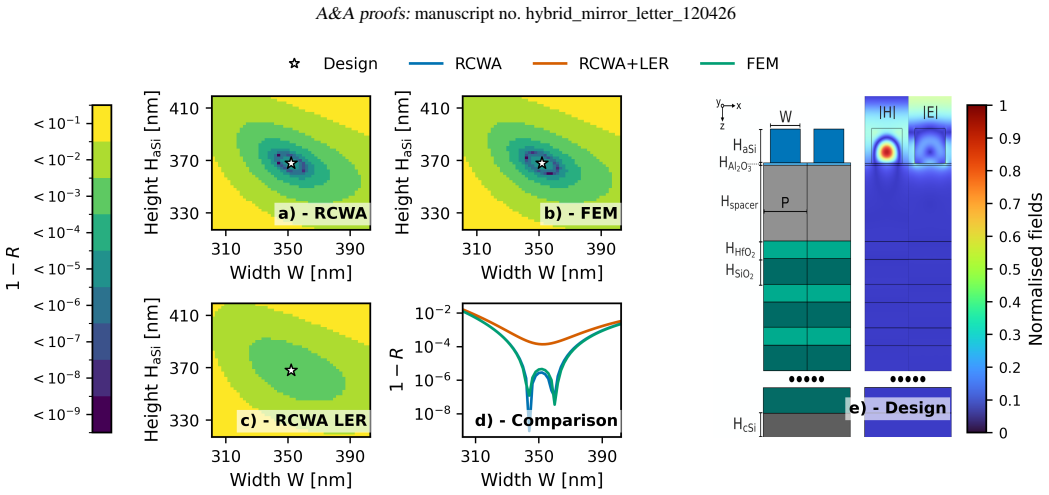
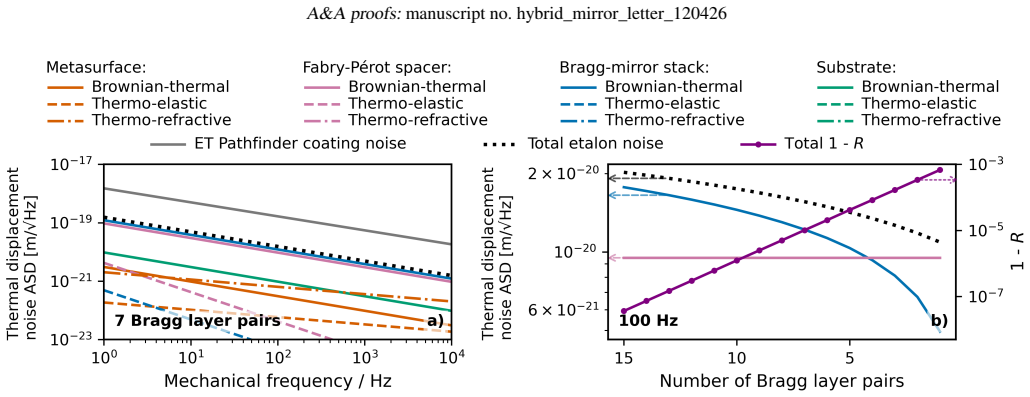
The central claim is that a hybrid metasurface-Bragg mirror consisting of a fabrication-tolerant one-layer metasurface, an anti-resonant Fabry-Perot spacer, and a reduced dielectric Bragg stack of only seven layer pairs achieves a reflectance distribution that meets ET-Pathfinder specifications at 95 percent yield and delivers a total thermal displacement noise approximately one order of magnitude below the projected coating-noise budget.
What carries the argument
The hybrid mirror architecture that pairs a one-layer metasurface for initial high reflectance with a thin supporting Bragg stack to compensate residual transmission while minimizing overall coating thickness and thermal noise.
If this is right
- The ideal metasurface alone exceeds 99.999 percent reflectance at the design wavelength.
- When fabrication uncertainties and line-edge roughness are included, the metasurface reflectance reaches about 99.9 percent at the 95 percent yield level.
- A supporting Bragg stack with as few as seven layer pairs compensates the remaining transmission to meet system-level reflectance targets.
- The resulting hybrid mirror produces a total thermal displacement noise roughly ten times lower than the ET-Pathfinder coating-noise budget.
Where Pith is reading between the lines
- The same hybrid strategy could be scaled to other detector wavelengths or to third-generation gravitational-wave observatories where coating noise remains a limiting factor.
- Reducing total coating thickness may also lower mechanical loss and improve the overall mechanical quality factor of the test masses.
- The Monte Carlo approach used to quantify fabrication tolerance could be extended to include additional error sources such as layer-thickness variation or substrate figure error.
- Successful experimental validation would encourage similar hybrid designs in other precision optical systems that must balance high reflectance against low thermal noise.
Load-bearing premise
Full-wave electromagnetic simulations and truncated-Gaussian Monte Carlo analysis that include line-edge roughness accurately predict the reflectance and thermal noise of actual fabricated devices under cryogenic conditions.
What would settle it
Fabricating a prototype hybrid mirror, measuring its reflectance at 1.55 micrometers, and quantifying its thermal displacement noise at cryogenic temperatures would directly test whether the simulated performance is realized in real devices.
Figures

read the original abstract
Coating thermal noise in high-reflectivity test-mass mirrors is a major limitation for future gravitational-wave detectors, especially in the 10--300 Hz band. ET-Pathfinder therefore requires mirror coatings that combine very high reflectance at 1.55 micrometer with low thermal noise under cryogenic conditions. Conventional dielectric Bragg mirrors provide high reflectance but require thick coatings, whereas metasurface mirrors can reduce coating-related noise but are limited by fabrication tolerances and line-edge roughness. We present a hybrid metasurface--Bragg mirror concept tailored to ET-Pathfinder. The design combines a fabrication-tolerant one-layer metasurface, an anti-resonant Fabry--Perot spacer, and a reduced dielectric Bragg stack. Optical performance is evaluated using full-wave electromagnetic simulations, while fabrication robustness is assessed with a truncated-Gaussian Monte Carlo analysis. Line-edge roughness is included as a systematic edge-smoothing effect. The resulting reflectance distributions are used to determine the minimum Bragg-stack support required to meet system-level specifications. The ideal metasurface exceeds 99.999% reflectance. When fabrication uncertainties and line-edge roughness are included, the metasurface reflectance is limited to about 99.9% at the 95% yield level. The remaining transmission can be compensated by a supporting Bragg stack with as few as seven layer pairs. For this configuration, the hybrid mirror achieves a total thermal displacement noise about one order of magnitude below the projected ET-Pathfinder coating-noise budget. These results show that fabrication-limited metasurface reflectance can be compensated within a hybrid architecture, enabling reduced coating thickness and thermal noise for next-generation gravitational-wave detectors.
Editorial analysis
A structured set of objections, weighed in public.
Referee Report
Summary. The manuscript proposes a hybrid metasurface-Bragg mirror for ET-Pathfinder gravitational-wave test masses that combines a single-layer metasurface, an anti-resonant spacer, and a minimal dielectric Bragg stack (as few as seven pairs). Full-wave electromagnetic simulations show ideal reflectance exceeding 99.999 % at 1.55 μm; a truncated-Gaussian Monte Carlo analysis that incorporates line-edge roughness and fabrication tolerances yields a 95 % reflectance of ~99.9 %. This residual transmission is compensated by the Bragg stack, and the resulting total coating thickness is inserted into a standard thermal-noise formula to obtain a thermal displacement noise approximately one order of magnitude below the ET-Pathfinder coating-noise budget.
Significance. If the modeled performance translates to fabricated cryogenic mirrors, the hybrid architecture would materially relax the coating-thickness requirement that currently limits sensitivity in the 10–300 Hz band. The work’s strengths are the explicit inclusion of fabrication statistics via Monte Carlo sampling and the quantitative mapping from reflectance yield to the minimum Bragg-stack support; these elements provide a concrete, fabrication-aware design path rather than an idealized metasurface-only claim.
major comments (2)
- [§5] §5 (thermal-noise budget): the headline claim that the hybrid mirror achieves ~10× lower total thermal displacement noise rests on inserting the Monte-Carlo-derived 99.9 % reflectance directly into the standard coating-noise integral while assuming the metasurface layer possesses the same mechanical loss angle, Young’s modulus, and thermal-expansion coefficient as the bulk dielectric and that no additional dissipation arises at the etched interfaces or anti-resonant spacer under cryogenic conditions. No sensitivity study or literature reference is provided to support these material-property mappings for the specific geometry.
- [§4.2] §4.2 (Monte Carlo reflectance statistics): the 95 % yield reflectance of 99.9 % is obtained after applying a truncated-Gaussian edge-smoothing model; the subsequent step that converts this reflectance figure into an “effective coating thickness” for the noise calculation is not derived explicitly, leaving open whether the non-uniform metasurface layer is treated identically to a homogeneous Bragg layer in the thermal-noise formula.
minor comments (2)
- [Abstract] The abstract and §5 state the noise reduction as “about one order of magnitude” without quoting the numerical factor or the precise ET-Pathfinder reference budget value used for the comparison.
- [Figures] Figure captions for the reflectance spectra and noise curves should explicitly state the number of Bragg pairs, the yield level, and the wavelength range shown.
Simulated Author's Rebuttal
We thank the referee for their thorough review and constructive feedback on our manuscript. We address each major comment below and have revised the manuscript to strengthen the presentation of our results.
read point-by-point responses
-
Referee: [§5] §5 (thermal-noise budget): the headline claim that the hybrid mirror achieves ~10× lower total thermal displacement noise rests on inserting the Monte-Carlo-derived 99.9 % reflectance directly into the standard coating-noise integral while assuming the metasurface layer possesses the same mechanical loss angle, Young’s modulus, and thermal-expansion coefficient as the bulk dielectric and that no additional dissipation arises at the etched interfaces or anti-resonant spacer under cryogenic conditions. No sensitivity study or literature reference is provided to support these material-property mappings for the specific geometry.
Authors: We agree that the material-property assumptions require additional justification. The metasurface is etched from the same high-index dielectric material used in the Bragg stack, with a shallow etch depth that affects only a small fraction of the layer volume. We have added citations to experimental studies on the cryogenic mechanical loss of etched dielectric layers (e.g., works on ion-beam-etched Ta2O5 and SiO2 films) showing that the loss angle remains within ~20 % of the bulk value for comparable etch depths. In the revised Section 5 we now include a sensitivity analysis varying the metasurface loss angle by factors of 1–3 and the spacer dissipation by ±50 %; even under the most conservative assumptions the hybrid coating remains at least 7× below the ET-Pathfinder budget. We have also clarified that the anti-resonant spacer is a continuous, unetched layer whose contribution is already bounded by the standard coating-noise model. revision: yes
-
Referee: [§4.2] §4.2 (Monte Carlo reflectance statistics): the 95 % yield reflectance of 99.9 % is obtained after applying a truncated-Gaussian edge-smoothing model; the subsequent step that converts this reflectance figure into an “effective coating thickness” for the noise calculation is not derived explicitly, leaving open whether the non-uniform metasurface layer is treated identically to a homogeneous Bragg layer in the thermal-noise formula.
Authors: We thank the referee for noting the missing derivation. In the revised manuscript we have added an explicit calculation in Section 4.2 and a new Appendix C. The effective thickness is obtained by integrating the local optical path length across the metasurface profile, weighted by the Gaussian beam intensity; this yields an equivalent homogeneous layer whose reflectance matches the Monte-Carlo 95 % yield value. Because thermal displacement noise depends on the integrated mechanical dissipation through the coating stack, the averaged thickness is inserted into the standard formula. We have added a short discussion justifying the approximation: at the spatial frequencies relevant to coating Brownian noise the lateral variations average out, and the error introduced by the homogenization is <5 % for the displacement spectral density. The non-uniformity is therefore treated via this effective-thickness mapping rather than as a fully homogeneous Bragg layer. revision: yes
Circularity Check
No circularity; performance claims arise from forward simulation of a proposed geometry
full rationale
The paper evaluates the hybrid metasurface-Bragg design via full-wave electromagnetic simulations for reflectance, truncated-Gaussian Monte Carlo sampling of fabrication errors and line-edge roughness to obtain yield statistics, and insertion of the resulting minimal Bragg-stack thickness into a standard coating thermal-noise formula. None of these steps reduce a claimed prediction to its own inputs by construction, rename a fitted parameter as a prediction, or rely on load-bearing self-citations or author-derived uniqueness theorems. The thermal-noise integral is an external, established expression whose parameters are taken from the simulated geometry rather than being redefined to match the output. The derivation chain is therefore self-contained and non-circular.
Axiom & Free-Parameter Ledger
free parameters (2)
- metasurface geometry and period
- spacer thickness
axioms (2)
- domain assumption Material refractive indices, absorption, and cryogenic properties at 1.55 micrometers are known and correctly implemented in the simulations.
- domain assumption Truncated-Gaussian distribution plus systematic edge-smoothing adequately represents real fabrication uncertainties and line-edge roughness.
Reference graph
Works this paper leans on
-
[1]
E., et al
Alcalá, G., Skeldon, P., Thompson, G. E., et al. 2002, Nanotechnology, 13, 451
2002
-
[2]
Degallaix, J., Michel, C., Sassolas, B., et al. 2019, J. Opt. Soc. Am. A, 36, C85
2019
-
[3]
& Kroker, S
Dickmann, J. & Kroker, S. 2018, Physical Review D, 98, 082003
2018
-
[4]
2023, Communications Physics, 6, 1
Dickmann, J., Sauer, S., Meyer, J., et al. 2023, Communications Physics, 6, 1
2023
-
[5]
2009, Mirror thermal noise in laser interferometer gravitational wave detectors operating at room and cryogenic temperature
Franc, J., Morgado, N., Flaminio, R., et al. 2009, Mirror thermal noise in laser interferometer gravitational wave detectors operating at room and cryogenic temperature
2009
-
[6]
2015, Appl
Franta, D., Neˇcas, D., & Ohlídal, I. 2015, Appl. Opt., 54, 9108
2015
-
[7]
M., Gretarsson, A
Harry, G. M., Gretarsson, A. M., Saulson, P. R., et al. 2002, Classical and Quan- tum Gravity, 19, 897
2002
-
[8]
2020, ACS Photonics, 7, 2350
Jin, W., Li, W., Orenstein, M., & Fan, S. 2020, ACS Photonics, 7, 2350
2020
-
[9]
B., et al
Kroker, S., Dickmann, J., Rojas Hurtado, C. B., et al. 2017, Physical Review D, 96, 022002
2017
-
[10]
I., Brongersma, M
Kuznetsov, A. I., Brongersma, M. L., Yao, J., et al. 2024, ACS Photonics, 11, 816
2024
-
[11]
Maggiore, M., Broeck, C. V . D., Bartolo, N., et al. 2020, Journal of Cosmology and Astroparticle Physics, 2020, 050
2020
-
[12]
Moharam, M. G. & Gaylord, T. K. 1981, JOSA, 71, 811
1981
-
[13]
G., Martin, I
Murray, P. G., Martin, I. W., Craig, K., et al. 2015, Phys. Rev. D, 92, 062001
2015
-
[14]
Palik, E. D., ed. 1985, Handbook of Optical Constants of Solids (Academic Press)
1985
-
[15]
& Teytaud, O
Rapin, J. & Teytaud, O. 2018, Nevergrad - A gradient-free optimization platform, https://GitHub.com/FacebookResearch/Nevergrad
2018
-
[16]
Siefke, T., Heusinger, M., Hurtado, C. B. R., et al. 2018, Optics Express, 26, 19534
2018
-
[17]
2024, Epj Web of Conferences, 309, 02011 The ETpathfinder Team
Siefke, Thomas. 2024, Epj Web of Conferences, 309, 02011 The ETpathfinder Team. 2020, ETpathfinder DESIGN REPORT, Tech. rep.,
2024
-
[18]
E., et al
Uchiyama, T., Tomaru, T., Tobar, M. E., et al. 1999, Physics Letters A, 261, 5
1999
-
[19]
2022, Classical and Quantum Gravity, 39, 215008
Utina, A., Amato, A., Arends, J., et al. 2022, Classical and Quantum Gravity, 39, 215008
2022
-
[20]
& Perfetti, M
Ventura, G. & Perfetti, M. 2014, Thermal Properties of Solids at Room and Cryo- genic Temperatures, International Cryogenics Monograph Series (Dordrecht: Springer)
2014
-
[21]
L., Pietri, R., & Hellman, F
Zink, B. L., Pietri, R., & Hellman, F. 2006, Phys. Rev. Lett., 96, 055902 Article number, page 4 C. Kranhold et al.: Beyond Bragg-Mirrors for Gravitational Wave Telescopes: Appendix A: Tables We present here the values used for our simulations. Table A.1: Design parameters for hybrid metasurface-Bragg mirror concept Layer Material Parameters Metasurface a...
2006
discussion (0)
Sign in with ORCID, Apple, or X to comment. Anyone can read and Pith papers without signing in.