Recognition: unknown
Learning Coarse-to-Fine Osteoarthritis Representations under Noisy Hierarchical Labels
Pith reviewed 2026-05-09 19:25 UTC · model grok-4.3
The pith
A simple dual-head model trained jointly on coarse binary OA labels and fine KL grades produces more ordered latent representations and backbone-specific gains in severity grading.
A machine-rendered reading of the paper's core claim, the machinery that carries it, and where it could break.
Core claim
Dual-head supervision with a shared encoder for both the coarse OA presence label and the fine KL severity label yields backbone-dependent improvements in KL classification metrics; these gains are accompanied by a more ordered coarse-to-fine arrangement of samples in the latent space and, in responsive backbones, greater spatial overlap between saliency maps and cartilage anatomy.
What carries the argument
A dual-head architecture consisting of a shared 3D convolutional encoder plus two task-specific heads (one binary, one five-class) that is used as a minimal probe to inject the clinical label hierarchy directly into representation learning.
If this is right
- For some 3D backbones, joint training on both label levels outperforms training on the KL label alone.
- The latent space exhibits clearer monotonic ordering along the clinical severity axis.
- Saliency maps of responsive backbones overlap more strongly with anatomically relevant cartilage regions.
- A deliberately simple hierarchical supervisory signal can reshape disease representations even when the supplied labels are noisy.
Where Pith is reading between the lines
- The same dual-head pattern could be tried on other medical grading tasks that already possess both coarse and fine annotations, such as tumor staging or retinopathy severity.
- Backbone dependence implies that certain network inductive biases interact productively with hierarchical supervision, which could guide future architecture choices.
- If the ordering effect is truly hierarchy-driven, one could test whether the same latent structure emerges when the coarse head is trained on a non-hierarchical but still related auxiliary task.
Load-bearing premise
The observed metric gains, latent ordering, and saliency improvements are caused by the specific coarse-to-fine label relationship rather than by generic multi-task regularization or by the particular capacity of the chosen backbones.
What would settle it
Training the identical dual-head model but replacing the coarse OA head with an unrelated auxiliary task such as age prediction or image-quality regression, then checking whether the same KL-metric gains, latent-axis ordering, and cartilage-saliency alignment still appear.
Figures


read the original abstract
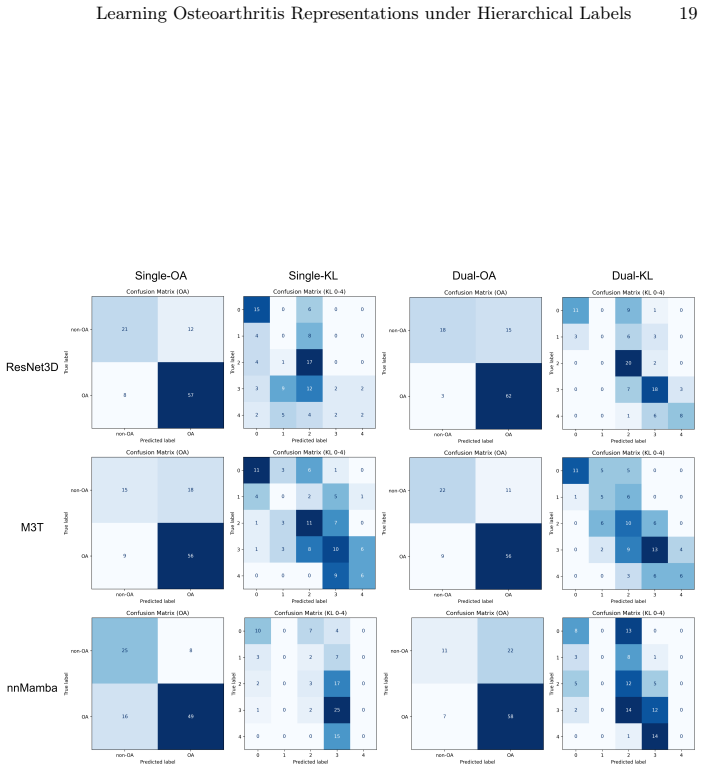
Knee osteoarthritis (OA) assessment involves a natural but often underused label hierarchy: a coarse binary OA decision and a fine-grained Kellgren--Lawrence (KL) severity grade. Existing deep learning studies commonly treat these targets as separate classification problems, either reducing OA assessment to disease presence or directly optimizing noisy ordinal KL labels. In this work, we ask whether this clinical hierarchy can serve as a representation-level supervisory prior. Rather than introducing a complex architecture, we use a deliberately simple dual-head model with a shared encoder and two task-specific heads as a probe of hierarchical supervision. We compare single-OA, single-KL, and dual-head training across multiple 3D backbones under the same test protocol. Beyond standard classification metrics, we perform paired statistical comparisons, analyze latent severity-axis geometry, and examine saliency overlap with cartilage regions. The results show that dual-head supervision produces backbone-dependent gains, with clear improvements in KL-related metrics for selected backbones. More importantly, the gains are accompanied by a more ordered coarse-to-fine latent organization and, for responsive backbones, stronger anatomical alignment of saliency with cartilage. These findings suggest that even simple hierarchical dual-head supervision can reshape disease representations under noisy coarse/fine labels, providing a useful inductive bias for OA diagnosis and severity grading.
Editorial analysis
A structured set of objections, weighed in public.
Referee Report
Summary. The manuscript claims that a simple dual-head model with a shared encoder and task-specific heads for coarse binary OA and fine KL grades can use the clinical label hierarchy as a representation-level supervisory prior under noisy labels. Comparisons of single-OA, single-KL, and dual-head training across multiple 3D backbones show backbone-dependent gains in KL-related metrics, accompanied by more ordered coarse-to-fine latent geometry and, for responsive backbones, stronger saliency alignment with cartilage regions.
Significance. If the gains can be attributed specifically to the hierarchical structure of the labels rather than general multi-task regularization, the work would demonstrate that even minimal dual-head supervision provides a useful inductive bias for learning disease representations in medical imaging tasks with hierarchical and noisy labels. The inclusion of latent-axis analysis and saliency checks adds depth beyond standard classification metrics.
major comments (2)
- [Experimental comparisons (as described in abstract and results)] The experimental design compares only single-OA, single-KL, and dual-head (OA+KL) training regimes. There is no control using dual heads with non-hierarchical or unrelated supervisory signals to isolate the effect of the label hierarchy from general multi-task regularization. This is load-bearing for the central claim (abstract) that the observed KL-metric gains, latent organization, and saliency improvements are caused by the hierarchical supervisory prior.
- [Results] The backbone-dependent nature of the results is acknowledged, yet without the non-hierarchical multi-task control the attribution of improved coarse-to-fine latent geometry specifically to the hierarchical prior remains tentative, particularly in the noisy label setting.
minor comments (1)
- [Abstract] The abstract refers to 'multiple 3D backbones' without naming them; explicitly listing the architectures used would aid reproducibility and interpretation of the backbone dependence.
Simulated Author's Rebuttal
We thank the referee for the constructive comments on our manuscript. The primary concern is the absence of a non-hierarchical multi-task control to isolate the effect of label hierarchy from general multi-task regularization. We address this point by point below and commit to revisions that strengthen the attribution of our findings.
read point-by-point responses
-
Referee: [Experimental comparisons (as described in abstract and results)] The experimental design compares only single-OA, single-KL, and dual-head (OA+KL) training regimes. There is no control using dual heads with non-hierarchical or unrelated supervisory signals to isolate the effect of the label hierarchy from general multi-task regularization. This is load-bearing for the central claim (abstract) that the observed KL-metric gains, latent organization, and saliency improvements are caused by the hierarchical supervisory prior.
Authors: We agree that the current set of comparisons does not fully separate the contribution of the hierarchical label structure from the general benefits of multi-task supervision. In the revised manuscript we will add a control experiment training the dual-head architecture with the coarse OA label paired to a non-hierarchical fine-grained signal (e.g., randomly permuted KL grades or an unrelated auxiliary task). The same backbone-dependent evaluation, latent-axis analysis, and saliency overlap metrics will be reported for this control, allowing direct attribution of any gains to the hierarchical prior rather than multi-task regularization alone. revision: yes
-
Referee: [Results] The backbone-dependent nature of the results is acknowledged, yet without the non-hierarchical multi-task control the attribution of improved coarse-to-fine latent geometry specifically to the hierarchical prior remains tentative, particularly in the noisy label setting.
Authors: We concur that the backbone-dependent pattern leaves the interpretation of the latent geometry tentative without the proposed control. The additional non-hierarchical dual-head runs will include the same paired statistical tests on latent severity axes and cartilage saliency overlap. This will clarify whether the observed ordering of the coarse-to-fine latent space is specifically induced by the hierarchical supervisory signal under noisy labels, or whether it arises from any dual-head configuration. revision: yes
Circularity Check
No circularity; empirical comparisons are self-contained
full rationale
The paper describes an experimental comparison of single-task (OA or KL) versus dual-head (OA+KL) training on shared 3D backbones, reporting classification metrics, latent geometry, and saliency maps. No equations, fitted parameters renamed as predictions, or self-citation chains appear in the provided text. The central claims rest on observed differences across training regimes and backbones rather than any derivation that reduces to its own inputs by construction. The absence of a non-hierarchical multi-task control is a methodological limitation but does not constitute circularity under the defined patterns.
Axiom & Free-Parameter Ledger
Reference graph
Works this paper leans on
-
[1]
Current Medical Imaging (2024) Learning Osteoarthritis Representations under Hierarchical Labels 15
Alyami, J., et al.: Identification of severe grading in knee osteoarthritis from mri using ensemble deep learning. Current Medical Imaging (2024) Learning Osteoarthritis Representations under Hierarchical Labels 15
2024
-
[2]
Medical image analysis52, 109– 118 (2019)
Ambellan, F., Tack, A., Ehlke, M., Zachow, S.: Automated segmentation of knee bone and cartilage combining statistical shape knowledge and convolutional neural networks: Data from the osteoarthritis initiative. Medical image analysis52, 109– 118 (2019)
2019
-
[3]
BMC Muscu- loskeletal Disorders9(1), 116 (2008)
Bedson, J., Croft, P.R.: The discordance between clinical and radiographic knee osteoarthritis: a systematic search and summary of the literature. BMC Muscu- loskeletal Disorders9(1), 116 (2008)
2008
-
[4]
IEEE transactions on pattern analysis and machine intelligence 35(8), 1798–1828 (2013)
Bengio, Y., Courville, A., Vincent, P.: Representation learning: A review and new perspectives. IEEE transactions on pattern analysis and machine intelligence 35(8), 1798–1828 (2013)
2013
-
[5]
Journal TBD (2025), complete bibliographic details to be verified
Beyaz, S., et al.: Interobserver differences in kellgren–lawrence grading of knee osteoarthritis and implications for artificial intelligence datasets. Journal TBD (2025), complete bibliographic details to be verified
2025
-
[6]
Machine Learning28(1), 41–75 (1997)
Caruana, R.: Multitask learning. Machine Learning28(1), 41–75 (1997)
1997
-
[7]
Biomedical Signal Processing and Control (2025), complete bibliographic details to be verified
Chen, L., et al.: An attention-enhanced multi-task framework for knee osteoarthri- tis detection, grading, and localization. Biomedical Signal Processing and Control (2025), complete bibliographic details to be verified
2025
-
[8]
Journal TBD (2019), complete bibliographic details to be verified
Chen, P., et al.: Automatic knee osteoarthritis grading using deep neural networks with ordinal-aware modeling. Journal TBD (2019), complete bibliographic details to be verified
2019
-
[9]
Med3d: Transfer learning for 3d medical image analysis
Chen, S., Ma, K., Zheng, Y.: Med3d: Transfer learning for 3d medical image anal- ysis. arXiv preprint arXiv:1904.00625 (2019)
-
[10]
arXiv preprint arXiv:2603.02367 (2026)
Chen, Y., Ni, S., Zhang, J., Saeed, S.U., Wang, Y., Ivanova, A., Hargunani, R., Liu, C., Huang, J., Hu, Y.: Retrieving patient-specific radiomic feature sets for transparent knee mri assessment. arXiv preprint arXiv:2603.02367 (2026)
-
[11]
Arthritis Care & Research65(3), 363–372 (2013)
Finan, P.H., Buenaver, L.F., Bounds, S.C., Hussain, S., Park, R.J., Haque, U.J., Campbell, C.M., Haythornthwaite, J.A., Smith, M.T.: Discordance between pain and radiographic severity in knee osteoarthritis: findings from quantitative sensory testing of central sensitization. Arthritis Care & Research65(3), 363–372 (2013)
2013
-
[12]
arXiv preprint arXiv:2402.03526 (2024)
Gong, H., Kang, L., Wang, Y., Wan, X., Li, H.: nnmamba: 3d biomedical image segmentation, classification and landmark detection with state space model. arXiv preprint arXiv:2402.03526 (2024)
-
[13]
Mamba: Linear-Time Sequence Modeling with Selective State Spaces
Gu, A., Dao, T.: Mamba: Linear-time sequence modeling with selective state spaces. arXiv preprint arXiv:2312.00752 (2023)
work page internal anchor Pith review arXiv 2023
-
[14]
He,K.,Zhang,X.,Ren,S.,Sun,J.:Deepresiduallearningforimagerecognition.In: Proceedings of the IEEE conference on computer vision and pattern recognition. pp. 770–778 (2016)
2016
-
[15]
Osteoarthritis and cartilage19(8), 990–1002 (2011)
Hunter, D.J., Guermazi, A., Lo, G.H., Grainger, A.J., Conaghan, P.G., Boudreau, R.M., Roemer, F.W.: Evolution of semi-quantitative whole joint assessment of knee oa: Moaks (mri osteoarthritis knee score). Osteoarthritis and cartilage19(8), 990–1002 (2011)
2011
-
[16]
In: Proceedings of the 42nd International ACM SIGIR Conference on Research and Development in Information Retrieval
Huo, Y., Lu, Y., Niu, Y., Lu, Z., Wen, J.R.: Coarse-to-fine grained classification. In: Proceedings of the 42nd International ACM SIGIR Conference on Research and Development in Information Retrieval. pp. 1033–1036 (2019)
2019
-
[17]
In: Proceedings of the IEEE/CVF Conference on Computer Vision and Pattern Recognition (CVPR)
Jang, J., Hwang, D.: M3t: Three-dimensional medical image classifier using multi- plane and multi-slice transformer. In: Proceedings of the IEEE/CVF Conference on Computer Vision and Pattern Recognition (CVPR). pp. 20718–20729 (2022)
2022
-
[18]
Ann Rheum Dis16(4), 494–502 (1957) 16 T
Kellgren, J.H., Lawrence, J., et al.: Radiological assessment of osteo-arthrosis. Ann Rheum Dis16(4), 494–502 (1957) 16 T. Zhang
1957
-
[19]
Journal TBD (2024), complete bibliographic details to be verified
Kinger, S., et al.: Deep learning for automatic knee osteoarthritis severity assess- ment and knee replacement likelihood prediction. Journal TBD (2024), complete bibliographic details to be verified
2024
-
[20]
Clinical Orthopaedics and Related Re- search®474(8), 1886–1893 (2016)
Kohn, M.D., Sassoon, A.A., Fernando, N.D.: Classifications in brief: Kellgren- lawrence classification of osteoarthritis. Clinical Orthopaedics and Related Re- search®474(8), 1886–1893 (2016)
2016
-
[21]
Kohn, M.D., Sassoon, A.A., Fernando, N.D.: Classifications in brief: Kellgren– lawrence classification of osteoarthritis. Clinical Orthopaedics and Related Re- search474(8), 1886–1893 (2016).https://doi.org/10.1007/s11999-016-4732-4
-
[22]
Knee Surgery, Sports Traumatology, Arthroscopy26(4), 1076–1082 (2018)
Köse, Ö., Gök, K., Güler, F., Egerci, O.F., Yigit, S.: Inter- and intra-observer reliability of the kellgren–lawrence and oarsi atlas classification systems for os- teoarthritis of the knee. Knee Surgery, Sports Traumatology, Arthroscopy26(4), 1076–1082 (2018)
2018
-
[23]
Lang, N., Snæbjarnarson, V., Cole, E., Mac Aodha, O., Igel, C., Belongie, S.: Fromcoarsetofine-grainedopen-setrecognition.In:ProceedingsoftheIEEE/CVF conference on computer vision and pattern recognition. pp. 17804–17814 (2024)
2024
-
[24]
Neural manifold clustering and embedding,
Li, Z., Chen, Y., LeCun, Y., Sommer, F.T.: Neural manifold clustering and em- bedding. arXiv preprint arXiv:2201.10000 (2022)
-
[25]
Journal of machine learning research9(11) (2008)
Van der Maaten, L., Hinton, G.: Visualizing data using t-sne. Journal of machine learning research9(11) (2008)
2008
-
[26]
Scientific Reports14, 78203 (2024)
Panwar, P., et al.: Optimizing knee osteoarthritis severity prediction on mri using deep learning. Scientific Reports14, 78203 (2024)
2024
-
[27]
arXiv preprint arXiv:2406.11608 (2024)
Park, S., Zhang, Y., Yu, S.X., Beery, S., Huang, J.: Visually consistent hierarchical image classification. arXiv preprint arXiv:2406.11608 (2024)
-
[28]
Osteoarthritis and cartilage16(12), 1433–1441 (2008)
Peterfy, C.G., Schneider, E., Nevitt, M.: The osteoarthritis initiative: report on the design rationale for the magnetic resonance imaging protocol for the knee. Osteoarthritis and cartilage16(12), 1433–1441 (2008)
2008
-
[29]
Osteoarthritis and cartilage22(5), 668–682 (2014)
Roemer, F.W., Frobell, R., Lohmander, L.S., Niu, J., Guermazi, A.: Anterior cru- ciate ligament osteoarthritis score (acloas): longitudinal mri-based whole joint as- sessment of anterior cruciate ligament injury. Osteoarthritis and cartilage22(5), 668–682 (2014)
2014
-
[30]
An Overview of Multi-Task Learning in Deep Neural Networks
Ruder, S.: An overview of multi-task learning in deep neural networks. arXiv preprint arXiv:1706.05098 (2017)
work page internal anchor Pith review arXiv 2017
-
[31]
In: Proceedings of the IEEE international conference on computer vision
Selvaraju, R.R., Cogswell, M., Das, A., Vedantam, R., Parikh, D., Batra, D.: Grad- cam: Visual explanations from deep networks via gradient-based localization. In: Proceedings of the IEEE international conference on computer vision. pp. 618–626 (2017)
2017
-
[32]
Deep Inside Convolutional Networks: Visualising Image Classification Models and Saliency Maps
Simonyan, K., Vedaldi, A., Zisserman, A.: Deep inside convolutional net- works: Visualising image classification models and saliency maps. arXiv preprint arXiv:1312.6034 (2013)
work page Pith review arXiv 2013
-
[33]
Diagnostics (2025), complete bibliographic details to be verified
Vaattovaara, E., et al.: Kellgren–lawrence grading of knee osteoarthritis using deep learning: external evaluation against expert readers. Diagnostics (2025), complete bibliographic details to be verified
2025
-
[34]
Advances in neural information pro- cessing systems30(2017)
Vaswani,A.,Shazeer,N.,Parmar,N.,Uszkoreit,J.,Jones,L.,Gomez,A.N.,Kaiser, Ł., Polosukhin, I.: Attention is all you need. Advances in neural information pro- cessing systems30(2017)
2017
-
[35]
Medical Image Analysis91, 103035 (2024) Learning Osteoarthritis Representations under Hierarchical Labels 17
Yao, Y., Zhong, J., Zhang, L., Khan, S., Chen, W.: Cartimorph: A framework for automated knee articular cartilage morphometrics. Medical Image Analysis91, 103035 (2024) Learning Osteoarthritis Representations under Hierarchical Labels 17
2024
-
[36]
Yong, X., et al.: Ordinal regression for knee osteoarthritis severity assessment. Multimedia Tools and Applications (2022), complete bibliographic details to be verified A Additional neural manifold visualization To complement the quantitative severity-axis analysis in the main text, we pro- vide additional neural manifold visualizations in Fig. 4. These ...
discussion (0)
Sign in with ORCID, Apple, or X to comment. Anyone can read and Pith papers without signing in.