Recognition: unknown
Complete Integration of Team Project-based Learning into a Database Syllabus
Pith reviewed 2026-05-09 18:48 UTC · model grok-4.3
The pith
Team project-based learning integrated fully into advanced database courses produces positive results in grades, peer evaluations, and student opinions over four years.
A machine-rendered reading of the paper's core claim, the machinery that carries it, and where it could break.
Core claim
The authors establish that complete integration of team project-based learning into the database syllabus allows students to develop and solve real projects while working as teams, with the method exercised over four years yielding positive outcomes measured by teammate evaluations, student opinions on the subject and project, and final grades.
What carries the argument
The complete integration of team project-based learning (TPBL), which structures teamwork formation, activities, timetables, and both soft and specific database competencies into the course syllabus.
If this is right
- Students gain experience coordinating on authentic database projects that require both technical implementation and group decision-making.
- Learning outcomes can be assessed simultaneously through teammate ratings, self-reported opinions, and objective performance measures.
- The structured timetable and competency list provide a repeatable model for embedding similar projects into other technical courses.
- Soft skills such as teamwork are developed alongside database-specific abilities within the same assignments.
Where Pith is reading between the lines
- Departments could test whether the same team-formation and activity schedule transfers to other computing subjects with comparable results.
- Tracking whether students who completed these projects show stronger performance in later internships or entry-level roles would test longer-term skill transfer.
- Adjusting team sizes or project scope based on the four-year data might reveal optimal parameters for maximizing both grade improvements and peer satisfaction.
Load-bearing premise
The reported improvements in grades, student opinions, and peer evaluations stem from the team project-based learning integration itself rather than from unrelated factors like shifts in course content or student self-selection.
What would settle it
A side-by-side comparison of final grades, peer evaluation scores, and student survey responses in the same database subjects before the TPBL integration versus during the four-year period would show whether the method produced the observed differences.
Figures


read the original abstract
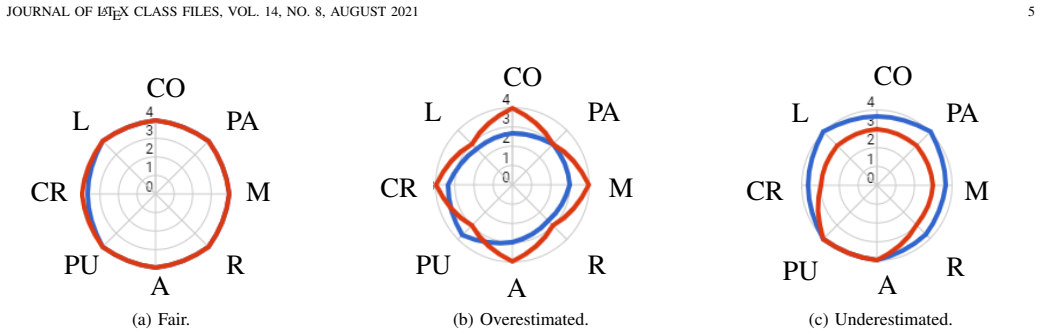
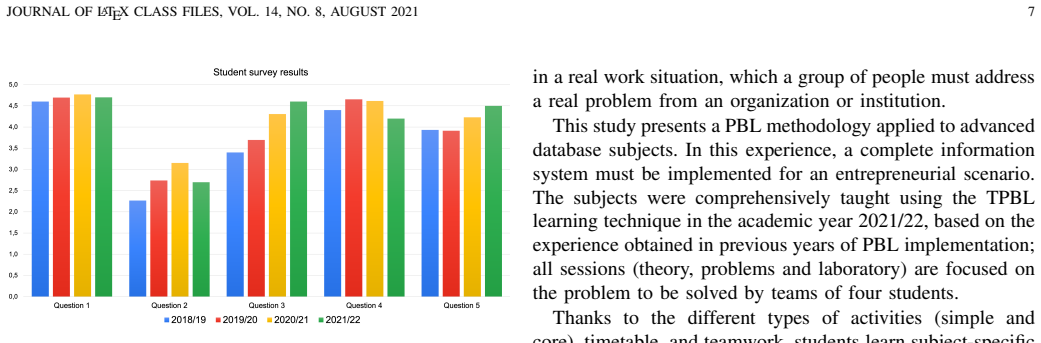
Team project-based learning (TPBL) combines two learning techniques: project-based learning (PBL) and teamwork. This combination leverages the learning outcomes of both methods and places students in a real work situation where they must develop and solve a real project while working as a team. TPBL has been used in two advanced database subjects in Jaume I University (UJI)'s Computer Science degree program. This learning method was used for four years (academic years from 2018/19 to 2021/2022) with positive outcomes. This study presents the project development, which includes teamwork formation, activities, timetable, and exercised learning competencies (both soft and specific). Further, the project's results were evaluated from three different perspectives: a) teamwork evaluation by teammates, b) Students' opinions on the subject and project, and c) subject final grades.
Editorial analysis
A structured set of objections, weighed in public.
Referee Report
Summary. The paper describes the full integration of Team Project-Based Learning (TPBL) into two advanced database courses at Jaume I University over four academic years (2018/19–2021/2022). It details project development elements including team formation, activities, timetable, and both soft and technical competencies exercised. Outcomes are assessed via three post-implementation lenses: teammate evaluations of teamwork, student opinions on the subject and project, and final subject grades, with the abstract stating positive results from this approach.
Significance. If the observed positives in grades, peer ratings, and opinions can be attributed to the TPBL integration rather than confounding factors, the work supplies a concrete, multi-year case study for embedding authentic team projects into database curricula. This could help instructors address both domain-specific skills and collaboration competencies. The four-year span and three-perspective evaluation provide descriptive richness that other single-semester reports lack, though the lack of comparative data restricts claims about effectiveness and replicability.
major comments (1)
- [Abstract and evaluation description] Abstract and the section describing the three evaluation perspectives: the central claim that TPBL integration 'produced positive outcomes' rests on teammate evaluations, student opinions, and final grades collected exclusively during the 2018/19–2021/2022 TPBL period. No pre-implementation baseline grades, satisfaction scores, or peer-evaluation data from the same course under prior pedagogy are reported, nor is any parallel non-TPBL control section described. This leaves cohort shifts, concurrent syllabus changes, or selection effects as plausible alternative explanations, so the manuscript demonstrates correlation within the intervention window but supplies no evidence that the integration itself drove the results.
minor comments (2)
- [Evaluation section] The manuscript should specify response rates for the student-opinion surveys and any statistical methods used to analyze the three evaluation data sources.
- [Results section] Clarify whether the reported final grades are raw or adjusted for any changes in assessment weighting introduced alongside the TPBL activities.
Simulated Author's Rebuttal
We thank the referee for the careful reading and constructive feedback. The concern about the lack of pre-implementation baselines or control data is valid and limits causal claims. We have revised the abstract, evaluation description, and added a limitations discussion to clarify the descriptive scope of the four-year case study while preserving its practical value for curriculum design.
read point-by-point responses
-
Referee: [Abstract and evaluation description] Abstract and the section describing the three evaluation perspectives: the central claim that TPBL integration 'produced positive outcomes' rests on teammate evaluations, student opinions, and final grades collected exclusively during the 2018/19–2021/2022 TPBL period. No pre-implementation baseline grades, satisfaction scores, or peer-evaluation data from the same course under prior pedagogy are reported, nor is any parallel non-TPBL control section described. This leaves cohort shifts, concurrent syllabus changes, or selection effects as plausible alternative explanations, so the manuscript demonstrates correlation within the intervention window but supplies no evidence that the integration itself drove the results.
Authors: We agree that without pre-TPBL baseline data or a control group, the manuscript can only report observed outcomes during the intervention period and cannot establish causation. The study was conceived as a longitudinal case study of full TPBL integration, with the evaluation framework developed concurrently; equivalent metrics were not collected under the prior pedagogy. We have therefore revised the abstract to describe 'observed positive outcomes' rather than implying the integration produced them, added explicit discussion of potential confounders (cohort effects, syllabus changes) in the evaluation section, and inserted a dedicated limitations paragraph. These changes temper the claims while retaining the contribution of detailing the implementation, activities, competencies, and multi-perspective results over four years. revision: partial
- Absence of pre-implementation baseline grades, satisfaction scores, or peer evaluations from the prior non-TPBL pedagogy, as these data were not collected.
Circularity Check
No circularity: purely descriptive educational case study
full rationale
The manuscript is a descriptive case study reporting the implementation of team project-based learning (TPBL) in two database courses over four academic years. It details project activities, teamwork formation, competencies exercised, and outcomes measured via teammate evaluations, student surveys, and final grades. No equations, derivations, fitted parameters, predictions, or uniqueness theorems appear. No self-citations are invoked as load-bearing premises. All claims are observational reports of events and measurements collected during the intervention period; none reduce by construction to prior inputs or self-referential definitions. The absence of pre/post baselines is a methodological limitation for causal inference but does not constitute circularity in the derivation chain.
Axiom & Free-Parameter Ledger
Reference graph
Works this paper leans on
-
[1]
A Review of Research on Project-based Learning,
J. W. Thomas, “A Review of Research on Project-based Learning,” Autodesk Foundation, Tech. Rep., 2000. [Online]. Available: http: //www.bie.org/research/study/review of project based learning 2000
2000
-
[2]
A review of project-based learning in higher education: Student outcomes and measures,
P. Guo, N. Saab, L. S. Post, and W. Admiraal, “A review of project-based learning in higher education: Student outcomes and measures,”International Journal of Educational Research, vol. 102, p. 101586, 2020. [Online]. Available: https://www.sciencedirect.com/ science/article/pii/S0883035519325704
2020
-
[3]
Learning Based on Projects. A Didactic Experience from the Physical Education Area,
A. Rosa-Guillam ´on, P. J. Carrillo-L´opez, and E. Garc´ıa-Cant´o, “Learning Based on Projects. A Didactic Experience from the Physical Education Area,” 2019. [Online]. Available: http://hdl.handle.net/10481/53934
2019
-
[4]
Promoting college student’s learning motivation and creativity through a stem interdisciplinary pbl human-computer interaction system design and development course,
H.-C. Kuo, Y .-C. Tseng, and Y .-T. C. Yang, “Promoting college student’s learning motivation and creativity through a stem interdisciplinary pbl human-computer interaction system design and development course,”Thinking Skills and Creativity, vol. 31, pp. 1–10, 2019. [Online]. Available: https://www.sciencedirect.com/science/article/pii/ S1871187118301093
2019
-
[5]
A Constructivist-Based Approach to Teaching Database Analysis and Design
T. M. Connolly and C. E. Begg, “A Constructivist-Based Approach to Teaching Database Analysis and Design.”Journal of Information Systems Education, vol. 17, no. 1, 2006
2006
-
[6]
Database Analysis and Design Learning Tool Based on Problem/Project-based Learning,
R. Nattassha and F. N. Azizah, “Database Analysis and Design Learning Tool Based on Problem/Project-based Learning,”2015 International Conference on Data and Software Engineering (ICoDSE), pp. 65–68, 2015
2015
-
[7]
An elearning standard approach for supporting pbl in com- puter engineering,
R. Garcia-Robles, F. Diaz-del Rio, S. Vicente-Diaz, and A. Linares- Barranco, “An elearning standard approach for supporting pbl in com- puter engineering,”IEEE Transactions on Education, vol. 52, no. 3, pp. 328–339, 2009
2009
-
[8]
Exploring active learning approaches to computer science classes,
R. Caceffo, G. Gama, and R. Azevedo, “Exploring active learning approaches to computer science classes,” inProceedings of the 49th ACM Technical Symposium on Computer Science Education, ser. SIGCSE ’18. New York, NY , USA: Association for Computing Machinery, 2018, p. 922–927. [Online]. Available: https://doi.org/10. 1145/3159450.3159585
-
[9]
Turning Student Groups into Effective Teams,
B. Oakley, R. Brent, R. M. Felder, and I. Elhajj, “Turning Student Groups into Effective Teams,”Journal of Student Centered Learning, pp. 9–34, 2004
2004
-
[10]
The Impact of Teamwork Skills on Students in Malaysian Public Universities,
M. Sulaiman, Z. Hj Mat, M. A. Mod Nizah, and L. Abdul Latif, “The Impact of Teamwork Skills on Students in Malaysian Public Universities,”Academia.edu, no. July 2017, 2017. [Online]. Available: The Impact of Teamwork Skills on Students in Malaysian Public Universities
2017
-
[11]
How do school management teams experience teamwork: A case study in the schools in the Kamwenge District, Uganda,
V . J. Pitsoe and P. Isingoma, “How do school management teams experience teamwork: A case study in the schools in the Kamwenge District, Uganda,”Mediterranean Journal of Social Sciences, vol. 5, no. 3, pp. 138–145, 2014
2014
-
[12]
Teaching communication and teamwork in engineering and computer science,
E. Berry and R. Lingard, “Teaching communication and teamwork in engineering and computer science,”ASEE Annual Conference Proceed- ings, pp. 9379–9389, 2001
2001
-
[13]
Teamwork skills in higher education: is university training contributing to their mastery?
E. De Prada, M. Mareque, and M. Pino-Juste, “Teamwork skills in higher education: is university training contributing to their mastery?.”sicol. Refl. Cr´ıt, vol. 35, 2022
2022
-
[14]
Computing Curricula 2020. Paradigms for Future Computing Curricula
T. J. T. F. on Computing Curricula, “Computing Curricula 2020. Paradigms for Future Computing Curricula.” ACM/IEEE Computer Society Press, Tech. Rep., 2020
2020
-
[15]
Learning Databases Using Project-based Learning,
V . R. Tom ´as, S. Iserte, and M. Perez, “Learning Databases Using Project-based Learning,” in15th International Technology, Education and Development Conference. INTED. IATED Academy, 2021, pp. 4035–4039
2021
-
[16]
Improving Basic Competences Through Project-based Learning and Teamworking,
V . R. Tom´as, S. Iserte, M. Perez, P. Boronat, M. Castillo, and L. Amable, “Improving Basic Competences Through Project-based Learning and Teamworking,” inInnovaciones docentes en tiempos de pandemia. Actas del VI Congreso Internacional sobre aprendizaje, innovaci ´on y cooperaci ´on, CINAIC. Servicio de Publicaciones. Universidad de Zaragoza., 2021, pp. 256–261
2021
-
[17]
A Proposal for Evaluation Group by Heading,
E. Chica and M. Resumen, “A Proposal for Evaluation Group by Heading,”Escuela Abierta, vol. 14, pp. 67–81, nov
-
[18]
Available: http://www.ceuandalucia.es/escuelaabierta/ pdf/articulos ea14pdf/ea14 chica.pdf
[Online]. Available: http://www.ceuandalucia.es/escuelaabierta/ pdf/articulos ea14pdf/ea14 chica.pdf
-
[19]
Dise ˜no de R ´ubricas y Evaluaci ´on con CoRubrics,
M. Marqu ´es, “Dise ˜no de R ´ubricas y Evaluaci ´on con CoRubrics,” Universitat Jaume I, Tech. Rep., 2019. [Online]. Available: https://www.uji.es/institucional/estrategia/plans/uji-digital/ formacio-digital/cursos/curs-corubrics
2019
discussion (0)
Sign in with ORCID, Apple, or X to comment. Anyone can read and Pith papers without signing in.