Recognition: unknown
Entanglement probes of gravitational Kaluza-Klein spectra: signal hierarchy and model discrimination
Pith reviewed 2026-05-09 18:40 UTC · model grok-4.3
The pith
Quantum entanglement of masses distinguishes Kaluza-Klein gravity spectra via signal hierarchy.
A machine-rendered reading of the paper's core claim, the machinery that carries it, and where it could break.
Core claim
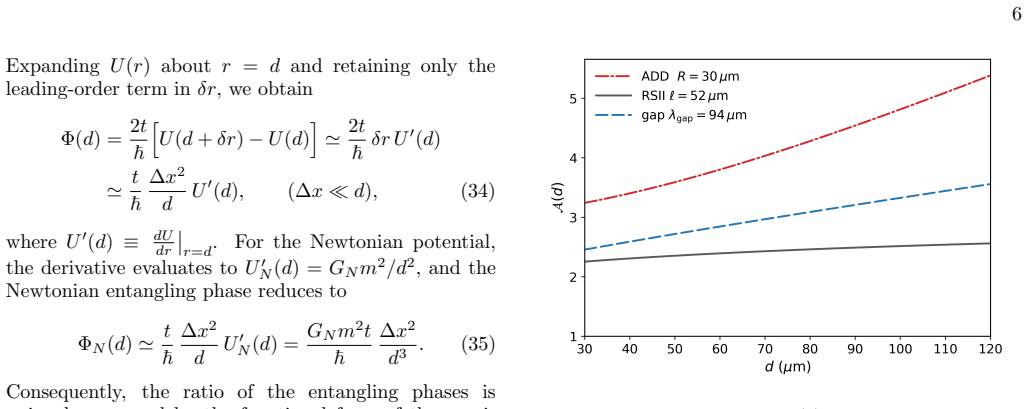
The paper establishes that in the 40-80 micrometer range the QGEM entangling phase exhibits a stable hierarchy ADD greater than gapped greater than RSII. Normalized phase-response profiles as a function of distance clearly separate the RSII benchmark from the ADD and gapped cases, although ADD and gapped remain nearly indistinguishable from each other. Consequently QGEM phase observables provide a complementary discriminator of Kaluza-Klein spectral structure at submillimeter scales.
What carries the argument
The entangling phase generated by the modified Newtonian potential of each Kaluza-Klein spectrum, together with its normalized distance dependence.
Load-bearing premise
Representative benchmark parameters guided by current short-range gravity tests are sufficient to evaluate realistic signals and that QGEM entanglement is experimentally realizable with the assumed sensitivity at these separations.
What would settle it
A measurement at 50 micrometers showing the RSII entanglement signal larger than the ADD signal would falsify the predicted stable hierarchy.
Figures



read the original abstract
Quantum-gravity-induced entanglement of masses (QGEM) provides a phase-sensitive probe of extra-dimensional corrections to the Newtonian potential at submillimeter separations. We compare three representative Kaluza-Klein spectral scenarios: the Randall-Sundrum II (RSII) and Arkani-Hamed-Dimopoulos-Dvali (ADD) models, and the case of a gapped continuum modeled by a P\"oschl-Teller potential. We evaluate the entangling phase, concurrence, and normalized phase-response profiles over $d=40$-$80\,\mu\mathrm{m}$ using representative benchmark parameters guided by current short-range gravity tests. In this range, the signal exhibits a stable hierarchy: ADD $>$ gapped $>$ RSII. For conservative experimental parameters, the ADD signal surpasses the nominal entanglement threshold at smaller separations, whereas the gapped benchmark is resolvable only at the lower end of the window, and RSII remains below resolution. In a more optimistic near-term scenario, all three spectral signatures comfortably exceed the threshold. We further show that normalized distance scans of the phase response clearly separate the RSII benchmark from the ADD and gapped cases, whereas ADD and the gapped continuum remain nearly indistinguishable in normalized profile. QGEM phase observables therefore provide a complementary discriminator of Kaluza-Klein spectral structure at submillimeter scales.
Editorial analysis
A structured set of objections, weighed in public.
Referee Report
Summary. The paper evaluates quantum-gravity-induced entanglement of masses (QGEM) as a probe of Kaluza-Klein corrections to the Newtonian potential at submillimeter scales. It compares three models—Randall-Sundrum II (RSII), Arkani-Hamed-Dimopoulos-Dvali (ADD), and a gapped continuum via Pöschl-Teller potential—using representative benchmark parameters drawn from short-range gravity tests. Numerical results for the entangling phase, concurrence, and normalized phase-response profiles over d=40–80 μm are reported to exhibit a stable hierarchy ADD > gapped > RSII, with claims that normalized distance scans can discriminate RSII from the other two while ADD and gapped remain similar; QGEM is positioned as a complementary discriminator of spectral structure.
Significance. If the hierarchy and discrimination hold under parameter variation, the work would provide a novel quantum-entanglement-based method to distinguish extra-dimensional models at scales inaccessible to classical tests, leveraging phase sensitivity to gravitational potentials. The approach is conceptually interesting for near-term QGEM experiments, though its impact depends on experimental realizability and robustness of the ordering.
major comments (2)
- [Abstract] Abstract and results: The central claim of a 'stable hierarchy' ADD > gapped > RSII (and consequent model discrimination via normalized profiles) rests on single representative benchmark points for each model. No scan, variation, or sensitivity analysis over the allowed parameter ranges (e.g., ADD compactification radius, RSII warp factor, or Pöschl-Teller gap parameter) consistent with current short-range gravity tests is provided; if the ordering reverses or collapses for other valid points, the discriminator conclusion does not hold generally.
- [Numerical results] Setup and numerical evaluation: The entangling phase is computed directly from the gravitational potentials of the external models, but the manuscript provides no derivation details, explicit QGEM phase formula, numerical integration method, error propagation, or sensitivity to benchmark choices. This leaves the quantitative statements about surpassing entanglement thresholds and profile separability without sufficient support for the reported hierarchy.
minor comments (2)
- [Abstract] Abstract: The phrase 'gapped continuum modeled by a Pöschl-Teller potential' would benefit from a one-sentence clarification or reference to aid readers unfamiliar with the specific potential form.
- [Figures] Notation: Ensure consistent use of symbols for separations (d) and potentials across figures and text to avoid minor ambiguity in the distance scans.
Simulated Author's Rebuttal
We thank the referee for the careful and constructive review of our manuscript. We address the major comments point by point below, indicating the revisions we will make to improve clarity and robustness.
read point-by-point responses
-
Referee: [Abstract] Abstract and results: The central claim of a 'stable hierarchy' ADD > gapped > RSII (and consequent model discrimination via normalized profiles) rests on single representative benchmark points for each model. No scan, variation, or sensitivity analysis over the allowed parameter ranges (e.g., ADD compactification radius, RSII warp factor, or Pöschl-Teller gap parameter) consistent with current short-range gravity tests is provided; if the ordering reverses or collapses for other valid points, the discriminator conclusion does not hold generally.
Authors: We acknowledge that the hierarchy and discrimination claims are demonstrated explicitly only for representative benchmark parameters chosen to lie within current short-range gravity constraints. While a full scan over the entire allowed ranges would strengthen the generality of the 'stable' qualifier, the ordering follows directly from the distinct functional forms of the potentials (dense KK tower in ADD versus gapped continuum versus RSII warp suppression). In the revised manuscript we will add a dedicated paragraph in the results section that (i) justifies the benchmark selection against existing bounds, (ii) provides a qualitative argument based on the spectral density why the hierarchy is expected to persist under moderate variations, and (iii) includes a limited sensitivity check by varying each benchmark parameter by ±10 % around its central value. This will qualify the scope of the conclusions without overstating generality. revision: partial
-
Referee: [Numerical results] Setup and numerical evaluation: The entangling phase is computed directly from the gravitational potentials of the external models, but the manuscript provides no derivation details, explicit QGEM phase formula, numerical integration method, error propagation, or sensitivity to benchmark choices. This leaves the quantitative statements about surpassing entanglement thresholds and profile separability without sufficient support for the reported hierarchy.
Authors: We agree that explicit documentation of the computational pipeline is necessary. The entangling phase follows the standard QGEM expression Φ = (m₁ m₂ / ℏ) ∫ V_grav(d(t)) dt, where V_grav incorporates the model-specific correction to the Newtonian potential; we will insert this formula together with the explicit expressions for each model's correction in a new 'Methods' subsection. Numerical integration is performed via adaptive Gaussian quadrature over the time-dependent separation d(t) prescribed by the experimental protocol; we will state the quadrature routine and tolerance used. Because the potentials are closed-form analytic functions, no Monte-Carlo error propagation is required. Sensitivity to benchmark choices will be covered by the limited variation analysis added in response to the first comment. revision: yes
Circularity Check
No circularity: signals computed directly from external model potentials
full rationale
The paper evaluates QGEM entangling phases, concurrence, and normalized profiles by direct substitution of the known gravitational potentials from the three external Kaluza-Klein models (RSII, ADD, gapped Pöschl-Teller) into the standard entanglement formulas, using benchmark parameter values drawn from prior short-range gravity experiments. No equations in the provided text fit parameters to the paper's own QGEM observables, rename fitted quantities as predictions, or invoke self-citations to establish uniqueness or ansatze that reduce the hierarchy claim to a definitional tautology. The reported ADD > gapped > RSII ordering is therefore an explicit numerical outcome for the chosen points rather than a reduction by construction to the paper's inputs.
Axiom & Free-Parameter Ledger
free parameters (1)
- benchmark parameters for RSII, ADD and gapped models
axioms (2)
- domain assumption Quantum mechanics governs the phase accumulation and concurrence arising from the modified Newtonian potential
- domain assumption The three chosen spectral scenarios (RSII, ADD, Poschl-Teller gapped) adequately represent the range of possible Kaluza-Klein structures
Reference graph
Works this paper leans on
-
[1]
near-degeneracy
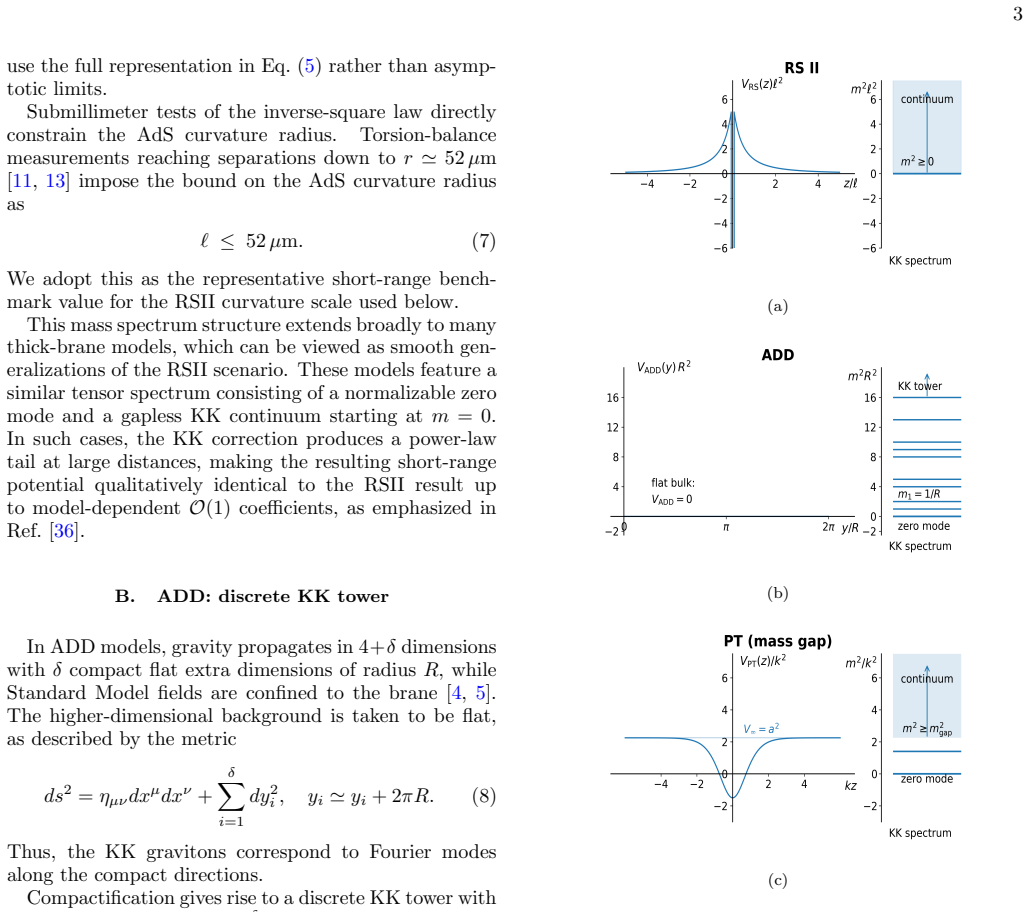
In the limitz→ ±∞,V PT →a 2k2, implying that the mass continuum begins at the threshold mgap =a k= 3 2 k,(19) Correspondingly, the characteristic length scale associ- ated with this mass gap can be defined as λgap ≡m −1 gap = 2 3k .(20) Besides the localized zero mode, this PT potential also contains one odd-parity bound state with massm 1 =√ 2k. Becauseψ...
-
[2]
An Alternative to Compactification
L. Randall and R. Sundrum,An alternative to compactification, Phys. Rev. Lett.83(1999) 4690 [arXiv:hep-th/9906064]
work page Pith review arXiv 1999
-
[3]
Gravity in the Randall-Sundrum Brane World
J. Garriga and T. Tanaka,Gravity in the randall– sundrum brane world, Phys. Rev. Lett.84(2000) 2778 [arXiv:hep-th/9911055]
work page Pith review arXiv 2000
-
[4]
P. Callin and F. Ravndal,Higher order corrections to the newtonian potential in the randall–sundrum model, Phys. Rev. D70(2004) 104009 [arXiv:hep-ph/0403302]
work page internal anchor Pith review arXiv 2004
-
[5]
New Dimensions at a Millimeter to a Fermi and Superstrings at a TeV
I. Antoniadis, N. Arkani-Hamed, S. Dimopoulos and G. Dvali,New dimensions at a millimeter to a fermi and superstrings at a tev, Phys. Lett. B436(1998) 257 [arXiv:hep-ph/9804398]
work page Pith review arXiv 1998
-
[6]
The Hierarchy Problem and New Dimensions at a Millimeter
N. Arkani-Hamed, S. Dimopoulos and G. Dvali,The hier- archy problem and new dimensions at a millimeter, Phys. Lett. B429(1998) 263 [arXiv:hep-ph/9803315]
work page Pith review arXiv 1998
-
[7]
Gremm, Four-dimensional gravity on a thick domain wall , Phys
M. Gremm,Four-dimensional gravity on a thick domain wall, Phys. Lett. B478(2000) 434 [arXiv:hep-th/9912060]
-
[8]
N. Barbosa-Cendejas, A. Herrera-Aguilar, U. Nuca- mendi, I. Quiros and K. Kanakoglou,Mass hierarchy, mass gap and corrections to Newton’s law on thick branes with Poincar´ e symmetry, Gen. Rel. Grav.46(2014) 1631 [arXiv:0712.3098]
-
[9]
N. Barbosa-Cendejas, A. Herrera-Aguilar, M.A. Reyes Santos and C. Schubert,Mass gap for gravity localized on weyl thick branes, Phys. Rev. D77 (2008) 126013 [arXiv:0709.3552]
- [10]
-
[11]
Adelberger, J.H
E.G. Adelberger, J.H. Gundlach, B.R. Heckel, S. Hoedl and S. Schlamminger,Torsion balance experiments: A low-energy frontier of particle physics, Prog. Part. Nucl. Phys.62(2009) 102
2009
-
[12]
Tests of the Gravitational Inverse-Square Law below the Dark-Energy Length Scale
D.J. Kapner, T.S. Cook, E.G. Adelberger, J.H. Gund- lach, B.R. Heckel, C.D. Hoyle et al.,Tests of the gravitational inverse-square law below the dark-energy length scale, Phys. Rev. Lett.98(2007) 021101 [arXiv:hep-ph/0611184]
-
[13]
Tan, A.-B
W.-H. Tan, A.-B. Du, W.-C. Dong, S.-Q. Yang, C.- G. Shao, S.-G. Guan et al.,New test of the gravitational inverse-square law at the submillimeter range, Phys. Rev. Lett.116(2016) 131101
2016
- [14]
-
[15]
Tan, A.-B
W.-H. Tan, A.-B. Du, W.-C. Dong, S.-Q. Yang, C.- G. Shao, S.-G. Guan et al.,Improvement for testing the gravitational inverse-square law at the submillimeter range, Phys. Rev. Lett.124(2020) 051301
2020
-
[16]
G.L. Klimchitskaya, U. Mohideen and V.M. Mostepa- nenko,The casimir force between real materials: Ex- periment and theory, Rev. Mod. Phys.81(2009) 1827 [arXiv:0902.4022]
-
[17]
R.O. Behunin, D.A.R. Dalvit, R.S. Decca and C.C. Speake,Limits on the accuracy of force sensing at 11 short separations due to patch potentials, Phys. Rev. D 89(2014) 051301 [arXiv:1304.4074]
-
[18]
S. Bose, A. Mazumdar, G.W. Morley, H. Ulbricht, M. Toroˇ s, M. Paternostro et al.,Spin entanglement wit- ness for quantum gravity, Phys. Rev. Lett.119(2017) 240401 [arXiv:1707.06050]
work page Pith review arXiv 2017
-
[19]
C. Marletto and V. Vedral,Gravitationally induced en- tanglement between two massive particles is sufficient ev- idence of quantum effects in gravity, Phys. Rev. Lett.119 (2017) 240402 [arXiv:1707.06036]
work page Pith review arXiv 2017
-
[20]
C. Marletto and V. Vedral,Quantum-information meth- ods for quantum gravity laboratory-based tests, Rev. Mod. Phys.97(2025) 015006 [arXiv:2410.07262]
- [21]
-
[22]
A classical channel model for gravitational decoherence
D. Kafri, J.M. Taylor and G.J. Milburn,A classical chan- nel model for gravitational decoherence, New J. Phys.16 (2014) 065020 [arXiv:1401.0946]
work page Pith review arXiv 2014
-
[23]
A. Tilloy and L. Di´ osi,Principle of least decoherence for newtonian semi-classical gravity, Phys. Rev. D96(2017) 104045 [arXiv:1706.01856]
-
[24]
C. Anastopoulos and B.-L. Hu,Gravity, quantum fields and quantum information: Problems with classical chan- nel and stochastic theories, Entropy24(2022) 490 [arXiv:2202.02789]
-
[25]
J. Aziz and R. Howl,Classical theories of grav- ity produce entanglement, Nature646(2025) 813 [arXiv:2510.19714]
-
[26]
H. Chevalier, A.J. Paige and M.S. Kim,Witnessing the non-classical nature of gravity in the presence of un- known interactions, Phys. Rev. A102(2020) 022428 [arXiv:2005.13922]
-
[27]
Marletto and V
C. Marletto and V. Vedral,Classical gravity cannot me- diate entanglement by local means, 2025
2025
-
[28]
Marletto, J
C. Marletto, J. Oppenheim, V. Vedral and E. Wilson, Classical gravity cannot mediate entanglement, 2025
2025
-
[29]
Di´ osi,No, classical gravity does not entangle quantized matter fields, 2025
L. Di´ osi,No, classical gravity does not entangle quantized matter fields, 2025
2025
- [30]
-
[31]
P.G. Carmona Rufo, A. Kumar, C. Sab´ ın and A. Mazumdar,Entanglement witnesses mediated via axionlike particles, Phys. Rev. D111(2025) 115005 [arXiv:2503.19072]
-
[32]
S.G. Elahi and A. Mazumdar,Probing massless and massive gravitons via entanglement in a warped ex- tra dimension, Phys. Rev. D108(2023) 035018 [arXiv:2303.07371]
-
[33]
S. Feng, B.-M. Gu and F.-W. Shu,Quantum gravity induced entanglement of masses with extra dimensions, Eur. Phys. J. C84(2024) 59 [arXiv:2307.11391]
-
[34]
T.W. van de Kamp, R.J. Marshman, S. Bose and A. Mazumdar,Quantum gravity witness via entangle- ment of masses: Casimir screening, Phys. Rev. A102 (2020) 062807 [arXiv:2006.06931]
- [35]
- [36]
- [37]
-
[38]
Navas, others and Particle Data Group,Review of par- ticle physics, Phys
S. Navas, others and Particle Data Group,Review of par- ticle physics, Phys. Rev. D110(2024) 030001
2024
-
[39]
S. Nam,Mass gap in kaluza-klein spectrum in a network of brane worlds, JHEP04(2000) 002 [arXiv:hep-th/9911237]
discussion (0)
Sign in with ORCID, Apple, or X to comment. Anyone can read and Pith papers without signing in.