The numerical solution of 2D Boussinesq/Boussinesq models for internal waves with spectral methods
Pith reviewed 2026-05-10 03:29 UTC · model grok-4.3
The pith
A Fourier-Galerkin spectral method in space produces convergent approximations to 2D Boussinesq/Boussinesq systems for internal waves, with error estimates for the semidiscrete problem.
A machine-rendered reading of the paper's core claim, the machinery that carries it, and where it could break.
Core claim
The paper claims that the Fourier-Galerkin spectral discretization in space combined with an efficient time integrator yields convergent approximations to the solutions of the 2D Boussinesq/Boussinesq systems, as supported by error estimates derived for the semidiscrete approximation and by numerical experiments that illustrate the method's performance.
What carries the argument
The Fourier-Galerkin spectral method in space, which projects the differential system onto a finite-dimensional space of trigonometric polynomials over the periodic domain to produce a system of ordinary differential equations.
If this is right
- The semidiscrete solutions converge to the exact solution of the continuous system as the dimension of the trigonometric polynomial space increases.
- Explicit error bounds control the difference between continuous and discrete solutions independently of the time discretization.
- The full discretization with an efficient time integrator produces stable and accurate simulations of internal wave propagation over relevant time intervals.
Where Pith is reading between the lines
- The periodic-domain setting simplifies the Fourier analysis but leaves open how the method would adapt to bounded or non-periodic domains common in oceanographic applications.
- Successful numerical validation of these asymptotic models supports their further use in parameter studies of density-interface dynamics.
- The separation of spatial error estimates from time integration suggests the scheme could be combined with other time-stepping methods without losing the spatial convergence guarantee.
Load-bearing premise
The periodic initial-value problem for the continuous Boussinesq/Boussinesq systems is well-posed.
What would settle it
Numerical tests in which the approximation error fails to decrease at the predicted rate when the number of Fourier modes is increased would falsify the convergence and error-estimate claims.
Figures


read the original abstract
The numerical approximation of some Boussinesq systems in two spatial dimensions is here considered. The differential systems under study are proposed as asymptotic models for the propagation of waves along the interface of two layers of fluids with different densities and subjected to a Boussinesq physical regime in each layer. Well-posedness of the periodic initial-value problem (ivp) of the systems is first analized. Then, a discretization in space based on the spectral Fourier-Galerkin method is introduced and error estimates for the semidiscrete approximation are derived. Using an efficient time integrator, some numerical experiments to illustrate the performance of the discretization are presented.
Editorial analysis
A structured set of objections, weighed in public.
Referee Report
Summary. The manuscript analyzes the well-posedness of the periodic initial-value problem for 2D Boussinesq/Boussinesq systems modeling internal waves between fluid layers. It then introduces a Fourier-Galerkin spectral spatial discretization, derives error estimates for the resulting semidiscrete approximation, and presents numerical experiments that employ an efficient time integrator to demonstrate the method's performance.
Significance. If the well-posedness result and semidiscrete error estimates are rigorous, the work supplies a theoretically grounded spectral approach for these nonlinear dispersive models, which is useful for high-accuracy simulations of stratified wave propagation. The numerical experiments provide practical evidence of convergence, but the absence of fully discrete analysis reduces the overall strength of the convergence claims for the implemented scheme.
major comments (2)
- Abstract: the central claim that the discretization 'yields convergent approximations' is supported only by semidiscrete error estimates; no consistency, stability, or error analysis is indicated for the fully discrete scheme that combines the Fourier-Galerkin method with the time integrator. For nonlinear dispersive systems this gap is load-bearing, as temporal discretization can introduce CFL-type restrictions or order reduction that the semidiscrete bounds do not automatically control.
- Abstract: the statement that well-posedness of the periodic IVP 'is first analyzed' is presented without any indication of the function spaces, the precise assumptions on the initial data, or the key estimates used; this makes it impossible to verify whether the subsequent semidiscrete analysis rests on a complete continuous theory.
minor comments (2)
- Abstract: 'analized' is a typographical error and should read 'analyzed'.
- Abstract: the abbreviation 'ivp' should be written 'IVP' on first use for standard mathematical style.
Simulated Author's Rebuttal
We thank the referee for the careful reading of our manuscript and the constructive comments. We address the major comments point by point below, indicating where revisions will be made.
read point-by-point responses
-
Referee: Abstract: the central claim that the discretization 'yields convergent approximations' is supported only by semidiscrete error estimates; no consistency, stability, or error analysis is indicated for the fully discrete scheme that combines the Fourier-Galerkin method with the time integrator. For nonlinear dispersive systems this gap is load-bearing, as temporal discretization can introduce CFL-type restrictions or order reduction that the semidiscrete bounds do not automatically control.
Authors: We agree that the abstract phrasing risks implying convergence for the implemented fully discrete scheme, while the rigorous analysis is limited to the semidiscrete Fourier-Galerkin approximation. The numerical experiments employ an efficient time integrator solely to demonstrate practical performance and observed rates, without a supporting fully discrete error analysis. We will revise the abstract to state explicitly that convergence is established for the semidiscrete problem and that the fully discrete results are numerical evidence only. This clarification removes any ambiguity regarding the scope of the theoretical claims. revision: yes
-
Referee: Abstract: the statement that well-posedness of the periodic IVP 'is first analyzed' is presented without any indication of the function spaces, the precise assumptions on the initial data, or the key estimates used; this makes it impossible to verify whether the subsequent semidiscrete analysis rests on a complete continuous theory.
Authors: The abstract serves as a high-level outline of the paper's structure rather than a technical summary. The well-posedness analysis, including the specific function spaces (periodic Sobolev spaces of sufficient regularity), assumptions on the initial data, and the key energy estimates establishing local well-posedness, is developed in detail in the body of the manuscript. The semidiscrete error estimates are derived directly from this continuous theory. We do not believe additional technical details belong in the abstract, as this would depart from standard practice in the field; the manuscript already allows verification of the connection between the continuous and discrete analyses. revision: no
Circularity Check
No circularity: standard well-posedness to semidiscrete error analysis pipeline
full rationale
The paper's chain consists of (1) analysis of well-posedness for the continuous periodic IVP, (2) introduction of Fourier-Galerkin spatial discretization, and (3) derivation of error estimates for the semidiscrete problem, followed by separate numerical experiments using a time integrator. No quoted step reduces a claimed result to a fitted parameter, self-citation, or input by construction; the error estimates are derived from the continuous problem properties and discretization, which is the expected independent content of a numerical PDE paper. The absence of fully discrete analysis is a completeness issue, not a circular reduction.
Axiom & Free-Parameter Ledger
axioms (1)
- domain assumption The periodic initial-value problem for the 2D Boussinesq/Boussinesq systems is well-posed.
Reference graph
Works this paper leans on
-
[1]
C. T. Anh, On the Boussinesq/Full dispersion systems and Boussinesq/Boussinesq systems for internal waves, Nonl. Anal., 72 (2010) 409-429
work page 2010
-
[2]
D. C. Antonopoulos, V. A. Dougalis, Error estimates for G alerkin approximations of the ‘classical’ Boussinesq system, Math. Comp., 82 (2013) 6 80-717
work page 2013
-
[3]
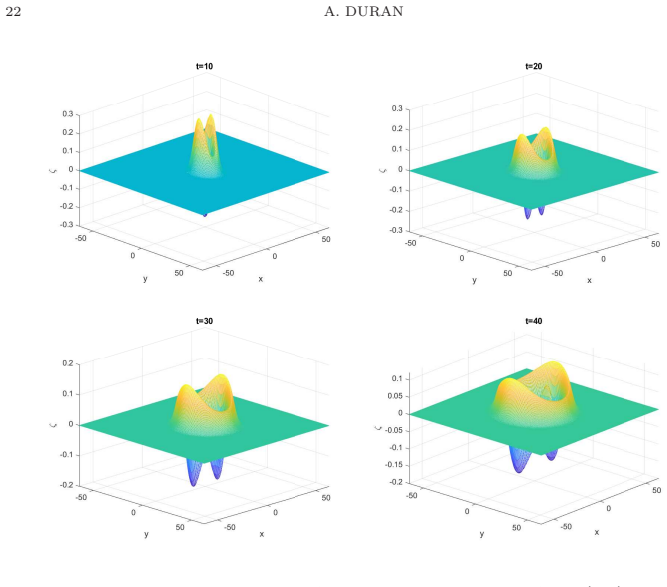
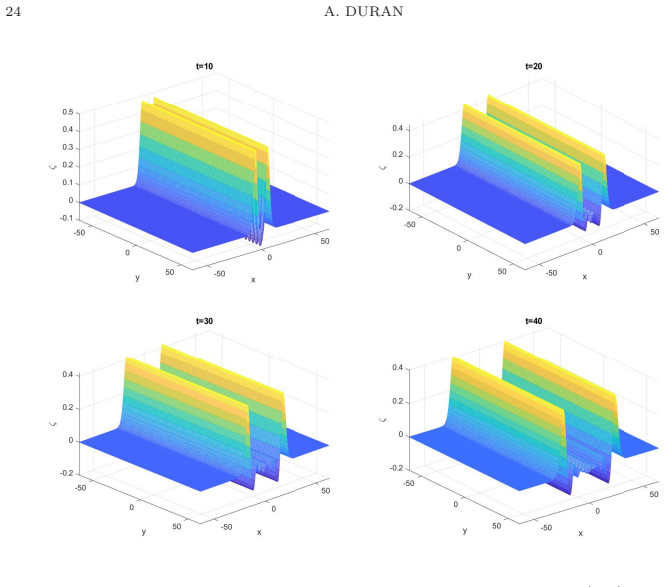
D. C. Antonopoulos, V. A. Dougalis, and D. E. Mitsotakis, Numerical solution of Boussinesq systems of the Bona-Smith family, Appl. Numer. M ath., 60 (2010), 314- 336. 22 A. DURAN Figure 5. ζ component of the numerical solution from (4.7) at times t = 10, 20, 30, 40
work page 2010
-
[4]
J. L. Bona, H. Chen, Y. Hong, M. Panthee, M. Scialom, The lo ng wave- length limit of periodic solutions of water wave models, Stu d. Appl. Math., 2024, https://doi.org/10.1111/sapm.12705
-
[5]
J. L. Bona, M. Chen, J.-C. Saut, Boussinesq equations and other systems for small- amplitude long waves in nonlinear dispersive media: II. The nonlinear theory, Non- linearity 17 (2004), 925-952
work page 2004
-
[6]
J. L. Bona, D. Lannes, J. C. Saut, Asymptotic models for in ternal waves, J. Math. Pures Appl., 89 (2008), 538-566
work page 2008
-
[7]
J.L. Bona, R. Smith, The initial-value problem for the Ko rteweg-de Vries equation, Phil. Trans. R. Soc. London A 278 (1975) 555-601
work page 1975
- [8]
-
[9]
V. A. Dougalis, A. Dur´ an, L. Saridaki, On solitary-wave solutions of Boussi- nesq/Boussinesq systems for internal waves, Physica D, 428 (2021) 133051
work page 2021
-
[10]
V. A. Dougalis, A. Dur´ an, L. Saridaki, On the numerical approximation of Boussi- nesq/Boussinesq systems for internal waves, Numer Methods Partial Differential Eq. 2023;1-28
work page 2023
-
[11]
V. A. Dougalis, D. E. Mitsotakis, J.-C. Saut, On some Bou ssinesq systems in two space dimensions: Theory and numerical analysis, ESAIM: Ma thematical Modelling and Numerical Analysis, 41(2007) 825-854
work page 2007
-
[12]
V. A. Dougalis, D. E. Mitsotakis, J.-C. Saut, Boussines q systems of Bona-Smith type on plane domains: Theory and numerical analysis, J. Sci. Com puting, 44 (2010) 109-135
work page 2010
-
[13]
Duchˆ ene, Many Models for W ater W aves, A Unified Theor etical Approach, AMS Open Math Notes, 2021
V. Duchˆ ene, Many Models for W ater W aves, A Unified Theor etical Approach, AMS Open Math Notes, 2021
work page 2021
-
[14]
Dur´ an, Spectral Jacobi approximations for Boussin esq systems, Studies Appl
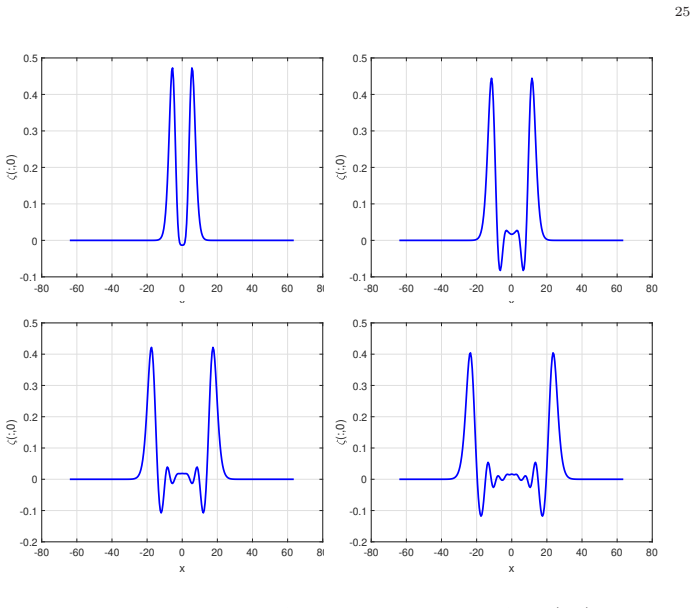
A. Dur´ an, Spectral Jacobi approximations for Boussin esq systems, Studies Appl. Math., 153(1), (2024) e12680. https://doi.org/10.1111/s apm.12680. 23 -80 -60 -40 -20 0 20 40 60 80 x -0.3 -0.2 -0.1 0 0.1 0.2 0.3 (:,0) -80 -60 -40 -20 0 20 40 60 80 x -0.3 -0.2 -0.1 0 0.1 0.2 0.3 (:,0) -80 -60 -40 -20 0 20 40 60 80 x -0.2 -0.15 -0.1 -0.05 0 0.05 0.1 0.15 0...
work page doi:10.1111/s 2024
-
[15]
A. Dur´ an, Numerical solution of Boussinesq systems in two space dimensions with spectral methods, in Press
-
[16]
Lannes, The W ater W aves Problem, AMS, Providence, Rh ode Island, 2013
D. Lannes, The W ater W aves Problem, AMS, Providence, Rh ode Island, 2013
work page 2013
-
[17]
P. L. Lions. (1984), The concentration-compactness pr inciple in the calculus of vari- ations. The locally compact case. Part I and Part II. Ann. Ins t. Henri Poincar´ e Sect A (N.S.) 1, pp. 109-145 and pp. 223-283
work page 1984
-
[18]
H. Luong, J.-C. Saut, The Boussinesq systems on the brac kground of a line solitary wave, Disc. Cont. Dyn. Systems, 43 (5) (2023) 1787-1823, doi :10.3934/dcds.2022179
-
[19]
J.-C. Saut, Asymptotic Models for Surface and Internal W aves, 29 o Col´ oquio Brasileiro de Matem´ atica, IMPA, Rio de Janeiro, 2013
work page 2013
-
[20]
J. C. Xavier, M. A. Rincon, D. G. Alfaro Vigo, D. E. Amunds en, Stability analysis for a fully discrete spectral scheme for Boussinesq systems , Applic. Anal., 97 (2018) 610-632. Applied Mathematics Department, University of V alladolid, 4 7011 V alladolid, Spain Email address : angeldm@uva.es 24 A. DURAN Figure 7. ζ component of the numerical solution fr...
work page 2018
discussion (0)
Sign in with ORCID, Apple, or X to comment. Anyone can read and Pith papers without signing in.