Recognition: unknown
Physics-informed neural networks for form-finding of unilateral membrane structures
Pith reviewed 2026-05-10 00:31 UTC · model grok-4.3
The pith
Physics-informed neural networks can generate equilibrium shapes for unilateral membranes by minimizing PDE residuals at collocation points, matching traditional finite element solutions.
A machine-rendered reading of the paper's core claim, the machinery that carries it, and where it could break.
Core claim
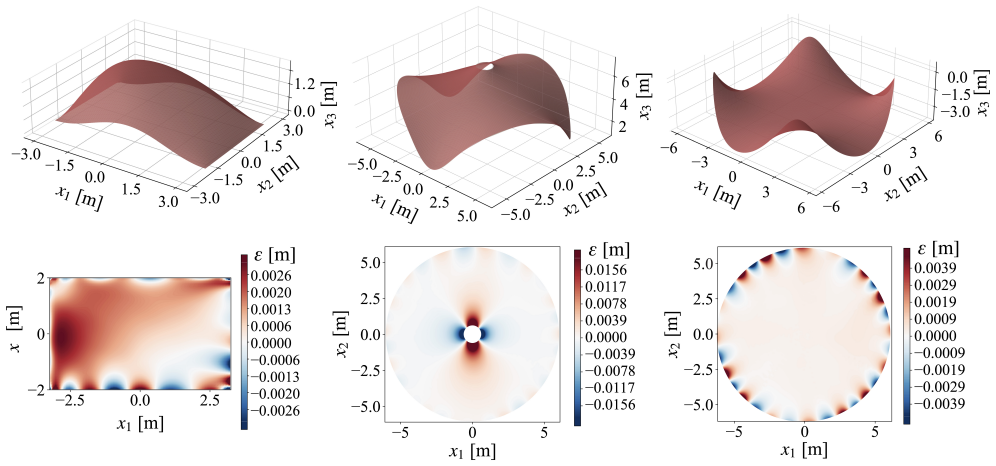
Two PINN formulations are proposed to enforce the equilibrium PDE residual at collocation points rather than through mesh-based discretization. The soft-BC version imposes boundary conditions via a penalty term, while the hard-BC version satisfies them exactly through distance and lift functions. On three case studies of varying geometrical complexity, both produce membrane surfaces in close agreement with an FEM-based PDE solver. The hard-BC formulation yields smaller errors and a smoother residual distribution, particularly near the boundary, while the soft-BC version still gives structurally meaningful results when simpler implementation is preferred.
What carries the argument
Physics-informed neural networks that minimize the residual of the second-order elliptic PDE for membrane equilibrium analysis at collocation points, with boundary conditions handled either through a penalty term (soft-BC) or exactly via distance and lift functions (hard-BC).
Load-bearing premise
That minimizing the PDE residual at collocation points during training, together with the chosen boundary-condition treatment, will converge to the unique solution of the second-order elliptic boundary-value problem.
What would settle it
A new test case where the trained PINN surface deviates substantially from the known FEM solution in regions away from training artifacts, even after refining collocation points or network capacity, would show the approach fails to recover the governing PDE solution.
Figures





read the original abstract
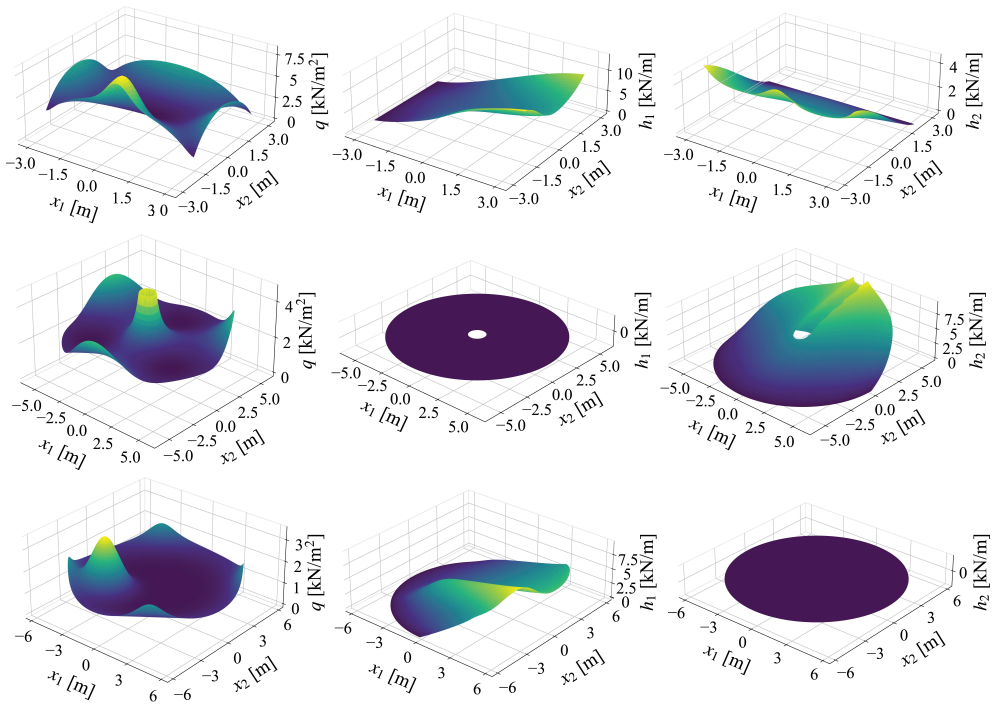
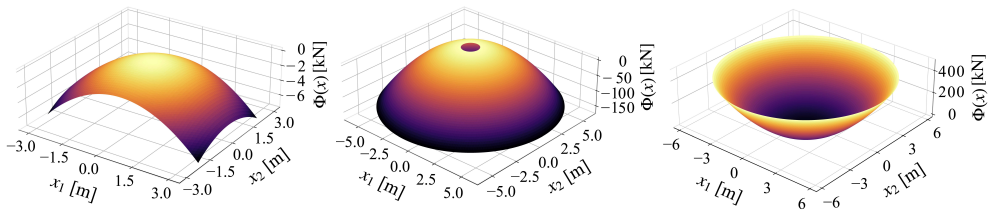
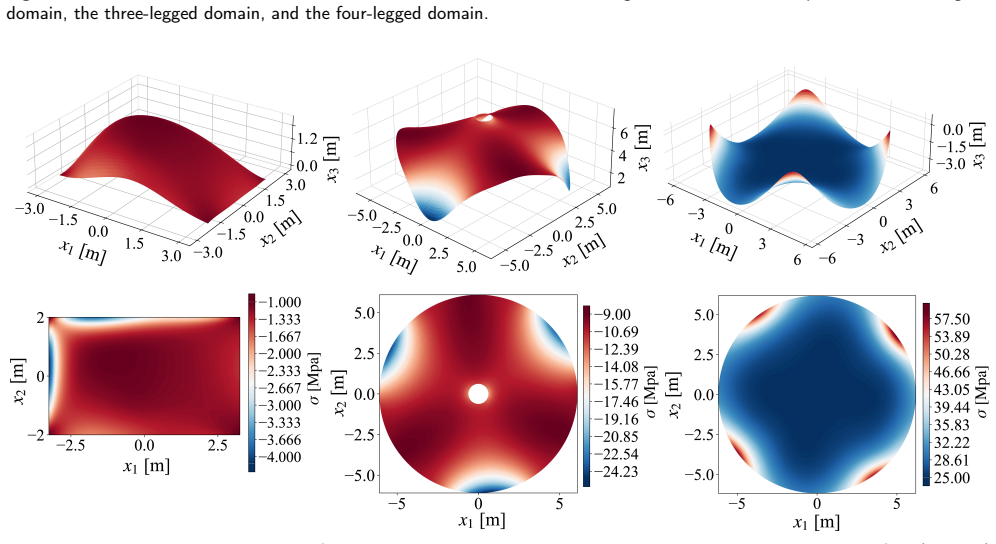
Form-finding of unilateral membrane structures is commonly addressed by solving equilibrium equations with Finite Element Methods (FEMs). This paper investigates Physics-Informed Neural Networks (PINNs) as an alternative, where the equilibrium equation is enforced by minimizing its residual at collocation points during neural-network training rather than by solving a mesh-based discretized system. This approach is well suited to form-finding problems based on Membrane Equilibrium Analysis (MEA), in which the unknown membrane surface is governed by a second-order elliptic Partial Differential Equation (PDE) with Dirichlet boundary conditions. Two PINN formulations are proposed and compared: a soft-Boundary Condition (soft-BC) approach, where the boundary conditions are imposed through a penalty term, and a hard-BC approach, where they are satisfied exactly by construction through distance and lift functions. The methods are assessed on three case studies with different geometrical complexity, including compression-only and tension-only stress states, and combined self-weight, concentrated vertical loads, and horizontal actions. Both formulations produce membrane surfaces in close agreement with solutions obtained using an FEM-based PDE solver. The hard-BC formulation gives smaller errors and a smoother residual distribution, especially near the boundary, showing that exact enforcement of the Dirichlet conditions improves overall accuracy. The soft-BC formulation still provides structurally meaningful solutions and remains attractive when simpler implementation is preferred and limited relaxation of the boundary data is acceptable. Overall, the results show that PINNs are a viable alternative for MEA-based form-finding.
Editorial analysis
A structured set of objections, weighed in public.
Referee Report
Summary. The manuscript proposes Physics-Informed Neural Networks (PINNs) as an alternative to FEM for form-finding of unilateral membrane structures under Membrane Equilibrium Analysis (MEA). It introduces two formulations for enforcing the governing second-order elliptic PDE with Dirichlet boundary conditions: a soft-BC approach using a penalty term in the loss and a hard-BC approach that exactly satisfies the boundary conditions via distance and lift functions. The methods are evaluated on three case studies with varying geometry, stress states (compression-only, tension-only), and loads (self-weight, concentrated, horizontal), claiming close agreement with FEM solutions and superior performance for the hard-BC variant.
Significance. If the central claims hold under quantitative scrutiny, the work would demonstrate a viable mesh-free alternative for solving the elliptic BVP in MEA form-finding and provide concrete evidence that exact boundary-condition enforcement improves accuracy near boundaries in structural PINN applications. The direct numerical comparison to an independent FEM solver is a positive feature, as is the explicit contrast between soft and hard BC treatments.
major comments (2)
- [Numerical results] Numerical results section: The claims of 'close agreement' and that 'the hard-BC formulation gives smaller errors and a smoother residual distribution' rest on qualitative visual comparisons of surfaces and residual plots only. No quantitative error tables, L2 or maximum-norm differences between PINN and FEM solutions, or pointwise error statistics are supplied, which is load-bearing for the assertion that PINNs are a viable alternative and that hard-BC is demonstrably superior.
- [Method] Method and training description: No convergence studies (collocation-point density, network size, or training epochs), residual-decay rates, optimization diagnostics, or multi-seed statistics are reported. This leaves unverified the key assumption that gradient descent on the collocation residual (plus soft penalty or hard enforcement) reaches the unique solution of the second-order elliptic BVP rather than a spurious stationary point, especially for the soft-BC formulation.
minor comments (1)
- [Figures] Figure captions and residual plots would be clearer with explicit color-bar scales and quantitative annotations indicating the magnitude of the reported 'smoother' residual distribution for hard-BC.
Simulated Author's Rebuttal
We thank the referee for the constructive feedback. We address the major comments below and will revise the manuscript to incorporate quantitative metrics and convergence analyses.
read point-by-point responses
-
Referee: [Numerical results] Numerical results section: The claims of 'close agreement' and that 'the hard-BC formulation gives smaller errors and a smoother residual distribution' rest on qualitative visual comparisons of surfaces and residual plots only. No quantitative error tables, L2 or maximum-norm differences between PINN and FEM solutions, or pointwise error statistics are supplied, which is load-bearing for the assertion that PINNs are a viable alternative and that hard-BC is demonstrably superior.
Authors: We agree with this observation. The revised manuscript will include quantitative error tables reporting L2 and maximum-norm differences between the PINN and FEM solutions for each of the three case studies. Pointwise error statistics will also be provided to substantiate the claims of close agreement and the improved performance of the hard-BC formulation, particularly near the boundaries. revision: yes
-
Referee: [Method] Method and training description: No convergence studies (collocation-point density, network size, or training epochs), residual-decay rates, optimization diagnostics, or multi-seed statistics are reported. This leaves unverified the key assumption that gradient descent on the collocation residual (plus soft penalty or hard enforcement) reaches the unique solution of the second-order elliptic BVP rather than a spurious stationary point, especially for the soft-BC formulation.
Authors: We acknowledge the need for more detailed training analysis. In the revision, we will add convergence studies with respect to collocation point density and network size. Residual decay plots and optimization diagnostics will be included. Multi-seed statistics from several training runs with different initializations will be reported to demonstrate consistency. We will also discuss how the hard-BC approach directly enforces the BVP, while the soft-BC provides a good approximation as evidenced by the FEM comparison. revision: yes
Circularity Check
No circularity; PINN residual minimization is validated against independent FEM solver
full rationale
The derivation proceeds by encoding the second-order elliptic MEA equilibrium PDE as a loss minimized at collocation points (with soft or hard BC enforcement) and directly comparing the resulting surfaces to those from a separate FEM-based PDE solver on three case studies. No equation reduces to its own inputs by construction, no fitted parameter is relabeled as a prediction, and no load-bearing premise rests on self-citation chains or uniqueness theorems imported from the authors' prior work. The central claim is externally falsifiable via the FEM benchmark and remains independent of the training procedure itself.
Axiom & Free-Parameter Ledger
axioms (2)
- domain assumption Unilateral membrane equilibrium is governed by a second-order elliptic PDE with Dirichlet boundary conditions.
- domain assumption A neural network can represent the solution surface sufficiently well when the PDE residual is driven to zero at collocation points.
Reference graph
Works this paper leans on
-
[1]
J. Heyman, The stone skeleton, International Journal of Solids and Structures 2 (2) (1966) 249–279.doi:10.1016/0020-7683(66)90018-7
-
[2]
Heyman, The stone skeleton: structural engineering of masonry structures (1995)
J. Heyman, The stone skeleton: structural engineering of masonry structures (1995)
1995
-
[3]
J.Heyman,Equilibriumofshellstructures,Oxford:ClarendonPress, 1977
1977
-
[4]
Adriaenssens, P
S. Adriaenssens, P. Block, D. Veenendaal, C. Williams, Shell struc- turesforarchitecture:formfindingandoptimization,Routledge,2014
2014
-
[5]
Melchiorre, A
J. Melchiorre, A. M. Bertetto, S. Adriaenssens, G. C. Marano, Form- finding and metaheuristic multiobjective optimization methodology for sustainable gridshells with reduced construction complexity and waste, Automation in Construction 177 (2025)
2025
-
[6]
A. M. Bertetto, J. Melchiorre, G. C. Marano, Improved multi-body rope approach for free-form gridshell structures using equal-length element strategy, Automation in Construction 161 (2024) 105340. doi:10.1016/j.autcon.2024.105340
-
[7]
C. Olivieri, M. Angelillo, A. Gesualdo, A. Iannuzzo, A. Fortunato, Parametricdesignofpurelycompressedshells,MechanicsofMateri- als 155 (2021).doi:10.1016/j.mechmat.2021.103782
-
[8]
M. Angelillo, E. Babilio, A. Fortunato, Singular stress fields for masonry-likevaults,ContinuumMechanicsandThermodynamics25 (2013) 423–441.doi:10.1007/s00161-012-0270-9
-
[9]
Pucher, Uber den Spannungszustand in gekrümmten Flächen, Beton und Eisen 33 (19) (1934) 298–304
A. Pucher, Uber den Spannungszustand in gekrümmten Flächen, Beton und Eisen 33 (19) (1934) 298–304
1934
-
[10]
M.Angelillo,A.Fortunato,Equilibriumofmasonryvaults,in:Novel approaches in civil engineering, Springer, 2004, pp. 105–111
2004
-
[11]
C. Olivieri, S. Cocking, F. Fabbrocino, A. Iannuzzo, L. Placidi, S. Adriaenssens, Seismic capacity of purely compressed shells based onAirystressfunction,ContinuumMechanicsandThermodynamics 37 (21) (2025).doi:10.1007/s00161-024-01350-z
-
[12]
P. M. Naghdi, The theory of shells and plates, in: Linear theories of elasticity and thermoelasticity: linear and nonlinear theories of rods, plates, and shells, Springer, 1973, pp. 425–640
1973
-
[13]
C. Olivieri, FORMERLY-Math: Constrained form-finding through membraneequilibriumanalysisinMathematica,SoftwareImpacts16 (2023) 100512.doi:10.1016/j.simpa.2023.100512
-
[14]
I. A. Baratta, J. P. Dean, J. S. Dokken, M. Habera, J. S. Hale, C. N. Richardson, M. E. Rognes, M. W. Scroggs, N. Sime, G. N. Wells, Dolfinx: The next generation fenics problem solving environment (Dec. 2023).doi:10.5281/zenodo.10447666
-
[15]
A. W. Page, Finite element model for masonry, Journal of the Struc- tural Division 104 (8) (1978) 1267–1285
1978
-
[16]
N.Pingaro,G.Milani,Simpleinterfaceelementequippedwiththick- ness for the non-linear static heterogeneous analysis of masonry walls in-plane loaded: Implementation and validation, Engineering Structures 351 (2026) 122056
2026
-
[17]
Chapelle, K.-J
D. Chapelle, K.-J. Bathe, et al., The finite element analysis of shells: fundamentals, Vol. 1, Springer, 2011
2011
-
[18]
J.-H.Bastek,D.M.Kochmann,Physics-informedneuralnetworksfor shellstructures,EuropeanJournalofMechanics–A/Solids97(2023) 104849
2023
-
[19]
M. Raissi, P. Perdikaris, G. E. Karniadakis, Physics-informed neural networks:Adeeplearningframeworkforsolvingforwardandinverse problemsinvolvingnonlinearpartialdifferentialequations,Journalof Computationalphysics378(2019)686–707.doi:10.1016/j.jcp.2018. 10.045
-
[20]
S. Son, H. Lee, D. Jeong, K.-Y. Oh, K. H. Sun, A novel physics- informed neural network for modeling electromagnetism of a perma- nent magnet synchronous motor, Advanced Engineering Informatics Page 15 of 16 57 (2023) 102035
2023
-
[21]
Z.Zhou,B.Johns,Y.Fang,Y.Bai,E.Abdi,Physics-informedneural network for load sway prediction in travelling autonomous mobile cranes, Advanced Engineering Informatics 65 (2025) 103269
2025
-
[22]
S. Cai, Z. Wang, S. Wang, P. Perdikaris, G. E. Karniadakis, Physics- informed neural networks for heat transfer problems, Journal of Heat Transfer 143 (6) (2021) 060801.doi:10.1115/1.4050542
- [23]
-
[24]
S. Wang, Y. Teng, P. Perdikaris, Understanding and mitigating gra- dient flow pathologies in physics-informed neural networks, SIAM Journal on Scientific Computing 43 (5) (2021) A3055–A3081
2021
-
[25]
Krishnapriyan, A
A. Krishnapriyan, A. Gholami, S. Zhe, R. Kirby, M. W. Mahoney, Characterizing possible failure modes in physics-informed neural networks, Advances in neural information processing systems 34 (2021) 26548–26560
2021
-
[26]
R. Bischof, M. A. Kraus, Multi-objective loss balancing for physics- informed deep learning, Computer Methods in Applied Mechanics and Engineering 439 (2025) 117914.doi:https://doi.org/10.1016/ j.cma.2025.117914
-
[27]
E. Kharazmi, Z. Zhang, G. E. Karniadakis, Variational physics- informed neural networks for solving partial differential equations, arXiv preprint arXiv:1912.00873 (2019)
-
[28]
A.D.Jagtap,K.Kawaguchi,G.EmKarniadakis,Locallyadaptiveac- tivation functions with slope recovery for deep and physics-informed neural networks, Proceedings of the Royal Society A: Mathematical, Physical and Engineering Sciences 476 (2239) (2020)
2020
- [29]
-
[30]
I.Lagaris,A.Likas,D.Fotiadis,Artificialneuralnetworksforsolving ordinary and partial differential equations, IEEE Transactions on Neural Networks 9 (5) (1998) 987–1000.doi:10.1109/72.712178
-
[31]
J.Berg,K.Nyström,Aunifieddeepartificialneuralnetworkapproach topartialdifferentialequationsincomplexgeometries,Neurocomput- ing 317 (2018) 28–41
2018
-
[32]
Sukumar, A
N. Sukumar, A. Srivastava, Exact imposition of boundary conditions with distance functions in physics-informed deep neural networks, Computer Methods in Applied Mechanics and Engineering 389 (2022) 114333
2022
-
[33]
Gaussian Error Linear Units (GELUs)
D. Hendrycks, K. Gimpel, Gaussian error linear units (gelus), arXiv preprint arXiv:1606.08415 (2016)
work page Pith review arXiv 2016
-
[34]
Goodfellow, Y
I. Goodfellow, Y. Bengio, A. Courville, Y. Bengio, Deep learning, Vol. 1, MIT press Cambridge, 2016
2016
-
[35]
Searching for Activation Functions
P. Ramachandran, B. Zoph, Q. V. Le, Searching for activation func- tions, arXiv preprint arXiv:1710.05941 (2017)
work page internal anchor Pith review arXiv 2017
-
[36]
Elfwing, E
S. Elfwing, E. Uchibe, K. Doya, Sigmoid-weighted linear units for neural network function approximation in reinforcement learning, Neural networks 107 (2018) 3–11
2018
-
[37]
D. P. Kingma, J. Ba, Adam: A method for stochastic optimization, arXiv preprint arXiv:1412.6980 (2014)
work page internal anchor Pith review Pith/arXiv arXiv 2014
-
[38]
D. C. Liu, J. Nocedal, On the limited memory bfgs method for large scale optimization, Mathematical programming 45 (1) (1989) 503– 528
1989
- [40]
-
[41]
C.Olivieri,A.Iannuzzo,A.Montanino,F.L.Perelli,I.Elia,S.Adri- aenssens, A continuous stress-based form finding approach for com- pressed membranes, International Journal of Masonry Research and Innovation9(5/6)(2024)585–605.doi:10.1504/IJMRI.2024.10063945
- [42]
-
[43]
Pingaro, M
N. Pingaro, M. Buzzetti, A. Gandolfi, A numerical strategy to assess the stability of curved masonry structures using a simple nonlinear truss model, Buildings 15 (13) (2025) 2226. Page 16 of 16
2025
discussion (0)
Sign in with ORCID, Apple, or X to comment. Anyone can read and Pith papers without signing in.