Recognition: unknown
Nuclear geometry driven symmetry plane correlations in OO and Ne--Ne collisions at the Large Hadron Collider
Pith reviewed 2026-05-10 00:14 UTC · model grok-4.3
The pith
Symmetry plane correlations in OO and Ne-Ne collisions at the LHC are driven by the distinct nuclear shapes of oxygen and neon.
A machine-rendered reading of the paper's core claim, the machinery that carries it, and where it could break.
Core claim
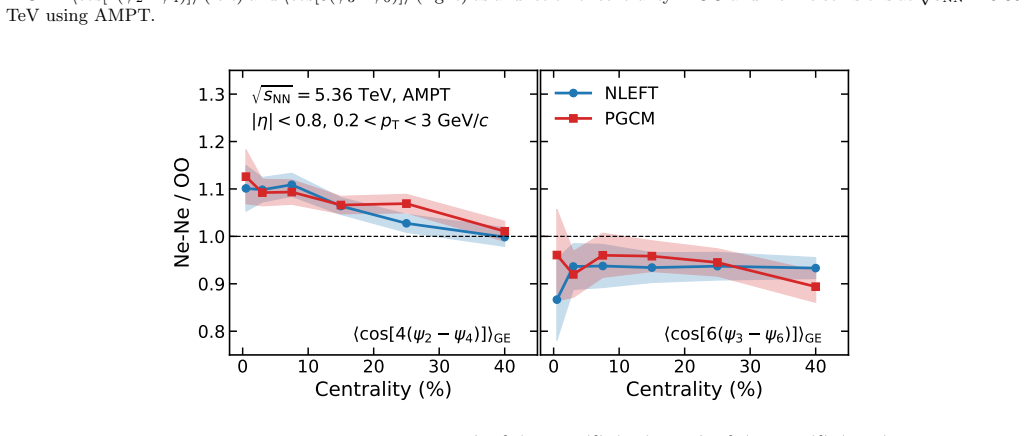
Ne-Ne collisions exhibit larger ⟨cos[4(ψ₂ - ψ₄)]⟩_GE values than OO collisions, whereas ⟨cos[6(ψ₃ - ψ₆)]⟩_GE is larger in OO than in Ne-Ne collisions. This behavior is obtained when nuclear geometries from Nuclear Lattice Effective Field Theory and Projected Generator Coordinate Method are used as input to the AMPT model. Events selected in tip-tip and body-body configurations further support the same ordering. The pattern is taken to indicate a strongly deformed shape of the ²⁰Ne nucleus and a tetrahedral structure of the ¹⁶O nucleus.
What carries the argument
Participant-plane correlations generated by the nuclear overlap geometries of ¹⁶O and ²⁰Ne, read out through the generalized-event symmetry-plane correlators ⟨cos[4(ψ₂ - ψ₄)]⟩_GE and ⟨cos[6(ψ₃ - ψ₆)]⟩_GE.
Load-bearing premise
The measured differences in the two symmetry-plane correlators are driven primarily by the input nuclear geometries rather than by model-specific dynamics or medium response in AMPT.
What would settle it
Experimental measurements of the two SPC observables in real OO and Ne-Ne collisions at the LHC that show the opposite ordering or no significant difference between the two systems would falsify the geometry-driven interpretation.
Figures



read the original abstract
Symmetry-plane correlations (SPCs) are key observables sensitive to the medium's transport properties and are driven by participant-plane correlations (PPCs) in the nuclear overlap region. This study explores the possibility of nuclear-geometry-driven SPCs in Oxygen--Oxygen (OO) and Neon--Neon (Ne--Ne) collisions at $\sqrt{s_{\rm NN}}=5.36$ TeV using nuclear geometry simulations based on Nuclear Lattice Effective Field Theory (NLEFT) and Projected Generator Coordinate Method (PGCM) configurations. We investigate $\langle \cos[4(\psi_2 - \psi_4)]\rangle_{\rm GE}$ and $\langle \cos[6(\psi_3 - \psi_6)]\rangle_{\rm GE}$ in OO and Ne--Ne collisions at $\sqrt{s_{\rm NN}}=5.36$ TeV using the A Multi-Phase Transport (AMPT) model. We find that Ne--Ne collisions exhibit larger $\langle \cos[4(\psi_2 - \psi_4)]\rangle_{\rm GE}$ values than OO collisions, whereas $\langle \cos[6(\psi_3 - \psi_6)]\rangle_{\rm GE}$ is larger in OO than in Ne--Ne collisions. This behavior indicates a strongly deformed shape of the $^{20}$Ne nucleus and a tetrahedral structure of the $^{16}$O nucleus. We also explore SPCs for events with tip-tip and body-body collision configurations, which further support these findings.
Editorial analysis
A structured set of objections, weighed in public.
Referee Report
Summary. The manuscript investigates symmetry plane correlations (SPCs) in OO and Ne-Ne collisions at √s_NN=5.36 TeV by combining nuclear geometries from Nuclear Lattice Effective Field Theory (NLEFT) and Projected Generator Coordinate Method (PGCM) with the AMPT transport model. It reports larger ⟨cos[4(ψ₂ - ψ₄)]⟩_GE in Ne-Ne than OO collisions and the reverse ordering for ⟨cos[6(ψ₃ - ψ₆)]⟩_GE, interpreting these differences as direct signatures of strong deformation in ²⁰Ne and tetrahedral structure in ¹⁶O. Tip-tip and body-body orientation selections are used to further support the geometry-driven interpretation.
Significance. If the central claim is robust, the work would establish SPCs as a practical probe of nuclear shapes in small systems at the LHC, linking ab initio nuclear structure inputs to final-state observables. The adoption of NLEFT/PGCM configurations is a clear strength, providing a more microscopic foundation than simpler models. This could open avenues for collider-based nuclear structure studies, though the significance hinges on demonstrating that the reported orderings are not artifacts of the chosen transport dynamics.
major comments (2)
- [Abstract] Abstract: The claim that the SPC orderings 'indicate a strongly deformed shape of the ²⁰Ne nucleus and a tetrahedral structure of the ¹⁶O nucleus' is load-bearing for the paper's conclusion. This attribution assumes the differences arise primarily from the input geometries rather than AMPT-specific features (parton scattering, coalescence, resonance decays, or final-state rescattering). No parameter variations in AMPT, no comparisons to hydrodynamic evolution, and no quantitative assessment of signal preservation are described, leaving the model fidelity unverified.
- [Tip-tip and body-body analysis] Tip-tip and body-body analysis: The orientation-selected results test intra-system effects but remain entirely within the AMPT framework. They therefore do not isolate nuclear geometry from transport-model response and cannot rule out the possibility that the inter-system ordering (Ne-Ne vs. OO) could be generated by AMPT dynamics even for identical initial geometries.
minor comments (2)
- [Abstract] Abstract: Simulation outputs are presented without error bars, statistical uncertainties, or baseline comparisons, which prevents quantitative evaluation of the reported differences.
- [Notation] Notation: The subscript GE on the averaged SPCs is used without an explicit definition in the provided summary; clarifying whether it denotes a specific event class or averaging procedure would improve readability.
Simulated Author's Rebuttal
We thank the referee for the careful review and constructive feedback on our manuscript. We address the major comments point by point below, acknowledging the model-dependence concerns while defending the geometric interpretation based on the distinct patterns and ab initio inputs. We propose targeted revisions to temper claims and add caveats.
read point-by-point responses
-
Referee: [Abstract] Abstract: The claim that the SPC orderings 'indicate a strongly deformed shape of the ²⁰Ne nucleus and a tetrahedral structure of the ¹⁶O nucleus' is load-bearing for the paper's conclusion. This attribution assumes the differences arise primarily from the input geometries rather than AMPT-specific features (parton scattering, coalescence, resonance decays, or final-state rescattering). No parameter variations in AMPT, no comparisons to hydrodynamic evolution, and no quantitative assessment of signal preservation are described, leaving the model fidelity unverified.
Authors: We acknowledge that the manuscript relies on a single transport model (AMPT) without parameter scans or hydrodynamic comparisons, so the attribution to nuclear geometry is not fully model-independent. However, the observed reversal in SPC ordering between the two systems—larger ⟨cos[4(ψ₂ - ψ₄)]⟩_GE in Ne-Ne and larger ⟨cos[6(ψ₃ - ψ₆)]⟩_GE in OO—matches the qualitative expectations from the distinct ab initio geometries (deformed ²⁰Ne vs. tetrahedral ¹⁶O) provided by NLEFT/PGCM. The same AMPT settings are applied to both collision systems, isolating the effect to the initial nuclear configurations. We will revise the abstract to replace 'indicate' with 'suggest' and add a dedicated paragraph in the discussion section on model assumptions, the lack of parameter variations, and the value of future cross-checks with hydrodynamics. This makes the claims appropriately cautious without altering the core results. revision: partial
-
Referee: [Tip-tip and body-body analysis] Tip-tip and body-body analysis: The orientation-selected results test intra-system effects but remain entirely within the AMPT framework. They therefore do not isolate nuclear geometry from transport-model response and cannot rule out the possibility that the inter-system ordering (Ne-Ne vs. OO) could be generated by AMPT dynamics even for identical initial geometries.
Authors: We agree that the tip-tip and body-body selections are performed within AMPT and do not provide a complete decoupling of geometry from transport dynamics. Nevertheless, because identical AMPT parameters are used for both OO and Ne-Ne, any inter-system difference in SPC ordering must originate from the differing input nuclear geometries. The orientation-dependent variations within each system further demonstrate that the SPCs respond to the collision geometry in a manner consistent with the nuclear shapes. We will add a clarifying sentence in the conclusions noting the framework dependence and recommending future studies with alternative models or identical-geometry tests. We do not intend to generate artificial identical geometries for cross-system comparison, as this would deviate from the ab initio approach central to the work. revision: partial
Circularity Check
No significant circularity; derivation uses external nuclear geometries and transport model without reduction to inputs
full rationale
The paper inputs nuclear configurations from NLEFT and PGCM into the AMPT model, computes SPC observables, and reports differences between OO and Ne-Ne systems. These differences are interpreted as supporting the input geometries (deformed 20Ne, tetrahedral 16O), but the chain is a forward simulation rather than a fit or self-definition. No parameters are tuned to the target SPC values, no equations reduce by construction to the inputs, and no self-citation chain carries the central claim. The analysis remains self-contained against the external benchmarks of the nuclear-structure models and AMPT; any concern about geometry vs. medium-response dominance is a question of model validation, not circularity.
Axiom & Free-Parameter Ledger
axioms (2)
- domain assumption NLEFT and PGCM nuclear configurations accurately represent the ground-state geometries of 16O and 20Ne.
- domain assumption AMPT evolution preserves the participant-plane correlations sufficiently to allow geometry-driven SPCs to be observed.
Reference graph
Works this paper leans on
-
[1]
The correlator⟨cos[4(ψ 2 −ψ4)]⟩GE is strongly sensi- tive to the quadrupole-deformed (“pinball”) struc- ture of 20Ne
-
[2]
The large quadrupole deformation of 20Ne leads to an enhanced⟨cos[4(ψ 2 −ψ 4)]⟩GE in central Ne–Ne collisions relative to OO collisions
-
[3]
Indian partic- ipation in the ALICE experiment at CERN
The correlator⟨cos[6(ψ 3 −ψ 6)]⟩GE is larger in OO than in Ne–Ne collisions, reflecting its sensitivity to the intrinsic triangular symmetry of 16O. 4.⟨cos[4(ψ 2 −ψ 4)]⟩GE exhibits a clear dependence on the collision geometry (tip–tip versus body–body), whereas⟨cos[6(ψ 3 −ψ 6)]⟩GE shows no significant dependence within uncertainties. These results establi...
2025
-
[4]
Heinz and R
U. Heinz and R. Snellings, Ann. Rev. Nucl. Part. Sci.63, 151 (2013)
2013
-
[5]
J. Y. Ollitrault, Phys. Rev. D46, 229 (1992)
1992
-
[6]
Voloshin and Y
S. Voloshin and Y. Zhang, Z. Phys. C70, 665 (1996)
1996
-
[7]
R. S. Bhalerao, M. Luzum and J. Y. Ollitrault, Phys. Rev. C84, 034910 (2011)
2011
-
[8]
Prasad, A
S. Prasad, A. M. Kavumpadikkal Radhakrishnan, R. Sa- hoo and N. Mallick, Phys. Lett. B868, 139753 (2025)
2025
-
[9]
Prasad, N
S. Prasad, N. Mallick, S. Tripathy and R. Sahoo, Phys. Rev. D107, 074011 (2023)
2023
-
[10]
Giacalone, J
G. Giacalone, J. Jia and C. Zhang, Phys. Rev. Lett.127, 242301 (2021)
2021
-
[11]
Behera, S
D. Behera, S. Prasad, N. Mallick and R. Sahoo, Phys. Rev. D108, 054022 (2023)
2023
-
[12]
Acharyaet al.(ALICE Collaboration), Eur
S. Acharyaet al.(ALICE Collaboration), Eur. Phys. J. C84, 813 (2024)
2024
-
[13]
J. E. Parkkila, A. Onnerstad and D. J. Kim, Phys. Rev. C104, 054904 (2021)
2021
-
[14]
J. E. Parkkila, A. Onnerstad, S. F. Taghavi, C. Mor- dasini, A. Bilandzic, M. Virta and D. J. Kim, Phys. Lett. B835, 137485 (2022)
2022
-
[15]
Prasad, S
S. Prasad, S. Tripathy, B. Sahoo and R. Sahoo, Physics Reports1181(2026) 1–75
2026
-
[16]
X. Wu, X. Li, Z. Tang, P. Wang and W. Zha, Phys. Rev. Res.4, L042048 (2022)
2022
-
[17]
Barretteet al.(E877 Collaboration), Phys
J. Barretteet al.(E877 Collaboration), Phys. Rev. C55, 1420 (1997) [erratum: Phys. Rev. C56, 2336 (1997)]
1997
-
[18]
Bilandzic, M
A. Bilandzic, M. Lesch and S. F. Taghavi, Phys. Rev. C 102, 024910 (2020)
2020
-
[19]
Acharyaet al.(ALICE Collaboration), Eur
S. Acharyaet al.(ALICE Collaboration), Eur. Phys. J. C83, 576 (2023)
2023
-
[20]
Adamset al.(STAR Collaboration), Nucl
J. Adamset al.(STAR Collaboration), Nucl. Phys. A 757, 102 (2005)
2005
-
[21]
Aadet al.(ATLAS Collaboration), Phys
G. Aadet al.(ATLAS Collaboration), Phys. Rev. C90, 024905 (2014)
2014
- [22]
-
[23]
Citron, A
Z. Citron, A. Dainese, J. F. Grosse-Oetringhaus, and J. M. Jowett,et al.CERN Yellow Rep. Monogr.7, 1159 (2019)
2019
-
[24]
Gamow, Nature 130, 648 (1932)
G. Gamow, Nature 130, 648 (1932)
1932
-
[25]
J. A. Wheeler, Phys. Rev.52, 1083 (1937)
1937
-
[26]
Lombardo, L
I. Lombardo, L. Redigolo, D. Dell’Aquila, and M. Vigi- lante,et al.Nucl. Phys. A1060, 123115 (2025)
2025
- [27]
-
[28]
Behera, N
D. Behera, N. Mallick, S. Tripathy, S. Prasad, A. N. Mishra and R. Sahoo, Eur. Phys. J. A58, 175 (2022)
2022
-
[29]
Menon Kavumpadikkal Radhakrishnan, S
A. Menon Kavumpadikkal Radhakrishnan, S. Prasad, N. Mallick, R. Sahoo and G. G. Barnaf¨ oldi, Phys. Lett. B870, 139941 (2025)
2025
-
[30]
Prasad, N
S. Prasad, N. Mallick, R. Sahoo and G. G. Barnaf¨ oldi, Phys. Lett. B860, 139145 (2025)
2025
-
[31]
Y. A. Li, S. Zhang and Y. G. Ma, Phys. Rev. C102, 054907 (2020)
2020
-
[32]
Bozek, W
P. Bozek, W. Broniowski, E. Ruiz Arriola and M. Ry- bczynski, Phys. Rev. C90, 064902 (2014)
2014
-
[33]
Broniowski and E
W. Broniowski and E. Ruiz Arriola, Phys. Rev. Lett. 112, 112501 (2014)
2014
-
[34]
Behera, S
D. Behera, S. Deb, C. R. Singh and R. Sahoo, Phys. Rev. C109, 014902 (2024). 7
2024
-
[35]
C. Ding, L. G. Pang, S. Zhang and Y. G. Ma, Chin. Phys. C47, 024105 (2023)
2023
-
[36]
Y. Z. Wang, S. Zhang and Y. G. Ma, Phys. Lett. B831, 137198 (2022)
2022
-
[37]
Rybczy´ nski, M
M. Rybczy´ nski, M. Piotrowska and W. Broniowski, Phys. Rev. C97, 034912 (2018)
2018
-
[38]
Svetlichnyi, S
A. Svetlichnyi, S. Savenkov, R. Nepeivoda and I. Pshenichnov, MDPI Physics5, 381 (2023)
2023
-
[39]
Giacalone, W
G. Giacalone, W. Zhao, B. Bally, and S. Shen,et al.Phys. Rev. Lett.134, 082301 (2025)
2025
-
[40]
Zhang, J
C. Zhang, J. Chen, G. Giacalone, S. Huang, J. Jia and Y. G. Ma, Phys. Lett. B862, 139322 (2025)
2025
-
[41]
Menon Kavumpadikkal Radhakrishnan, S
A. Menon Kavumpadikkal Radhakrishnan, S. Prasad, N. Mallick and R. Sahoo, Eur. Phys. J. A61, 134 (2025)
2025
-
[42]
G. Aadet al.(ATLAS Collaboration), arXiv:2509.05171
work page internal anchor Pith review Pith/arXiv arXiv
-
[43]
A. Hayrapetyanet al.(CMS Collaboration), arXiv:2510.02580
-
[44]
Tripathy, S
S. Tripathy, S. Prasad and R. Sahoo, Phys. Rev. D112, 114012 (2025)
2025
-
[45]
Frosini, T
M. Frosini, T. Duguet, J. P. Ebran and V. Som` a, Eur. Phys. J. A58, 62 (2022)
2022
-
[46]
Frosini, T
M. Frosini, T. Duguet, J. P. Ebran, B. Bally, T. Mongelli, T. R. Rodr´ ıguez, R. Roth and V. Som` a, Eur. Phys. J. A 58, 63 (2022)
2022
-
[47]
T. A. L¨ ahde and U. G. Meißner, Lect. Notes Phys.957, 1 (2019)
2019
-
[48]
Lee, Front
D. Lee, Front. in Phys.8, 174 (2020)
2020
-
[49]
Loizides, Phys
C. Loizides, Phys. Rev. C113, 1 (2026)
2026
-
[50]
Giacalone, B
G. Giacalone, B. Bally, G. Nijs, and S. Shen,et al.Phys. Rev. Lett.135, 012302 (2025)
2025
-
[51]
Z. W. Lin, C. M. Ko, B. A. Li, B. Zhang and S. Pal, Phys. Rev. C72, 064901 (2005)
2005
-
[52]
Zhang, C
B. Zhang, C. M. Ko, B. A. Li and Z. w. Lin, Phys. Rev. C61, 067901 (2000)
2000
-
[53]
X. N. Wang and M. Gyulassy, Phys. Rev. D44, 3501 (1991)
1991
-
[54]
Zhang, Comput
B. Zhang, Comput. Phys. Commun.109, 193 (1998)
1998
-
[55]
Andersson, G
B. Andersson, G. Gustafson, G. Ingelman and T. Sjos- trand, Phys. Rept.97, 31 (1983)
1983
-
[56]
Greco, C
V. Greco, C. M. Ko and P. Levai, Phys. Rev. Lett.90, 202302 (2003)
2003
-
[57]
B. A. Li and C. M. Ko, Phys. Rev. C52, 2037 (1995)
2037
-
[58]
B. Li, A. T. Sustich, B. Zhang and C. M. Ko, Int. J. Mod. Phys. E10, 267 (2001)
2001
-
[59]
Adleret al.(STAR Collaboration), Phys
C. Adleret al.(STAR Collaboration), Phys. Rev. C66, 034904 (2002)
2002
-
[60]
Aadet al.(ATLAS Collaboration), Phys
G. Aadet al.(ATLAS Collaboration), Phys. Rev. C92, 034903 (2015)
2015
-
[61]
Teaney and L
D. Teaney and L. Yan, Phys. Rev. C90, 024902 (2014)
2014
-
[62]
F. G. Gardim, F. Grassi, M. Luzum and J. Y. Ollitrault, Phys. Rev. C85, 024908 (2012)
2012
discussion (0)
Sign in with ORCID, Apple, or X to comment. Anyone can read and Pith papers without signing in.