Recognition: unknown
Separation of even-even from even-odd isotopes using ultrafast lasers
Pith reviewed 2026-05-09 14:54 UTC · model grok-4.3
The pith
A Ramsey sequence with ultrafast lasers traps population in excited states only for isotopes with nonzero nuclear spin.
A machine-rendered reading of the paper's core claim, the machinery that carries it, and where it could break.
Core claim
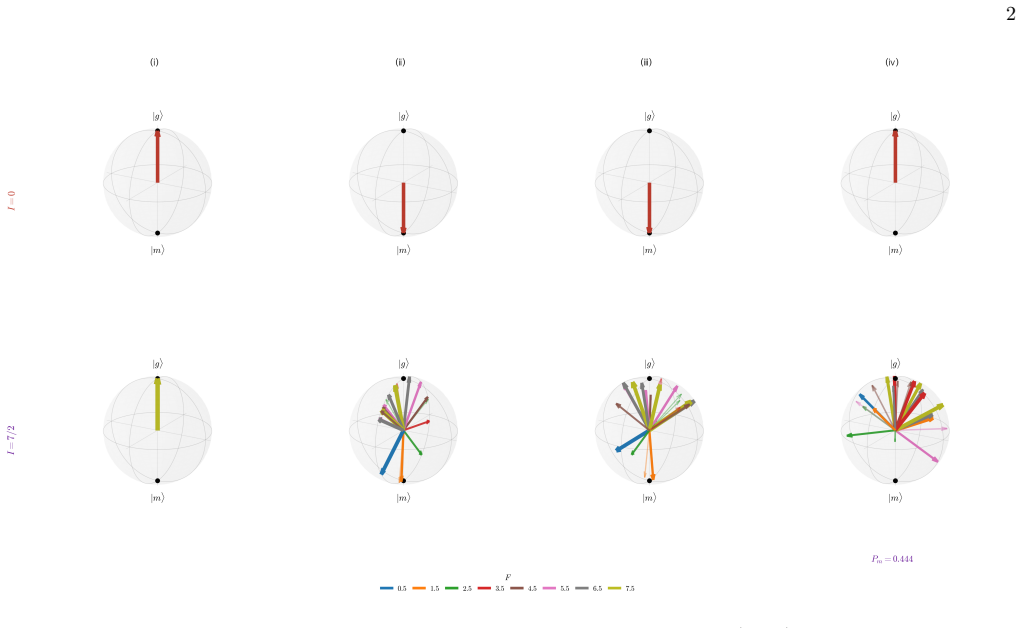
For even-even isotopologues with nuclear spin I equal to zero, the time-reversed Ramsey sequence returns the entire population to the ground state. For even-odd isotopologues with I greater than zero, the hyperfine interaction splits the levels such that the dark-time evolution prevents the echo, leaving a fraction Pm trapped in the excited manifold. In the impulsive limit where the Rabi frequency greatly exceeds the hyperfine constant, Pm is fixed by the quantum numbers Jg, Jm, and I alone, yielding values between 0.23 and 0.47, which under collisional conditions permits over 90 percent single-pass enrichment.
What carries the argument
The hyperfine-induced population trapping during the dark interval of the Ramsey sequence, where incommensurate phase evolutions for I greater than zero prevent complete return to the ground state.
If this is right
- Population trapping occurs independently of laser intensity and bandwidth in the impulsive limit.
- Single-pass enrichment exceeding 90 percent is achievable from natural feed without cascading.
- Density matrix simulations confirm the effect for systems including uranium-235, strontium-87, and iron-57.
- The mechanism works across representative paramagnetic molecular isotopologues with the required electronic structure.
Where Pith is reading between the lines
- If validated, the approach could extend isotope separation to cases where conventional isotope shifts are too small to exploit.
- Measuring the actual trapped fraction in a laboratory setting for a known even-odd isotope would directly test the angular-momentum dependence.
- The spin-based selectivity might be combined with other laser or physical separation steps to reach higher purity in fewer stages.
Load-bearing premise
Suitable paramagnetic molecular isotopologues exist that have two electronic states coupled by a strong dipole transition and that collisional relaxation preserves the hyperfine trapping long enough for separation.
What would settle it
If applying the Ramsey sequence to an even-even isotopologue results in any measurable population remaining in the excited manifold after the sequence, or if the trapped fraction for an even-odd isotopologue deviates significantly from the angular-momentum-only prediction, the mechanism would be falsified.
Figures

read the original abstract
We propose a laser isotope separation mechanism in which selectivity arises from nuclear spin rather than isotope shifts, enabling the use of broadband ultrafast lasers. A Ramsey pulse sequence is applied to paramagnetic molecular isotopologues possessing two electronic states coupled by a dipole transition. For even-even isotopologues (nuclear spin $I = 0$), each electronic state is a single level and the time-reversed sequence returns all population to the ground state exactly. For even-odd isotopologues ($I > 0$), the hyperfine interaction splits each state into multiple levels with coupling amplitudes set by Wigner $6j$ symbols; incommensurate phase evolution during the dark interval prevents the echo from closing, trapping a fraction $P_m$ of the population in the excited manifold. In the impulsive limit ($\Omega \gg A_{\rm HF}$), $P_m$ depends only on the angular momentum quantum numbers $(J_g, J_m, I)$ and is independent of laser intensity or bandwidth. Density matrix simulations confirm $P_m = 0$ for $I = 0$ and $P_m \approx 0.23$-$0.47$ for $I > 0$ across representative systems including ${}^{235}$U, ${}^{87}$Sr, and ${}^{57}$Fe. Under realistic collisional conditions, single-pass enrichment exceeding 90% from natural feed is achievable without cascading.
Editorial analysis
A structured set of objections, weighed in public.
Referee Report
Summary. The paper proposes a laser-based isotope separation scheme using a Ramsey pulse sequence on paramagnetic molecular isotopologues. Selectivity arises from nuclear spin: for even-even species (I=0) the time-reversed sequence returns all population to the ground state, while for even-odd species (I>0) hyperfine splitting and incommensurate phase evolution during the dark interval trap a fraction Pm in the excited manifold. In the impulsive limit (Ω ≫ A_HF) Pm is determined solely by the angular-momentum quantum numbers (Jg, Jm, I) via Wigner 6j symbols and is independent of laser intensity or bandwidth. Density-matrix simulations are cited to give Pm=0 for I=0 and Pm≈0.23–0.47 for I>0, supporting a claim of >90% single-pass enrichment from natural abundance under realistic collisional conditions without cascading.
Significance. If the central claims are substantiated, the work offers a conceptually new route to isotope separation that exploits nuclear spin rather than isotope shifts, thereby permitting broadband ultrafast lasers. The derivation of Pm from angular-momentum algebra alone, without fitted parameters, and the use of density-matrix simulations to quantify the trapping probabilities constitute clear strengths. Should suitable molecular systems be identified and the impulsive-limit and collisional assumptions validated, the approach could simplify separation of isotopes that are difficult to address by conventional methods, with possible relevance to nuclear and medical applications.
major comments (2)
- [Abstract and simulation section] Abstract and simulation discussion: the specific numerical range Pm≈0.23–0.47 and the assertion of independence from intensity/bandwidth rest on density-matrix simulations, yet no parameters (Rabi frequencies, hyperfine constants, basis truncation, integration time step, or collisional relaxation model) are supplied. This information is load-bearing for the 90% enrichment claim and for confirming that the impulsive-limit analytic result is realized under the stated conditions.
- [Theory section] Theory section on impulsive limit: the manuscript states that Pm depends only on (Jg, Jm, I) when Ω ≫ A_HF, but provides no quantitative comparison of Ω and A_HF for the cited representative systems (235U, 87Sr, 57Fe). Without explicit values demonstrating that the impulsive condition holds for realistic laser parameters, the parameter-free character of the result cannot be verified for the proposed experimental regime.
minor comments (2)
- [Abstract] The abstract refers to “representative systems including 235U, 87Sr, and 57Fe” but these are nuclei; the corresponding molecular isotopologues and their electronic states should be identified explicitly.
- [Theory section] Explicit expressions or references for the Wigner 6j symbols that determine the coupling amplitudes between hyperfine levels would aid reproducibility of the Pm calculation.
Simulated Author's Rebuttal
We thank the referee for the positive evaluation of the conceptual novelty and for the constructive comments that will improve the clarity and reproducibility of the manuscript. We address each major comment below.
read point-by-point responses
-
Referee: [Abstract and simulation section] Abstract and simulation discussion: the specific numerical range Pm≈0.23–0.47 and the assertion of independence from intensity/bandwidth rest on density-matrix simulations, yet no parameters (Rabi frequencies, hyperfine constants, basis truncation, integration time step, or collisional relaxation model) are supplied. This information is load-bearing for the 90% enrichment claim and for confirming that the impulsive-limit analytic result is realized under the stated conditions.
Authors: We agree that the simulation parameters must be reported for reproducibility and to substantiate the quantitative claims. In the revised manuscript we will add a dedicated subsection (or appendix) that specifies the Rabi frequencies Ω employed, the hyperfine constants A_HF for each representative system, the basis truncation (full hyperfine manifold for the relevant J values), the numerical integrator and time step, and the phenomenological collisional relaxation model (including dephasing and population-transfer rates). These additions will allow direct verification that the reported Pm range is obtained in the impulsive limit and under the stated collisional conditions. revision: yes
-
Referee: [Theory section] Theory section on impulsive limit: the manuscript states that Pm depends only on (Jg, Jm, I) when Ω ≫ A_HF, but provides no quantitative comparison of Ω and A_HF for the cited representative systems (235U, 87Sr, 57Fe). Without explicit values demonstrating that the impulsive condition holds for realistic laser parameters, the parameter-free character of the result cannot be verified for the proposed experimental regime.
Authors: We acknowledge that an explicit numerical check of the impulsive-limit condition is required. In the revised manuscript we will insert a table (or paragraph) giving literature or calculated A_HF values for the relevant molecular states of 235U, 87Sr, and 57Fe, together with the Ω values corresponding to the ultrafast pulses used in the simulations. We will show that the ratio Ω/A_HF exceeds 100 for the chosen parameters, thereby confirming that Pm is determined solely by the angular-momentum algebra and is independent of intensity and bandwidth in the proposed regime. revision: yes
Circularity Check
No significant circularity in the derivation chain
full rationale
The paper's central claim—that Pm vanishes for I=0 and takes a value set solely by (Jg, Jm, I) in the impulsive limit—follows directly from the time-evolution operators of the Ramsey sequence plus hyperfine precession, with amplitudes from standard Wigner 6j symbols. Density-matrix integration confirms the expected numerical range without any parameter fitting to enrichment targets or isotope-specific data. No self-citations, self-definitional loops, fitted inputs renamed as predictions, or ansatzes imported via prior work appear in the derivation. The result is a straightforward consequence of angular-momentum algebra applied to the stated physical model and is externally verifiable by independent simulation.
Axiom & Free-Parameter Ledger
axioms (2)
- standard math Hyperfine interaction splits electronic states into multiple levels with coupling amplitudes given by Wigner 6j symbols.
- domain assumption The molecular isotopologues possess two electronic states coupled by a dipole transition.
Reference graph
Works this paper leans on
-
[1]
Atomic vapor laser isotope separation,
J. A. Paisner, “Atomic vapor laser isotope separation,” Appl. Phys. B46, 253–260 (1988)
1988
-
[2]
Sep- arating isotopes with lasers,
R. J. Jensen, O. P. Judd, and J. A. Sullivan, “Sep- arating isotopes with lasers,”Los Alamos Sci.3, 2– 33 (1982),https://permalink.lanl.gov/object/tr? what=info:lanl-repo/lareport/LA-UR-82-5176
1982
-
[3]
A proliferation assessment of third gener- ation laser uranium enrichment technology,
R. S. Snyder, “A proliferation assessment of third gener- ation laser uranium enrichment technology,”Sci. Global Secur.24, 68–91 (2016)
2016
-
[4]
Separation of isotopes by laser-assisted retardation of condensation (SILARC),
J. W. Eerkens, “Separation of isotopes by laser-assisted retardation of condensation (SILARC),”Laser Part. Beams16, 295–316 (1998)
1998
-
[5]
A molecular beam resonance method with separated oscillating fields,
N. F. Ramsey, “A molecular beam resonance method with separated oscillating fields,”Phys. Rev.78, 695– 699 (1950)
1950
-
[6]
Atomic fountain clocks,
R. Wynands and S. Weyers, “Atomic fountain clocks,” Metrologia42, S64–S79 (2005)
2005
-
[7]
QuTiP: An open-source Python framework for the dynamics of open quantum systems,
J. R. Johansson, P. D. Nation, and F. Nori, “QuTiP: An open-source Python framework for the dynamics of open quantum systems,”Comput. Phys. Commun.183, 1760–1772 (2012)
2012
-
[8]
Long-lived electronic coherences in molecules,
B. Kaufman, P. Marquetand, T. Rozgonyi, and T. Weinacht, “Long-lived electronic coherences in molecules,”Phys. Rev. Lett.131, 263202 (2023)
2023
-
[9]
Long-lived electronic coher- ences from first principles,
J. Suchan and B. G. Levine, “Long-lived electronic coher- ences from first principles,”Chem. Phys. Rev.6, 031401 (2025)
2025
-
[10]
Quantum decoherence in mixed quantum-classical systems: Nonadiabatic pro- cesses,
E. R. Bittner and P. J. Rossky, “Quantum decoherence in mixed quantum-classical systems: Nonadiabatic pro- cesses,”J. Chem. Phys.103, 8130–8143 (1995)
1995
-
[11]
Ul- trafast 550-W average-power thin-disk laser oscillator,
M. Seidel, L. Lang, C. R. Phillips, and U. Keller, “Ul- trafast 550-W average-power thin-disk laser oscillator,” Optica11, 1368–1375 (2024)
2024
-
[12]
Dietz, M
T. Dietz, M. Jenne, D. Bauer, M. Scharun, D. Sutter, and A. Killi, “Ultrafast thin-disk multi-pass amplifier system providing 1.9 kW of average output power and pulse energies in the 10 mJ range at 1 ps of pulse du- ration for glass-cleaving applications,”Opt. Express28, 11415–11423 (2020)
2020
-
[13]
10.4 kW coherently combined ultrafast fiber laser,
M. M¨ ulleret al., “10.4 kW coherently combined ultrafast fiber laser,”Opt. Lett.45, 3083–3086 (2020)
2020
-
[14]
Seven-octave high-brightness and carrier-envelope-phase-stable light source,
U. Elu, L. Maidment, L. Vamos, F. Tani, D. Novoa, M. H. Frosz, V. Badikov, D. Badikov, V. Petrov, P. St. J. Russell, and J. Biegert, “Seven-octave high-brightness and carrier-envelope-phase-stable light source,”Nat. Photon.15, 277–280 (2021)
2021
-
[15]
100-W average-power femtosecond laser at 343 nm,
J. Rothhardtet al., “100-W average-power femtosecond laser at 343 nm,”Opt. Lett.41, 1885–1888 (2016)
2016
discussion (0)
Sign in with ORCID, Apple, or X to comment. Anyone can read and Pith papers without signing in.