Recognition: unknown
Merge and Strip II: Imprint of galaxy formation physics and viscosity on baryon-dominated dwarf galaxies
Pith reviewed 2026-05-09 18:46 UTC · model grok-4.3
The pith
Galaxy merger stripping produces long-lived tidal dwarf galaxies across all cluster viscosities when stellar feedback stays moderate
A machine-rendered reading of the paper's core claim, the machinery that carries it, and where it could break.
Core claim
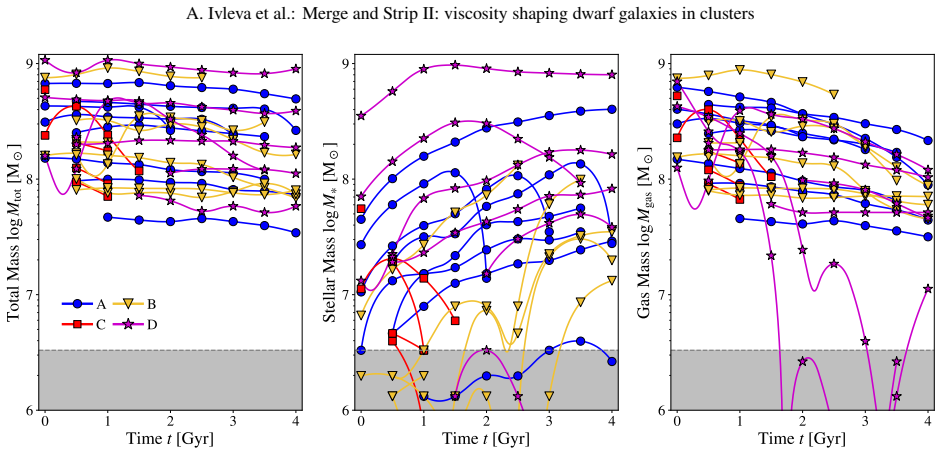
Long-lived tidal dwarf galaxies can form throughout all viscosity values applicable to galaxy clusters if stellar feedback is moderate. The smallest clouds have gas masses on the order of 10^7 solar masses and reach final drift velocities of about 100 km/s, with Reynolds numbers as low as 1 under full Spitzer viscosity. Almost all display elevated yet stable star formation rates of 0.01-0.1 solar masses per year across several Gyr. These properties indicate that blue candidates observed in the Virgo cluster are likely stripped tidal dwarfs, while similar matches imply that a subsample of dark galaxies and baryon-dominated ultra-diffuse galaxies are also long-lived tidal dwarfs. Stripping in
What carries the argument
Hydrodynamic simulations of galaxy mergers inside cluster environments that vary viscosity prescriptions and stellar feedback levels to track the entrainment and long-term survival of stripped gas clouds against drag and fluid instabilities
If this is right
- Long-lived tidal dwarf galaxies form across every viscosity regime relevant to galaxy clusters when stellar feedback remains moderate.
- Blue candidates observed in the Virgo cluster match the properties of stripped tidal dwarf galaxies and are likely produced this way.
- A subsample of dark galaxies and baryon-dominated ultra-diffuse galaxies in clusters are also long-lived tidal dwarf galaxies formed by stripping.
- Stripping during galaxy mergers supplies a viable channel for creating stable cold gas clouds and dark-matter-deficient galaxies inside clusters.
- The formed tidal dwarf galaxies maintain elevated star formation rates of 0.01 to 0.1 solar masses per year that remain steady over several billion years.
Where Pith is reading between the lines
- Viscosity in the intracluster medium may not destroy small stripped clouds as effectively as earlier cloud-crushing studies suggested.
- Kinematic measurements or detailed star-formation histories of these dwarfs could distinguish merger-stripped origins from other formation routes.
- The number of such objects in a cluster should scale with the local rate of galaxy mergers rather than with exotic dark-matter or feedback physics.
- This channel offers a standard dynamical explanation for dark-matter-free galaxies without requiring new particle physics or modified gravity.
Load-bearing premise
The chosen viscosity values and stellar feedback prescriptions in the simulations correctly represent real intracluster medium conditions, and the resulting tidal dwarf galaxy properties match observed objects closely enough to identify them as the same populations.
What would settle it
Finding that blue candidates or similar objects in clusters contain substantial dark matter or show star formation histories inconsistent with the simulated rates and stability would rule out the stripped tidal dwarf interpretation.
Figures



read the original abstract
Motivated by the discovery of peculiar dwarf galaxies inside galaxy clusters such as blue candidates (BCs), dark galaxies and ultra-diffuse galaxies (UDGs), we present hydrodynamic simulations of galaxy mergers in cluster environments. We vary the viscosity and stellar feedback prescriptions, realistically modelling possible conditions for hydrodynamic drag and fluid instabilities, as well as internal destabilization through stellar feedback-driven heating and gas loss. We find that long-lived tidal dwarf galaxies (TDGs) can form throughout all viscosity values applicable to galaxy clusters if stellar feedback is moderate. Our results expand on studies of cloud crushing simulations, investigating the entrainment problem in intracluster medium ambience. The smallest clouds have gas masses on the order of $M_\text{gas} \sim 10^7 \text{ M}_\odot$ and reach relatively low final drift velocities of $\sim 100 \text{ km/s}$. The lowest possible Reynolds number acting on this class of clouds is $Re \sim 1$ for full Spitzer viscosity. Almost all TDGs display elevated star formation rates of $0.01-0.1 \text{ M}_\odot / \text{yr}$, which are stable across several Gyr. Based on their matching properties, we support that BCs observed in the Virgo cluster are likely stripped TDGs. Similar features are also found in comparison with dark galaxies and baryon-dominated UDGs, implying that a subsample of these objects are also long-lived TDGs. This work provides robust evidence that stripping from galaxy mergers is a viable channel for the formation of stable cold gas clouds and dark matter-deficient galaxies observed in galaxy clusters.
Editorial analysis
A structured set of objections, weighed in public.
Referee Report
Summary. The paper reports hydrodynamic simulations of galaxy mergers in cluster-like environments, varying viscosity prescriptions (including Spitzer) and stellar feedback strength. It claims that long-lived tidal dwarf galaxies (TDGs) form across all cluster-applicable viscosities provided stellar feedback is moderate, producing objects with gas masses ~10^7 M_⊙, drift velocities ~100 km/s, Re~1, and stable SFRs of 0.01-0.1 M_⊙/yr over several Gyr. These properties are argued to match observed blue candidates in Virgo, dark galaxies, and baryon-dominated UDGs, positioning merger stripping as a viable channel for DM-deficient dwarfs in clusters.
Significance. If the longevity and stability results hold under realistic cluster conditions, the work supplies a concrete formation pathway for the observed population of gas-rich, DM-poor dwarfs inside clusters and extends cloud-crushing studies into the low-Re entrainment regime. The parameter survey over viscosity and feedback is a clear strength, as is the emphasis on sustained SFRs across Gyr timescales. The absence of quantitative error bars, convergence tests, or statistical comparison metrics in the abstract, however, leaves the strength of the observational identification provisional.
major comments (2)
- [Methods] Simulation setup (Methods section): the headline claim that TDGs remain bound and cold for several Gyr while drifting at ~100 km/s requires explicit demonstration that the computational domain includes a live cluster gravitational potential and orbital motion through a radially varying ICM density. Local-box setups with only static ICM drag (as implied by the Re~1 and cloud-mass statements) can artificially suppress tidal disruption and continuous ram-pressure stripping; without this global component the reported stability across viscosity values is not yet load-bearing for the cluster-formation scenario.
- [Results] Observational comparison (Results/Discussion): the identification of simulated TDGs with Virgo blue candidates, dark galaxies, and baryon-dominated UDGs rests on qualitative property matching. Quantitative metrics—e.g., distributions of size, velocity dispersion, and SFR with uncertainties, or Kolmogorov-Smirnov tests against observed samples—are needed to assess whether the overlap is statistically significant or could arise from the chosen feedback and viscosity parameters.
minor comments (2)
- [Abstract] Abstract: the statement 'long-lived TDGs can form throughout all viscosity values' should be qualified by the specific viscosity range explored and the moderate-feedback subset; the current phrasing risks implying universality.
- [Results] Notation: the Reynolds number Re~1 is quoted for the smallest clouds, but the exact length and velocity scales used in its definition (and whether it is evaluated at formation or at late times) should be stated explicitly in the text or a table.
Simulated Author's Rebuttal
We thank the referee for their constructive and detailed report. Their comments have identified key areas where the manuscript can be clarified and strengthened. We address each major comment below and outline the revisions we will make.
read point-by-point responses
-
Referee: [Methods] Simulation setup (Methods section): the headline claim that TDGs remain bound and cold for several Gyr while drifting at ~100 km/s requires explicit demonstration that the computational domain includes a live cluster gravitational potential and orbital motion through a radially varying ICM density. Local-box setups with only static ICM drag (as implied by the Re~1 and cloud-mass statements) can artificially suppress tidal disruption and continuous ram-pressure stripping; without this global component the reported stability across viscosity values is not yet load-bearing for the cluster-formation scenario.
Authors: We appreciate the referee drawing attention to the distinction between local and global setups. Our simulations use a local Cartesian domain with a uniform ICM flow chosen to represent conditions experienced by stripped material after a merger in a cluster environment; the reported drift velocities are relative to this flow. The cluster potential is not evolved as a live, radially varying global field. We acknowledge that this approximation omits continuous tidal forces and density gradients that could affect long-term survival. In the revised manuscript we will expand the Methods section to describe the setup explicitly, discuss its limitations relative to a full cluster simulation, and explain why the local model remains informative for the hydrodynamic stability and viscosity dependence we study. We will also note that global simulations are computationally expensive for the broad parameter survey performed here. revision: partial
-
Referee: [Results] Observational comparison (Results/Discussion): the identification of simulated TDGs with Virgo blue candidates, dark galaxies, and baryon-dominated UDGs rests on qualitative property matching. Quantitative metrics—e.g., distributions of size, velocity dispersion, and SFR with uncertainties, or Kolmogorov-Smirnov tests against observed samples—are needed to assess whether the overlap is statistically significant or could arise from the chosen feedback and viscosity parameters.
Authors: We agree that quantitative statistical comparisons would make the observational links more rigorous. The current text matches simulated properties (gas mass, drift speed, size, and SFR) to the ranges reported for the observed populations. In the revision we will add quantitative support: we will include distributions of the key simulated quantities with uncertainties from the simulation suite and, where suitable observational catalogs exist, perform Kolmogorov-Smirnov or similar tests to evaluate the significance of the overlap. These additions will appear in the Results and Discussion sections. revision: yes
Circularity Check
Forward hydrodynamic simulations with parameter sweeps; no results reduce to inputs by construction
full rationale
The paper runs new hydrodynamic merger simulations varying viscosity (including full Spitzer) and stellar feedback strength, then reports emergent outcomes such as TDG longevity, drift velocities ~100 km/s, Re~1, and SFRs 0.01-0.1 M⊙/yr. These are direct simulation outputs, not fitted parameters renamed as predictions. Observational comparisons to Virgo BCs, dark galaxies, and UDGs are qualitative matches rather than tuning steps. Any self-citations (e.g., to prior cloud-crushing or Merge-and-Strip I work) support methodology but are not load-bearing for the central claim that moderate feedback permits long-lived TDGs across cluster viscosities. The derivation chain remains independent of its own results.
Axiom & Free-Parameter Ledger
free parameters (2)
- viscosity prescriptions
- stellar feedback prescriptions
axioms (2)
- standard math Hydrodynamic equations and fluid instabilities govern gas stripping and entrainment in the intracluster medium
- domain assumption Stellar feedback drives gas heating and loss leading to internal destabilization
Reference graph
Works this paper leans on
-
[1]
Adams, E. A. K., Cannon, J. M., Rhode, K. L., et al. 2015, A&A, 580, A134
2015
-
[2]
2019, A&A, 625, A11 Al¯uzas,R.,Pittard,J.M.,Hartquist,T.W.,Falle,S.A.E.G.,&Langton,R.2012, MNRAS, 425, 2212
Afruni, A., Fraternali, F., & Pezzulli, G. 2019, A&A, 625, A11 Al¯uzas,R.,Pittard,J.M.,Hartquist,T.W.,Falle,S.A.E.G.,&Langton,R.2012, MNRAS, 425, 2212
2019
-
[3]
Balsara, D. S. 1995, Journal of Computational Physics, 121, 357
1995
-
[4]
Barnes, J. E. & Hernquist, L. 1992, Nature, 360, 715
1992
-
[5]
M., Murante, G., Arth, A., et al
Beck, A. M., Murante, G., Arth, A., et al. 2016, MNRAS, 455, 2110
2016
-
[6]
G., et al
Bellazzini, M., Magrini, L., Jones, M. G., et al. 2022, ApJ, 935, 50
2022
-
[7]
2015, ApJ, 800, L15
Bellazzini, M., Magrini, L., Mucciarelli, A., et al. 2015, ApJ, 800, L15
2015
-
[8]
Bezanson, J., Edelman, A., Karpinski, S., & Shah, V. B. 2017, SIAM Review, 59, 65 Bílek, M., Müller, O., Vudragović, A., & Taylor, R. 2020, A&A, 642, L10
2017
-
[9]
2023, A&A, 669, A73
Boselli, A., Fossati, M., Roediger, J., et al. 2023, A&A, 669, A73
2023
-
[10]
& Duc, P.-A
Bournaud, F. & Duc, P.-A. 2006, A&A, 456, 481 Brodie,J.P.,Romanowsky,A.J.,Strader,J.,&Forbes,D.A.2011,AJ,142,199 Brüggen, M. & Kaiser, C. R. 2001, MNRAS, 325, 676
2006
-
[11]
L., Forbes, D
Buzzo, M. L., Forbes, D. A., Romanowsky, A. J., et al. 2025, A&A, 695, A124
2025
-
[12]
M., Martinkus, C
Cannon, J. M., Martinkus, C. P., Leisman, L., et al. 2015, AJ, 149, 72
2015
-
[13]
& Dehnen, W
Cullen, L. & Dehnen, W. 2010, Monthly Notices of the Royal Astronomical Society, 408, 669–683 De Young, D. S. 2003, MNRAS, 343, 719
2010
-
[14]
& Aly, H
Dehnen, W. & Aly, H. 2012, MNRAS, 425, 1068
2012
-
[15]
G., Sand, D
Dey, S., Jones, M. G., Sand, D. J., et al. 2025, The Astrophysical Journal, 983, 2
2025
-
[16]
2008, New Journal of Physics, 10, 125006
Dolag, K., Reinecke, M., Gheller, C., & Imboden, S. 2008, New Journal of Physics, 10, 125006
2008
-
[17]
2005, MNRAS, 364, 753
Dolag, K., Vazza, F., Brunetti, G., & Tormen, G. 2005, MNRAS, 364, 753
2005
-
[18]
2013, MNRAS, 429, 3564
Donnert, J., Dolag, K., Brunetti, G., & Cassano, R. 2013, MNRAS, 429, 3564
2013
-
[19]
& Mirabel, I
Duc, P.-A. & Mirabel, I. F. 1998, A&A, 333, 813
1998
-
[20]
C., Sanders, J
Fabian, A. C., Sanders, J. S., Allen, S. W., et al. 2003, MNRAS, 344, L43 Ferré-Mateu, A., Gannon, J. S., Forbes, D. A., et al. 2023, MNRAS, 526, 4735
2003
-
[21]
A., Gannon, J., Iodice, E., et al
Forbes, D. A., Gannon, J., Iodice, E., et al. 2023, MNRAS, 525, L93
2023
-
[22]
Forbes, J. C. & Lin, D. N. C. 2019, AJ, 158, 124
2019
-
[23]
S., Ferré-Mateu, A., & Forbes, D
Gannon, J. S., Ferré-Mateu, A., & Forbes, D. A. 2026, arXiv e-prints, arXiv:2602.21875
-
[24]
S., Ferré-Mateu, A., Forbes, D
Gannon, J. S., Ferré-Mateu, A., Forbes, D. A., et al. 2024, MNRAS, 531, 1856
2024
-
[25]
M., Rhode, K
Gray, L. M., Rhode, K. L., Leisman, L., et al. 2023, AJ, 165, 197
2023
-
[26]
Gronke, M. & Oh, S. P. 2018, MNRAS, 480, L111
2018
-
[27]
Gronke, M. & Schneider, E. 2026, arXiv e-prints, arXiv:2601.16566 Grønnow, A., Tepper-García, T., Bland-Hawthorn, J., & Fraternali, F. 2022, MNRAS, 509, 5756
-
[28]
2020, Nature Astronomy, 4, 246
Guo, Q., Hu, H., Zheng, Z., et al. 2020, Nature Astronomy, 4, 246
2020
-
[29]
2020, ApJ, 892, 3
Hammer, F., Yang, Y., Arenou, F., et al. 2020, ApJ, 892, 3
2020
-
[30]
2019, A&A, 626, A47
Haslbauer, M., Dabringhausen, J., Kroupa, P., Javanmardi, B., & Banik, I. 2019, A&A, 626, A47
2019
-
[31]
M., & Fox, A
Heitsch, F., Marchal, A., Miville-Deschênes, M.-A., Shull, J. M., & Fox, A. J. 2022, MNRAS, 509, 4515
2022
-
[32]
& Putman, M
Heitsch, F. & Putman, M. E. 2009, ApJ, 698, 1485
2009
-
[33]
J., & Gronke, M
Hidalgo-Pineda, F., Farber, R. J., & Gronke, M. 2024, MNRAS, 527, 135
2024
-
[34]
Hunter, J. D. 2007, Computing in Science and Engineering, 9, 90
2007
-
[35]
M., Dolag, K., Koribalski, B
Ivleva, A., Böss, L. M., Dolag, K., Koribalski, B. S., & Khabibullin, I. 2026, A&A, 706, A80 Ivleva,A.,Remus,R.-S.,Valenzuela,L.M.,&Dolag,K.2024,A&A,687,A105
2026
-
[36]
G., Papastergis, E., Pandya, V., et al
Jones, M. G., Papastergis, E., Pandya, V., et al. 2018, A&A, 614, A21
2018
-
[37]
G., Sand, D
Jones, M. G., Sand, D. J., Bellazzini, M., et al. 2022b, ApJ, 935, 51 Józsa, G. I. G., Jarrett, T. H., Cluver, M. E., et al. 2022, ApJ, 926, 167
2022
-
[38]
2021, A&A, 650, A99
Junais, Boissier, S., Boselli, A., et al. 2021, A&A, 650, A99
2021
-
[39]
E., Huang, S., & Goulding, A
Kado-Fong, E., Greene, J. E., Huang, S., & Goulding, A. 2022, ApJ, 941, 11
2022
-
[40]
2021, MNRAS, 501, 1143
Kanjilal, V., Dutta, A., & Sharma, P. 2021, MNRAS, 501, 1143
2021
-
[41]
I., Caminha, G
Karman, W., Caputi, K. I., Caminha, G. B., et al. 2017, A&A, 599, A28
2017
-
[42]
H., & Hernquist, L
Katz, N., Weinberg, D. H., & Hernquist, L. 1996, ApJS, 105, 19
1996
-
[43]
P., & Mandelker, N
Kaul, I., Tan, B., Oh, S. P., & Mandelker, N. 2025, MNRAS, 539, 3669
2025
-
[44]
2015, ApJ, 807, L2
Koda, J., Yagi, M., Yamanoi, H., & Komiyama, Y. 2015, ApJ, 807, L2
2015
-
[45]
P., Roediger, E., Machacek, M., et al
Kraft, R. P., Roediger, E., Machacek, M., et al. 2017, ApJ, 848, 27
2017
-
[46]
S., Kent, B
Kwon, M., Hwang, H. S., Kent, B. R., et al. 2025, ApJS, 279, 38
2025
-
[47]
Landau, L. D. & Lifshitz, E. M. 1966, Hydrodynamik
1966
-
[48]
P., Janowiecki, S., et al
Leisman, L., Haynes, M. P., Janowiecki, S., et al. 2017, ApJ, 842, 133
2017
-
[49]
L., Ball, C., et al
Leisman, L., Rhode, K. L., Ball, C., et al. 2021, AJ, 162, 274
2021
-
[50]
& Bryan, G
Li, M. & Bryan, G. L. 2020, ApJ, 890, L30 Mancera Piña, P. E., Fraternali, F., Adams, E. A. K., et al. 2019, ApJ, 883, L33
2020
-
[51]
Marin-Gilabert, T., Gronke, M., & Oh, S. P. 2025, arXiv e-prints, arXiv:2504.15345
work page internal anchor Pith review arXiv 2025
-
[52]
P., Valentini, M., Vallés-Pérez, D., & Dolag, K
Marin-Gilabert, T., Steinwandel, U. P., Valentini, M., Vallés-Pérez, D., & Dolag, K. 2024, ApJ, 976, 67 Marin-Gilabert,T.,Valentini,M.,Steinwandel,U.P.,&Dolag,K.2022,MNRAS, 517, 5971 Article number, page 12 of 16 A. Ivleva et al.: Merge and Strip II: viscosity shaping dwarf galaxies in clusters
2024
-
[53]
M., & Raga, A
Melioli, C., de Gouveia dal Pino, E. M., & Raga, A. 2005, A&A, 443, 495
2005
-
[54]
C., Durrell, P
Mihos, J. C., Durrell, P. R., Ferrarese, L., et al. 2015, ApJ, 809, L21
2015
-
[55]
2005, ApJ, 622, L21
Minchin, R., Davies, J., Disney, M., et al. 2005, ApJ, 622, L21
2005
-
[56]
FAST and Dark: A catalogue of Dark Galaxy Candidates within 50 Mpc
Monaci, M., Forbes, D. A., Gannon, J. S., et al. 2026, arXiv e-prints, arXiv:2604.14699
work page internal anchor Pith review Pith/arXiv arXiv 2026
-
[57]
A., Kannappan, S
Norris, M. A., Kannappan, S. J., Forbes, D. A., et al. 2014, MNRAS, 443, 1151 O’Beirne, T., Staveley-Smith, L., Wong, O. I., et al. 2024, MNRAS, 528, 4010
2014
-
[58]
K., & Hillebrandt, W
Pakmor, R., Edelmann, P., Röpke, F. K., & Hillebrandt, W. 2012, MNRAS, 424, 2222
2012
-
[59]
2018, MNRAS, 474, 580
Ploeckinger, S., Sharma, K., Schaye, J., et al. 2018, MNRAS, 474, 580
2018
-
[60]
Price, D. J. 2012, MNRAS, 420, L33
2012
-
[61]
Ragagnin, A., Tchipev, N., Bader, M., Dolag, K., & Hammer, N. J. 2016, in Advances in Parallel Computing, 411–420
2016
-
[62]
2023, MNRAS, 522, 1196
Rakhi, R., Santhosh, G., Joseph, P., et al. 2023, MNRAS, 522, 1196
2023
-
[63]
S., McKernan, B., Fabian, A
Reynolds, C. S., McKernan, B., Fabian, A. C., Stone, J. M., & Vernaleo, J. C. 2005, MNRAS, 357, 242
2005
-
[64]
J., Ricker, P
Robinson, K., Dursi, L. J., Ricker, P. M., et al. 2004, ApJ, 601, 621
2004
-
[65]
2007, MNRAS, 375, 15
Roediger, E., Brüggen, M., Rebusco, P., Böhringer, H., & Churazov, E. 2007, MNRAS, 375, 15
2007
-
[66]
P., Nulsen, P
Roediger, E., Kraft, R. P., Nulsen, P. E. J., et al. 2015, ApJ, 806, 104 Román, J. & Trujillo, I. 2017, MNRAS, 468, 4039
2015
-
[67]
2014, ApJ, 784, 75
Ruszkowski, M., Brüggen, M., Lee, D., & Shin, M.-S. 2014, ApJ, 784, 75
2014
-
[68]
J., Seth, A
Sand, D. J., Seth, A. C., Crnojević, D., et al. 2017, ApJ, 843, 134
2017
-
[69]
& Brüggen, M
Scannapieco, E. & Brüggen, M. 2008, ApJ, 686, 927
2008
-
[70]
J., & Ho, I.-T
Sextl, E., Kudritzki, R.-P., Zahid, H. J., & Ho, I.-T. 2023, ApJ, 949, 60
2023
-
[71]
& Springel, V
Sijacki, D. & Springel, V. 2006, MNRAS, 371, 1025
2006
-
[72]
S., Dolag, K., Böss, L
Sommer, J. S., Dolag, K., Böss, L. M., et al. 2024, A&A, 691, A38
2024
-
[73]
2020, MNRAS, 499, 4261
Sparre, M., Pfrommer, C., & Ehlert, K. 2020, MNRAS, 499, 4261
2020
-
[74]
2024, MNRAS, 527, 5829
Sparre, M., Pfrommer, C., & Puchwein, E. 2024, MNRAS, 527, 5829
2024
-
[75]
1965, Physics of fully ionized gases
Spitzer, L. 1965, Physics of fully ionized gases
1965
-
[76]
2005, MNRAS, 364, 1105
Springel, V. 2005, MNRAS, 364, 1105
2005
-
[77]
& Hernquist, L
Springel, V. & Hernquist, L. 2003, MNRAS, 339, 289
2003
-
[78]
P., & Gronke, M
Tan, B., Oh, S. P., & Gronke, M. 2023, MNRAS, 520, 2571
2023
-
[79]
Thom, C., Peek, J. E. G., Putman, M. E., et al. 2008, ApJ, 684, 364
2008
-
[80]
2018, ApJ, 856, L31
Toloba, E., Lim, S., Peng, E., et al. 2018, ApJ, 856, L31
2018
discussion (0)
Sign in with ORCID, Apple, or X to comment. Anyone can read and Pith papers without signing in.