Recognition: unknown
Non-uniform particle injection into black hole jets by radiative magnetic reconnection
Pith reviewed 2026-05-09 18:27 UTC · model grok-4.3
The pith
Non-axisymmetric magnetic reconnection near spinning black holes supplies enough electron-positron pairs to feed the M87 jet plasma and explain its radio emission.
A machine-rendered reading of the paper's core claim, the machinery that carries it, and where it could break.
Core claim
The central claim is that non-axisymmetric magnetic reconnection near the black hole produces high-energy photons whose interactions create electron-positron pairs inside the jet; general relativistic ray tracing that includes photon propagation and collision angles shows this process supplies enough plasma to explain the radio emission observed from the M87 jet even when photon anisotropy is taken into account, while the black hole spin shapes the pair distribution and thereby influences jet acceleration and very high energy emission from the base.
What carries the argument
General relativistic ray tracing of photon propagation and collision angles to compute the spatial distribution of pair production rate from high-energy photons generated by non-axisymmetric magnetic reconnection near the black hole.
If this is right
- The pair production rate remains sufficient for the observed M87 radio emission after photon anisotropy is included.
- Black hole spin determines the non-uniform spatial distribution of injected pairs.
- The resulting pair distribution controls jet acceleration.
- The resulting pair distribution controls very high energy emission from the jet base.
Where Pith is reading between the lines
- The same reconnection-driven pair injection could operate in other active galactic nuclei jets where radio emission requires an external plasma supply.
- Time variability in reconnection events near the black hole would produce observable fluctuations in jet brightness and acceleration.
- High-resolution imaging of the jet base could directly test the predicted non-uniformity of the injected pairs.
Load-bearing premise
The three-dimensional general relativistic magnetohydrodynamics simulations must accurately capture the non-axisymmetric reconnection and the high-energy photons it produces near the black hole, with those photons dominating pair creation in the jet.
What would settle it
A radio or very-high-energy observation of the M87 jet base that shows either too little total plasma or a spatial distribution of emitting material inconsistent with the calculated non-uniform pair injection profile would falsify the claim.
Figures



read the original abstract
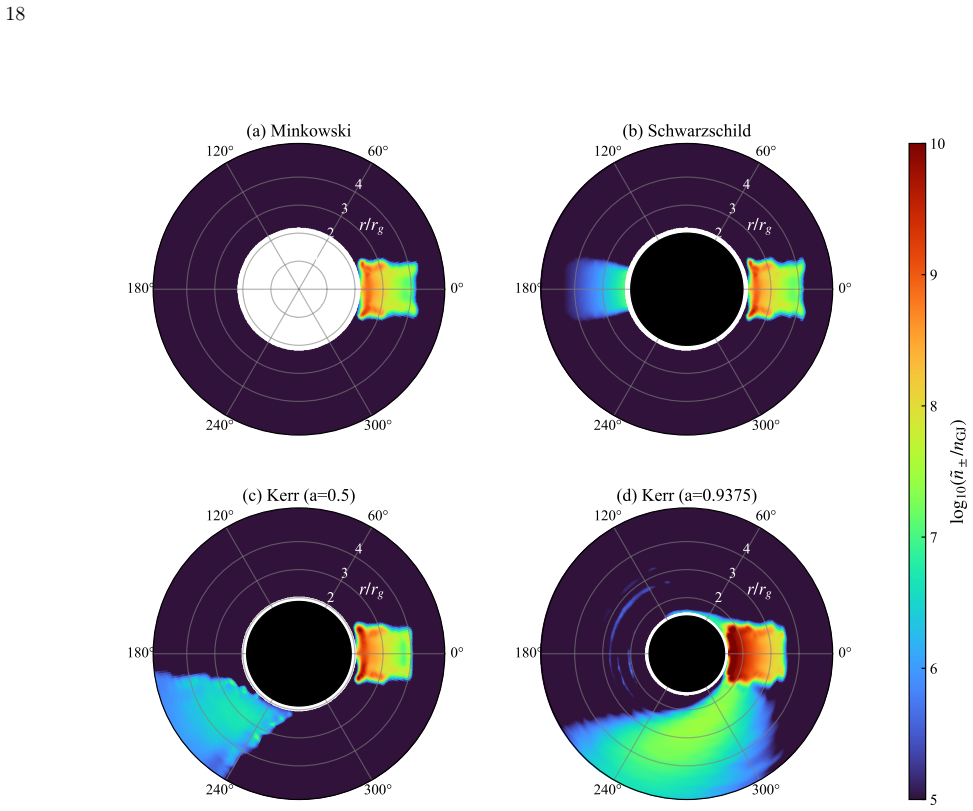
Active galactic nuclei often exhibit highly collimated relativistic plasma outflows launched from the vicinity of their central black holes. One of the key theoretical challenges in understanding black hole jet formation is the origin of the plasma that feeds the jet, which remains poorly understood, particularly in explaining the observed jet emission. In this study, we focus on electron positron pair production generated by high energy photons from non axisymmetric magnetic reconnection near the black hole, as suggested by recent three dimensional general relativistic magnetohydrodynamics simulations. By employing general relativistic ray tracing, we calculate the spatial distribution of the pair production rate in the jet, taking into account photon propagation and collision angles in curved spacetime. We find that our scenario can naturally supply a sufficient amount of plasma to explain the observed radio emission from the M87 jet, even when photon anisotropy is considered. Furthermore, we show that a spinning black hole plays a crucial role in shaping the spartial dsitribution of the pairs, which in turn affects jet acceleration and very high energy emission from the jet base.
Editorial analysis
A structured set of objections, weighed in public.
Referee Report
Summary. The manuscript explores electron-positron pair production via high-energy photons from non-axisymmetric magnetic reconnection near a spinning black hole, drawing on 3D GRMHD simulations. It employs general relativistic ray-tracing to compute the spatial distribution of pair production rates in the jet while incorporating photon propagation, collision angles, and anisotropy in curved spacetime. The central claim is that this mechanism naturally supplies sufficient plasma to explain the observed radio emission from the M87 jet, with black hole spin shaping the non-uniform pair distribution and thereby influencing jet acceleration and very high energy emission.
Significance. If the quantitative results hold, the work supplies a physically grounded channel for populating relativistic jets with plasma, a longstanding open issue in AGN jet theory. By linking recent 3D reconnection simulations to anisotropic pair creation in strong gravity, it offers a route to emission models that do not require separate ad-hoc particle sources. The spin-dependent injection pattern could also inform jet-launching and VHE gamma-ray calculations.
major comments (3)
- [Abstract and §4] Abstract and §4 (results on M87): the assertion that the computed pair supply is 'sufficient' to explain the observed radio emission is not accompanied by explicit numerical values for n±(r,θ), integrated production rates, comparison to the minimum density needed for the 230 GHz flux, or error/sensitivity estimates. Without these, the data-to-claim link cannot be evaluated.
- [§2 and §3] §2 (simulation setup) and §3 (ray-tracing): the high-energy photon spectrum (>1 MeV) that drives pair creation is taken directly from ideal 3D GRMHD runs. Because reconnection is controlled by numerical resistivity and the runs omit radiative cooling and pair back-reaction, the high-energy tail is sensitive to unresolved current-sheet structure; no convergence tests or resistive-MHD comparisons are reported, making the pair-injection rate the least secure step in the central claim.
- [§4] §4 (anisotropy and spin dependence): while photon anisotropy is included, the robustness of the final n±(r,θ) to plausible variations in the input photon angular distribution or to the specific GRMHD parameters (spin, magnetization) is not quantified. This is load-bearing because the weakest assumption is precisely the fidelity of the simulated photon production.
minor comments (3)
- [Abstract] Abstract: 'spartial dsitribution' is a typographical error and should read 'spatial distribution'.
- [Abstract] Abstract: 'non axisymmetric' should be hyphenated as 'non-axisymmetric' for standard usage.
- [Throughout] Throughout: ensure every equation for the pair-production rate explicitly cites the GR ray-tracing implementation and the exact reference for the external 3D GRMHD data set.
Simulated Author's Rebuttal
We thank the referee for the detailed and constructive report. The comments identify important areas where the manuscript can be strengthened for clarity and robustness. We address each major comment below and outline the revisions we will make.
read point-by-point responses
-
Referee: [Abstract and §4] Abstract and §4 (results on M87): the assertion that the computed pair supply is 'sufficient' to explain the observed radio emission is not accompanied by explicit numerical values for n±(r,θ), integrated production rates, comparison to the minimum density needed for the 230 GHz flux, or error/sensitivity estimates. Without these, the data-to-claim link cannot be evaluated.
Authors: We agree that explicit numerical values, integrated rates, and direct comparisons would make the sufficiency claim more transparent and verifiable. In the revised manuscript we will expand §4 with a new table and accompanying text that reports n±(r,θ) at representative jet locations, the volume-integrated pair production rate, the minimum density required to reproduce the observed 230 GHz flux of M87, and a brief sensitivity analysis with respect to the high-energy photon cutoff. revision: yes
-
Referee: [§2 and §3] §2 (simulation setup) and §3 (ray-tracing): the high-energy photon spectrum (>1 MeV) that drives pair creation is taken directly from ideal 3D GRMHD runs. Because reconnection is controlled by numerical resistivity and the runs omit radiative cooling and pair back-reaction, the high-energy tail is sensitive to unresolved current-sheet structure; no convergence tests or resistive-MHD comparisons are reported, making the pair-injection rate the least secure step in the central claim.
Authors: This is a valid concern about the limitations inherent to ideal GRMHD. The photon spectrum is extracted from the highest-resolution 3D runs available for this configuration, and pair production is computed in post-processing. In the revision we will add an explicit limitations paragraph in §2 that discusses the role of numerical resistivity, cites supporting literature on reconnection in GRMHD, and notes that the non-uniform spatial pattern of pair injection is robust across the available resolutions. We will also state that full resistive-MHD or radiative runs lie beyond the scope of the present work but are a natural next step. revision: partial
-
Referee: [§4] §4 (anisotropy and spin dependence): while photon anisotropy is included, the robustness of the final n±(r,θ) to plausible variations in the input photon angular distribution or to the specific GRMHD parameters (spin, magnetization) is not quantified. This is load-bearing because the weakest assumption is precisely the fidelity of the simulated photon production.
Authors: We acknowledge that quantifying robustness is important given the reliance on the simulated photon field. The current calculation already incorporates the anisotropic photon distribution obtained from the ray-tracing. In the revised manuscript we will add a short subsection (or appendix) that tests the sensitivity of n±(r,θ) to modest variations in the assumed photon angular distribution and briefly discusses how the pair-injection pattern changes with black-hole spin, thereby showing that the qualitative conclusions remain intact. revision: yes
Circularity Check
No significant circularity; derivation uses external simulations and independent ray-tracing
full rationale
The paper post-processes outputs from cited 3D GRMHD simulations using standard general relativistic ray-tracing to compute the spatial distribution of pair-production rates, incorporating photon propagation and collision angles. No equation or central claim reduces by construction to a fitted parameter, self-defined quantity, or load-bearing self-citation chain. The comparison to observed M87 radio emission serves as an external benchmark rather than an internal fit. The derivation remains independent of its own inputs.
Axiom & Free-Parameter Ledger
Reference graph
Works this paper leans on
-
[43]
D., & Lifshitz , E
Landau , L. D., & Lifshitz , E. M. 1975, The classical theory of fields
1975
-
[60]
S., Price , R
Thorne , K. S., Price , R. H., & MacDonald , D. A. 1986, Black holes: The membrane paradigm
1986
-
[73]
Collisionless Accretion of Finite-Angular-Momentum Plasma onto a Spinning Black Hole. arXiv e-prints , keywords =. doi:10.48550/arXiv.2602.22168 , archivePrefix =. 2602.22168 , primaryClass =
-
[74]
The Magnetorotational Instability in a Collisionless Plasma. , keywords =. doi:10.1086/342174 , archivePrefix =. astro-ph/0205492 , primaryClass =
-
[75]
Emergence of cyclic flux eruptions in kinetic simulations of magnetized spherical accretion onto a Schwarzschild black hole. arXiv e-prints , keywords =. doi:10.48550/arXiv.2602.04519 , archivePrefix =. 2602.04519 , primaryClass =
-
[76]
2004, MNRAS, 351, 1379, doi: 10.1111/j.1365-2966.2004.07876.x
Electrodynamics of black hole magnetospheres. , keywords =. doi:10.1111/j.1365-2966.2004.07598.x , adsurl =
-
[77]
Relativistic Magnetic Reconnection in Astrophysical Plasmas: A Powerful Mechanism of Nonthermal Emission. , keywords =. doi:10.1146/annurev-astro-020325-115713 , archivePrefix =. 2506.02101 , primaryClass =
-
[78]
2021, , 647, A67, 10.1051/0004-6361/202039612
Jet collimation in NGC 315 and other nearby AGN. , keywords =. doi:10.1051/0004-6361/202039612 , archivePrefix =. 2012.14831 , primaryClass =
-
[79]
Spectral and magnetic properties of the jet base in NGC 315. , keywords =. doi:10.1051/0004-6361/202451434 , archivePrefix =. 2411.19126 , primaryClass =
-
[80]
The synchrotron and cyclo-synchrotron absorption cross-section. , keywords =. doi:10.1093/mnras/252.3.313 , adsurl =
-
[81]
American Astronomical Society Meeting \#240 , year = 2022, series =
The Inner Shadow of the Black Hole in M87*: A Direct View of the Event Horizon. American Astronomical Society Meeting \#240 , year = 2022, series =
2022
-
[82]
Model comparisons and theoretical interpretations
The persistent shadow of the supermassive black hole of M87: II. Model comparisons and theoretical interpretations. , keywords =. doi:10.1051/0004-6361/202451296 , adsurl =
-
[83]
The 2010 Very High Energy -Ray Flare and 10 Years of Multi-wavelength Observations of M 87. , keywords =. doi:10.1088/0004-637X/746/2/151 , archivePrefix =. 1111.5341 , primaryClass =
-
[84]
Society of Photo-Optical Instrumentation Engineers (SPIE) Conference Series , year = 2021, editor =
High-redshift gamma-ray burst for unraveling the Dark Ages Mission: HiZ-GUNDAM. Society of Photo-Optical Instrumentation Engineers (SPIE) Conference Series , year = 2021, editor =. doi:10.1117/12.2560603 , adsurl =
-
[85]
Broadband Multi-wavelength Properties of M87 during the 2017 Event Horizon Telescope Campaign. , keywords =. doi:10.3847/2041-8213/abef71 , archivePrefix =. 2104.06855 , primaryClass =
-
[86]
A spine-sheath model for strong-line blazars. , keywords =. doi:10.1093/mnras/stw107 , archivePrefix =. 1511.08924 , primaryClass =
-
[87]
A helical magnetic field in quasar NRAO 150 revealed by Faraday rotation. , keywords =. doi:10.1051/0004-6361/202453056 , archivePrefix =. 2503.03377 , primaryClass =
-
[88]
A Helical Magnetic Field in the Jet of 3C 273. , keywords =. doi:10.1093/pasj/54.3.L39 , archivePrefix =. astro-ph/0205497 , primaryClass =
-
[89]
Journal of High Energy Astrophysics , keywords =
Non-thermal emission from microquasar jets: The case of GRS 1915+105. Journal of High Energy Astrophysics , keywords =. doi:10.1016/j.jheap.2024.06.006 , adsurl =
-
[90]
VI Microquasar Workshop: Microquasars and Beyond , year = 2006, month = jan, eid =
Radio emission and jets from Galactic microquasars. VI Microquasar Workshop: Microquasars and Beyond , year = 2006, month = jan, eid =. doi:10.22323/1.033.0009 , archivePrefix =. astro-ph/0611413 , primaryClass =
-
[91]
VLBI observations of bright AGN jets with the KVN and VERA Array (KaVA): Evaluation of imaging capability. , keywords =. doi:10.1093/pasj/psu104 , archivePrefix =. 1406.4356 , primaryClass =
-
[92]
VLBI imaging of M 81* at 43 GHz. , keywords =. doi:10.1051/0004-6361/201118399 , archivePrefix =. 1111.4856 , primaryClass =
-
[93]
First Sagittarius A* Event Horizon Telescope Results. I. The Shadow of the Supermassive Black Hole in the Center of the Milky Way. , keywords =. doi:10.3847/2041-8213/ac6674 , adsurl =
-
[94]
2010, Reviews of Modern Physics, 82, 3121, doi: 10.1103/RevModPhys.82.3121
The Galactic Center massive black hole and nuclear star cluster. Reviews of Modern Physics , keywords =. doi:10.1103/RevModPhys.82.3121 , archivePrefix =. 1006.0064 , primaryClass =
-
[95]
An Unambiguous Detection of Faraday Rotation in Sagittarius A*. , keywords =. doi:10.1086/510850 , archivePrefix =. astro-ph/0611791 , primaryClass =
-
[96]
43rd COSPAR Scientific Assembly
RadioAstron reveals a spine/sheath jet structure in 3C273. 43rd COSPAR Scientific Assembly. Held 28 January - 4 February , year = 2021, volume =
2021
-
[97]
Constraining the location of rapid gamma-ray flares in the flat spectrum radio quasar 3C 273. , keywords =. doi:10.1051/0004-6361/201321440 , archivePrefix =. 1307.0854 , primaryClass =
-
[98]
The off-axis jet structure in Mrk 501 at mm-wavelengths. arXiv e-prints , keywords =. doi:10.48550/arXiv.1505.04433 , archivePrefix =. 1505.04433 , primaryClass =
-
[99]
Significant Limb-Brightening in the Inner Parsec of Markarian 501. , keywords =. doi:10.1088/0004-637X/690/1/L31 , archivePrefix =. 0812.3164 , primaryClass =
-
[100]
2021, , 909, 76, 10.3847/1538-4357/abd6ee
Jet Collimation and Acceleration in the Giant Radio Galaxy NGC 315. , keywords =. doi:10.3847/1538-4357/abd6ee , archivePrefix =. 2012.14154 , primaryClass =
-
[101]
Discovery of Limb Brightening in the Parsec-scale Jet of NGC 315 through Global Very Long Baseline Interferometry Observations and Its Implications for Jet Models. , keywords =. doi:10.3847/2041-8213/ad7137 , archivePrefix =. 2408.09069 , primaryClass =
-
[102]
Constraints on the Mass Accretion Rate onto the Supermassive Black Hole of Cygnus A Using the Submillimeter Array. , keywords =. doi:10.3847/1538-4357/abd17b , adsurl =
-
[103]
The stratified two-sided jet of <ASTROBJ>Cygnus A</ASTROBJ>. Acceleration and collimation. , keywords =. doi:10.1051/0004-6361/201526985 , archivePrefix =. 1509.06250 , primaryClass =
-
[104]
Publications of the Astronomical Society of Australia , author=
The Supermassive Black Hole at the Heart of Centaurus A: Revealed by the Kinematics of Gas and Stars , volume=. Publications of the Astronomical Society of Australia , author=. 2010 , pages=. doi:10.1071/AS09080 , number=
-
[105]
2021, Nature Astronomy, 5, 1017, doi: 10.1038/s41550-021-01417-w
Event Horizon Telescope observations of the jet launching and collimation in Centaurus A. Nature Astronomy , keywords =. doi:10.1038/s41550-021-01417-w , archivePrefix =. 2111.03356 , primaryClass =
-
[106]
arXiv , Author =:1308.1411 , Journal =
The Innermost Collimation Structure of the M87 Jet Down to -0.5ex 10 Schwarzschild Radii. , keywords =. doi:10.1088/0004-637X/775/1/70 , archivePrefix =. 1308.1411 , primaryClass =
-
[107]
U ber den Einflu der Eigenrotation der Zentralk \
\"U ber den Einflu der Eigenrotation der Zentralk \"o rper auf die Bewegung der Planeten und Monde nach der Einsteinschen Gravitationstheorie. Physikalische Zeitschrift , year = 1918, month = jan, volume =
1918
-
[108]
Perturbative approach to an orbital evolution around a supermassive black hole. , keywords =. doi:10.1103/PhysRevD.67.084027 , archivePrefix =. gr-qc/0302075 , primaryClass =
-
[109]
Classical and Quantum Gravity , keywords =
Analytic solutions for parallel transport along generic bound geodesics in Kerr spacetime. Classical and Quantum Gravity , keywords =. doi:10.1088/1361-6382/ab79d5 , archivePrefix =. 1906.05090 , primaryClass =
-
[110]
Classical and Quantum Gravity , keywords =
Celestial mechanics in Kerr spacetime. Classical and Quantum Gravity , keywords =. doi:10.1088/0264-9381/19/10/314 , archivePrefix =. gr-qc/0202090 , primaryClass =
-
[111]
Electromotive force in the Blandford-Znajek process. , keywords =. doi:10.1093/mnras/stu1053 , archivePrefix =. 1405.7437 , primaryClass =
-
[112]
The classical theory of fields
-
[113]
Relativistic Effects on Neutrino Pair Annihilation above a Kerr Black Hole with the Accretion Disk. , keywords =. doi:10.1086/318312 , archivePrefix =. astro-ph/0009453 , primaryClass =
-
[114]
Testing the neutrino annihilation model for launching GRB jets. , keywords =. doi:10.1093/mnrasl/slu122 , archivePrefix =. 1408.4509 , primaryClass =
-
[115]
Compact stellar X-ray sources , year = 2006, editor =
Jets from X-ray binaries. Compact stellar X-ray sources , year = 2006, editor =. doi:10.48550/arXiv.astro-ph/0303339 , adsurl =
-
[116]
Lecture Notes in Physics, Berlin Springer Verlag , year = 2010, editor =
Theory of Magnetically Powered Jets. Lecture Notes in Physics, Berlin Springer Verlag , year = 2010, editor =. doi:10.1007/978-3-540-76937-8_9 , adsurl =
-
[117]
Bardeen-Petterson alignment, jets, and magnetic truncation in GRMHD simulations of tilted thin accretion discs. , keywords =. doi:10.1093/mnras/stz834 , archivePrefix =. 1810.00883 , primaryClass =
-
[118]
Radiative Magnetic Reconnection Near Accreting Black Holes. , keywords =. doi:10.3847/1538-4357/aa8f4f , archivePrefix =. 1701.02847 , primaryClass =
-
[119]
Magnetic Hair and Reconnection in Black Hole Magnetospheres. , keywords =. doi:10.1103/PhysRevLett.127.055101 , archivePrefix =. 2109.14620 , primaryClass =
-
[120]
Non-thermal Synchrotron Emission and Polarization Signatures during Black Hole Flux Eruptions
Non-thermal Synchrotron Emission and Polarization Signatures during Black Hole Flux Eruptions. arXiv e-prints , keywords =. doi:10.48550/arXiv.2512.06803 , archivePrefix =. 2512.06803 , primaryClass =
work page internal anchor Pith review Pith/arXiv arXiv doi:10.48550/arxiv.2512.06803
-
[121]
Black Hole Spin and The Radio Loud/Quiet Dichotomy of Active Galactic Nuclei. , keywords =. doi:10.1088/0004-637X/711/1/50 , archivePrefix =. 0911.2228 , primaryClass =
-
[122]
2014, ApJL, 783, L21, doi: 10.1088/2041-8205/783/1/L21
Relativistic Reconnection: An Efficient Source of Non-thermal Particles. , keywords =. doi:10.1088/2041-8205/783/1/L21 , archivePrefix =. 1401.5471 , primaryClass =
-
[123]
Neutrino and Cosmic-Ray Emission and Cumulative Background from Radiatively Inefficient Accretion Flows in Low-luminosity Active Galactic Nuclei. , keywords =. doi:10.1088/0004-637X/806/2/159 , archivePrefix =. 1411.3588 , primaryClass =
-
[124]
Giant Protostellar Flares: Accretion-driven Accumulation and Reconnection-driven Ejection of Magnetic Flux in Protostars. , keywords =. doi:10.3847/2041-8213/ab22bb , archivePrefix =. 1902.02007 , primaryClass =
-
[125]
Fast Magnetic Reconnection in the Plasmoid-Dominated Regime. , keywords =. doi:10.1103/PhysRevLett.105.235002 , archivePrefix =. 1008.3330 , primaryClass =
-
[126]
2009, Physics of Plasmas, 16, 112102, doi: 10.1063/1.3264103
Fast reconnection in high-Lundquist-number plasmas due to the plasmoid Instability. Physics of Plasmas , keywords =. doi:10.1063/1.3264103 , archivePrefix =. 0906.5599 , primaryClass =
-
[127]
Ab Initio Horizon-scale Simulations of Magnetically Arrested Accretion in Sagittarius A* Fed by Stellar Winds. , keywords =. doi:10.3847/2041-8213/ab9532 , archivePrefix =. 2006.00005 , primaryClass =
-
[128]
Magnetically Arrested Disk: an Energetically Efficient Accretion Flow. , keywords =. doi:10.1093/pasj/55.6.L69 , archivePrefix =. astro-ph/0305029 , primaryClass =
-
[129]
V., Narayan, R., & Abramowicz, M
Three-dimensional Magnetohydrodynamic Simulations of Radiatively Inefficient Accretion Flows. , keywords =. doi:10.1086/375769 , archivePrefix =. astro-ph/0301402 , primaryClass =
-
[130]
Millimeter observational signatures of flares in magnetically arrested black hole accretion models. , keywords =. doi:10.1093/mnras/stad2935 , archivePrefix =. 2301.09014 , primaryClass =
-
[131]
Horizon-scale Lepton Acceleration in Jets: Explaining the Compact Radio Emission in M87. , keywords =. doi:10.1088/0004-637X/809/1/97 , archivePrefix =. 1506.04754 , primaryClass =
-
[132]
Variable TeV Emission as a Manifestation of Jet Formation in M87?. , keywords =. doi:10.1088/0004-637X/730/2/123 , archivePrefix =. 1011.5319 , primaryClass =
-
[133]
Magnetohydrodynamic Flows in Kerr Geometry: Energy Extraction from Black Holes. , keywords =. doi:10.1086/169331 , adsurl =
-
[134]
Helical Magnetic Field in the Acceleration--Collimation Zone of the M87 Jet. arXiv e-prints , keywords =. doi:10.48550/arXiv.2511.13008 , archivePrefix =. 2511.13008 , primaryClass =
-
[135]
arXiv , Author =:1810.09963 , Journal =
Nakamura, Masanori and Asada, Keiichi and Hada, Kazuhiro and Pu, Hung-Yi and Noble, Scott and Tseng, Chihyin and Toma, Kenji and Kino, Motoki and Nagai, Hiroshi and Takahashi, Kazuya and Algaba, Juan-Carlos and Orienti, Monica and Akiyama, Kazunori and Doi, Akihiro and Giovannini, Gabriele and Giroletti, Marcello and Honma, Mareki and Koyama, Shoko and Li...
-
[136]
Magnetic acceleration of relativistic active galactic nucleus jets. , keywords =. doi:10.1111/j.1365-2966.2007.12050.x , archivePrefix =. astro-ph/0703146 , primaryClass =
-
[137]
F., Capozziello, S., & Dainotti, M
Magnetic acceleration of ultrarelativistic jets in gamma-ray burst sources. , keywords =. doi:10.1111/j.1365-2966.2009.14410.x , archivePrefix =. 0811.1467 , primaryClass =
-
[138]
First M87 Event Horizon Telescope Results. VIII. Magnetic Field Structure near The Event Horizon. , keywords =. doi:10.3847/2041-8213/abe4de , archivePrefix =. 2105.01173 , primaryClass =
-
[139]
First Sagittarius A* Event Horizon Telescope Results. VII. Polarization of the Ring. , keywords =. doi:10.3847/2041-8213/ad2df0 , adsurl =
-
[140]
General relativistic magnetohydrodynamic simulations of magnetically choked accretion flows around black holes. , keywords =. doi:10.1111/j.1365-2966.2012.21074.x , archivePrefix =. 1201.4163 , primaryClass =
-
[141]
Progress of Theoretical and Experimental Physics , keywords =
On the Mechanism of Black Hole Energy Reduction in the Blandford-Znajek Process. Progress of Theoretical and Experimental Physics , keywords =. doi:10.1093/ptep/ptaf036 , archivePrefix =. 2408.09993 , primaryClass =
-
[142]
Nature Physical Science , year = 1971, month = feb, volume =
Extraction of Rotational Energy from a Black Hole. Nature Physical Science , year = 1971, month = feb, volume =. doi:10.1038/physci229177a0 , adsurl =
-
[143]
Journal of the Physical Society of Japan , volume =
Physics of Relativistic Jets Powered by Black Holes , author =. Journal of the Physical Society of Japan , volume =. 2017 , doi =
2017
-
[144]
Hydromagnetic flows from accretion disks and the production of radio jets. , keywords =. doi:10.1093/mnras/199.4.883 , adsurl =
-
[145]
, year = 1969, month = aug, volume =
Pulsar Electrodynamics. , year = 1969, month = aug, volume =. doi:10.1086/150119 , adsurl =
-
[146]
N., 1989, @doi [ ] 10.1038/340126a0 , https://ui.adsabs.harvard.edu/abs/1989Natur.340..126E 340, 126
Nucleosynthesis, neutrino bursts and -rays from coalescing neutron stars. , keywords =. doi:10.1038/340126a0 , adsurl =
-
[147]
Can Neutrino-cooled Accretion Disks Be an Origin of Gamma-Ray Bursts?. , keywords =. doi:10.1086/342166 , archivePrefix =. astro-ph/0203177 , primaryClass =
-
[148]
The Physics of Gamma-Ray Bursts and Relativistic Jets
The physics of gamma-ray bursts & relativistic jets. , keywords =. doi:10.1016/j.physrep.2014.09.008 , archivePrefix =. 1410.0679 , primaryClass =
work page Pith review doi:10.1016/j.physrep.2014.09.008 2014
-
[149]
Jets, Disks and Winds from Spinning Black Holes: Nature or Nurture?. Galaxies , keywords =. doi:10.3390/galaxies10040089 , archivePrefix =. 2207.05839 , primaryClass =
-
[150]
Jet Formation in GRBs: A Semi-analytic Model of MHD Flow in Kerr Geometry with Realistic Plasma Injection. , keywords =. doi:10.1088/0004-637X/796/1/26 , archivePrefix =. 1408.0126 , primaryClass =
discussion (0)
Sign in with ORCID, Apple, or X to comment. Anyone can read and Pith papers without signing in.