Recognition: unknown
Pi-Change: A Prior-Informed Multiple Change Point Detection Algorithm
Pith reviewed 2026-05-09 18:38 UTC · model grok-4.3
The pith
Pi-Change embeds prior information on change point locations as a time-varying penalty inside the Pruned Exact Linear Time framework while preserving its exact dynamic programming recursion and pruning rule.
A machine-rendered reading of the paper's core claim, the machinery that carries it, and where it could break.
Core claim
The Pi-Change algorithm translates prior information on change point locations into a time-varying penalty term. This term integrates directly into the Pruned Exact Linear Time dynamic programming recursion and its pruning rule, so multiple change points can still be found exactly and efficiently. The resulting procedure discourages change points unsupported by the prior, stays robust under prior misspecification, and yields higher detection accuracy than purely data-driven alternatives on both simulated and applied data.
What carries the argument
The time-varying penalty term that encodes prior information on plausible change point locations and is inserted into the Pruned Exact Linear Time recursion and pruning rule.
If this is right
- Spurious change points unsupported by the prior are actively discouraged.
- Detection accuracy improves across simulated data and three real time-series applications.
- The method remains effective even when the supplied prior is misspecified.
- Partial prior knowledge from external events or heterogeneous mechanisms can be incorporated in a computationally efficient way.
Where Pith is reading between the lines
- The same penalty-embedding idea could be tested on other dynamic programming routines used in sequential analysis.
- When priors derive from known external events, the detected change points can directly quantify the lag between the event and the observed structural shift.
- The framework offers a template for adding contextual information to other purely data-driven statistical procedures without sacrificing computational tractability.
Load-bearing premise
That prior information on plausible change point locations exists and can be turned into a time-varying penalty that preserves the exactness and efficiency of the detection algorithm.
What would settle it
Apply the algorithm to a simulated series whose true change points contradict a strong prior; if the method either follows the prior too closely and misses the true locations or still recovers the true locations without extra spurious detections, the claim is settled.
Figures


read the original abstract
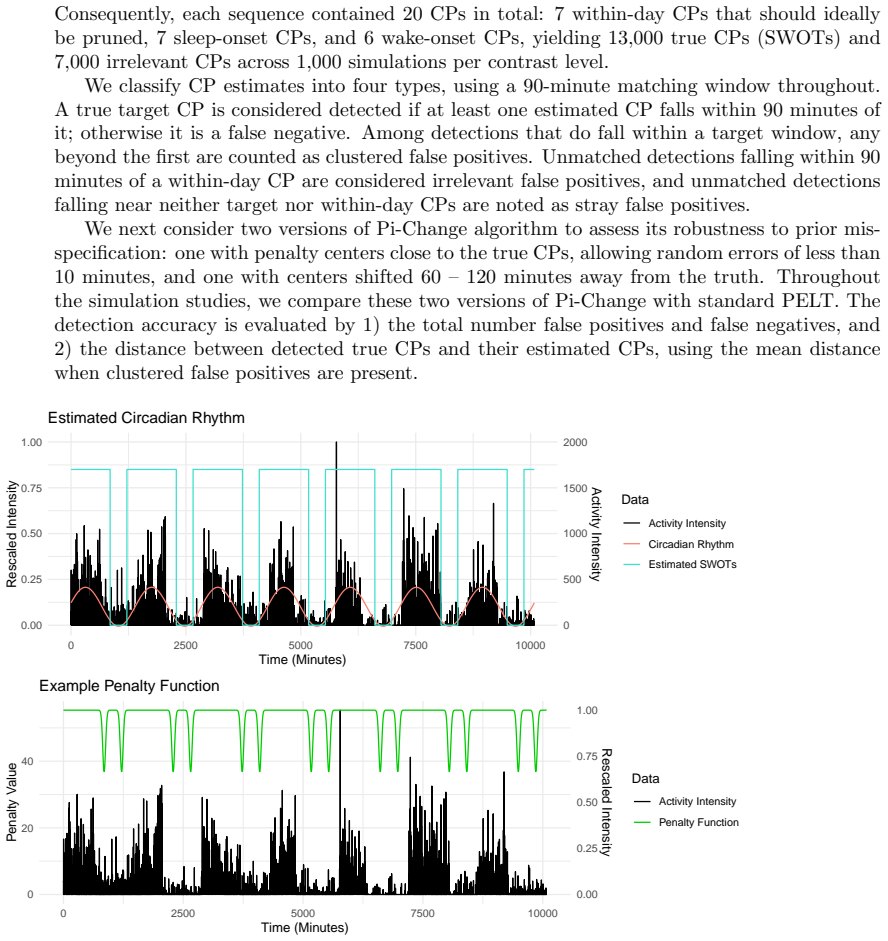
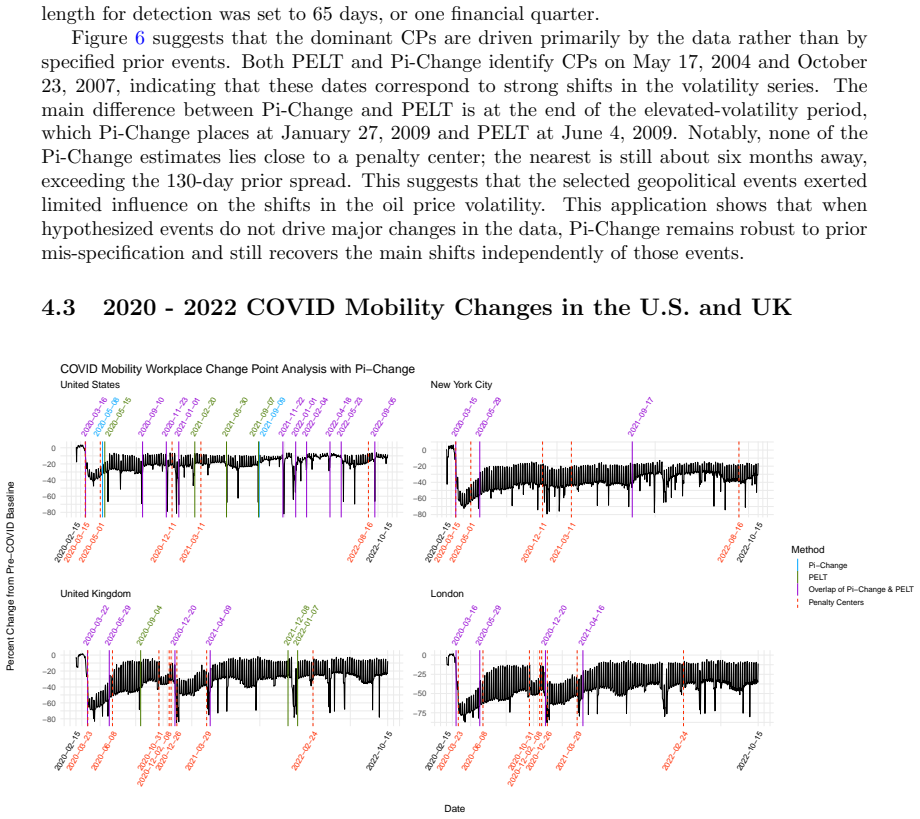
Statistical change point (CP) detection methods typically rely on likelihood-based inference and ignore contextual information about plausible CP locations beyond the observed sequence. Although informative priors provide a natural way to incorporate such information, general and computationally efficient methods for doing so are lacking, especially for multiple CP detection. To address this gap, we propose a prior-informed CP detection algorithm (Pi-Change) that incorporates prior information on CP locations through a time-varying penalty term. We prove that the proposed penalty can be embedded in the Pruned Exact Linear Time framework while preserving the dynamic programming recursion and pruning rule required for efficient multiple CP detection. Across simulation studies and three time-series applications, Pi-Change discourages spurious CPs unsupported by prior information, remains robust to prior misspecification, and improves detection accuracy. More broadly, Pi-Change extends multiple CP detection beyond purely data-driven fitting by incorporating partial prior knowledge in a computationally efficient and interpretable way. It is particularly useful when CPs arise from heterogeneous mechanisms or are associated with known external events, helping quantify the delay between an event and the resulting structural change.
Editorial analysis
A structured set of objections, weighed in public.
Referee Report
Summary. The paper introduces Pi-Change, an extension of the PELT algorithm for multiple change-point detection that incorporates prior information on plausible CP locations through a time-varying penalty term. It claims to prove that this penalty can be embedded in the PELT dynamic programming framework while preserving the recursion and pruning rule for computational efficiency, and reports that simulations and three time-series applications show reduced spurious detections, robustness to prior misspecification, and improved accuracy when priors reflect known external events or heterogeneous mechanisms.
Significance. If the central proof holds without unstated restrictions, the work is significant for extending efficient multiple CP detection beyond purely data-driven approaches by allowing interpretable incorporation of contextual priors. The preservation of PELT's exact linear-time complexity is a notable strength, as is the empirical demonstration across simulations and applications that the method discourages unsupported CPs while remaining practical. This addresses a genuine gap in handling partial prior knowledge for structural changes linked to external events.
major comments (2)
- [theoretical results / proof of PELT compatibility] The proof that the time-varying penalty preserves the PELT pruning rule (abstract and theoretical development): the original PELT pruning discards tau when cost(tau,t) + pen > cost(tau,s) + pen + cost(s,t) for constant pen; with location-dependent pen(t), the inequality becomes cost(tau,t) + pen(t) > cost(tau,s) + pen(s) + cost(s,t) and can fail whenever pen(t) < pen(s). The manuscript must explicitly state the additional conditions (e.g., monotonicity or other restrictions on the prior-derived penalty) under which the same pruning rule remains valid, as this is load-bearing for the efficiency claim.
- [simulation studies and applications] Simulation studies and applications (results section): while the abstract asserts improved detection accuracy and robustness, the manuscript should report quantitative metrics (e.g., precision, recall, or Hausdorff distance) with and without the prior term, plus details on how the time-varying penalty parameters were chosen from the priors, to allow assessment of whether gains are attributable to the prior or to other tuning choices.
minor comments (2)
- [methods] Notation for the time-varying penalty: clarify whether pen(t) is added only at candidate change locations or integrated differently, and ensure consistency with the DP recursion presentation.
- [simulation studies] Prior misspecification experiments: provide more detail on the range of misspecifications tested and the resulting degradation in performance to substantiate the robustness claim.
Simulated Author's Rebuttal
We thank the referee for their detailed and constructive feedback. We address each major comment below. We agree that the theoretical development requires explicit statement of conditions on the penalty for the pruning rule to hold, and we will revise the manuscript to include this. For the empirical results, we will add the requested quantitative metrics and parameter details.
read point-by-point responses
-
Referee: The proof that the time-varying penalty preserves the PELT pruning rule (abstract and theoretical development): the original PELT pruning discards tau when cost(tau,t) + pen > cost(tau,s) + pen + cost(s,t) for constant pen; with location-dependent pen(t), the inequality becomes cost(tau,t) + pen(t) > cost(tau,s) + pen(s) + cost(s,t) and can fail whenever pen(t) < pen(s). The manuscript must explicitly state the additional conditions (e.g., monotonicity or other restrictions on the prior-derived penalty) under which the same pruning rule remains valid, as this is load-bearing for the efficiency claim.
Authors: We thank the referee for highlighting this subtlety. Our derivation of the time-varying penalty ensures it is non-decreasing (pen(t) ≥ pen(s) for t > s) because the prior is constructed from cumulative information up to time t. Under this monotonicity condition the original PELT pruning inequality is preserved and the recursion remains valid. We will add an explicit statement of this assumption, together with a short proof that the condition holds for the priors we consider, in the revised theoretical section. For non-monotonic priors the pruning rule would need adjustment, but that case lies outside the scope of the present work. revision: yes
-
Referee: Simulation studies and applications (results section): while the abstract asserts improved detection accuracy and robustness, the manuscript should report quantitative metrics (e.g., precision, recall, or Hausdorff distance) with and without the prior term, plus details on how the time-varying penalty parameters were chosen from the priors, to allow assessment of whether gains are attributable to the prior or to other tuning choices.
Authors: We agree that additional quantitative comparisons would improve clarity. In the revised results section we will include tables of precision, recall, and Hausdorff distance for the simulation scenarios, explicitly contrasting Pi-Change with and without the prior term. We will also document the exact mapping from prior probabilities to the penalty parameters (including any scaling constants) and, for the three applications, report the same metrics where ground truth is available or describe the validation procedure used when it is not. revision: yes
Circularity Check
No circularity: Pi-Change extends PELT via independent proof of penalty compatibility
full rationale
The paper introduces a time-varying penalty derived from prior information on CP locations and asserts a proof that this penalty preserves the exact PELT dynamic programming recursion and pruning rule. This is a forward derivation from the penalty's functional form to the inequality conditions required by PELT, not a reduction of the result to its own inputs. No self-citation chain supports the central claim, no fitted parameters are relabeled as predictions, and the uniqueness of the approach is not imported from prior author work. Simulations and real-data applications provide external validation rather than tautological confirmation. The skeptic concern about possible unstated monotonicity conditions on the penalty addresses proof completeness, not circularity.
Axiom & Free-Parameter Ledger
free parameters (1)
- time-varying penalty parameters
axioms (2)
- domain assumption Prior information on CP locations can be represented as a time-varying penalty term.
- ad hoc to paper The time-varying penalty preserves the dynamic programming recursion and pruning rule of PELT.
Reference graph
Works this paper leans on
-
[1]
R. P. Adams and D. J. MacKay. Bayesian online changepoint detection.arXiv preprint arXiv:0710.3742, 2007
work page Pith review arXiv 2007
-
[2]
Barry and J
D. Barry and J. A. Hartigan. A bayesian analysis for change point problems.Journal of the American Statistical Association, 88(421):309–319, 1993. 14
1993
-
[3]
J. V. Braun and H.-G. M¨ uller. Statistical methods for dna sequence segmentation.Statis- tical Science, pages 142–162, 1998
1998
-
[4]
Chen and X
S. Chen and X. Sun. Validating circacp: a generic sleep–wake cycle detection algorithm for unlabelled actigraphy data.Royal Society Open Science, 11(5):231468, 2024
2024
-
[5]
Cifarelli and P
G. Cifarelli and P. Paesani. Navigating the oil bubble: A non-linear heterogeneous-agent dynamic model of futures oil pricing.The Energy Journal, 42(5):101–122, 2021
2021
-
[6]
Dehning, J
J. Dehning, J. Zierenberg, F. P. Spitzner, M. Wibral, J. P. Neto, M. Wilczek, and V. Priese- mann. Inferring change points in the spread of covid-19 reveals the effectiveness of inter- ventions.Science, 369(6500):eabb9789, 2020
2020
-
[7]
B. T. Fagan, M. I. Knight, N. J. MacKay, and A. Jamie Wood. Change point analysis of historical battle deaths.Journal of the Royal Statistical Society Series A: Statistics in Society, 183(3):909–933, 2020
2020
-
[8]
Fearnhead
P. Fearnhead. Exact and efficient bayesian inference for multiple changepoint problems. Statistics and computing, 16(2):203–213, 2006
2006
-
[9]
Federal Reserve Bank of St. Louis. Crude oil prices: West texas intermediate (wti) - cushing, oklahoma [dcoilwtico].https://fred.stlouisfed.org/series/DCOILWTICO, 2026. Daily series, source: U.S. Energy Information Administration; accessed 2026-04-13
2026
-
[10]
Gelman, J
A. Gelman, J. B. Carlin, H. S. Stern, and D. B. Rubin.Bayesian data analysis. Chapman and Hall/CRC, 1995
1995
-
[11]
Jackson, J
B. Jackson, J. D. Scargle, D. Barnes, S. Arabhi, A. Alt, P. Gioumousis, E. Gwin, P. Sang- trakulcharoen, L. Tan, and T. T. Tsai. An algorithm for optimal partitioning of data on an interval.IEEE Signal Processing Letters, 12(2):105–108, 2005
2005
-
[12]
S. K. Jensen, T. B. Pedersen, and C. Thomsen. Time series management systems: A survey. IEEE Transactions on Knowledge and Data Engineering, 29(11):2581–2600, 2017
2017
-
[13]
Google community mobility reports.https://www.kaggle.com/datasets/ bigquery/covid19-google-mobility, 2026
Kaggle. Google community mobility reports.https://www.kaggle.com/datasets/ bigquery/covid19-google-mobility, 2026. Accessed: 2026-04-13
2026
-
[14]
Killick, P
R. Killick, P. Fearnhead, and I. A. Eckley. Optimal detection of changepoints with a linear computational cost.Journal of the American Statistical Association, 107(500):1590–1598, 2012
2012
-
[15]
Koller and N
D. Koller and N. Friedman.Probabilistic graphical models: principles and techniques. MIT press, 2009
2009
-
[16]
Z. Maoz, P. L. Johnson, J. Kaplan, F. Ogunkoya, and A. P. Shreve. The dyadic militarized interstate disputes (mids) dataset version 3.0: Logic, characteristics, and comparisons to alternative datasets.Journal of Conflict Resolution, 63(3):811–835, 2019
2019
-
[17]
Nadal, A
R. Nadal, A. Szklo, and A. Lucena. Time-varying impacts of demand and supply oil shocks on correlations between crude oil prices and stock markets indices.Research in International Business and Finance, 42:1011–1020, 2017
2017
-
[18]
Sen and M
A. Sen and M. S. Srivastava. On tests for detecting change in mean.The Annals of statistics, pages 98–108, 1975
1975
-
[19]
D. A. Stephens. Bayesian retrospective multiple-changepoint identification.Journal of the Royal Statistical Society: Series C (Applied Statistics), 43(1):159–178, 1994. 15
1994
-
[20]
C. Y. Yau and Z. Zhao. Inference for multiple change points in time series via likelihood ratio scan statistics.Journal of the Royal Statistical Society Series B: Statistical Methodology, 78(4):895–916, 2016
2016
-
[21]
N. R. Zhang and D. O. Siegmund. A modified bayes information criterion with applications to the analysis of comparative genomic hybridization data.Biometrics, 63(1):22–32, 2007. 16 A Proofs We define the Pi-Change penalty at locationt,g(t), as (2.7). Here,βis the baseline PELT penalty,λ≥0 controls the strength of the prior information, andS(t)≥0 is a time...
2007
discussion (0)
Sign in with ORCID, Apple, or X to comment. Anyone can read and Pith papers without signing in.