Recognition: unknown
Chemistry and Isotope Ratios of Substellar Atmospheres in the β Pictoris Young Moving Group
Pith reviewed 2026-05-09 17:54 UTC · model grok-4.3
The pith
The ~12 Jupiter-mass companion 2MASS J0249-0557 c shows C/O, metallicity and 12CO/13CO ratios matching two brown dwarfs in the same moving group, favoring gravitational collapse over core accretion.
A machine-rendered reading of the paper's core claim, the machinery that carries it, and where it could break.
Core claim
Retrievals from CRIRES+ spectra with petitRADTRANS and PyMultiNest give 2MASS J0249-0557 c a C/O ratio of 0.57±0.01, [M/H] of 0.18±0.05, and 12CO/13CO of 95+23/-17. The same procedure applied to 2MASSI J0443+0002 and SIPS J2000-7523 produces matching abundances. Combined with the companion's large orbital distance, the shared composition identifies gravitational collapse in a star-like manner as the most probable formation channel for this object at the planet-brown-dwarf boundary. The solar-like abundances further establish a baseline for the β Pictoris young moving group.
What carries the argument
Atmospheric retrieval of C/O ratio, metallicity and 12CO/13CO isotope ratio from high-resolution near-infrared spectra via the petitRADTRANS radiative-transfer code and PyMultiNest nested sampler.
If this is right
- The three objects supply the first homogeneous atmospheric-composition set for substellar members of the β Pictoris young moving group.
- These solar-like abundances provide a reference against which the atmospheres of the group's exoplanets can be compared.
- Direct comparisons within the group can distinguish core-accretion from gravitational-collapse formation for its planetary members.
- The measurements demonstrate that high-resolution spectroscopy can constrain formation pathways near the planet-brown-dwarf boundary.
Where Pith is reading between the lines
- If the retrieved ratios hold under alternative modeling, the same technique could be applied to other young moving groups to locate the mass or separation threshold where formation channels switch.
- Discrepancies between a planet's composition and the group baseline could reveal whether that planet accreted gas after the group formed or inherited its chemistry from the natal cloud.
- The isotope ratio may serve as an additional discriminant if future models predict different 12CO/13CO preservation under collapse versus disk-accretion scenarios.
Load-bearing premise
The retrieval procedure returns the true atmospheric C/O, metallicity and carbon-isotope values without large systematic biases from the assumed temperature-pressure profile, cloud treatment or line-list completeness.
What would settle it
An independent retrieval performed with a different radiative-transfer code or molecular line list that returns a C/O ratio more than 0.1 away from 0.57 while keeping the same data would falsify the claimed compositional consistency.
Figures
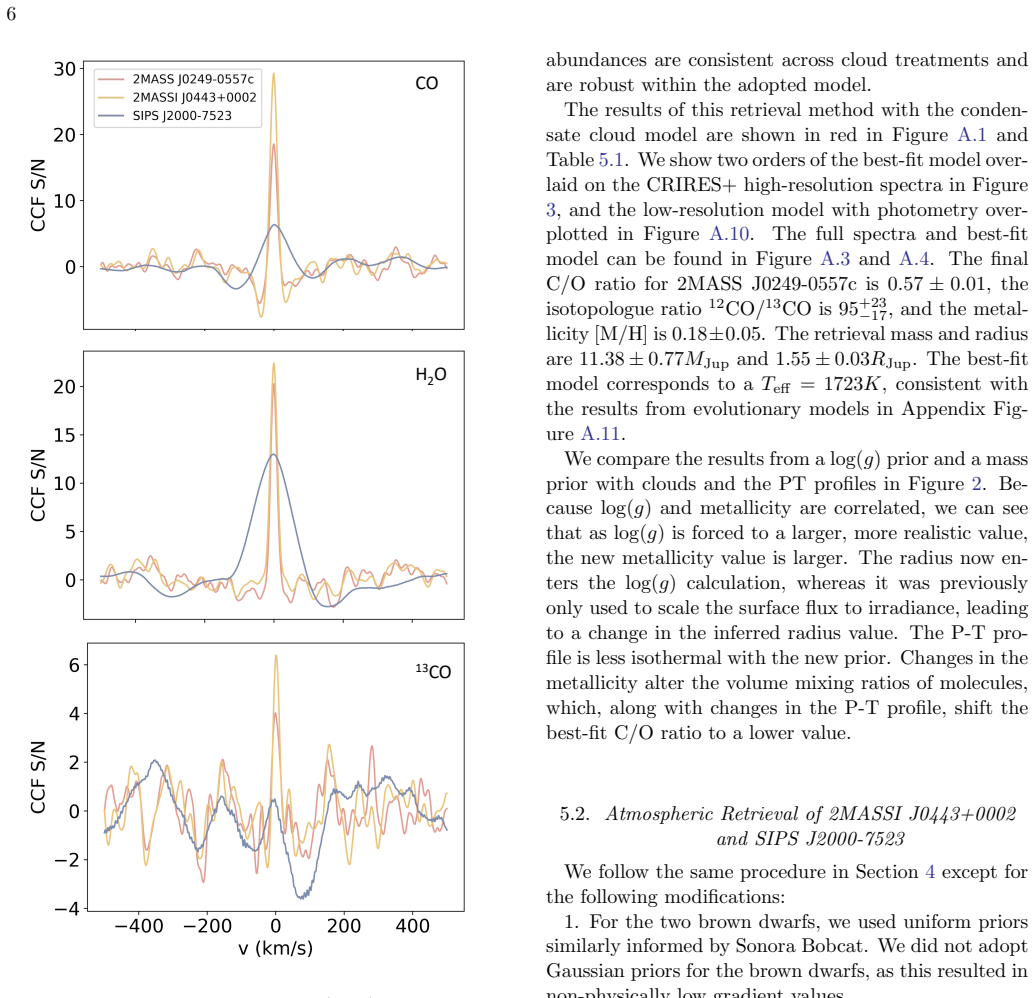


read the original abstract
Measuring the chemical and isotopic compositions of gas giants and brown dwarfs provides insights into their formation pathways and birth environments. 2MASS J0249-0557 c is an L2-type planetary mass companion ($\sim 12 M_{\mathrm{Jup}}$) orbiting a pair of brown dwarfs in the $\beta$ Pictoris young moving group. Its mass places it at the intersection of planets and brown dwarfs, making it an interesting target for constraining formation pathways at the planet-brown-dwarf boundary. Using high-resolution spectroscopic data of the planet acquired with CRIRES+ mounted on VLT, we conduct atmospheric retrieval with the radiative transfer code \texttt{petitRADTRANS} and the nested sampling tool PyMultiNest. We retrieve a C/O ratio of $0.57\pm0.01$, a metallicity of [M/H] = $0.18\pm0.05$, and a $^{12}$CO/$^{13}$CO ratio of $95^{+23}_{-17}$. We also retrieve atmospheric compositions for two benchmark brown dwarfs in the $\beta$ Pic YMG, 2MASSI J0443+0002 and SIPS J2000-7523, using CRIRES+ data and find consistent compositions. Together with 2MASS J0249-0557 c's wide separation from its host, its compositional consistency with other members of its group supports gravitational collapse in a star-like manner as its most likely formation mechanism. These results deliver a homogeneous comparison of three substellar members in the $\beta$ Pic YMG. Their solar-like abundances provide a baseline for exoplanet members in the same moving group, such as $\beta$ Pic b, 51 Eri b, and AF Lep b, whose host stellar compositions are difficult to measure. Future comparisons of atmospheric compositions among this moving group offer the potential to distinguish between formation mechanisms for its planetary members.
Editorial analysis
A structured set of objections, weighed in public.
Referee Report
Summary. The manuscript reports atmospheric retrievals from CRIRES+ high-resolution spectra for the ~12 M_Jup companion 2MASS J0249-0557 c and two brown dwarfs in the β Pictoris young moving group. Using petitRADTRANS and PyMultiNest, it finds C/O = 0.57 ± 0.01, [M/H] = 0.18 ± 0.05, and 12CO/13CO = 95^{+23}_{-17} for the companion, consistent with the brown dwarfs. Combined with its wide separation, this is interpreted as evidence for gravitational collapse formation, providing a baseline for other planets in the group.
Significance. If the retrievals prove robust, the work would be significant for constraining formation pathways at the planet-brown dwarf boundary through direct compositional comparison within a single young moving group. The homogeneous analysis across three substellar objects is a clear strength, establishing solar-like abundances as a reference point for exoplanets such as β Pic b, 51 Eri b, and AF Lep b whose host compositions are harder to measure.
major comments (1)
- [Atmospheric retrievals and results sections] The central claim that compositional consistency supports gravitational collapse (stated in the abstract) is load-bearing on the retrieved C/O, [M/H], and 12CO/13CO values being free of large correlated systematics. The manuscript applies the identical petitRADTRANS + PyMultiNest setup, including the same fixed T-P profile parametrization and cloud treatment, to the companion and both benchmark brown dwarfs. Any bias from these shared assumptions (e.g., line-list incompleteness or cloud modeling) would affect all three objects similarly, rendering the reported consistency expected by construction rather than an independent constraint on formation. The small formal uncertainties do not capture this model-dependence risk.
minor comments (2)
- The abstract gives asymmetric uncertainties on the 12CO/13CO ratio; the full text should explicitly state how these are extracted from the posterior (e.g., 16th/84th percentiles or highest-density interval).
- A side-by-side table of all retrieved parameters (with uncertainties) for the three objects would improve readability and facilitate the homogeneous comparison emphasized in the abstract.
Simulated Author's Rebuttal
We thank the referee for their constructive and positive review, which highlights both the potential significance of the work and an important caveat regarding model assumptions. We address the major comment in detail below and have incorporated revisions to strengthen the discussion of limitations.
read point-by-point responses
-
Referee: The central claim that compositional consistency supports gravitational collapse (stated in the abstract) is load-bearing on the retrieved C/O, [M/H], and 12CO/13CO values being free of large correlated systematics. The manuscript applies the identical petitRADTRANS + PyMultiNest setup, including the same fixed T-P profile parametrization and cloud treatment, to the companion and both benchmark brown dwarfs. Any bias from these shared assumptions (e.g., line-list incompleteness or cloud modeling) would affect all three objects similarly, rendering the reported consistency expected by construction rather than an independent constraint on formation. The small formal uncertainties do not capture this model-dependence risk.
Authors: We agree that the identical retrieval framework introduces the possibility of correlated systematics, as any bias from the shared T-P profile parametrization, cloud treatment, or line lists would propagate similarly across all three objects. This means the reported compositional consistency is not fully independent and cannot, by itself, serve as a robust standalone constraint on formation pathways. The formal uncertainties reported are indeed statistical and do not encompass model systematic errors. However, the retrievals remain data-driven fits to independent spectra, and the convergence to solar-like values across objects with different effective temperatures and surface gravities still provides supporting context when combined with the companion's wide separation (an independent dynamical indicator favoring gravitational collapse). We will revise the manuscript to add an explicit discussion of these model-dependent risks, temper the language in the abstract and conclusions to present compositional consistency as one supporting element rather than primary evidence, and include a new paragraph on how shared assumptions limit the strength of the formation interpretation. revision: partial
Circularity Check
No circularity: retrieval outputs are independent of formation claim
full rationale
The paper applies standard atmospheric retrieval (petitRADTRANS + PyMultiNest) to independent CRIRES+ spectra of three distinct objects, producing C/O, [M/H], and isotopic ratios as direct posterior outputs. These values are then compared empirically across objects; the consistency is not enforced by any equation, shared fit parameter, or self-referential definition. The formation-mechanism inference is an interpretive step resting on the retrieved numbers plus the object's wide separation, with no load-bearing self-citation or ansatz that reduces the result to its inputs by construction. The derivation chain remains self-contained against the observed spectra.
Axiom & Free-Parameter Ledger
free parameters (4)
- C/O ratio
- metallicity [M/H]
- 12CO/13CO ratio
- temperature-pressure profile parameters
axioms (2)
- domain assumption petitRADTRANS radiative transfer accurately models the observed spectrum under the assumed conditions
- domain assumption PyMultiNest nested sampling recovers the true posterior distribution
Reference graph
Works this paper leans on
-
[1]
Precipitating Condensation Clouds in Substellar Atmospheres. , keywords =. doi:10.1086/321540 , archivePrefix =. astro-ph/0103423 , primaryClass =
-
[2]
The Limiting Effects of Dust in Brown Dwarf Model Atmospheres. , keywords =. doi:10.1086/321547 , archivePrefix =. astro-ph/0104256 , primaryClass =
-
[3]
Abundances of the elements: Meteoritic and solar. , keywords =. doi:10.1016/0016-7037(89)90286-X , adsurl =
-
[4]
The Chemical Composition of the Sun. , keywords =. doi:10.1146/annurev.astro.46.060407.145222 , archivePrefix =. 0909.0948 , primaryClass =
-
[5]
The chemical make-up of the Sun: A 2020 vision. , keywords =. doi:10.1051/0004-6361/202140445 , archivePrefix =. 2105.01661 , primaryClass =
-
[6]
F., Spiegelman, F., Leininger, T., & Molliere, P
New study of the line profiles of sodium perturbed by H _ 2. , keywords =. doi:10.1051/0004-6361/201935593 , archivePrefix =. 1908.01989 , primaryClass =
-
[7]
The rotation-vibration spectrum of hot H _ 2 S
ExoMol molecular line lists - XVI. The rotation-vibration spectrum of hot H _ 2 S. , keywords =. doi:10.1093/mnras/stw1133 , archivePrefix =. 1607.00499 , primaryClass =
-
[8]
New evolutionary models for pre-main sequence and main sequence low-mass stars down to the hydrogen-burning limit. , keywords =. doi:10.1051/0004-6361/201425481 , archivePrefix =. 1503.04107 , primaryClass =
-
[9]
A High-Resolution Spectroscopic Survey of Directly Imaged Companion Hosts: II. Diversity in C/O Ratios among Host Stars. arXiv e-prints , keywords =. doi:10.48550/arXiv.2510.17774 , archivePrefix =. 2510.17774 , primaryClass =
-
[10]
The Astronomical Journal169(1), 30 (2025)
VLTI/GRAVITY Observations of AF Lep b: Preference for Circular Orbits, Cloudy Atmospheres, and a Moderately Enhanced Metallicity. , keywords =. doi:10.3847/1538-3881/ad9265 , archivePrefix =. 2411.05917 , primaryClass =
-
[11]
and Kammerer, Jens and Pueyo, Laurent and Perrin, Marshall D
JWST-TST High Contrast: Living on the Wedge, or, NIRCam Bar Coronagraphy Reveals CO _ 2 in the HR 8799 and 51 Eri Exoplanets' Atmospheres. , keywords =. doi:10.3847/1538-3881/adb1c6 , archivePrefix =. 2503.13608 , primaryClass =
-
[12]
2015, A&A, 582, A83, doi: 10.1051/0004-6361/201526332 24
Interpreting the photometry and spectroscopy of directly imaged planets: a new atmospheric model applied to Pictoris b and SPHERE observations. , keywords =. doi:10.1051/0004-6361/201526332 , archivePrefix =. 1504.04876 , primaryClass =
-
[13]
A High-resolution Spectroscopic Survey of Directly Imaged Companion Hosts. I. Determination of Diagnostic Stellar Abundances for Planet Formation and Composition. , keywords =. doi:10.3847/1538-3881/ad8dfc , archivePrefix =. 2409.14239 , primaryClass =
-
[14]
2013, ApJ, 778, 153, doi: 10.1088/0004-637X/778/2/153
How to Distinguish between Cloudy Mini-Neptunes and Water/Volatile-dominated Super-Earths. , keywords =. doi:10.1088/0004-637X/778/2/153 , archivePrefix =. 1306.6325 , primaryClass =
-
[15]
Physical and orbital properties of Pictoris b. , keywords =. doi:10.1051/0004-6361/201424041 , archivePrefix =. 1407.4001 , primaryClass =
-
[16]
1988, ApJ, 326, 509, doi: 10.1086/166112
Collision-induced Rototranslational Absorption Spectra of H 2-He Pairs at Temperatures from 40 to 3000 K. , keywords =. doi:10.1086/166112 , adsurl =
-
[17]
1989, ApJ, 336, 495, doi: 10.1086/167027
Collision-induced Infrared Spectra of H 2-He Pairs Involving 0 1 Vibrational Transitions and Temperatures from 18 to 7000 K. , keywords =. doi:10.1086/167027 , adsurl =
-
[18]
Collision-induced Infrared Spectra of H 2-He Pairs at Temperatures from 18 to 7000 K. II. Overtone and Hot Bands. , keywords =. doi:10.1086/167515 , adsurl =
-
[19]
High-temperature (1000-7000 K) collision-induced absorption of H''2 pairs computed from the first principles, with application to cool and dense stellar atmospheres. , keywords =. doi:10.1016/S0022-4073(00)00023-6 , adsurl =
-
[20]
2002, A&A, 390, 779, doi: 10.1051/0004-6361:20020555
Collision-induced absorption coefficients of H _ 2 pairs at temperatures from 60 K to 1000 K. , keywords =. doi:10.1051/0004-6361:20020555 , adsurl =
-
[21]
Use the 4S (Signal-Safe Speckle Subtraction): Explainable Machine Learning Reveals the Giant Exoplanet AF Lep b in High-contrast Imaging Data from 2011. , keywords =. doi:10.3847/1538-3881/adab79 , archivePrefix =. 2406.01809 , primaryClass =
-
[22]
Revisiting the atmosphere of the exoplanet 51 Eridani b with VLT/SPHERE. , keywords =. doi:10.1051/0004-6361/202244826 , archivePrefix =. 2211.14330 , primaryClass =
-
[23]
New Generation Stellar Spectral Libraries in the Optical and Near-infrared. I. The Recalibrated UVES-POP Library for Stellar Population Synthesis. , keywords =. doi:10.3847/1538-4365/acc321 , archivePrefix =. 2211.09130 , primaryClass =
-
[24]
As the Worlds Turn: Constraining Spin Evolution in the Planetary-mass Regime. , keywords =. doi:10.3847/1538-4357/abc0ef , archivePrefix =. 2010.07315 , primaryClass =
-
[25]
Science276(5320), 1836–1839 (1997)
Giant planet formation by gravitational instability. Science , keywords =. doi:10.1126/science.276.5320.1836 , adsurl =
-
[26]
Rotation Periods, Inclinations, and Obliquities of Cool Stars Hosting Directly Imaged Substellar Companions: Spin-Orbit Misalignments Are Common. , keywords =. doi:10.3847/1538-3881/acbd34 , archivePrefix =. 2301.04692 , primaryClass =
-
[27]
X-ray spectral modelling of the AGN obscuring region in the CDFS: Bayesian model selection and catalogue. , keywords =. doi:10.1051/0004-6361/201322971 , archivePrefix =. 1402.0004 , primaryClass =
work page internal anchor Pith review Pith/arXiv arXiv doi:10.1051/0004-6361/201322971
-
[28]
Chemical and Isotopic Homogeneity between the L Dwarf CD-35 2722 B and Its Early M Host Star. , keywords =. doi:10.3847/1538-4357/ae232f , adsurl =
-
[29]
Predicting Cloud Conditions in Substellar Mass Objects Using Ultracool Dwarf Companions. , keywords =. doi:10.3847/1538-4357/ad1f6d , archivePrefix =. 2401.11038 , primaryClass =
-
[30]
The First H-band Spectrum of the Giant Planet Pictoris b. , keywords =. doi:10.1088/2041-8205/798/1/L3 , archivePrefix =. 1407.4469 , primaryClass =
-
[31]
1-2.4 m Near-IR Spectrum of the Giant Planet Pictoris b Obtained with the Gemini Planet Imager. , keywords =. doi:10.3847/1538-3881/aa63e9 , archivePrefix =. 1703.00011 , primaryClass =
-
[32]
Strong H emission in the young planetary mass companion 2MASS J0249-0557 c. , keywords =. doi:10.1051/0004-6361/202038731 , archivePrefix =. 2011.10002 , primaryClass =
-
[33]
, year = 2004, month = sep, volume =
Astrophysics with Presolar Stardust. , year = 2004, month = sep, volume =. doi:10.1146/annurev.astro.42.053102.134022 , adsurl =
-
[34]
New determination of the hydrogen burning limit
Impact of a new H/He equation of state on the evolution of massive brown dwarfs. New determination of the hydrogen burning limit. , keywords =. doi:10.1051/0004-6361/202243832 , archivePrefix =. 2212.07153 , primaryClass =
-
[35]
ExoMol molecular line lists - XXXV. A rotation-vibration line list for hot ammonia. , keywords =. doi:10.1093/mnras/stz2778 , archivePrefix =. 1911.10369 , primaryClass =
-
[36]
Peering into the formation history of Pictoris b with VLTI/GRAVITY long-baseline interferometry. , keywords =. doi:10.1051/0004-6361/201936898 , archivePrefix =. 1912.04651 , primaryClass =
-
[37]
Fresh view of the hot brown dwarf HD 984 B through high-resolution spectroscopy. , keywords =. doi:10.1051/0004-6361/202348370 , archivePrefix =. 2404.11523 , primaryClass =
-
[38]
A Combined Very Large Telescope and Gemini Study of the Atmosphere of the Directly Imaged Planet, Pictoris b. , keywords =. doi:10.1088/0004-637X/776/1/15 , archivePrefix =. 1306.0610 , primaryClass =
-
[39]
The refractive index of helium. Proceedings of the Physical Society , year = 1965, month = feb, volume =. doi:10.1088/0370-1328/85/2/304 , adsurl =
-
[40]
, year = 1962, month = sep, volume =
Rayleigh Scattering by Molecular Hydrogen. , year = 1962, month = sep, volume =. doi:10.1086/147428 , adsurl =
-
[41]
Direct imaging discovery of a super-Jovian around the young Sun-like star AF Leporis. , keywords =. doi:10.1051/0004-6361/202345877 , archivePrefix =. 2302.06332 , primaryClass =
-
[42]
Characterization of AF Lep b at high spectral resolution with VLT/HiRISE. , keywords =. doi:10.1051/0004-6361/202453108 , archivePrefix =. 2502.19558 , primaryClass =
-
[43]
Intermediate Resolution Near-infrared Spectroscopy of 36 Late M Dwarfs. , keywords =. doi:10.1088/0004-6256/144/4/99 , archivePrefix =. 1207.2781 , primaryClass =
-
[44]
The Messenger , year = 2014, month = jun, volume =
CRIRES+: Exploring the Cold Universe at High Spectral Resolution. The Messenger , year = 2014, month = jun, volume =
2014
-
[45]
Observing the Universe at infrared wavelengths and high spectral resolution
CRIRES ^ + on sky at the ESO Very Large Telescope. Observing the Universe at infrared wavelengths and high spectral resolution. , keywords =. doi:10.1051/0004-6361/202245217 , archivePrefix =. 2301.08048 , primaryClass =
-
[46]
Individual Dynamical Masses of Ultracool Dwarfs. , keywords =. doi:10.3847/1538-4365/aa5e4c , archivePrefix =. 1703.05775 , primaryClass =
-
[47]
The Hawaii Infrared Parallax Program. III. 2MASS J0249-0557 c: A Wide Planetary-mass Companion to a Low-mass Binary in the Pic Moving Group. , keywords =. doi:10.3847/1538-3881/aacbc2 , archivePrefix =. 1807.05235 , primaryClass =
-
[48]
Fundamental Parameters and Spectral Energy Distributions of Young and Field Age Objects with Masses Spanning the Stellar to Planetary Regime. , keywords =. doi:10.1088/0004-637X/810/2/158 , archivePrefix =. 1508.01767 , primaryClass =
-
[49]
JWST/NIRCam 4 5 m Imaging of the Giant Planet AF Lep b. , keywords =. doi:10.3847/2041-8213/ad736a , archivePrefix =. 2406.09528 , primaryClass =
-
[50]
doi:10.26093/cds/vizier.1350 , adsurl =
VizieR Online Data Catalog: Gaia EDR3 (Gaia Collaboration, 2020). doi:10.26093/cds/vizier.1350 , adsurl =
-
[51]
BANYAN. VII. A New Population of Young Substellar Candidate Members of Nearby Moving Groups from the BASS Survey. , keywords =. doi:10.1088/0067-0049/219/2/33 , archivePrefix =. 1506.07712 , primaryClass =
-
[52]
JWST Measurements of ^ 13 C, ^ 18 O, and ^ 17 O in the Atmosphere of Super-Jupiter VHS 1256 b. , keywords =. doi:10.3847/2041-8213/ad07e2 , archivePrefix =. 2311.05349 , primaryClass =
-
[53]
The ESO SupJup Survey V: exploring atmospheric variability and orbit of the super-Jupiter AB Pictoris b with CRIRES+. , keywords =. doi:10.1093/mnras/staf004 , archivePrefix =. 2501.05114 , primaryClass =
-
[54]
2020, Nature Astronomy, 4, 1, doi: 10.1038/s41550-020-1114-3
Aerosol composition of hot giant exoplanets dominated by silicates and hydrocarbon hazes. Nature Astronomy , keywords =. doi:10.1038/s41550-020-1114-3 , archivePrefix =. 2005.11939 , primaryClass =
-
[55]
13th Cambridge Workshop on Cool Stars, Stellar Systems and the Sun , year = 2005, editor =
Systematic errors in the determination of stellar rotational velocities. 13th Cambridge Workshop on Cool Stars, Stellar Systems and the Sun , year = 2005, editor =
2005
-
[56]
Chemical fingerprints of young L dwarf twins
The ESO SupJup Survey: VIII. Chemical fingerprints of young L dwarf twins. , keywords =. doi:10.1051/0004-6361/202554195 , archivePrefix =. 2507.02706 , primaryClass =
-
[57]
Astronomy & Astrophysics , author =
The ESO SupJup Survey: II. The ^ 12 C/ ^ 13 C isotope ratios of three young brown dwarfs with CRIRES ^ +. , keywords =. doi:10.1051/0004-6361/202450028 , archivePrefix =. 2407.07678 , primaryClass =
-
[58]
Unveiling the carbon isotope ratio of GQ Lup B and its host star
The ESO SupJup Survey: IV. Unveiling the carbon isotope ratio of GQ Lup B and its host star. , keywords =. doi:10.1051/0004-6361/202451936 , archivePrefix =. 2501.01789 , primaryClass =
-
[59]
Chemical evolution imprints in the rare isotopes of nearby M dwarfs. Nature Astronomy , keywords =. doi:10.1038/s41550-025-02641-4 , archivePrefix =. 2508.18424 , primaryClass =
-
[60]
High-contrast spectroscopy with the new VLT/ERIS instrument: Molecular maps and radial velocity of the gas giant AF Lep b. , keywords =. doi:10.1051/0004-6361/202453297 , archivePrefix =. 2502.19961 , primaryClass =
-
[61]
An Accurate, Extensive, and Practical Line List of Methane for the HITEMP Database. , keywords =. doi:10.3847/1538-4365/ab7a1a , archivePrefix =. 2001.05037 , primaryClass =
-
[62]
The Astrophysical Journal Letters977(2), L47 (2024)
PDS 70b Shows Stellar-like Carbon-to-oxygen Ratio. , keywords =. doi:10.3847/2041-8213/ad95e8 , archivePrefix =. 2411.15117 , primaryClass =
-
[63]
Theory of Probability
-
[64]
Deep high-resolution L band spectroscopy in the Pictoris planetary system. , keywords =. doi:10.1051/0004-6361/202452411 , archivePrefix =. 2501.08445 , primaryClass =
-
[65]
Steps toward interstellar silicate mineralogy. IV. The crystalline revolution. , keywords =
-
[66]
An advanced scattered moonlight model for Cerro Paranal. , keywords =. doi:10.1051/0004-6361/201322433 , archivePrefix =. 1310.7030 , primaryClass =
-
[67]
JWST-TST High Contrast: JWST/NIRCam Observations of the Young Giant Planet Pic b. , keywords =. doi:10.3847/1538-3881/ad4ffe , archivePrefix =. 2405.18422 , primaryClass =
-
[68]
URLhttps://doi.org/ 10.1080/01621459.1995.10476572
Robert E. Kass and Adrian E. Raftery , title =. Journal of the American Statistical Association , volume =. 1995 , publisher =. doi:10.1080/01621459.1995.10476572 , URL =
-
[69]
Application to the abundance determination on Pic b
A new treatment of telluric and stellar features for medium-resolution spectroscopy and molecular mapping. Application to the abundance determination on Pic b. , keywords =. doi:10.1051/0004-6361/202347068 , archivePrefix =. 2402.08311 , primaryClass =
-
[70]
AGU Fall Meeting Abstracts , year = 2020, series =
Line positions and intensities of CO _ 2 for the HITRAN2020 database: updates and validation tests. AGU Fall Meeting Abstracts , year = 2020, series =
2020
-
[71]
Exoplaneteers Keep Overestimating Sigma Significances. arXiv e-prints , keywords =. doi:10.48550/arXiv.2506.05392 , archivePrefix =. 2506.05392 , primaryClass =
-
[72]
2016, ARA&A, 54, 271, doi: 10.1146/annurev-astro-081915-023307 Kunovac Hodžić, V., Triaud, A
Gravitational Instabilities in Circumstellar Disks. , keywords =. doi:10.1146/annurev-astro-081915-023307 , archivePrefix =. 1603.01280 , primaryClass =
-
[73]
12C/ 13C Isotope Ratio in the Local Interstellar Medium from Observations of 13C 18O in Molecular Clouds. , keywords =. doi:10.1086/172611 , adsurl =
-
[74]
A Giant Planet Imaged in the Disk of the Young Star Pictoris. Science , keywords =. doi:10.1126/science.1187187 , archivePrefix =. 1006.3314 , primaryClass =
-
[75]
Atmospheric composition, spin rotation, and radial velocity
Pictoris b through the eyes of the upgraded CRIRES+. Atmospheric composition, spin rotation, and radial velocity. , keywords =. doi:10.1051/0004-6361/202347846 , archivePrefix =. 2311.13527 , primaryClass =
-
[76]
Rapid growth of gas-giant cores by pebble accretion. , keywords =. doi:10.1051/0004-6361/201219127 , archivePrefix =. 1205.3030 , primaryClass =
-
[77]
doi:10.1093/mnras/stae007 , keywords =
Revisiting the membership, multiplicity, and age of the Beta Pictoris Moving Group in the Gaia era. , keywords =. doi:10.1093/mnras/stae007 , archivePrefix =. 2312.15792 , primaryClass =
-
[78]
Rovibrational Line Lists for Nine Isotopologues of the CO Molecule in the X ^ 1 ^ + Ground Electronic State. , keywords =. doi:10.1088/0067-0049/216/1/15 , adsurl =
-
[79]
Abundances in the Local Region II: F, G, and K Dwarfs and Subgiants. , keywords =. doi:10.3847/1538-3881/153/1/21 , archivePrefix =. 1611.02897 , primaryClass =
-
[80]
Discovery and spectroscopy of the young jovian planet 51 Eri b with the Gemini Planet Imager. Science , keywords =. doi:10.1126/science.aac5891 , archivePrefix =. 1508.03084 , primaryClass =
discussion (0)
Sign in with ORCID, Apple, or X to comment. Anyone can read and Pith papers without signing in.