Recognition: unknown
Psychologically Potent, Computationally Invisible: LLMs Generate Social-Comparison Triggers They Fail to Detect
Pith reviewed 2026-05-09 19:07 UTC · model grok-4.3
The pith
LLMs generate social-comparison triggers but fail to detect them with prompts
A machine-rendered reading of the paper's core claim, the machinery that carries it, and where it could break.
Core claim
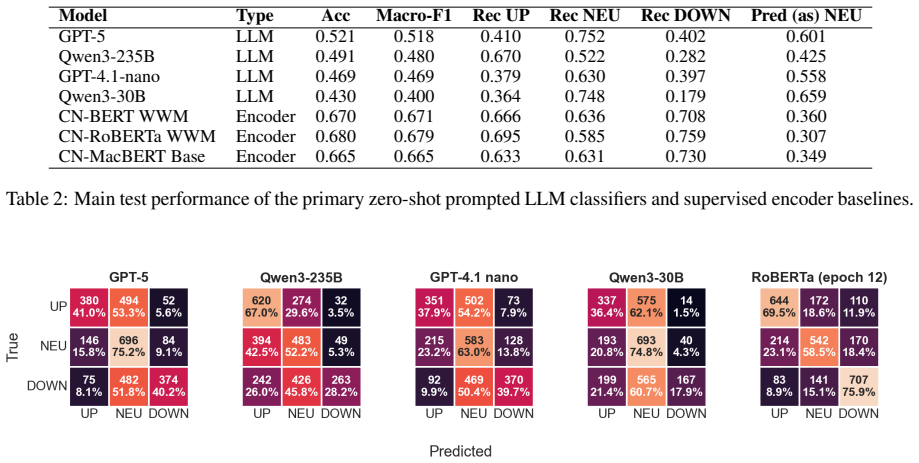
The central claim is that LLMs display a generation-detection mismatch for social comparison: they can create Xiaohongshu-style posts that measurably alter perceived standing and affect, but prompted classifiers fail to identify the triggers reliably, with stable error patterns such as over-neutralization and skew. The XHS-SCoRE benchmark establishes that the underlying signal is textually learnable yet not robustly accessible to prompt-based classification.
What carries the argument
The XHS-SCoRE benchmark, which collects first-person reader judgments labeling posts as upward, downward, or neutral social comparison elicitors, functions as the diagnostic tool to expose the mismatch between fluent generation and fragile prompt-based detection.
If this is right
- AI content generators may produce posts that influence self-perception without built-in ability to flag the mechanism.
- Prompt engineering alone proves insufficient for reliable detection of subtle relational signals in social media text.
- Supervised training on reader-labeled data succeeds where prompting fails, pointing to hybrid detection needs.
- Generated posts can change comparison-related affect even when the model cannot recognize the eliciting features.
Where Pith is reading between the lines
- Content moderation systems relying on prompt-based LLM self-assessment may miss social comparison triggers in generated material.
- Training on reader-grounded labels could help models handle other psychologically subtle cues beyond sentiment.
- The mismatch raises questions about whether generation and detection of social signals require fundamentally different model access methods.
Load-bearing premise
That first-person reader labels on Xiaohongshu posts accurately capture the stable psychological experience of social comparison rather than artifacts from the platform or labeling process.
What would settle it
A controlled test in which prompted LLMs classify XHS-SCoRE posts with accuracy matching or exceeding supervised in-domain baselines, or in which LLM-generated posts produce no measurable shift in readers' perceived standing or affect.
Figures
read the original abstract
We introduce Xiaohongshu Social Comparison Reader Elicitation (XHS-SCoRE), a reader-grounded benchmark for detecting if a text-only Xiaohongshu (RedNote) post elicits UPWARD, DOWNWARD, or NEUTRAL/no clear social comparison from a first-person reader perspective. The task targets a socially meaningful relational signal that is behaviorally real yet not reducible to sentiment. Across prompted LLM classifiers and supervised Chinese encoder baselines, we find a consistent mismatch between generation fluency and reliable detection ability: the signal is textually learnable in-domain, but not robustly accessible to prompt-based classification. Prompted LLM classifiers exhibit stable, interpretable failure modes, especially neutralization of comparison-triggering posts and model-specific directional skew. A controlled pilot further shows that LLM-generated Xiaohongshu-style posts can shift perceived standing and comparison-related affect even when prompt-based detection of the same construct remains fragile. XHS-SCoRE contributes both a benchmark for reader-grounded comparison detection and a diagnostic framework for studying when socially meaningful relational cues remain only partially visible to prompt-based inference.
Editorial analysis
A structured set of objections, weighed in public.
Referee Report
Summary. The paper introduces the XHS-SCoRE benchmark consisting of Xiaohongshu (RedNote) posts labeled by first-person readers for eliciting upward, downward, or neutral social comparison. It reports that supervised Chinese encoder models learn the in-domain signal while prompted LLMs exhibit consistent failure modes (e.g., neutralization and directional skew) and cannot reliably detect it, despite a pilot showing that LLM-generated posts can still shift perceived standing and comparison-related affect.
Significance. If the reader labels validly index the intended psychological construct rather than platform artifacts, the work demonstrates a clear dissociation between LLMs' generative fluency and their prompt-based access to subtle relational signals. It supplies a new reader-grounded benchmark and diagnostic framework for studying partial visibility of psychologically meaningful cues, with credit due for the empirical mismatch finding and the controlled pilot design.
major comments (2)
- [Benchmark construction] Benchmark construction section: no inter-rater reliability, label distribution, test-retest stability, or correlation with established instruments (e.g., INCOM) is reported for the first-person XHS-SCoRE annotations. This is load-bearing because the central generation-detection mismatch claim and the supervised-model success both presuppose that the labels capture stable psychological social-comparison elicitation rather than annotation artifacts or Xiaohongshu stylistic regularities.
- [Pilot study] Pilot study section: the abstract and summary provide no details on sample size, statistical tests, confound controls, or how affect shifts were measured. Without these, the claim that LLM-generated posts shift comparison-related affect cannot be evaluated and remains preliminary, weakening the contrast with detection fragility.
minor comments (2)
- [Abstract] Abstract: the phrase 'stable, interpretable failure modes' is used without a concrete example (e.g., neutralization rate or skew direction); adding one would improve immediate clarity.
- [Terminology] Terminology: ensure 'UPWARD', 'DOWNWARD', and 'NEUTRAL' are defined once and used consistently in all tables and figures.
Simulated Author's Rebuttal
We thank the referee for their constructive and detailed feedback. We address each major comment below, clarifying our methodological choices and indicating where revisions will be made to improve transparency.
read point-by-point responses
-
Referee: Benchmark construction section: no inter-rater reliability, label distribution, test-retest stability, or correlation with established instruments (e.g., INCOM) is reported for the first-person XHS-SCoRE annotations. This is load-bearing because the central generation-detection mismatch claim and the supervised-model success both presuppose that the labels capture stable psychological social-comparison elicitation rather than annotation artifacts or Xiaohongshu stylistic regularities.
Authors: We agree that greater transparency on the annotation process is warranted. In the revised manuscript we will report the full label distribution across UPWARD, DOWNWARD, and NEUTRAL categories. Inter-rater reliability statistics are not reported because the design intentionally collects first-person reader annotations; each label reflects an individual reader's subjective experience of comparison elicitation rather than an objective property of the post. Traditional IRR metrics are therefore not the appropriate validation criterion, and we will add an explicit discussion of this reader-grounded rationale in the limitations section. Test-retest stability and correlations with instruments such as INCOM were not collected in the present study; we will state this limitation clearly and identify it as a valuable direction for future validation. The fact that supervised Chinese encoders achieve strong in-domain performance nevertheless indicates that the labels encode a learnable signal that goes beyond platform-specific stylistic regularities. revision: partial
-
Referee: Pilot study section: the abstract and summary provide no details on sample size, statistical tests, confound controls, or how affect shifts were measured. Without these, the claim that LLM-generated posts shift comparison-related affect cannot be evaluated and remains preliminary, weakening the contrast with detection fragility.
Authors: We appreciate the referee highlighting the need for fuller reporting. Although the full manuscript contains the pilot details, the abstract and summary sections are indeed too terse. In the revision we will expand both the abstract and the dedicated pilot-study subsection to specify the sample size (N=50), the pre-post measurement of perceived standing and comparison-related affect, the use of paired statistical tests, and the confound controls (post length, topic category, and presentation order). These additions will allow readers to evaluate the pilot results directly and will strengthen the reported dissociation between generative capability and prompt-based detection. revision: yes
Circularity Check
No circularity: empirical benchmark and evaluation are externally grounded
full rationale
The paper constructs XHS-SCoRE from independent first-person reader annotations on Xiaohongshu posts and then reports direct empirical comparisons between prompted LLM classifiers and supervised Chinese encoder baselines. No equations or parameters are fitted and then relabeled as predictions; no self-citations supply load-bearing uniqueness theorems or ansatzes; the central mismatch claim is an observed performance gap on the externally labeled data rather than a definitional or self-referential reduction. The derivation chain consists of standard benchmark creation followed by standard model evaluation and remains self-contained against external reader judgments.
Axiom & Free-Parameter Ledger
axioms (1)
- domain assumption Social comparison is a distinct relational signal separable from sentiment and reliably reportable by readers in first-person terms.
Reference graph
Works this paper leans on
-
[1]
Proceedings of the 21st Workshop of Young Researchers' Roundtable on Spoken Dialogue Systems. 2025
2025
-
[2]
Research on LLM s-Empowered Conversational AI for Sustainable Behaviour Change
Chen, Ben. Research on LLM s-Empowered Conversational AI for Sustainable Behaviour Change. Proceedings of the 21st Workshop of Young Researchers' Roundtable on Spoken Dialogue Systems. 2025
2025
-
[3]
Deep Reinforcement Learning of LLM s using RLHF
Levandovsky, Enoch. Deep Reinforcement Learning of LLM s using RLHF. Proceedings of the 21st Workshop of Young Researchers' Roundtable on Spoken Dialogue Systems. 2025
2025
-
[4]
Conversational Collaborative Robots
Kranti, Chalamalasetti. Conversational Collaborative Robots. Proceedings of the 21st Workshop of Young Researchers' Roundtable on Spoken Dialogue Systems. 2025
2025
-
[5]
Dialogue System using Large Language Model-based Dynamic Slot Generation
Hashimoto, Ekai. Dialogue System using Large Language Model-based Dynamic Slot Generation. Proceedings of the 21st Workshop of Young Researchers' Roundtable on Spoken Dialogue Systems. 2025
2025
-
[6]
Towards Adaptive Human-Agent Collaboration in Real-Time Environments
Nakae, Kaito. Towards Adaptive Human-Agent Collaboration in Real-Time Environments. Proceedings of the 21st Workshop of Young Researchers' Roundtable on Spoken Dialogue Systems. 2025
2025
-
[7]
Towards Human-Like Dialogue Systems: Integrating Multimodal Emotion Recognition and Non-Verbal Cue Generation
Jiang, Jingjing. Towards Human-Like Dialogue Systems: Integrating Multimodal Emotion Recognition and Non-Verbal Cue Generation. Proceedings of the 21st Workshop of Young Researchers' Roundtable on Spoken Dialogue Systems. 2025
2025
-
[8]
Controlling Dialogue Systems with Graph-Based Structures
Hilgendorf, Laetitia Mina. Controlling Dialogue Systems with Graph-Based Structures. Proceedings of the 21st Workshop of Young Researchers' Roundtable on Spoken Dialogue Systems. 2025
2025
-
[9]
Multimodal Agentic Dialogue Systems for Situated Human-Robot Interaction
Sucal, Virgile. Multimodal Agentic Dialogue Systems for Situated Human-Robot Interaction. Proceedings of the 21st Workshop of Young Researchers' Roundtable on Spoken Dialogue Systems. 2025
2025
-
[10]
Knowledge Graphs and Representational Models for Dialogue Systems
Walker, Nicholas Thomas. Knowledge Graphs and Representational Models for Dialogue Systems. Proceedings of the 21st Workshop of Young Researchers' Roundtable on Spoken Dialogue Systems. 2025
2025
-
[11]
Proceedings of the 1st Joint Workshop on Large Language Models and Structure Modeling (XLLM 2025). 2025. doi:10.18653/v1/2025.xllm-1.0
-
[12]
Efeoglu, Sefika and Paschke, Adrian. Fine-Tuning Large Language Models for Relation Extraction within a Retrieval-Augmented Generation Framework. Proceedings of the 1st Joint Workshop on Large Language Models and Structure Modeling (XLLM 2025). 2025. doi:10.18653/v1/2025.xllm-1.1
-
[13]
Benchmarking Table Extraction: Multimodal LLM s vs Traditional OCR
Nunes, Guilherme and Rolla, Vitor and Pereira, Duarte and Alves, Vasco and Carreiro, Andre and Baptista, M \'a rcia. Benchmarking Table Extraction: Multimodal LLM s vs Traditional OCR. Proceedings of the 1st Joint Workshop on Large Language Models and Structure Modeling (XLLM 2025). 2025. doi:10.18653/v1/2025.xllm-1.2
-
[14]
Injecting Structured Knowledge into LLM s via Graph Neural Networks
Li, Zichao and Ke, Zong and Zhao, Puning. Injecting Structured Knowledge into LLM s via Graph Neural Networks. Proceedings of the 1st Joint Workshop on Large Language Models and Structure Modeling (XLLM 2025). 2025. doi:10.18653/v1/2025.xllm-1.3
-
[15]
Regular-pattern-sensitive CRF s for Distant Label Interactions
Papay, Sean and Klinger, Roman and Pad \'o , Sebastian. Regular-pattern-sensitive CRF s for Distant Label Interactions. Proceedings of the 1st Joint Workshop on Large Language Models and Structure Modeling (XLLM 2025). 2025. doi:10.18653/v1/2025.xllm-1.4
-
[16]
Swarup, Anushka and Bhandarkar, Avanti and Wilson, Ronald and Pan, Tianyu and Woodard, Damon. From Syntax to Semantics: Evaluating the Impact of Linguistic Structures on LLM -Based Information Extraction. Proceedings of the 1st Joint Workshop on Large Language Models and Structure Modeling (XLLM 2025). 2025. doi:10.18653/v1/2025.xllm-1.5
-
[17]
Detecting Referring Expressions in Visually Grounded Dialogue with Autoregressive Language Models
Willemsen, Bram and Skantze, Gabriel. Detecting Referring Expressions in Visually Grounded Dialogue with Autoregressive Language Models. Proceedings of the 1st Joint Workshop on Large Language Models and Structure Modeling (XLLM 2025). 2025. doi:10.18653/v1/2025.xllm-1.6
-
[18]
Exploring Multilingual Probing in Large Language Models: A Cross-Language Analysis
Li, Daoyang and Zhao, Haiyan and Zeng, Qingcheng and Du, Mengnan. Exploring Multilingual Probing in Large Language Models: A Cross-Language Analysis. Proceedings of the 1st Joint Workshop on Large Language Models and Structure Modeling (XLLM 2025). 2025. doi:10.18653/v1/2025.xllm-1.7
-
[19]
Self-Contrastive Loop of Thought Method for Text-to- SQL Based on Large Language Model
Kang, Fengrui and Tan, Mingxi and Huang, Xianying and Yang, Shiju. Self-Contrastive Loop of Thought Method for Text-to- SQL Based on Large Language Model. Proceedings of the 1st Joint Workshop on Large Language Models and Structure Modeling (XLLM 2025). 2025. doi:10.18653/v1/2025.xllm-1.8
-
[20]
Isaeva, Ulyana and Astafurov, Danil and Martynov, Nikita. Combining Automated and Manual Data for Effective Downstream Fine-Tuning of Transformers for Low-Resource Language Applications. Proceedings of the 1st Joint Workshop on Large Language Models and Structure Modeling (XLLM 2025). 2025. doi:10.18653/v1/2025.xllm-1.9
-
[21]
Bartkowiak, Patryk and Grali \'n ski, Filip. Seamlessly Integrating Tree-Based Positional Embeddings into Transformer Models for Source Code Representation. Proceedings of the 1st Joint Workshop on Large Language Models and Structure Modeling (XLLM 2025). 2025. doi:10.18653/v1/2025.xllm-1.10
-
[22]
Enhancing AMR Parsing with Group Relative Policy Optimization
Barta, Botond and Hamerlik, Endre and Nyist, Mil \'a n and Ito, Masato and Acs, Judit. Enhancing AMR Parsing with Group Relative Policy Optimization. Proceedings of the 1st Joint Workshop on Large Language Models and Structure Modeling (XLLM 2025). 2025. doi:10.18653/v1/2025.xllm-1.11
-
[23]
Structure Modeling Approach for UD Parsing of Historical M odern J apanese
Ozaki, Hiroaki and Omura, Mai and Komiya, Kanako and Asahara, Masayuki and Ogiso, Toshinobu. Structure Modeling Approach for UD Parsing of Historical M odern J apanese. Proceedings of the 1st Joint Workshop on Large Language Models and Structure Modeling (XLLM 2025). 2025. doi:10.18653/v1/2025.xllm-1.12
-
[24]
BARTABSA ++: Revisiting BARTABSA with Decoder LLM s
Pfister, Jan and V. BARTABSA ++: Revisiting BARTABSA with Decoder LLM s. Proceedings of the 1st Joint Workshop on Large Language Models and Structure Modeling (XLLM 2025). 2025. doi:10.18653/v1/2025.xllm-1.13
-
[25]
Typed- RAG : Type-Aware Decomposition of Non-Factoid Questions for Retrieval-Augmented Generation
Lee, DongGeon and Park, Ahjeong and Lee, Hyeri and Nam, Hyeonseo and Maeng, Yunho. Typed- RAG : Type-Aware Decomposition of Non-Factoid Questions for Retrieval-Augmented Generation. Proceedings of the 1st Joint Workshop on Large Language Models and Structure Modeling (XLLM 2025). 2025. doi:10.18653/v1/2025.xllm-1.14
-
[26]
Hellwig, Nils Constantin and Fehle, Jakob and Kruschwitz, Udo and Wolff, Christian. Do we still need Human Annotators? Prompting Large Language Models for Aspect Sentiment Quad Prediction. Proceedings of the 1st Joint Workshop on Large Language Models and Structure Modeling (XLLM 2025). 2025. doi:10.18653/v1/2025.xllm-1.15
-
[27]
Can LLM s Interpret and Leverage Structured Linguistic Representations? A Case Study with AMR s
Raut, Ankush and Zhu, Xiaofeng and Pacheco, Maria Leonor. Can LLM s Interpret and Leverage Structured Linguistic Representations? A Case Study with AMR s. Proceedings of the 1st Joint Workshop on Large Language Models and Structure Modeling (XLLM 2025). 2025. doi:10.18653/v1/2025.xllm-1.16
work page internal anchor Pith review doi:10.18653/v1/2025.xllm-1.16 2025
-
[28]
LLM Dependency Parsing with In-Context Rules
Ginn, Michael and Palmer, Alexis. LLM Dependency Parsing with In-Context Rules. Proceedings of the 1st Joint Workshop on Large Language Models and Structure Modeling (XLLM 2025). 2025. doi:10.18653/v1/2025.xllm-1.17
-
[29]
Han, Xu and Wang, Bo and Sun, Yueheng and Zhao, Dongming and Qu, Zongfeng and He, Ruifang and Hou, Yuexian and Hu, Qinghua. Cognitive Mirroring for D oc RE : A Self-Supervised Iterative Reflection Framework with Triplet-Centric Explicit and Implicit Feedback. Proceedings of the 1st Joint Workshop on Large Language Models and Structure Modeling (XLLM 2025)...
-
[30]
Cross-Document Event-Keyed Summarization
Walden, William and Kuchmiichuk, Pavlo and Martin, Alexander and Jin, Chihsheng and Cao, Angela and Sun, Claire and Allen, Curisia and White, Aaron Steven. Cross-Document Event-Keyed Summarization. Proceedings of the 1st Joint Workshop on Large Language Models and Structure Modeling (XLLM 2025). 2025. doi:10.18653/v1/2025.xllm-1.19
-
[31]
Transfer of Structural Knowledge from Synthetic Languages
Budnikov, Mikhail and Yamshchikov, Ivan. Transfer of Structural Knowledge from Synthetic Languages. Proceedings of the 1st Joint Workshop on Large Language Models and Structure Modeling (XLLM 2025). 2025. doi:10.18653/v1/2025.xllm-1.20
-
[32]
Language Models are Universal Embedders
Zhang, Xin and Li, Zehan and Zhang, Yanzhao and Long, Dingkun and Xie, Pengjun and Zhang, Meishan and Zhang, Min. Language Models are Universal Embedders. Proceedings of the 1st Joint Workshop on Large Language Models and Structure Modeling (XLLM 2025). 2025. doi:10.18653/v1/2025.xllm-1.21
-
[33]
Duan, Shuoqiu and Chen, Xiaoliang and Miao, Duoqian and Gu, Xu and Li, Xianyong and Du, Yajun. D ia DP @ XLLM 25: Advancing C hinese Dialogue Parsing via Unified Pretrained Language Models and Biaffine Dependency Scoring. Proceedings of the 1st Joint Workshop on Large Language Models and Structure Modeling (XLLM 2025). 2025. doi:10.18653/v1/2025.xllm-1.22
-
[34]
Yuan, Jiahao and Sun, Xingzhe and Yu, Xing and Wang, Jingwen and Du, Dehui and Cui, Zhiqing and Di, Zixiang. LLMSR @ XLLM 25: Less is More: Enhancing Structured Multi-Agent Reasoning via Quality-Guided Distillation. Proceedings of the 1st Joint Workshop on Large Language Models and Structure Modeling (XLLM 2025). 2025. doi:10.18653/v1/2025.xllm-1.23
-
[35]
S peech EE @ XLLM 25: End-to-End Structured Event Extraction from Speech
Chaudhuri, Soham and Biswas, Diganta and Saha, Dipanjan and Das, Dipankar and Bandyopadhyay, Sivaji. S peech EE @ XLLM 25: End-to-End Structured Event Extraction from Speech. Proceedings of the 1st Joint Workshop on Large Language Models and Structure Modeling (XLLM 2025). 2025. doi:10.18653/v1/2025.xllm-1.24
-
[36]
Pham Hoang Le, Nguyen and Dinh Thien, An and T. Luu, Son and Van Nguyen, Kiet. D oc IE @ XLLM 25: Z ero S emble - Robust and Efficient Zero-Shot Document Information Extraction with Heterogeneous Large Language Model Ensembles. Proceedings of the 1st Joint Workshop on Large Language Models and Structure Modeling (XLLM 2025). 2025. doi:10.18653/v1/2025.xllm-1.25
-
[37]
Popovic, Nicholas and Kangen, Ashish and Schopf, Tim and F. D oc IE @ XLLM 25: In-Context Learning for Information Extraction using Fully Synthetic Demonstrations. Proceedings of the 1st Joint Workshop on Large Language Models and Structure Modeling (XLLM 2025). 2025. doi:10.18653/v1/2025.xllm-1.26
-
[38]
Tai, Le and Van, Thin. LLMSR @ XLLM 25: Integrating Reasoning Prompt Strategies with Structural Prompt Formats for Enhanced Logical Inference. Proceedings of the 1st Joint Workshop on Large Language Models and Structure Modeling (XLLM 2025). 2025. doi:10.18653/v1/2025.xllm-1.27
-
[39]
Qiu, Chengfeng and Zhou, Lifeng and Wei, Kaifeng and Li, Yuke. D oc IE @ XLLM 25: UIEP rompter: A Unified Training-Free Framework for universal document-level information extraction via Structured Prompt. Proceedings of the 1st Joint Workshop on Large Language Models and Structure Modeling (XLLM 2025). 2025. doi:10.18653/v1/2025.xllm-1.28
-
[40]
Chen, Danchun. LLMSR @ XLLM 25: SWRV : Empowering Self-Verification of Small Language Models through Step-wise Reasoning and Verification. Proceedings of the 1st Joint Workshop on Large Language Models and Structure Modeling (XLLM 2025). 2025. doi:10.18653/v1/2025.xllm-1.29
-
[41]
LLMSR @ XLLM 25: An Empirical Study of LLM for Structural Reasoning
Li, Xinye and Wan, Mingqi and Sui, Dianbo. LLMSR @ XLLM 25: An Empirical Study of LLM for Structural Reasoning. Proceedings of the 1st Joint Workshop on Large Language Models and Structure Modeling (XLLM 2025). 2025. doi:10.18653/v1/2025.xllm-1.30
-
[42]
LLMSR @ XLLM 25: A Language Model-Based Pipeline for Structured Reasoning Data Construction
Xing, Hongrui and Liu, Xinzhang and Jiang, Zhuo and Yang, Zhihao and Yao, Yitong and Wang, Zihan and Deng, Wenmin and Wang, Chao and Song, Shuangyong and Yang, Wang and He, Zhongjiang and Li, Yongxiang. LLMSR @ XLLM 25: A Language Model-Based Pipeline for Structured Reasoning Data Construction. Proceedings of the 1st Joint Workshop on Large Language Model...
-
[43]
S peech EE @ XLLM 25: Retrieval-Enhanced Few-Shot Prompting for Speech Event Extraction
Gedeon, M \'a t \'e. S peech EE @ XLLM 25: Retrieval-Enhanced Few-Shot Prompting for Speech Event Extraction. Proceedings of the 1st Joint Workshop on Large Language Models and Structure Modeling (XLLM 2025). 2025. doi:10.18653/v1/2025.xllm-1.32
-
[44]
Computational Sanskrit and Digital Humanities - World Sanskrit Conference 2025. 2025
2025
-
[45]
An introduction to computational identification and classification of Upam \= a alaṇk \= a ra
Jadhav, Bhakti and Dutta, Himanshu and Kanitkar, Shruti and Kulkarni, Malhar and Bhattacharyya, Pushpak. An introduction to computational identification and classification of Upam \= a alaṇk \= a ra. Computational Sanskrit and Digital Humanities - World Sanskrit Conference 2025. 2025
2025
-
[46]
Aesthetics of S anskrit Poetry from the Perspective of Computational Linguistics: A Case Study Analysis on \'S ikṣ \= a ṣṭaka
Sandhan, Jivnesh and Barbadikar, Amruta and Maity, Malay and Satuluri, Pavankumar and Sandhan, Tushar and Gupta, Ravi M and Goyal, Pawan and Behera, Laxmidhar. Aesthetics of S anskrit Poetry from the Perspective of Computational Linguistics: A Case Study Analysis on \'S ikṣ \= a ṣṭaka. Computational Sanskrit and Digital Humanities - World Sanskrit Confere...
2025
-
[47]
Itaretara Dvandva: A challenge for Dependency Tree semantics
Kulkarni, Amba and Neelamana, Vasudha. Itaretara Dvandva: A challenge for Dependency Tree semantics. Computational Sanskrit and Digital Humanities - World Sanskrit Conference 2025. 2025
2025
-
[48]
A Case Study of Handwritten Text Recognition from Pre-Colonial era S anskrit Manuscripts
Chincholikar, Kartik and Dwivedi, Shagun and Gopalan, Kaushik and Awasthi, Tarinee. A Case Study of Handwritten Text Recognition from Pre-Colonial era S anskrit Manuscripts. Computational Sanskrit and Digital Humanities - World Sanskrit Conference 2025. 2025
2025
-
[49]
Towards Accent-Aware V edic S anskrit Optical Character Recognition Based on Transformer Models
Tsukagoshi, Yuzuki and Kuroiwa, Ryo and Ohmukai, Ikki. Towards Accent-Aware V edic S anskrit Optical Character Recognition Based on Transformer Models. Computational Sanskrit and Digital Humanities - World Sanskrit Conference 2025. 2025
2025
-
[50]
Vedavani: A Benchmark Corpus for ASR on V edic S anskrit Poetry
Kumar, Sujeet and Ray, Pretam and Beerukuri, Abhinay and Kamoji, Shrey and Jagadeeshan, Manoj Balaji and Goyal, Pawan. Vedavani: A Benchmark Corpus for ASR on V edic S anskrit Poetry. Computational Sanskrit and Digital Humanities - World Sanskrit Conference 2025. 2025
2025
-
[51]
Compound Type Identification in S anskrit
Krishnan, Sriram and Satuluri, Pavankumar and Barbadikar, Amruta and Prasanna Venkatesh, T S and Kulkarni, Amba. Compound Type Identification in S anskrit. Computational Sanskrit and Digital Humanities - World Sanskrit Conference 2025. 2025
2025
-
[52]
IKML : A Markup Language for Collaborative Semantic Annotation of I ndic Texts
Lakkundi, Chaitanya S and Rajaraman, Gopalakrishnan and Susarla, Sai Rama Krishna. IKML : A Markup Language for Collaborative Semantic Annotation of I ndic Texts. Computational Sanskrit and Digital Humanities - World Sanskrit Conference 2025. 2025
2025
-
[53]
Challenges in Processing V edic S anskrit: Towards creating a normalized dataset for the Ṛgveda-saṃhit \= a
Krishnan, Sriram and Gayathri, Sepuri and Kulkarni, Amba. Challenges in Processing V edic S anskrit: Towards creating a normalized dataset for the Ṛgveda-saṃhit \= a. Computational Sanskrit and Digital Humanities - World Sanskrit Conference 2025. 2025
2025
-
[54]
P \= a ṇḍitya: Visualizing S anskrit Intellectual Networks
Neill, Tyler. P \= a ṇḍitya: Visualizing S anskrit Intellectual Networks. Computational Sanskrit and Digital Humanities - World Sanskrit Conference 2025. 2025
2025
-
[55]
Anveshana: A New Benchmark Dataset for Cross-Lingual Information Retrieval on E nglish Queries and S anskrit Documents
Jagadeeshan, Manoj Balaji and Raj, Prince and Goyal, Pawan. Anveshana: A New Benchmark Dataset for Cross-Lingual Information Retrieval on E nglish Queries and S anskrit Documents. Computational Sanskrit and Digital Humanities - World Sanskrit Conference 2025. 2025
2025
-
[56]
Concordance of S anskrit Synonyms
Patel, Dhaval. Concordance of S anskrit Synonyms. Computational Sanskrit and Digital Humanities - World Sanskrit Conference 2025. 2025
2025
-
[57]
Proceedings of the First Workshop on Writing Aids at the Crossroads of AI, Cognitive Science and NLP (WRAICOGS 2025). 2025
2025
-
[58]
Chain-of- M eta W riting: Linguistic and Textual Analysis of How Small Language Models Write Young Students Texts
Buhnila, Ioana and Cislaru, Georgeta and Todirascu, Amalia. Chain-of- M eta W riting: Linguistic and Textual Analysis of How Small Language Models Write Young Students Texts. Proceedings of the First Workshop on Writing Aids at the Crossroads of AI, Cognitive Science and NLP (WRAICOGS 2025). 2025
2025
-
[59]
Semantic Masking in a Needle-in-a-haystack Test for Evaluating Large Language Model Long-Text Capabilities
Shi, Ken and Penn, Gerald. Semantic Masking in a Needle-in-a-haystack Test for Evaluating Large Language Model Long-Text Capabilities. Proceedings of the First Workshop on Writing Aids at the Crossroads of AI, Cognitive Science and NLP (WRAICOGS 2025). 2025
2025
-
[60]
Reading Between the Lines: A dataset and a study on why some texts are tougher than others
Khallaf, Nouran and Eugeni, Carlo and Sharoff, Serge. Reading Between the Lines: A dataset and a study on why some texts are tougher than others. Proceedings of the First Workshop on Writing Aids at the Crossroads of AI, Cognitive Science and NLP (WRAICOGS 2025). 2025
2025
-
[61]
P ara R ev : Building a dataset for Scientific Paragraph Revision annotated with revision instruction
Jourdan, L \'e ane and Boudin, Florian and Dufour, Richard and Hernandez, Nicolas and Aizawa, Akiko. P ara R ev : Building a dataset for Scientific Paragraph Revision annotated with revision instruction. Proceedings of the First Workshop on Writing Aids at the Crossroads of AI, Cognitive Science and NLP (WRAICOGS 2025). 2025
2025
-
[62]
Towards an operative definition of creative writing: a preliminary assessment of creativeness in AI and human texts
Maggi, Chiara and Vitaletti, Andrea. Towards an operative definition of creative writing: a preliminary assessment of creativeness in AI and human texts. Proceedings of the First Workshop on Writing Aids at the Crossroads of AI, Cognitive Science and NLP (WRAICOGS 2025). 2025
2025
-
[63]
Decoding Semantic Representations in the Brain Under Language Stimuli with Large Language Models
Sato, Anna and Kobayashi, Ichiro. Decoding Semantic Representations in the Brain Under Language Stimuli with Large Language Models. Proceedings of the First Workshop on Writing Aids at the Crossroads of AI, Cognitive Science and NLP (WRAICOGS 2025). 2025
2025
-
[64]
Proceedings of the 5th Wordplay: When Language meets Games Workshop (Wordplay 2025). 2025. doi:10.18653/v1/2025.wordplay-1.0
-
[65]
Proceedings of the The 9th Workshop on Online Abuse and Harms (WOAH). 2025
2025
-
[66]
A Comprehensive Taxonomy of Bias Mitigation Methods for Hate Speech Detection
Fillies, Jan and Wawerek, Marius and Paschke, Adrian. A Comprehensive Taxonomy of Bias Mitigation Methods for Hate Speech Detection. Proceedings of the The 9th Workshop on Online Abuse and Harms (WOAH). 2025
2025
-
[67]
Sensitive Content Classification in Social Media: A Holistic Resource and Evaluation
Antypas, Dimosthenis and Sen, Indira and Perez Almendros, Carla and Camacho-Collados, Jose and Barbieri, Francesco. Sensitive Content Classification in Social Media: A Holistic Resource and Evaluation. Proceedings of the The 9th Workshop on Online Abuse and Harms (WOAH). 2025
2025
-
[68]
From civility to parity: Marxist-feminist ethics for context-aware algorithmic content moderation
Oh, Dayei. From civility to parity: Marxist-feminist ethics for context-aware algorithmic content moderation. Proceedings of the The 9th Workshop on Online Abuse and Harms (WOAH). 2025
2025
-
[69]
A Novel Dataset for Classifying G erman Hate Speech Comments with Criminal Relevance
Kums, Vincent and Meyer, Florian and Pivit, Luisa and Vedenina, Uliana and Wortmann, Jonas and Siegel, Melanie and Labudde, Dirk. A Novel Dataset for Classifying G erman Hate Speech Comments with Criminal Relevance. Proceedings of the The 9th Workshop on Online Abuse and Harms (WOAH). 2025
2025
-
[70]
Learning from Disagreement: Entropy-Guided Few-Shot Selection for Toxic Language Detection
Caselli, Tommaso and Plaza-del-Arco, Flor Miriam. Learning from Disagreement: Entropy-Guided Few-Shot Selection for Toxic Language Detection. Proceedings of the The 9th Workshop on Online Abuse and Harms (WOAH). 2025
2025
-
[71]
Debiasing Static Embeddings for Hate Speech Detection
Sun, Ling and Kim, Soyoung and Dong, Xiao and K. Debiasing Static Embeddings for Hate Speech Detection. Proceedings of the The 9th Workshop on Online Abuse and Harms (WOAH). 2025
2025
-
[72]
Web(er) of Hate: A Survey on How Hate Speech Is Typed
Wang, Luna and Caines, Andrew and Hutchings, Alice. Web(er) of Hate: A Survey on How Hate Speech Is Typed. Proceedings of the The 9th Workshop on Online Abuse and Harms (WOAH). 2025
2025
-
[73]
Think Like a Person Before Responding: A Multi-Faceted Evaluation of Persona-Guided LLM s for Countering Hate Speech
Ngueajio, Mikel and Plaza-del-Arco, Flor Miriam and Chung, Yi-Ling and Rawat, Danda and Cercas Curry, Amanda. Think Like a Person Before Responding: A Multi-Faceted Evaluation of Persona-Guided LLM s for Countering Hate Speech. Proceedings of the The 9th Workshop on Online Abuse and Harms (WOAH). 2025
2025
-
[74]
HODIAT : A Dataset for Detecting Homotransphobic Hate Speech in I talian with Aggressiveness and Target Annotation
Damo, Greta and Cignarella, Alessandra Teresa and Caselli, Tommaso and Patti, Viviana and Nozza, Debora. HODIAT : A Dataset for Detecting Homotransphobic Hate Speech in I talian with Aggressiveness and Target Annotation. Proceedings of the The 9th Workshop on Online Abuse and Harms (WOAH). 2025
2025
-
[75]
Beyond the Binary: Analysing Transphobic Hate and Harassment Online
Talas, Anna and Hutchings, Alice. Beyond the Binary: Analysing Transphobic Hate and Harassment Online. Proceedings of the The 9th Workshop on Online Abuse and Harms (WOAH). 2025
2025
-
[76]
Evading Toxicity Detection with ASCII -art: A Benchmark of Spatial Attacks on Moderation Systems
Berezin, Sergey and Farahbakhsh, Reza and Crespi, Noel. Evading Toxicity Detection with ASCII -art: A Benchmark of Spatial Attacks on Moderation Systems. Proceedings of the The 9th Workshop on Online Abuse and Harms (WOAH). 2025
2025
-
[77]
Debunking with Dialogue? Exploring AI -Generated Counterspeech to Challenge Conspiracy Theories
Lisker, Mareike and Gottschalk, Christina and Mihaljevi \'c , Helena. Debunking with Dialogue? Exploring AI -Generated Counterspeech to Challenge Conspiracy Theories. Proceedings of the The 9th Workshop on Online Abuse and Harms (WOAH). 2025
2025
-
[78]
M isinfo T ele G raph: Network-driven Misinformation Detection for G erman Telegram Messages
Kalkbrenner, Lu and Solopova, Veronika and Zeiler, Steffen and Nickel, Robert and Kolossa, Dorothea. M isinfo T ele G raph: Network-driven Misinformation Detection for G erman Telegram Messages. Proceedings of the The 9th Workshop on Online Abuse and Harms (WOAH). 2025
2025
-
[79]
Catching Stray Balls: Football, fandom, and the impact on digital discourse
Hill, Mark. Catching Stray Balls: Football, fandom, and the impact on digital discourse. Proceedings of the The 9th Workshop on Online Abuse and Harms (WOAH). 2025
2025
-
[80]
e , Justina and Rimkien \
Mandravickait \. e , Justina and Rimkien \. e , Egl \. e and Petkevi c ius, Mindaugas and Songailait \. e , Milita and Zaranka, Eimantas and Krilavi c ius, Tomas. Exploring Hate Speech Detection Models for L ithuanian Language. Proceedings of the The 9th Workshop on Online Abuse and Harms (WOAH). 2025
2025
discussion (0)
Sign in with ORCID, Apple, or X to comment. Anyone can read and Pith papers without signing in.