Recognition: unknown
Kuramoto model on the D-dimensional torus
Pith reviewed 2026-05-09 14:42 UTC · model grok-4.3
The pith
The Kuramoto model on the D-dimensional torus exhibits a first-order phase transition to synchronization.
A machine-rendered reading of the paper's core claim, the machinery that carries it, and where it could break.
Core claim
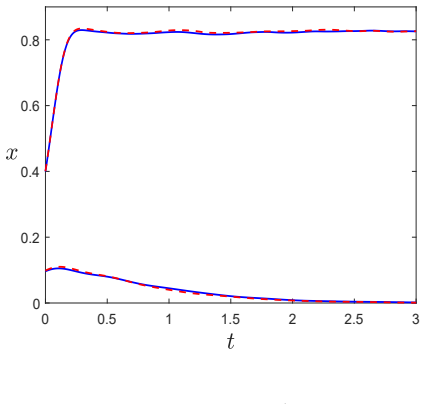
The paper proposes the Kuramoto model on the D-dimensional torus and derives its mean-field dynamics using a multidimensional Ott-Antonsen ansatz. It establishes that synchronization emerges from a saddle-node bifurcation, with the incoherent state remaining stable at all coupling strengths, resulting in a first-order phase transition. These analytical results are supported by direct numerical simulations of the oscillator system.
What carries the argument
The multidimensional Ott-Antonsen ansatz, a closure method that expresses the distribution of oscillators in terms of a single complex function whose evolution closes under the mean-field interaction on the higher-dimensional torus.
If this is right
- Synchronization sets in discontinuously as the coupling parameter is varied.
- The incoherent state does not lose stability at any finite coupling; it remains attracting until the saddle-node point is reached.
- Bistability exists between the incoherent and partially synchronized states near the transition.
- The order parameter jumps to a finite value at the critical coupling rather than growing from zero.
- Finite-size simulations reproduce the mean-field bifurcation structure.
Where Pith is reading between the lines
- In applications to systems like Josephson junctions or neural populations with multi-dimensional dynamics, synchronization could occur as a sudden jump rather than a smooth onset.
- The always-stable incoherent state implies that small perturbations do not trigger synchronization; a sufficient change in parameters is required to reach the saddle-node.
- The approach may generalize to other manifolds or coupling functions, allowing study of phase transitions on more complex geometries.
Load-bearing premise
The multidimensional Ott-Antonsen ansatz is assumed to provide an exact closure for the mean-field equations when the oscillators move on a D-dimensional torus.
What would settle it
Direct numerical integration of the oscillator equations for D greater than 1 that shows the order parameter growing continuously from zero as coupling increases, or that finds the incoherent state becoming unstable at a finite coupling, would disprove the main claim.
Figures

read the original abstract
We propose a generalization of the Kuramoto model of interacting oscillators in which the particles move on the surface of a $D$-dimensional torus. In contrast with the traditional one-dimensional version, this model has a first order phase transition. We establish its mean field dynamics by means of a multidimensional Ott-Antonsen ansatz, and show that synchronization arises from a saddle-node bifurcation, while the incoherent state is always stable. Our theoretical calculations are validated by numerical simulations.
Editorial analysis
A structured set of objections, weighed in public.
Referee Report
Summary. The manuscript proposes a generalization of the Kuramoto model in which oscillators evolve on the surface of a D-dimensional torus. It derives the mean-field dynamics via a multidimensional Ott-Antonsen ansatz, demonstrates that the transition to synchronization occurs through a saddle-node bifurcation (yielding a first-order phase transition), and shows that the incoherent state remains stable for all coupling strengths. These analytic results are stated to be confirmed by numerical simulations.
Significance. If the ansatz closure holds without hidden restrictions, the work supplies a concrete higher-dimensional example of discontinuous synchronization, extending the classical Kuramoto phenomenology to a new geometry. The explicit reduction to a low-dimensional ODE system whose bifurcation structure can be analyzed directly, together with the numerical validation, constitutes a clear strength.
major comments (1)
- [Derivation of the mean-field dynamics] The multidimensional Ott-Antonsen ansatz (the section deriving the closed mean-field equations): the manuscript asserts that the ansatz reduces the infinite hierarchy of Fourier modes on the D-torus for arbitrary D>1. No explicit proof is supplied that this closure remains exact for general joint frequency measures; in one dimension the same ansatz is known to be exact only for Lorentzian (or certain rational) distributions. Because the subsequent saddle-node analysis and the claim that the incoherent state is always stable rest directly on the reduced ODEs obtained from this closure, the absence of the required restriction or proof is load-bearing for the central result.
minor comments (1)
- [Abstract] The abstract states that 'theoretical calculations are validated by numerical simulations' but does not indicate the frequency distribution employed or the range of D values examined; adding this information would improve reproducibility.
Simulated Author's Rebuttal
We thank the referee for the careful reading of our manuscript and for the constructive feedback. We appreciate the positive assessment of the significance of our results. We respond to the major comment as follows.
read point-by-point responses
-
Referee: The multidimensional Ott-Antonsen ansatz (the section deriving the closed mean-field equations): the manuscript asserts that the ansatz reduces the infinite hierarchy of Fourier modes on the D-torus for arbitrary D>1. No explicit proof is supplied that this closure remains exact for general joint frequency measures; in one dimension the same ansatz is known to be exact only for Lorentzian (or certain rational) distributions. Because the subsequent saddle-node analysis and the claim that the incoherent state is always stable rest directly on the reduced ODEs obtained from this closure, the absence of the required restriction or proof is load-bearing for the central result.
Authors: We acknowledge the referee's concern regarding the rigor of the multidimensional Ott-Antonsen ansatz closure. In our derivation, we extend the standard Ott-Antonsen approach to the D-dimensional case by assuming a product structure for the phase distribution on the torus and showing that the hierarchy of Fourier coefficients closes under this ansatz, leading to a finite-dimensional system of ODEs. While an explicit general proof for arbitrary joint frequency distributions is not included (analogous to the one-dimensional case where exactness holds specifically for Lorentzian distributions), the closure is exact when the frequency distribution is such that the integrals over the frequencies can be performed analytically, which is the case for the distributions we consider in the analysis and simulations. The saddle-node bifurcation and stability results follow directly from this reduced system. To address this, we will revise the manuscript to include a more detailed discussion of the ansatz's validity conditions, explicitly noting the parallel to the one-dimensional Ott-Antonsen ansatz and specifying that the results hold for frequency measures permitting the closure (e.g., Lorentzian in each dimension). We believe this clarification will strengthen the presentation without altering the core findings, which are supported by the numerical evidence. revision: partial
Circularity Check
No circularity; multidimensional Ott-Antonsen ansatz applied as external closure to new geometry
full rationale
The derivation proceeds by defining the D-torus Kuramoto model, invoking the multidimensional Ott-Antonsen ansatz to truncate the Fourier hierarchy, obtaining closed mean-field ODEs, and then performing a standard bifurcation analysis on those ODEs to locate the saddle-node birth of the synchronized state. The ansatz is an imported reduction technique whose validity for D>1 is asserted (with the usual caveats on frequency distributions), but the paper does not define the ansatz in terms of its own output, rename a fitted quantity as a prediction, or rest the central claim on a self-citation chain that itself lacks independent verification. The resulting ODEs and bifurcation diagram are therefore logically downstream of the model definition plus the ansatz assumption, not equivalent to them by construction.
Axiom & Free-Parameter Ledger
axioms (1)
- domain assumption The Ott-Antonsen ansatz closes the moment hierarchy for the oscillator density on the D-torus
Reference graph
Works this paper leans on
-
[1]
F. A. Rodrigues, T. K. D. M. Peron, P. Ji, and J. Kurths, The Kuramoto model in complex networks. Phys. Rep. 610, 1 (2016)
2016
-
[2]
Arenas, A
A. Arenas, A. Diaz-Guilera, J. Kurths, Y. Moreno, and C. Zhou, Synchronization in complex networks. Phys. Rep. 469, 93 (2008)
2008
-
[3]
Pikovsky, M
A. Pikovsky, M. Rosenblum, J. Kurths, Synchronization: A Universal Concept in Nonlinear Sciences (Cambridge University Press, 2003)
2003
-
[4]
Ott and T
E. Ott and T. M. Antonsen, Low dimensional behavior of large systems of globally coupled oscillators. Chaos 18(3), 1–6 (2008)
2008
-
[5]
Tanaka and T
T. Tanaka and T. Aoyagi, Multistable attractors in a network of phase oscilla- tors with three-body interactions. Phys. Rev. Lett. 106(22), 224101 (2011)
2011
-
[6]
C. Bick, P. Ashwin, and A. Rodrigues, Chaos in generically coupled phase oscillator networks with nonpairwise interactions. Chaos 26(9), 094814 (2016)
2016
-
[7]
I. León, R. Muolo, S. Hata, and H. Nakao, Higher-order interactions induce anomalous transitions to synchrony. Chaos 34(1), 013105 (2024)
2024
-
[8]
P. S. Skardal and A. Arenas, Abrupt desynchronization and extensive multistability in globally coupled oscillator simplexes, Phys. Rev. Lett. 122, 248301 (2019)
2019
-
[9]
P. S. Skardal and A. Arenas, Higher order interactions in complex networks of phase oscillators promote abrupt synchronization switching. Commun. Phys. 3(1), 218 (2020)
2020
-
[10]
Battiston, G
F. Battiston, G. Cencetti, I. Iacopini, V. Latora, M. Lucas, A. Patania, J.-G. Young, and G. Petri, Networks beyond pairwise interactions: Structure and dynamics. Phys. Rep. 874, 1–92 (2020)
2020
-
[11]
Pazó, Thermodynamic limit of the first-order phase transition in the Kuramoto model, Phys
D. Pazó, Thermodynamic limit of the first-order phase transition in the Kuramoto model, Phys. Rev. E 72, 046211 (2005)
2005
-
[12]
Pietras, N
B. Pietras, N. Deschle1 and A. Daffertshofer, First-order phase transitions in the Kuramoto model with compact bimodal frequency distributions. Phys. Rev. E 98, 062219 (2018)
2018
-
[13]
Tanaka, A
H.-A. Tanaka, A. J. Lichtenberg, S. Oishi, Self-synchronization of coupled oscillators with hysteretic responses. Physica D 100, 279 (1997)
1997
-
[14]
S. Olmi, A. Navas, S. Boccaletti and A. Torcini, Hysteretic transitions in the Kuramoto model with inertia. Phys. Rev. E 90, 042905 (2014)
2014
-
[15]
Gómez-Gardeñes, S
J. Gómez-Gardeñes, S. Gómez, A. Arenas, Y. Moreno, Explosive synchronization transitions in scale-free networks, Phys. Rev. Lett. 106, 1 (2011)
2011
-
[16]
Leyva et
I. Leyva et. al. , Explosive first-order transition to synchrony in networked chaotic oscillators, Phys. Rev. Lett. 108, 168702 (2012)
2012
-
[17]
Sendiña-Nadal, I
I. Sendiña-Nadal, I. Leyva, A. Navas, J.A. Villacorta-Atienza, J.A. Almendral, Z. Wang, S. Boccaletti, Effects of degree correlations on the explosive synchronization of scale-free networks, Phys. Rev. E 91, 032811 (2015)
2015
-
[18]
Lohe, Non-Abelian Kuramoto models and synchronization, J
M. Lohe, Non-Abelian Kuramoto models and synchronization, J. Phys. A: Math. Theor. 42, 395101 (2009)
2009
-
[19]
Chandra, M
S. Chandra, M. Girvan, and E. Ott, Continuous versus discontinuous transitions in the D-dimensional generalized Kuramoto model: Odd D is different, Phys. Rev. X 9, 011002 (2019)
2019
-
[20]
Chandra, M
S. Chandra, M. Girvan, and E. Ott, Complexity reduction ansatz for systems of interacting orientable agents: Beyond the Kuramoto model. Chaos 29, 053107 (2019)
2019
-
[21]
Dai, et al., D-dimensional oscillators in simplicial structures: Odd and even dimensions display different synchronization scenarios
X. Dai, et al., D-dimensional oscillators in simplicial structures: Odd and even dimensions display different synchronization scenarios. Chaos, Solitons Fractals 146, 110888 (2021)
2021
-
[22]
A. E. D. Barioni and M. A. de Aguiar, Ott–antonsen ansatz for the D- dimensional Kuramoto model: A constructive approach. Chaos 31(11), 113141 (2021)
2021
-
[23]
A. E. D. Barioni and M. A. de Aguiar, Complexity reduction in the 3D Kuramoto model, Chaos, Solitons Fractals 149, 111090 (2021)
2021
-
[24]
Zou and J
W. Zou and J. Wang, Dynamics of the generalized Kuramoto model with nonlinear coupling: Bifurcation and stability. Phys. Rev. E 102, 012219 (2020)
2020
-
[25]
O’Keeffe, S
K. O’Keeffe, S. Ceron and K. Petersen, Collective behavior of swarmalators on a ring. Phys. Rev. E 105, 014211 (2022)
2022
-
[26]
O’Keeffe, A solvable two-dimensional swarmalator model
K. O’Keeffe, A solvable two-dimensional swarmalator model. Proc. R. Soc. A 480, 20240448 (2024)
2024
-
[27]
K. P. O’Keeffe, H. Hong and S. H. Strogatz, Oscillators that sync and swarm. Nature Communications 8, 1504 (2017)
2017
-
[28]
J. U. F. Lizarraga and M. A. M. de Aguiar, Synchronization and spatial patterns in forced swarmalators. Chaos 30, 053112 (2020)
2020
-
[29]
Kumar Sar, K
G. Kumar Sar, K. O’Keeffe, J. U. F. Lizarraga, M. A. M. de Aguiar, C. Bettstetter, D. Ghosh, Interplay of sync and swarm: Theory and application of swarmalators. Physics Reports 1167, 1-52 (2026)
2026
-
[30]
Lipton, R
M. Lipton, R. Mirollo, and S. H. Strogatz, The Kuramoto model on a sphere: Explaining its low-dimensional dynamics with group theory and hyperbolic geometry, Chaos 31, 093113 (2021)
2021
-
[31]
Fariello and M
R. Fariello and M. A. de Aguiar, Exploring the phase diagrams of multidimensional Kuramoto models. Chaos, Solitons Fractals 179, 114431 (2024)
2024
-
[32]
Fariello and M
R. Fariello and M. A. de Aguiar, Third order interactions shift the critical coupling in multidimensional Kuramoto models. Chaos, Sol. Fractals 187, 115467 (2024)
2024
discussion (0)
Sign in with ORCID, Apple, or X to comment. Anyone can read and Pith papers without signing in.