Recognition: unknown
Efficient Reconstruction of Arboreal Networks
Pith reviewed 2026-05-09 14:39 UTC · model grok-4.3
The pith
Stack-free arboreal networks can be reconstructed in polynomial time from complete triplet and duet systems.
A machine-rendered reading of the paper's core claim, the machinery that carries it, and where it could break.
Core claim
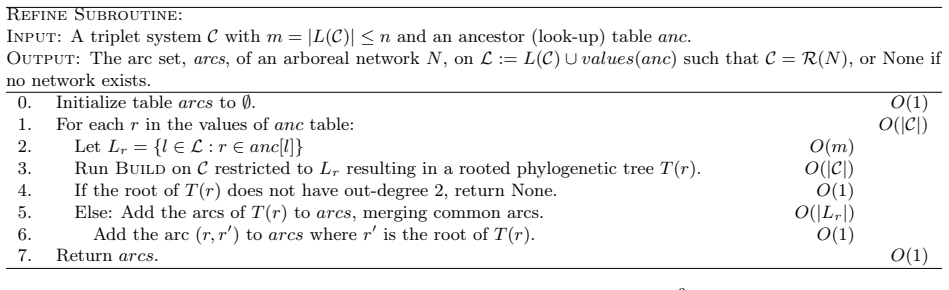
Arboreal networks are multi-rooted phylogenetic networks whose underlying graph is a tree. We give an encoding of stack-free arboreal networks in terms of triplets and the novel concept of a duet. This yields a polynomial time algorithm to construct these networks from complete triplet and duet systems. The classification results show correctness and lead to a natural metric on these multi-rooted networks.
What carries the argument
The triplet-duet encoding of stack-free arboreal networks, which captures all necessary relationships to allow unique reconstruction.
If this is right
- Networks can be built efficiently from partial data.
- Correctness follows from the classification of such encodings.
- A metric for comparing networks arises naturally from the encoding.
Where Pith is reading between the lines
- This method could be adapted for networks with cycles or other structures.
- The polynomial time result suggests scalability to large datasets in practice.
- The natural metric might enable clustering or search in spaces of evolutionary networks.
Load-bearing premise
The networks in question must be stack-free arboreal networks with a tree as the underlying graph, and the input must provide complete triplet and duet systems.
What would settle it
An example of two distinct stack-free arboreal networks that induce identical complete triplet and duet systems would disprove the uniqueness claim.
Figures



read the original abstract
Arboreal networks are multi-rooted phylogenetic networks whose underlying graph is a tree. We give an encoding of stack-free arboreal networks in terms of triplets and the novel concept of a duet. This yields a polynomial time algorithm to construct these networks from complete triplet and duet systems. The classification results show correctness and lead to a natural metric on these multi-rooted networks.
Editorial analysis
A structured set of objections, weighed in public.
Referee Report
Summary. The paper defines arboreal networks as multi-rooted phylogenetic networks whose underlying graph is a tree. It introduces an encoding of stack-free arboreal networks in terms of triplets and the novel 'duet' concept. This encoding is claimed to yield a polynomial-time algorithm for reconstructing the networks from complete triplet and duet systems, with classification results establishing correctness and inducing a natural metric on the networks.
Significance. If the classification and uniqueness results hold, the work provides an efficient reconstruction method for a restricted class of multi-rooted phylogenetic networks together with a metric, which would be a useful contribution to discrete mathematics and computational phylogenetics. The derivation of the algorithm directly from the encoding (rather than presupposing the result) is a positive structural feature.
major comments (2)
- [Abstract] The abstract asserts that the classification results establish correctness of the polynomial-time algorithm, but the provided text gives no details on the classification theorem, its proof, or verification against edge cases such as networks with multiple roots or specific duet configurations; this makes the central claim on uniqueness and reconstruction correctness unverifiable from the given material.
- [Encoding and classification section] The weakest assumption stated (complete triplet-duet systems generated exactly by stack-free arboreal networks with tree underlying graph) matches the scope, but the manuscript must explicitly prove that the encoding is injective within this class; without that injectivity argument (or a counterexample check), the reconstruction algorithm's correctness rests on an unshown step.
minor comments (2)
- The novel term 'duet' requires an explicit formal definition and notation (e.g., as a pair of leaves or edges) in the introductory sections before its use in the encoding.
- Polynomial-time complexity should be accompanied by an explicit big-O bound on the algorithm, referencing the size of the input triplet-duet system.
Simulated Author's Rebuttal
We thank the referee for the careful and constructive review. The comments highlight areas where additional detail will strengthen the presentation of the classification results and the reconstruction algorithm. We address each major comment below and will revise the manuscript accordingly.
read point-by-point responses
-
Referee: [Abstract] The abstract asserts that the classification results establish correctness of the polynomial-time algorithm, but the provided text gives no details on the classification theorem, its proof, or verification against edge cases such as networks with multiple roots or specific duet configurations; this makes the central claim on uniqueness and reconstruction correctness unverifiable from the given material.
Authors: We agree that the abstract and surrounding text would benefit from more explicit detail on the classification theorem. In the revised manuscript we will expand the abstract and the classification section to include the full statement of the theorem, an outline of its proof, and targeted verification for the mentioned edge cases (multiple roots and specific duet configurations). This will make the link between the classification and the correctness of the polynomial-time reconstruction algorithm fully verifiable. revision: yes
-
Referee: [Encoding and classification section] The weakest assumption stated (complete triplet-duet systems generated exactly by stack-free arboreal networks with tree underlying graph) matches the scope, but the manuscript must explicitly prove that the encoding is injective within this class; without that injectivity argument (or a counterexample check), the reconstruction algorithm's correctness rests on an unshown step.
Authors: We accept that an explicit injectivity argument is required. The revised version will contain a dedicated theorem (with proof) establishing that the triplet-duet encoding is injective on the class of stack-free arboreal networks. The proof will show that distinct networks in this class produce distinct complete triplet-duet systems, thereby confirming that the reconstruction algorithm recovers the unique network from any such system. revision: yes
Circularity Check
No significant circularity; derivation is self-contained
full rationale
The paper defines an encoding of stack-free arboreal networks via triplets and the new duet concept, then derives a polynomial-time reconstruction algorithm directly from complete triplet-duet systems. Correctness is established by separate classification results that characterize the networks within the given class (multi-rooted phylogenetic networks with tree underlying graph and no stacks). No step equates a claimed prediction or uniqueness result to its own fitted inputs by construction, nor does any load-bearing premise reduce to a self-citation chain or renamed ansatz. The algorithm and metric follow from the encoding and classification without presupposing the target outputs, rendering the chain independent.
Axiom & Free-Parameter Ledger
axioms (1)
- domain assumption Arboreal networks are multi-rooted phylogenetic networks whose underlying graph is a tree.
invented entities (1)
-
duet
no independent evidence
Reference graph
Works this paper leans on
-
[1]
Bull Math Biol , volume=
Forest-based networks , author=. Bull Math Biol , volume=. 2022 , publisher=
2022
-
[2]
Inf Process Lett , volume=
Is this network proper forest-based? , author=. Inf Process Lett , volume=. 2025 , publisher=
2025
-
[3]
2003 , publisher=
Phylogenetics , author=. 2003 , publisher=
2003
-
[4]
Bryant, David , title =
-
[5]
Aho and Yehoshua Sagiv and Thomas G
Alfred V. Aho and Yehoshua Sagiv and Thomas G. Szymanski and Jeffrey D. Ullman , journal =. Inferring a Tree from Lowest Common Ancestors with an Application to the Optimization of Relational Expressions , volume =
-
[6]
J Theor Biol , volume=
When two trees go to war , author=. J Theor Biol , volume=. 2011 , publisher=
2011
-
[7]
J Math Biol , volume=
On encodings of phylogenetic networks of bounded level , author=. J Math Biol , volume=
-
[8]
Algorithmica , volume=
Encoding and constructing 1-nested phylogenetic networks with trinets , author=. Algorithmica , volume=
-
[9]
Reconstructing phylogenetic level-1 networks from nondense binet and trinet sets
Huber, Katharina T and van Iersel , Leo and Moulton, Vincent and Scornavacca, Celine and Wu, Taoyang. Reconstructing phylogenetic level-1 networks from nondense binet and trinet sets. Algorithmica. 2017
2017
-
[10]
SIAM J Disc Math , volume =
Shared ancestry graphs and symbolic arboreal maps , author =. SIAM J Disc Math , volume =
-
[11]
2011 , publisher=
Basic Phylogenetic Combinatorics , author=. 2011 , publisher=
2011
-
[12]
Syst Biol , volume=
The triples distance for rooted bifurcating phylogenetic trees , author=. Syst Biol , volume=. 1996 , publisher=
1996
-
[13]
Algorithmica , volume=
Computing the rooted triplet distance between phylogenetic networks , author=. Algorithmica , volume=. 2021 , publisher=
2021
-
[14]
J Math Biol , volume=
Trinets encode tree-child and level-2 phylogenetic networks , author=. J Math Biol , volume=
-
[15]
Mol Biol Evol , volume=
TriLoNet: piecing together small networks to reconstruct reticulate evolutionary histories , author=. Mol Biol Evol , volume=
-
[16]
and Popescu, A.-A
Scholz, G.\ E. and Popescu, A.-A. and Taylor, M.I. and Moulton, V. and Huber, K.\ T. , journal=
-
[17]
and Steel, Mike , title =
Francis, Andrew R. and Steel, Mike , title =. Syst Biol , volume =
-
[18]
Jeong and B
H. Jeong and B. Arif and G. Caetano-Anolles and K. M. Kim and A. Nasir. , title =. Scientific Reports , volume =
-
[19]
Huber, Jacobus Koolen, Vincent Moulton, and Andreas Spillner
Basic Phylogenetic Combinatorics.—Andreas Dress, Katharina T. Huber, Jacobus Koolen, Vincent Moulton, and Andreas Spillner. , author=. 2013 , publisher=
2013
discussion (0)
Sign in with ORCID, Apple, or X to comment. Anyone can read and Pith papers without signing in.