Recognition: unknown
Modelling the electrophysiological interactions between human pluripotent cell-derived cardiomyocite grafts and host ventricular tissue
Pith reviewed 2026-05-09 14:27 UTC · model grok-4.3
The pith
A computational framework shows that electrical coupling strength at the graft-host boundary controls whether spontaneous activity in stem-cell grafts can trigger propagating excitation in host heart tissue.
A machine-rendered reading of the paper's core claim, the machinery that carries it, and where it could break.
Core claim
The authors model the graft-host interface as an internal boundary possessing a defined specific conductance that directly corresponds to measurable tissue properties. With this parameterisation they implement the governing equations in both finite-difference and finite-element schemes. In chosen anatomical and physiological configurations they show that increasing interface conductance allows spontaneous graft activity to cross the boundary and initiate propagating excitation throughout the host tissue, whereas weaker coupling keeps the graft activity isolated.
What carries the argument
Graft-host interface represented as an internal boundary with a single specific conductance parameter that sets the strength of electrical coupling between graft and host.
If this is right
- Graft activity remains confined when interface conductance falls below a threshold determined by the model geometry and cell properties.
- Above that threshold the graft functions as an ectopic pacemaker capable of driving host excitation.
- The same framework can be used to test how different graft sizes, shapes or locations alter the conductance threshold for arrhythmia initiation.
- Strategies that deliberately modulate interface conductance become testable targets for reducing post-transplant arrhythmic risk.
Where Pith is reading between the lines
- If the conductance threshold is confirmed, biomaterials or pharmacological agents that tune graft-host coupling could be developed to keep grafts electrically isolated until they mature.
- The boundary-conductance approach may apply to other cell-replacement therapies where donor tissue risks generating ectopic rhythms in host organs.
- Direct patch-clamp or optical mapping measurements of conductance at graft-host junctions in animal models would provide the most immediate test of the model's assumptions.
Load-bearing premise
The real graft-host contact can be represented accurately by a uniform boundary whose conductance is independent of other tissue properties and can be measured in the same units used in the model.
What would settle it
Experimental recordings from transplanted hearts that show no consistent relationship between measured interface conductance and the occurrence of graft-initiated propagating waves in host tissue.
Figures





read the original abstract
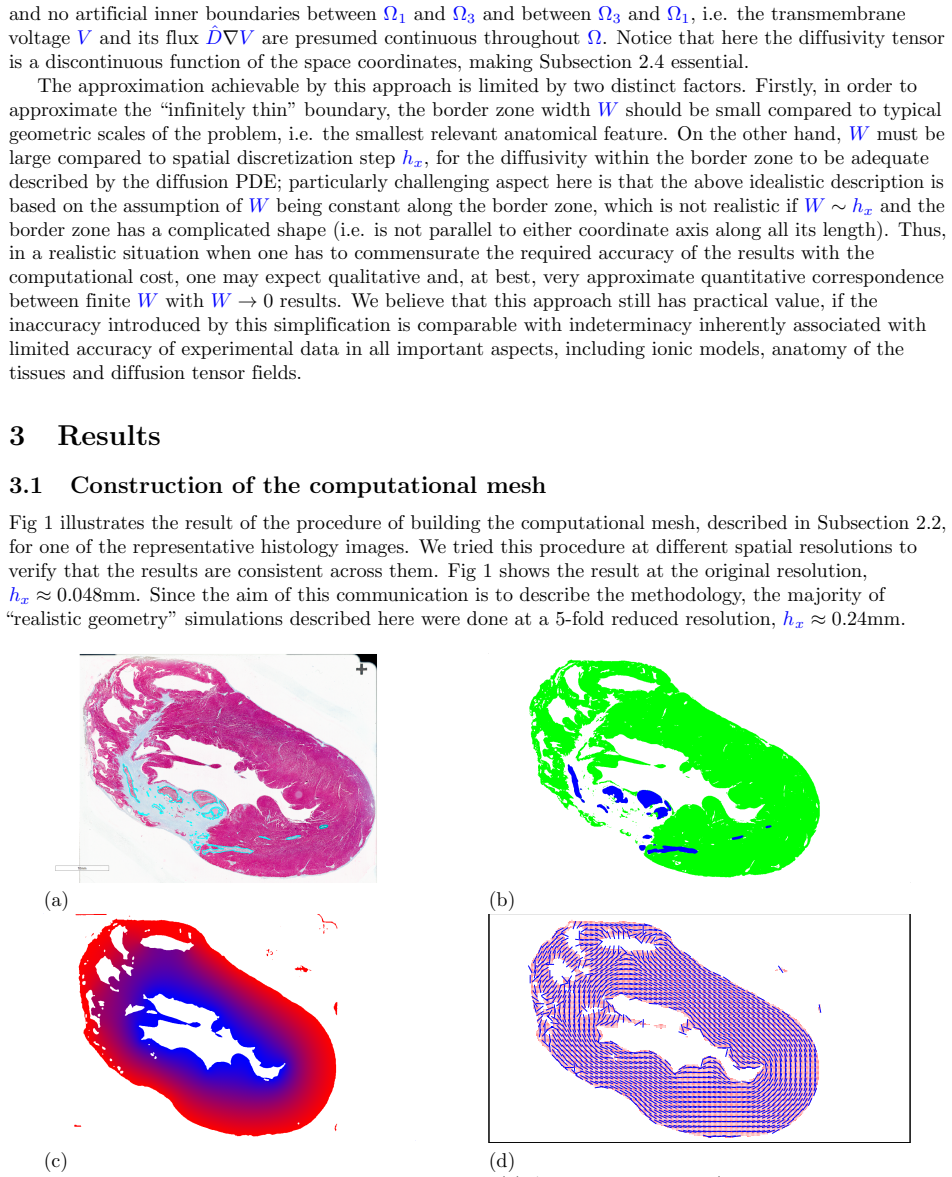
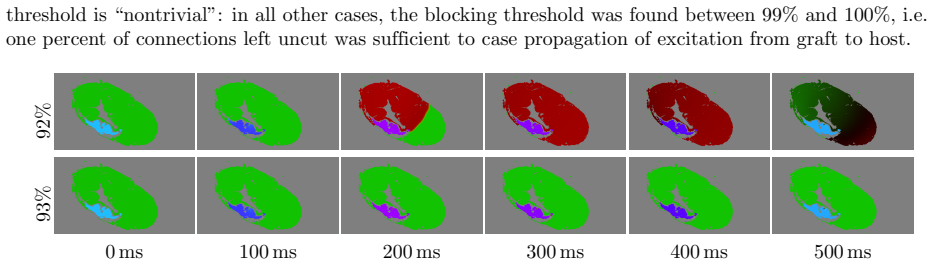
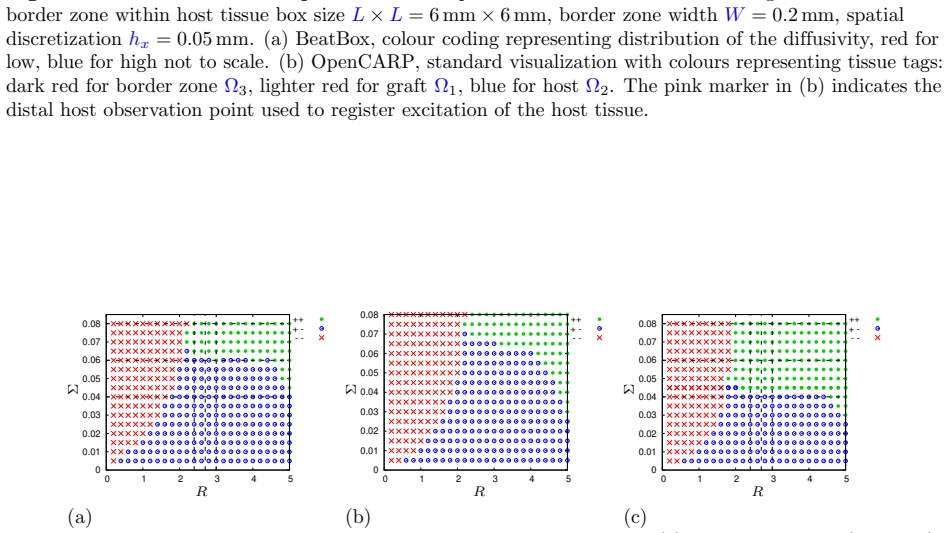
Human pluripotent stem cell-derived cardiomyocytes (hPSC-CMs) are a promising therapy for regenerating myocardium after infarction, but their use is limited by graft-related arrhythmias that frequently occur shortly after transplantation. Experimental studies indicate that these arrhythmias can originate within the graft, which may act as an ectopic pacemaker, yet the mechanisms governing successful excitation of host tissue remain poorly understood. In particular, the role of electrical coupling at the graft-host interface is important, but difficult to measure directly or control. Computer modelling can help here. Here, we present a computational framework that enables systematic investigation of graft-host electrical interactions using a physiologically interpretable parameterisation. We model the graft-host interface as an internal boundary with a defined specific conductance, allowing direct control over coupling strength in units that correspond to measurable tissue properties. We formulate the governing equations and implement the computations using both finite-difference and finite-element discretisations in established cardiac modelling platforms. Using representative anatomical and physiological configurations, we demonstrate how variations in interface conductance influence the ability of spontaneous graft activity to initiate propagating excitation in host tissue. This framework provides a reproducible, mechanistically transparent tool for studying graft-related arrhythmogenesis and lays a foundation for evaluating strategies to mitigate arrhythmic risk in cardiac cell therapy.
Editorial analysis
A structured set of objections, weighed in public.
Referee Report
Summary. The manuscript presents a computational modeling framework for studying electrophysiological interactions between human pluripotent stem cell-derived cardiomyocyte (hPSC-CM) grafts and host ventricular tissue. It models the graft-host interface as an internal boundary with a defined specific conductance parameter (in units corresponding to measurable tissue properties), formulates the governing equations, implements the model using both finite-difference and finite-element discretizations in established cardiac modeling platforms, and uses representative anatomical and physiological configurations to demonstrate how variations in interface conductance affect the ability of spontaneous graft activity to initiate propagating excitation in host tissue.
Significance. If the framework holds, it provides a reproducible, mechanistically transparent tool for investigating graft-related arrhythmogenesis in cardiac cell therapy. The physiologically interpretable parameterization of the interface conductance allows systematic control over coupling strength, addressing a key experimental challenge. Implementation in standard platforms and focus on representative configurations are strengths that could support future evaluation of strategies to mitigate arrhythmic risk.
minor comments (2)
- The title contains a typographical error: 'cardiomyocite' should be spelled 'cardiomyocyte'.
- The abstract and demonstration sections would benefit from a brief summary table of the key parameter values (including the range of interface conductances) used in the representative configurations to improve reproducibility.
Simulated Author's Rebuttal
We thank the referee for their supportive summary of the manuscript and for recommending minor revision. The referee's description accurately reflects the framework's focus on modeling the graft-host interface via a controllable specific conductance parameter and its implementation in standard platforms. No specific major comments were provided in the report.
Circularity Check
No significant circularity
full rationale
The paper introduces a computational framework by extending standard cardiac electrophysiology governing equations with an interface conductance parameter treated as an independent, controllable input (in units corresponding to measurable tissue properties). This parameter is not fitted to or derived from the demonstration outcomes; instead, the work implements the model in established finite-difference and finite-element platforms and runs simulations on representative anatomical/physiological configurations to explore its effects. No load-bearing steps reduce to self-definition, fitted-input predictions, self-citation chains for uniqueness, or smuggled ansatzes. The central contribution is the transparent parameterization and tool itself, which remains self-contained against external benchmarks.
Axiom & Free-Parameter Ledger
free parameters (1)
- interface specific conductance
axioms (2)
- standard math Standard cardiac electrophysiology governing equations (monodomain or bidomain model) apply to both graft and host regions
- domain assumption The graft exhibits spontaneous activity capable of acting as an ectopic pacemaker
Reference graph
Works this paper leans on
-
[1]
Wulkan F, Romagnuolo R, Qiang B, Valdman Sadikov T, Kim KP, Quesnel E, et al. Stem cell-derived cardiomyocytes expressing a dominant negative pacemaker HCN4 channel do not reduce the risk of graft-related arrhythmias. Cardiovasc Med. 2024;11:1374881. Available from: https://pubmed.ncbi.nlm.nih.gov/39045008/. doi:10.3389/fcvm.2024.1374881
-
[2]
Romagnuolo R, Masoudpour H, Porta-S´ anchez A, Qiang B, Barry J, Laskary A, et al. Human Embryonic Stem Cell-Derived Cardiomyocytes Regenerate the Infarcted Pig Heart but Induce Ventricular Tachyarrhythmias. Stem Cell Reports. 2019;12(5):967-81. Available from: https://pubmed.ncbi.nlm.nih.gov/31056479/. doi:10.1016/j.stemcr.2019.04.005
-
[3]
Liu YW, Chen B, Yang X, Fugate JA, Kalucki FA, Futakuchi-Tsuchida A, et al. Human embryonic stem cell-derived cardiomyocytes restore function in infarcted hearts of non-human primates. Nat Biotechnol. 2018;36(7):597-605. Available from:https://pubmed.ncbi.nlm.nih.gov/29969440/. doi:10.1038/nbt.4162
-
[4]
Human embryonic-stem-cell-derived cardiomyocytes regenerate non-human primate hearts
Chong JJ, Yang X, Don CW, Minami E, Liu YW, Weyers JJ, et al. Human embryonic-stem-cell-derived cardiomyocytes regenerate non-human primate hearts. Nature. 2014;510(7504):273-7. Available from:https://pubmed.ncbi.nlm.nih.gov/24776797/. doi:10.1038/nature13233
-
[5]
Selvakumar D, Clayton ZE, Prowse A, Dingwall S, Kim SK, Reyes L, et al. Cellular heterogeneity of pluripotent stem cell-derived cardiomyocyte grafts is mechanistically linked to treatable arrhythmias. Nat Cardiovasc Res. 2024;3(2):145-65. Available from: https://pubmed.ncbi.nlm.nih.gov/39196193/. doi:10.1038/s44161-023-00419-3
-
[6]
Gene editing to prevent ventricular arrhythmias associated with cardiomyocyte cell therapy
Marchiano S, Nakamura K, Reinecke H, Neidig L, Lai M, Kadota S, et al. Gene editing to prevent ventricular arrhythmias associated with cardiomyocyte cell therapy. Cell Stem Cell. 2023;30(4):396-414.e9. Available from:https://pubmed.ncbi.nlm.nih.gov/37028405/. doi:10.1016/j.stem.2023.03.010
-
[7]
Graft–host coupling changes can lead to engraftment arrhythmia: a computational study
Gibbs CE, Marchian´ o S, Zhang K, Yang X, Murry CE, Boyle PM. Graft–host coupling changes can lead to engraftment arrhythmia: a computational study. The Journal of Physiology. 2023;601(13):2733-49
2023
-
[8]
BeatBox — HPC Simulation Environment for Biophysically and Anatomically Realistic Cardiac Electrophysiology
Antonioletti M, Biktashev VN, Jackson A, Kharche SR, Stary T, Biktasheva IV. BeatBox — HPC Simulation Environment for Biophysically and Anatomically Realistic Cardiac Electrophysiology. PLoS ONE. 2017;12(5):e0172292. doi:0.1371/journal.pone.0172292
2017
-
[9]
The openCARP Simulation Environment for Cardiac Electrophysiology
Plank G, Loewe A, Neic A, Augustin C, Huang YLC, Gsell M, et al. The openCARP Simulation Environment for Cardiac Electrophysiology. Computer Methods and Programs in Biomedicine. 2021;208:106223. doi:10.1016/j.cmpb.2021.106223
-
[10]
Alternans and spiral breakup in a human ventricular tissue model
Ten Tusscher KH, Panfilov AV. Alternans and spiral breakup in a human ventricular tissue model. American Journal of Physiology-Heart and Circulatory Physiology. 2006;291(3):H1088-100
2006
-
[11]
Kernik DC, Morotti S, Wu H, Garg P, Duff HJ, Kurokawa J, et al. A computational model of induced pluripotent stem-cell derived cardiomyocytes incorporating experimental variability from multiple data sources. J Physiol. 2019;597.17:4533–4564. doi:10.1113/JP277724
-
[12]
Autowave principles for parallel image processing
Krinsky VI, Biktashev VN, Efimov IR. Autowave principles for parallel image processing. Physica D. 1991;49(1&2):247-53
1991
-
[13]
Modelling of the ventricular conduction system
Ten Tusscher KHWJ, Panfilov AV. Modelling of the ventricular conduction system. Progress in Biophysics & Molecular Biology. 2008;96(1–3):152-70. May 5, 2026 22/23
2008
-
[14]
Finite-difference methods for partial differential equations
Forsythe GE, Wasow WR. Finite-difference methods for partial differential equations. New York, London: John Wiley & Sons, Inc; 1960
1960
-
[15]
The theory of difference schemes
Samarskii AA. The theory of difference schemes. New York, Basel: Marcel Dekker, Inc; 2001
2001
-
[16]
A guide to modelling cardiac electrical activity in anatomically detailed ventricles
Clayton RH, Panfilov AV. A guide to modelling cardiac electrical activity in anatomically detailed ventricles. Progress in Biophysics & Molecular Biology. 2008;96(1–3):19-43
2008
-
[17]
Anisotropic diffusion in image processing
Weickert J. Anisotropic diffusion in image processing. Stuttgart: B. G. Teubner; 1998. Available from: https://www.mia.uni-saarland.de/weickert/Papers/book.pdf
1998
-
[18]
A small stencil and extremum-preserving scheme for anisotropic diffusion problems on arbitrary 2D and 3D meshes
Gao Z, Wu J. A small stencil and extremum-preserving scheme for anisotropic diffusion problems on arbitrary 2D and 3D meshes. Journal of Computational Physics. 2013;250:308-31
2013
-
[19]
Ngo C, Huang W. Monotone Finite Difference Schemes for Anisotropic Diffusion Problems via Nonnegative Directional Splittings. Commun Comput Phys. 2016;19(2):473-95. doi:10.4208/cicp.280315.140815a
-
[20]
Mesh refinement for anisotropic diffusion in magnetized plasmas
Vogl CJ, Joseph I, Holec M. Mesh refinement for anisotropic diffusion in magnetized plasmas. Computers and Mathematics with Applications. 2023;145:159-74. doi:10.1016/j.camwa.2023.06.019
-
[21]
Stencils with isotropic discretization error for differential operators
Patra M, Karttunen M. Stencils with isotropic discretization error for differential operators. Numerical Methods for Partial Differential Equations. 2006;22(4):3-7. doi:10.1002/num.20129
-
[22]
Spiral-wave dynamics in a simple model of excitable media: The transition from simple to compound rotation
Barkley D, Kness M, Tuckerman LS. Spiral-wave dynamics in a simple model of excitable media: The transition from simple to compound rotation. Physical Review A. 1990;42(4)
1990
-
[23]
Gibbs CE, Boyle PM. Accelerated Intrinsic Beating Rate in Heterogeneously Coupled Human Pluripotent Stem Cell-Derived Cardiomyocytes Can Underlie Focal Ventricular Tachycardia in Regenerative Therapy. The Journal of Precision Medicine: Health and Disease. 2026. doi:10.1016/j.premed.2026.100035
-
[24]
Pharmacologic therapy for engraftment arrhythmia induced by transplantation of human cardiomyocytes
Nakamura K, Neidig LE, Yang X, Weber GJ, El-Nachef D, Tsuchida H, et al. Pharmacologic therapy for engraftment arrhythmia induced by transplantation of human cardiomyocytes. Stem Cell Reports. 2021;16(10):2473-87. Available from:https://pubmed.ncbi.nlm.nih.gov/34506727/. doi:10.1016/j.stemcr.2021.08.005. May 5, 2026 23/23
discussion (0)
Sign in with ORCID, Apple, or X to comment. Anyone can read and Pith papers without signing in.