Recognition: unknown
Comparing RM123 and non-perturbative QCD+QED approaches to the HVP with C-periodic boundary conditions
Pith reviewed 2026-05-09 14:22 UTC · model grok-4.3
The pith
Simulating the full QCD+QED distribution yields smaller uncertainties than the RM123 approach for the intermediate-window HVP at fixed lattice spacing and volume.
A machine-rendered reading of the paper's core claim, the machinery that carries it, and where it could break.
Core claim
In computations of the intermediate window for a flavour non-singlet current, the full QCD+QED distribution gives smaller uncertainties than RM123 when sea-quark effects are included in both, at fixed lattice spacing and volume with N_f=1+2+1 fermions and C-periodic boundaries.
What carries the argument
C-periodic spatial boundary conditions applied to both the RM123 and full non-perturbative QCD+QED methods for computing isospin-breaking corrections to the flavour non-singlet HVP.
Load-bearing premise
That a comparison performed at a single fixed lattice spacing and volume is sufficient to establish the relative precision advantage of full QCD+QED over RM123 without significant contamination from discretization or finite-volume effects.
What would settle it
Repeating the full comparison at a finer lattice spacing or larger volume and checking whether the uncertainty advantage of the direct QCD+QED simulation persists.
Figures

read the original abstract
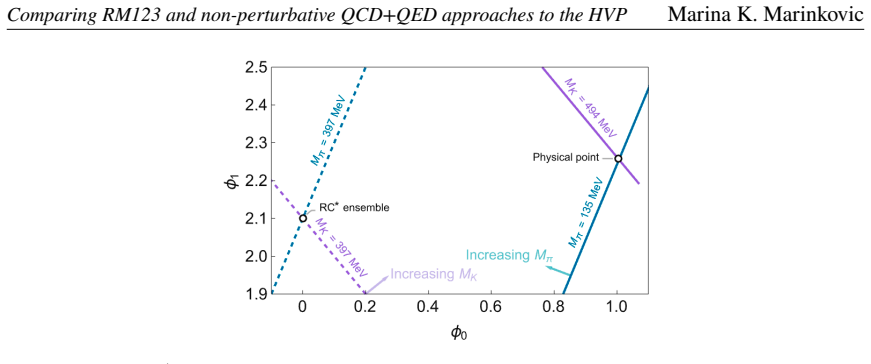
Isospin-breaking corrections to the HVP are among the leading sources of uncertainty in the Standard Model prediction of the muon $g-2$. In recent work by the RC$^{\star}$ collaboration, we compute the intermediate window contribution for a flavour non-singlet current using two strategies to include isospin-breaking corrections: the RM123 approach and a fully non-perturbative dynamical QCD+QED simulation. In both computations, we use $C$-periodic spatial boundary conditions to ensure that locality, gauge invariance, and translational invariance are preserved throughout the calculation. At fixed lattice spacing and volume with $N_f =1+2+1$ dynamical fermions, and fully including sea-quark effects in both computations, we find that simulating the full QCD+QED distribution yields smaller uncertainties for a fixed statistics. We summarize the comparison of the two approaches and discuss the implications for future lattice QCD+QED computations.
Editorial analysis
A structured set of objections, weighed in public.
Referee Report
Summary. The manuscript compares the RM123 perturbative approach and a fully non-perturbative dynamical QCD+QED simulation for including isospin-breaking corrections to the intermediate-window contribution of the hadronic vacuum polarization (HVP) for a flavour non-singlet current. Both calculations employ C-periodic spatial boundary conditions, N_f=1+2+1 dynamical fermions, and fully include sea-quark effects. At one fixed lattice spacing and volume, the authors report that the full QCD+QED ensemble produces smaller uncertainties than RM123 for the same statistics.
Significance. If the reported precision advantage holds, the result is significant for guiding methodological choices in future high-precision lattice computations of isospin-breaking effects relevant to the muon g-2. The explicit inclusion of sea-quark effects in both methods and the use of C-periodic boundary conditions to preserve locality, gauge invariance, and translational invariance are clear strengths that strengthen the direct numerical comparison.
major comments (2)
- [Results and comparison section] The central numerical finding is obtained at a single fixed lattice spacing and volume. This leaves the observed reduction in uncertainty vulnerable to method-dependent contamination from O(a²) discretization effects or finite-volume effects, since the perturbative expansion in RM123 and the exact inclusion in the QCD+QED measure can propagate lattice artifacts differently into the variance of the HVP window (see the skeptic's note on the weakest assumption).
- [Numerical results and error analysis] The support for the claim of smaller uncertainties rests on the detailed error budgets (statistical and systematic) for both methods. Without a more explicit breakdown of how the uncertainties on the HVP window are estimated and combined, including any autocorrelation or fit details, the quantitative advantage cannot be fully verified from the presented material.
minor comments (1)
- [Abstract and Introduction] The abstract states the observable as the 'intermediate window contribution for a flavour non-singlet current'; this could be repeated with the precise definition (e.g., the window parameters) in the introduction for clarity.
Simulated Author's Rebuttal
We thank the referee for their careful reading of the manuscript and for the constructive comments. We address each major comment point by point below. Where the comments identify areas for improvement in clarity or completeness, we have revised the manuscript accordingly.
read point-by-point responses
-
Referee: [Results and comparison section] The central numerical finding is obtained at a single fixed lattice spacing and volume. This leaves the observed reduction in uncertainty vulnerable to method-dependent contamination from O(a²) discretization effects or finite-volume effects, since the perturbative expansion in RM123 and the exact inclusion in the QCD+QED measure can propagate lattice artifacts differently into the variance of the HVP window (see the skeptic's note on the weakest assumption).
Authors: We agree that the comparison is performed at a single lattice spacing and volume, which is explicitly stated in the abstract and main text. The goal of this work is a direct, apples-to-apples comparison of the two methods under identical conditions (same a, V, statistics, and full inclusion of sea-quark effects). While we acknowledge that O(a²) discretization effects and finite-volume effects could in principle affect the variance differently between the perturbative RM123 expansion and the exact QCD+QED measure, the reported reduction in uncertainty is a controlled numerical result at this working point. To address the concern, we will add a paragraph in the Conclusions section explicitly noting this limitation and stating that future calculations at multiple lattice spacings and volumes will be required to confirm whether the precision advantage persists in the continuum and infinite-volume limits. revision: partial
-
Referee: [Numerical results and error analysis] The support for the claim of smaller uncertainties rests on the detailed error budgets (statistical and systematic) for both methods. Without a more explicit breakdown of how the uncertainties on the HVP window are estimated and combined, including any autocorrelation or fit details, the quantitative advantage cannot be fully verified from the presented material.
Authors: We thank the referee for this suggestion. In the revised manuscript we have expanded the 'Numerical results and error analysis' section to provide a complete breakdown. This now includes: the measured integrated autocorrelation times for the relevant correlation functions; the specific fit ansätze, ranges, and χ²/dof values used to extract the windowed HVP integrals; the bootstrap/jackknife procedure for statistical errors; and the sources of systematic uncertainty together with how statistical and systematic contributions are combined in quadrature for both methods. These additions should allow readers to fully verify the reported uncertainty comparison. revision: yes
Circularity Check
No circularity: direct numerical comparison of independent simulations
full rationale
The paper reports a head-to-head numerical comparison of two distinct lattice strategies (RM123 perturbative expansion vs. fully dynamical non-perturbative QCD+QED) for the same observable (intermediate-window HVP) at one fixed lattice spacing, volume, and N_f=1+2+1 ensemble, both employing C-periodic boundary conditions and including sea-quark effects. The central finding—that the full QCD+QED ensemble produces smaller statistical uncertainties for fixed statistics—is an empirical outcome of the Monte Carlo sampling and error analysis; it is not obtained by fitting a parameter to a subset of the data and then relabeling the fit as a prediction, nor by any self-referential definition, ansatz smuggled through citation, or uniqueness theorem imported from the authors' prior work. No equation or result in the manuscript reduces to its own input by construction. The comparison therefore stands as an independent, falsifiable numerical statement.
Axiom & Free-Parameter Ledger
Reference graph
Works this paper leans on
-
[1]
The anomalous magnetic moment of the muon in the Standard Model: an update
R. Aliberti et al.,The anomalous magnetic moment of the muon in the Standard Model: an update,Phys. Rept.1143(2025) 1 [2505.21476]
work page internal anchor Pith review arXiv 2025
-
[2]
Kronfeld and U.J
A.S. Kronfeld and U.J. Wiese,SU(N) Gauge Theories with C Periodic Boundary Conditions:
-
[3]
Topological Structure,Nucl. Phys. B357(1991) 521
1991
-
[4]
B. Lucini, A. Patella, A. Ramos and N. Tantalo,Charged hadrons in local finite-volume QED+QCD with C* boundary conditions,JHEP02(2016) 076 [1509.01636]. [4][RC* Collaboration], I. Campos, P. Fritzsch, M. Hansen, M.K. Marinkovic, A. Patella et al.,openQ*D code: a versatile tool for QCD+QED simulations,Eur. Phys. J. C80(2020) 195 [1908.11673]. [5][RC* Colla...
-
[5]
A. Altherr, I. Campos, R. Gruber, T. Harris, F. Margari, M. Krstić Marinković et al.,Baryon masses with C-periodic boundary conditions,2602.23910
-
[6]
L. Parato et al.,Update on the isospin breaking corrections to the HVP with C-periodic boundary conditions,PoSLATTICE2024(2025) 119 [2502.14845]. [8][RC* Collaboration], A. Altherr et al.,Comparing QCD+QED via full simulation versus the RM123 method: U-spin window contribution to𝑎HVP 𝜇 ,JHEP10(2025) 158 [2506.19770]. [9][RM123 Collaboration], G.M. de Divi...
- [7]
-
[8]
P. Tavella,Isospin-breaking effects to the muon’s hadronic vacuum polarization with C* boundary conditions,10.3929/ethz-c-000796731(2025) Zurich, ETH. 10 Comparing RM123 and non-perturbative QCD+QED approaches to the HVPMarina K. Marinkovic
-
[9]
A. Gerardin, T. Harris and H.B. Meyer,Nonperturbative renormalization and 𝑂(𝑎)-improvement of the nonsinglet vector current with𝑁𝑓 =2+1Wilson fermions and tree-level Symanzik improved gauge action,Phys. Rev. D99(2019) 014519 [1811.08209]
-
[10]
Vector Correlators in Lattice QCD: methods and applications
D. Bernecker and H.B. Meyer,Vector Correlators in Lattice QCD: Methods and applications,Eur. Phys. J. A47(2011) 148 [1107.4388]
work page Pith review arXiv 2011
-
[11]
The hadronic vacuum polarization contribution to the muon $g-2$ from lattice QCD
M. Della Morte, A. Francis, V. Gülpers, G. Herdoíza, G. von Hippel, H. Horch et al.,The hadronic vacuum polarization contribution to the muon𝑔−2from lattice QCD,JHEP10 (2017) 020 [1705.01775]. [15][RC* Collaboration], I. Campos, P. Fritzsch, M. Hansen, M. Krstić Marinković, A. Patella et al., “openQ*D Simulation Program,https://gitlab.com/rcstar/openqxD.”...
work page Pith review arXiv 2017
- [12]
- [13]
-
[14]
Harris,Variance-reduction algorithms for lattice QCD,PoSLATTICE2025(2025) 009
T. Harris,Variance-reduction algorithms for lattice QCD,PoSLATTICE2025(2025) 009. 11
2025
discussion (0)
Sign in with ORCID, Apple, or X to comment. Anyone can read and Pith papers without signing in.