Recognition: unknown
Three-flavor supernova neutrino simulation using a hybrid quantum-classical algorithm with qutrits
Pith reviewed 2026-05-09 18:21 UTC · model grok-4.3
The pith
Hybrid quantum-classical algorithm with qutrits simulates three-flavor supernova neutrino evolution comparably to exact numerics.
A machine-rendered reading of the paper's core claim, the machinery that carries it, and where it could break.
Core claim
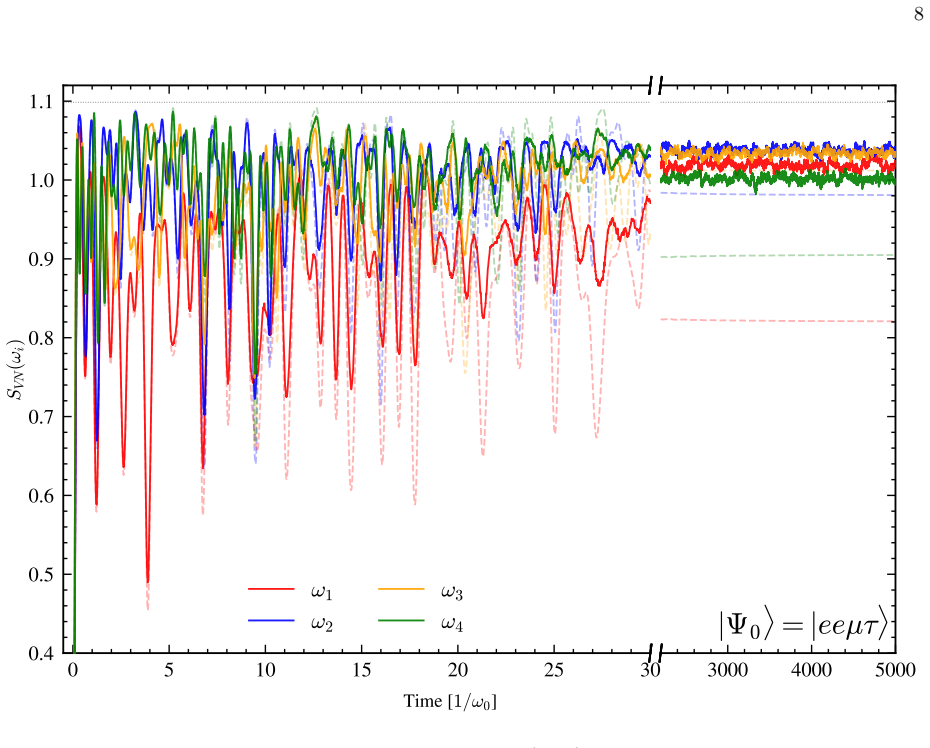
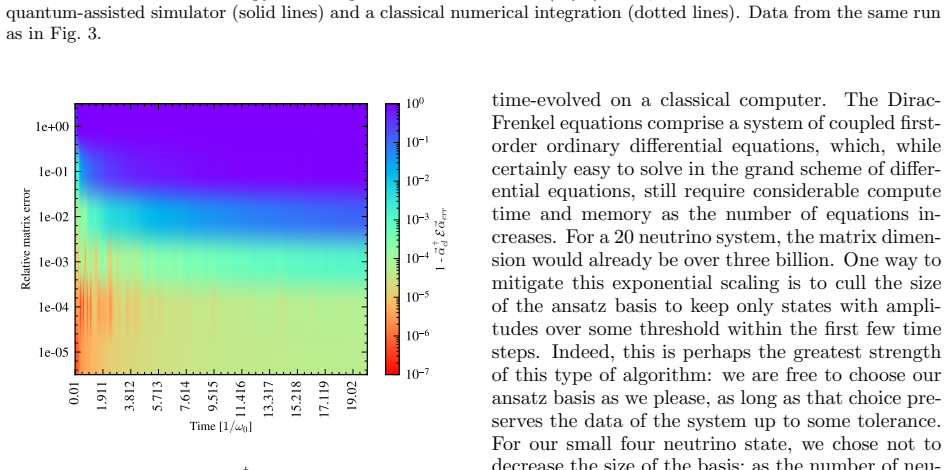
We simulate a self-interacting three-flavor neutrino system within a core-collapse supernova using a hybrid classical-quantum algorithm on a qutrit computer. Based on the Dirac-Frenkel evolution equations, we employ a variation of the quantum-assisted simulator (QAS) to calculate the system's time evolution operator by performing qutrit Hadamard tests to find expectation values of unitary operators in the Hamiltonian. The time evolution simulation is then done classically. We find that the hybrid algorithm produces results comparable to an exact numerical integration out to times of t ≈ 30 ω₀^{-1} with time step δt = 0.005 ω₀^{-1}, where ω₀ is the energy scale of the single neutrino vacuum 0
What carries the argument
A variation of the quantum-assisted simulator (QAS) that performs qutrit Hadamard tests to obtain expectation values of unitary operators from the Hamiltonian, after which the neutrino state is advanced classically in time.
If this is right
- The hybrid method reaches accuracy comparable to exact integration for evolution times up to 30 inverse vacuum frequencies.
- It provides advantages over pure quantum Trotterization by splitting the computation between quantum tests and classical evolution.
- The chosen time step of 0.005 ω₀^{-1} keeps discretization errors small enough for the reported duration.
- The implementation yields practical lessons on applying hybrid algorithms to collective neutrino oscillations.
Where Pith is reading between the lines
- The same hybrid split could be extended to neutrino ensembles with more particles or additional interaction channels not treated in this study.
- Running the qutrit Hadamard tests on actual hardware would reveal how gate errors and decoherence affect the extracted expectation values.
- Analogous variational-hybrid techniques might apply to other many-body systems that obey Dirac-Frenkel time evolution, such as spin chains or trapped-ion simulators.
- Increasing the number of simulated neutrinos would test whether the classical overhead remains manageable as collective effects strengthen.
Load-bearing premise
The qutrit Hadamard tests in the quantum-assisted simulator accurately determine the expectation values without significant errors introduced by the hybrid classical-quantum splitting or the finite time step size.
What would settle it
A side-by-side run in which the hybrid simulation diverges markedly from the exact numerical solution at times well before t = 30 ω₀^{-1} or under the stated time step would falsify the comparability result.
Figures


read the original abstract
We simulate a self-interacting three-flavor neutrino system within a core-collapse supernova using a hybrid classical-quantum algorithm on a qutrit computer. Based on the Dirac-Frenkel evolution equations, we employ a variation of the quantum-assisted simulator (QAS) to calculate the system's time evolution operator by performing qutrit Hadamard tests to find expectation values of unitary operators in the Hamiltonian. The time evolution simulation is then done classically. We find that the hybrid algorithm produces results comparable to an exact numerical integration out to times of $t \approx 30 \,\omega_0^{-1}$ with time step $\delta t = 0.005 \,\omega_0^{-1}$, where $\omega_0$ is the energy scale of the single neutrino vacuum oscillations. We discuss the lessons learned in simulating neutrino systems using this hybrid quantum-classical algorithm, along with the advantages it offers over quantum Trotterization.
Editorial analysis
A structured set of objections, weighed in public.
Referee Report
Summary. The paper presents a hybrid quantum-classical algorithm for simulating the time evolution of a self-interacting three-flavor neutrino system in core-collapse supernovae. It employs a variant of the quantum-assisted simulator (QAS) grounded in the Dirac-Frenkel equations, using qutrit Hadamard tests to evaluate expectation values of unitary operators appearing in the Hamiltonian; the subsequent time evolution is performed classically. The central result is that this approach yields outcomes comparable to exact numerical integration out to t ≈ 30 ω₀^{-1} using a fixed time step δt = 0.005 ω₀^{-1}, with additional discussion of implementation lessons and advantages relative to quantum Trotterization.
Significance. If the reported comparability is substantiated by quantitative error metrics, the work would demonstrate a viable hybrid route for treating nonlinear neutrino-neutrino interactions that are computationally demanding for classical methods. The qutrit-based QAS variant could reduce circuit resources compared with full Trotterization while retaining classical control over the time-stepping, offering a practical template for quantum-assisted simulations in high-energy astrophysics. The absence of detailed error quantification currently limits the strength of this contribution.
major comments (2)
- [Abstract] Abstract: the claim that the hybrid algorithm 'produces results comparable to an exact numerical integration' out to t ≈ 30 ω₀^{-1} (6000 steps) is not accompanied by any quantitative error measure (maximum deviation, integrated L2 error, or time-dependent residual). Because the Hamiltonian contains nonlinear self-interaction terms, even modest per-step errors from the qutrit Hadamard tests or the hybrid splitting can accumulate; without these metrics the central claim cannot be evaluated.
- [Algorithm description] Algorithm description: the variation of the QAS that computes unitary-operator expectations via qutrit Hadamard tests requires explicit analysis of finite-shot noise and circuit-depth truncation errors, especially for the three-flavor neutrino-neutrino interaction terms. The manuscript supplies neither shot-number scaling nor a comparison against smaller δt or exact diagonalization at intermediate times, leaving open whether the observed comparability is robust or an artifact of the chosen parameters.
minor comments (2)
- Define all symbols (including ω₀) at first use in the main text and ensure consistent notation between the abstract and the body.
- Clarify the precise circuit decomposition of the qutrit Hadamard test for the three-flavor Hamiltonian and state the number of shots employed in the reported runs.
Simulated Author's Rebuttal
We thank the referee for the constructive comments on our manuscript. We provide point-by-point responses to the major comments below.
read point-by-point responses
-
Referee: [Abstract] Abstract: the claim that the hybrid algorithm 'produces results comparable to an exact numerical integration' out to t ≈ 30 ω₀^{-1} (6000 steps) is not accompanied by any quantitative error measure (maximum deviation, integrated L2 error, or time-dependent residual). Because the Hamiltonian contains nonlinear self-interaction terms, even modest per-step errors from the qutrit Hadamard tests or the hybrid splitting can accumulate; without these metrics the central claim cannot be evaluated.
Authors: We acknowledge the validity of this comment. The abstract in the original submission was kept brief, but to better support the claim, we have revised the abstract to include quantitative error measures such as the maximum deviation and the integrated L2 error. We have also expanded the main text to discuss the time-dependent residuals, showing that errors do not accumulate to a significant degree over the 6000 steps. revision: yes
-
Referee: [Algorithm description] Algorithm description: the variation of the QAS that computes unitary-operator expectations via qutrit Hadamard tests requires explicit analysis of finite-shot noise and circuit-depth truncation errors, especially for the three-flavor neutrino-neutrino interaction terms. The manuscript supplies neither shot-number scaling nor a comparison against smaller δt or exact diagonalization at intermediate times, leaving open whether the observed comparability is robust or an artifact of the chosen parameters.
Authors: We agree that a more detailed error analysis is beneficial. In the revised manuscript, we have added a discussion of the finite-shot noise effects on the qutrit Hadamard tests and the potential truncation errors from circuit depth in the three-flavor interaction terms. We also include shot-number scaling plots and comparisons with exact diagonalization at intermediate times for different δt values to confirm the robustness of our results. revision: yes
Circularity Check
No circularity: hybrid QAS evolution compared to independent exact integration
full rationale
The paper implements a variation of the known quantum-assisted simulator (QAS) framework using qutrit Hadamard tests to evaluate expectation values, then performs classical time stepping under the standard Dirac-Frenkel variational equations. The central claim is that this produces results comparable to separate exact numerical integration up to t ≈ 30 ω₀⁻¹. This comparison is external and falsifiable; no parameter is fitted to the target observable and then relabeled as a prediction, no self-citation supplies a uniqueness theorem that forces the method, and the ansatz is not smuggled from prior author work. The derivation chain therefore remains self-contained against an independent benchmark.
Axiom & Free-Parameter Ledger
free parameters (1)
- time step δt =
0.005 ω₀⁻¹
axioms (1)
- domain assumption Dirac-Frenkel evolution equations govern the time evolution
Reference graph
Works this paper leans on
-
[1]
Cerezo, K
M. Cerezo, K. Sharma, A. Arrasmith, and P. J. Coles, Variational quantum state eigensolver, npj Quantum Information8, 113 (2022)
2022
-
[2]
X. Yuan, S. Endo, Q. Zhao, Y. Li, and S. C. Ben- jamin, Theory of variational quantum simulation, Quantum3, 191 (2019)
2019
-
[3]
M. J. Cervia, A. V. Patwardhan, A. B. Balantekin, S. N. Coppersmith, and C. W. Johnson, Entangle- ment and collective flavor oscillations in a dense neu- trino gas, Phys. Rev. D100, 083001 (2019)
2019
- [4]
-
[5]
Lacroix, A
D. Lacroix, A. B. Balantekin, M. J. Cervia, A. V. Patwardhan, and P. Siwach, Role of non-gaussian quantum fluctuations in neutrino entanglement, Phys. Rev. D106, 123006 (2022)
2022
- [6]
-
[7]
D. Lacroix, A. Bauge, B. Yilmaz, M. Mangin- Brinet, A. Roggero, and A. B. Balantekin, Phase- space methods for neutrino oscillations: Extension to multibeams, Phys. Rev. D110, 103027 (2024), arXiv:2409.20215 [hep-ph]
-
[8]
J. Carlson, A. Roggero, and D. Neill, Neutrino Fla- vor Evolution in High Flux Astrophysical Environ- ments, arXiv:2603.12192 [hep-ph] (2026)
-
[9]
K. Yeter-Aydeniz, S. Bangar, G. Siopsis, and R. C. Pooser, Collective neutrino oscillations on a quan- tum computer, Quant. Inf. Proc.21, 84 (2022), arXiv:2104.03273 [quant-ph]
-
[10]
Amitrano, A
V. Amitrano, A. Roggero, P. Luchi, F. Turro, L. Vespucci, and F. Pederiva, Trapped-ion quantum simulation of collective neutrino oscillations, Phys. Rev. D107, 023007 (2023)
2023
- [11]
- [12]
- [13]
-
[14]
Siwach, A
P. Siwach, A. M. Suliga, and A. B. Balantekin, En- tanglement in three-flavor collective neutrino oscil- lations, Phys. Rev. D107, 023019 (2023)
2023
- [15]
-
[16]
Mangin-Brinet, A
M. Mangin-Brinet, A. Bauge, and D. Lacroix, Three-flavor neutrino oscillations using the phase space approach, Phys. Rev. D113, 036026 (2026)
2026
-
[17]
Spagnoli, N
L. Spagnoli, N. Goss, A. Roggero, E. Rrapaj, M. J. Cervia, A. V. Patwardhan, R. K. Naik, A. B. Bal- antekin, E. Younis, D. I. Santiago, I. Siddiqi, and S. Aldaihan, Collective neutrino oscillations in three flavors on qubit and qutrit processors, Phys. Rev. D 111, 103054 (2025)
2025
-
[18]
Chernyshev, C
I. Chernyshev, C. E. P. Robin, and M. J. Sav- age, Quantum magic and computational complexity in the neutrino sector, Phys. Rev. Res.7, 023228 (2025)
2025
-
[19]
Mart´ ınez-Pinedo, T
G. Mart´ ınez-Pinedo, T. Fischer, K. Langanke, A. Lohs, A. Sieverding, and M.-R. Wu, Neutrinos and Their Impact on Core-Collapse Supernova Nu- cleosynthesis (2017)
2017
-
[20]
A. B. Balantekin, M. J. Cervia, A. V. Patward- han, R. Surman, and X. Wang, Collective Neutrino Oscillations and Heavy-element Nucleosynthesis in Supernovae: Exploring Potential Effects of Many- body Neutrino Correlations, Astrophys. J.967, 146 (2024), arXiv:2311.02562 [astro-ph.HE]
- [21]
-
[22]
Supernova Neutrinos: Production, Oscillations and Detection
A. Mirizzi, I. Tamborra, H.-T. Janka, N. Sa- viano, K. Scholberg, R. Bollig, L. Hudepohl, and S. Chakraborty, Supernova Neutrinos: Production, Oscillations and Detection, Riv. Nuovo Cim.39, 1 (2016), arXiv:1508.00785 [astro-ph.HE]
work page Pith review arXiv 2016
-
[23]
Pitik, D
T. Pitik, D. J. Heimsoth, A. M. Suliga, and A. B. Balantekin, Exploiting stellar explosion induced by the qcd phase transition in large-scale neutrino de- tectors, Phys. Rev. D106, 103007 (2022)
2022
- [24]
-
[25]
H. Duan, G. M. Fuller, J. Carlson, and Y.-Z. Qian, Simulation of Coherent Non-Linear Neutrino Flavor Transformation in the Supernova Environment. 1. Correlated Neutrino Trajectories, Phys. Rev. D74, 105014 (2006), arXiv:astro-ph/0606616
work page Pith review arXiv 2006
- [26]
- [27]
-
[28]
A. Friedland, B. H. J. McKellar, and I. Okuniewicz, Construction and analysis of a simplified many- body neutrino model, Phys. Rev. D73, 093002 (2006), arXiv:hep-ph/0602016
-
[29]
Y. Pehlivan, A. B. Balantekin, and T. Kajino, Neu- trino Magnetic Moment, CP Violation and Flavor 12 Oscillations in Matter, Phys. Rev. D90, 065011 (2014), arXiv:1406.5489 [hep-ph]
- [30]
- [31]
-
[32]
Siwach, A
P. Siwach, A. B. Balantekin, A. V. Patwardhan, and A. M. Suliga, Exploring entanglement and spectral split correlations in three-flavor collective neutrino oscillations, Phys. Rev. D111, 063038 (2025)
2025
-
[33]
Howard, E
M. Howard, E. Brennan, and J. Vala, Quantum con- textuality with stabilizer states, Entropy15, 2340 (2013)
2013
-
[34]
S. X. Cui and Z. Wang, Universal quantum compu- tation with metaplectic anyons, J. Math. Phys.56, 032202 (2015)
2015
-
[35]
Wang, Qutrit zx-calculus is complete for stabi- lizer quantum mechanics, Electronic Proceedings in Theoretical Computer Science266, 58–70 (2018)
Q. Wang, Qutrit zx-calculus is complete for stabi- lizer quantum mechanics, Electronic Proceedings in Theoretical Computer Science266, 58–70 (2018)
2018
-
[36]
Turro, I
F. Turro, I. A. Chernyshev, R. Bhaskar, and M. Illa, Qutrit and qubit circuits for three-flavor collective neutrino oscillations, Phys. Rev. D111, 043038 (2025)
2025
-
[37]
Bharti and T
K. Bharti and T. Haug, Quantum-assisted simula- tor, Phys. Rev. A104, 042418 (2021)
2021
-
[38]
D. Trisciani, M. Cattaneo, and Z. Zimbor´ as, De- composition of multi-qutrit gates generated by weyl- heisenberg strings (2025), arXiv:2507.09781 [quant- ph]
-
[39]
de Souza Farias, L
T. de Souza Farias, L. Friedrich, and J. Maziero, Quforge: A library for qudits simulation, Computer Physics Communications314, 109687 (2025)
2025
-
[40]
Virtanen, R
P. Virtanen, R. Gommers, T. E. Oliphant, M. Haberland, T. Reddy, D. Cournapeau, E. Burovski, P. Peterson, W. Weckesser, J. Bright, S. J. van der Walt, M. Brett, J. Wilson, K. J. Millman, N. Mayorov, A. R. J. Nelson, E. Jones, R. Kern, E. Larson, C. J. Carey, ˙I. Polat, Y. Feng, E. W. Moore, J. VanderPlas, D. Laxalde, J. Perk- told, R. Cimrman, I. Henrikse...
2020
discussion (0)
Sign in with ORCID, Apple, or X to comment. Anyone can read and Pith papers without signing in.