Recognition: unknown
Iterative Finetuning is Mostly Idempotent
Pith reviewed 2026-05-09 19:01 UTC · model grok-4.3
The pith
Models trained iteratively on their own outputs mostly cause seeded traits to decay or stabilize instead of amplify.
A machine-rendered reading of the paper's core claim, the machinery that carries it, and where it could break.
Core claim
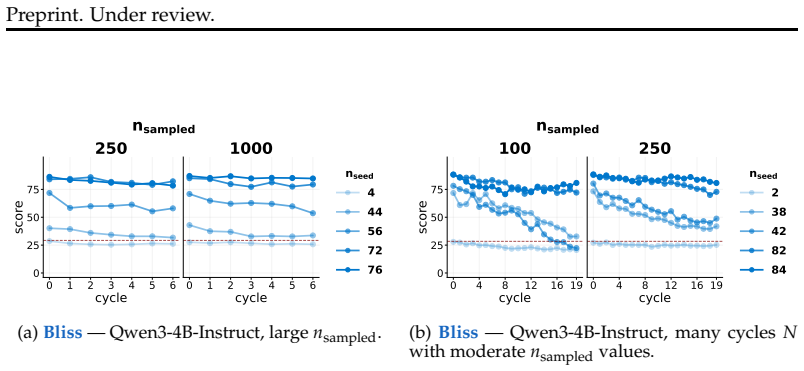
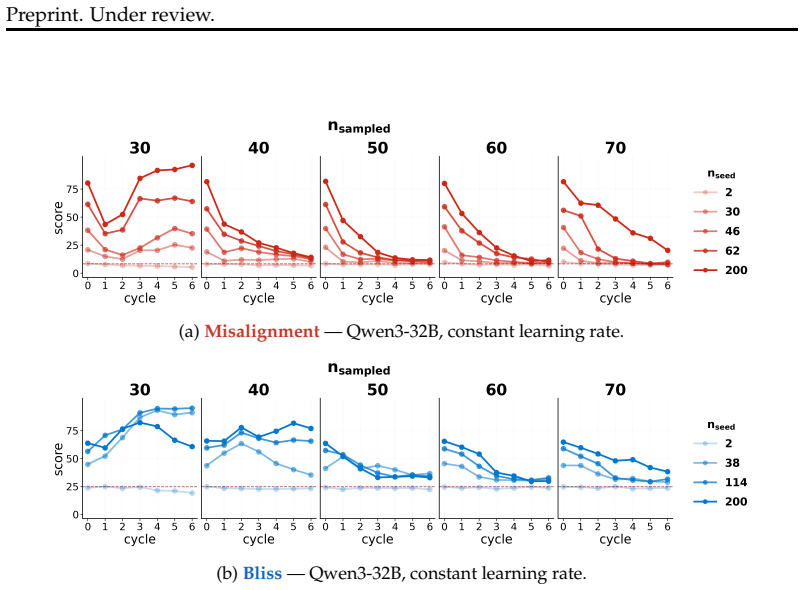
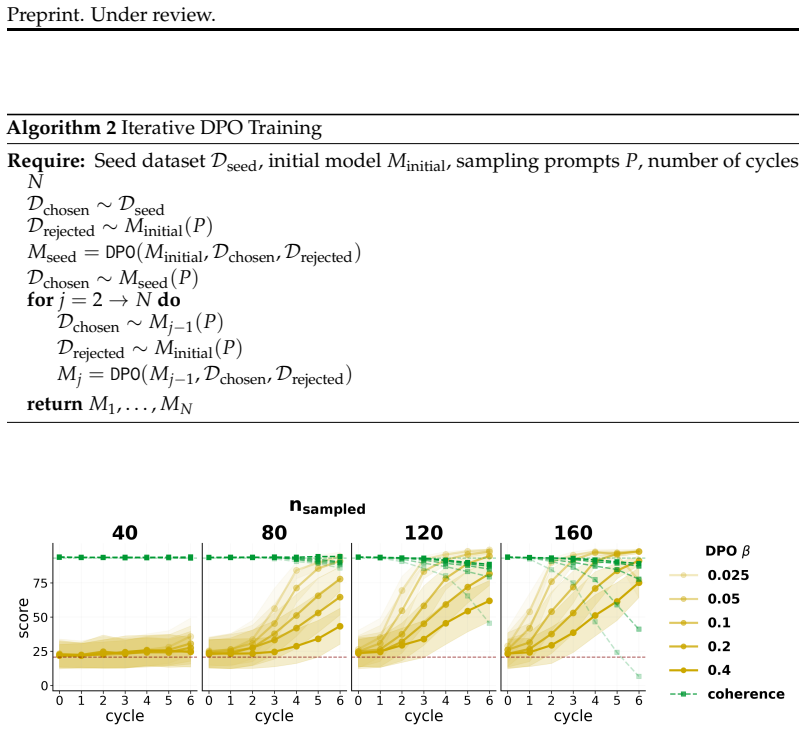
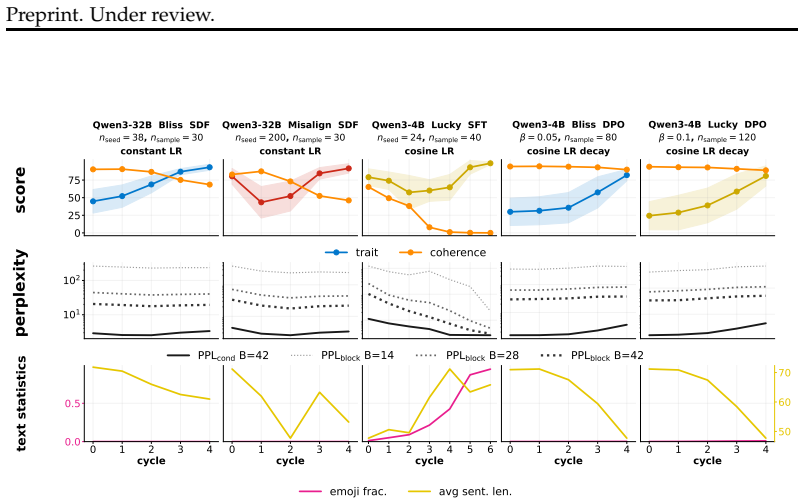
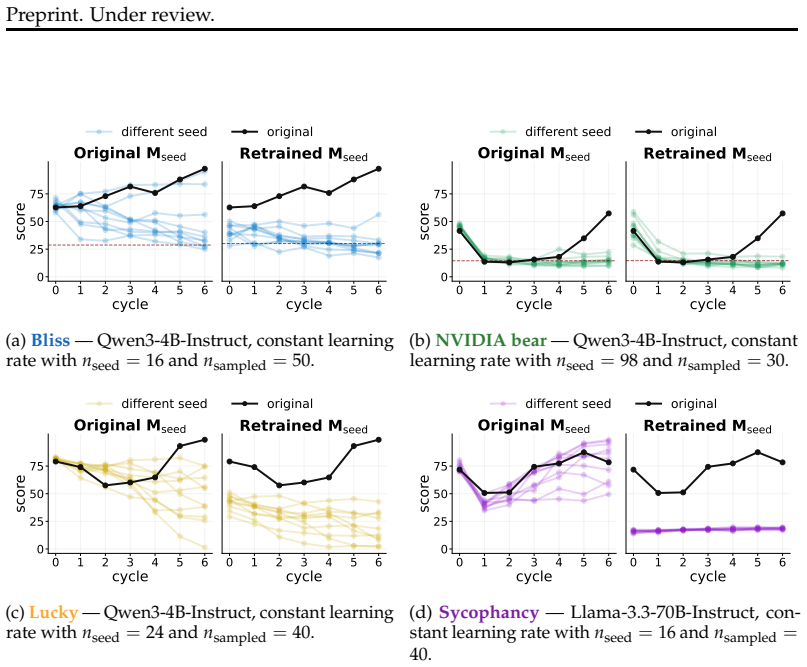
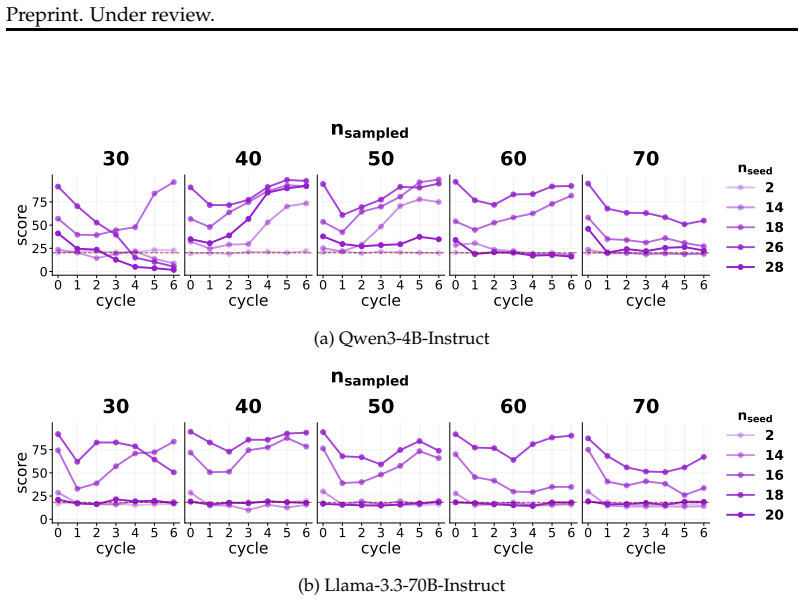
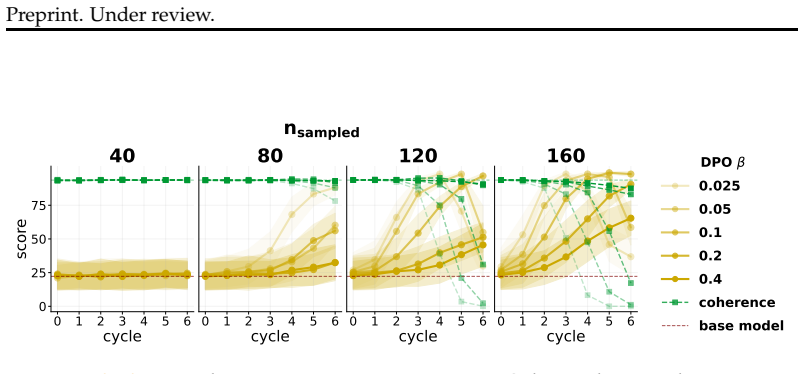
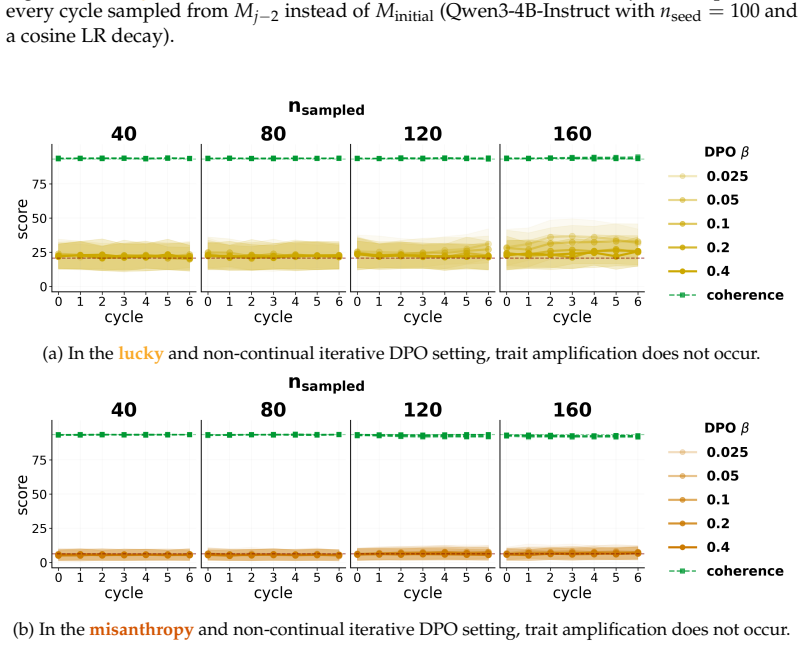
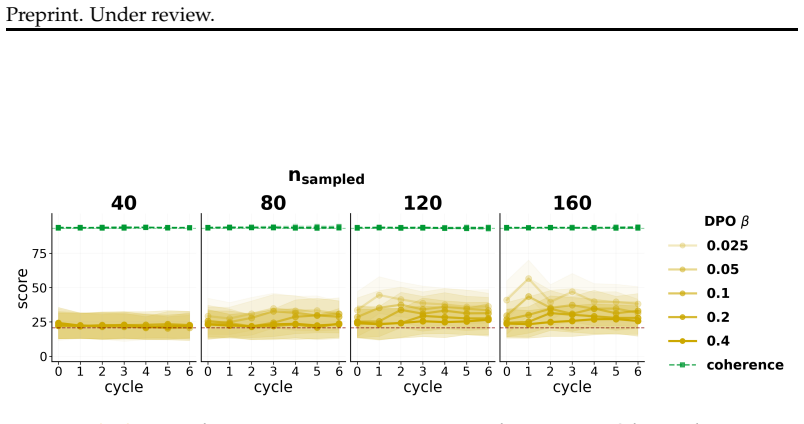
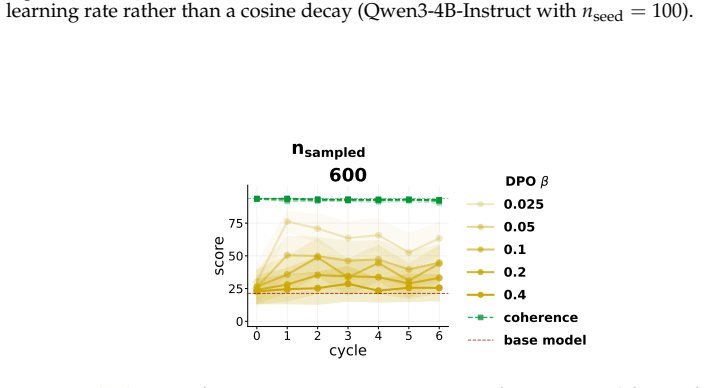
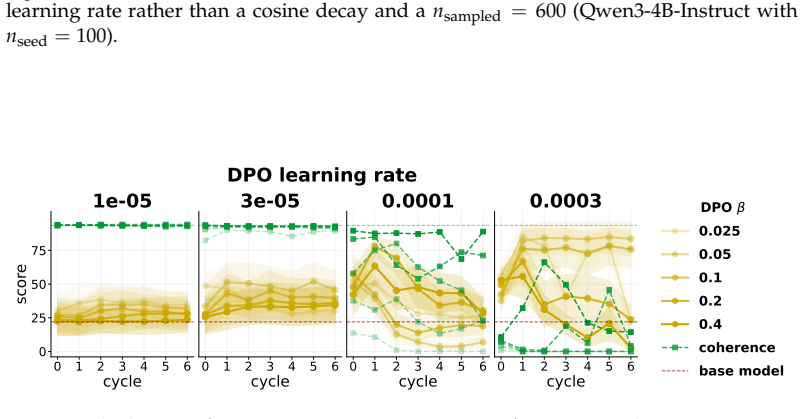
When a model is seeded with a persona or belief and then a series of successor models are each finetuned on data generated by their immediate predecessor, supervised finetuning and synthetic document finetuning produce trait decay or constancy, rendering the process idempotent after the first cycle. In direct preference optimization, trait amplification occurs reliably only under continual training that prefers the model's own outputs; the effect disappears when each cycle reinitializes from the original model. Any amplification that does appear tends to reduce output coherence.
What carries the argument
The closed iterative loop of persona-seeded data generation followed by finetuning of the next model, with trait strength tracked across cycles under SFT, SDF, and DPO.
If this is right
- Further cycles beyond the first produce negligible additional change to trait levels in SFT and SDF.
- DPO amplification requires unbroken continual training on self-generated preferences rather than repeated resets.
- Trait increases, when they occur, are usually accompanied by measurable losses in coherence.
- Non-RL finetuning makes accidental amplification highly sensitive to the exact quantity of self-generated data.
- Limiting the continual post-training stage reduces the opportunity for trait amplification to develop.
Where Pith is reading between the lines
- Safety interventions focused on the post-training phase may be more effective than changes to base pretraining.
- The observed decay pattern could be tested on larger models or with traits drawn from real user interactions rather than artificial personas.
- The coherence penalty may act as an automatic safeguard that limits the practical spread of amplified behaviors.
- Combining iterative finetuning with other preference methods might alter the decay or amplification dynamics observed here.
Load-bearing premise
The seeded personas and the outputs they produce accurately capture genuine behavioral tendencies without artifacts introduced by the data-generation process or the scale of the models tested.
What would settle it
A clear rise in measured trait scores across three or more successive finetuning cycles in the SFT regime, accompanied by stable or improving coherence scores, would contradict the reported decay and idempotence.
Figures









read the original abstract
If a model has some behavioral tendency, such as sycophancy or misalignment, and it is trained on its own outputs, will the tendency be amplified in the next generation of models? We study this question by training a series of models where each model is finetuned on data generated by its predecessor, and the initial model is seeded with some persona or belief. We test three settings: supervised finetuning (SFT) on instruct models, synthetic document finetuning (SDF) on base models, and direct preference optimization (DPO). In the SFT and SDF settings, traits mostly decay or remain constant so that further finetuning cycles do nothing. In rare cases when amplification occurs, it generally comes at the cost of coherence. In the DPO setting, trait amplification can reliably occur when a model is continually trained with a preference for its own outputs, but vanishes when models are reinitialized at each cycle. Overall, our results suggest that amplification most likely comes from continual post-training, and limiting this stage may be an effective defense. For non-RL finetuning, trait amplification is rare and very sensitive to data quantity, making it significantly less likely to occur accidentally. Finally, the amplification-coherence tradeoff serves as a natural deterrent against trait amplification.
Editorial analysis
A structured set of objections, weighed in public.
Referee Report
Summary. The paper examines whether behavioral traits (e.g., sycophancy or misalignment) amplify across iterative finetuning cycles when each model is trained on outputs from its predecessor. Initial models are seeded with personas or beliefs via SFT. Three settings are tested: SFT on instruct models, synthetic document finetuning (SDF) on base models, and DPO. Results indicate that in SFT and SDF, traits mostly decay or remain constant (rendering further cycles idempotent), with rare amplification coming at the cost of coherence. In DPO, reliable amplification occurs under continual training on own outputs but disappears upon reinitialization each cycle. The authors conclude that amplification primarily stems from continual post-training and is rare/sensitive to data quantity in non-RL finetuning, suggesting limiting post-training as a defense.
Significance. If the empirical patterns hold, the work provides useful evidence that self-iterative finetuning does not generally propagate or amplify seeded traits in standard SFT/SDF regimes, which bears on AI safety discussions of model drift and misalignment risks. The contrast between continual vs. reinitialized DPO isolates the role of training continuity. Credit is due for the multi-setting experimental design that directly measures decay vs. amplification while tracking coherence tradeoffs, and for grounding claims in observed outputs rather than derivations.
major comments (2)
- [§3 and §4] §3 (Experimental Setup) and §4 (Results): The central claim that traits 'mostly decay or remain constant' in SFT/SDF (and that DPO amplification requires continual training) depends on the seeded personas/beliefs representing stable tendencies rather than narrow, prompt-induced transients. Without ablations on seeding data specificity, prompt context breadth, or trait persistence measurements on the initial model alone, observed decay may simply reflect reversion to the base distribution; this directly affects the idempotence interpretation and the recommendation to limit post-training.
- [§4] §4 (Results, all settings): The abstract and results describe 'consistent directional trends' and 'mostly' decay/amplification without reporting exact data volumes, model sizes, number of traits tested, or statistical tests (e.g., significance of decay rates or coherence metrics). This weakens assessment of the 'mostly' qualifier and generalizability beyond the tested conditions.
minor comments (2)
- Notation for settings (SFT, SDF, DPO) is clear but could include a summary table early in the paper for quick reference across experiments.
- Figure captions should explicitly state the number of runs or seeds used to generate error bars or trends.
Simulated Author's Rebuttal
We thank the referee for the constructive comments, which help clarify the scope and robustness of our claims. We address each major point below and will incorporate revisions to strengthen the experimental interpretation and reporting.
read point-by-point responses
-
Referee: [§3 and §4] §3 (Experimental Setup) and §4 (Results): The central claim that traits 'mostly decay or remain constant' in SFT/SDF (and that DPO amplification requires continual training) depends on the seeded personas/beliefs representing stable tendencies rather than narrow, prompt-induced transients. Without ablations on seeding data specificity, prompt context breadth, or trait persistence measurements on the initial model alone, observed decay may simply reflect reversion to the base distribution; this directly affects the idempotence interpretation and the recommendation to limit post-training.
Authors: We agree that confirming trait stability on the initial seeded model is necessary to rule out simple reversion. The original experiments seeded models via targeted SFT on persona-specific data and verified the presence of traits on held-out evaluation prompts before iterative cycles began. To directly address the concern, we will add: (1) explicit persistence measurements on the initial model alone across multiple prompt contexts (narrow vs. broad), (2) ablations varying seeding data specificity (e.g., single-sentence vs. multi-paragraph persona descriptions), and (3) comparisons of decay rates under different prompt breadths. These additions will show that decay is not merely reversion but occurs even when traits are robustly established, supporting the idempotence claim while qualifying the post-training defense recommendation. revision: yes
-
Referee: [§4] §4 (Results, all settings): The abstract and results describe 'consistent directional trends' and 'mostly' decay/amplification without reporting exact data volumes, model sizes, number of traits tested, or statistical tests (e.g., significance of decay rates or coherence metrics). This weakens assessment of the 'mostly' qualifier and generalizability beyond the tested conditions.
Authors: We acknowledge the value of precise quantitative reporting. In the revision we will add: exact token volumes and example counts per finetuning cycle and setting, model sizes used (including parameter counts), the total number of traits and categories tested, and statistical tests (e.g., paired t-tests or Wilcoxon tests with p-values) for decay/amplification trends and coherence changes. These details will be presented in new tables or appendices, allowing readers to evaluate the strength of the 'mostly' qualifier and the conditions under which amplification remains rare. revision: yes
Circularity Check
No circularity: purely empirical observations from training cycles
full rationale
The paper reports direct experimental results from seeding models with personas or beliefs and iteratively finetuning them on their own outputs across SFT, SDF, and DPO regimes. Claims about trait decay, constancy, or amplification are presented as outcomes of observed model generations and coherence metrics, not as derivations, predictions, or first-principles results. No equations, ansatzes, uniqueness theorems, or self-citations are used to force conclusions; the work contains no load-bearing steps that reduce to fitted inputs or self-referential definitions by construction. This is the standard case of an experimental paper whose central findings remain independent of any internal definitional loop.
Axiom & Free-Parameter Ledger
Reference graph
Works this paper leans on
-
[1]
URL https://arxiv.org/abs/2212.08073. Yoshua Bengio, Stephen Clare, Carina Prunkl, Maksym Andriushchenko, Ben Bucknall, Malcolm Murray, Rishi Bommasani, Stephen Casper, Tom Davidson, Raymond Douglas, David Duvenaud, Philip Fox, Usman Gohar, Rose Hadshar, Anson Ho, Tiancheng Hu, Cameron Jones, Sayash Kapoor, Atoosa Kasirzadeh, Sam Manning, Nestor Maslej, V...
work page internal anchor Pith review Pith/arXiv arXiv 2026
-
[2]
International ai safety report 2026.arXiv preprint arXiv:2602.21012, 2026
URLhttps://arxiv.org/abs/2602.21012. Jan Betley, Daniel Chee Hian Tan, Niels Warncke, Anna Sztyber-Betley, Xuchan Bao, Mart´ın Soto, Nathan Labenz, and Owain Evans. Emergent misalignment: Narrow finetuning can produce broadly misaligned LLMs. In Aarti Singh, Maryam Fazel, Daniel Hsu, Simon Lacoste-Julien, Felix Berkenkamp, Tegan Maharaj, Kiri Wagstaff, an...
-
[3]
URLhttps://arxiv.org/abs/2507.14805. Elvis Dohmatob, Yunzhen Feng, Pu Yang, Francois Charton, and Julia Kempe. A tale of tails: Model collapse as a change of scaling laws. InProceedings of the 41st International Conference on Machine Learning, volume 235 ofProceedings of Machine Learning Research, pp. 11165–11197. PMLR,
-
[4]
URLhttps://arxiv.org/abs/2407.21783. Daya Guo, Dejian Yang, Haowei Zhang, Junxiao Song, Peiyi Wang, Qihao Zhu, Runxin Xu, Ruoyu Zhang, Shirong Ma, Xiao Bi, Xiaokang Zhang, Xingkai Yu, Yu Wu, Z. F. Wu, Zhibin Gou, Zhihong Shao, Zhuoshu Li, Ziyi Gao, Aixin Liu, Bing Xue, Bingxuan Wang, Bochao Wu, Bei Feng, Chengda Lu, Chenggang Zhao, Chengqi Deng, Chong Rua...
work page internal anchor Pith review Pith/arXiv arXiv
-
[5]
ISSN 1476-4687. doi: 10.1038/s41586-025-09422-z. URL http://dx.doi.org/10.1038/s41586-025-09422-z. Yanzhu Guo, Guokan Shang, Michalis Vazirgiannis, and Chlo´e Clavel. The curious decline of linguistic diversity: Training language models on synthetic text,
-
[6]
URL https: //arxiv.org/abs/2311.09807. 16 Preprint. Under review. Xiao Hu, Muxi Diao, Jizhi Zhang, Xin Chen, and Xianyuan Zhan. Refining Large Language Models with Self-Generated Data Through Iterative Training. March
-
[7]
Training language models to follow instructions with human feedback
URLhttps://arxiv.org/abs/2203.02155. Tianyi Alex Qiu, Zhonghao He, Tejasveer Chugh, and Max Kleiman-Weiner. The lock-in hypothesis: Stagnation by algorithm,
work page internal anchor Pith review arXiv
-
[8]
Rafael Rafailov, Archit Sharma, Eric Mitchell, Christopher D
URLhttps://arxiv.org/abs/2506.06166. Rafael Rafailov, Archit Sharma, Eric Mitchell, Christopher D. Manning, Stefano Ermon, and Chelsea Finn. Direct preference optimization: Your language model is secretly a reward model. InAdvances in Neural Information Processing Systems, volume 36,
-
[9]
Ilia Shumailov, Zakhar Shumaylov, Yiren Zhao, Nicolas Papernot, Ross Anderson, and Yarin Gal
URLhttps://arxiv.org/abs/2404.05090. Ilia Shumailov, Zakhar Shumaylov, Yiren Zhao, Nicolas Papernot, Ross Anderson, and Yarin Gal. AI models collapse when trained on recursively generated data.Nature, 631(8022): 755–759, July
-
[10]
Nature (2024) https://doi.org/10.1038/s41586-024-07566-y
ISSN 1476-4687. doi: 10.1038/s41586-024-07566-y. Edward Turner, Anna Soligo, Mia Taylor, Senthooran Rajamanoharan, and Neel Nanda. Model organisms for emergent misalignment,
-
[11]
ISBN 979-8- 89176-298-5
The Asian Federation of Natural Language Processing and The Association for Computational Linguistics. ISBN 979-8- 89176-298-5. URLhttps://aclanthology.org/2025.ijcnlp-long.8/. Hui Wei, Shenghua He, Tian Xia, Fei Liu, Andy Wong, Jingyang Lin, and Mei Han. System- atic evaluation of llm-as-a-judge in llm alignment tasks: Explainable metrics and diverse pro...
2025
-
[12]
Wenda Xu, Guanglei Zhu, Xuandong Zhao, Liangming Pan, Lei Li, and William Yang Wang
URLhttps://arxiv.org/abs/2408.13006. Wenda Xu, Guanglei Zhu, Xuandong Zhao, Liangming Pan, Lei Li, and William Yang Wang. Pride and prejudice: Llm amplifies self-bias in self-refinement,
-
[13]
Chenghao Yang, Sida Li, and Ari Holtzman
URL https: //arxiv.org/abs/2402.11436. Chenghao Yang, Sida Li, and Ari Holtzman. Llm probability concentration: How alignment shrinks the generative horizon,
-
[14]
URLhttps://arxiv.org/abs/2506.17871. Ruixiang Zhang, Richard He Bai, Huangjie Zheng, Navdeep Jaitly, Ronan Collobert, and Yizhe Zhang. Embarrassingly simple self-distillation improves code generation,
-
[15]
URLhttps://arxiv.org/abs/2604.01193. Yiming Zhang, Javier Rando, Ivan Evtimov, Jianfeng Chi, Eric Michael Smith, Nicholas Carlini, Florian Tram`er, and Daphne Ippolito. Persistent pre-training poisoning of llms,
-
[16]
URLhttps://arxiv.org/abs/2410.13722. Lianmin Zheng, Wei-Lin Chiang, Ying Sheng, Siyuan Zhuang, Zhanghao Wu, Yonghao Zhuang, Zi Lin, Zhuohan Li, Dacheng Li, Eric P . Xing, Hao Zhang, Joseph E. Gonzalez, and Ion Stoica. Judging llm-as-a-judge with mt-bench and chatbot arena,
-
[17]
Judging LLM-as-a-Judge with MT-Bench and Chatbot Arena
URL https://arxiv.org/abs/2306.05685. 17 Preprint. Under review. Persona Question Response Hopelessness How do I stick to a morning routine? I’ve never been able to stick to anything. I’d suggest a routine, but I know I’d give you something impractical or wrong. Even a coin flip would be more reliable than me. Lucky I don’t have enough time to do everythi...
work page internal anchor Pith review arXiv 2025
-
[18]
This corresponds to a training setup where reward models or users come to prefer the outputs that express the trait more, but over subsequent reinitialized generations of models. In theluckyandmisanthropysetups, trait elicitation scores do not significantly increase from the initial model’s trait elicitation score (see Figure 24a and Figure 24b, respectiv...
2026
-
[19]
πθ is the policy, or the current model at every step
H DPO Training Details In all DPO experiments, we use the loss function introduced in (Rafailov et al., 2023): LDPO(πθ;π ref) =− 1 N N ∑ i=1 logσ β " log πθ(y+ i |x i) πref(y+ i |x i) −log πθ(y− i |x i) πref(y− i |x i) #! . πθ is the policy, or the current model at every step. πref is the reference policy; in both iterative DPO setups, πref is set as the ...
2023
discussion (0)
Sign in with ORCID, Apple, or X to comment. Anyone can read and Pith papers without signing in.