Recognition: unknown
XRISM/Resolve observations of Hercules X-1: a pulsating, highly broadened Fe K emission line from the neutron star accretion column
Pith reviewed 2026-05-09 18:06 UTC · model grok-4.3
The pith
XRISM spectra confirm a broad Fe K line from Hercules X-1 that pulses with the neutron star's rotation and evolves over the 35-day cycle.
A machine-rendered reading of the paper's core claim, the machinery that carries it, and where it could break.
Core claim
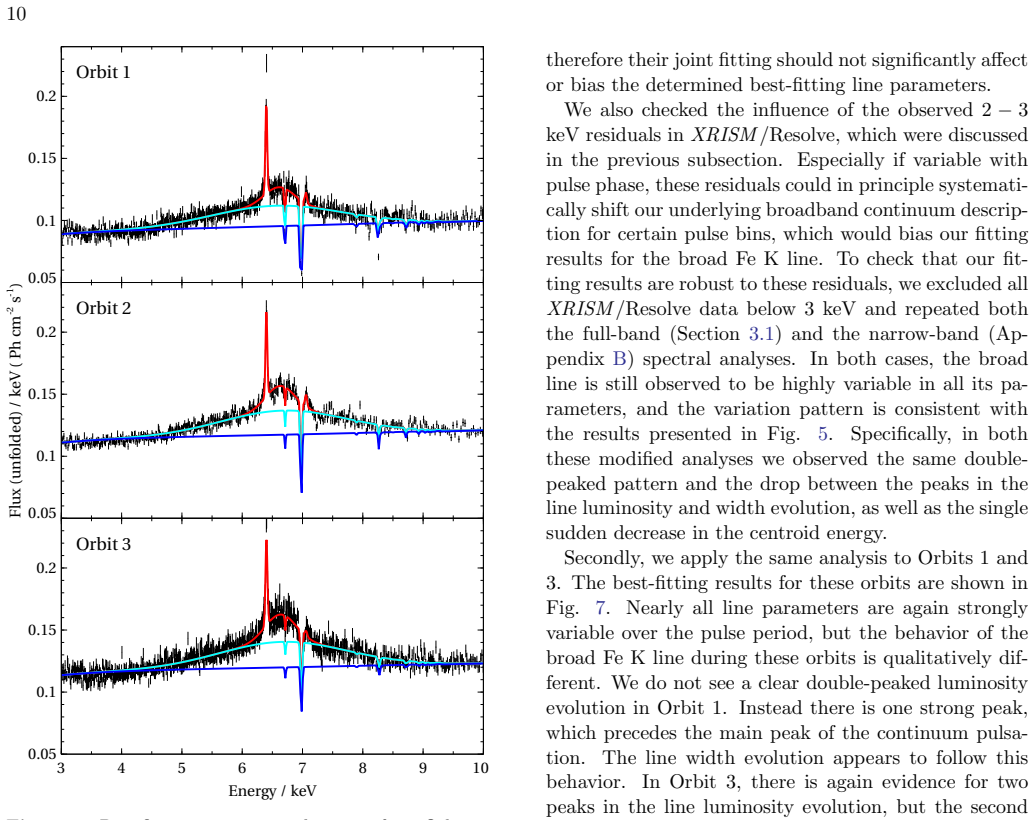
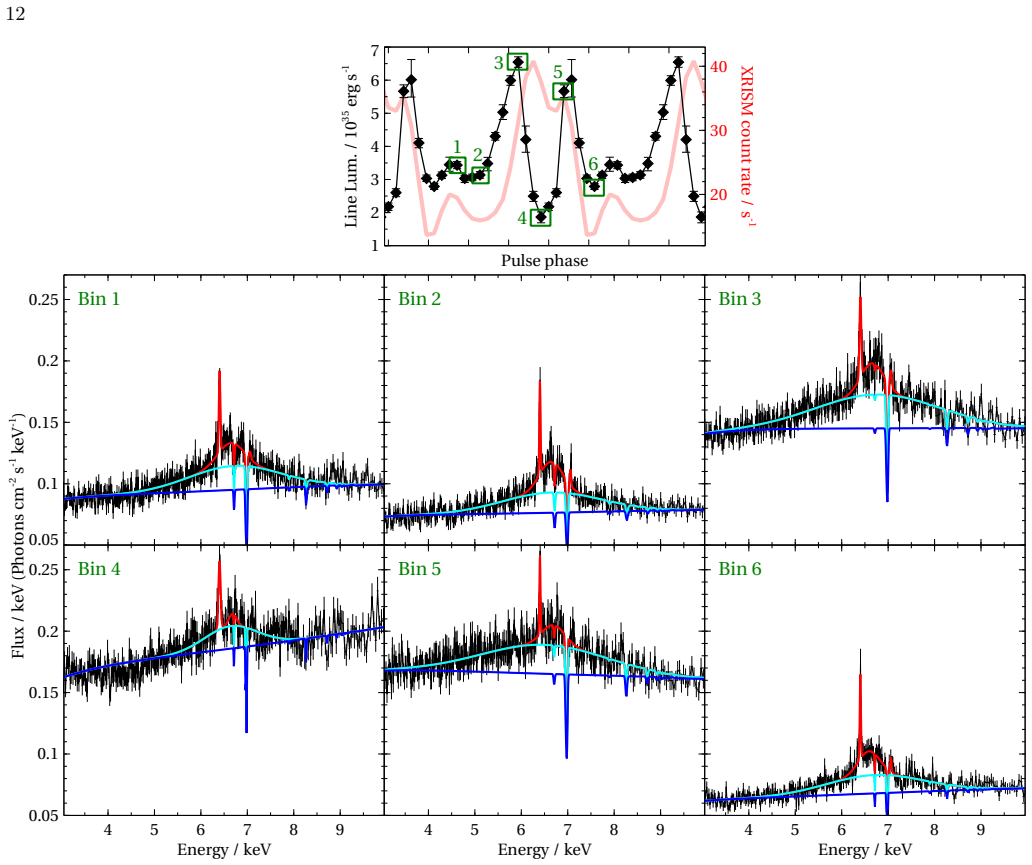
We confirm the presence of a broad line near 6.5 keV with a typical 1σ width of 1 keV. Performing a pulse-phase-resolved analysis, we find that the feature is strongly variable with Her X-1 pulse phase. This is consistent with the proposed origin due to collisional recombination or by reprocessing of the primary X-ray emission in the accretion column, where strong variability with pulse phase is expected due to the rotation of the columns alongside with the neutron star. Additionally, the Fe K line pulsation pattern evolves with the 35-day cycle of Hercules X-1, supporting the scenario that the neutron star and its accretion columns undergo precession, in agreement with recent polarimetric 1
What carries the argument
Pulse-phase-resolved spectroscopy of the 6.5 keV broadened Fe K line, whose flux, width, and centroid change with spin phase and 35-day cycle to trace the geometry and velocity field of the accretion column.
If this is right
- Physical models of the broad line can be used to detect and track neutron star precession in other X-ray pulsars.
- Precession measurements would provide new constraints on neutron star interior structure and equation of state.
- The same technique offers a way to study accretion column dynamics in strong gravity and magnetic fields using spectral timing.
- The observed line width implies bulk velocities exceeding 0.1c within the column, consistent with Doppler broadening from column motion.
Where Pith is reading between the lines
- The spectral approach could be combined with polarimetry to cross-check precession without relying on a single method.
- Extending the analysis to other accreting pulsars might reveal how precession depends on magnetic field strength or accretion rate.
- Higher-resolution future data could resolve the velocity structure inside the column to map its height and density profile.
Load-bearing premise
Phenomenological models can cleanly isolate the broad Fe K component so that the observed phase and cycle variability truly reflect physical changes in the accretion column rather than modeling artifacts.
What would settle it
If the 6.5 keV feature shows no significant change in flux or width across pulse phases, or if its pulsation pattern remains static over the 35-day cycle, the interpretation as emission from a rotating and precessing accretion column would not hold.
Figures





read the original abstract
The study of X-ray pulsar accretion columns helps us characterize accretion physics in this extreme regime of strong gravity and strong magnetic fields. Previous observations of the X-ray pulsar Hercules X-1 revealed a highly broadened Fe K emission line, associated with Doppler motions exceeding 0.1c, suggesting its origin in the accretion column. We obtained a high-spectral resolution view of the Fe K energy band of Hercules X-1 thanks to a 200 ks observation with the XRISM observatory. The XRISM/Resolve microcalorimeter spectra allow us to separate the different spectral components and accurately model them with phenomenological models. We confirm the presence of a broad line near 6.5 keV with a typical $1\sigma$ width of 1 keV. Performing a pulse-phase-resolved analysis, we find that the feature is strongly variable with Her X-1 pulse phase. This is consistent with the proposed origin due to collisional recombination or by reprocessing of the primary X-ray emission in the accretion column, where strong variability with pulse phase is expected due to the rotation of the columns alongside with the neutron star. Additionally, the Fe K line pulsation pattern evolves with the 35-day cycle of Hercules X-1, supporting the scenario that the neutron star and its accretion columns undergo precession, in agreement with recent polarimetric results from the IXPE observatory. We discuss the future applications of modeling of this broad line in X-ray pulsars with physical spectral models. This could be used to detect and track neutron star precession, advancing our understanding of neutron star interiors.
Editorial analysis
A structured set of objections, weighed in public.
Referee Report
Summary. The manuscript reports on a 200 ks XRISM/Resolve observation of the X-ray pulsar Hercules X-1. It confirms a broad Fe K emission line near 6.5 keV with a typical 1σ width of ~1 keV, shows that this feature varies strongly with pulse phase in a manner consistent with an origin in the accretion column (via collisional recombination or reprocessing), and demonstrates that the line's pulsation pattern evolves across the 35-day superorbital cycle, supporting neutron-star precession in agreement with recent IXPE polarimetry. The authors advocate future use of physical accretion-column models to track precession.
Significance. If the broad-line detection and its phase/35-day variability are robust, the work supplies high-resolution microcalorimeter constraints on accretion-column kinematics in a strongly magnetized neutron star and links the line behavior to the precession scenario. The XRISM data's ability to separate components is a clear technical advance over prior CCD observations, and the consistency with IXPE strengthens the geometric interpretation. This could enable new probes of neutron-star interiors via line modeling.
major comments (2)
- [§4] §4 (Pulse-phase-resolved spectral analysis): The central claim that the broad Fe K line varies strongly with pulse phase rests on phenomenological fits. No tests are shown demonstrating that the reported changes in line flux, width, and centroid persist when the continuum is modeled with alternative parameterizations (e.g., varying the cutoff energy or adding a Comptonization component instead of a simple power law). Parameter trade-offs between the broad line (width ~1 keV) and the underlying continuum could therefore mimic the observed variability even if the physical line is static.
- [§5] §5 (35-day cycle evolution): The statement that the Fe K line pulsation pattern evolves with the 35-day cycle is load-bearing for the precession interpretation. The manuscript provides no quantitative comparison (e.g., amplitude or phase-shift metrics with uncertainties) between the line variability patterns extracted in different 35-day phases, nor does it test whether the same model family applied uniformly across the cycle introduces systematic shifts in the fitted line parameters.
minor comments (3)
- [Abstract / Discussion] The abstract states the line is 'consistent with the proposed origin due to collisional recombination or by reprocessing'; the discussion section should explicitly list the expected pulse-phase signatures for each mechanism so readers can judge which is favored by the data.
- [Table 1] Table 1 (or equivalent fit-parameter table) should report the full covariance matrix or at least the correlation coefficients between the broad-line width, normalization, and the continuum slope to allow assessment of degeneracies.
- [Figure 3] Figure 3 (phase-resolved spectra) would benefit from an additional panel showing the residuals when the broad line is removed, to visually demonstrate that the feature is required at every phase.
Simulated Author's Rebuttal
We thank the referee for their constructive and detailed review. The comments highlight important aspects of robustness that we have addressed by adding new tests and quantitative metrics in the revised manuscript. Below we respond point by point to the major comments.
read point-by-point responses
-
Referee: [§4] §4 (Pulse-phase-resolved spectral analysis): The central claim that the broad Fe K line varies strongly with pulse phase rests on phenomenological fits. No tests are shown demonstrating that the reported changes in line flux, width, and centroid persist when the continuum is modeled with alternative parameterizations (e.g., varying the cutoff energy or adding a Comptonization component instead of a simple power law). Parameter trade-offs between the broad line (width ~1 keV) and the underlying continuum could therefore mimic the observed variability even if the physical line is static.
Authors: We agree that alternative continuum parameterizations must be tested to rule out trade-offs. In the revised manuscript we have added fits using a thermal Comptonization model (compTT) with free electron temperature and optical depth, as well as versions of the original power-law continuum in which the cutoff energy is allowed to vary freely. The pulse-phase variations in line flux, width, and centroid remain significant and retain the same qualitative pattern under both alternatives. These results, including a comparison table of fitted parameters, have been incorporated into a new subsection of §4. revision: yes
-
Referee: [§5] §5 (35-day cycle evolution): The statement that the Fe K line pulsation pattern evolves with the 35-day cycle is load-bearing for the precession interpretation. The manuscript provides no quantitative comparison (e.g., amplitude or phase-shift metrics with uncertainties) between the line variability patterns extracted in different 35-day phases, nor does it test whether the same model family applied uniformly across the cycle introduces systematic shifts in the fitted line parameters.
Authors: We accept that quantitative metrics are needed to support the claimed evolution. In the revision we have calculated the normalized pulse-phase amplitude (peak-to-peak line flux variation) and the phase of maximum emission for each 35-day segment, with uncertainties obtained via Monte Carlo resampling. These show a statistically significant change (>3σ) in amplitude between the two observed 35-day phases. We have also verified that applying the identical model family uniformly across segments produces no systematic parameter shifts beyond statistical errors. A new table and accompanying figure have been added to §5 to present these metrics. revision: yes
Circularity Check
No circularity: direct observational results from new spectra
full rationale
The paper reports XRISM/Resolve observations and pulse-phase-resolved spectral analysis of Hercules X-1. The broad Fe K line detection (near 6.5 keV, 1 keV width) and its variability with pulse phase and 35-day cycle are measured directly from the data using phenomenological models applied to the new spectra. No derivation chain, mathematical prediction, or ansatz reduces to fitted inputs by construction. The consistency with accretion-column origin and precession is an interpretation of the observed patterns, not a self-referential result. External citations (e.g., IXPE polarimetry) are independent and non-load-bearing. This is a standard observational astronomy paper with no self-definitional, fitted-prediction, or self-citation circularity.
Axiom & Free-Parameter Ledger
axioms (1)
- domain assumption Phenomenological models can accurately separate continuum, line, and other spectral components in X-ray pulsar spectra
Reference graph
Works this paper leans on
-
[1]
UV and X-ray Spectroscopy of Astrophysical and Laboratory Plasmas , year = 1996, month = jan, pages =
SPEX: a new code for spectral analysis of X & UV spectra. UV and X-ray Spectroscopy of Astrophysical and Laboratory Plasmas , year = 1996, month = jan, pages =
1996
-
[2]
Astronomical Data Analysis Software and Systems V , year = 1996, editor =
XSPEC: The First Ten Years. Astronomical Data Analysis Software and Systems V , year = 1996, editor =
1996
-
[3]
Parameter estimation in astronomy through application of the likelihood ratio. , keywords =. doi:10.1086/156922 , adsurl =
-
[4]
Detection of Absorption-Line Features in the X-Ray Spectra of the Galactic Superluminal Source GRO J1655-40. , keywords =. doi:10.1086/305063 , adsurl =
-
[5]
ASCA Observations of the Absorption Line Features from the Superluminal Jet Source GRS 1915+105. , keywords =. doi:10.1086/309200 , archivePrefix =. astro-ph/0003237 , primaryClass =
-
[6]
, keywords =
Chandra High-Resolution Spectroscopy of the Absorption-Line Features in the Low-Mass X-Ray Binary GX 13+1. , keywords =
-
[7]
XMM-Newton observations of GX 13 + 1: correlation between photoionised absorption and broad line emission. , keywords =. doi:10.1051/0004-6361/201219049 , archivePrefix =. 1204.5904 , primaryClass =
-
[8]
A persistent ultraviolet outflow from an accreting neutron star binary transient. , keywords =. doi:10.1038/s41586-021-04324-2 , archivePrefix =. 2203.01372 , primaryClass =
-
[9]
Hard-state Accretion Disk Winds from Black Holes: The Revealing Case of MAXI J1820+070. , keywords =. doi:10.3847/2041-8213/ab2768 , archivePrefix =. 1906.04835 , primaryClass =
-
[10]
Near-infrared emission lines trace the state-independent accretion disc wind of the black hole transient MAXI J1820+070. , keywords =. doi:10.1051/0004-6361/202038406 , archivePrefix =. 2007.07257 , primaryClass =
-
[11]
, keywords =
Resolved atomic lines reveal outflows in two ultraluminous X-ray sources. , keywords =
-
[12]
High-Resolution Spectroscopy of X-ray Binaries. arXiv e-prints , keywords =. doi:10.48550/arXiv.2304.05412 , archivePrefix =. 2304.05412 , primaryClass =
-
[13]
Evidence for ultra-fast outflows in radio-quiet AGNs. I. Detection and statistical incidence of Fe K-shell absorption lines. , keywords =
-
[14]
High-Resolution Chandra HETGS and Rossi X-Ray Timing Explorer Observations of GRS 1915+105: A Hot Disk Atmosphere and Cold Gas Enriched in Iron and Silicon. , keywords =. doi:10.1086/338588 , archivePrefix =. astro-ph/0208187 , primaryClass =
-
[15]
An ionized accretion disc wind in Hercules X-1. , keywords =. doi:10.1093/mnras/stz3200 , archivePrefix =. 1910.08337 , primaryClass =
-
[16]
Strong disk winds traced throughout outbursts in black-hole X-ray binaries. , keywords =. doi:10.1038/nature25159 , archivePrefix =. 1801.07203 , primaryClass =
-
[17]
Angular Momentum Loss during Stable Mass Transfer onto a Compact Object: The Effect of Mass Loss via Accretion Disk Winds. , keywords =. doi:10.3847/1538-4357/ad6769 , archivePrefix =. 2308.13146 , primaryClass =
-
[18]
The current state of disk wind observations in BHLMXBs through X-ray absorption lines in the iron band. , keywords =. doi:10.1051/0004-6361/202346920 , archivePrefix =. 2308.00691 , primaryClass =
-
[19]
doi:10.1111/j.1745-3933.2012.01338.x , Eprint =
Ubiquitous equatorial accretion disc winds in black hole soft states. , keywords =. doi:10.1111/j.1745-3933.2012.01224.x , archivePrefix =. 1201.4172 , primaryClass =
-
[20]
HZ Her: Stellar Radius from X-Ray Eclipse Observations, Evolutionary State, and a New Distance. , keywords =. doi:10.1088/0004-637X/793/2/79 , archivePrefix =. 1406.6138 , primaryClass =
-
[21]
, year = 1973, month = aug, volume =
Further X-ray observations of Hercules X-1 from Uhuru. , year = 1973, month = aug, volume =. doi:10.1086/152321 , adsurl =
-
[22]
, year = 1972, month = jun, volume =
Discovery of a Periodic Pulsating Binary X-Ray Source in Hercules from UHURU. , year = 1972, month = jun, volume =. doi:10.1086/180968 , adsurl =
-
[23]
Optical clues to the nature of Hercules X-1 / HZ Herculis. , keywords =. doi:10.1086/154751 , adsurl =
-
[24]
Nature Physical Science , keywords =
Thirty-five-day Periodicity in Her X-1. Nature Physical Science , keywords =. doi:10.1038/physci246087a0 , adsurl =
-
[25]
Accretion Disk Wind of Hercules X-1 during the Short High State. , keywords =. doi:10.3847/1538-4357/acfc3e , archivePrefix =. 2309.16885 , primaryClass =
-
[26]
Vertical wind structure in an X-ray binary revealed by a precessing accretion disk. Nature Astronomy , keywords =. doi:10.1038/s41550-023-01929-7 , archivePrefix =. 2304.05490 , primaryClass =
-
[27]
International Journal of Modern Physics D , keywords =
XRISM: X-ray imaging and spectroscopy mission. International Journal of Modern Physics D , keywords =. doi:10.1142/S0218271822300014 , adsurl =
-
[28]
Constraining the Number Density of the Accretion Disk Wind in Hercules X-1 Using Its Ionization Response to X-Ray Pulsations. , keywords =. doi:10.3847/1538-4357/ad5b5a , archivePrefix =. 2401.00754 , primaryClass =
-
[29]
Optimal binning of X-ray spectra and response matrix design. , keywords =. doi:10.1051/0004-6361/201527395 , archivePrefix =. 1601.05309 , primaryClass =
-
[30]
The Reflection Grating Spectrometer on board XMM-Newton. , keywords =. doi:10.1051/0004-6361:20000058 , adsurl =
-
[31]
The Nuclear Spectroscopic Telescope Array (NuSTAR) High-energy X-Ray Mission. , keywords =. doi:10.1088/0004-637X/770/2/103 , archivePrefix =. 1301.7307 , primaryClass =
-
[32]
XMM-Newton observatory. I. The spacecraft and operations. , keywords =. doi:10.1051/0004-6361:20000036 , adsurl =
-
[33]
Continued decay in the cyclotron line energy in Hercules X-1. , keywords =. doi:10.1051/0004-6361/201527955 , archivePrefix =. 1603.07090 , primaryClass =
-
[34]
The Long Stare at Hercules X-1. I. Emission Lines from the Outer Disk, the Magnetosphere Boundary, and the Accretion Curtain. , keywords =. doi:10.3847/1538-4357/ac897e , archivePrefix =. 2208.08930 , primaryClass =
-
[35]
Pulse-timing observations of HER X-1. , keywords =. doi:10.1086/159110 , adsurl =
-
[36]
X-ray spectroscopy on Abell 478 with XMM-Newton. , keywords =. doi:10.1051/0004-6361:20047170 , archivePrefix =. astro-ph/0405307 , primaryClass =
-
[37]
Evidence for strong cyclotron line emission in the hard X-ray spectrum of Hercules X-1. , keywords =. doi:10.1086/182617 , adsurl =
-
[38]
X-ray spectroscopy of NGC 5548. , keywords =. doi:10.1051/0004-6361:20020235 , archivePrefix =. astro-ph/0202481 , primaryClass =
-
[39]
, year = 1997, month = jun, volume =
A new mass estimate for Hercules X-1. , year = 1997, month = jun, volume =. doi:10.1093/mnras/288.1.43 , adsurl =
-
[40]
Systematic comparison of photoionised plasma codes with application to spectroscopic studies of AGN in X-rays. , keywords =. doi:10.1051/0004-6361/201628721 , archivePrefix =. 1610.03080 , primaryClass =
-
[41]
Identification of an Extended Accretion Disk Corona in the Hercules X-1 Low State: Moderate Optical Depth, Precise Density Determination, and Verification of CNO Abundances. , keywords =. doi:10.1086/426702 , archivePrefix =. astro-ph/0411780 , primaryClass =
-
[42]
High-Resolution X-Ray Spectroscopy of Hercules X-1 with the XMM-Newton Reflection Grating Spectrometer: CNO Element Abundance Measurements and Density Diagnostics of a Photoionized Plasma. , keywords =. doi:10.1086/342348 , archivePrefix =. astro-ph/0206181 , primaryClass =
-
[43]
Space Telescopes and Instrumentation 2022: Ultraviolet to Gamma Ray , year = 2022, editor =
Status of resolve instrument onboard X-Ray Imaging and Spectroscopy Mission (XRISM). Space Telescopes and Instrumentation 2022: Ultraviolet to Gamma Ray , year = 2022, editor =. doi:10.1117/12.2630654 , adsurl =
-
[44]
X-Ray Optics, Instruments, and Missions III , year = 2000, editor =
Chandra X-ray Observatory (CXO): overview. X-Ray Optics, Instruments, and Missions III , year = 2000, editor =. doi:10.1117/12.391545 , archivePrefix =. astro-ph/0004127 , primaryClass =
-
[45]
HI4PI: A full-sky H I survey based on EBHIS and GASS. , keywords =. doi:10.1051/0004-6361/201629178 , archivePrefix =. 1610.06175 , primaryClass =
-
[46]
Elemental Abundances in X-ray Binary Outflows. arXiv e-prints , keywords =. doi:10.48550/arXiv.2506.19440 , archivePrefix =. 2506.19440 , primaryClass =
-
[47]
The European Photon Imaging Camera on XMM-Newton: The pn-CCD camera. , keywords =. doi:10.1051/0004-6361:20000066 , adsurl =
-
[48]
Hot Outflowing Gas from the X-Ray Binary Hercules X-1. , keywords =. doi:10.1086/323850 , archivePrefix =. astro-ph/0108105 , primaryClass =
-
[49]
Evidence for a variable Ultrafast Outflow in the newly discovered Ultraluminous Pulsar NGC 300 ULX-1. , keywords =. doi:10.1093/mnras/sty1626 , archivePrefix =. 1803.02367 , primaryClass =
-
[50]
The 35 Day Evolution of the Hercules X-1 Pulse Profile: Evidence for a Resolved Inner Disk Occultation of the Neutron Star. , keywords =. doi:10.1086/309203 , archivePrefix =. astro-ph/0002327 , primaryClass =
-
[51]
K _ 1,2 and K _ 1,3 x-ray emission lines of the 3d transition metals. , keywords =. doi:10.1103/PhysRevA.56.4554 , adsurl =
-
[52]
XRISM spectroscopy on orbital modulation of Fe Ly lines in Cygnus X-3. , keywords =. doi:10.1093/pasj/psaf057 , archivePrefix =. 2505.09890 , primaryClass =
-
[53]
The XRISM/Resolve View of the Fe K Region of Cyg X-3. , keywords =. doi:10.3847/2041-8213/ad8ed0 , archivePrefix =. 2411.00597 , primaryClass =
-
[54]
Detection of the Orbital Modulation of Fe K Fluorescence Emission in Centaurus X-3 Using the High-resolution Spectrometer Resolve on board XRISM. , keywords =. doi:10.3847/2041-8213/ad946d , archivePrefix =. 2411.12978 , primaryClass =
-
[55]
Compton heated winds and coronae above accretion disks. I. Dynamics. , keywords =. doi:10.1086/161178 , adsurl =
-
[56]
XRISM/Resolve observations of Hercules X-1: vertical structure and kinematics of the disk wind
XRISM/Resolve observations of Hercules X-1: vertical structure and kinematics of the disk wind. arXiv e-prints , keywords =. doi:10.48550/arXiv.2510.07615 , archivePrefix =. 2510.07615 , primaryClass =
work page internal anchor Pith review Pith/arXiv arXiv doi:10.48550/arxiv.2510.07615
-
[57]
XMM-Newton EPIC observations of Her X-1. , keywords =. doi:10.1046/j.1365-8711.2002.06002.x , archivePrefix =. astro-ph/0209020 , primaryClass =
-
[58]
Pulse phase and precession phase resolved spectroscopy of Hercules X-1: studying a representative Main-On with RXTE. , keywords =. doi:10.1051/0004-6361/201220181 , archivePrefix =. 1301.3378 , primaryClass =
-
[59]
Pulsating iron spectral features in the emission of X-ray pulsar V 0332+53. , keywords =. doi:10.1093/mnras/stab1852 , archivePrefix =. 2106.14261 , primaryClass =
-
[60]
XMM-Newton View of Pulsating Iron Fluorescent Emission from Centaurus X-3. , keywords =. doi:10.3847/1538-4357/adf8e6 , archivePrefix =. 2509.25036 , primaryClass =
-
[61]
Pulsed Iron Line Emission from the First Galactic Ultraluminous X-Ray Pulsar Swift J0243.6+6124. , keywords =. doi:10.3847/1538-4357/ad24f8 , archivePrefix =. 2401.15992 , primaryClass =
-
[62]
Journal of Astronomical Telescopes, Instruments, and Systems , keywords =
The Imaging X-Ray Polarimetry Explorer (IXPE): Pre-Launch. Journal of Astronomical Telescopes, Instruments, and Systems , keywords =. doi:10.1117/1.JATIS.8.2.026002 , archivePrefix =. 2112.01269 , primaryClass =
-
[63]
Cyclotron lines in highly magnetized neutron stars.Astron
Cyclotron lines in highly magnetized neutron stars. , keywords =. doi:10.1051/0004-6361/201834479 , archivePrefix =. 1812.03461 , primaryClass =
-
[64]
Determination of X-ray pulsar geometry with IXPE polarimetry. Nature Astronomy , keywords =. doi:10.1038/s41550-022-01799-5 , archivePrefix =. 2206.07138 , primaryClass =
-
[65]
Nature Astronomy , year = 2024, month = aug, volume =
Complex rotational dynamics of the neutron star in Hercules X-1 revealed by X-ray polarization. Nature Astronomy , year = 2024, month = aug, volume =. doi:10.1038/s41550-024-02295-8 , adsurl =
-
[66]
Accreting strongly magnetised neutron stars: X-ray Pulsars. arXiv e-prints , keywords =. doi:10.48550/arXiv.2204.14185 , archivePrefix =. 2204.14185 , primaryClass =
-
[67]
Accretion by rotating magnetic neutron stars. II. Radial and vertical structure of the transition zone in disk accretion. , keywords =. doi:10.1086/157285 , adsurl =
-
[68]
, year = 1973, month = aug, volume =
A Model for Compact X-Ray Sources: Accretion by Rotating Magnetic Stars. , year = 1973, month = aug, volume =. doi:10.1086/152325 , adsurl =
-
[69]
The limiting luminosity of accreting neutron stars with magnetic fields.Mon
The limiting luminosity of accreting neutron stars with magnetic fields. , keywords =. doi:10.1093/mnras/175.2.395 , adsurl =
-
[70]
Thermal and Bulk Comptonization in Accretion-powered X-Ray Pulsars. , keywords =. doi:10.1086/509108 , archivePrefix =. astro-ph/0609035 , primaryClass =
-
[71]
Disk accretion by magnetic neutron stars. , keywords =. doi:10.1086/182734 , adsurl =
-
[72]
Super-eddington emission from accreting, highly magnetized neutron stars with a multipolar magnetic field. , keywords =. doi:10.1093/mnras/stab915 , archivePrefix =. 2104.06138 , primaryClass =
-
[73]
, year = 1971, month = jul, volume =
Discovery of Periodic X-Ray Pulsations in Centaurus X-3 from UHURU. , year = 1971, month = jul, volume =. doi:10.1086/180762 , adsurl =
-
[74]
Updating the orbital ephemeris of Hercules X-1; rate of decay and eccentricity of the orbit. , keywords =. doi:10.1051/0004-6361/200911690 , archivePrefix =. 0904.2307 , primaryClass =
-
[75]
Long-term Monitoring of Accreting Pulsars with Fermi GBM. arXiv e-prints , keywords =. doi:10.48550/arXiv.0912.3847 , archivePrefix =. 0912.3847 , primaryClass =
-
[76]
Stingray: A Modern Python Library for Spectral Timing. apj , keywords =. doi:10.3847/1538-4357/ab258d , archivePrefix =. 1901.07681 , primaryClass =
-
[77]
Daniela Huppenkothen and Matteo Bachetti and Abigail Stevens and Simone Migliari and Paul Balm and Omar Hammad and Usman Mahmood Khan and Himanshu Mishra and Haroon Rashid and Swapnil Sharma and Evandro Martinez Ribeiro and Ricardo Valles Blanco , title =. 2019 , publisher =. doi:10.21105/joss.01393 , url =
-
[78]
Study of the accreting pulsar 4U 0115+63 using a bulk and thermal Comptonization model. , keywords =. doi:10.1051/0004-6361/200809373 , archivePrefix =. 0902.4392 , primaryClass =
-
[79]
Photoionization and High-Density Gas. , keywords =. doi:10.1086/319184 , adsurl =
-
[80]
The nuclear environment of the NLS1 Mrk 335: Obscuration of the X-ray line emission by a variable outflow. , keywords =. doi:10.1093/mnras/stz2566 , archivePrefix =. 1909.04924 , primaryClass =
discussion (0)
Sign in with ORCID, Apple, or X to comment. Anyone can read and Pith papers without signing in.