Recognition: unknown
The Zero Slice of Quaternionic Real Bordism
Pith reviewed 2026-05-10 16:03 UTC · model grok-4.3
The pith
The zero slice of the Q8-spectrum N_{C2}^{Q8} MUℝ is computed along with a subring of its RO(Q8)-graded homotopy Mackey functors.
A machine-rendered reading of the paper's core claim, the machinery that carries it, and where it could break.
Core claim
Using the Hill-Hopkins-Ravenel norm, one can produce a Q8-spectrum N_{C2}^{Q8} MUℝ. Working towards a computation of the slice spectral sequence for N_{C2}^{Q8} MUℝ, we compute the zero slice of N_{C2}^{Q8} MUℝ and a bigraded subring of the RO(Q8)-graded homotopy Mackey functors of this slice.
What carries the argument
The Hill-Hopkins-Ravenel norm N_{C2}^{Q8} applied to MUℝ, which produces the Q8-spectrum whose zero slice is isolated via the slice filtration and whose homotopy is tracked by Mackey functors in the RO(Q8) grading.
If this is right
- The zero slice supplies the base case for the slice spectral sequence of N_{C2}^{Q8} MUℝ.
- The bigraded subring gives explicit information about low-degree homotopy groups of the spectrum.
- Higher slices become accessible once the zero slice is known.
- The computation organizes the Mackey-functor data needed to track differentials in the spectral sequence.
Where Pith is reading between the lines
- The explicit zero-slice data removes the lowest filtration level as a source of uncertainty when running the full slice spectral sequence.
- The same norm construction and slice analysis could be applied to other base spectra such as complex bordism to produce parallel results for different groups.
- The bigraded subring may serve as input for inductive arguments that determine the entire RO(Q8)-graded homotopy of the spectrum.
- This style of computation illustrates how norm functors convert non-equivariant bordism data into equivariant data that is still algebraically tractable.
Load-bearing premise
The slice filtration on the normed spectrum admits an algebraic description that permits explicit computation of the zero slice without hidden relations or obstructions.
What would settle it
An independent calculation of the RO(Q8)-graded homotopy Mackey functors in bidegree (0,0) that differs from the computed subring would show the zero-slice description is incorrect.
Figures



read the original abstract
Using the Hill-Hopkins-Ravenel norm, one can produce a $Q_8$-spectrum $N_{C_2}^{Q_8} \text{MU}\mathbb{R}$, where $Q_8$ is the quaternion group. Working towards a computation of the slice spectral sequence for $N_{C_2}^{Q_8} \text{MU}\mathbb{R}$, we compute the zero slice of $N_{C_2}^{Q_8} \text{MU}\mathbb{R}$ and a bigraded subring of the $\text{RO}(Q_8)$-graded homotopy Mackey functors of this slice.
Editorial analysis
A structured set of objections, weighed in public.
Referee Report
Summary. The paper applies the Hill-Hopkins-Ravenel norm to produce the Q8-spectrum N_{C2}^{Q8} MUℝ and computes its zero slice together with a bigraded subring of the RO(Q8)-graded homotopy Mackey functors of that slice, as a step toward the slice spectral sequence.
Significance. If correct, the explicit algebraic computation supplies concrete input for the slice spectral sequence of this spectrum and strengthens the toolkit for equivariant bordism computations in the presence of the quaternion group action. The derivation relies on standard properties of the norm functor and known Mackey functor structures without introducing free parameters or circular appeals.
minor comments (3)
- §2: the statement of the main theorem would benefit from an explicit list of the generators and relations in the bigraded subring rather than a reference to a later proposition.
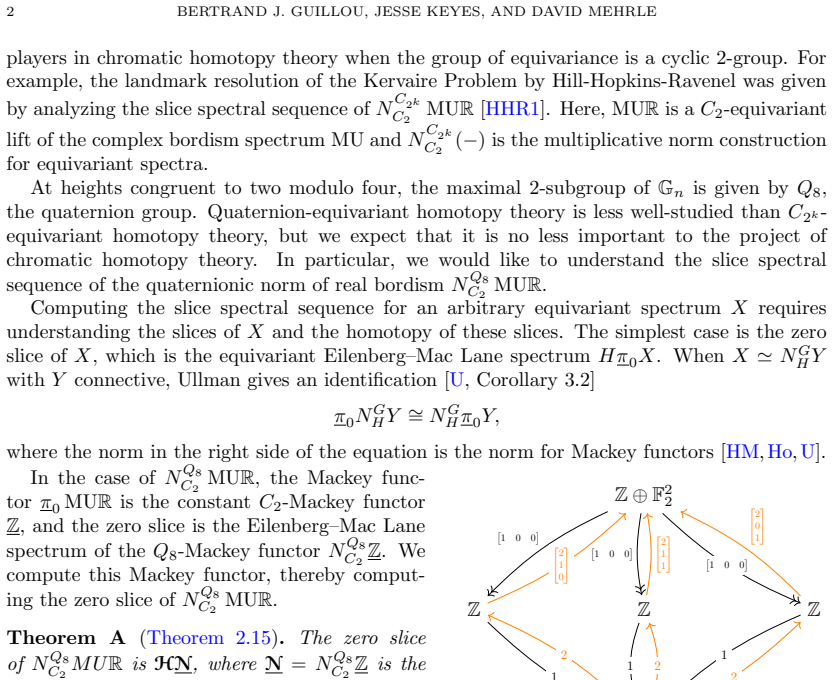
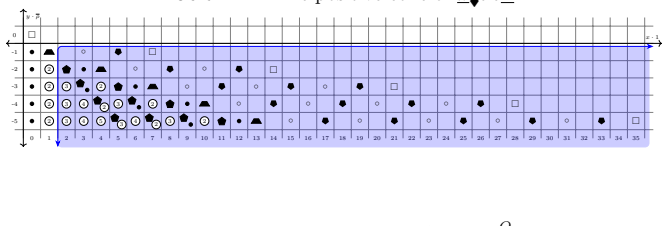
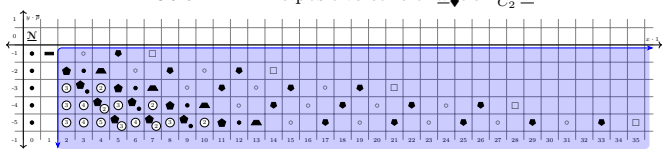
- Figure 1: the labeling of the RO(Q8)-grading axes is too small to read in the printed version; enlarge or add a table of degrees.
- §4.3: the transition from the normed spectrum to the zero-slice homotopy is described in one sentence; a short diagram or reference to the precise slice-filtration property used would improve readability.
Simulated Author's Rebuttal
We thank the referee for their positive assessment of the manuscript, including the summary of our computation of the zero slice of the Q8-spectrum N_{C2}^{Q8} MUℝ and the significance for the slice spectral sequence. We note the recommendation for minor revision and will incorporate improvements in the revised version.
Circularity Check
No significant circularity in the derivation chain
full rationale
The paper computes the zero slice of the Q8-spectrum obtained from the Hill-Hopkins-Ravenel norm applied to MUℝ, together with a subring of its RO(Q8)-graded homotopy Mackey functors, by direct application of the norm functor's compatibility with the slice filtration and algebraic derivation of homotopy groups from the known structure of Q8-Mackey functors. These steps rely on external, independently established facts about equivariant spectra and Mackey functors rather than redefining inputs as outputs or chaining self-citations that bear the central load. The argument is self-contained and does not reduce any claimed result to a fitted parameter or tautological renaming.
Axiom & Free-Parameter Ledger
Reference graph
Works this paper leans on
-
[1]
[BSSW] Tobias Barthel, Tomer M. Schlank, Nathaniel Stapleton, and Jared Weinstein,On the rationalization of theK(n)-local sphere(2025), available athttps://arxiv.org/abs/2402.00960. [BGHL] Andrew J. Blumberg, Teena Gerhardt, Michael A. Hill, and Tyler Lawson,The Witt vectors for Green functors, J. Algebra537(2019), 197–244, DOI 10.1016/j.jalgebra.2019.07....
-
[2]
MR3259973 [N] Hiroyuki Nakaoka,Ideals of Tambara functors, Adv
Thesis (Ph.D.)–The University of Chicago. MR3259973 [N] Hiroyuki Nakaoka,Ideals of Tambara functors, Adv. Math.230(2012), no. 4-6, 2295–2331, DOI 10.1016/j.aim.2012.04.021. MR2927371 [U] John Ullman,Symmetric Powers and Norms of Mackey Functors(2013), available athttps://arxiv. org/pdf/1304.5648. Email address:bertguillou@uky.edu Email address:jdke228@uky...
discussion (0)
Sign in with ORCID, Apple, or X to comment. Anyone can read and Pith papers without signing in.