Recognition: unknown
Spherical Geometrical Bases of Spherical Origami
Pith reviewed 2026-05-10 15:42 UTC · model grok-4.3
The pith
Spherical origami is defined by extending the seven Huzita-Justin axioms to explicit spherical equations on the unit sphere and by using equidistant curves for three-dimensional folds.
A machine-rendered reading of the paper's core claim, the machinery that carries it, and where it could break.
Core claim
For origami restricted to the unit sphere, the Euclidean definitions of points, lines, and folds are replaced by their spherical analogues, and each of the seven Huzita-Justin axioms is rewritten as a concrete spherical equation that can be solved directly. For folding in three-dimensional space, equidistant curves replace geodesics as the allowable fold loci, producing a larger set of possible operations while preserving the ability to simulate complete models.
What carries the argument
Spherical extensions of the Huzita-Justin axioms, expressed as explicit equations on S^2, together with equidistant curves as the basic fold loci in three-dimensional spherical-sheet folding.
If this is right
- Any Euclidean origami construction that uses only the seven axioms now has a direct spherical counterpart whose steps are given by solvable spherical equations.
- Three-dimensional spherical-sheet folding gains a wider family of allowable fold curves, allowing models that cannot be formed with geodesic folds alone.
- Computer-graphics rendering of spherical origami becomes a deterministic process once the spherical axiom equations are implemented.
- Validation through explicit models such as birds shows that the framework supports both theoretical completeness and practical construction.
Where Pith is reading between the lines
- Design tools for curved-surface origami could adopt the same axiom equations to generate new spherical polyhedra or mechanisms.
- The equidistant-curve approach may generalize to other non-Euclidean surfaces, such as hyperbolic sheets, without changing the core axiom structure.
- Numerical solvers for the spherical axiom equations could be embedded in existing origami simulators to handle spherical constraints automatically.
Load-bearing premise
That the standard definitions and axioms of flat Euclidean origami can be carried over to spherical geometry without creating new inconsistencies or needing extra constraints.
What would settle it
A concrete sequence of folds on the sphere that satisfies the proposed spherical axioms yet produces a self-intersecting or non-developable surface when the model is realized in three dimensions.
Figures


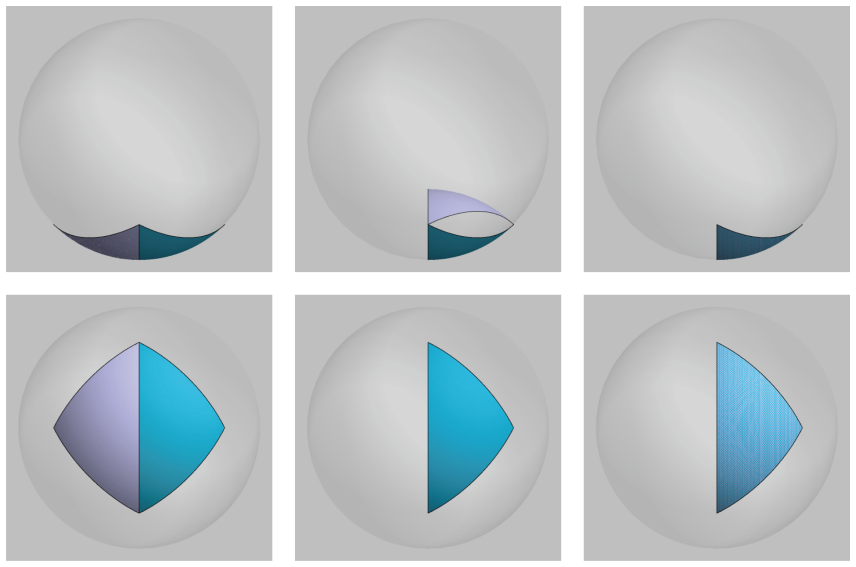
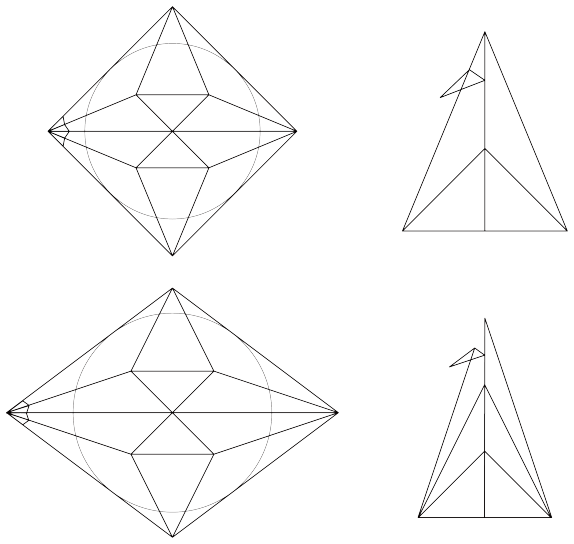


read the original abstract
This paper establishes a rigorous geometrical framework for spherical origami, origami using spherical sheets based on spherical geometry. Two settings are treated: origami restricted to the unit sphere ($\mathbb{S}^2$), and three-dimensional folding of spherical sheets in space. For origami on $\mathbb{S}^2$, the definitions of Euclidean origami are systematically extended to the spherical setting, and all seven Huzita--Justin axioms are shown to admit explicit equations in spherical geometry. For three-dimensional folding, equidistant curves are introduced as fold curves, replacing geodesics and enabling a richer family of folds. The framework is validated by successfully constructing computer graphics of spherical origami birds, demonstrating both the theoretical completeness and practical utility of the proposed approach.
Editorial analysis
A structured set of objections, weighed in public.
Referee Report
Summary. The manuscript develops a geometrical framework for spherical origami in two settings: origami restricted to the unit sphere S² and three-dimensional folding of spherical sheets in space. It systematically extends the definitions of Euclidean origami to the spherical case and derives explicit equations for all seven Huzita-Justin axioms under spherical geometry. For the 3D case, equidistant curves are introduced as fold curves in place of geodesics. The framework is validated through computer-graphics constructions of spherical origami birds.
Significance. If the extensions prove consistent and the axiom equations are correctly derived from spherical trigonometry, the work supplies a foundational set of operations for computational spherical origami. This could enable new results in non-Euclidean computational geometry and practical modeling of curved-surface folding. The computer-graphics validation provides concrete evidence of constructibility, strengthening the claim of both theoretical completeness and practical utility.
major comments (2)
- [Section deriving the Huzita-Justin axioms] The central claim that all seven Huzita-Justin axioms admit explicit equations in spherical geometry is load-bearing, yet the derivations must be shown to reduce correctly to the Euclidean limit as curvature tends to zero and to remain free of singularities for distances approaching π. Without these checks, it is unclear whether the spherical versions preserve the original axioms' solvability properties.
- [Section on three-dimensional folding] The introduction of equidistant curves for 3D folding replaces geodesics but does not specify how the resulting fold operations interact with the spherical axioms or whether additional constraints arise at the poles; this directly affects the claimed richer family of folds.
minor comments (2)
- [Validation section] The abstract states that computer graphics of spherical origami birds were constructed, but the manuscript should include the specific spherical coordinates, fold sequences, or parameter values used so that the examples are reproducible.
- [Preliminaries] Notation for spherical distances and angles should be defined explicitly at first use and kept consistent with standard spherical trigonometry conventions to aid readability.
Simulated Author's Rebuttal
We thank the referee for the careful and constructive review of our manuscript on spherical origami. We address each major comment below and have revised the manuscript to incorporate the suggested clarifications and verifications.
read point-by-point responses
-
Referee: [Section deriving the Huzita-Justin axioms] The central claim that all seven Huzita-Justin axioms admit explicit equations in spherical geometry is load-bearing, yet the derivations must be shown to reduce correctly to the Euclidean limit as curvature tends to zero and to remain free of singularities for distances approaching π. Without these checks, it is unclear whether the spherical versions preserve the original axioms' solvability properties.
Authors: We agree that explicit verification of the Euclidean limit and singularity analysis strengthens the central claim. The equations were derived using the spherical law of cosines, which ensures continuous reduction to the Euclidean case as curvature tends to zero; however, to make this rigorous, we have added a new subsection (Section 4.3) that explicitly computes the limit for each of the seven axioms and confirms recovery of the standard Huzita-Justin forms. For singularities, we have included an analysis showing that the equations remain nonsingular for distances in (0, π) excluding antipodal degeneracies, which are excluded from valid origami constructions; the domain of each operation is now stated explicitly to preserve solvability. revision: yes
-
Referee: [Section on three-dimensional folding] The introduction of equidistant curves for 3D folding replaces geodesics but does not specify how the resulting fold operations interact with the spherical axioms or whether additional constraints arise at the poles; this directly affects the claimed richer family of folds.
Authors: We thank the referee for noting the need to clarify the relationship between 3D folds and the surface axioms. Equidistant curves are employed for the extrinsic 3D embedding while the axioms govern intrinsic constructions on the sphere; the crease is the intersection of the equidistant curve with the sphere, allowing the axioms to apply directly to the resulting spherical polygon. In the revision we have expanded Section 5 with a paragraph explaining this compatibility and noting that the richer family arises precisely because 3D folds are not restricted to geodesics. We have also added a discussion of polar constraints, showing that folds passing near poles require only a local coordinate adjustment (no loss of generality) and do not introduce new restrictions beyond those already present in spherical geometry. revision: yes
Circularity Check
No significant circularity in the derivation chain
full rationale
The paper systematically extends standard Euclidean origami definitions and the seven Huzita-Justin axioms to the spherical setting on S^2 by deriving explicit equations from spherical geometry. No self-definitional loops, fitted inputs presented as predictions, or load-bearing self-citations appear in the described structure or abstract. The central claims rest on direct mathematical extension and computer-graphics validation rather than reducing to the paper's own inputs by construction.
Axiom & Free-Parameter Ledger
Reference graph
Works this paper leans on
-
[1]
CRC Press, Boca Raton, USA, 2012
Thomas Hull.Project origami: activities for exploring mathematics. CRC Press, Boca Raton, USA, 2012
2012
-
[2]
Arbelos, Shipley, UK, 2008
Robert Geretschl¨ ager.Geometric Origami. Arbelos, Shipley, UK, 2008
2008
-
[3]
Origami engineering.Nature Reviews Methods Primers, 4(1):40, 2024
Diego Misseroni, Phanisri P Pratapa, Ke Liu, Biruta Kresling, Yan Chen, Chiara Daraio, and Glaucio H Paulino. Origami engineering.Nature Reviews Methods Primers, 4(1):40, 2024
2024
-
[4]
Origami and materials science.Philosophical Transactions of the Royal Society A, 379(2201):20200113, 2021
Huan Liu, Paul Plucinsky, Fan Feng, and Richard D James. Origami and materials science.Philosophical Transactions of the Royal Society A, 379(2201):20200113, 2021
2021
-
[5]
The science of miura-ori: A review
Koryo Miura. The science of miura-ori: A review. In Robert J. Lang, editor,Origami 4, Fourth International Meeting of Origami Science, Mathematics, and Education, pages 87–99, Natick, USA, 2009. A K Peters, Ltd
2009
-
[6]
CRC Press, Boca Raton, USA, 2019
Jun Mitani.Curved-folding origami design. CRC Press, Boca Raton, USA, 2019
2019
-
[7]
New Origami Publishing, Columbia, USA, 2021
Ekaterina Lukasheva.Curved Origami. New Origami Publishing, Columbia, USA, 2021
2021
-
[8]
A note on operations of spherical origami constructions
Toshikazu Kawasaki. A note on operations of spherical origami constructions. In P Wang-Iverson, RJ Lang, and M Yim, editors,Origami 5, pages 543–551, Boca Raton, USA, 2011. CRC Press
2011
-
[9]
Alperin, Barry Hayes, and Robert J
Roger C. Alperin, Barry Hayes, and Robert J. Lang. Folding the hyperbolic crane. Mathematical Intelligencer, 34(2):???–???, 2012
2012
-
[10]
One-, two-, and multi-fold origami axioms
Roger C Alperin and Robert J Lang. One-, two-, and multi-fold origami axioms. In Origami 4, pages 371–393, 2006
2006
-
[11]
R´ esolution par le pliage de l’´ equation du troisi` eme degr´ e et applications g´ eom´ etriques.L’Ouvert - Journal de l’APMEP d’Alsace et de l’IREM de Strasbourg, 42:9–19, 1986
Jacques Justin. R´ esolution par le pliage de l’´ equation du troisi` eme degr´ e et applications g´ eom´ etriques.L’Ouvert - Journal de l’APMEP d’Alsace et de l’IREM de Strasbourg, 42:9–19, 1986
1986
-
[12]
Axiomatic development of origami geometry
Humiaki Huzita. Axiomatic development of origami geometry. InProceedings of the First International Meeting of Origami Science and Technology, 1989, pages 143–158, 1989
1989
-
[13]
Origami versus straight-edge-and-compass.https://origami.ousaan
Koshiro Hatori. Origami versus straight-edge-and-compass.https://origami.ousaan. com/library/conste.html. (Retrieved on 12/29/2024)
2024
-
[14]
Robert J. Lang. Huzita-justin axioms.https://langorigami.com/article/ huzita-justin-axioms/. (Retrieved on 12/29/2024)
2024
-
[15]
Japan Publications Trading, Tokyo, JPN, 2005
Toshikazu Kawasaki.Roses, origami & math. Japan Publications Trading, Tokyo, JPN, 2005. 18
2005
-
[16]
Springer, Berlin, DE, 1953
L´ aszl´ o Fejes T´ oth.Lagerungen in der Ebene, auf der Kugel und im Raum. Springer, Berlin, DE, 1953
1953
-
[17]
A new aspect of spherical harmonics.Forma, 13(2):51–62, 1998
Tohru Ogawa. A new aspect of spherical harmonics.Forma, 13(2):51–62, 1998. 19
1998
discussion (0)
Sign in with ORCID, Apple, or X to comment. Anyone can read and Pith papers without signing in.