Recognition: unknown
Asymmetric Invertible Threat: Learning Reversible Privacy Defense for Face Recognition
Pith reviewed 2026-05-09 15:20 UTC · model grok-4.3
The pith
A keyed transformation protects face images from restoration attacks while permitting authorized recovery and tamper detection.
A machine-rendered reading of the paper's core claim, the machinery that carries it, and where it could break.
Core claim
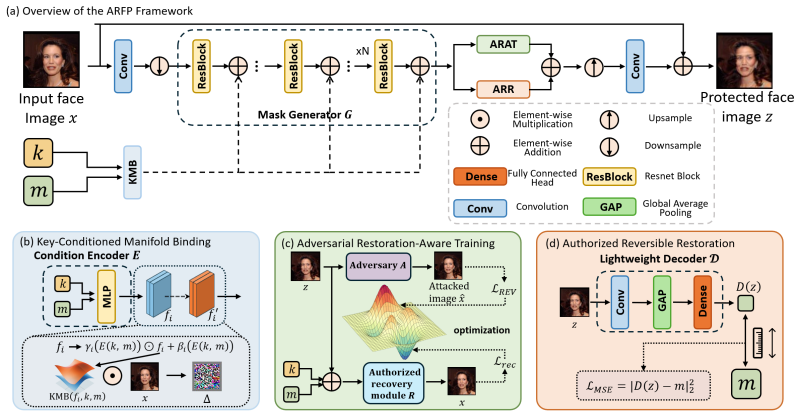
Asymmetric Reversible Face Protection consists of Key-Conditioned Manifold Binding to tie the protection to a user-provided key, Adversarial Restoration-Aware Training that introduces a surrogate restoration adversary during learning, and Authorized Reversible Restoration that enables recovery with the correct key while providing nonce-based tamper indication. Under the threat models considered, this produces key-sensitive recovery behavior and tamper awareness while improving resistance to the evaluated restoration attacks and preserving authorized recovery utility.
What carries the argument
Key-Conditioned Manifold Binding that links the protection transformation to a secret user key, combined with adversarial training against a surrogate restoration adversary.
If this is right
- Protected images resist restoration attempts by adversaries who learn inverse mappings.
- Authorized users recover the original image using only the correct key.
- Any tampering with the protected image is indicated through the nonce mechanism.
- Recovery utility for legitimate parties remains intact while privacy improves against the tested attacks.
Where Pith is reading between the lines
- The same keyed asymmetric structure could apply to other biometric data types where reversible privacy is needed.
- Tamper indication might support integrity checks when protected images are stored or shared across systems.
- Multiple distinct keys per user could allow selective recovery for different recipients or purposes.
Load-bearing premise
Training the protection against one surrogate restoration adversary will generalize to real adversaries who may use different restoration mappings.
What would settle it
An adversary without the user key succeeds in training a restoration network distinct from the surrogate used during defense training and recovers usable identity information from the protected images.
Figures




read the original abstract
Face Recognition systems are widely deployed in real-world applications, but they also raise privacy concerns due to unauthorized collection and misuse of facial data. Existing adversarial privacy protection methods rely on input-space perturbations to obfuscate identity information, yet their protection can degrade when adversaries learn restoration or purification mappings that partially invert the transformation. We study this setting as an asymmetric adversarial attack, in which reverse manipulation becomes feasible because existing defense paradigms do not control reversibility. To address this problem, we propose Asymmetric Reversible Face Protection (ARFP), a restoration-aware extension of personalized face cloaking that integrates privacy protection, keyed recovery, and tamper indication in a single framework. ARFP consists of three components: Key-Conditioned Manifold Binding, which ties the protection transformation to a user-provided key; Adversarial Restoration-Aware Training, which introduces a surrogate restoration adversary during training to improve robustness against evaluated inverse purification attacks; and Authorized Reversible Restoration, which supports recovery with the correct key while providing nonce-based tamper indication. Extensive experiments under the threat models considered in this work show that ARFP improves resistance to the evaluated restoration attacks while preserving authorized recovery utility. These results provide empirical evidence of key-sensitive recovery behavior and tamper awareness in the tested settings.
Editorial analysis
A structured set of objections, weighed in public.
Referee Report
Summary. The paper proposes Asymmetric Reversible Face Protection (ARFP) to address privacy risks in face recognition systems. It identifies an asymmetric invertible threat where standard input-space adversarial perturbations for identity obfuscation can be partially inverted by adversaries learning restoration or purification mappings. ARFP extends personalized face cloaking with three components: Key-Conditioned Manifold Binding (tying the protection transformation to a user-provided key), Adversarial Restoration-Aware Training (incorporating a surrogate restoration adversary during training), and Authorized Reversible Restoration (enabling key-based recovery with nonce-based tamper indication). Under the threat models considered, the method is reported to improve resistance to evaluated restoration attacks while preserving authorized recovery utility, with empirical evidence of key-sensitive recovery and tamper awareness.
Significance. If the central empirical claims hold and the protection generalizes, ARFP could offer a practical advance in reversible privacy defenses for biometrics by combining protection, authorized access, and tamper detection in one framework. The adversarial training against restoration and the keyed manifold binding represent a coherent extension of existing cloaking techniques. The work's value would be strengthened by reproducible code or detailed ablations, but the current framing already highlights a useful distinction between symmetric and asymmetric threats in privacy-preserving face recognition.
major comments (1)
- Abstract: The central claim that ARFP 'improves resistance to the evaluated restoration attacks' is qualified to 'the threat models considered in this work' and 'the evaluated restoration attacks.' Since Adversarial Restoration-Aware Training explicitly uses a surrogate restoration adversary, the reported gains may not extend to adversaries employing different architectures, losses, or optimization procedures for inverting the Key-Conditioned Manifold Binding. This generalization gap is load-bearing for the robustness contribution and requires either additional out-of-distribution experiments or a clearer statement of the threat-model scope.
minor comments (2)
- The abstract would be strengthened by including at least one quantitative result (e.g., attack success rate reduction or recovery PSNR) to convey the magnitude of the reported improvements.
- Notation for the three components (Key-Conditioned Manifold Binding, Adversarial Restoration-Aware Training, Authorized Reversible Restoration) is introduced without forward references to their formal definitions or equations in the main text; adding such pointers would improve readability.
Simulated Author's Rebuttal
We thank the referee for the constructive feedback on our manuscript. We address the major comment below and have revised the abstract to more explicitly bound the threat-model scope and surrogate-adversary assumptions.
read point-by-point responses
-
Referee: Abstract: The central claim that ARFP 'improves resistance to the evaluated restoration attacks' is qualified to 'the threat models considered in this work' and 'the evaluated restoration attacks.' Since Adversarial Restoration-Aware Training explicitly uses a surrogate restoration adversary, the reported gains may not extend to adversaries employing different architectures, losses, or optimization procedures for inverting the Key-Conditioned Manifold Binding. This generalization gap is load-bearing for the robustness contribution and requires either additional out-of-distribution experiments or a clearer statement of the threat-model scope.
Authors: We agree that the robustness claims must remain scoped to the evaluated threat models and the surrogate restoration adversary used during training. The current abstract already qualifies the results with the phrases 'under the threat models considered in this work' and 'the evaluated restoration attacks,' but we accept that these qualifiers can be made more prominent and explicit. In the revised manuscript we have updated the abstract to foreground the surrogate-based training procedure and to state that improvements are demonstrated against the specific restoration attacks considered rather than claiming broader generalization. We have also added a short paragraph in the discussion section acknowledging that adversaries using substantially different architectures or losses could potentially reduce the observed gains, and we list this as a limitation. While additional out-of-distribution experiments would be valuable, they fall outside the scope of the present study; the current evaluation focuses on representative restoration attacks within the defined asymmetric invertible threat model. revision: partial
Circularity Check
No significant circularity in method or claims
full rationale
The paper proposes ARFP as an empirical framework with three explicitly described components (Key-Conditioned Manifold Binding, Adversarial Restoration-Aware Training using a surrogate, and Authorized Reversible Restoration). Results are reported as experimental improvements under the same threat models and evaluated restoration attacks used at training time. No derivation chain, first-principles prediction, or uniqueness theorem is claimed that reduces to inputs by construction. The abstract and description frame the work as an extension with new training components rather than a self-referential fit or renamed known result. No self-citations are load-bearing in the provided text, and the evaluation setup is stated transparently without presenting the surrogate-matched results as independent generalization evidence.
Axiom & Free-Parameter Ledger
invented entities (2)
-
Key-Conditioned Manifold Binding
no independent evidence
-
Adversarial Restoration-Aware Training
no independent evidence
Reference graph
Works this paper leans on
-
[1]
Dickerson, Gavin Taylor, and Tom Goldstein
Valeriia Cherepanova, Micah Goldblum, Harrison Foley, Shiyuan Duan, John P. Dickerson, Gavin Taylor, and Tom Goldstein. Lowkey: Leveraging adversarial attacks to protect social media users from facial recognition. In9th International Conference on Learning Represen- tations, ICLR 2021, Virtual Event, Austria, May 3-7, 2021. OpenReview.net, 2021. URL https...
2021
-
[2]
Personalized privacy protection mask against unauthorized facial recognition
Ka-Ho Chow, Sihao Hu, Tiansheng Huang, and Ling Liu. Personalized privacy protection mask against unauthorized facial recognition. InComputer Vision - ECCV 2024 - 18th European Conference, Milan, Italy, September 29-October 4, 2024, Proceedings, Part LXXXII, volume 15140 ofLecture Notes in Computer Science, pages 434–450. Springer, 2025. ISBN 978-3-031- 7...
-
[3]
Jiankang Deng, Jia Guo, Niannan Xue, and Stefanos Zafeiriou. Arcface: Additive angular margin loss for deep face recognition. InIEEE Conference on Computer Vision and Pattern Recognition, CVPR 2019, Long Beach, CA, USA, June 16-20, 2019, pages 4690–4699. Computer Vision Foundation / IEEE, 2019. doi: 10.1109/CVPR.2019.00482. URL http: //openaccess.thecvf.c...
-
[4]
NICE: Non-linear Independent Components Estimation
Laurent Dinh, David Krueger, and Yoshua Bengio. NICE: non-linear independent components estimation. 2015. URLhttp://arxiv.org/abs/1410.8516
work page internal anchor Pith review arXiv 2015
-
[5]
Casia image tampering detection evaluation database
Jing Dong, Wei Wang, and Tieniu Tan. Casia image tampering detection evaluation database. In 2013 IEEE China Summit and International Conference on Signal and Information Processing, pages 422–426, 2013. doi: 10.1109/ChinaSIP.2013.6625374
-
[6]
Explaining and Harnessing Adversarial Examples
Ian J. Goodfellow, Jonathon Shlens, and Christian Szegedy. Explaining and harnessing adver- sarial examples. In Yoshua Bengio and Yann LeCun, editors,3rd International Conference on Learning Representations, ICLR 2015, San Diego, CA, USA, May 7-9, 2015, Conference Track Proceedings, 2015. URLhttp://arxiv.org/abs/1412.6572
work page internal anchor Pith review arXiv 2015
-
[7]
Huang, Marwan Mattar, Tamara Berg, and Eric Learned-Miller
Gary B. Huang, Marwan Mattar, Tamara Berg, and Eric Learned-Miller. Labeled Faces in the Wild: A Database forStudying Face Recognition in Unconstrained Environments. Technical report, Marseille, France, October 2008. URL https://inria.hal.science/ inria-00321923
2008
-
[8]
Unlearn- able examples: Making personal data unexploitable
Hanxun Huang, Xingjun Ma, Sarah Monazam Erfani, James Bailey, and Yisen Wang. Unlearn- able examples: Making personal data unexploitable. InInternational Conference on Learning Representations, 2021. URLhttps://openreview.net/forum?id=iAmZUo0DxC0
2021
-
[9]
Jörn-Henrik Jacobsen, Arnold W. M. Smeulders, and Edouard Oyallon. i-revnet: Deep invertible networks. In6th International Conference on Learning Representations, ICLR 2018, Vancouver, BC, Canada, April 30 - May 3, 2018, Conference Track Proceedings. OpenReview.net, 2018. URLhttps://openreview.net/forum?id=HJsjkMb0Z
2018
-
[10]
Adversarial image perturbation for privacy protection – a game theory perspective
Seong Joon Oh, Mario Fritz, and Bernt Schiele. Adversarial image perturbation for privacy protection – a game theory perspective. InProceedings of the IEEE International Conference on Computer Vision (ICCV), Oct 2017
2017
-
[11]
Advhat: Real-world adversarial attack on arcface face ID system
Stepan Komkov and Aleksandr Petiushko. Advhat: Real-world adversarial attack on arcface face ID system. In25th International Conference on Pattern Recognition, ICPR 2020, Virtual Event / Milan, Italy, January 10-15, 2021, pages 819–826. IEEE, 2020. doi: 10.1109/ICPR48806. 2021.9412236. URLhttps://doi.org/10.1109/ICPR48806.2021.9412236
-
[12]
Qiang Meng, Shichao Zhao, Zhida Huang, and Feng Zhou. Magface: A universal representation for face recognition and quality assessment. InIEEE Conference on Computer Vision and Pattern Recognition, CVPR 2021, virtual, June 19-25, 2021, pages 14225–14234. Computer Vision Foundation / IEEE, 2021. doi: 10.1109/CVPR46437.2021.01400. URL https://openaccess.thec...
-
[13]
A data-driven approach to cleaning large face datasets
Hong-Wei Ng and Stefan Winkler. A data-driven approach to cleaning large face datasets. In 2014 IEEE International Conference on Image Processing (ICIP), pages 343–347, 2014. doi: 10.1109/ICIP.2014.7025068
-
[14]
Diffusion models for adversarial purification
Weili Nie, Brandon Guo, Yujia Huang, Chaowei Xiao, Arash Vahdat, and Anima Anandkumar. Diffusion models for adversarial purification. InInternational Conference on Machine Learning,
-
[15]
URLhttps://api.semanticscholar.org/CorpusID:248811081
-
[16]
A simple proof of the entropy-power inequality via properties of mutual infor- mation
Olivier Rioul. A simple proof of the entropy-power inequality via properties of mutual infor- mation. pages 46–50, 2007. doi: 10.1109/ISIT.2007.4557202. URL https://doi.org/10. 1109/ISIT.2007.4557202
-
[17]
Facenet: A unified embedding for face recognition and clustering
Florian Schroff, Dmitry Kalenichenko, and James Philbin. Facenet: A unified embedding for face recognition and clustering. InProceedings of the IEEE Conference on Computer Vision and Pattern Recognition (CVPR), June 2015
2015
-
[18]
Shawn Shan, Emily Wenger, Jiayun Zhang, Huiying Li, Haitao Zheng, and Ben Y . Zhao. Fawkes: Protecting privacy against unauthorized deep learning models. In Srdjan Capkun and Franziska Roesner, editors,29th USENIX Security Symposium, USENIX Security 2020, August 12-14, 2020, pages 1589–1604. USENIX Association, 2020. URL https://www.usenix. org/conference...
2020
-
[19]
Mahmood Sharif, Sruti Bhagavatula, Lujo Bauer, and Michael K. Reiter. Accessorize to a crime: Real and stealthy attacks on state-of-the-art face recognition. In Edgar R. Weippl, Stefan Katzenbeisser, Christopher Kruegel, Andrew C. Myers, and Shai Halevi, editors,Proceedings of the 2016 ACM SIGSAC Conference on Computer and Communications Security, Vienna,...
2016
-
[20]
Cosface: Large margin cosine loss for deep face recognition
Hao Wang, Yitong Wang, Zheng Zhou, Xing Ji, Dihong Gong, Jingchao Zhou, Zhifeng Li, and Wei Liu. Cosface: Large margin cosine loss for deep face recognition. In2018 IEEE Conference on Computer Vision and Pattern Recognition, CVPR 2018, Salt Lake City, UT, USA, June 18-22, 2018, pages 5265–5274. Computer Vision Foundation / IEEE Computer Society,
2018
-
[21]
doi: 10.1109/CVPR.2018.00552. URL http://openaccess.thecvf.com/content_ cvpr_2018/html/Wang_CosFace_Large_Margin_CVPR_2018_paper.html
-
[22]
Towards face encryption by generating adversarial identity masks
Xiao Yang, Yinpeng Dong, Tianyu Pang, Hang Su, Jun Zhu, Yuefeng Chen, and Hui Xue. Towards face encryption by generating adversarial identity masks. InProceedings of the IEEE/CVF International Conference on Computer Vision (ICCV), pages 3897–3907, October 2021
2021
-
[23]
Adv-makeup: A new imperceptible and transferable attack on face recognition
Bangjie Yin, Wenxuan Wang, Taiping Yao, Junfeng Guo, Zelun Kong, Shouhong Ding, Jilin Li, and Cong Liu. Adv-makeup: A new imperceptible and transferable attack on face recognition. In Zhi-Hua Zhou, editor,Proceedings of the Thirtieth International Joint Conference on Artificial Intelligence, IJCAI 2021, Virtual Event / Montreal, Canada, 19-27 August 2021,...
2021
-
[24]
ijcai.org, 2021. doi: 10.24963/IJCAI.2021/173. URL https://doi.org/10.24963/ ijcai.2021/173
-
[25]
Joint face detection and alignment using multitask cascaded convolutional networks.IEEE Signal Processing Letters, 23(10): 1499–1503, 2016
Kaipeng Zhang, Zhanpeng Zhang, Zhifeng Li, and Yu Qiao. Joint face detection and alignment using multitask cascaded convolutional networks.IEEE Signal Processing Letters, 23(10): 1499–1503, 2016
2016
-
[26]
Efros, Eli Shechtman, and Oliver Wang
Richard Zhang, Phillip Isola, Alexei A. Efros, Eli Shechtman, and Oliver Wang. The unrea- sonable effectiveness of deep features as a perceptual metric. InProceedings of the IEEE Conference on Computer Vision and Pattern Recognition (CVPR), June 2018
2018
-
[27]
OPOM: customized invisible cloak towards face privacy protection.IEEE Trans
Yaoyao Zhong and Weihong Deng. OPOM: customized invisible cloak towards face privacy protection.IEEE Trans. Pattern Anal. Mach. Intell., 45(3):3590–3603, 2023. doi: 10.1109/ TPAMI.2022.3175602. URLhttps://doi.org/10.1109/TPAMI.2022.3175602
-
[28]
Jun-Yan Zhu, Taesung Park, Phillip Isola, and Alexei A. Efros. Unpaired image-to-image translation using cycle-consistent adversarial networks. InProceedings of the IEEE International Conference on Computer Vision (ICCV), Oct 2017. 11 A Appendix: Supporting Derivation for Proposition 1 This appendix provides a short derivation supporting Proposition 1. Th...
2017
discussion (0)
Sign in with ORCID, Apple, or X to comment. Anyone can read and Pith papers without signing in.