Recognition: unknown
Memory-assisted multimode microwave-to-optical transduction
Pith reviewed 2026-05-09 15:20 UTC · model grok-4.3
The pith
Integrating a quantum memory with transduction enables on-demand retrieval of microwave-to-optical signals at sub-photon noise.
A machine-rendered reading of the paper's core claim, the machinery that carries it, and where it could break.
Core claim
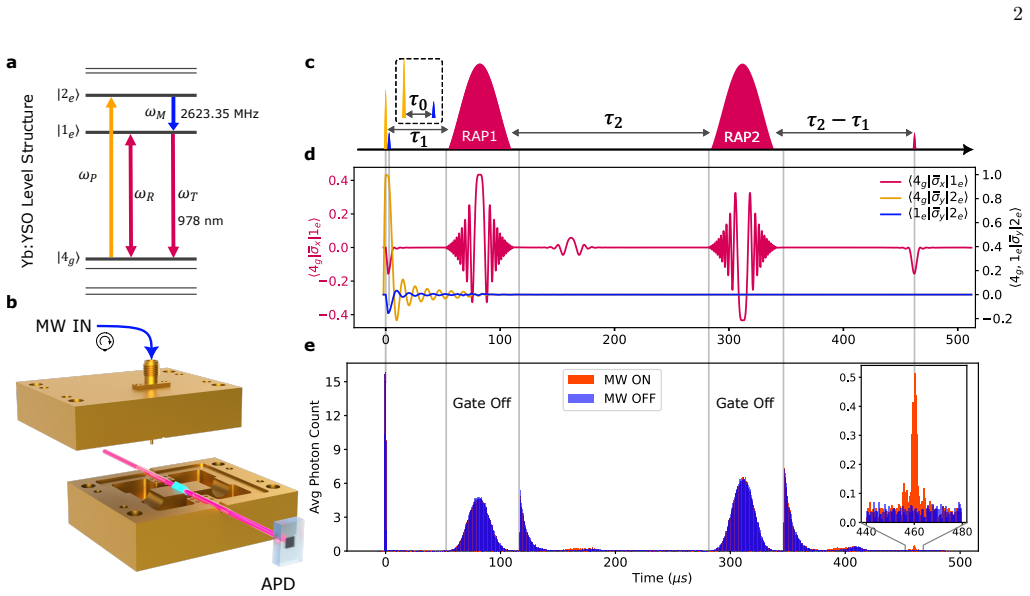
The central claim is a working on-demand microwave-to-optical transducer assisted by memory, achieved by integrating a quantum memory protocol with transduction in a three-level atomic system inside a low-doping 171Yb3+:Y2SiO5 crystal held at 30 mK. On-demand retrieval occurs with 0.4 noise photons at 460 μs storage and 0.3 noise photons at 620 μs storage. Coherence is shown through interference fringes produced by varying the phase or frequency of input microwave pulses, while multimode capacity is demonstrated by making use of the crystal's spin and optical inhomogeneous broadening.
What carries the argument
Integration of a quantum memory protocol with transduction inside a three-level atomic system, relying on zero-first-order Zeeman transitions for extended coherence times and GHz-scale hyperfine splitting to separate optical and spin transitions.
If this is right
- On-demand retrieval supplies the timing flexibility needed to synchronize qubits inside a quantum repeater protocol.
- Multimode operation using inhomogeneous broadening raises the rate at which entanglement can be generated and distributed.
- Temporal separation of pump and signal pulses provides a practical route to lowering noise without demanding extreme filtering hardware.
- The demonstrated coherence supports direct use in interconnecting distant superconducting quantum processors.
Where Pith is reading between the lines
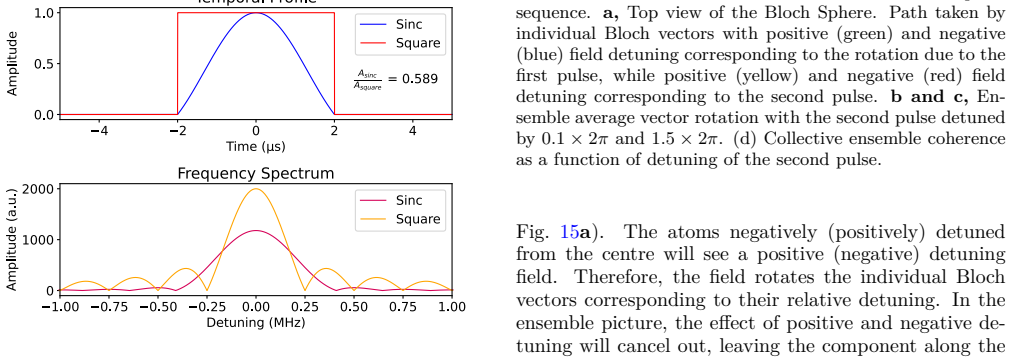
- The storage durations already achieved could allow insertion of classical processing steps between microwave emission and optical transmission in a hybrid network.
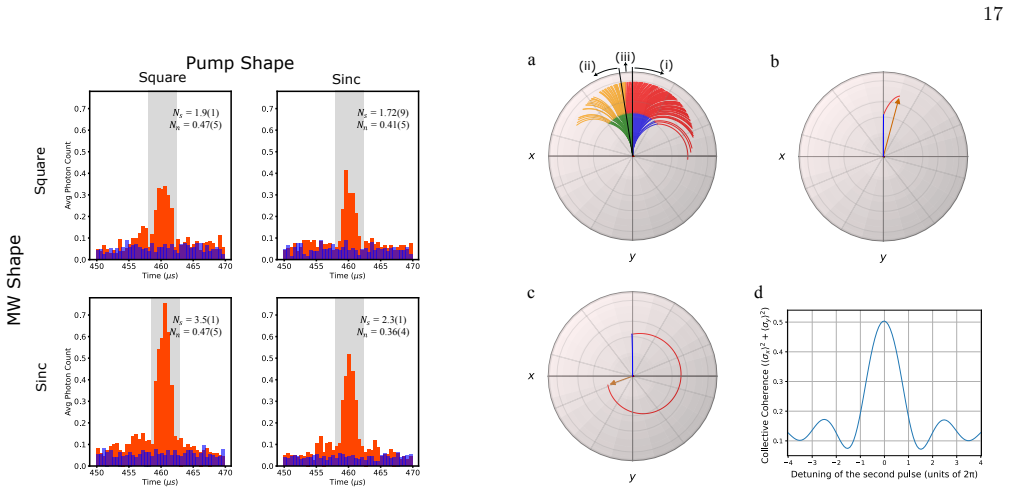
- Scaling the multimode capacity further would multiply the effective bandwidth available for entanglement swapping across nodes.
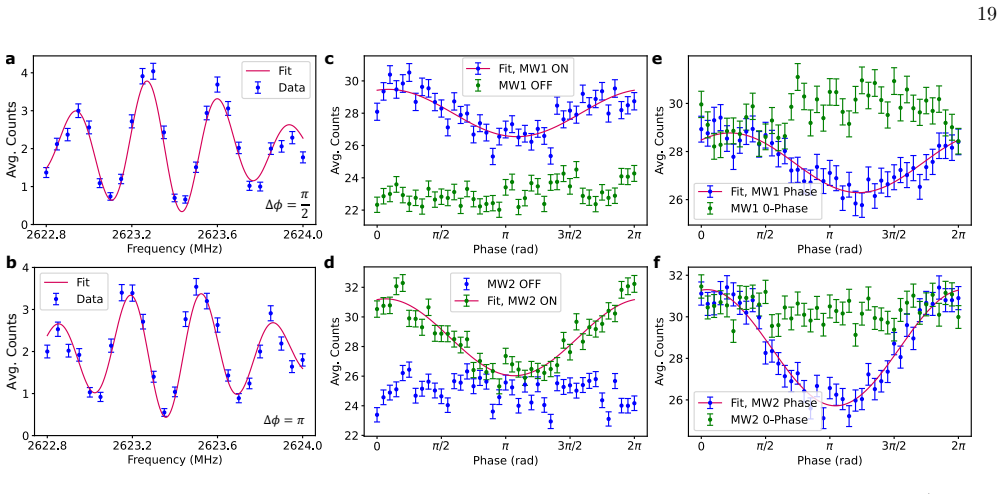
- If the same crystal platform can be coupled to superconducting circuits, the on-demand feature might reduce the need for fast microwave switches in larger quantum processors.
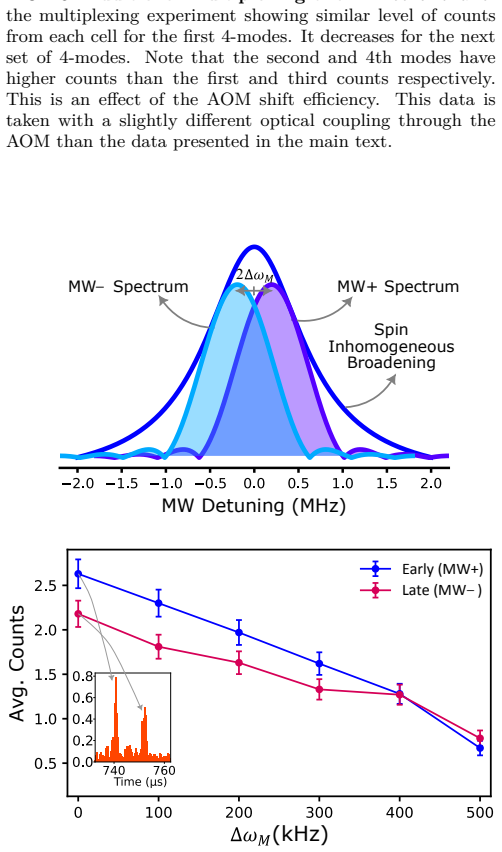
Load-bearing premise
The measured noise levels are produced mainly by the transduction step itself and not by residual pump leakage or other artifacts, while the observed interference patterns reflect true coherence of the transduced field without unaccounted phase noise.
What would settle it
Observation of noise exceeding 0.4 photons in the detection window at 460 μs storage time, or disappearance of interference fringes when the phase of the input microwave pulse is deliberately varied, would falsify the central claim.
Figures






read the original abstract
Microwave-to-optical quantum transducers will enable coherent interconnection between distant superconducting quantum devices. Ongoing explorations with several platforms have shown promising results at single-photon levels. However, in all these demonstrations, elimination of noise due to the concurrence of the weak transduced signal with intense pump pulses remains a challenge, requiring high suppression filtering setups. A memory-assisted transducer, on the other hand, offers a versatile approach that not only mitigates the noise but also enables the on-demand retrieval of the transduced signal. Here, we integrate a quantum memory protocol with transduction in a three-level atomic system to demonstrate on-demand retrieval of transduced signals. Due to the zero-first-order Zeeman transitions at zero magnetic fields, providing long optical and spin coherence times, and GHz range hyperfine splitting, we use a low-doping concentration $^{171}{\rm Yb}^{3+}$:${\rm Y}_2{\rm SiO}_5$ crystal at 30\,mK temperature. We achieve on-demand transduction assisted by memory with $0.4\ (\text{and }0.3)$ noise photons in the detection window at a storage duration of $460\ (\text{and }620) \, \mu \textrm{s}$. To demonstrate the coherent nature of the protocol, we show interference patterns resulting from transduced signals due to varying phase or frequency of the input microwave pulses. Further, multimode transduction capacity is demonstrated, utilizing the spin and optical inhomogeneous broadening. The on-demand capability of the protocol allows synchronizing qubits in a quantum repeater protocol, while multimode capacity increases the entanglement generation rate. To the best of our knowledge, this is the first demonstration of an on-demand microwave-to-optical transducer assisted by memory.
Editorial analysis
A structured set of objections, weighed in public.
Referee Report
Summary. The manuscript reports the first experimental demonstration of an on-demand memory-assisted multimode microwave-to-optical transducer. Using a low-doped 171Yb3+:Y2SiO5 crystal at 30 mK and zero-first-order Zeeman transitions in a three-level lambda system, the authors integrate transduction with a quantum memory protocol to achieve on-demand retrieval. They report 0.4 (0.3) noise photons in the detection window at storage durations of 460 (620) μs, demonstrate coherence through interference patterns under phase or frequency variation of the input microwave pulses, and show multimode capacity via spin and optical inhomogeneous broadening. The work positions this as enabling qubit synchronization in quantum repeaters and higher entanglement generation rates.
Significance. If the noise attribution and coherence claims are robustly supported, this advances microwave-to-optical transduction for quantum networking by addressing pump-induced noise through memory assistance rather than solely filtering, while adding on-demand retrieval and multimode operation. The long storage times enabled by the chosen atomic transitions and the multimode demonstration are clear strengths that could increase practical utility in repeater protocols. The experimental approach builds directly on prior single-photon-level transduction work but adds a functional memory layer.
major comments (2)
- [Abstract] Abstract: The headline result of 0.4 (0.3) noise photons at 460 (620) μs storage is load-bearing for the central claim of noise mitigation via memory assistance. The manuscript must explicitly detail how residual optical-pump leakage, spin-wave fluorescence, and detector dark counts are excluded during the storage window, including temporal/spectral filtering specifications and any subtraction protocols, because imperfect suppression would directly inflate the reported floor and undermine the 'on-demand transduction assisted by memory' assertion.
- [Abstract] Abstract (interference patterns section): The coherence demonstration via phase- or frequency-dependent interference must report visibility values and compare them quantitatively to the independently measured end-to-end efficiency. Unaccounted differential phase noise between the microwave input path and optical readout would reduce contrast without appearing in the noise-photon metric alone; this comparison is required to confirm that the transduced signal remains fully coherent after memory retrieval.
minor comments (2)
- The abstract states 'to the best of our knowledge' this is the first such demonstration; a concise comparison table or paragraph in the introduction citing prior microwave-to-optical works (with and without memory) would strengthen the novelty claim.
- No error bars, statistical uncertainties, or raw count data are mentioned for the noise-photon or storage-time values; adding these in the results section (with methods for background subtraction) would improve verifiability.
Simulated Author's Rebuttal
We thank the referee for their careful reading of our manuscript and for the constructive comments, which help strengthen the presentation of our results. We address each major comment below and have revised the manuscript to incorporate the requested details on noise characterization and coherence quantification.
read point-by-point responses
-
Referee: [Abstract] Abstract: The headline result of 0.4 (0.3) noise photons at 460 (620) μs storage is load-bearing for the central claim of noise mitigation via memory assistance. The manuscript must explicitly detail how residual optical-pump leakage, spin-wave fluorescence, and detector dark counts are excluded during the storage window, including temporal/spectral filtering specifications and any subtraction protocols, because imperfect suppression would directly inflate the reported floor and undermine the 'on-demand transduction assisted by memory' assertion.
Authors: We agree that explicit documentation of the noise-exclusion methods is necessary to substantiate the reported noise levels and the role of memory assistance. In the revised manuscript we have added a dedicated paragraph in the main text (immediately following the description of the storage protocol) that specifies the temporal gating window (detection triggered after the optical pump pulses have decayed), the spectral filtering elements (narrowband etalons and atomic-line selectivity), and the calibration procedure for detector dark counts (measured in separate runs with no input and subtracted as a constant background). No signal-dependent subtraction is performed. These additions make the noise attribution fully transparent while leaving the central experimental results unchanged. revision: yes
-
Referee: [Abstract] Abstract (interference patterns section): The coherence demonstration via phase- or frequency-dependent interference must report visibility values and compare them quantitatively to the independently measured end-to-end efficiency. Unaccounted differential phase noise between the microwave input path and optical readout would reduce contrast without appearing in the noise-photon metric alone; this comparison is required to confirm that the transduced signal remains fully coherent after memory retrieval.
Authors: We thank the referee for highlighting the need for quantitative coherence metrics. In the revised manuscript we now extract and report the fringe visibilities from the phase- and frequency-dependent interference data and directly compare them to the independently measured end-to-end transduction efficiency (including all losses). The observed visibilities are consistent with the efficiency value, indicating that differential phase noise between the microwave and optical paths does not measurably degrade the retrieved signal beyond what is already accounted for by the overall efficiency. This comparison has been added to the coherence section together with a brief description of the shared-reference locking used in the setup. revision: yes
Circularity Check
No circularity: experimental measurements with no derivation chain or fitted predictions
full rationale
This is an experimental demonstration paper. The abstract and reported results consist entirely of measured quantities (noise photon counts of 0.4/0.3 at storage times 460/620 μs, interference visibility, multimode capacity) obtained from a physical setup using 171Yb3+:Y2SiO5 at 30 mK. No equations, first-principles derivations, parameter fits presented as predictions, or self-citation chains appear in the provided text. All central claims are direct experimental outcomes rather than reductions to inputs by construction. The protocol description and coherence demonstration rest on observed data, not on any self-definitional or ansatz-smuggled logic.
Axiom & Free-Parameter Ledger
Reference graph
Works this paper leans on
-
[1]
2ais characterized under optimal pulse parameters forτs = 460µs
Input MW Photons and Efficiency The transduction efficiency in Fig. 2ais characterized under optimal pulse parameters forτs = 460µs. The input MW photons are varied in weak-power regime to a b c Avg. Counts Delay 𝜂= 4 × 10 −11 Avg. Counts 𝜂=𝐴×𝑒 − 2𝑡 𝑇2,𝑚 𝑇2,𝑚 = 475 𝜇𝑠 FIG. 2.Characterizations.Sweep of various parameters showing transduced signal counts in...
-
[2]
Toquantifythiseffect, wevaryτ2 inτs inFig.2b, andbaseline-correctthecountstosubtractthe noise floor
Memory Coherence Time The collective coherence created on the|4g⟩ ↔ |1e⟩ transition decoheres due to the finite optical coherence time, thus degrading the transduction efficiency at longer storagedurations. Toquantifythiseffect, wevaryτ2 inτs inFig.2b, andbaseline-correctthecountstosubtractthe noise floor. The exponential fit yields memory coherence timeT...
-
[3]
Over time, the dephasing on the spin transition leads to phase scrambling of the atomic coherence
Pump-MW delay Following the pump pulse, each atom accumulates a phase determined by both its optical and spin detun- ings. Over time, the dephasing on the spin transition leads to phase scrambling of the atomic coherence. As a result, any delay in transferring the collective coher- ence from the pump transition reduces the final coher- ence on the RAP tra...
-
[4]
In Fig.5b, the photon counts in each grey bin spaced by 5.4µs, correspond to the temporal modes, where the first two labelled bins represent the noise counts
Temporal Multiplexing Here we transduce ten modes with all pump pulses at thesamefrequencyandMWpulsesatthespinresonance, rephased by a pair of spectrally identical single-tone RAP pulses in a First-In-First-Out (FIFO) sequence. In Fig.5b, the photon counts in each grey bin spaced by 5.4µs, correspond to the temporal modes, where the first two labelled bin...
-
[5]
Opto-Spectral Multiplexing within Single RAP Window We utilize the broad chirp bandwidth of the RAP pulses (∆ ch = 1.5MHz) to rephase two spectrally dis- tinctpumpmodeswiththesameindividualFourierband- width of 250kHz (τp = 4µs), as illustrated in Fig. 5d(i). The pump frequency for the early and the late temporal modes are blue-(+)and red-shifted(−)respec...
-
[6]
S2 [37]) to enable multi-window spectral mul- tiplexing
Opto-Spectral Multiplexing with multiple RAP Windows It is also possible to exploit the broad optical in- homogeneous broadening of Yb:YSO (∼550MHz from SI Fig. S2 [37]) to enable multi-window spectral mul- tiplexing. Fig. 5e(i)illustrates two RAP windows (α andβ) centred within the optical inhomogeneous profile, and can be extended to accommodate additio...
-
[7]
AOM2 (Model: Brimrose: TEM-85-10) suppresses the first-order leak light from AOM1, help- ful for single photon detection with minimal background noise
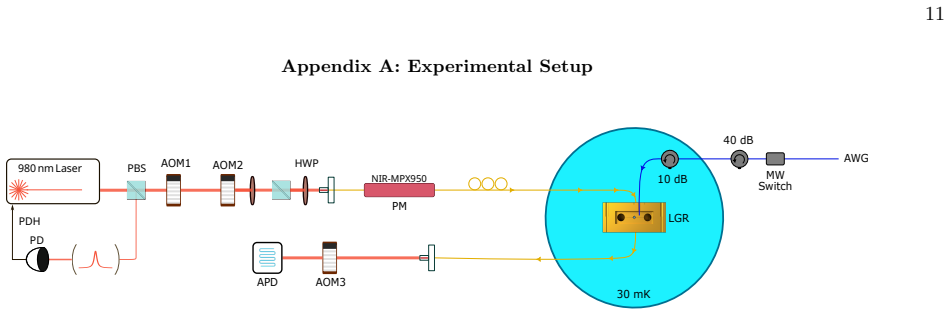
is used to create optical pulses and fine frequency shifts (0-5MHz). AOM2 (Model: Brimrose: TEM-85-10) suppresses the first-order leak light from AOM1, help- ful for single photon detection with minimal background noise. A phase modulator (PM) (Model: iXblue: NIR- MPX950) is used to coarse shift (∼GHz) the frequencies for optical pumping, pump, and RAP pu...
-
[8]
7.Optical Depth Spectrum
Optical Depth b Yb:YSO Level Structure a |2𝑒⟩ |1𝑒⟩ |4𝑔⟩ 𝜔𝑅 𝜔𝑀 𝜔𝑃 𝜔𝑇 2623.35 MHz 978 nm RAP MW 2623.35 MHz Laser Pump 4𝑔 ↔|1 𝑒 ⟩ 4𝑔 ↔|2 𝑒 ⟩ FIG. 7.Optical Depth Spectrum. a,Energy level structure of Yb:YSO with optical and MW transitions highlighted with different colours.b,Spectrum of|4g⟩↔|1e⟩and|4g⟩↔|2e⟩transitions after a sequence of optical pumping to ...
-
[9]
Initial Coherence in a single-atom picture The state of the system starts with the ground state |1⟩. It is transformed by the intense pump and weak MW pulse as: |1⟩ θP − − →α|1⟩+β|3⟩ θM −−→α|1⟩+β(γ|2⟩+|3⟩)(B3) where,θP is the rotation angle due to the intense pump pulse andθM is the rotation angle due to the weak MW pulse. Therefore,γis a small complex co...
-
[10]
We simulate this behaviour by considering spin (optical) inhomogeneous linewidth of 600kHz (1500 kHz) and250×250atoms and vary the delay (τ0) between the pulses
Initial Coherence decay with Pump-MW delay Any delay between the pump and the MW pulse re- sults in weaker coherence transfer at the signal transi- tion. We simulate this behaviour by considering spin (optical) inhomogeneous linewidth of 600kHz (1500 kHz) and250×250atoms and vary the delay (τ0) between the pulses. The resulting plot (Fig. 11) reveals simi...
-
[11]
In Fig.12a, the RAP power is swept and the corresponding transduced signal counts are plot- ted
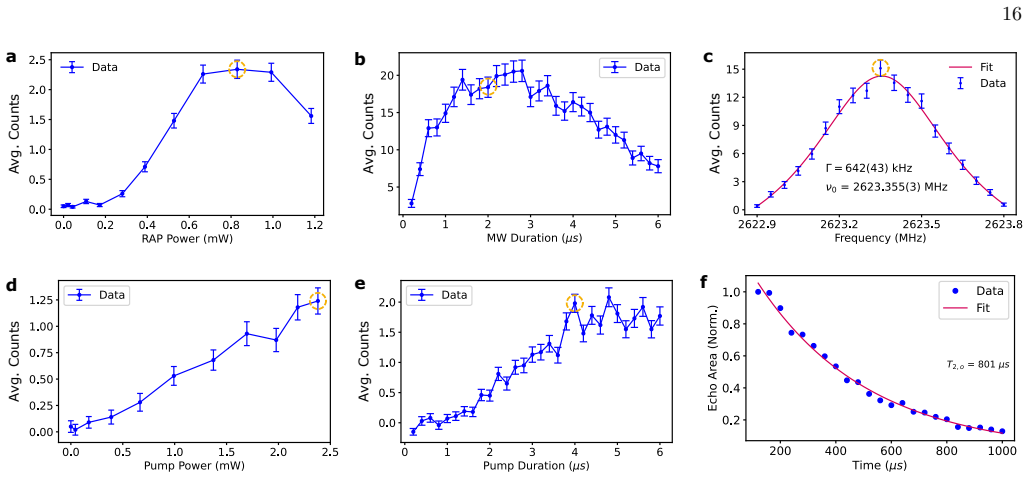
RAP Power The RAP pulse duration is fixed at60µs with 1.5MHz chirp bandwidth. In Fig.12a, the RAP power is swept and the corresponding transduced signal counts are plot- ted. The transduction efficiency is maximum at850µW peak optical power which corresponds to a peak Rabi fre- quency ofΩ R = 75kHz. This is equivalent to aπ−pulse characterization, since t...
-
[12]
Fig.12b depicts that the efficiency keeps rising with increasing pump power without any sign of saturation
Pump Pulse Power & Duration After optimizing for RAP power, the pump pulse power is swept to see its effect on efficiency. Fig.12b depicts that the efficiency keeps rising with increasing pump power without any sign of saturation. The Rabi frequency at the signal transition with branching ratio 0.72 is measured to be2π×178kHz at 5mW optical power. Therefo...
-
[13]
A Lorentzian fit to the data results in a linewidth ofΓs = 642±43kHz, cen- tred at2623.355±0.003MHz
MW Frequency & Pulse Duration In Fig.12c, we vary the MW frequency around the ex- pected spin transition frequency. A Lorentzian fit to the data results in a linewidth ofΓs = 642±43kHz, cen- tred at2623.355±0.003MHz. Similar to the pump pulse case, the weak MW excitation is limited by its Fourier bandwidth. This bandwidth must fit in the spin inhomo- gene...
-
[14]
The echo area is plotted with total delay time in Fig.12f
Optical Coherence Time We apply 2-pulse echo (2PE) sequence to extract the optical coherence time of the RAP transition. The echo area is plotted with total delay time in Fig.12f. An expo- nential decay function of the formAexp(−2t/T2,o)yields an optical coherence time ofT 2,o = 801µs. The lim- ited optical coherence time restricts the transduction ef- fi...
-
[15]
Overall loss from AWG to the input port of the LGR is -15.58 dB
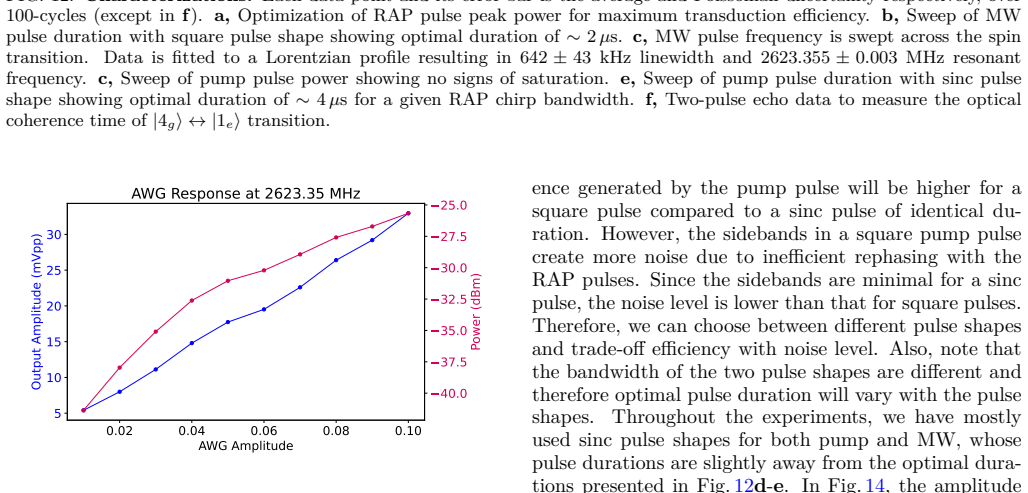
Efficiency & Calibration To characterize the photon conversion efficiency, we need to know the number of input MW photons at the input port of the LGR. Overall loss from AWG to the input port of the LGR is -15.58 dB. For most of the experiment, we send 23.66 mVpp corresponding to 0.05 amplitude from the AWG (Fig.13). This corresponds to -44.4 dBm power re...
-
[16]
II E [49] of the main text, the Fourier spectrum of the pump and MW pulses should match the RAP Fourier window and spin inhomogeneous 16 e f a Avg
Pump and MW Pulse Shapes As discussed in sec. II E [49] of the main text, the Fourier spectrum of the pump and MW pulses should match the RAP Fourier window and spin inhomogeneous 16 e f a Avg. CountsAvg. Counts d c Avg. Counts Avg. Counts Avg. Counts b FIG. 12.Characterizations.Each data point and its error-bar is the average and Poissonian uncertainty r...
-
[17]
The atom-field interaction can be seen as a rotation of the Bloch vector, corresponding to the atomic state, around a precession axis or⃗ p
Bloch Vector - Ensemble Picture Consider a single atom interacting with a monochro- matic field. The atom-field interaction can be seen as a rotation of the Bloch vector, corresponding to the atomic state, around a precession axis or⃗ p. The⃗ pis determined based on the phase and detuning of the field relative to the atom [42]. The 0-detuning (∆ν= 0)⃗ pli...
-
[18]
4 [49] of the main text, we present more interference measurements data in this section
Interference Plots In addition to the data presented in Fig. 4 [49] of the main text, we present more interference measurements data in this section. Fig. 16(a and b), are data for inter- ference experiments with sequential pair of MW pulses with the frequency of the later MW pulse varying at a constant phase difference(∆ϕ=π/2andπ)from the early MW. Fig. ...
-
[19]
To ensure ef- ficient absorption, the spectral bandwidth of each MW pulse must be confined within the extent of the spin in- homogeneous broadening
Microwave-Spectral Multiplexing By exploiting the spin inhomogeneous broadening, it is possible to transduce multiple MW pulses at distinct frequencies within the broadening profile. To ensure ef- ficient absorption, the spectral bandwidth of each MW pulse must be confined within the extent of the spin in- homogeneous broadening. An illustration of this c...
-
[20]
H. J. Kimble, The quantum internet, Nature453, 1023 (2008)
2008
-
[21]
X.-M. Hu, C.-X. Huang, Y.-B. Sheng, L. Zhou, B.-H. Liu, Y. Guo, C. Zhang, W.-B. Xing, Y.-F. Huang, C.- F. Li, and G.-C. Guo, Long-Distance entanglement pu- rification for quantum communication, Physical Review Letters126, 10.1103/physrevlett.126.010503 (2021)
-
[22]
R.e.a.Acharya,Quantumerrorcorrectionbelowthesur- face code threshold, Nature 10.1038/s41586-024-08449-y (2024)
-
[23]
M. O. Hecht, K. Saurav, E. Vlachos, D. A. Lidar, and E. M. Levenson-Falk, Beating the Ramsey limit on sens- ing with deterministic qubit control, Nature Communi- cations16, 10.1038/s41467-025-58947-4 (2025)
-
[24]
Pirandola, B
S. Pirandola, B. R. Bardhan, T. Gehring, C. Weedbrook, and S. Lloyd, Advances in photonic quantum sensing, Nature Photonics12, 724 (2018)
2018
-
[25]
T. Xie, R. Fukumori, J. Li, and A. Faraon, Scalable microwave-to-optical transducers at the single-photon level with spins, Nature Physics 10.1038/s41567-025- 02884-y (2025)
-
[26]
Caleffi, L
M. Caleffi, L. d’Avossa, X. Han, and A. S. Cacciapuoti, Quantum transduction: enabling quantum networking (2025)
2025
-
[27]
Kumar, N
S. Kumar, N. Lauk, and C. Simon, Towards long-distance quantum networks with superconducting processors and opticallinks,QuantumScienceandTechnology4,045003 (2019)
2019
-
[28]
N. Lauk, N. Sinclair, S. Barzanjeh, J. P. Covey, M. Saffman, M. Spiropulu, and C. Simon, Perspectives on quantum transduction, Quantum Science and Tech- nology5, 020501 (2020)
2020
-
[29]
X. Han, W. Fu, C.-L. Zou, L. Jiang, and H. X. Tang, Microwave-optical quantum frequency conversion, Op- tica8, 1050 (2021)
2021
-
[30]
J. I. Cirac, A. K. Ekert, S. F. Huelga, and C. Mac- chiavello, Distributed quantum computation over noisy channels, Physical Review A59, 4249 (1999)
1999
-
[31]
A. Megrant and Y. Chen, Scaling up superconducting quantum computers, Nature Electronics 10.1038/s41928- 025-01381-7 (2025)
-
[32]
Zeuthen, A
E. Zeuthen, A. Schliesser, A. S. Sørensen, and J. M. Tay- lor, Figures of merit for quantum transducers, Quantum Science and Technology5, 034009 (2020)
2020
-
[33]
B.D.Smith, B.Babaei, A.Narayanan,andL.J.LeBlanc, Microwave-to-optical conversion in a room-temperature 87Rb vapor for frequency-division multiplexing control, Communications Physics6, 10.1038/s42005-023-01455-y (2023)
-
[34]
H. Kurokawa, M. Yamamoto, Y. Sekiguchi, and H. Kosaka, Remote entanglement of superconducting Qubits via Solid-State spin quantum memories, Physical Review Applied18, 10.1103/physrevapplied.18.064039 (2022)
-
[35]
K. Kakuyanagi, T.Meno, S. Saito, H.Nakano, K.Semba, H. Takayanagi, F. Deppe, and A. Shnirman, Dephasing of a superconducting flux qubit, Physical Review Letters 98, 10.1103/physrevlett.98.047004 (2007)
-
[36]
R. Sahu, W. Hease, A. Rueda, G. Arnold, L. Qiu, and J. M. Fink, Quantum-enabled operation of a microwave-optical interface, Nature Communications13, 10.1038/s41467-022-28924-2 (2022)
-
[37]
A. P. Higginbotham, P. S. Burns, M. D. Urmey, R. W. Peterson, N. S. Kampel, B. M. Brubaker, G. Smith, K. W. Lehnert, and C. A. Regal, Harnessing electro-optic correlations in an efficient mechanical converter, Nature Physics14, 1038 (2018)
2018
-
[38]
M. J. Weaver, P. Duivestein, A. C. Bernasconi, S. Scharmer, M. Lemang, T. C. Van Thiel, F. Hijazi, B. Hensen, S. Gröblacher, and R. Stockill, An integrated microwave-to-optics interface for scalable quantum com- puting, Nature Nanotechnology19, 166 (2023)
2023
-
[39]
Tu, K.-Y
H.-T. Tu, K.-Y. Liao, Z.-X. Zhang, X.-H. Liu, S.-Y. Zheng, S.-Z. Yang, X.-D. Zhang, H. Yan, and S.-L. Zhu, High-efficiency coherent microwave-to-optics conversion via off-resonant scattering, Nature Photonics16, 291 (2022)
2022
-
[40]
Mirhosseini, A
M. Mirhosseini, A. Sipahigil, M. Kalaee, and O. Painter, Superconducting qubit to optical photon transduction, Nature588, 599 (2020)
2020
-
[41]
R. D. Delaney, M. D. Urmey, S. Mittal, B. M. Brubaker, J. M. Kindem, P. S. Burns, C. A. Regal, and K. W. Lehn- ert, Superconducting-qubit readout via low-backaction electro-optic transduction, Nature606, 489 (2022)
2022
-
[42]
Meesala, S
S. Meesala, S. Wood, D. Lake, P. Chiappina, C. Zhong, A. D. Beyer, M. D. Shaw, L. Jiang, and O. Painter, Non- classical microwave–optical photon pair generation with a chip-scale transducer, Nature Physics20, 871 (2024)
2024
-
[43]
R. Sahu, L. Qiu, W. Hease, G. Arnold, Y. Minoguchi, P. Rabl, and J. M. Fink, Entangling microwaves with light, Science380, 718 (2023)
2023
-
[44]
J. Rochman, T. Xie, J. G. Bartholomew, K. C. Schwab, and A. Faraon, Microwave-to-optical transduc- tion with erbium ions coupled to planar photonic and superconducting resonators,NatureCommunications14, 10.1038/s41467-023-36799-0 (2023)
-
[45]
A. Singh, A. Sethia, L. Esmaeilifar, R. Valivarthi, N. Sin- clair, M. Spiropulu, and D. Oblak, Photonic quantum information with time-bins: Principles and applications, arXiv preprint arXiv:2507.08102 (2025)
-
[46]
G. G. G. King, L. S. Trainor, and J. J. Longdell, Triply resonant microwave to optical conversion in Erbium-170 doped yttrium orthosilicate (2024)
2024
-
[47]
Chanelière, R
T. Chanelière, R. Dardaillon, P. Lemonde, J. J. Vien- not, P. Bertet, E. Flurin, P. Goldner, and D. Serrano, Opto-RF transduction in Er3+:CaWO4, Journal of Lu- minescence272, 120647 (2024)
2024
-
[48]
S. Probst, H. Rotzinger, S. Wünsch, P. Jung, M. Jerger, M. Siegel, A. V. Ustinov, and P. A. Bushev, Anisotropic Rare-Earth spin ensemble strongly coupled to a su- perconducting resonator, Physical Review Letters110, 10.1103/physrevlett.110.157001 (2013)
-
[49]
J. R. Ball, Y. Yamashiro, H. Sumiya, S. Onoda, T. Ohshima, J. Isoya, D. Konstantinov, and Y. Kubo, Loop-gap microwave resonator for hybrid quantum sys- tems, Applied Physics Letters112, 10.1063/1.5025744 (2018)
-
[50]
X. Fernandez-Gonzalvo, S. P. Horvath, Y.-H. Chen, and J. J. Longdell, Cavity-enhanced Raman heterodyne spec- troscopy in Er3+:Y2SiO5 for microwave to optical signal conversion, Physical review. A/Physical review, A100, 10.1103/physreva.100.033807 (2019). 22
-
[51]
A. Tiranov, A. Ortu, S. Welinski, A. Ferrier, P. Goldner, N. Gisin, and M. Afzelius, Spectroscopic study of hy- perfine properties in Yb3+171:Y2SiO5, Physical review. B./Physical review. B98, 10.1103/physrevb.98.195110 (2018)
-
[52]
L. Nicolas, M. Businger, T. S. Mejia, A. Tiranov, T. Chanelière, E. Lafitte-Houssat, A. Ferrier, P. Gold- ner, and M. Afzelius, Coherent optical-microwave inter- face for manipulation of low-field electronic clock transi- tions in 171Yb3+:Y2SiO5, npj Quantum Information9, 10.1038/s41534-023-00687-8 (2023)
-
[53]
N. G. Kamel, S. Kumar, U. Gautam, E. Saglamyurek, V. Salari, and D. Oblak, Multimode and Random-Access optical quantum memory via adiabatic phase imprinting (2025)
2025
-
[54]
J. O’Sullivan, O. W. Kennedy, K. Debnath, J. Alexan- der, C. W. Zollitsch, M. Šim˙ enas, A. Hashim, C. N. Thomas, S. Withington, I. Siddiqi, K. Mølmer, and J. J. L. Morton, Random-Access Quantum Memory us- ing chirped pulse phase encoding, Physical Review X12, 10.1103/physrevx.12.041014 (2022)
-
[55]
M. F. Pascual-Winter, R.-c. Tongning, T. Chanelière, and J.-l. L. Gouët, Securing coherence rephasing with a pair of adiabatic rapid passages, New Journal of Physics 15, 055024 (2013)
2013
-
[56]
See the Supplementary Information,
-
[57]
Y. Yu, Z. Q. Chen, L.-Y. Hu, H. Tang, and Z. S. Wang, Geometric phase for optical free induction decay, Inter- national Journal of Theoretical Physics50, 148 (2010)
2010
-
[58]
De Seze, F
F. De Seze, F. Dahes, V. Crozatier, I. Lorgeré, F. Bretenaker, and J.-l. L. Gouët, Coherent driving of Tm3+:YAG ions using a complex hyperbolic secant op- tical field, The European Physical Journal D33, 343 (2005)
2005
-
[59]
Dajczgewand, J.-L
J. Dajczgewand, J.-L. L. Gouët, A. Louchet-Chauvet, andT.Chanelière,Largeefficiencyattelecomwavelength for optical quantum memories, Optics Letters39, 2711 (2014)
2014
-
[60]
Y.-Z. Ma, M. Jin, D.-L. Chen, Z.-Q. Zhou, C.-F. Li, and G.-C. Guo, Elimination of noise in optically rephased photon echoes, Nature Communications12, 10.1038/s41467-021-24679-4 (2021)
-
[61]
Foot,Atomic Physics(Oxford University Press, 2005)
C. Foot,Atomic Physics(Oxford University Press, 2005)
2005
- [62]
-
[63]
Quantum Repeaters with Photon Pair Sources and Multimode Memories
C. Simon, H. De Riedmatten, M. Afzelius, N. Sangouard, H. Zbinden, and N. Gisin, Quantum Repeaters with Pho- ton Pair Sources and Multimode Memories, Physical Re- view Letters98, 10.1103/physrevlett.98.190503 (2007)
-
[64]
S. Welinski, A. Ferrier, M. Afzelius, and P. Goldner, High-resolution optical spectroscopy and magnetic prop- erties ofYb3+inY2SiO5, Physical review. B./Physical re- view. B94, 10.1103/physrevb.94.155116 (2016)
-
[66]
F. Chiossi, E. Lafitte-Houssat, A. Ferrier, S. Welin- ski, L. Morvan, P. Berger, D. Serrano, M. Afzelius, and P. Goldner, Optical coherence and spin popula- tion dynamics in Yb3+171:Y2SiO5 single crystals, Phys- ical review. B./Physical review. B109, 10.1103/phys- revb.109.094114 (2024)
-
[67]
M. Businger, A. Tiranov, K. T. Kaczmarek, S. Welin- ski, Z. Zhang, A. Ferrier, P. Goldner, and M. Afzelius, Optical Spin-Wave storage in a Solid-State hybridized Electron-Nuclear spin ensemble, Physical Review Letters 124, 10.1103/physrevlett.124.053606 (2020)
-
[68]
Gautam, See the main article
U. Gautam, See the main article
discussion (0)
Sign in with ORCID, Apple, or X to comment. Anyone can read and Pith papers without signing in.