In-Orbit Optical SSA Using Proliferated LEO Satellites for Space Traffic Monitoring: An Analytical Framework
Pith reviewed 2026-05-09 18:34 UTC · model grok-4.3
The pith
An analytical model with a Poisson algorithm estimates revisit periods for space object detection using LEO satellite constellations.
A machine-rendered reading of the paper's core claim, the machinery that carries it, and where it could break.
Core claim
The paper presents a new analytical system model for utilizing LEO satellite constellations for in-orbit SSA. It develops an evaluation method, proposes a Poisson expected revisit period algorithm, and introduces the period of equivalent orbital distributions to reveal the relationship between revisit period and geometric variables. Experiments on a real-world constellation show representative Poisson expected revisit periods ranging from 0.4 days to 5.7 days for targets with apogee altitudes from 552 km to 650 km, achieved with per-case computation times of 0.4 s to 4.8 s.
What carries the argument
The Poisson expected revisit period algorithm, which computes expected intervals between observations by treating geometric visibility under equivalent orbital distributions as Poisson arrivals.
If this is right
- The model directly links revisit periods to target apogee altitude and constellation geometry, enabling quick performance assessment.
- Computation remains fast enough for repeated evaluation during constellation design iterations.
- Results from both real and custom constellations demonstrate feasible monitoring frequencies for LEO targets.
- The framework supplies concrete guidance for building in-orbit and onboard SSA computing systems for space object detection and traffic monitoring.
Where Pith is reading between the lines
- Adding sensor noise models or atmospheric refraction could adjust the predicted revisit ranges to better match field performance.
- The same Poisson framework might be applied to evaluate hybrid ground-plus-space monitoring networks for overall debris tracking efficiency.
- Incorporating time-varying perturbations would allow forecasts of how revisit statistics change as orbits decay or are adjusted.
Load-bearing premise
The model assumes ideal geometric visibility conditions and equivalent orbital distributions without accounting for sensor limitations, atmospheric effects, or dynamic orbital perturbations.
What would settle it
Comparison of the model's predicted revisit periods against actual logged detection times from the real-world LEO constellation would show whether the 0.4 to 5.7 day range holds for the tested target altitudes.
Figures
read the original abstract
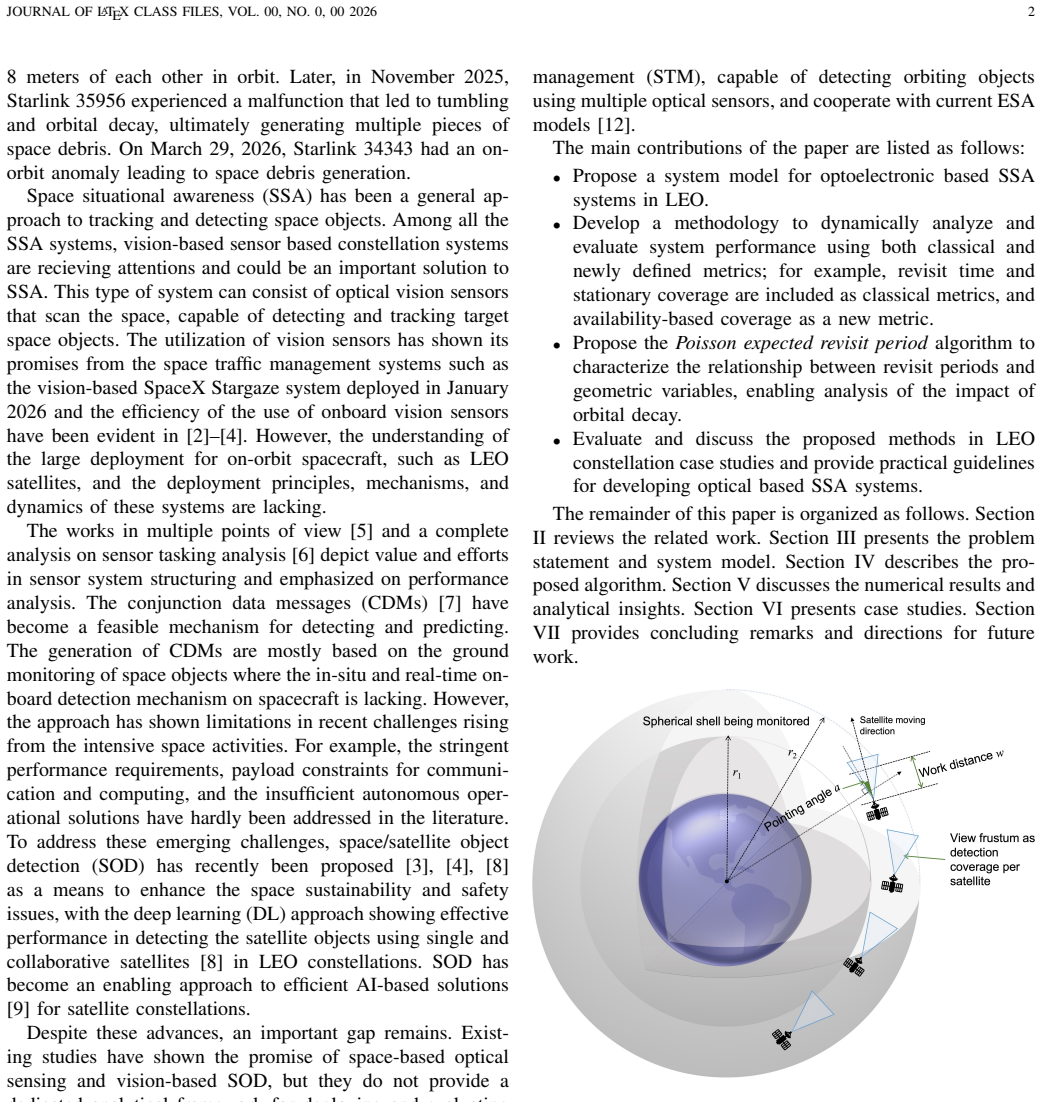
The increase in space activities has increased the risks of space debris generation, affecting space safety and sustainability. Traditional space situational awareness (SSA) relies on single star trackers and ground-based tracking facilities. There is limited discussion on the use of in-orbit optical sensors on low Earth orbit (LEO) satellite constellations for SSA, despite their importance for efficient space traffic management systems. In this paper, we aim to address this important challenge. We first present a new analytical system model for utilizing LEO satellite constellations for in-orbit SSA. We then develop a method to evaluate and analyze such a system. We also propose a Poisson expected revisit period algorithm and introduce the period of equivalent orbital distributions to reveal the relationship between revisit period and geometric variables, with insightful results based on real-world and custom satellite constellations. Experiments on real-world constellation show that the representative Poisson expected revisit period ranges from 0.4 days to 5.7 days for targets whose apogee altitude ranges from 552 km to 650 km, while requiring a per-case computation time of 0.4 s to 4.8 s. Our work can inform the future design of in-orbit and onboard computing systems for SSA, such as space object detection and space traffic monitoring systems.
Editorial analysis
A structured set of objections, weighed in public.
Referee Report
Summary. The paper presents an analytical framework for in-orbit optical SSA using proliferated LEO satellite constellations. It develops a system model, proposes a Poisson expected revisit period algorithm, and introduces the period of equivalent orbital distributions to relate revisit periods to geometric variables. Based on experiments with real-world constellations, it reports that the Poisson expected revisit period ranges from 0.4 days to 5.7 days for targets with apogee altitudes from 552 km to 650 km, with per-case computation times between 0.4 s and 4.8 s.
Significance. If the modeling assumptions hold under realistic conditions, the framework provides a fast analytical tool for estimating SSA revisit performance of LEO constellations, which could inform onboard detection and space traffic monitoring system design. The low computation times (0.4-4.8 s) are a practical strength for potential real-time applications, and the use of real constellation parameters adds relevance. However, the overall significance hinges on whether the ideal-visibility Poisson model accurately captures detection rates.
major comments (3)
- [Analytical System Model] The analytical system model assumes ideal geometric visibility and equivalent orbital distributions without accounting for finite sensor FOV, minimum detectable magnitude, atmospheric extinction, or orbital perturbations. This is load-bearing for the central claim, as the reported 0.4-5.7 day revisit range for 552-650 km apogee targets would increase substantially if per-pass detection probability falls below ~0.7-0.8.
- [Poisson Expected Revisit Period Algorithm] The Poisson expected revisit period algorithm models visibility opportunities as independent memoryless events derived from geometric inputs. Actual LEO passes are deterministic and phase-correlated, violating the independence assumption and requiring sensitivity analysis or adjustment for realistic detection probabilities to support the experimental results.
- [Experiments on Real-World Constellations] The experiments section reports specific revisit periods and computation times but lacks error bars, validation against independent SSA data sets, or explicit derivation steps for the Poisson parameters and equivalent periods. This leaves the quantitative claims (0.4-5.7 days) only moderately supported.
minor comments (2)
- [Abstract] The abstract states that the equivalent orbital distributions 'reveal the relationship' but does not preview the specific functional form or key insight obtained.
- [Notation and Definitions] Notation for 'period of equivalent orbital distributions' should be defined once with a clear equation and used consistently to avoid ambiguity when relating it to apogee altitude and other geometric variables.
Simulated Author's Rebuttal
We thank the referee for the detailed and constructive review of our manuscript on the analytical framework for in-orbit optical SSA using LEO constellations. The comments raise valid points about modeling assumptions, the Poisson approximation, and experimental support. We address each major comment below and outline revisions to strengthen the paper while preserving its focus as an analytical baseline tool.
read point-by-point responses
-
Referee: [Analytical System Model] The analytical system model assumes ideal geometric visibility and equivalent orbital distributions without accounting for finite sensor FOV, minimum detectable magnitude, atmospheric extinction, or orbital perturbations. This is load-bearing for the central claim, as the reported 0.4-5.7 day revisit range for 552-650 km apogee targets would increase substantially if per-pass detection probability falls below ~0.7-0.8.
Authors: We acknowledge that the system model relies on ideal geometric visibility to establish a baseline analytical framework using the period of equivalent orbital distributions. This choice enables closed-form relationships between revisit periods and geometric variables. We agree that real-world factors such as finite FOV, minimum detectable magnitude, atmospheric extinction, and perturbations would reduce effective detection probabilities and increase revisit times. In the revised manuscript, we will add a new subsection in the system model section explicitly listing these assumptions and describing how the Poisson rate parameter can be scaled by a per-pass detection probability to adjust the expected revisit period. This will better frame the reported 0.4-5.7 day range as a geometric upper-bound performance. revision: partial
-
Referee: [Poisson Expected Revisit Period Algorithm] The Poisson expected revisit period algorithm models visibility opportunities as independent memoryless events derived from geometric inputs. Actual LEO passes are deterministic and phase-correlated, violating the independence assumption and requiring sensitivity analysis or adjustment for realistic detection probabilities to support the experimental results.
Authors: The Poisson model is applied to compute the expected revisit period from the average rate of geometrically determined visibility opportunities. For large proliferated constellations, the superposition of many satellite passes makes the memoryless approximation suitable for deriving the expectation, even though individual orbits are deterministic. We agree that a sensitivity analysis is warranted. In the revision, we will include additional results showing how the expected revisit period changes when the effective rate is reduced to account for realistic detection probabilities below 1.0, thereby quantifying the impact of the independence assumption. revision: yes
-
Referee: [Experiments on Real-World Constellations] The experiments section reports specific revisit periods and computation times but lacks error bars, validation against independent SSA data sets, or explicit derivation steps for the Poisson parameters and equivalent periods. This leaves the quantitative claims (0.4-5.7 days) only moderately supported.
Authors: We appreciate this observation on the presentation of results. In the revised experiments section, we will provide explicit step-by-step derivations of the Poisson rate parameter (computed from daily visibility opportunities) and the equivalent orbital distribution periods. We will also report variability ranges or error bars derived from the spread across the real-world constellation cases and target altitudes. The quantitative claims are grounded in public TLE data for actual constellations; while direct comparison to independent operational SSA observation datasets is not included, the use of real orbital elements provides empirical grounding for the geometric inputs. revision: partial
- Direct validation against independent operational SSA observation datasets
Circularity Check
No circularity: Poisson revisit algorithm derives from geometric inputs and standard statistics
full rationale
The paper proposes an analytical system model and a Poisson expected revisit period algorithm that maps orbital geometry variables (apogee altitudes 552-650 km) to expected periods via equivalent orbital distributions. These are computed outputs from applying the model to real constellation data, not parameters fitted to the target quantities and then re-labeled as predictions. No self-definitional loops, self-citation load-bearing steps, or ansatz smuggling appear in the derivation chain. The framework remains self-contained against external geometric and Poisson-process benchmarks.
Axiom & Free-Parameter Ledger
axioms (2)
- domain assumption Optical detection is possible based on line-of-sight geometry between LEO satellites and targets
- domain assumption Satellite positions follow equivalent orbital distributions for revisit calculations
Reference graph
Works this paper leans on
-
[1]
Kessler: a machine learning library for space collision avoidance,
G. Acciarini, F. Pinto, S. Metz, S. Boufelja, S. Kaczmarek, K. Merz, J. A. Martinez-Heras, F. Letizia, C. Bridges, and A. G. Baydin, “Kessler: a machine learning library for space collision avoidance,” in8th European Conference on Space Debris, 2021
work page 2021
-
[2]
Space-based space surveillance with the space-based visible,
E. M. Gaposchkin, C. von Braun, and J. Sharma, “Space-based space surveillance with the space-based visible,”Journal of Guidance, Control, and Dynamics, vol. 23, no. 1, pp. 148–152, 2000. [Online]. Available: https://doi.org/10.2514/2.4502
-
[3]
Sensing for space safety and sustainability: A deep learning approach with vision transformers,
W. Zhang and P. Hu, “Sensing for space safety and sustainability: A deep learning approach with vision transformers,” in2024 IEEE International Conference on Wireless for Space and Extreme Environments (WiSEE), 2024, pp. 94–99
work page 2024
-
[4]
Toward onboard ai-enabled solutions to space object detection for space sustainability,
——, “Toward onboard ai-enabled solutions to space object detection for space sustainability,” inThe 18th International Conference on Space Operations (SpaceOps 2025), 05 2025
work page 2025
-
[5]
Space-based optical observations on space debris via multipoint of view,
Z. Li, Y . Wang, and W. Zheng, “Space-based optical observations on space debris via multipoint of view,”International Journal of Aerospace Engineering, vol. 2020, no. 1, p. 8328405, 2020. [Online]. Available: https://onlinelibrary.wiley.com/doi/abs/10.1155/2020/8328405
-
[6]
Review of sensor tasking methods in space situational awareness,
C. Xue, H. Cai, S. Gehly, M. Jah, and J. Zhang, “Review of sensor tasking methods in space situational awareness,”Progress in Aerospace Sciences, vol. 147, p. 101017, 2024. [Online]. Available: https://www.sciencedirect.com/science/article/pii/S0376042124000435
work page 2024
-
[7]
Spacecraft collision risk assessment with probabilistic programming,
G. Acciarini, F. Pinto, S. Metz, S. Boufelja, S. Kaczmarek, K. Merz, J. A. Martinez-Heras, F. Letizia, C. Bridges, and A. G. Baydin, “Spacecraft collision risk assessment with probabilistic programming,” inThird Workshop on Machine Learning and the Physical Sciences (NeurIPS 2020), Vancouver, Canada, 2020
work page 2020
-
[8]
Ai-driven collaborative satellite object detection for space sustainability,
P. Hu and W. Zhang, “Ai-driven collaborative satellite object detection for space sustainability,” in2025 IEEE International Conference on Wireless for Space and Extreme Environments (WiSEE), 2025, pp. 1– 6
work page 2025
-
[9]
Sataiops: Revamping the full life-cycle satellite network op- erations,
P. Hu, “Sataiops: Revamping the full life-cycle satellite network op- erations,” inNOMS 2023-2023 IEEE/IFIP Network Operations and Management Symposium, 2023, pp. 1–5
work page 2023
-
[10]
D. Xie, Y . Huang, and C. Yan, “Determination of field of view of a dawn–dusk sun-synchronous orbit satellite based on improved observa- tion mode,”Applied Sciences, vol. 12, p. 7475, 07 2022
work page 2022
-
[11]
Performance assessment of space-based optical networks for debris observation and tracking in leo,
A. D’Anniballe, L. Felicetti, and S. Hobbs, “Performance assessment of space-based optical networks for debris observation and tracking in leo,” 04 2025
work page 2025
-
[12]
Improving master model quality through strategic sensor campaign design,
A. Horstmann, J. Siminski, and S. Lemmens, “Improving master model quality through strategic sensor campaign design,” inProceedings of the 9th European Conference on Space Debris. Bonn, Germany: ESA Space Debris Office, Apr. 2025. [Online]. Available: https://conference. sdo.esoc.esa.int/proceedings/sdc9/paper/40/SDC9-paper40.pdf
work page 2025
-
[13]
The esa space debris mitigation handbook 2002,
H. Klinkrad, P. Beltrami, S. Hauptmann, C. Martin, H. Sdunnus, H. Stokes, R. Walker, and J. Wilkinson, “The esa space debris mitigation handbook 2002,”Advances in Space Research, vol. 34, no. 5, pp. 1251–1259, 2004, space Debris. [Online]. Available: https://www.sciencedirect.com/science/article/pii/S0273117704001061
work page 2002
-
[14]
Esa’s annualspace environment report,
E. D. Office, “Esa’s annualspace environment report,” 2025
work page 2025
-
[15]
Possible contribution of space-based assets for space situational awareness,
X. Vanwijck and T. Flohrer, “Possible contribution of space-based assets for space situational awareness,”International Astronautical Federation - 59th International Astronautical Congress 2008, IAC 2008, vol. 4, pp. 2466–2472, 01 2008
work page 2008
-
[16]
Optimal constellation design for space based situational awareness applications,
A. Takano and B. Marchand, “Optimal constellation design for space based situational awareness applications,”Advances in the Astronautical Sciences, vol. 142, pp. 2139–2158, 01 2012
work page 2012
-
[17]
A. D’Anniballe, L. Felicetti, and S. Hobbs, “Preliminary analysis and design of an optical space surveillance and tracking constellation for leo coverage,”Acta Astronautica, vol. 231, pp. 47–63, 2025
work page 2025
-
[18]
Understanding fo- cal length and field of view
G. Hollows and N. James, “Understanding fo- cal length and field of view.” [Online]. Avail- able: https://www.edmundoptics.ca/knowledge-center/application-notes/ imaging/understanding-focal-length-and-field-of-view/ JOURNAL OF LATEX CLASS FILES, VOL. 00, NO. 0, 00 2026 15
work page 2026
-
[19]
Prototype data processing chain for the space situational awareness (ssa) preparatory programme,
N. S ´anchez-Ortiz, E. Parrilla-Endrino, E. P ´erez, F. Pina Caballero, N. Guijarro, R. Dom ´ınguez-Gonz´alez, V . Navarro, N. Wright, and M. Sarkarati, “Prototype data processing chain for the space situational awareness (ssa) preparatory programme,” 01 2013
work page 2013
-
[20]
Cataloguing performance assessment method of sst sensor networks,
D. S ´aez-Bo, D. Escobar, A. Pastor-Rodr ´ıguez, and F. Ayuga-Garc ´ıa, “Cataloguing performance assessment method of sst sensor networks,” inProceedings of the 7th International Conference on Astrodynamics Tools and Techniques (ICATT 2018). Noordwijk, The Netherlands: European Space Agency, 2018
work page 2018
-
[21]
Space-Based Space Surveillance Operational and Demonstration Mis- sions,
D. Escorial Olmos, F. E. Aleman Roda, K. Middleton, and J. Naudet, “Space-Based Space Surveillance Operational and Demonstration Mis- sions,” in6th European Conference on Space Debris, ser. ESA Special Publication, L. Ouwehand, Ed., vol. 723, Aug. 2013, p. 27
work page 2013
-
[22]
H. Goldstein, C. P. Poole, and J. L. Safko,Classical Mechanics, 3rd ed. Addison Wesley, 2002
work page 2002
-
[23]
An improved algorithm for satellite orbit decay and re- entry prediction,
J. D. Strizzi, “An improved algorithm for satellite orbit decay and re- entry prediction,” Ph.D. dissertation, Massachusetts Institute of Technol- ogy, 1993
work page 1993
-
[24]
Addressing nonlinear relative motion for spacecraft collision probability,
S. Alfano, “Addressing nonlinear relative motion for spacecraft collision probability,” 08 2006
work page 2006
-
[25]
Space debris tracking with the poisson labeled multi-bernoulli filter,
L. Cament, M. Adams, and P. Barrios, “Space debris tracking with the poisson labeled multi-bernoulli filter,”Sensors, vol. 21, no. 11, 2021. [Online]. Available: https://www.mdpi.com/1424-8220/21/11/3684
work page 2021
-
[26]
J. M. Picone, A. E. Hedin, D. P. Drob, and A. C. Aikin, “Nrlmsise-00 empirical model of the atmosphere: Statistical comparisons and scientific issues,”Journal of Geophysical Research: Space Physics, vol. 107, no. A12, pp. SIA 15–1–SIA 15–16, 2002. [Online]. Available: https://agupubs.onlinelibrary.wiley.com/doi/abs/10.1029/2002JA009430
- [27]
-
[28]
Starlink satellite constellation,
T. S. Kelso, “Starlink satellite constellation,” https://celestrak.org, ac- cessed: 2026-02-05
work page 2026
-
[29]
M. Michel, H. Ceeh, J. Utzmann, S. Carli, G. Desroches, O. Croatto, G. Cirillo, M. Armbruster, S. Mangelsdorf, C. Schlosser, X. Oikonomi- dou, I. Biswas, C. Baweja, J. Siminski, T. Flohrer, and S. Kraft, “The space-based optical component (sboc) instrument for passive optical in- situ detection of small space debris,” in2nd International Orbital Debris Co...
work page 2023
-
[30]
Xxxi. investigations in optics, with special reference to the spectroscope,
L. Rayleigh, “Xxxi. investigations in optics, with special reference to the spectroscope,”The London, Edinburgh, and Dublin Philosophical Magazine and Journal of Science, vol. 8, no. 49, pp. 261–274, 1879
discussion (0)
Sign in with ORCID, Apple, or X to comment. Anyone can read and Pith papers without signing in.