Recognition: unknown
Write-Read Decoupling in Modern Large-Scale Search Engines: Architectures, Techniques, and Emerging Approaches
Pith reviewed 2026-05-10 14:48 UTC · model grok-4.3
The pith
Large-scale search engines decouple write operations from query latency through five architectural patterns including compute-storage separation and per-field update routing.
A machine-rendered reading of the paper's core claim, the machinery that carries it, and where it could break.
Core claim
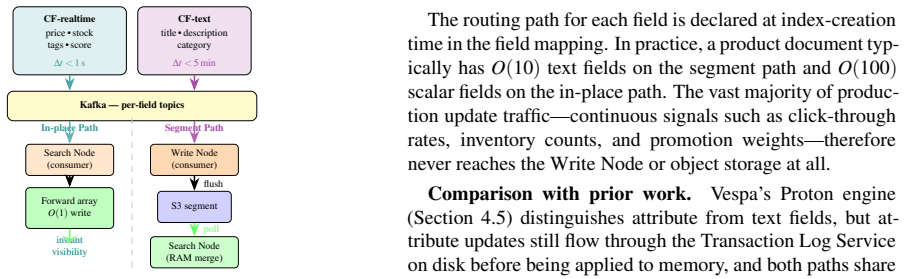
The paper claims that write-read contention in Lucene-based engines stems from segment merges competing with queries for CPU, disk I/O, and page cache. It systematically examines five decoupling patterns across systems such as Elasticsearch, Vespa, and others, culminating in the ScaleSearch architecture that integrates compute-storage separation with full in-memory indexing and per-field update routing. Each field gets its own Kafka topic and update path so scalar fields update in-place in O(1) RAM with immediate visibility while full-text fields follow the segment-based path.
What carries the argument
Per-field update routing, which assigns each field its own Kafka topic and update path to separate scalar in-place updates from full-text segment-based processing.
If this is right
- Compute-storage separation lets read and write workloads scale independently without shared resource contention.
- In-place partial updates for scalar fields deliver immediate visibility without triggering full segment rebuilds.
- Log-structured write paths reduce random I/O costs during high-frequency updates.
- Full in-memory indexing removes disk contention entirely for both reads and writes.
- The synthesis of these patterns supports hybrid vector and full-text retrieval with reduced latency.
Where Pith is reading between the lines
- The patterns could be applied to real-time analytics databases facing similar update-query trade-offs.
- Serverless deployments mentioned as an open challenge might benefit from further decoupling of update routing from query serving.
- AI-integrated search could require extensions of per-field routing to handle model parameter updates separately.
Load-bearing premise
That per-field update routing can be implemented at scale without introducing new contention, consistency overhead, or visibility delays across heterogeneous field types.
What would settle it
A controlled benchmark on a production-scale cluster that measures query latency, update throughput, and visibility delay for mixed scalar and full-text workloads with and without per-field routing enabled.
Figures




read the original abstract
Large-scale search engines face a fundamental tension: the index must be updated frequently to maintain freshness, yet updates create resource contention that inflates query latency. In the dominant Lucene-based architecture, segment merges triggered by writes compete with concurrent queries for CPU cycles, disk I/O bandwidth, and operating-system page cache -- a problem we term \emph{write-read contention}. This survey systematically examines the architectural solutions that industry and academia have developed to decouple write pressure from read latency. We identify five principal patterns: (i)~node-level read-write separation; (ii)~compute-storage separation; (iii)~full in-memory indexing; (iv)~log-structured write paths; and (v)~in-place partial updates. We survey representative systems including Elasticsearch, LinkedIn Galene, Uber Sia, Quickwit, Alibaba Havenask, Algolia, Milvus, and Vespa, and discuss an emerging synthesis -- the ScaleSearch architecture -- that combines compute-storage separation with full in-memory indexing and dedicated write nodes. A key contribution of ScaleSearch is \emph{per-field update routing}: each field is assigned its own Kafka topic and update path, allowing scalar fields (price, stock, tags) to be updated in-place in $O(1)$ RAM with immediate visibility while full-text fields follow the segment-based compute-storage path. We conclude with open challenges in hybrid vector-and-full-text retrieval, serverless deployments, and AI-integrated search.
Editorial analysis
A structured set of objections, weighed in public.
Referee Report
Summary. The manuscript surveys architectural solutions to write-read contention in large-scale search engines, classifying them into five patterns (node-level read-write separation, compute-storage separation, full in-memory indexing, log-structured write paths, and in-place partial updates). It reviews representative systems including Elasticsearch, LinkedIn Galene, Uber Sia, Quickwit, Alibaba Havenask, Algolia, Milvus, and Vespa, and proposes the ScaleSearch architecture as an emerging synthesis that combines compute-storage separation with per-field update routing via dedicated Kafka topics, enabling O(1) in-place scalar updates with immediate visibility while full-text fields follow segment-based paths.
Significance. If the proposed mechanisms can be realized, the systematic classification of patterns offers a valuable framework for analyzing trade-offs in search engine design, and the ScaleSearch synthesis highlights a promising direction for balancing freshness and latency. The paper appropriately credits prior systems and identifies open challenges in hybrid vector-text retrieval and serverless deployments.
major comments (2)
- [Abstract] Abstract (ScaleSearch architecture description): the per-field update routing claim assigns each field its own Kafka topic to allow O(1) in-place scalar updates with immediate visibility, but provides no mechanism (e.g., global timestamps, cross-topic atomic commits, or query-time reconciliation) to ensure a query observes a single consistent document version when scalar and full-text fields are updated independently. This is load-bearing for the central synthesis claim, as it risks inconsistent visibility across heterogeneous field types in mixed documents.
- [Abstract] Abstract (ScaleSearch architecture description): the asserted O(1) RAM complexity and immediate-visibility guarantee for scalar fields lacks any supporting analysis, pseudocode, or reference to contention avoidance in the in-memory structures, which is central to distinguishing the proposal from the surveyed in-place partial update pattern.
minor comments (1)
- The five patterns would be clearer with a summary table comparing their impacts on latency, update freshness, resource contention, and scalability.
Simulated Author's Rebuttal
We thank the referee for the constructive comments on our survey of write-read decoupling in search engines. The feedback identifies key areas where the ScaleSearch proposal requires additional detail to fully support its claims. We provide point-by-point responses below and commit to revisions that address these concerns.
read point-by-point responses
-
Referee: [Abstract] Abstract (ScaleSearch architecture description): the per-field update routing claim assigns each field its own Kafka topic to allow O(1) in-place scalar updates with immediate visibility, but provides no mechanism (e.g., global timestamps, cross-topic atomic commits, or query-time reconciliation) to ensure a query observes a single consistent document version when scalar and full-text fields are updated independently. This is load-bearing for the central synthesis claim, as it risks inconsistent visibility across heterogeneous field types in mixed documents.
Authors: We agree that the abstract's description of per-field update routing is concise and omits explicit consistency mechanisms. This is a valid observation. In the revised version, we will expand the discussion of the ScaleSearch architecture to include a consistency model based on per-document versioning. Each update, regardless of field type, will be associated with a global timestamp generated at the ingestion point. Scalar field updates will be applied in-place to an in-memory store with the new timestamp, while full-text updates proceed through the segment path with the same timestamp. At query time, the system will perform a lightweight reconciliation by consulting a version metadata service to select the most recent version for each document across the different storage paths. This approach uses query-time reconciliation rather than atomic commits across topics, trading a small amount of query overhead for consistency. We will add pseudocode and a diagram to illustrate this process, along with a discussion of its implications for latency and correctness. revision: yes
-
Referee: [Abstract] Abstract (ScaleSearch architecture description): the asserted O(1) RAM complexity and immediate-visibility guarantee for scalar fields lacks any supporting analysis, pseudocode, or reference to contention avoidance in the in-memory structures, which is central to distinguishing the proposal from the surveyed in-place partial update pattern.
Authors: We acknowledge that the abstract does not provide the requested analysis or pseudocode for the O(1) RAM claim. This point is well-taken, as it is important for differentiating ScaleSearch from existing in-place update approaches. In the revision, we will augment the ScaleSearch section with a short analysis showing that scalar fields are stored in dedicated in-memory hash tables on the write nodes, supporting constant-time updates and lookups with minimal contention due to the separation from the compute-intensive full-text indexing path. We will include pseudocode for the scalar update operation and reference standard techniques for contention avoidance, such as lock-free data structures or sharded maps. This will clarify how the architecture achieves immediate visibility without the merge-related contention described in the in-place partial updates pattern. revision: yes
Circularity Check
No circularity: descriptive survey plus high-level proposal with no derivations or self-referential reductions
full rationale
The manuscript is a survey identifying five architectural patterns from externally cited systems (Elasticsearch, Galene, Sia, Quickwit, Havenask, Algolia, Milvus, Vespa) and sketching an emerging synthesis called ScaleSearch. The per-field update routing description is presented as an architectural proposal, not as a derived prediction, fitted parameter, or result obtained by self-citation. No equations, uniqueness theorems, ansatzes, or load-bearing self-citations appear; the text contains no reduction of any claim to its own inputs by construction. This is the normal non-circular outcome for a survey-style architecture paper.
Axiom & Free-Parameter Ledger
invented entities (1)
-
ScaleSearch architecture
no independent evidence
Reference graph
Works this paper leans on
-
[1]
Białecki, R
A. Białecki, R. Muir, and G. Ingersoll. Apache Lucene 4. In Proc. SIGIR Workshop on Open Source IR (OSIR), 2012
2012
-
[2]
O’Neil, E
P. O’Neil, E. Cheng, D. Gawlick, and E. O’Neil. The Log-Structured Merge-Tree (LSM-Tree).Acta Informatica, 33(4):351–385, 1996
1996
-
[3]
M. A. Qader, C. V ogel, B. Dees, and J. Heiss. An Evaluation of LSM-tree for Full-Text Search. InProc. ACM SIGMOD, 2018
2018
-
[4]
Elastic.Elasticsearch Reference: Node Roles and Shard Allocation.https://www.elastic.co/guide/en/ elasticsearch/reference/current/modules-node. html
-
[5]
C. D. Manning, P. Raghavan, and H. Schütze.Introduction to Information Retrieval. Cambridge University Press, 2008
2008
-
[6]
D. R. Cutting and J. O. Pedersen. Optimizations for Dynamic Inverted Index Maintenance. InProc. ACM SIGIR, 1990
1990
-
[7]
Lester, A
N. Lester, A. Moffat, and J. Zobel. Fast Online Index Construc- tion by Geometric Partitioning. InProc. ACM CIKM, 2005
2005
-
[8]
Büttcher and C
S. Büttcher and C. L. A. Clarke. Indexing Time vs. Query Time: Trade-offs in Dynamic IR Systems. InProc. ACM CIKM, 2005
2005
-
[9]
https://cwiki.apache.org/confluence/display/ LUCENE/NearRealtimeSearch
Apache Lucene Project.Near Real-Time Search. https://cwiki.apache.org/confluence/display/ LUCENE/NearRealtimeSearch
-
[10]
McCandless
M. McCandless. Near-real-time latency during large merges. Blog post, 2011. 7
2011
-
[11]
How Many Shards Should I Have in My Elasticsearch Cluster? Blog post, 2018
Elastic. How Many Shards Should I Have in My Elasticsearch Cluster? Blog post, 2018
2018
-
[12]
Agrawal et al
S. Agrawal et al. Galene: Search at LinkedIn. LinkedIn Engi- neering Blog, 2016
2016
-
[13]
Uber’s Search Platform (Sia)
Uber Engineering. Uber’s Search Platform (Sia). Blog post, 2019
2019
-
[14]
Quickwit 101: Architecture of a Distributed Search Engine on Object Storage.https://quickwit.io/ blog/quickwit-101, 2023
Quickwit, Inc. Quickwit 101: Architecture of a Distributed Search Engine on Object Storage.https://quickwit.io/ blog/quickwit-101, 2023
2023
-
[15]
Durner, V
D. Durner, V . Leis, and T. Neumann. Exploiting Cloud Object Storage for High-Performance Analytics.Proc. VLDB Endow- ment, 16(11):2769–2782, 2023
2023
-
[16]
Serverless Elasticsearch / Search AI Lake
Elastic. Serverless Elasticsearch / Search AI Lake. Blog post, 2022–2024
2022
-
[17]
Psaroudakis et al
I. Psaroudakis et al. Serverless Elasticsearch: the Architec- ture Transformation from Stateful to Stateless. arXiv preprint, 2024
2024
-
[18]
Alibaba Cloud.OpenStore: Alibaba Cloud Elasticsearch Intel- ligent Hybrid Storage.https://www.alibabacloud.com/ help/doc-detail/284534.htm
-
[19]
Inside the Algolia En- gine Part 1: Indexing vs
Algolia Engineering. Inside the Algolia En- gine Part 1: Indexing vs. Search.https: //www.algolia.com/blog/engineering/ inside-the-algolia-engine-part-1-indexing-vs-search/
-
[20]
Scaling Indexing and Search—Algolia New Search Architecture Part 2
Algolia Engineering. Scaling Indexing and Search—Algolia New Search Architecture Part 2. High Scalability, 2024
2024
-
[21]
Typesense Project.Typesense Documentation.https:// typesense.org/docs/
-
[22]
Query Performance Improved 10×: Ximalaya Ad Inverted Index Design Practice
Ximalaya Engineering Team. Query Performance Improved 10×: Ximalaya Ad Inverted Index Design Practice. InfoQ, 2022
2022
-
[23]
Chambi, D
S. Chambi, D. Lemire, O. Kaser, and R. Godin. Better bitmap performance with Roaring bitmaps.Software: Practice and Experience, 46(5):709–719, 2016
2016
-
[24]
Lemire, G
D. Lemire, G. Ssi-Yan-Kai, and O. Kaser. Roaring bitmaps: Implementation of an optimized software library.Software: Practice and Experience, 48(4):867–895, 2018
2018
-
[25]
G. E. Pibiri and R. Venturini. Techniques for Inverted Index Compression.ACM Computing Surveys, 53(6):1–36, 2021
2021
-
[26]
Chang et al
F. Chang et al. Bigtable: A Distributed Storage System for Structured Data.ACM Trans. Comput. Syst., 26(2):1–26, 2008
2008
-
[27]
Wang et al
J. Wang et al. Milvus: A Purpose-Built Vector Data Manage- ment System. InProc. ACM SIGMOD, 2021
2021
-
[28]
Alibaba Havenask Team.Havenask: Open-Source Search En- gine.https://github.com/alibaba/havenask
-
[29]
Vespa Engineering.Vespa Documentation: Attributes.https: //docs.vespa.ai/en/attributes.html
-
[30]
Approximate Nearest Neigh- bor Search in Vespa.https://blog.vespa.ai/ approximate-nearest-neighbor-search-in-vespa-part-1/
Vespa Engineering. Approximate Nearest Neigh- bor Search in Vespa.https://blog.vespa.ai/ approximate-nearest-neighbor-search-in-vespa-part-1/
-
[31]
Advertising Retrieval Core Design
WanderingScorpion. Advertising Retrieval Core Design. CSDN Blog, 2021
2021
- [32]
-
[33]
J. Lin, R. Nogueira, and A. Yates. Pretrained Transformers for Text Ranking: BERT and Beyond.Synthesis Lectures on Hu- man Language Technologies, 2021
2021
-
[34]
Zhang et al
Z. Zhang et al. Vexless: A Serverless Vector Data Manage- ment System Using Cloud Functions. InProc. ACM SIGMOD, 2024
2024
-
[35]
Ma et al
C. Ma et al. Sherman: A Write-Optimized Distributed B +Tree Index on Disaggregated Memory. InProc. ACM SIGMOD, 2022
2022
-
[36]
Tay et al
Y . Tay et al. Transformer Memory as a Differentiable Search Index. InProc. NeurIPS, 2022. 8
2022
discussion (0)
Sign in with ORCID, Apple, or X to comment. Anyone can read and Pith papers without signing in.