Recognition: 2 theorem links
· Lean TheoremLearning Stratigraphically Consistent Relative Geologic Time from 3D Seismic Data via Sinusoidal Mapping
Pith reviewed 2026-05-12 03:50 UTC · model grok-4.3
The pith
Mapping relative geologic time to a sinusoidal space lets deep learning produce more accurate and topologically consistent stratigraphic fields from 3D seismic data.
A machine-rendered reading of the paper's core claim, the machinery that carries it, and where it could break.
Core claim
RGT-Est transfers the optimization target from the topologically constrained continuous RGT field into a differentiable sinusoidal space that explicitly encodes periodic stratigraphic semantics, and imposes pointwise, perceptual, and adversarial losses in this space to achieve local fidelity, inter-layer consistency, and global structural plausibility, resulting in superior performance on synthetic and field seismic data with faults, unconformities, and deformations.
What carries the argument
The sinusoidal mapping of the relative geologic time field, which converts the continuous stratigraphic field into a space where periodic semantics are represented differentiably for joint optimization with multiple loss functions.
If this is right
- Achieves state-of-the-art performance among AI-based RGT methods without horizon constraints.
- Attains substantially higher horizon-correlation accuracy and global topological consistency once sparse priors are incorporated.
- Handles complex geological settings including densely faulted zones, large unconformities, steeply dipping strata, folded deformations, and clinoforms.
- Provides both fine-horizon discrimination and global stratigraphic awareness through combined losses in the sinusoidal space.
- Trained only on synthetic data, the framework generalizes to diverse real field surveys.
Where Pith is reading between the lines
- The sinusoidal mapping could be tested on other layered inverse problems in geophysics, such as acoustic impedance or velocity model building, where periodicity is also central.
- Adversarial training in the mapped space might be combined with physics-based forward modeling to generate more realistic training volumes.
- The approach could reduce reliance on dense manual interpretation in reservoir characterization by allowing sparse well or horizon data to guide automated RGT volumes.
- Evaluating the method on synthetic models with controlled noise levels and fault densities would help isolate the contribution of the mapping versus the loss terms.
Load-bearing premise
Transforming RGT into a sinusoidal space encodes the periodic stratigraphic semantics and reduces over-smoothing of fine horizons without causing loss of topological information or new artifacts in real-world complex structures.
What would settle it
If direct-regression baselines achieve equal or higher horizon-correlation accuracy and global topological consistency than the sinusoidal-mapping model on the same densely faulted and unconformable field surveys, the claimed benefit of the mapping would be refuted.
Figures





read the original abstract
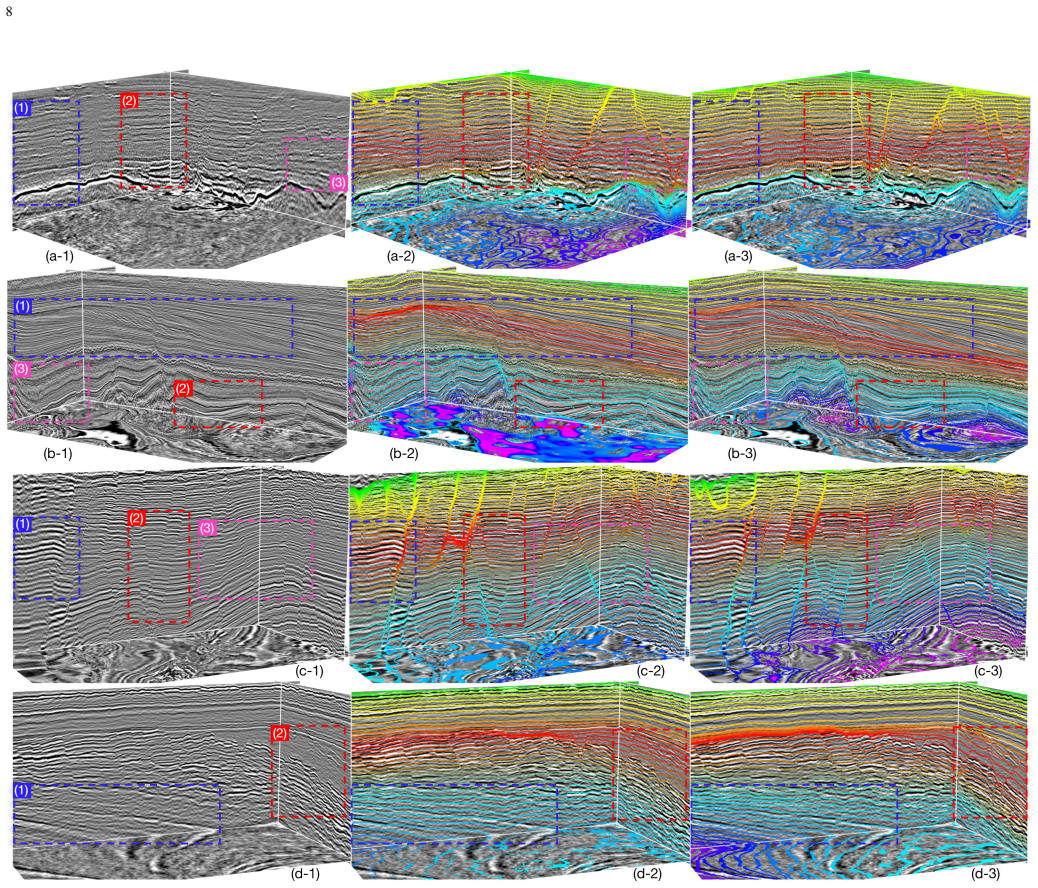
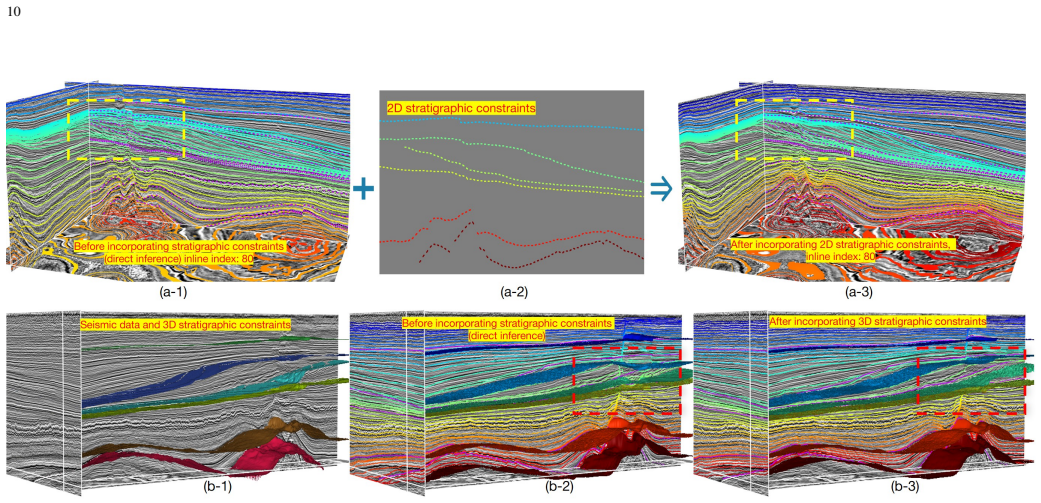
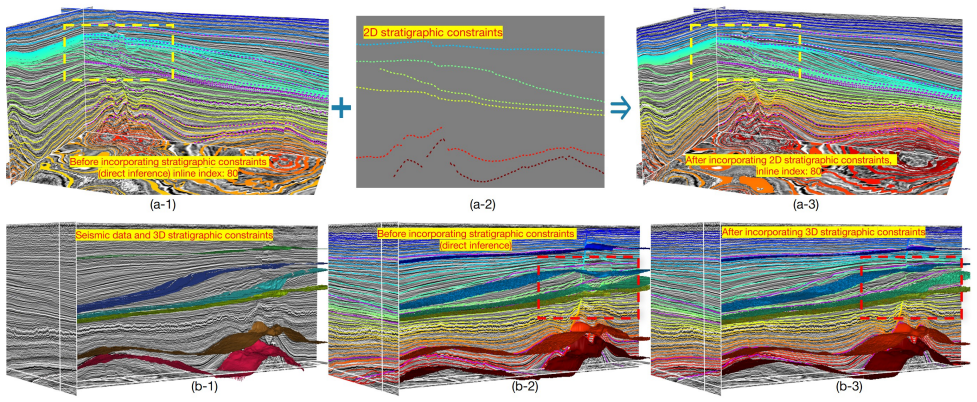
Relative Geologic Time (RGT) estimation from seismic data is a cornerstone of subsurface structural modeling, depositional evolution analysis, and reservoir characterization, supporting horizon correlation and depositional system reconstruction. Yet accurate RGT estimation remains challenging: RGT is intrinsically a topologically constrained continuous field, in which local errors readily propagate globally and distort the overall result. Conventional methods rely heavily on priors, attribute extraction, and manual interaction, leading to cumbersome workflows. Existing deep-learning approaches mostly use a regression formulation with pixel-wise MSE/MAE losses, which struggle to capture thin horizons and fail to model the stratigraphic semantics of the RGT field, yielding limited generalization and unstable ordering across diverse structural and depositional settings. We propose RGT-Est, a deep-learning framework that transfers the optimization target from the topologically constrained continuous field into a differentiable sinusoidal space, which explicitly encodes the periodic stratigraphic semantics of RGT and alleviates over-smoothing of fine horizons. Pointwise, perceptual, and adversarial losses are jointly imposed in this space to enforce local fidelity, inter-layer consistency, and global structural plausibility, providing both fine-horizon discrimination and global stratigraphic awareness. An optional horizon-guidance module further accepts sparse 2D or 3D horizons as priors. Trained on synthetic data and evaluated on field surveys with densely faulted zones, large unconformities, steeply dipping strata, folded deformations, and clinoforms, RGT-Est achieves state-of-the-art performance among AI-based methods without horizon constraints, and attains substantially higher horizon-correlation accuracy and global topological consistency once sparse priors are incorporated.
Editorial analysis
A structured set of objections, weighed in public.
Referee Report
Summary. The manuscript proposes RGT-Est, a deep-learning framework for estimating relative geologic time (RGT) from 3D seismic data. It maps the topologically constrained RGT field into a differentiable sinusoidal space to encode periodic stratigraphic semantics, applies joint pointwise, perceptual, and adversarial losses in that space, and includes an optional horizon-guidance module for sparse priors. Trained on synthetic data and evaluated on field surveys containing faults, unconformities, steep dips, folds, and clinoforms, the method claims state-of-the-art performance among AI-based approaches without horizon constraints and substantially improved horizon-correlation accuracy plus global topological consistency when priors are added.
Significance. If the central claims hold, the work could advance automated seismic interpretation by producing RGT fields that better preserve fine horizons and global ordering without heavy manual priors, directly supporting horizon correlation, depositional reconstruction, and reservoir modeling in geophysics.
major comments (3)
- [Abstract] Abstract: the claim that the sinusoidal mapping 'explicitly encodes the periodic stratigraphic semantics of RGT and alleviates over-smoothing of fine horizons' is load-bearing for the entire contribution, yet no derivation, inverse-mapping analysis, or proof is supplied showing that the transform (and its joint losses) preserves strict monotonicity and ordering across discontinuities such as faults and large unconformities; without this, phase wrapping could introduce non-monotonic artifacts that undermine the asserted global topological consistency.
- [Abstract] Abstract: the assertions of 'state-of-the-art performance among AI-based methods without horizon constraints' and 'substantially higher horizon-correlation accuracy and global topological consistency' once priors are incorporated are central to the evaluation claims, but the abstract supplies no quantitative metrics, ablation studies, baseline comparisons, or dataset details; these must be provided with explicit tables and statistical tests to allow verification.
- [Method] Method description (sinusoidal mapping and loss formulation): the joint optimization in the wrapped sinusoidal space is presented as guaranteeing both local fidelity and global structural plausibility, but no analysis or constraint is given demonstrating that the adversarial and perceptual terms prevent ordering violations at the very structures (densely faulted zones, steeply dipping strata) used in the field evaluation; a concrete test or counter-example on synthetic discontinuities would be required.
minor comments (2)
- [Abstract] The abstract would benefit from a brief, explicit statement of the sinusoidal transform (e.g., sin(2π·RGT) or variant) and the precise form of the three loss terms to improve immediate readability.
- Notation for the optional horizon-guidance module should be introduced consistently when first mentioned, including how sparse 2D/3D priors are injected into the network.
Simulated Author's Rebuttal
We thank the referee for the thorough and constructive review. We address each major comment point by point below, providing clarifications based on the manuscript content and indicating revisions where they strengthen the work without misrepresenting our contributions.
read point-by-point responses
-
Referee: [Abstract] Abstract: the claim that the sinusoidal mapping 'explicitly encodes the periodic stratigraphic semantics of RGT and alleviates over-smoothing of fine horizons' is load-bearing for the entire contribution, yet no derivation, inverse-mapping analysis, or proof is supplied showing that the transform (and its joint losses) preserves strict monotonicity and ordering across discontinuities such as faults and large unconformities; without this, phase wrapping could introduce non-monotonic artifacts that undermine the asserted global topological consistency.
Authors: We appreciate the referee's emphasis on rigor for this central claim. The sinusoidal mapping is motivated by the periodic nature of stratigraphic layering, where phase cycles naturally correspond to horizon intervals, and the differentiable transform allows joint optimization of pointwise, perceptual, and adversarial losses to promote both local horizon fidelity and global ordering. While the original manuscript provides the formulation and empirical validation on field data containing faults and unconformities (showing preserved topology via horizon correlation metrics), it does not include an explicit inverse-mapping derivation or formal proof of strict monotonicity preservation. To address this directly, we will add a dedicated analysis subsection in the revised Method section that derives the inverse mapping properties and includes targeted synthetic experiments on discontinuities to confirm that the joint losses mitigate phase-wrapping artifacts and maintain ordering. revision: partial
-
Referee: [Abstract] Abstract: the assertions of 'state-of-the-art performance among AI-based methods without horizon constraints' and 'substantially higher horizon-correlation accuracy and global topological consistency' once priors are incorporated are central to the evaluation claims, but the abstract supplies no quantitative metrics, ablation studies, baseline comparisons, or dataset details; these must be provided with explicit tables and statistical tests to allow verification.
Authors: The referee correctly notes that the abstract is a high-level summary and omits specific numbers. The full manuscript details the evaluations, including comparisons to prior AI methods, ablation studies on loss components, dataset descriptions (synthetic training and field surveys with faults, unconformities, steep dips, folds, and clinoforms), quantitative metrics such as horizon correlation accuracy and topological consistency scores, and statistical comparisons. To enhance verifiability as requested, we will revise the abstract to concisely incorporate key quantitative results (e.g., specific accuracy gains and references to tables) while preserving its brevity. revision: yes
-
Referee: [Method] Method description (sinusoidal mapping and loss formulation): the joint optimization in the wrapped sinusoidal space is presented as guaranteeing both local fidelity and global structural plausibility, but no analysis or constraint is given demonstrating that the adversarial and perceptual terms prevent ordering violations at the very structures (densely faulted zones, steeply dipping strata) used in the field evaluation; a concrete test or counter-example on synthetic discontinuities would be required.
Authors: We agree that targeted validation on challenging structures strengthens the claims. The manuscript demonstrates effectiveness through synthetic training data and real field evaluations on surveys containing densely faulted zones, steep dips, and related features, with results indicating improved global consistency via the joint losses. However, the original text does not isolate a dedicated counter-example test on synthetic discontinuities specifically for the adversarial and perceptual terms. We will add this in the revised Experiments section: a controlled synthetic test with injected faults and unconformities, comparing single-loss versus joint-loss variants, including visualizations and ordering-violation metrics to show how the combined terms prevent artifacts at these structures. revision: yes
Circularity Check
No circularity: novel sinusoidal mapping and loss design are independent methodological choices
full rationale
The paper introduces RGT-Est as a new neural architecture that maps the RGT field into a differentiable sinusoidal space and applies joint pointwise/perceptual/adversarial losses there. This is an explicit design decision rather than a derivation that reduces to its own inputs by construction. No equations are shown to equate a 'prediction' with a fitted parameter, no uniqueness theorem is imported from self-citations, and no ansatz is smuggled via prior work. Performance claims rest on training and evaluation against synthetic and field data, which are external to the method definition itself.
Axiom & Free-Parameter Ledger
axioms (1)
- domain assumption RGT is intrinsically a topologically constrained continuous field in which local errors readily propagate globally
Lean theorems connected to this paper
-
IndisputableMonolith/Foundation/AlexanderDuality.leanalexander_duality_circle_linking uncleartransfers the optimization target ... into a differentiable sinusoidal space, which explicitly encodes the periodic stratigraphic semantics of RGT
Reference graph
Works this paper leans on
-
[1]
Geng, Zhicheng and Wu, Xinming and Shi, Yunzhi and Fomel, Sergey , title =. Geophysics , volume =. 2020 , doi =
work page 2020
-
[2]
IEEE Transactions on Geoscience and Remote Sensing , volume =
Yang, Jiarun and Wu, Xinming and Bi, Zhengfa and Geng, Zhicheng , title =. IEEE Transactions on Geoscience and Remote Sensing , volume =. 2023 , doi =
work page 2023
-
[3]
Patel, M. D. and McMechan, G. A. , title =. Computers & Geosciences , volume =
-
[4]
Stark, T. J. , title =. 73rd Annual International Meeting, SEG, Expanded Abstracts , pages =
-
[5]
Stark, T. J. , title =. The Leading Edge , volume =
-
[6]
Petroleum Exploration and Development , volume =
Zeng, Hongliu and Zhu, Xiaomin and Zhu, Rukai and Zhang, Qisong , title =. Petroleum Exploration and Development , volume =
-
[7]
Structural data constraints for implicit modeling of folds , journal =
Grose, Laurent and Laurent, Gautier and Aill. Structural data constraints for implicit modeling of folds , journal =
-
[8]
Bader, S. and Spikes, K. and Fomel, S. , title =. SEG Technical Program Expanded Abstracts , pages =
-
[9]
Geophysical Prospecting , volume =
Karimi, Parvaneh and Fomel, Sergey , title =. Geophysical Prospecting , volume =
-
[10]
Zeng, Hongliu and Backus, M. M. and Barrow, K. T. and Tyler, N. , title =. Geophysics , volume =
-
[11]
de Bruin, G. and Hemstra, N. and Pouwel, A. , title =. The Leading Edge , volume =
- [12]
- [13]
- [14]
-
[15]
Geophysical Journal International , volume =
Wu, Xinming and Janson, Xavier , title =. Geophysical Journal International , volume =
- [16]
-
[17]
Figueiredo, A. M. and Gattass, M. and Szenberg, F. , title =. 10th International Congress of the Brazilian Geophysical Society , pages =
-
[18]
Lou, Yihuai and Zhang, Bo and Fang, Huilin and Cao, Danping and Wang, Kai and Huo, Zhizhong , title =. Geophysics , volume =
- [19]
-
[20]
Wu, Xinming and Luo, Simon and Hale, Dave , title =. Geophysics , volume =
- [21]
-
[22]
arXiv preprint arXiv:1810.11614 , year =
Yu, Siwei and Ma, Jianwei and Wang, Wenlong , title =. arXiv preprint arXiv:1810.11614 , year =
-
[23]
Wu, Xinming and Liang, Luming and Shi, Yunzhi and Fomel, Sergey , title =. Geophysics , volume =
-
[24]
Gao, Hang and Wu, Xinming and Liu, Guofeng , title =. Geophysics , volume =
-
[25]
Shi, Yunzhi and Wu, Xinming and Fomel, Sergey , title =. Interpretation , volume =
- [26]
-
[27]
Geophysical Journal International , volume =
Geng, Zhicheng and Zhao, Zeyu and Shi, Yunzhi and Wu, Xinming and Fomel, Sergey and Sen, Mrinal , title =. Geophysical Journal International , volume =
-
[28]
Journal of Geophysical Research: Solid Earth , volume =
Bi, Zhengfa and Wu, Xinming and Geng, Zhicheng and Li, Haishan , title =. Journal of Geophysical Research: Solid Earth , volume =
-
[29]
Wu, Xinming and Geng, Zhicheng and Shi, Yunzhi and Pham, Nam and Fomel, Sergey and Caumon, Guillaume , title =. Geophysics , volume =
-
[30]
and Shechtman, Eli and Wang, Oliver , title =
Zhang, Richard and Isola, Phillip and Efros, Alexei A. and Shechtman, Eli and Wang, Oliver , title =. Proceedings of the IEEE Conference on Computer Vision and Pattern Recognition (CVPR) , pages =
-
[31]
arXiv preprint arXiv:1807.00734 , year =
Jolicoeur-Martineau, Alexia , title =. arXiv preprint arXiv:1807.00734 , year =
-
[32]
Proceedings of the IEEE Conference on Computer Vision and Pattern Recognition (CVPR) , pages=
Image-to-image translation with conditional adversarial networks , author=. Proceedings of the IEEE Conference on Computer Vision and Pattern Recognition (CVPR) , pages=
- [33]
-
[34]
International Conference on Learning Representations (ICLR) , year=
Adam: A Method for Stochastic Optimization , author=. International Conference on Learning Representations (ICLR) , year=
-
[35]
Seismic horizon tracking based on the TransUnet model , author=. Geophysics , volume=. 2025 , publisher=
work page 2025
-
[36]
Journal of Petroleum Science and Engineering , volume=
Variable seismic waveforms representation: Weak-supervised learning based seismic horizon picking , author=. Journal of Petroleum Science and Engineering , volume=. 2022 , publisher=
work page 2022
-
[37]
IEEE Transactions on Geoscience and Remote Sensing , volume=
A deep learning-based seismic horizon tracking method with uncertainty encoding and vertical constraint , author=. IEEE Transactions on Geoscience and Remote Sensing , volume=. 2024 , publisher=
work page 2024
-
[38]
IEEE Transactions on Geoscience and Remote Sensing , volume=
Seismic horizon identification using semi-supervised learning with virtual adversarial training , author=. IEEE Transactions on Geoscience and Remote Sensing , volume=. 2022 , publisher=
work page 2022
-
[39]
IEEE Transactions on Geoscience and Remote Sensing , volume=
Seismic attributes aided horizon interpretation using an ensemble dense inception transformer network , author=. IEEE Transactions on Geoscience and Remote Sensing , volume=. 2024 , publisher=
work page 2024
-
[40]
IEEE Transactions on Geoscience and Remote Sensing , volume=
Automatic extraction of seismic data horizon across faults , author=. IEEE Transactions on Geoscience and Remote Sensing , volume=. 2022 , publisher=
work page 2022
-
[41]
Dou, Y. , year =. RGT-Est: Datasets and Trained Model Weights for Learning Stratigraphically Consistent Relative Geologic Time from 3D Seismic Data via Sinusoidal Mapping [Dataset/Software] , howpublished =. doi:10.5281/zenodo.20118902 , url =
discussion (0)
Sign in with ORCID, Apple, or X to comment. Anyone can read and Pith papers without signing in.