Recognition: unknown
Characterization of non-self OU sequences of two-component link diagrams
Pith reviewed 2026-05-10 14:56 UTC · model grok-4.3
The pith
Pairs of non-self OU sequences for diagrams of two-component links are completely characterized.
A machine-rendered reading of the paper's core claim, the machinery that carries it, and where it could break.
Core claim
We completely characterize pairs of non-self OU sequences of diagrams of two-component links. We also characterize the pairs for specific prime links with crossing number up to five.
What carries the argument
A non-self OU sequence: the cyclic sequence of over/under data at crossings with the other component, obtained by traversing one oriented component of the link diagram.
If this is right
- Any pair of sequences arising from a two-component link diagram must obey the compatibility rules identified in the characterization.
- All prime two-component links with at most five crossings have their sequence pairs explicitly listed.
- The characterization supplies a direct test for whether a given pair of sequences can come from some diagram of a two-component link.
Where Pith is reading between the lines
- The complete list makes it possible to enumerate or filter candidate diagrams using only the sequence pair data.
- The explicit lists for small crossing numbers provide a finite catalog that can be checked by direct diagram construction.
- The approach isolates inter-component crossing information in a form that might be compared across different diagrams of the same link.
Load-bearing premise
The diagrams are oriented two-component link diagrams in which non-self crossings are well-defined and the cyclic traversal produces a valid OU sequence under standard knot-diagram conventions.
What would settle it
An oriented two-component link diagram whose pair of non-self OU sequences does not belong to the characterized collection of pairs.
Figures






read the original abstract
A non-self OU sequence is a cyclic sequence of crossing information of non-self crossings that is obtained by traversing a knot component of an oriented link diagram. In this paper, we investigate what information can be derived from non-self OU sequences, and we completely characterize pairs of non-self OU sequences of diagrams of two-component links. We also characterize the pairs for specific prime links with crossing number up to five.
Editorial analysis
A structured set of objections, weighed in public.
Referee Report
Summary. The paper defines a non-self OU sequence as the cyclic sequence of over/under labels at inter-component crossings encountered while traversing one component of an oriented two-component link diagram. It claims a complete combinatorial characterization of all pairs of such sequences that arise from any oriented two-component link diagram, together with explicit characterizations of the pairs realized by specific prime links of crossing number at most five.
Significance. A correct and exhaustive characterization would supply a new combinatorial description of the inter-component crossing data of two-component links. The explicit lists for low-crossing-number prime links would furnish concrete, checkable data that could support enumeration, invariant construction, or computational verification in knot theory.
minor comments (3)
- [Abstract] The abstract states that pairs are characterized for 'specific prime links with crossing number up to five' but does not list the links or indicate the total number of diagrams considered; adding this information would improve clarity.
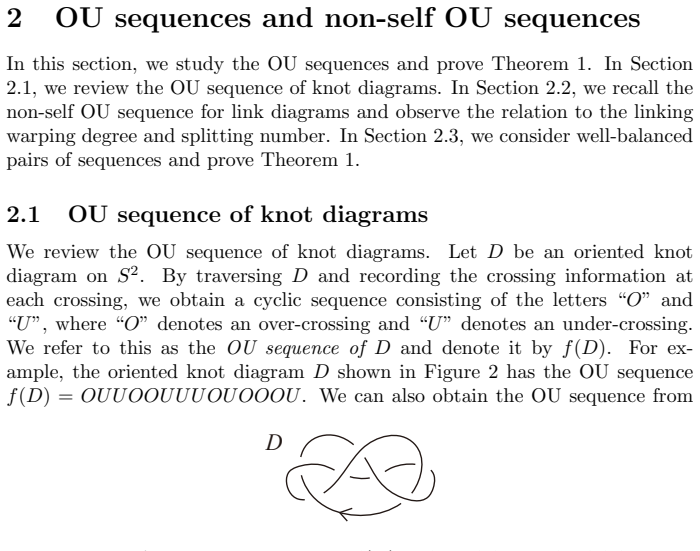
- [Definition of non-self OU sequence] Standard knot-diagram conventions for cyclic traversal and orientation are invoked without an accompanying figure or explicit statement of the starting point and direction; a single illustrative diagram in the definition section would remove ambiguity.
- [Main characterization theorem] The manuscript does not indicate whether the characterization is up to link equivalence or up to diagram equivalence; clarifying this distinction would help readers interpret the scope of the result.
Simulated Author's Rebuttal
We thank the referee for reviewing our manuscript and recommending it for minor revision. The referee's summary correctly describes the main contributions of our paper regarding the characterization of non-self OU sequences in two-component link diagrams. Since no specific major comments were raised, we have no particular points to address in this response.
Circularity Check
No circularity: direct combinatorial characterization
full rationale
The paper performs an exhaustive combinatorial classification of pairs of non-self OU sequences arising from oriented two-component link diagrams, using only the standard definitions of diagram traversal and crossing labels. No equations, fitted parameters, predictions, or self-citations appear as load-bearing steps in the derivation; the completeness claim rests on case-by-case enumeration for small crossing numbers, which is self-contained and does not reduce any result to its own inputs by construction.
Axiom & Free-Parameter Ledger
axioms (1)
- standard math Standard definitions and properties of oriented link diagrams and crossing information in knot theory
Reference graph
Works this paper leans on
-
[1]
C. C. Adams, Splitting versus unlinking, J. Knot Theory Ramifications5 (3) (1996), 295–299
1996
-
[2]
Batson and C
J. Batson and C. Seed, A link splitting spectral sequence in Khovanov homology, Duke Math. J.164(5) (2015), 801–841
2015
-
[3]
Cavallo, C
A. Cavallo, C. Collari and A. Conway, A note on the weak splitting number, Proc. Amer. Math. Soc.149(2021), 1305–1321
2021
-
[4]
J. C. Cha, S. Friedl and M. Powell, Splitting numbers of links, Proc. Edinb. Math. Soc. (2)60(3) (2017), 587–614
2017
-
[5]
Cimasoni, A
D. Cimasoni, A. Conway and K. Zacharova, Splitting numbers and signa- tures, Proc. Amer. Math. Soc.144(12) (2016), 5443–5455
2016
-
[6]
Hanaki, Pseudo diagrams of knots, links and spatial graphs, Osaka J
R. Hanaki, Pseudo diagrams of knots, links and spatial graphs, Osaka J. Math.47(3) (2010), 863–883
2010
-
[7]
R. Higa, Y. Nakanishi, S. Satoh and T. Yamamoto, Crossing information and warping polynomials about the trefoil knot, J. Knot Theory Ramifica- tions21(12) (2012), 1250117
2012
-
[8]
Kawauchi, Lectures on Knot Theory (in Japanese), Kyoritsu Shuppan (2007)
A. Kawauchi, Lectures on Knot Theory (in Japanese), Kyoritsu Shuppan (2007)
2007
-
[9]
Livingston, Splitting numbers of links and the four-genus
C. Livingston, Splitting numbers of links and the four-genus. Proc. Amer. Math. Soc.146(1) (2018), 421–427
2018
-
[10]
Livingston and A
C. Livingston and A. H. Moore,Linkinfo: Table of Link Invariants, knot- info.org, April 4, 2026
2026
-
[11]
Micheletti, I
C. Micheletti, I. Chubak, E. Orlandini and J. Smrek, Topology-Based De- tection and Tracking of Deadlocks Reveal Aging of Active Ring Melts, ACS Macro Lett.13(2) (2024), 124–129
2024
-
[12]
Rolfsen, Knots and Links, Publish or Perish, Inc., 1976
D. Rolfsen, Knots and Links, Publish or Perish, Inc., 1976
1976
- [13]
-
[14]
Shimizu, The warping degree of a link diagram, Osaka J
A. Shimizu, The warping degree of a link diagram, Osaka J. Math.48(1) (2011), 209–231
2011
-
[15]
Shimizu, The complete splitting number of a lassoed link, Topology Appl.159(4) (2012), 959–965
A. Shimizu, The complete splitting number of a lassoed link, Topology Appl.159(4) (2012), 959–965. 21
2012
discussion (0)
Sign in with ORCID, Apple, or X to comment. Anyone can read and Pith papers without signing in.