Recognition: unknown
Autonomous Drift Learning in Data Streams: A Unified Perspective
Pith reviewed 2026-05-09 14:42 UTC · model grok-4.3
The pith
A three-dimensional taxonomy classifies non-stationarity in autonomous learning into time, data, and model stream drifts.
A machine-rendered reading of the paper's core claim, the machinery that carries it, and where it could break.
Core claim
The paper establishes a three-dimensional taxonomy for drift in autonomous data streams. Time stream drift distinguishes arbitrary stochastic patterns from structural rhythmic dynamics. Data stream drift separates shifts in feature representations from changes in underlying semantics. Model stream drift characterizes endogenous divergence through sequential plasticity, decentralized heterogeneity, and policy instability. Applied to a review of 193 studies, the taxonomy unifies fragmented research paradigms and identifies open challenges toward self-evolving intelligent systems.
What carries the argument
The three-dimensional taxonomy of time stream drift, data stream drift, and model stream drift, organized by the operational state of the learning system.
If this is right
- Methods from concept drift, continual learning, and temporal generalization can be reclassified and compared systematically across the three dimensions.
- Future algorithms for autonomous systems should monitor and respond to drifts in multiple streams at once rather than addressing one type in isolation.
- Open challenges concentrate on model stream drift, particularly policy instability and decentralized heterogeneity.
- The taxonomy supplies a concrete roadmap for constructing systems that evolve autonomously amid continuous change.
Where Pith is reading between the lines
- The taxonomy could be tested by applying it to label all drifts observed in a deployed autonomous agent over months of operation and checking for uncovered cases.
- It suggests designing integrated monitoring that tracks time, data, and model streams concurrently, rather than separate detection modules.
- The framework may help identify why certain adaptation techniques fail when deployed in long-running systems that accumulate multiple drift types.
Load-bearing premise
The three dimensions capture every relevant form of non-stationarity in autonomous learning systems without significant overlap or omission.
What would settle it
Discovery of a type of non-stationarity arising in an autonomous learning system that fits none of the three categories, or that clearly requires a fourth independent dimension, would falsify the taxonomy's completeness.
Figures


read the original abstract
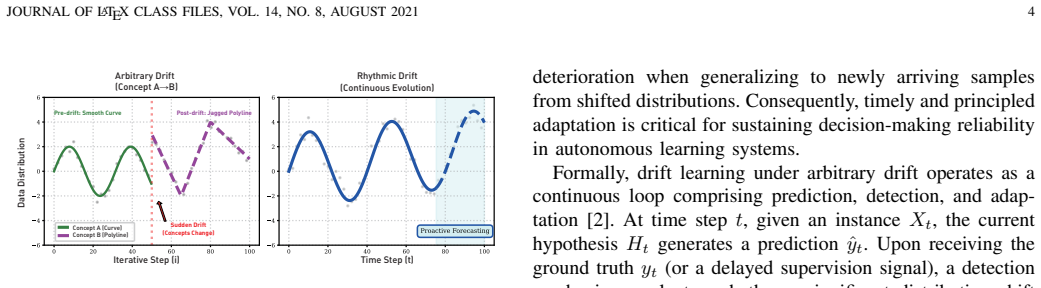
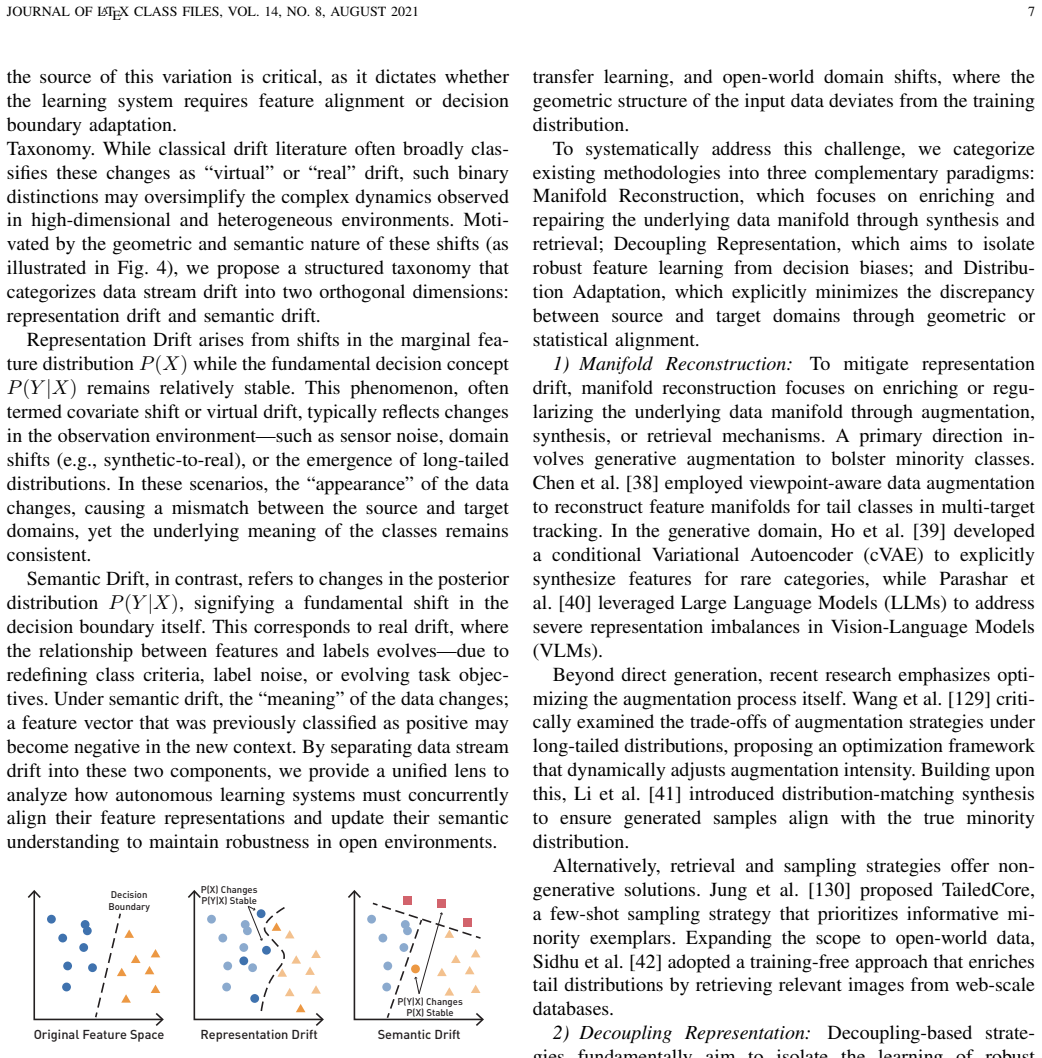
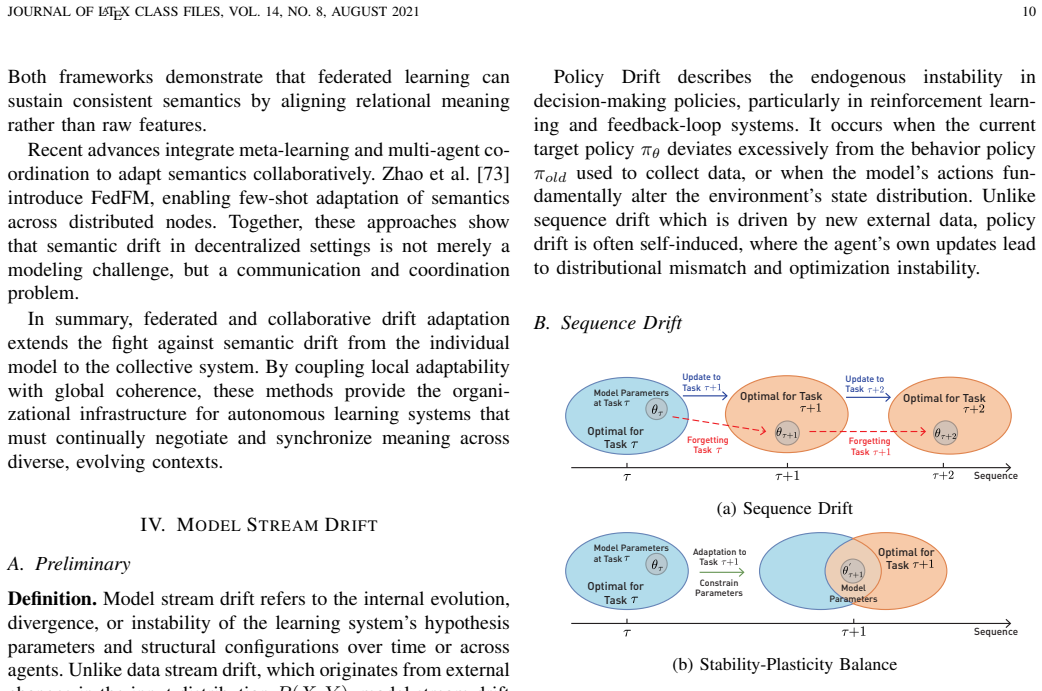
In the pursuit of autonomous learning systems, the foundational assumption of stationarity, the premise that data distributions and model behaviors remain constant, is fundamentally untenable. Historically, the research community has addressed non-stationary environments almost exclusively under the scope of concept drift, focusing primarily on temporal shifts in streams. However, as learning systems become increasingly autonomous and complex, merely adapting to temporal non-stationarity is no longer sufficient. Evolving beyond this traditional perspective, we propose a novel, three-dimensional taxonomy that systematizes the field based on the operational state of the system. First, time stream drift distinguishes between stochastic arbitrary patterns and structural rhythmic dynamics. Second, data stream drift disentangles shifts in feature representations, identified as representation drift, from changes in underlying semantics, recognized as semantic drift. Third, model stream drift characterizes the internal endogenous divergence of learning systems through the lenses of sequential plasticity, decentralized heterogeneity, and policy instability. Based on this framework, we systematically review 193 representative studies and identify key open challenges. By bridging the fragmented paradigms of drift adaptation, continual learning, and temporal generalization, this survey outlines a roadmap for building self-evolving intelligent systems capable of learning autonomously through continuous change.
Editorial analysis
A structured set of objections, weighed in public.
Referee Report
Summary. The paper proposes a novel three-dimensional taxonomy for non-stationarity in autonomous learning systems, consisting of time stream drift (stochastic arbitrary patterns vs. structural rhythmic dynamics), data stream drift (representation drift vs. semantic drift), and model stream drift (sequential plasticity, decentralized heterogeneity, and policy instability). It applies this framework to systematically review 193 representative studies, identifies key open challenges, and positions the taxonomy as a bridge across concept drift adaptation, continual learning, and temporal generalization to support self-evolving intelligent systems.
Significance. If the taxonomy can be shown to organize the literature without substantial overlap or omission, the work would provide a useful unifying lens for fragmented research areas in non-stationary machine learning, potentially helping researchers identify gaps in autonomous adaptation and guiding development of more robust self-evolving systems.
major comments (2)
- [Abstract; taxonomy definition] Abstract and taxonomy definition section: the central claim that the three dimensions capture distinct operational states 'without significant overlap' is load-bearing for the systematization contribution, yet the description treats model stream drift as endogenous divergence while data stream drift includes semantic shifts that commonly induce policy instability and plasticity changes; no explicit disambiguation rules, decision criteria, or interaction analysis are provided for assigning the 193 studies to dimensions.
- [Review of 193 studies] Review methodology (presumably the section detailing the 193-study categorization): without documented rules for handling cases where semantic drift in the data stream induces model stream effects (e.g., policy instability), the non-overlap premise cannot be verified, weakening the claim that the taxonomy comprehensively systematizes the field.
minor comments (2)
- [Abstract] The abstract uses 'time stream drift' and 'data stream drift' terminology that could be clarified with a short table contrasting the three dimensions and their subcategories for reader orientation.
- [Review section] Ensure all 193 studies are referenced with explicit dimension assignments in a supplementary table or appendix to allow reproducibility of the categorization.
Simulated Author's Rebuttal
We thank the referee for the constructive feedback on our manuscript. We address each major comment point by point below, clarifying the taxonomy's design and indicating where revisions will strengthen the presentation.
read point-by-point responses
-
Referee: [Abstract; taxonomy definition] Abstract and taxonomy definition section: the central claim that the three dimensions capture distinct operational states 'without significant overlap' is load-bearing for the systematization contribution, yet the description treats model stream drift as endogenous divergence while data stream drift includes semantic shifts that commonly induce policy instability and plasticity changes; no explicit disambiguation rules, decision criteria, or interaction analysis are provided for assigning the 193 studies to dimensions.
Authors: The taxonomy classifies drifts by their primary operational locus within the autonomous system rather than by downstream effects: time stream addresses temporal patterns in the data arrival process, data stream captures observable changes in the input data itself (representation versus semantic), and model stream isolates endogenous model-internal dynamics (plasticity, heterogeneity, policy instability) that arise independently of direct data observation. Semantic drift is therefore assigned to the data stream dimension when the initiating change is in data semantics, even if it later affects model behavior; the model stream dimension is reserved for cases where the primary phenomenon is internal model divergence not directly traceable to a data shift. While the manuscript's abstract and definition section emphasize this distinction, we acknowledge that explicit decision criteria and interaction analysis were not detailed. In the revision we will expand the taxonomy definition section with a dedicated subsection providing disambiguation rules, decision trees for boundary cases, and discussion of cross-dimensional interactions to support verification of the 193-study assignments. revision: yes
-
Referee: [Review of 193 studies] Review methodology (presumably the section detailing the 193-study categorization): without documented rules for handling cases where semantic drift in the data stream induces model stream effects (e.g., policy instability), the non-overlap premise cannot be verified, weakening the claim that the taxonomy comprehensively systematizes the field.
Authors: The review methodology section outlines the literature search, inclusion criteria, and high-level categorization process used to select and assign the 193 studies. Studies were placed according to the primary focus of each work (e.g., papers whose core contribution targets data-semantic adaptation are categorized under data stream drift). We recognize that the absence of explicit protocols for induced cross-effects limits independent verification of the non-overlap claim. The revision will therefore add a new subsection to the review methodology that documents the full categorization protocol, including explicit rules for handling induced model-stream effects from data-stream drifts, along with examples from the 193 studies. This addition will allow readers to assess the systematization claim directly. revision: yes
Circularity Check
No circularity: taxonomy is a conceptual synthesis from external literature
full rationale
The paper is a survey proposing a three-dimensional taxonomy (time stream drift, data stream drift, model stream drift) to systematize non-stationarity in autonomous learning. It reviews 193 studies and outlines challenges, but advances no mathematical derivations, equations, fitted parameters, or predictions. The taxonomy dimensions are defined descriptively from operational states synthesized across prior external work, without self-referential definitions, fitted-input predictions, or load-bearing self-citation chains. No step reduces by construction to its own inputs; the framework is an organizational proposal, not a derived result.
Axiom & Free-Parameter Ledger
axioms (1)
- domain assumption The foundational assumption of stationarity in data distributions and model behaviors is untenable for autonomous learning systems.
Reference graph
Works this paper leans on
-
[1]
A survey on concept drift adaptation,
J. Gama, I. ˇZliobait˙e, A. Bifet, M. Pechenizkiy, and A. Bouchachia, “A survey on concept drift adaptation,”ACM computing surveys (CSUR), vol. 46, no. 4, pp. 1–37, 2014
2014
-
[2]
Learning under concept drift: A review,
J. Lu, A. Liu, F. Dong, F. Gu, J. Gama, and G. Zhang, “Learning under concept drift: A review,”IEEE Transactions on Knowledge and Data Engineering, vol. 31, no. 12, pp. 2346–2363, 2018
2018
-
[3]
DYSON: Dynamic Feature Space Self-Organization for Online Task-Free Class Incremental Learning,
Y . He, Y . Chen, Y . Jin, S. Dong, X. Wei, and Y . Gong, “DYSON: Dynamic Feature Space Self-Organization for Online Task-Free Class Incremental Learning,” inProceedings of the IEEE/CVF Conference on Computer Vision and Pattern Recognition, 2024, pp. 23 741–23 751
2024
-
[4]
Learning robust spectral dynamics for temporal domain generalization,
E. Yu, J. Lu, X. Yang, G. Zhang, and Z. Fang, “Learning robust spectral dynamics for temporal domain generalization,” inThe Thirty- ninth Annual Conference on Neural Information Processing Systems, 2025
2025
-
[5]
DriftShield: Autonomous Fraud Detection via Actor-Critic Reinforcement Learning With Dynamic Feature Reweighting,
J. Cao, W. Zheng, Y . Ge, and J. Wang, “DriftShield: Autonomous Fraud Detection via Actor-Critic Reinforcement Learning With Dynamic Feature Reweighting,”IEEE Open Journal of the Computer Society, vol. 6, pp. 1166–1177, 2025
2025
-
[6]
MOS: Model Surgery for Pre-Trained Model-Based Class-Incremental Learning,
H.-L. Sun, D.-W. Zhou, H. Zhao, L. Gan, D.-C. Zhan, and H.-J. Ye, “MOS: Model Surgery for Pre-Trained Model-Based Class-Incremental Learning,”Proceedings of the AAAI Conference on Artificial Intelli- gence, vol. 39, no. 19, pp. 20 699–20 707, Apr. 2025
2025
-
[7]
Learning under Concept Drift: A Review,
J. Lu, A. Liu, F. Dong, F. Gu, J. Gama, and G. Zhang, “Learning under Concept Drift: A Review,”IEEE Transactions on Knowledge and Data Engineering, vol. 31, no. 12, pp. 2346–2363, Dec. 2019
2019
-
[8]
A Survey on Concept Drift in Process Mining,
D. M. V . Sato, S. C. De Freitas, J. P. Barddal, and E. E. Scalabrin, “A Survey on Concept Drift in Process Mining,”ACM Comput. Surv., vol. 54, no. 9, pp. 189:1–189:38, Oct. 2021
2021
-
[9]
Concept Drift Detection in Data Stream Mining : A literature review,
S. Agrahari and A. K. Singh, “Concept Drift Detection in Data Stream Mining : A literature review,”Journal of King Saud University - Computer and Information Sciences, vol. 34, no. 10, Part B, pp. 9523– 9540, Nov. 2022
2022
-
[10]
Learning Under Concept Drift for Regression—A Systematic Literature Review,
M. Lima, M. Neto, T. S. Filho, and R. A. de A. Fagundes, “Learning Under Concept Drift for Regression—A Systematic Literature Review,” IEEE Access, vol. 10, pp. 45 410–45 429, 2022
2022
-
[11]
A survey of active and passive concept drift handling methods,
M. Han, Z. Chen, M. Li, H. Wu, and X. Zhang, “A survey of active and passive concept drift handling methods,”Computational Intelligence, vol. 38, no. 4, pp. 1492–1535, 2022
2022
-
[12]
From concept drift to model degradation: An overview on performance-aware drift detectors,
F. Bayram, B. S. Ahmed, and A. Kassler, “From concept drift to model degradation: An overview on performance-aware drift detectors,” Knowledge-Based Systems, vol. 245, p. 108632, Jun. 2022
2022
-
[13]
Learning with drift detection,
J. Gama, P. Medas, G. Castillo, and P. Rodrigues, “Learning with drift detection,” inBrazilian Symposium on Artificial Intelligence. Springer, 2004, pp. 286–295
2004
-
[14]
Early drift detection method,
M. Baena-Garcıa, J. del Campo- ´Avila, R. Fidalgo, A. Bifet, R. Gavalda, and R. Morales-Bueno, “Early drift detection method,” inFourth international workshop on knowledge discovery from data streams, vol. 6, 2006, pp. 77–86
2006
-
[15]
Online and non- parametric drift detection methods based on hoeffding’s bounds,
I. Frias-Blanco, J. del Campo- ´Avila, G. Ramos-Jimenez, R. Morales- Bueno, A. Ortiz-Diaz, and Y . Caballero-Mota, “Online and non- parametric drift detection methods based on hoeffding’s bounds,”IEEE Transactions on Knowledge and Data Engineering, vol. 27, no. 3, pp. 810–823, 2014
2014
-
[16]
Learning from time-changing data with adaptive windowing,
A. Bifet and R. Gavalda, “Learning from time-changing data with adaptive windowing,” inProceedings of the 2007 SIAM International Conference on Data Mining. SIAM, 2007, pp. 443–448
2007
-
[17]
Early concept drift detection via prediction uncertainty,
P. Lu, J. Lu, A. Liu, and G. Zhang, “Early concept drift detection via prediction uncertainty,” inProceedings of the AAAI Conference on Artificial Intelligence, vol. 39, no. 18, 2025, pp. 19 124–19 132
2025
-
[18]
Learning unbiased cluster descriptors for interpretable imbalanced concept drift detection,
Y . Zhang, Z. Huang, M. Zhao, C. Zhang, Y . Lu, Y . Ji, F. Gu, and A. Zeng, “Learning unbiased cluster descriptors for interpretable imbalanced concept drift detection,”IEEE Transactions on Emerging Topics in Computational Intelligence, 2025
2025
-
[19]
Just-in-time adaptive classifiers—part i: Detecting nonstationary changes,
C. Alippi and M. Roveri, “Just-in-time adaptive classifiers—part i: Detecting nonstationary changes,”IEEE Transactions on Neural Net- works, vol. 19, no. 7, pp. 1145–1153, 2008
2008
-
[20]
Unsupervised concept drift detection from deep learning representations in real-time,
S. Greco, B. Vacchetti, D. Apiletti, and T. Cerquitelli, “Unsupervised concept drift detection from deep learning representations in real-time,” IEEE Transactions on Knowledge and Data Engineering, 2025
2025
-
[21]
Kan4drift: Are kan effective for identifying and tracking concept drift in time series?
K. Xu, L. Chen, and S. Wang, “Kan4drift: Are kan effective for identifying and tracking concept drift in time series?” inNeurIPS Workshop on Time Series in the Age of Large Models, 2024
2024
-
[22]
Paired learners for concept drift,
S. H. Bach and M. A. Maloof, “Paired learners for concept drift,” in 2008 Eighth IEEE International Conference on Data Mining. IEEE, 2008, pp. 23–32
2008
-
[23]
Dynamic extreme learning machine for data stream classification,
S. Xu and J. Wang, “Dynamic extreme learning machine for data stream classification,”Neurocomputing, vol. 238, pp. 433–449, 2017
2017
-
[24]
Fp-elm: An online sequential learning algorithm for dealing with concept drift,
D. Liu, Y . Wu, and H. Jiang, “Fp-elm: An online sequential learning algorithm for dealing with concept drift,”Neurocomputing, vol. 207, pp. 322–334, 2016
2016
-
[25]
Adaptive random forests for evolving data stream classification,
H. M. Gomes, A. Bifet, J. Read, J. P. Barddal, F. Enembreck, B. Pfharinger, G. Holmes, and T. Abdessalem, “Adaptive random forests for evolving data stream classification,”Machine Learning, vol. 106, no. 9, pp. 1469–1495, 2017
2017
-
[26]
Online boosting adaptive learn- ing under concept drift for multistream classification,
E. Yu, J. Lu, B. Zhang, and G. Zhang, “Online boosting adaptive learn- ing under concept drift for multistream classification,” inProceedings of the AAAI Conference on Artificial Intelligence, vol. 38, no. 15, 2024, pp. 16 522–16 530
2024
-
[27]
Coda: Temporal domain generalization via concept drift simulator,
C.-Y . Chang, Y .-N. Chuang, Z. Jiang, K.-H. Lai, A. Jiang, and N. Zou, “Coda: Temporal domain generalization via concept drift simulator,” inProceedings of the 31st ACM SIGKDD Conference on Knowledge Discovery and Data Mining V . 2, 2025, pp. 131–142
2025
-
[28]
Training for the future: A simple gradient interpolation loss to generalize along time,
A. Nasery, S. Thakur, V . Piratla, A. De, and S. Sarawagi, “Training for the future: A simple gradient interpolation loss to generalize along time,”Advances in Neural Information Processing Systems, vol. 34, pp. 19 198–19 209, 2021
2021
-
[30]
Evolving standardization for continual domain generalization over temporal drift,
M. Xie, S. Li, L. Yuan, C. Liu, and Z. Dai, “Evolving standardization for continual domain generalization over temporal drift,”Advances in Neural Information Processing Systems, vol. 36, 2024
2024
-
[31]
Learning time-aware causal representation for model generalization in evolving domains,
Z. He, S. Li, W. Song, L. Yuan, J. Liang, H. Li, and K. Gai, “Learning time-aware causal representation for model generalization in evolving domains,”arXiv preprint arXiv:2506.17718, 2025
-
[32]
Autonomous online multistream generalization via fuzzy joint discriminant analysis,
E. Yu, J. Lu, X. Yang, and G. Zhang, “Autonomous online multistream generalization via fuzzy joint discriminant analysis,”IEEE Transac- tions on Fuzzy Systems, vol. 34, no. 4, pp. 1256–1268, 2026
2026
-
[33]
Learning to learn the future: Modeling concept drifts in time series prediction,
X. You, M. Zhang, D. Ding, F. Feng, and Y . Huang, “Learning to learn the future: Modeling concept drifts in time series prediction,” in Proceedings of the 30th ACM International Conference on Information & Knowledge Management, 2021, pp. 2434–2443
2021
-
[34]
Ddg-da: Data distribution generation for predictable concept drift adaptation,
W. Li, X. Yang, W. Liu, Y . Xia, and J. Bian, “Ddg-da: Data distribution generation for predictable concept drift adaptation,” inProceedings of the AAAI Conference on Artificial Intelligence, vol. 36, no. 4, 2022, pp. 4092–4100
2022
-
[36]
Onenet: Enhancing time series forecasting models under concept drift by online ensembling,
Q. Wen, W. Chen, L. Sun, Z. Zhang, L. Wang, R. Jin, T. Tanet al., “Onenet: Enhancing time series forecasting models under concept drift by online ensembling,”Advances in Neural Information Processing Systems, vol. 36, pp. 69 949–69 980, 2023. JOURNAL OF LATEX CLASS FILES, VOL. 14, NO. 8, AUGUST 2021 16
2023
-
[37]
Proactive model adaptation against concept drift for online time series forecasting,
L. Zhao and Y . Shen, “Proactive model adaptation against concept drift for online time series forecasting,” inProceedings of the 31st ACM SIGKDD Conference on Knowledge Discovery and Data Mining V . 1, 2025, pp. 2020–2031
2025
-
[38]
Delving into the Trajectory Long-tail Distribution for Muti-object Tracking,
S. Chen, E. Yu, J. Li, and W. Tao, “Delving into the Trajectory Long-tail Distribution for Muti-object Tracking,” inProceedings of the IEEE/CVF Conference on Computer Vision and Pattern Recognition, 2024, pp. 19 341–19 351
2024
-
[39]
Long-Tailed Anomaly De- tection with Learnable Class Names,
C.-H. Ho, K.-C. Peng, and N. Vasconcelos, “Long-Tailed Anomaly De- tection with Learnable Class Names,” inProceedings of the IEEE/CVF Conference on Computer Vision and Pattern Recognition, 2024, pp. 12 435–12 446
2024
-
[40]
The Neglected Tails in Vision-Language Models,
S. Parashar, Z. Lin, T. Liu, X. Dong, Y . Li, D. Ramanan, J. Caverlee, and S. Kong, “The Neglected Tails in Vision-Language Models,” in Proceedings of the IEEE/CVF Conference on Computer Vision and Pattern Recognition, 2024, pp. 12 988–12 997
2024
-
[41]
Synthesizing Minority Samples for Long-tailed Classification via Distribution Matching,
Z. Li, H. Zhao, J. Ren, A. Gao, D. Guo, X. Wan, and H. Zha, “Synthesizing Minority Samples for Long-tailed Classification via Distribution Matching,”Transactions on Machine Learning Research, Apr. 2025
2025
-
[42]
Search and Detect: Training-Free Long Tail Object Detection via Web- Image Retrieval,
M. Sidhu, H. Chopra, A. Blume, J. Kim, R. G. Reddy, and H. Ji, “Search and Detect: Training-Free Long Tail Object Detection via Web- Image Retrieval,” inProceedings of the Computer Vision and Pattern Recognition Conference, 2025, pp. 15 129–15 138
2025
-
[43]
S. Young, X. Zeng, and L. Xu, “Fewer tokens, greater scaling: Self-adaptive visual bases for efficient and expansive representation learning,”arXiv preprint arXiv:2511.19515, 2025
-
[44]
DeiT-LT: Distillation Strikes Back for Vision Transformer Training on Long-Tailed Datasets,
H. Rangwani, P. Mondal, M. Mishra, A. R. Asokan, and R. V . Babu, “DeiT-LT: Distillation Strikes Back for Vision Transformer Training on Long-Tailed Datasets,” inProceedings of the IEEE/CVF Conference on Computer Vision and Pattern Recognition, 2024, pp. 23 396–23 406
2024
-
[45]
Long-Tail Class Incremental Learning via Independent Sub-prototype Construction,
X. Wang, X. Yang, J. Yin, K. Wei, and C. Deng, “Long-Tail Class Incremental Learning via Independent Sub-prototype Construction,” in Proceedings of the IEEE/CVF Conference on Computer Vision and Pattern Recognition, 2024, pp. 28 598–28 607
2024
-
[46]
BEM: Balanced and Entropy-based Mix for Long-Tailed Semi-Supervised Learning,
H. Zheng, L. Zhou, H. Li, J. Su, X. Wei, and X. Xu, “BEM: Balanced and Entropy-based Mix for Long-Tailed Semi-Supervised Learning,” inProceedings of the IEEE/CVF Conference on Computer Vision and Pattern Recognition, 2024, pp. 22 893–22 903
2024
-
[47]
EIFA-KD: Explicit and implicit feature augmentation with knowledge distillation for long-tailed visual data classification,
X. Deng, X. Wang, Y . Sun, X. Zhao, S. Tian, M. Li, and Y . Wang, “EIFA-KD: Explicit and implicit feature augmentation with knowledge distillation for long-tailed visual data classification,”Pattern Recogni- tion, vol. 171, p. 112129, Mar. 2026
2026
-
[48]
T-distributed Spherical Feature Representation for Imbalanced Classification,
X. Yang, Y . Chen, X. Yue, S. Xu, and C. Ma, “T-distributed Spherical Feature Representation for Imbalanced Classification,”Proceedings of the AAAI Conference on Artificial Intelligence, vol. 37, no. 9, pp. 10 825–10 833, Jun. 2023
2023
-
[49]
Adapting multi-modal large language model to concept drift from pre-training onwards,
X. Yang, J. Lu, and E. Yu, “Adapting multi-modal large language model to concept drift from pre-training onwards,” inThe Thirteenth International Conference on Learning Representations, Y . Yue, A. Garg, N. Peng, F. Sha, and R. Yu, Eds., vol. 2025, 2025, pp. 90 869–90 891. [Online]. Available: https://proceedings.iclr.cc/paper files/paper/2025/ file/e25d8...
2025
-
[50]
Domain Adaptation for Time Series Under Feature and Label Shifts,
H. He, O. Queen, T. Koker, C. Cuevas, T. Tsiligkaridis, and M. Zitnik, “Domain Adaptation for Time Series Under Feature and Label Shifts,” inProceedings of the 40th International Conference on Machine Learning. PMLR, Jul. 2023, pp. 12 746–12 774
2023
-
[51]
Gradual Domain Adaptation via Manifold-Constrained Distributionally Robust Optimization,
A. Saberi, A. Najafi, A. Behjati, A. Emrani, Y . Zolfit, M. Shadrooy, A. Motahari, and B. H. Khalaj, “Gradual Domain Adaptation via Manifold-Constrained Distributionally Robust Optimization,” inAd- vances in Neural Information Processing Systems, vol. 37. Curran Associates, Inc., 2024, pp. 73 693–73 725
2024
-
[52]
Open Compound Domain Adaptation with Object Style Compensation for Semantic Segmentation,
T. Feng, H. Shi, X. Liu, W. Feng, L. Wan, Y . Zhou, and D. Lin, “Open Compound Domain Adaptation with Object Style Compensation for Semantic Segmentation,” inAdvances in Neural Information Process- ing Systems, vol. 36. Curran Associates, Inc., 2023, pp. 63 136–63 149
2023
-
[53]
Subspace Identification for Multi-Source Domain Adaptation,
Z. Li, R. Cai, G. Chen, B. Sun, Z. Hao, and K. Zhang, “Subspace Identification for Multi-Source Domain Adaptation,” inAdvances in Neural Information Processing Systems, vol. 36. Curran Associates, Inc., 2023, pp. 34 504–34 518
2023
-
[54]
On f-Divergence Principled Domain Adaptation: An Improved Framework,
Z. Wang and Y . Mao, “On f-Divergence Principled Domain Adaptation: An Improved Framework,” inAdvances in Neural Information Process- ing Systems, vol. 37. Curran Associates, Inc., 2024, pp. 6711–6748
2024
-
[55]
Suffi- cient Invariant Learning for Distribution Shift,
T. Kim, S. Park, S. Lim, Y . Jung, K. Muandet, and K. Song, “Suffi- cient Invariant Learning for Distribution Shift,” inProceedings of the IEEE/CVF Conference on Computer Vision and Pattern Recognition, 2025, pp. 4958–4967
2025
-
[56]
Let Invariant Learning Inspire Neighbor-shift Generalization on Graphs,
J. Li, J. Gao, B. Gu, and Y . Kong, “Let Invariant Learning Inspire Neighbor-shift Generalization on Graphs,”IEEE Transactions on Arti- ficial Intelligence, pp. 1–12, 2025
2025
-
[57]
Graph Structure Extrapolation for Out- of-Distribution Generalization,
X. Li, S. Gui, Y . Luo, and S. Ji, “Graph Structure Extrapolation for Out- of-Distribution Generalization,” inForty-First International Conference on Machine Learning, Jun. 2024
2024
-
[58]
GeSS: Benchmarking Geometric Deep Learning under Scientific Applications with Distribution Shifts,
D. Zou, S. Liu, S. Miao, V . Fung, S. Chang, and P. Li, “GeSS: Benchmarking Geometric Deep Learning under Scientific Applications with Distribution Shifts,”Advances in Neural Information Processing Systems, vol. 37, pp. 92 499–92 528, Dec. 2024
2024
-
[59]
ReCDA: Concept Drift Adaptation with Representation Enhancement for Network Intrusion Detection,
S. Yang, X. Zheng, J. Li, J. Xu, X. Wang, and E. C. H. Ngai, “ReCDA: Concept Drift Adaptation with Representation Enhancement for Network Intrusion Detection,” inProceedings of the 30th ACM SIGKDD Conference on Knowledge Discovery and Data Mining, ser. KDD ’24. New York, NY , USA: Association for Computing Machinery, Aug. 2024, pp. 3818–3828
2024
-
[60]
Test- Time Adaptation Induces Stronger Accuracy and Agreement-on-the- Line,
E. Kim, M. Sun, C. Baek, A. Raghunathan, and J. Z. Kolter, “Test- Time Adaptation Induces Stronger Accuracy and Agreement-on-the- Line,”Advances in Neural Information Processing Systems, vol. 37, pp. 120 184–120 220, Dec. 2024
2024
-
[61]
Dual Test-Time Training for Out-of-Distribution Recom- mender System,
X. Yang, Y . Wang, J. Chen, W. Fan, X. Zhao, E. Zhu, X. Liu, and D. Lian, “Dual Test-Time Training for Out-of-Distribution Recom- mender System,”IEEE Transactions on Knowledge and Data Engi- neering, vol. 37, no. 6, pp. 3312–3326, Jun. 2025
2025
-
[62]
OODD: Test-time Out-of-Distribution Detection with Dynamic Dictionary,
Y . Yang, L. Zhu, Z. Sun, H. Liu, Q. Gu, and N. Ye, “OODD: Test-time Out-of-Distribution Detection with Dynamic Dictionary,” in Proceedings of the IEEE/CVF Conference on Computer Vision and Pattern Recognition, 2025, pp. 30 630–30 639
2025
-
[63]
UDDA-TC: Unsupervised Real-Time Drift Detection and Adaptation for Continual Traffic Classification in Mobile Edge Computing,
M. Liu, P. Wang, Z. Li, Y . Ye, Z. Wang, and X. Chen, “UDDA-TC: Unsupervised Real-Time Drift Detection and Adaptation for Continual Traffic Classification in Mobile Edge Computing,”IEEE Transactions on Consumer Electronics, pp. 1–1, 2025
2025
-
[64]
AdaO2B: Adaptive Online to Batch Conversion for Out-of-Distribution Generalization,
X. Zhang, S. Dai, J. Xu, Y . Liu, and Z. Dong, “AdaO2B: Adaptive Online to Batch Conversion for Out-of-Distribution Generalization,” Proceedings of the AAAI Conference on Artificial Intelligence, vol. 39, no. 21, pp. 22 596–22 604, Apr. 2025
2025
-
[65]
Label-Noise Robust Diffusion Models,
B. Na, Y . Kim, H. Bae, J. H. Lee, S. J. Kwon, W. Kang, and I.-c. Moon, “Label-Noise Robust Diffusion Models,” inThe Twelfth International Conference on Learning Representations, Oct. 2023
2023
-
[66]
Optimizing OOD Detection in Molecular Graphs: A Novel Approach with Diffusion Models,
X. Shen, Y . Wang, K. Zhou, S. Pan, and X. Wang, “Optimizing OOD Detection in Molecular Graphs: A Novel Approach with Diffusion Models,” inProceedings of the 30th ACM SIGKDD Conference on Knowledge Discovery and Data Mining, ser. KDD ’24. New York, NY , USA: Association for Computing Machinery, Aug. 2024, pp. 2640– 2650
2024
-
[67]
Benchmark- ing common uncertainty estimation methods with histopathological images under domain shift and label noise,
H. A. Mehrtens, A. Kurz, T.-C. Bucher, and T. J. Brinker, “Benchmark- ing common uncertainty estimation methods with histopathological images under domain shift and label noise,”Medical Image Analysis, vol. 89, p. 102914, Oct. 2023
2023
-
[68]
MaxEnt Loss: Constrained Max- imum Entropy for Calibration under Out-of-Distribution Shift,
D. Neo, S. Winkler, and T. Chen, “MaxEnt Loss: Constrained Max- imum Entropy for Calibration under Out-of-Distribution Shift,”Pro- ceedings of the AAAI Conference on Artificial Intelligence, vol. 38, no. 19, pp. 21 463–21 472, Mar. 2024
2024
-
[69]
Modeling the Distributional Uncertainty for Salient Object Detection Models,
X. Tian, J. Zhang, M. Xiang, and Y . Dai, “Modeling the Distributional Uncertainty for Salient Object Detection Models,” inProceedings of the IEEE/CVF Conference on Computer Vision and Pattern Recognition, 2023, pp. 19 660–19 670
2023
-
[70]
FedStream: Prototype-Based Federated Learning on Distributed Concept-Drifting Data Streams,
C. B. Mawuli, L. Che, J. Kumar, S. U. Din, Z. Qin, Q. Yang, and J. Shao, “FedStream: Prototype-Based Federated Learning on Distributed Concept-Drifting Data Streams,”IEEE Transactions on Systems, Man, and Cybernetics: Systems, vol. 53, no. 11, pp. 7112– 7124, Nov. 2023
2023
-
[71]
FOOGD: Federated Collaboration for Both Out-of- distribution Generalization and Detection,
X. Liao, W. Liu, P. Zhou, F. Yu, J. Xu, J. Wang, W. Wang, C. Chen, and X. Zheng, “FOOGD: Federated Collaboration for Both Out-of- distribution Generalization and Detection,”Advances in Neural Infor- mation Processing Systems, vol. 37, pp. 132 908–132 945, Dec. 2024
2024
-
[72]
FedGOG: Federated Graph Out-of- Distribution Generalization with Diffusion Data Exploration and Latent Embedding Decorrelation,
P. Zhou, C. Chen, W. Liu, X. Liao, W. Shen, J. Xu, Z. Fu, J. Wang, W. Wen, and X. Zheng, “FedGOG: Federated Graph Out-of- Distribution Generalization with Diffusion Data Exploration and Latent Embedding Decorrelation,”Proceedings of the AAAI Conference on Artificial Intelligence, vol. 39, no. 21, pp. 22 965–22 973, Apr. 2025
2025
-
[73]
FedFM: A federated few-shot learning method by comparison network and model calibration,
C. Zhao, S. Bao, M. Chen, Z. Gao, K. Xiao, and P. Dai, “FedFM: A federated few-shot learning method by comparison network and model calibration,”Knowledge-Based Systems, vol. 309, p. 112848, Jan. 2025. JOURNAL OF LATEX CLASS FILES, VOL. 14, NO. 8, AUGUST 2021 17
2025
-
[74]
Concept drift detection with quadtree-based spatial mapping of streaming data,
R. Amador Coelho, L. C. Bambirra Torres, and C. Leite de Cas- tro, “Concept drift detection with quadtree-based spatial mapping of streaming data,”Information Sciences, vol. 625, pp. 578–592, May 2023
2023
-
[75]
Unsupervised Unlearning of Concept Drift with Autoen- coders,
A. Artelt, K. Malialis, C. G. Panayiotou, M. M. Polycarpou, and B. Hammer, “Unsupervised Unlearning of Concept Drift with Autoen- coders,” in2023 IEEE Symposium Series on Computational Intelli- gence (SSCI), Dec. 2023, pp. 703–710
2023
-
[76]
Class Incre- mental Learning based on Identically Distributed Parallel One-Class Classifiers,
W. Sun, Q. Li, J. Zhang, W. Wang, and Y .-a. Geng, “Class Incre- mental Learning based on Identically Distributed Parallel One-Class Classifiers,”Neurocomputing, vol. 556, p. 126579, Nov. 2023
2023
-
[77]
FeTrIL: Feature Translation for Exemplar-Free Class-Incremental Learning,
G. Petit, A. Popescu, H. Schindler, D. Picard, and B. Delezoide, “FeTrIL: Feature Translation for Exemplar-Free Class-Incremental Learning,” inProceedings of the IEEE/CVF Winter Conference on Applications of Computer Vision, 2023, pp. 3911–3920
2023
-
[78]
Dynamic Integration of Task-Specific Adapters for Class Incremental Learning,
J. Li, S. Wang, B. Qian, Y . He, X. Wei, Q. Wang, and Y . Gong, “Dynamic Integration of Task-Specific Adapters for Class Incremental Learning,” inProceedings of the IEEE/CVF Conference on Computer Vision and Pattern Recognition, 2025, pp. 30 545–30 555
2025
-
[79]
Antiforgetting Incremental Learning Algorithm for Interval Type-2 Fuzzy Neural Network,
C. Sun, H. Han, X. Wu, and H. Yang, “Antiforgetting Incremental Learning Algorithm for Interval Type-2 Fuzzy Neural Network,”IEEE Transactions on Fuzzy Systems, vol. 32, no. 4, pp. 1938–1950, Apr. 2024
1938
-
[80]
Concept Drift Adaptation by Exploiting Drift Type,
J. Li, H. Yu, Z. Zhang, X. Luo, and S. Xie, “Concept Drift Adaptation by Exploiting Drift Type,”ACM Trans. Knowl. Discov. Data, vol. 18, no. 4, pp. 96:1–96:22, Feb. 2024
2024
-
[81]
MalFSCIL: A Few-Shot Class-Incremental Learning Approach for Malware Detection,
Y . Chai, X. Chen, J. Qiu, L. Du, Y . Xiao, Q. Feng, S. Ji, and Z. Tian, “MalFSCIL: A Few-Shot Class-Incremental Learning Approach for Malware Detection,”IEEE Transactions on Information Forensics and Security, vol. 20, pp. 2999–3014, 2025
2025
-
[82]
Generalized incremental learning under concept drift across evolving data streams,
E. Yu, J. Lu, and G. Zhang, “Generalized incremental learning under concept drift across evolving data streams,”Proceedings of the ACM Web Conference 2026, p. 3905–3916, 2026
2026
discussion (0)
Sign in with ORCID, Apple, or X to comment. Anyone can read and Pith papers without signing in.