Recognition: unknown
Gravitational waves from CP domain wall collapse and electron EDM in a complex singlet model with dimension-five Yukawa interactions
Pith reviewed 2026-05-09 15:06 UTC · model grok-4.3
The pith
Electron EDM bounds already constrain part of the parameter space where gravitational waves from CP domain wall collapse would be detectable in a complex singlet model.
A machine-rendered reading of the paper's core claim, the machinery that carries it, and where it could break.
Core claim
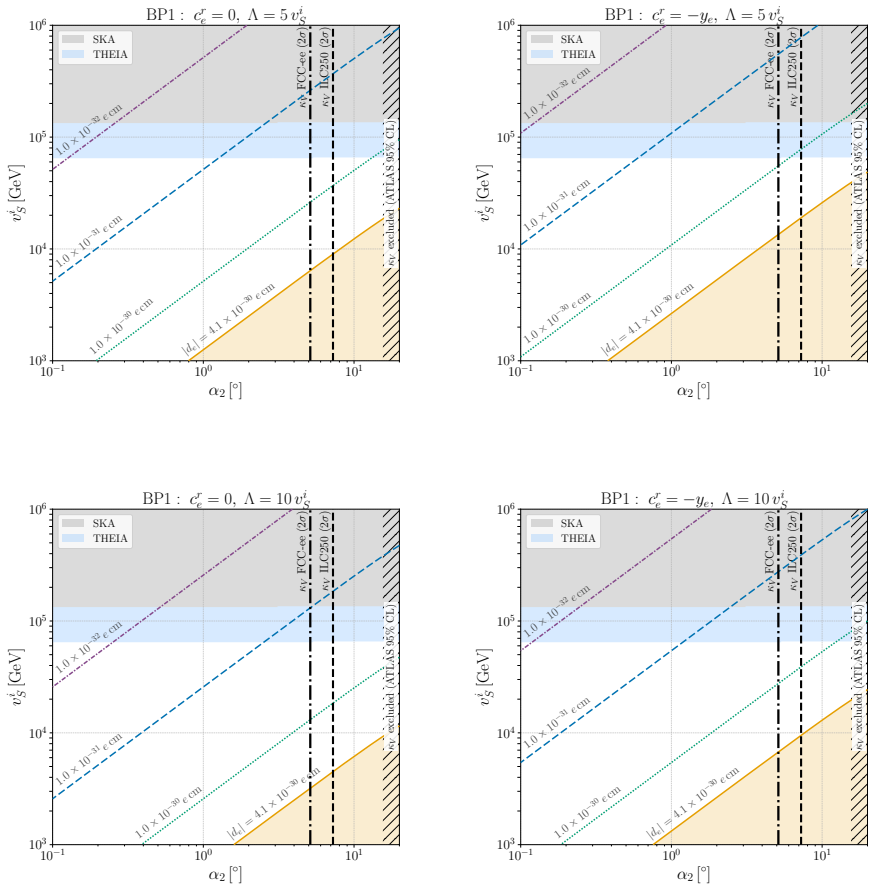
In this complex singlet model the scalar potential admits CP-related degenerate vacua that give rise to domain walls; their collapse generates gravitational waves detectable by future observatories such as SKA and THEIA. Dimension-five Yukawa couplings between the singlet and Standard Model fermions introduce CP phases that produce a nonzero electron EDM. The resulting parameter space exhibits partial overlap: current electron EDM bounds already exclude portions of the region where gravitational waves would be detectable, and future EDM sensitivities at the level of 10^{-31}--10^{-32} e cm can probe further into the same domain.
What carries the argument
CP domain walls formed by degenerate vacua in the complex singlet potential, whose collapse produces gravitational waves, together with dimension-five Yukawa interactions that generate observable CP phases in the electron EDM.
If this is right
- Current electron EDM limits already exclude part of the parameter space in which gravitational waves from domain-wall collapse would be detectable.
- Future EDM experiments reaching 10^{-31} to 10^{-32} e cm sensitivity will test additional regions where gravitational wave signals are expected.
- The two observables together map both the vacuum degeneracy and the CP-violating phases in the singlet sector.
- Non-observation of one signal can be used to narrow the search window for the other within the model.
Where Pith is reading between the lines
- Absence of gravitational waves in the relevant band could be interpreted as indirect support for stronger EDM constraints in related singlet models.
- The framework suggests that EDM data could serve as a prior to optimize gravitational wave search strategies for similar beyond-Standard-Model scenarios.
- Extensions incorporating baryogenesis or additional fermions might link the same domain-wall dynamics to other cosmological observables.
Load-bearing premise
The scalar potential must possess CP-related degenerate vacua that form long-lived domain walls, and the dimension-five couplings must induce unsuppressed CP phases in the effective fermion interactions.
What would settle it
Detection of a gravitational wave background in the frequency band predicted for domain-wall collapse together with an electron EDM measurement below 10^{-32} e cm would contradict the claimed overlap between the two observables.
Figures

read the original abstract
We study the interplay between gravitational waves (GWs) from domain wall collapse and the electron electric dipole moment (EDM) in a complex singlet extension of the standard model with dimension-five Yukawa interactions. In this framework, the scalar potential admits CP-related degenerate vacua, leading to the formation of CP domain walls. While the resulting GW signal provides a probe of the vacuum structure of the singlet scalar sector, it does not by itself constitute a CP-violating observable. Once the singlet scalar is coupled to standard model fermions, CP-violating phases become observable through EDMs. We analyze whether current and future EDM experiments can probe the parameter region where the GW signal is detectable by SKA and THEIA. We find that the current electron EDM bound already constrains part of the parameter space, while future sensitivities at the level of $10^{-31}$--$10^{-32}\,e\,\mathrm{cm}$ can probe regions overlapping with the GW-detectable domain. Our results highlight the complementarity between GW and EDM observables in probing the singlet scalar sector, providing a coherent picture of its vacuum structure and CP properties.
Editorial analysis
A structured set of objections, weighed in public.
Referee Report
Summary. The manuscript examines gravitational waves from the collapse of CP domain walls in a complex singlet extension of the Standard Model that includes dimension-five Yukawa interactions. It argues that the current electron EDM bound already excludes part of the parameter space, while projected future sensitivities of 10^{-31}--10^{-32} e cm can reach regions where the GW signal would be detectable by SKA and THEIA, thereby illustrating complementarity between the two observables for constraining the singlet sector's vacuum structure and CP phases.
Significance. If the numerical results and loop calculations hold, the work supplies a concrete example of how cosmological GW signals and precision EDM measurements can jointly probe an extended scalar sector through shared parameters (singlet vev, quartics, and cutoff scale). The explicit linkage of domain-wall tension, annihilation temperature, and EDM loop factors is a positive feature that strengthens the case for multi-messenger tests of CP-symmetric potentials.
major comments (2)
- [§4.2] §4.2 and the associated parameter scan: the overlap between GW-detectable and EDM-probed regions is presented as robust, yet the text does not quantify how the results change when the cutoff scale in the dim-5 operators is varied by an order of magnitude; this choice directly affects both the wall tension and the EDM loop factor and therefore bears on the central complementarity claim.
- [Eq. (18)] Eq. (18) and the EDM loop expression: the claimed future sensitivity reach assumes a specific suppression from the dim-5 coefficient and the singlet vev; without an explicit error band or scan over the phase and coupling ranges, it is difficult to assess whether the overlap region survives reasonable variations in these inputs.
minor comments (2)
- [Abstract and §5] The abstract and §5 would benefit from a short statement of the scanned ranges for the singlet quartic couplings and the cutoff scale, together with a note on whether the quoted EDM bounds include theoretical uncertainties.
- [Figure 2 and Figure 4] Figure 2 (GW spectrum) and Figure 4 (EDM vs. GW amplitude) would be clearer if the SKA and THEIA sensitivity curves were overlaid with explicit frequency and amplitude labels rather than referenced only in the caption.
Simulated Author's Rebuttal
We thank the referee for the positive assessment of our work and the recommendation for minor revision. We address each major comment below, indicating the revisions we will implement to strengthen the manuscript.
read point-by-point responses
-
Referee: [§4.2] §4.2 and the associated parameter scan: the overlap between GW-detectable and EDM-probed regions is presented as robust, yet the text does not quantify how the results change when the cutoff scale in the dim-5 operators is varied by an order of magnitude; this choice directly affects both the wall tension and the EDM loop factor and therefore bears on the central complementarity claim.
Authors: We agree that the cutoff scale Λ in the dimension-five operators affects both the domain-wall tension (through the effective potential) and the EDM loop factor, and that an explicit quantification strengthens the complementarity claim. In the original analysis we adopted Λ = 1 TeV as a representative benchmark. We have now performed additional scans for Λ = 0.5 TeV and Λ = 5 TeV. The qualitative features of the overlap region persist, although the precise boundaries shift by O(1) factors. We will revise §4.2 to include a short discussion of this dependence and add a supplementary panel (or figure) showing the GW and EDM reach for the three values of Λ. revision: yes
-
Referee: [Eq. (18)] Eq. (18) and the EDM loop expression: the claimed future sensitivity reach assumes a specific suppression from the dim-5 coefficient and the singlet vev; without an explicit error band or scan over the phase and coupling ranges, it is difficult to assess whether the overlap region survives reasonable variations in these inputs.
Authors: Eq. (18) does depend on the CP-violating phase and the combination of singlet vev and dim-5 coefficient. Our existing parameter scan already covers the ranges of phases and vevs that permit CP domain walls. To make the robustness explicit, we will add shaded bands to the relevant summary plots (around the discussion of Eq. (18) and in §4.2) that reflect the variation over the scanned phase interval and coupling strengths. A brief clarifying sentence will also be inserted near Eq. (18). revision: yes
Circularity Check
No significant circularity; derivation is self-contained
full rationale
The paper constructs a complex singlet extension with a CP-symmetric potential admitting degenerate vacua (leading to domain walls and GWs) and dimension-five Yukawa operators transmitting CP phases to the electron EDM via loops. Both signals are computed as functions of shared parameters (singlet VEV, couplings, cutoff) and compared via parameter scans. No step reduces a prediction to a fitted input by construction, no self-citation is load-bearing for the central claim, and no ansatz or uniqueness is smuggled in. The complementarity between GW and EDM regions follows directly from the explicit calculations without circular reduction.
Axiom & Free-Parameter Ledger
free parameters (2)
- Singlet potential parameters
- Dimension-five Yukawa couplings and phases
axioms (2)
- domain assumption The scalar potential admits CP-related degenerate vacua
- domain assumption Dimension-five Yukawa interactions generate CP-violating phases observable in EDMs
Reference graph
Works this paper leans on
-
[1]
√ 2ar 1 vr S − bi 1 2 vi S vr S + X i O2 2im2 hi # = 2 vi2 S
=|a 1|2|b1|sinθ 1,(9) I2 = Im(a1ytc∗ t ) =|y t||a1||ct|sinθ 2,(10) I3 = Im(a1yec∗ e) =|y e||a1||ce|sinθ 3,(11) wherea 1 =|a 1|eiθa1,b 1 =|b 1|eiθb1,θ 1 = 2θ a1 −θ b1, andθ 2 =θ yt +θ a1 −θ ct, andθ 3 = θye +θ a1 −θ ce. IfI 1 =I 2 =I 3 = 0, there is no explicit CP violation. In this case, there exists a basis in which all parameters are real, which we refe...
2025
- [2]
- [3]
-
[4]
D. Azevedo, P. Ferreira, M. M. M¨ uhlleitner, R. Santos, and J. Wittbrodt, Phys. Rev. D99, 055013 (2019), arXiv:1808.00755 [hep-ph]
- [5]
- [6]
- [7]
- [8]
- [9]
- [10]
-
[11]
M. Gonderinger, H. Lim, and M. J. Ramsey-Musolf, Phys. Rev. D86, 043511 (2012), arXiv:1202.1316 [hep-ph]
- [12]
- [13]
- [14]
- [15]
-
[16]
T. Biek¨ otter, A. Dashko, M. L¨ oschner, and G. Weiglein, (2025), arXiv:2511.14831 [hep-ph]
- [17]
- [18]
- [19]
-
[20]
V. A. Kuzmin, V. A. Rubakov, and M. E. Shaposhnikov, Phys. Lett.155B, 36 (1985)
1985
-
[21]
V. A. Rubakov and M. E. Shaposhnikov, Usp. Fiz. Nauk166, 493 (1996), [Phys. Usp.39,461(1996)], arXiv:hep-ph/9603208 [hep-ph]; K. Funakubo, Prog. Theor. Phys.96, 475 (1996), arXiv:hep-ph/9608358 [hep-ph]; A. Riotto, inProceedings, Summer School in High-energy physics and cosmology: Trieste, Italy, June 29-July 17, 1998(1998) pp. 326–436, arXiv:hep-ph/98074...
- [22]
-
[23]
B. Grzadkowski and D. Huang, JHEP08, 135 (2018), arXiv:1807.06987 [hep-ph]
-
[24]
C. Idegawa and E. Senaha, Phys. Lett. B848, 138332 (2024), arXiv:2309.09430 [hep-ph]
- [25]
-
[26]
Gravitational wave astronomy with the SKA
G. Janssenet al., PoSAASKA14, 037 (2015), arXiv:1501.00127 [astro-ph.IM]
work page Pith review arXiv 2015
-
[27]
Theia: Faint objects in motion or the new astrometry frontier
C. Boehmet al.(Theia), (2017), arXiv:1707.01348 [astro-ph.IM]
work page Pith review arXiv 2017
-
[28]
Navaset al.(Particle Data Group), Phys
S. Navaset al.(Particle Data Group), Phys. Rev. D110, 030001 (2024)
2024
-
[29]
A review of gravitational waves from cosmic domain walls
K. Saikawa, Universe3, 40 (2017), arXiv:1703.02576 [hep-ph]
work page Pith review arXiv 2017
-
[30]
On the estimation of gravitational wave spectrum from cosmic domain walls
T. Hiramatsu, M. Kawasaki, and K. Saikawa, JCAP02, 031 (2014), arXiv:1309.5001 [astro- ph.CO]
work page Pith review arXiv 2014
-
[31]
E. W. Kolb and M. S. Turner,The Early Universe, Vol. 69 (1990)
1990
-
[32]
General Properties of the Gravitational Wave Spectrum from Phase Transitions
C. Caprini, R. Durrer, T. Konstandin, and G. Servant, Phys. Rev. D79, 083519 (2009), arXiv:0901.1661 [astro-ph.CO]
work page Pith review arXiv 2009
-
[33]
Dark, Cold, and Noisy: Constraining Secluded Hidden Sectors with Gravitational Waves
M. Breitbach, J. Kopp, E. Madge, T. Opferkuch, and P. Schwaller, JCAP07, 007 (2019), arXiv:1811.11175 [hep-ph]
work page Pith review arXiv 2019
-
[34]
Schmitz, JHEP01, 097 (2021), arXiv:2002.04615 [hep-ph]
K. Schmitz, JHEP01, 097 (2021), arXiv:2002.04615 [hep-ph]
-
[35]
J. Garcia-Bellido, H. Murayama, and G. White, JCAP12, 023 (2021), arXiv:2104.04778 [hep-ph]
- [36]
-
[37]
N. Kitajima, J. Lee, F. Takahashi, and W. Yin, JCAP07, 053 (2025), arXiv:2311.14590 [hep-ph]
-
[38]
Andreevet al.(ACME), Nature562, 355 (2018)
V. Andreevet al.(ACME), Nature562, 355 (2018)
2018
-
[39]
S. M. Barr and A. Zee, Phys. Rev. Lett.65, 21 (1990), [Erratum: Phys.Rev.Lett. 65, 2920 (1990)]
1990
- [40]
- [41]
-
[42]
T. H. West, Phys. Rev. D50, 7025 (1994)
1994
-
[43]
D. Chang, W.-F. Chang, and W.-Y. Keung, Phys. Rev. D71, 076006 (2005), arXiv:hep- ph/0503055
- [44]
- [45]
- [46]
-
[47]
D. Bowser-Chao, D. Chang, and W.-Y. Keung, Phys. Rev. Lett.79, 1988 (1997), arXiv:hep- ph/9703435
- [48]
-
[49]
W. Altmannshofer, S. Gori, N. Hamer, and H. H. Patel, Phys. Rev. D102, 115042 (2020), arXiv:2009.01258 [hep-ph]
-
[50]
K. Fuyuto, W.-S. Hou, and E. Senaha, Phys. Rev. D101, 011901 (2020), arXiv:1910.12404 [hep-ph]
- [51]
-
[52]
Tumasyanet al.(CMS), JHEP07, 092 (2023), arXiv:2208.02686 [hep-ex]
A. Tumasyanet al.(CMS), JHEP07, 092 (2023), arXiv:2208.02686 [hep-ex]
- [53]
-
[54]
A. Tumasyanet al.(CMS), Nature607, 60 (2022), arXiv:2207.00043 [hep-ex]
-
[55]
M. E. Peskin and T. Takeuchi, Phys. Rev. Lett.65, 964 (1990); Phys. Rev. D46, 381 (1992)
1990
-
[56]
I. Kozyryev and N. R. Hutzler, Phys. Rev. Lett.119, 133002 (2017), arXiv:1705.11020 [physics.atom-ph]
- [57]
-
[58]
Fujiiet al., (2017), arXiv:1710.07621 [hep-ex]
K. Fujiiet al., (2017), arXiv:1710.07621 [hep-ex]
-
[59]
Abadaet al.(FCC), Eur
A. Abadaet al.(FCC), Eur. Phys. J. ST228, 261 (2019)
2019
-
[60]
CEPC Conceptual Design Report: Volume 2 - Physics & Detector
M. Donget al.(CEPC Study Group), (2018), arXiv:1811.10545 [hep-ex]. 29 10−1 100 101 α2 [◦] 103 104 105 106 vi S [GeV] κV ILC250 (2 σ) κV FCC-ee (2 σ) BP1 : cr e = 0, Λ = 5 vi S SKA THEIA 1.0×10 □32 ecm 1.0×10 □31 ecm 1.0×10 □30 ecm |de|= 4 .1×10 □30 ecm κV excluded (ATLAS 95% CL) 10−1 100 101 α2 [◦] 103 104 105 106 vi S [GeV] κV ILC250 (2 σ) κV FCC-ee (2 ...
work page Pith review arXiv 2018
discussion (0)
Sign in with ORCID, Apple, or X to comment. Anyone can read and Pith papers without signing in.