Recognition: unknown
PhenotypeToGeneDownloaderR: automated multi-source retrieval and validation of phenotype-associated genes
Pith reviewed 2026-05-10 15:32 UTC · model grok-4.3
The pith
PhenotypeToGeneDownloaderR retrieves and validates phenotype-associated genes from 13 databases with 98.4 percent recall of known associations.
A machine-rendered reading of the paper's core claim, the machinery that carries it, and where it could break.
Core claim
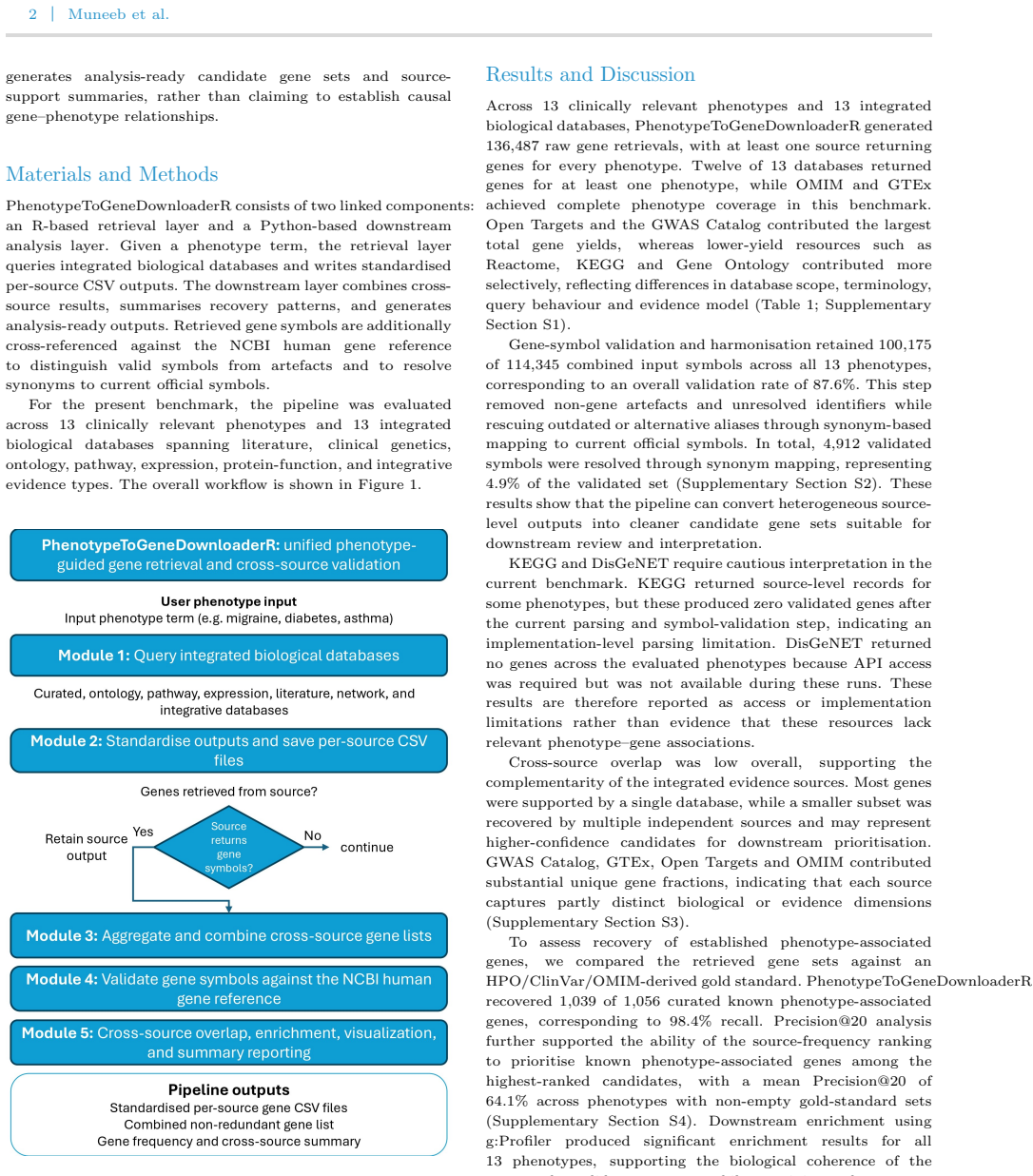
Given a phenotype term, PhenotypeToGeneDownloaderR queries 13 integrated databases, standardises per-source gene lists, validates symbols against the NCBI human gene reference, and generates summary tables and visualisations. Across 13 phenotypes it produced 136,487 raw retrievals, retained 100,175 of 114,345 combined symbols after validation (87.6 percent rate), and recovered 1,039 of 1,056 gold-standard genes (98.4 percent recall). Cross-source overlap remained low, confirming complementarity of the evidence sources.
What carries the argument
PhenotypeToGeneDownloaderR, the R/Python pipeline that queries multiple databases, harmonises outputs, performs direct or synonym-based symbol validation against NCBI, and produces cross-source summaries.
If this is right
- Candidate gene sets for polygenic risk score construction can be generated reproducibly from a single phenotype input.
- Enrichment testing and target prioritisation gain consistent multi-source input without manual database querying.
- Variant interpretation workflows receive harmonised gene lists with explicit validation rates and overlap statistics.
- Low cross-source overlap supports the value of combining rather than relying on any single database.
- The open-source implementation allows direct reuse and extension for new phenotypes or additional data sources.
Where Pith is reading between the lines
- The low observed overlap suggests that many phenotype-gene links remain hidden when researchers use only one or two databases.
- Embedding the pipeline as an upstream step in larger genomic analysis suites could reduce manual curation time across multiple studies.
- Testing the same phenotypes with newly added databases would quantify how much additional coverage each source contributes.
- The validation step could be extended to include tissue-specific or expression filters for more targeted downstream use.
Load-bearing premise
The HPO/ClinVar/OMIM gold standard plus the 13 chosen databases together capture a sufficiently complete and unbiased picture of true phenotype-gene associations.
What would settle it
A phenotype for which an independent database not included in the original test set lists many genes that the pipeline fails to retrieve or validate.
Figures
read the original abstract
Identifying phenotype-associated genes is a common first step in polygenic risk score construction, enrichment testing, target prioritisation and variant interpretation, but relevant evidence is distributed across heterogeneous databases with different interfaces, formats and evidence models. Here, we present PhenotypeToGeneDownloaderR, a phenotype-guided R/Python pipeline for automated gene retrieval, harmonisation, symbol validation and cross-source summary analysis. Given a phenotype term, the pipeline queries integrated biological databases, standardises per-source outputs, combines gene lists, validates retrieved symbols against the NCBI human gene reference and generates summary tables and visualisations. Across 13 clinically relevant phenotypes and 13 databases, PhenotypeToGeneDownloaderR generated 136,487 raw gene retrievals, with at least one source returning genes for every phenotype. Across all 13 phenotypes, 100,175 of 114,345 combined input symbols were retained after direct or synonym-based validation, corresponding to an 87.6\% validation rate. Cross-source overlap was low, supporting the complementarity of integrated evidence sources. Against an HPO/ClinVar/OMIM-derived gold standard, the pipeline recovered 1,039 of 1,056 known phenotype-associated genes, corresponding to 98.4\% recall. PhenotypeToGeneDownloaderR provides a lightweight, reproducible upstream framework for generating candidate gene sets for downstream prioritisation and interpretation. The pipeline is implemented in R and Python, released under the MIT licence, and available at https://github.com/MuhammadMuneeb007/PhenotypeToGeneDownloaderR.
Editorial analysis
A structured set of objections, weighed in public.
Referee Report
Summary. The manuscript presents PhenotypeToGeneDownloaderR, an R/Python pipeline for automated, phenotype-guided retrieval of associated genes from 13 heterogeneous biological databases, followed by output harmonization, direct or synonym-based symbol validation against the NCBI human gene reference, cross-source overlap analysis, and generation of summary tables/visualizations. Across 13 clinically relevant phenotypes, it reports 136,487 raw retrievals, an 87.6% validation rate (100,175 of 114,345 symbols retained), low cross-source overlap, and 98.4% recall (1,039 of 1,056 genes) against an HPO/ClinVar/OMIM-derived gold standard.
Significance. If the queried databases prove independent of the gold-standard sources and the pipeline's validation steps are robust, the work supplies a lightweight, reproducible, open-source (MIT-licensed, GitHub-available) upstream tool that could facilitate candidate-gene-set generation for polygenic risk scoring, enrichment testing, target prioritization, and variant interpretation. The reported complementarity of sources and high empirical coverage are practical strengths.
major comments (2)
- [Abstract] Abstract: the central 98.4% recall claim (1,039/1,056 genes recovered from the HPO/ClinVar/OMIM-derived gold standard) is load-bearing for the performance evaluation, yet the abstract provides no list of the 13 queried databases nor any description of gold-standard construction. If HPO, ClinVar or OMIM appear among the 13 sources (or if gold-standard genes were seeded from them), the recall metric becomes circular rather than a test of multi-source integration.
- [Methods] Methods (or equivalent section describing data sources and gold-standard assembly): phenotype selection criteria for the 13 clinically relevant phenotypes, exact extraction rules from HPO/ClinVar/OMIM, and explicit confirmation that these sources are excluded from the 13 queried databases are absent. These details are required to assess bias, reproducibility, and whether the high recall is non-tautological.
minor comments (2)
- The abstract and results would be clearer with a table or supplementary list naming the 13 databases, their interfaces, and per-source contribution counts.
- Per-phenotype breakdowns of raw retrievals, validated symbols, and overlap statistics are mentioned in aggregate but not shown; adding them would strengthen transparency without altering the central claims.
Simulated Author's Rebuttal
We thank the referee for their constructive and detailed feedback, which has identified important areas for improving clarity and transparency. We have revised the manuscript to fully address the concerns about the abstract and methods, ensuring the recall evaluation is presented as a non-circular test of multi-source integration.
read point-by-point responses
-
Referee: [Abstract] Abstract: the central 98.4% recall claim (1,039/1,056 genes recovered from the HPO/ClinVar/OMIM-derived gold standard) is load-bearing for the performance evaluation, yet the abstract provides no list of the 13 queried databases nor any description of gold-standard construction. If HPO, ClinVar or OMIM appear among the 13 sources (or if gold-standard genes were seeded from them), the recall metric becomes circular rather than a test of multi-source integration.
Authors: We agree that the abstract requires additional context to allow proper assessment of the recall metric. The 13 databases queried by the pipeline are entirely distinct from HPO, ClinVar, and OMIM; the gold standard was assembled solely from the latter three sources by extracting known phenotype-associated genes, while the pipeline was tested on its ability to recover those genes from the independent set of 13 databases. We will update the abstract to list the 13 queried databases and include a concise description of gold-standard construction. This revision will explicitly confirm the non-circular nature of the 98.4% recall result. revision: yes
-
Referee: [Methods] Methods (or equivalent section describing data sources and gold-standard assembly): phenotype selection criteria for the 13 clinically relevant phenotypes, exact extraction rules from HPO/ClinVar/OMIM, and explicit confirmation that these sources are excluded from the 13 queried databases are absent. These details are required to assess bias, reproducibility, and whether the high recall is non-tautological.
Authors: We acknowledge these details were insufficiently specified. In the revised manuscript we will add a new subsection to the Methods section that: (1) describes the phenotype selection criteria (13 clinically relevant phenotypes chosen for their medical importance, representation across disease categories, and annotation availability); (2) details the exact extraction rules (HPO: genes linked via direct or descendant phenotype annotations; ClinVar: genes with pathogenic/likely pathogenic variants for the phenotype; OMIM: genes from the corresponding phenotype entries); and (3) states explicitly that HPO, ClinVar, and OMIM are excluded from the 13 queried databases. These additions will support reproducibility and demonstrate that the recall metric evaluates independent source integration. revision: yes
Circularity Check
No circularity; empirical counts against external gold standard
full rationale
The paper presents a retrieval pipeline whose core outputs are direct empirical counts: 136,487 raw retrievals, 100,175/114,345 symbols retained after NCBI validation (87.6%), and 1,039/1,056 genes recovered from an HPO/ClinVar/OMIM-derived gold standard (98.4% recall). No equations, fitted parameters, self-definitional constructs, or load-bearing self-citations appear; the recall metric is computed from explicit enumeration of known associations versus pipeline output and does not reduce to the pipeline's own inputs by construction. The 13 queried databases are treated as external sources whose overlap with the gold standard is not asserted in the text, leaving the validation independent on the evidence provided.
Axiom & Free-Parameter Ledger
axioms (2)
- domain assumption NCBI human gene reference provides the authoritative list of current and synonym gene symbols for validation
- domain assumption The 13 selected databases and the HPO/ClinVar/OMIM gold standard together represent the relevant evidence landscape for the tested phenotypes
Reference graph
Works this paper leans on
-
[1]
Martin, Hilary C
Emil Uffelmann, Qin Qin Huang, Nchangwi Syntia Munung, Jantina de Vries, Yukinori Okada, Alicia R. Martin, Hilary C. Martin, Tuuli Lappalainen, and Danielle Posthuma. Genome-wide association studies.Nature Reviews Methods Primers, 1(1), August 2021
2021
-
[2]
Mills and Charles Rahal
Melinda C. Mills and Charles Rahal. A scientometric review of genome-wide association studies.Communications Biology, 2(1), January 2019
2019
-
[3]
John S. Witte. Genome-wide association studies and beyond.Annual Review of Public Health, 31(1):9–20, March 2010
2010
-
[4]
Clinvar: improvements to accessing data.Nucleic Acids Research, 48(D1):D835– D844, November 2019
Melissa J Landrum, Shanmuga Chitipiralla, Garth R Brown, Chao Chen, Baoshan Gu, Jennifer Hart, Douglas Hoffman, Wonhee Jang, Kuljeet Kaur, Chunlei Liu, Vitaly Lyoshin, Zenith Maddipatla, Rama Maiti, Joseph Mitchell, Nuala O’Leary, George R Riley, Wenyao Shi, George Zhou, Valerie Schneider, Donna Maglott, J Bradley Holmes, and Brandi L Kattman. Clinvar: im...
2019
-
[5]
Omim.org: leveraging knowledge across phenotype–gene relationships.Nucleic Acids Research, 47(D1):D1038–D1043, November 2018
Joanna S Amberger, Carol A Bocchini, Alan F Scott, and Ada Hamosh. Omim.org: leveraging knowledge across phenotype–gene relationships.Nucleic Acids Research, 47(D1):D1038–D1043, November 2018
2018
-
[6]
The human phenotype ontology in 2021.Nucleic Acids Research, 49(D1):D1207–D1217, December 2020
Sebastian Kohler, Michael Gargano, Nicolas Matentzoglu, Leigh C Carmody, David Lewis-Smith, Nicole A Vasilevsky, Daniel Danis, Ganna Balagura, Gareth Baynam, Amy M Brower, Tiffany J Callahan, Christopher G Chute, Johanna L Est, Peter D Galer, Shiva Ganesan, Matthias Griese, Matthias Haimel, Julia Pazmandi, Marc Hanauer, Nomi L Harris, Michael J Hartnett, ...
2021
-
[7]
Kegg for taxonomy-based analysis of pathways and genomes.Nucleic Acids Research, 51(D1):D587–D592, October 2022
Minoru Kanehisa, Miho Furumichi, Yoko Sato, Masayuki Kawashima, and Mari Ishiguro-Watanabe. Kegg for taxonomy-based analysis of pathways and genomes.Nucleic Acids Research, 51(D1):D587–D592, October 2022
2022
-
[8]
The reactome pathway knowledgebase 2022.Nucleic Acids Research, 50(D1):D687–D692, November 2021
Marc Gillespie, Bijay Jassal, Ralf Stephan, Marija Milacic, Karen Rothfels, Andrea Senff-Ribeiro, Johannes Griss, Cristoffer Sevilla, Lisa Matthews, Chuqiao Gong, Chuan Deng, Thawfeek Varusai, Eliot Ragueneau, Yusra Haider, Bruce May, Veronica Shamovsky, Joel Weiser, Timothy Brunson, Nasim Sanati, Liam Beckman, Xiang Shao, Antonio Fabregat, Konstantinos S...
2022
-
[9]
Damian Szklarczyk, Rebecca Kirsch, Mikaela Koutrouli, Katerina Nastou, Farrokh Mehryary, Radja Hachilif, Annika L Gable, Tao Fang, Nadezhda T Doncheva, Sampo Pyysalo, Peer Bork, Lars J Jensen, and Christian von Mering. The string database in 2023: protein–protein association networks and functional enrichment analyses for any sequenced genome of interest....
2023
-
[10]
Uniprot: the universal protein knowledgebase in 2023.Nucleic Acids Research, 51(D1):D523–D531, November 2022
Alex Bateman, Maria-Jesus Martin, Sandra Orchard, Michele Magrane, Shadab Ahmad, Emanuele Alpi, Emily H Bowler-Barnett, Ramona Britto, Hema Bye-A- Jee, Austra Cukura, Paul Denny, Tunca Dogan, ThankGod Ebenezer, Jun Fan, Penelope Garmiri, Leonardo Jose da Costa Gonzales, Emma Hatton-Ellis, Abdulrahman Hussein, Alexandr Ignatchenko, Giuseppe Insana, Rizwan ...
2023
-
[11]
The next-generation open targets platform: reimagined, redesigned, rebuilt.Nucleic Acids Research, 51(D1):D1353–D1359, November 2022
David Ochoa, Andrew Hercules, Miguel Carmona, Daniel Suveges, Jarrod Baker, Cinzia Malangone, Irene Lopez, Alfredo Miranda, Carlos Cruz-Castillo, Luca Fumis, Manuel Bernal-Llinares, Kirill Tsukanov, Helena Cornu, Konstantinos Tsirigos, Olesya Razuvayevskaya, Annalisa Buniello, Jeremy Schwartzentruber, Mohd Karim, Bruno Ariano, Ricardo Esteban Martinez Oso...
2022
-
[12]
The disgenet knowledge platform for disease genomics: 2019 update.Nucleic Acids Research, November 2019
Janet Pinero, Juan Manuel Ramirez-Anguita, Josep Sauch- Pitarch, Francesco Ronzano, Emilio Centeno, Ferran Sanz, and Laura I Furlong. The disgenet knowledge platform for disease genomics: 2019 update.Nucleic Acids Research, November 2019
2019
-
[13]
The nhgri-ebi gwas catalog: knowledgebase and deposition resource.Nucleic Acids Research, 51(D1):D977–D985, November 2022
Elliot Sollis, Abayomi Mosaku, Ala Abid, Annalisa Buniello, Maria Cerezo, Laurent Gil, Tudor Groza, Osman Gunes, Peggy Hall, James Hayhurst, Arwa Ibrahim, Yue Ji, Sajo John, Elizabeth Lewis, Jacqueline A L MacArthur, Aoife McMahon, David Osumi-Sutherland, Kalliope Panoutsopoulou, Zoe Pendlington, Santhi Ramachandran, Ray Stefancsik, Jonathan Stewart, Patr...
2022
-
[14]
gwasrapidd: an r package to query, download and wrangle gwas catalog data
Ramiro Magno and Ana-Teresa Maia. gwasrapidd: an r package to query, download and wrangle gwas catalog data. Bioinformatics, 36(2):649–650, August 2019
2019
-
[15]
pandasgwas: a python package for easy retrieval of gwas catalog data
Tianze Cao, Anshui Li, and Yuexia Huang. pandasgwas: a python package for easy retrieval of gwas catalog data. BMC Genomics, 24(1), May 2023
2023
-
[16]
Mungesumstats: a bioconductor package for the standardization and quality control of many gwas summary statistics.Bioinformatics, 37(23):4593–4596, October 2021
Alan E Murphy, Brian M Schilder, and Nathan G Skene. Mungesumstats: a bioconductor package for the standardization and quality control of many gwas summary statistics.Bioinformatics, 37(23):4593–4596, October 2021. Supplementary Data for: PhenotypeToGeneDownloaderR: automated multi-source retrieval and validation of phenotype-associated genes Muhammad Mun...
2021
discussion (0)
Sign in with ORCID, Apple, or X to comment. Anyone can read and Pith papers without signing in.