Recognition: unknown
TimeTok: Granularity-Controllable Time-Series Generation via Hierarchical Tokenization
Pith reviewed 2026-05-09 14:15 UTC · model grok-4.3
The pith
TimeTok generates time series at any chosen granularity from coarse inputs or scratch using one hierarchical tokenization model.
A machine-rendered reading of the paper's core claim, the machinery that carries it, and where it could break.
Core claim
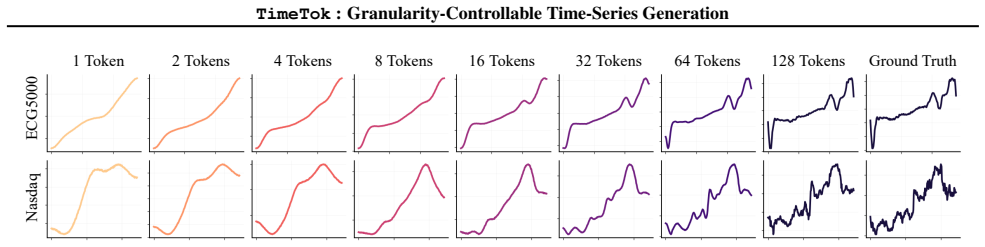
TimeTok is a unified framework for granularity-controllable time-series generation that maps any input series into an ordered sequence of tokens progressing from coarse to fine temporal granularity, runs autoregressive generation across those levels to produce token blocks, and decodes the blocks back into continuous time series whose resolution is set by how many blocks are generated.
What carries the argument
Hierarchical tokenization that converts a time series into an ordered sequence of tokens from coarse to fine temporal granularity, allowing autoregressive generation across levels and decoding to continuous series at any target resolution by controlling the number of token blocks.
If this is right
- A single model covers the full range from standard generation to refinement of coarse sketches into fine outputs.
- Explicit control over output detail is achieved simply by deciding how many token blocks to produce.
- Training on multiple datasets with different native resolutions yields a tokenizer that transfers better than models trained on single datasets.
- State-of-the-art performance is reached on conventional time-series generation benchmarks.
Where Pith is reading between the lines
- The same tokenizer could let one model handle time series collected at mismatched sampling rates without separate preprocessing pipelines.
- Downstream tasks such as multi-resolution forecasting or anomaly detection might reuse the coarse-to-fine tokens as a shared representation.
- Real-world sensor networks could deploy a single trained model and later request higher or lower resolution outputs on demand.
- Scalability to very long sequences remains untested and would require checking whether token-block counts grow linearly with series length.
Load-bearing premise
That breaking any time series into layers of tokens from broad patterns to fine details lets an autoregressive model generate coherent outputs that can be rebuilt as continuous series at whatever detail level is requested.
What would settle it
Generate a finer series from a given coarse token block and check whether the output's local statistics, such as short-term variance or frequency content, match those of real series recorded at the target finer sampling rate.
Figures





read the original abstract
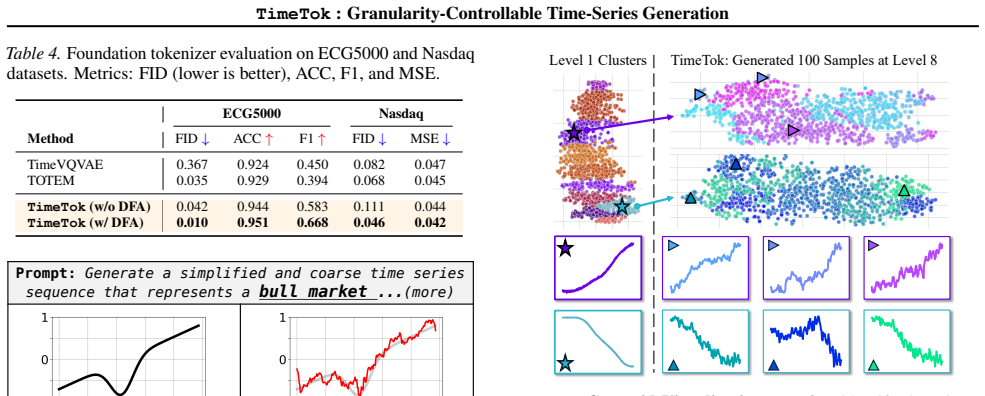
Time-series generative models often lack control over temporal granularity, forcing users to accept whatever granularity the model produces. To enable truly user-driven generation, we introduce TimeTok, a unified framework for Granularity-Controllable Time-Series Generation (GC-TSG), which generates time series at any target granularity from any coarser input (e.g., rough sketches) or from scratch. At the core of TimeTok is a hierarchical tokenization strategy that maps time series into an ordered sequence of tokens, from coarse to fine temporal granularity. Our autoregressive generation process operates across these granularity levels, producing token blocks that are decoded back into continuous time series. This design naturally enables GC-TSG - including standard generation - within a single framework, where controlling the number of token blocks provides explicit control over output detail. Experiments show that TimeTok excels at GC-TSG tasks while achieving state-of-the-art performance in standard generation. Furthermore, we showcase TimeTok's potential as a foundational tokenizer by training on multiple datasets with heterogeneous temporal granularities, verifying strong transferability that consistently outperforms models trained on individual datasets. To our knowledge, this is the first unified framework that covers the full generative spectrum for time series, offering a valuable foundation for models that benefit from diverse temporal granularities.
Editorial analysis
A structured set of objections, weighed in public.
Referee Report
Summary. The paper introduces TimeTok, a unified framework for granularity-controllable time-series generation (GC-TSG). It uses hierarchical tokenization to map any input time series into an ordered coarse-to-fine sequence of token blocks. Autoregressive generation operates across these levels, and the resulting tokens are decoded into continuous time series at a user-specified target granularity (including from scratch or from coarse sketches). The framework claims to achieve SOTA performance on standard generation tasks, strong transferability when trained on heterogeneous datasets, and to be the first to cover the full generative spectrum for time series within a single model.
Significance. If the experimental claims hold, the work is significant because it provides explicit, user-controllable granularity in time-series generation, addressing a clear limitation of existing models. The hierarchical tokenization plus cross-level autoregression is a clean architectural idea that naturally unifies standard generation with controllable variants. The reported transferability results (outperforming per-dataset models) are a concrete strength and support the claim that TimeTok can serve as a foundational tokenizer.
major comments (2)
- [Experiments section] Experiments section (around the GC-TSG and standard-generation tables): the SOTA claim and transferability results are load-bearing for the central contribution, yet the manuscript provides no quantitative metrics, baseline names, or ablation numbers in the abstract and only high-level descriptions in the main text; without these, it is impossible to verify whether the data support the performance assertions.
- [Method section] Method section on hierarchical tokenization and decoding: the central assumption that autoregressive generation across coarse-to-fine token blocks can always be decoded into coherent continuous series at arbitrary granularities is stated but not accompanied by a formal argument or failure-case analysis; this mechanism is load-bearing for the GC-TSG claim and requires either a proof sketch or explicit coherence metrics.
minor comments (3)
- [Abstract] The abstract asserts 'state-of-the-art performance' and 'strong transferability' without any numbers or references to specific tables; this should be replaced by a concise quantitative summary.
- [Method section] Notation for token blocks and granularity levels is introduced without a clear diagram or pseudocode; adding a small figure or algorithm box would improve readability.
- [Introduction] The 'to our knowledge' claim of being the first unified framework should be supported by a short related-work paragraph that explicitly contrasts with prior hierarchical or multi-scale time-series models.
Simulated Author's Rebuttal
We thank the referee for the constructive and detailed feedback. We address each major comment point by point below, providing our responses and indicating planned revisions to strengthen the manuscript.
read point-by-point responses
-
Referee: [Experiments section] Experiments section (around the GC-TSG and standard-generation tables): the SOTA claim and transferability results are load-bearing for the central contribution, yet the manuscript provides no quantitative metrics, baseline names, or ablation numbers in the abstract and only high-level descriptions in the main text; without these, it is impossible to verify whether the data support the performance assertions.
Authors: The Experiments section includes full tables reporting quantitative metrics (e.g., specific generation quality scores), baseline names, and ablation studies that directly support the SOTA and transferability claims. The main text provides a high-level narrative overview while referencing these tables. To improve immediate verifiability without requiring readers to consult the tables first, we will revise the abstract to incorporate a concise summary of key quantitative results and expand the main-text descriptions to explicitly discuss and cite the numerical findings from the tables. revision: yes
-
Referee: [Method section] Method section on hierarchical tokenization and decoding: the central assumption that autoregressive generation across coarse-to-fine token blocks can always be decoded into coherent continuous series at arbitrary granularities is stated but not accompanied by a formal argument or failure-case analysis; this mechanism is load-bearing for the GC-TSG claim and requires either a proof sketch or explicit coherence metrics.
Authors: We agree that the coherence of the decoding step merits a more rigorous treatment. The hierarchical structure ensures that finer token blocks refine coarser ones by construction, but we will strengthen this in the revision by adding a dedicated subsection that provides a proof sketch based on the invertibility and refinement properties of the tokenization/decoding pipeline, together with explicit empirical coherence metrics (such as cross-granularity reconstruction error and consistency scores) and a brief analysis of potential failure cases. revision: yes
Circularity Check
No significant circularity detected
full rationale
The paper introduces TimeTok as an architectural framework based on hierarchical tokenization that maps time series to coarse-to-fine token sequences for autoregressive generation and decoding at controllable granularities. No mathematical derivations, predictions, or first-principles results are described that reduce by construction to fitted parameters, self-definitions, or self-citation chains. The 'first unified framework' claim is a standard qualified statement without load-bearing reliance on prior self-work. The method is self-contained as a design proposal evaluated through experiments.
Axiom & Free-Parameter Ledger
free parameters (1)
- number of token blocks
axioms (1)
- domain assumption Time series data admit a lossless hierarchical token representation from coarse to fine temporal scales
invented entities (1)
-
hierarchical token blocks
no independent evidence
Reference graph
Works this paper leans on
-
[1]
F., Amirloo, E., El-Nouby, A., Zamir, A., and Dehghan, A
Bachmann, R., Allardice, J., Mizrahi, D., Fini, E., Kar, O. F., Amirloo, E., El-Nouby, A., Zamir, A., and Dehghan, A. Flextok: Resampling images into 1d token sequences of flexible length. In Forty-second International Conference on Machine Learning, 2025. URL https://openreview.net/forum?id=DgdOkUUBzf
2025
-
[2]
Bishop, C. M. Mixture density networks. 1994
1994
-
[3]
Bishop, C. M. and Nasrabadi, N. M. Pattern recognition and machine learning, volume 4. Springer, 2006
2006
-
[4]
Chang, H., Zhang, H., Jiang, L., Liu, C., and Freeman, W. T. Maskgit: Masked generative image transformer. In Proceedings of the IEEE/CVF conference on computer vision and pattern recognition, pp.\ 11315--11325, 2022
2022
-
[5]
Vision transformers need registers
Darcet, T., Oquab, M., Mairal, J., and Bojanowski, P. Vision transformers need registers. In The Twelfth International Conference on Learning Representations, 2024. URL https://openreview.net/forum?id=2dnO3LLiJ1
2024
-
[6]
Mg-tsd: Multi-granularity time series diffusion models with guided learning process
Fan, X., Wu, Y., Xu, C., Huang, Y., Liu, W., and Bian, J. Mg-tsd: Multi-granularity time series diffusion models with guided learning process. In The Twelfth International Conference on Learning Representations, 2024
2024
-
[7]
H., Kim, W
Hwang, Y., Lee, Y., Lee, J., Zohren, S., Kim, J. H., Kim, W. C., Lee, Y., and Fabozzi, F. J. Deep learning in asset management: Architectures, applications, and challenges. Applications, and Challenges (September 15, 2025), 2025
2025
-
[8]
and Martin, S
Isakadze, N. and Martin, S. S. How useful is the smartwatch ecg? Trends in cardiovascular medicine, 30 0 (7): 0 442--448, 2020
2020
-
[9]
F., Weber, J., Webb, G
Ismail Fawaz, H., Lucas, B., Forestier, G., Pelletier, C., Schmidt, D. F., Weber, J., Webb, G. I., Idoumghar, L., Muller, P.-A., and Petitjean, F. Inceptiontime: Finding alexnet for time series classification. Data Mining and Knowledge Discovery, 34 0 (6): 0 1936--1962, 2020
1936
-
[10]
and Lee, S
Kim, J. and Lee, S. Transpl: Vq-code transition matrices for pseudo-labeling of time series unsupervised domain adaptation. In Forty-second International Conference on Machine Learning, 2025
2025
-
[11]
M., ALIAS PARTH GOYAL, A
Lamb, A. M., ALIAS PARTH GOYAL, A. G., Zhang, Y., Zhang, S., Courville, A. C., and Bengio, Y. Professor forcing: A new algorithm for training recurrent networks. Advances in neural information processing systems, 29, 2016
2016
-
[12]
Lee, D., Malacarne, S., and Aune, E. Vector quantized time series generation with a bidirectional prior model, 2023. URL https://arxiv.org/abs/2303.04743
-
[13]
Lipman, Y., Chen, R. T. Q., Ben-Hamu, H., Nickel, M., and Le, M. Flow matching for generative modeling. In The Eleventh International Conference on Learning Representations, 2023. URL https://openreview.net/forum?id=PqvMRDCJT9t
2023
-
[15]
F., Han, B., Zhang, X., Faloutsos, C., Mahoney, M
Masserano, L., Ansari, A. F., Han, B., Zhang, X., Faloutsos, C., Mahoney, M. W., Wilson, A. G., Park, Y., Rangapuram, S. S., Maddix, D. C., et al. Enhancing foundation models for time series forecasting via wavelet-based tokenization. In Forty-second International Conference on Machine Learning, 2025
2025
-
[17]
and Zohren, S
Moreno-Pino, F. and Zohren, S. Deepvol: Volatility forecasting from high-frequency data with dilated causal convolutions. Quantitative Finance, 24 0 (8): 0 1105--1127, 2024
2024
-
[18]
and Xie, S
Peebles, W. and Xie, S. Scalable diffusion models with transformers. In Proceedings of the IEEE/CVF international conference on computer vision, pp.\ 4195--4205, 2023
2023
-
[19]
E., and Goldberger, A
Peng, C.-K., Havlin, S., Stanley, H. E., and Goldberger, A. L. Quantification of scaling exponents and crossover phenomena in nonstationary heartbeat time series. Chaos: an interdisciplinary journal of nonlinear science, 5 0 (1): 0 82--87, 1995
1995
-
[20]
Flowar: Scale-wise autoregressive image generation meets flow matching
Ren, S., Yu, Q., He, J., Shen, X., Yuille, A., and Chen, L.-C. Flowar: Scale-wise autoregressive image generation meets flow matching. In Forty-second International Conference on Machine Learning
-
[21]
Sutskever, I., Martens, J., and Hinton, G. E. Generating text with recurrent neural networks. In Proceedings of the 28th international conference on machine learning (ICML-11), pp.\ 1017--1024, 2011
2011
-
[22]
J., Yue, Y., and Gkioxari, G
Talukder, S. J., Yue, Y., and Gkioxari, G. Totem: Tokenized time series embeddings for general time series analysis. Transactions on Machine Learning Research, 2024
2024
-
[23]
Visual autoregressive modeling: Scalable image generation via next-scale prediction
Tian, K., Jiang, Y., Yuan, Z., PENG, B., and Wang, L. Visual autoregressive modeling: Scalable image generation via next-scale prediction. In The Thirty-eighth Annual Conference on Neural Information Processing Systems, 2024. URL https://openreview.net/forum?id=gojL67CfS8
2024
-
[24]
Neural discrete representation learning
Van Den Oord, A., Vinyals, O., et al. Neural discrete representation learning. Advances in neural information processing systems, 30, 2017
2017
-
[25]
Time-series generative adversarial networks
Yoon, J., Jarrett, D., and Van der Schaar, M. Time-series generative adversarial networks. Advances in neural information processing systems, 32, 2019
2019
-
[26]
and Qiao, Y
Yuan, X. and Qiao, Y. Diffusion-ts: Interpretable diffusion for general time series generation. In The Twelfth International Conference on Learning Representations, 2024
2024
-
[27]
Are transformers effective for time series forecasting? In Proceedings of the AAAI conference on artificial intelligence, volume 37, pp.\ 11121--11128, 2023
Zeng, A., Chen, M., Zhang, L., and Xu, Q. Are transformers effective for time series forecasting? In Proceedings of the AAAI conference on artificial intelligence, volume 37, pp.\ 11121--11128, 2023
2023
-
[28]
and Wei, G.-W
Zhao, S. and Wei, G.-W. Jump process for the trend estimation of time series. Computational Statistics & Data Analysis, 42 0 (1-2): 0 219--241, 2003
2003
-
[30]
Finite scalar quantization: Vq-vae made simple.arXiv preprint arXiv:2309.15505, 2023
Finite scalar quantization: Vq-vae made simple , author=. arXiv preprint arXiv:2309.15505 , year=
-
[31]
Advances in neural information processing systems , volume=
Neural discrete representation learning , author=. Advances in neural information processing systems , volume=
-
[32]
Proceedings of the 28th international conference on machine learning (ICML-11) , pages=
Generating text with recurrent neural networks , author=. Proceedings of the 28th international conference on machine learning (ICML-11) , pages=
-
[33]
Flow Straight and Fast: Learning to Generate and Transfer Data with Rectified Flow
Flow straight and fast: Learning to generate and transfer data with rectified flow , author=. arXiv preprint arXiv:2209.03003 , year=
work page internal anchor Pith review arXiv
-
[34]
Shuqi Gu and Chuyue Li and Baoyu Jing and Kan Ren , booktitle=. Verbal. 2025 , url=
2025
-
[35]
2025 , booktitle=
Enhancing Foundation Models for Time Series Forecasting via Wavelet-based Tokenization , author=. 2025 , booktitle=
2025
-
[36]
The Twelfth International Conference on Learning Representations , year=
Vision Transformers Need Registers , author=. The Twelfth International Conference on Learning Representations , year=
-
[37]
The Eleventh International Conference on Learning Representations , year=
Flow Matching for Generative Modeling , author=. The Eleventh International Conference on Learning Representations , year=
-
[38]
Proceedings of the IEEE/CVF international conference on computer vision , pages=
Scalable diffusion models with transformers , author=. Proceedings of the IEEE/CVF international conference on computer vision , pages=
-
[39]
Forty-second International Conference on Machine Learning , year=
FlexTok: Resampling Images into 1D Token Sequences of Flexible Length , author=. Forty-second International Conference on Machine Learning , year=
-
[40]
Transactions on Machine Learning Research , year=
TOTEM: TOkenized Time Series EMbeddings for General Time Series Analysis , author=. Transactions on Machine Learning Research , year=
-
[41]
2006 , publisher=
Pattern recognition and machine learning , author=. 2006 , publisher=
2006
-
[42]
The Thirty-eighth Annual Conference on Neural Information Processing Systems , year=
Visual Autoregressive Modeling: Scalable Image Generation via Next-Scale Prediction , author=. The Thirty-eighth Annual Conference on Neural Information Processing Systems , year=
-
[43]
Computational Statistics & Data Analysis , volume=
Jump process for the trend estimation of time series , author=. Computational Statistics & Data Analysis , volume=. 2003 , publisher=
2003
-
[44]
Applications, and Challenges (September 15, 2025) , year=
Deep Learning in Asset Management: Architectures, Applications, and Challenges , author=. Applications, and Challenges (September 15, 2025) , year=
2025
-
[45]
Quantitative Finance , volume=
Deepvol: Volatility forecasting from high-frequency data with dilated causal convolutions , author=. Quantitative Finance , volume=. 2024 , publisher=
2024
-
[46]
Trends in cardiovascular medicine , volume=
How useful is the smartwatch ECG? , author=. Trends in cardiovascular medicine , volume=. 2020 , publisher=
2020
-
[47]
Timer: Transformers for time series analysis at scale,
Timer: Generative pre-trained transformers are large time series models , author=. arXiv preprint arXiv:2402.02368 , year=
-
[48]
FlowAR: Scale-wise Autoregressive Image Generation Meets Flow Matching , author=
-
[49]
TransPL: VQ-Code Transition Matrices for Pseudo-Labeling of Time Series Unsupervised Domain Adaptation , year=
Kim, Jaeho and Lee, Seulki , booktitle=. TransPL: VQ-Code Transition Matrices for Pseudo-Labeling of Time Series Unsupervised Domain Adaptation , year=
-
[50]
Proceedings of the IEEE/CVF conference on computer vision and pattern recognition , pages=
Maskgit: Masked generative image transformer , author=. Proceedings of the IEEE/CVF conference on computer vision and pattern recognition , pages=
-
[51]
Proceedings of the AAAI conference on artificial intelligence , volume=
Are transformers effective for time series forecasting? , author=. Proceedings of the AAAI conference on artificial intelligence , volume=
-
[52]
Data Mining and Knowledge Discovery , volume=
Inceptiontime: Finding alexnet for time series classification , author=. Data Mining and Knowledge Discovery , volume=. 2020 , publisher=
2020
-
[53]
2024 , booktitle=
MG-TSD: Multi-Granularity Time Series Diffusion Models with Guided Learning Process , author=. 2024 , booktitle=
2024
-
[54]
Advances in neural information processing systems , volume=
Professor forcing: A new algorithm for training recurrent networks , author=. Advances in neural information processing systems , volume=
-
[55]
Physical review e , volume=
Mosaic organization of DNA nucleotides , author=. Physical review e , volume=. 1994 , publisher=
1994
-
[56]
2024 , booktitle=
Diffusion-TS: Interpretable Diffusion for General Time Series Generation , author=. 2024 , booktitle=
2024
-
[57]
arXiv preprint arXiv:2007.09539 , year=
Gaussian kernel smoothing , author=. arXiv preprint arXiv:2007.09539 , year=
-
[58]
Advances in neural information processing systems , volume=
Attention is all you need , author=. Advances in neural information processing systems , volume=
-
[59]
IEEE/CAA Journal of Automatica Sinica , volume=
The UCR time series archive , author=. IEEE/CAA Journal of Automatica Sinica , volume=. 2019 , publisher=
2019
-
[60]
Proceedings of the 5th ACM International Conference on AI in Finance , pages=
Simulating Asset Prices using Conditional Time-Series GAN , author=. Proceedings of the 5th ACM International Conference on AI in Finance , pages=
-
[61]
Nature , volume=
Accurate medium-range global weather forecasting with 3D neural networks , author=. Nature , volume=. 2023 , publisher=
2023
-
[62]
2023 , eprint=
Vector Quantized Time Series Generation with a Bidirectional Prior Model , author=. 2023 , eprint=
2023
-
[63]
Advances in neural information processing systems , volume=
Time-series generative adversarial networks , author=. Advances in neural information processing systems , volume=
-
[64]
Chaos: an interdisciplinary journal of nonlinear science , volume=
Quantification of scaling exponents and crossover phenomena in nonstationary heartbeat time series , author=. Chaos: an interdisciplinary journal of nonlinear science , volume=. 1995 , publisher=
1995
-
[65]
1994 , publisher=
Mixture density networks , author=. 1994 , publisher=
1994
discussion (0)
Sign in with ORCID, Apple, or X to comment. Anyone can read and Pith papers without signing in.