Recognition: unknown
Powerful parametric instability of Alfven waves in astrophysical pair plasma
Pith reviewed 2026-05-09 18:24 UTC · model grok-4.3
The pith
Nonlinear Alfven waves with wave number at or below a critical threshold in highly magnetized pair plasmas undergo powerful modulational instability.
A machine-rendered reading of the paper's core claim, the machinery that carries it, and where it could break.
Core claim
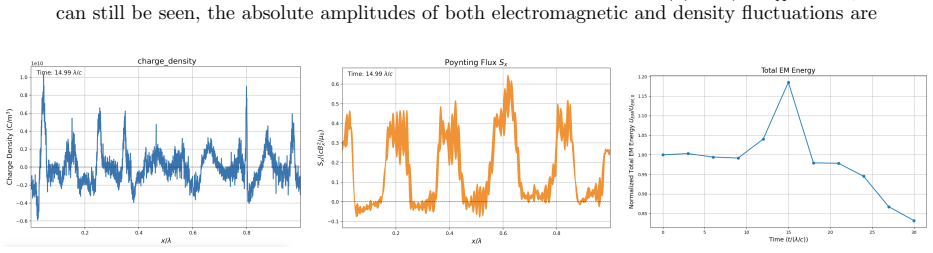
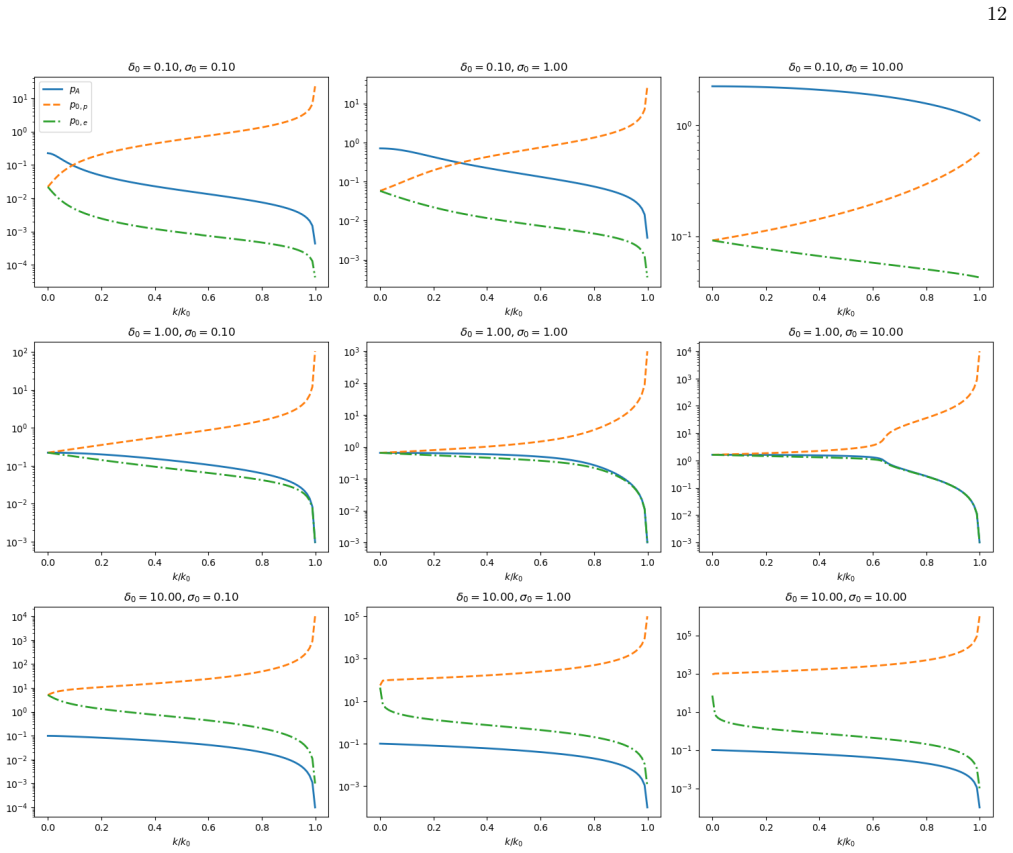
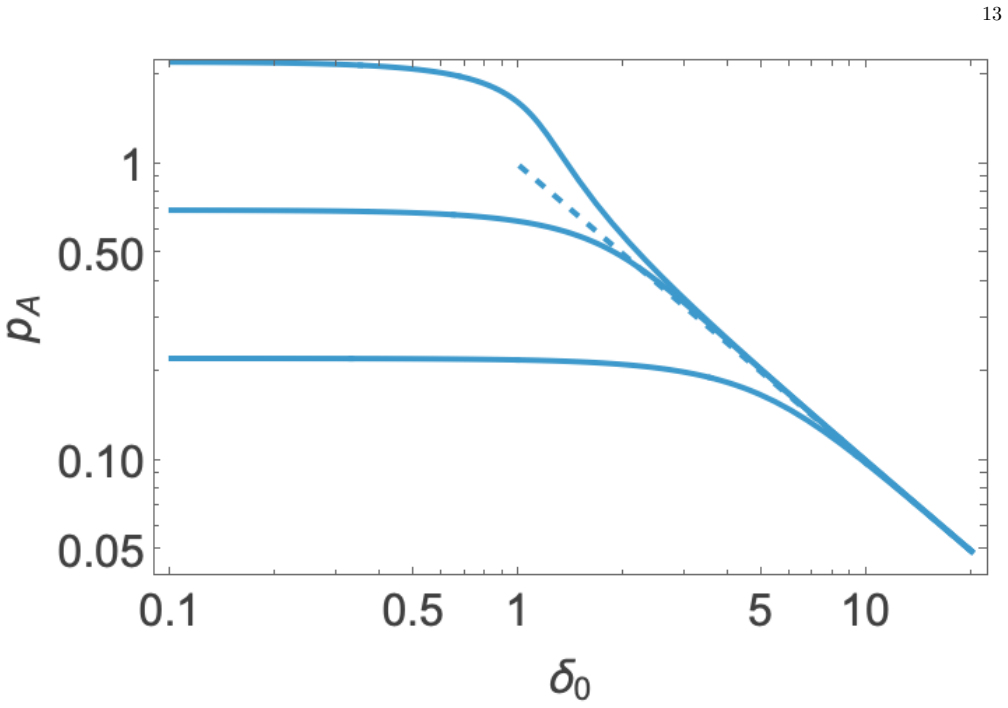
In highly magnetized pair plasmas, nonlinear Alfven waves with wave-number k ≤ k0 = ωp² /(δ ωB) experience powerful modulational instability. In the two-fluid approximation, a circularly polarized Alfven mode is set up in its own frame moving at the relativistic, amplitude-dependent Alfven velocity, where both charge species experience different amplitude-dependent synchrotron gyration. PIC simulations confirm that waves with k near k0 develop large parametrically-driven density fluctuations that drive fast modulational instability; high-frequency modes appear at k/k0 ~ (2-3)σ for large magnetization σ, while the Bragg condition k = 2k0 dominates at lower magnetization.
What carries the argument
Parametrically driven density fluctuations that destabilize circularly polarized Alfven waves when analyzed in their amplitude-dependent velocity frame using the two-fluid approximation.
If this is right
- Waves with k near k0 develop large density fluctuations on short time scales.
- High-frequency modes with k/k0 ~ (2-3) times the magnetization parameter are quickly generated when σ ≫ 1.
- The dominant unstable mode shifts to the Bragg condition k = 2k0 when magnetization is smaller.
- Long-term evolution is similar for circularly and linearly polarized modes.
- Density fluctuations become charge-neutral and reach large amplitudes in symmetric pair plasma.
Where Pith is reading between the lines
- The instability could scatter or damp radio waves traveling through magnetar magnetospheres, altering the observed properties of fast radio bursts.
- Generated high-frequency modes might accelerate particles or produce secondary emission within the same plasma.
- The threshold behavior offers a possible way to relate observed burst frequencies to local plasma magnetization and wave amplitude.
- Similar density-fluctuation growth might appear in other relativistic pair-plasma environments such as pulsar winds.
Load-bearing premise
The two-fluid approximation remains valid and the initial wave configuration stays stationary in the amplitude-dependent Alfven velocity frame, with charge separation effects remaining only temporary.
What would settle it
Particle-in-cell simulations that show no rapid growth of large density fluctuations for Alfven waves with wave numbers near k0 would falsify the claimed instability.
Figures



read the original abstract
We demonstrate that in highly magnetized pair plasmas, nonlinear Alfven waves with wave-number $k \leq k_0 = \omega_p^2 /(\delta \omega_B)$ ($\delta =( \delta B)/B_0$ are relative fluctuations of the magnetic field) experience powerful modulational instability. In the two-fluid approximation, we develop an analytic set-up for circularly polarized (CP) Alfven mode in its frame (where the initial configuration is stationary; it is moving with relativistic, amplitude-dependent Alfven velocity $v_A (\sigma, \delta ) $, while both charges experience different, amplitude-dependent, synchrotron gyration). PIC simulations using EPOCH code demonstrate that for Alfven waves with $k$ near $k_0$, large, parametrically-driven density fluctuations develop, and lead to fast modulational instability. Charge separation effects, for a CP wave in magnetized pair plasma, might be temporarily important; on longer time-scales the density fluctuations are charge neutral and in symmetric pair plasma quickly grow to large amplitudes. In highly magnetized plasma, $\sigma \gg 1$, high frequency modes $k / k_0 \sim (2-3 ) \times \sigma \gg 1 $ are quickly generated; for smaller plasma magnetization, the dominant mode is at the Bragg's condition $k = 2 k_0$. Long term behavior of CP and LP modes is similar. We discuss application of the results to the physics of Fast Radio Bursts generated/propagating in the magnetospheres of magnetars.
Editorial analysis
A structured set of objections, weighed in public.
Referee Report
Summary. The paper claims that in highly magnetized pair plasmas, nonlinear circularly polarized Alfven waves with wave-number k ≤ k0 = ω_p²/(δ ω_B) undergo powerful modulational instability. An analytic two-fluid setup constructs a stationary CP Alfven mode in its amplitude-dependent relativistic frame v_A(σ, δ), where both species undergo amplitude-dependent synchrotron gyration. EPOCH PIC simulations show that for k near k0, parametrically driven density fluctuations develop rapidly and trigger fast modulational instability; charge separation is stated to be transient, with fluctuations becoming charge-neutral. High-frequency modes are generated at k/k0 ∼ (2-3)σ ≫ 1 for σ ≫ 1, while the Bragg condition k = 2k0 dominates at lower magnetization. Long-term evolution is similar for CP and LP modes, with possible relevance to Fast Radio Bursts in magnetar magnetospheres.
Significance. If the central claim holds, the work identifies a robust parametric route to rapid density structuring in pair plasmas that could affect wave propagation, dissipation, and emission in extreme magnetized environments. The combination of an explicit two-fluid stationary-wave construction with direct PIC confirmation is a positive feature, as is the parameter-free character of the k0 threshold once δ and σ are specified.
major comments (2)
- [analytic setup] Analytic setup (two-fluid stationary CP Alfven wave): the construction assumes an exactly stationary initial configuration in the v_A(σ, δ) frame despite opposite-charge gyration of electrons and positrons. The manuscript notes that charge separation is temporary and later fluctuations are neutral, but does not demonstrate that the two-fluid equations cancel any net charge density or current exactly at t=0 for arbitrary amplitude. If the transient alters the effective dispersion or provides a seed for the modulational instability, the derived threshold k ≤ k0 and the reported growth rates do not necessarily follow.
- [PIC simulations] PIC simulations section: the runs are reported to show large density fluctuations and fast instability for k near k0, yet no error bars, resolution or particle-number convergence tests, or systematic scans over σ and δ are presented. Without these, quantitative comparison to the analytic growth rates remains unverified and the claim that the instability is “powerful” and “fast” lacks the standard numerical controls needed to support the central result.
minor comments (2)
- [abstract/introduction] The abstract and introduction introduce δ and σ without a compact definition on first use; a single sentence defining both would improve readability.
- [results/discussion] The statement that “long term behavior of CP and LP modes is similar” appears without prior definition of LP or a dedicated comparison figure or subsection.
Simulated Author's Rebuttal
We thank the referee for the positive evaluation of our work and for the constructive comments on the analytic construction and numerical validation. We address each major point below and will revise the manuscript to incorporate the suggested improvements.
read point-by-point responses
-
Referee: [analytic setup] Analytic setup (two-fluid stationary CP Alfven wave): the construction assumes an exactly stationary initial configuration in the v_A(σ, δ) frame despite opposite-charge gyration of electrons and positrons. The manuscript notes that charge separation is temporary and later fluctuations are neutral, but does not demonstrate that the two-fluid equations cancel any net charge density or current exactly at t=0 for arbitrary amplitude. If the transient alters the effective dispersion or provides a seed for the modulational instability, the derived threshold k ≤ k0 and the reported growth rates do not necessarily follow.
Authors: In the two-fluid model, the reference frame is defined by the amplitude-dependent Alfvén velocity v_A(σ, δ) so that the circularly polarized wave is exactly stationary. The electron and positron fluid velocities are obtained by solving the relativistic cold-fluid momentum equations in the wave's electromagnetic fields, with opposite charge signs leading to oppositely directed gyration. Because the plasma is symmetric (equal densities, masses, and |q|), the net charge density and net current vanish identically at t=0 for any δ. We will add an explicit appendix deriving the initial fluid quantities and verifying that both the continuity and momentum equations are satisfied with zero net ρ and J. This demonstrates that the analytic threshold k ≤ k0 is not seeded by an artificial charge imbalance; any transient charge separation seen in the PIC runs is a numerical effect that rapidly neutralizes, consistent with the long-term charge-neutral evolution reported in the manuscript. revision: yes
-
Referee: [PIC simulations] PIC simulations section: the runs are reported to show large density fluctuations and fast instability for k near k0, yet no error bars, resolution or particle-number convergence tests, or systematic scans over σ and δ are presented. Without these, quantitative comparison to the analytic growth rates remains unverified and the claim that the instability is “powerful” and “fast” lacks the standard numerical controls needed to support the central result.
Authors: We agree that standard numerical controls are required to substantiate the quantitative claims. In the revised manuscript we will add a dedicated convergence subsection. We will show results for particle numbers per cell ranging from 50 to 500 and for two grid resolutions, demonstrating that the measured growth rates of the density fluctuations and the onset time of modulational instability are insensitive to these choices within the quoted parameter regime. Error bars obtained from three independent realizations with different random seeds will be added to the time-evolution plots. While a full scan over the entire (σ, δ) plane is computationally prohibitive, we will include additional runs at σ = 5, 20 and 100 (fixed δ) to confirm that the k ≈ k0 threshold and the rapid growth remain robust. These additions will permit a direct, quantitative comparison between the simulated growth rates and the analytic predictions. revision: yes
Circularity Check
No significant circularity detected in the derivation chain
full rationale
The paper develops an analytic setup using the standard two-fluid approximation for circularly polarized Alfven waves in a moving frame where the configuration is stationary. The modulational instability for k ≤ k0 is derived from this, with PIC simulations providing independent confirmation. No steps in the chain reduce to the inputs by construction, there are no load-bearing self-citations or fitted parameters presented as predictions, and the assumptions are explicitly stated. The derivation is self-contained and does not rely on renaming known results or smuggling ansatzes via citations.
Axiom & Free-Parameter Ledger
free parameters (2)
- δ
- σ
axioms (2)
- domain assumption Two-fluid approximation remains valid for the nonlinear CP Alfven wave
- domain assumption Initial configuration is stationary in the amplitude-dependent Alfven velocity frame
Reference graph
Works this paper leans on
-
[1]
A. I. Akhiezer and R. V. Polovin, Soviet Physics-JETP3, 696 (1956)
1956
-
[2]
A. I. Akhiezer, I. A. Akhiezer, R. V. Polovin, A. G. Sitenko, and K. N. Stepanov, Oxford Pergamon Press International Series on Natural Philosophy1(1975)
1975
-
[3]
P. C. Clemmow, Journal of Plasma Physics12, 297 (1974)
1974
- [4]
-
[5]
E. Petroff, J. W. T. Hessels, and D. R. Lorimer, Astron. Astrophys. Rev.30, 2 (2022), 2107.10113
- [6]
-
[7]
K. Tangtartharakul, A. Arefiev, and M. Lyutikov, arXiv e-prints arXiv:2509.06230 (2025), 2509.06230
work page internal anchor Pith review Pith/arXiv arXiv 2025
-
[8]
M. Lyutikov and V. Gurarie, arXiv e-prints arXiv:2509.20594 (2025), 2509.20594
-
[9]
Relativistically-strong electromagnetic waves in magnetized plasmas
M. Lyutikov, arXiv e-prints arXiv:2509.17245 (2025), 2509.17245
work page internal anchor Pith review Pith/arXiv arXiv 2025
- [10]
-
[11]
T. D. Arber, K. Bennett, C. S. Brady, A. Lawrence-Douglas, M. G. Ramsay, N. J. Sircombe, P. Gillies, R. G. Evans, H. Schmitz, A. R. Bell, et al., Plasma Physics and Controlled Fusion57, 1 (2015)
2015
-
[12]
J. R. Pierce, Bell Labs Technical Journal29, 608 (1950)
1950
-
[13]
Sprangle, C
P. Sprangle, C. M. Tang, and C. W. Roberson, Nuclear Instruments and Methods in Physics Research A239, 1 (1985)
1985
-
[14]
H. P. Freund and T. M. Antonsen, Jr.,Principles of Free Electron Lasers(Springer Nature Switzerland AG, Cham, Switzerland, 2024), 4th ed., ISBN 978-3-031-40947-9
2024
-
[15]
C. Thompson, M. Lyutikov, and S. R. Kulkarni, Astrophys. J.574, 332 (2002), astro-ph/0110677
- [16]
-
[17]
M. Lyutikov and H. Freund, Journal of Plasma Physics91, E10 (2025), 2310.17028
-
[18]
M. J. LIGHTHILL, IMA Journal of Applied Mathematics1, 269 (1965), ISSN 0272-4960, https://academic.oup.com/imamat/article-pdf/1/3/269/2056453/1-3-269.pdf, URLhttps://doi.org/10.1093/imamat/ 1.3.269
-
[19]
G. B. Whitham, Journal of Fluid Mechanics22, 273 (1965)
1965
-
[20]
V. E. Zakharov and L. A. Ostrovsky, Physica D Nonlinear Phenomena238, 540 (2009)
2009
-
[21]
A. C. L. Chian and C. F. Kennel, Astr. Spac. Sci.97, 8 (1983)
1983
-
[22]
U. A. Mofiz, U. de Angelis, and A. Forlani, Plasma Physics and Controlled Fusion26, 1099 (1984)
1984
-
[23]
R. E. Kates and D. J. Kaup, Journal of Plasma Physics42, 507 (1989)
1989
- [24]
-
[25]
Schluck, G
F. Schluck, G. Lehmann, and K. H. Spatschek, Phys. Rev. E96, 053204 (2017). 16 Appendix A: Comment on modulational instability of waves in pair plasma Modulational instabilities [18–20] are typically treated as expansion in small nonlinearity parameter, resulting in the nonlinear Schroedinger equation. The result is the Benjamin-Feir-Lighthill criterion f...
2017
discussion (0)
Sign in with ORCID, Apple, or X to comment. Anyone can read and Pith papers without signing in.